
Mercurys Craters How They Are And What They
- Slides: 12
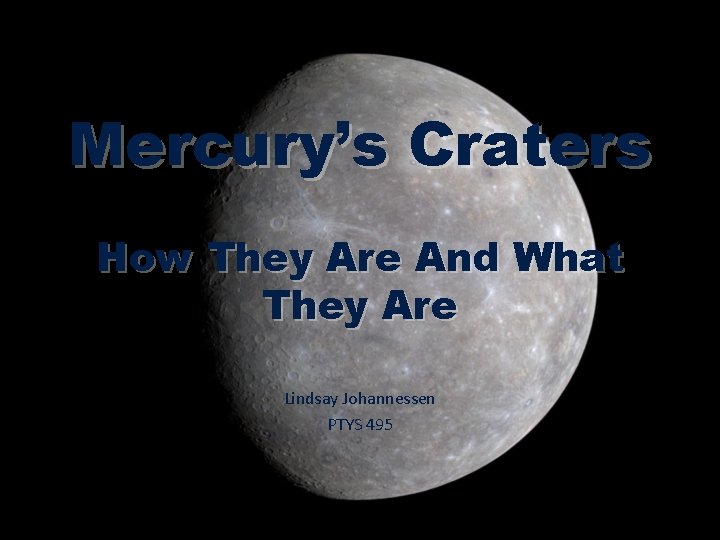
Mercury’s Craters How They Are And What They Are Lindsay Johannessen PTYS 495
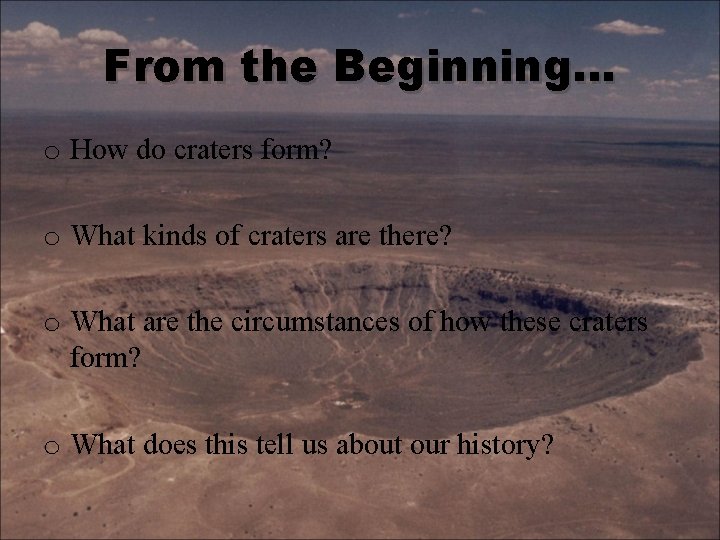
From the Beginning… o How do craters form? o What kinds of craters are there? o What are the circumstances of how these craters form? o What does this tell us about our history?
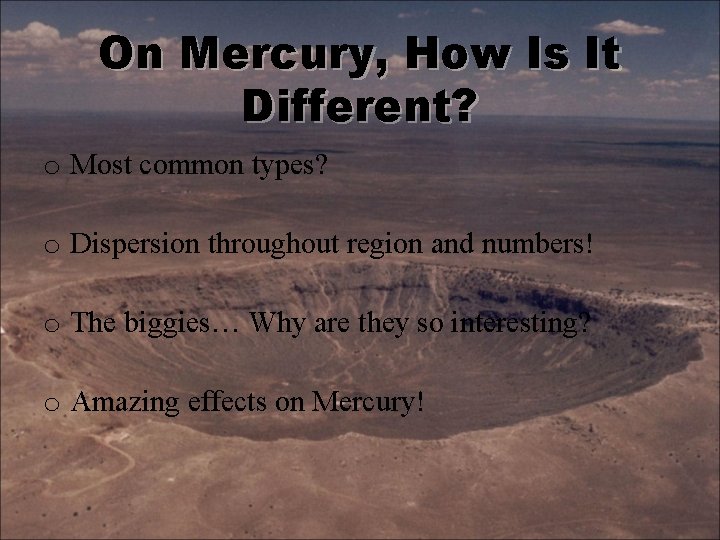
On Mercury, How Is It Different? o Most common types? o Dispersion throughout region and numbers! o The biggies… Why are they so interesting? o Amazing effects on Mercury!
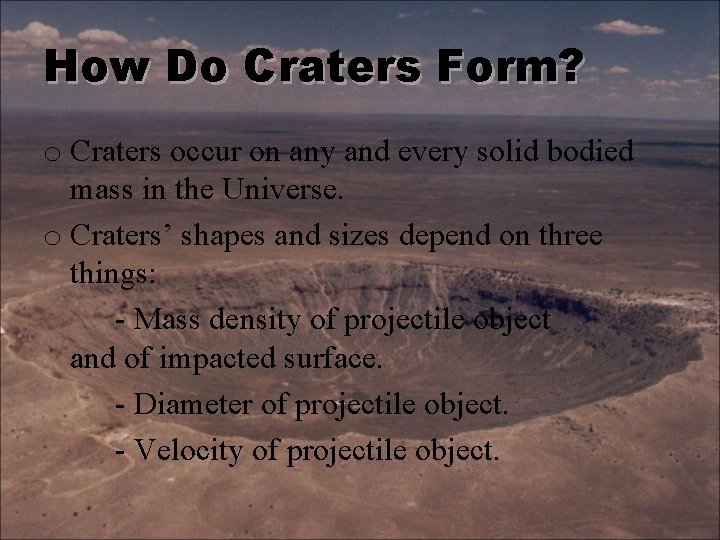
How Do Craters Form? o Craters occur on any and every solid bodied mass in the Universe. o Craters’ shapes and sizes depend on three things: - Mass density of projectile object and of impacted surface. - Diameter of projectile object. - Velocity of projectile object.
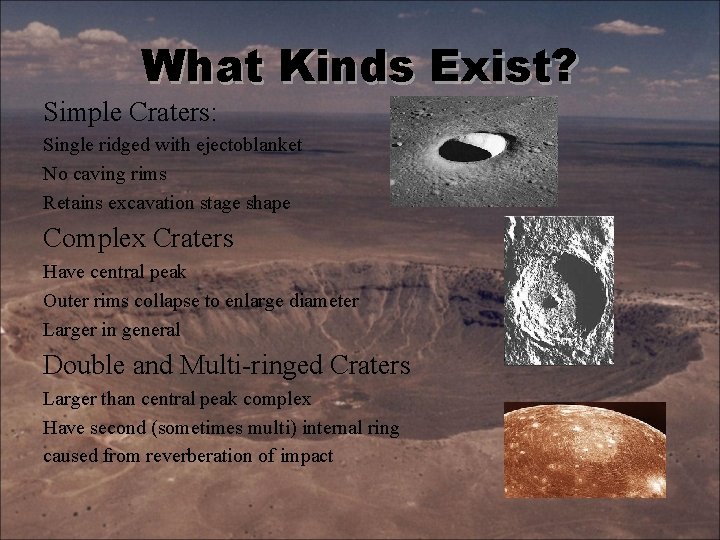
What Kinds Exist? Simple Craters: Single ridged with ejectoblanket No caving rims Retains excavation stage shape Complex Craters Have central peak Outer rims collapse to enlarge diameter Larger in general Double and Multi-ringed Craters Larger than central peak complex Have second (sometimes multi) internal ring caused from reverberation of impact
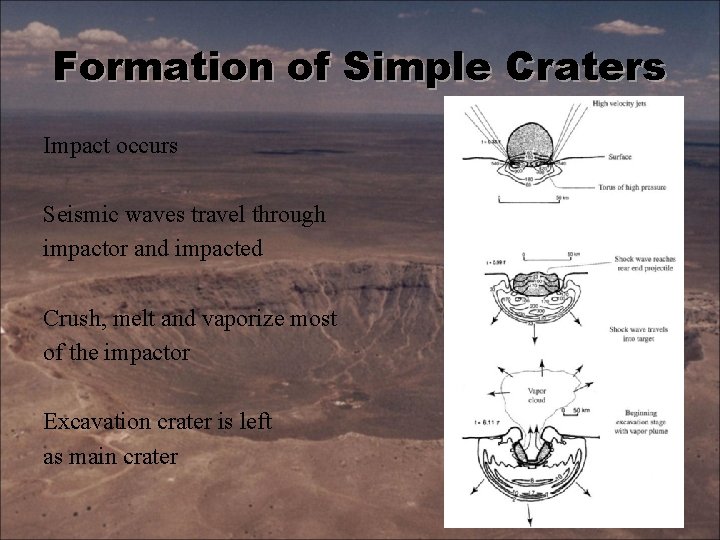
Formation of Simple Craters Impact occurs Seismic waves travel through impactor and impacted Crush, melt and vaporize most of the impactor Excavation crater is left as main crater
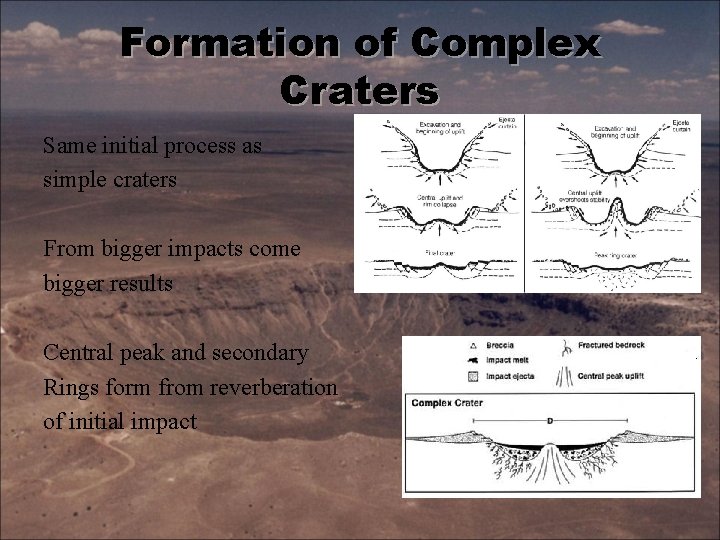
Formation of Complex Craters Same initial process as simple craters From bigger impacts come bigger results Central peak and secondary Rings form from reverberation of initial impact
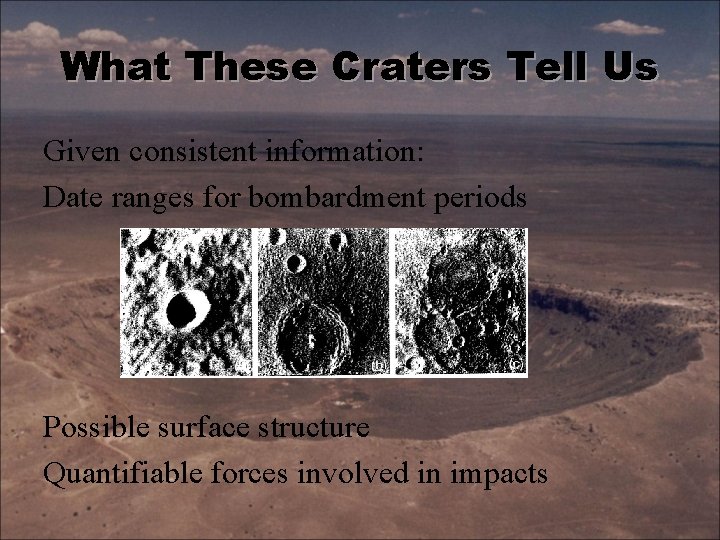
What These Craters Tell Us Given consistent information: Date ranges for bombardment periods Possible surface structure Quantifiable forces involved in impacts
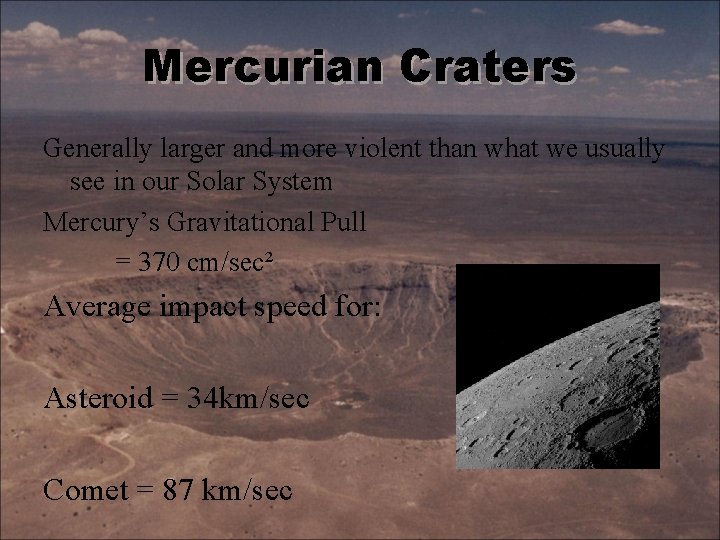
Mercurian Craters Generally larger and more violent than what we usually see in our Solar System Mercury’s Gravitational Pull = 370 cm/sec² Average impact speed for: Asteroid = 34 km/sec Comet = 87 km/sec
Size of Craters on Mercury Simple craters on Mercury: Range up to approx. 10 km in Diameter (19 km on the Moon and 3 km on Earth) Complex Craters: Range from 10 km up to 200 km with a central peak Range from about 200 km to 750 km with Double Ring Range from 750 km to 1500 and up with multiple rings.
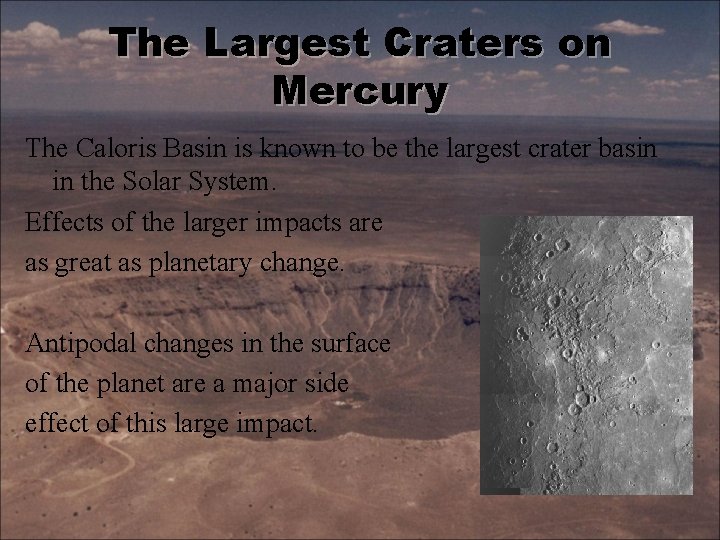
The Largest Craters on Mercury The Caloris Basin is known to be the largest crater basin in the Solar System. Effects of the larger impacts are as great as planetary change. Antipodal changes in the surface of the planet are a major side effect of this large impact.
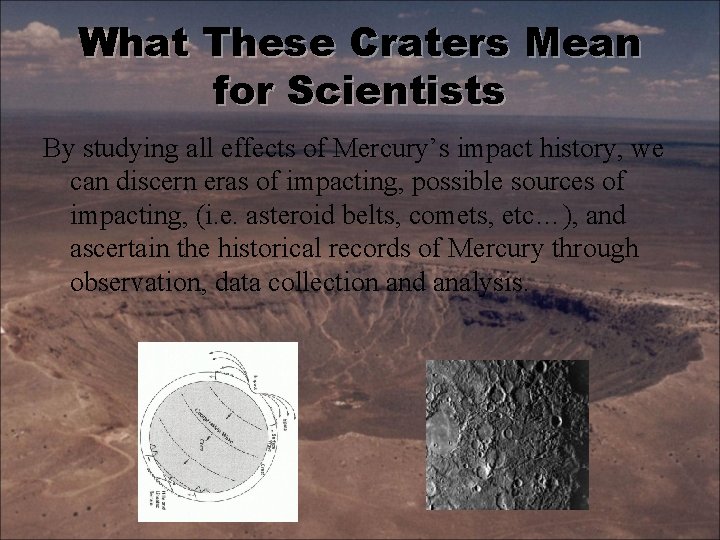
What These Craters Mean for Scientists By studying all effects of Mercury’s impact history, we can discern eras of impacting, possible sources of impacting, (i. e. asteroid belts, comets, etc…), and ascertain the historical records of Mercury through observation, data collection and analysis.