
Mercury Passive Air Sampler www tekran com labairinfotekran
Mercury Passive Air Sampler www. tekran. com lab-air-info@tekran. com
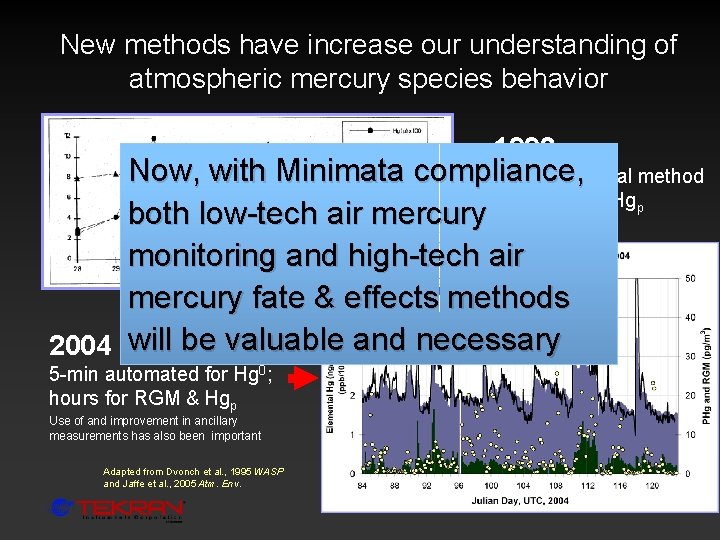
New methods have increase our understanding of atmospheric mercury species behavior 1993 Now, with Minimata compliance, 24 hour manual method for TGM and Hgp both low-tech air mercury monitoring and high-tech air mercury fate & effects methods 2004 will be valuable and necessary 5 -min automated for Hg 0; hours for RGM & Hgp Use of and improvement in ancillary measurements has also been important Adapted from Dvonch et al. , 1995 WASP and Jaffe et al. , 2005 Atm. Env.

Basics of Mer. PAS § Design resulted in precise, stable, robust sampling rate (SR) § Jar provides protection, eliminates wind effects and used as a container for transport § SR determined using the Tekran 2537 Hg Monitor www. tekran. com lab-air-info@tekran. com

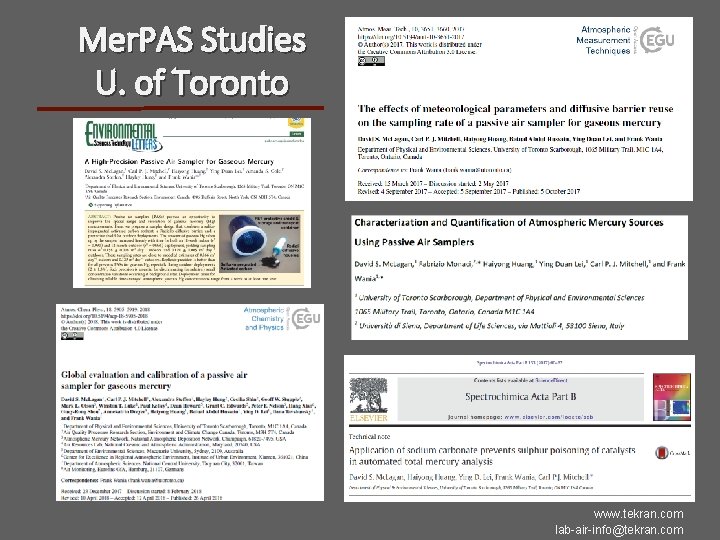
Mer. PAS Development Summary § Developed at U. of Toronto by Mc. Lagan, Wania and Mitchell § Global study showed Mer. PAS is highly sensitive, accurate and precise for ambient air levels (1 -5 ng/m 3). Only passive sampler capable of accurate and precise ambient air measurements. § Study completed (in press) to quantify annual emissions at a former mercury mine (max 6. 7 ug/m 3) § Further studies underway for performance in indoor air and extreme concentrations (up to mg/m 3) § Tekran is commercializing sampler through licensing agreement with U. Toronto and scientists www. tekran. com lab-air-info@tekran. com
Mer. PAS Studies U. of Toronto www. tekran. com lab-air-info@tekran. com

Mer. PAS Features § No power required § Simple to deploy & retrieve § Low entry cost – low temporal resolution § Range likely unlimited (1 ng/m 3 to 10 mg/m 3)* § Relatively immune to wind and temperature effects § Uses well known Radiello diffusive barrier § Highly tested and characterized * See specifics in subsequent slide www. tekran. com lab-air-info@tekran. com

Select Applications • Remote sites – no power • Artisanal gold mining • Identifying and mapping hot spots • Community exposure monitoring • Contaminated site cleanup monitoring • Indoor spill cleanup and monitoring Vertical profile industry site • Personal exposure industry, schools, workplace & homes • Area source emission estimates (high spatial resolution and vertical gradients) www. tekran. com lab-air-info@tekran. com
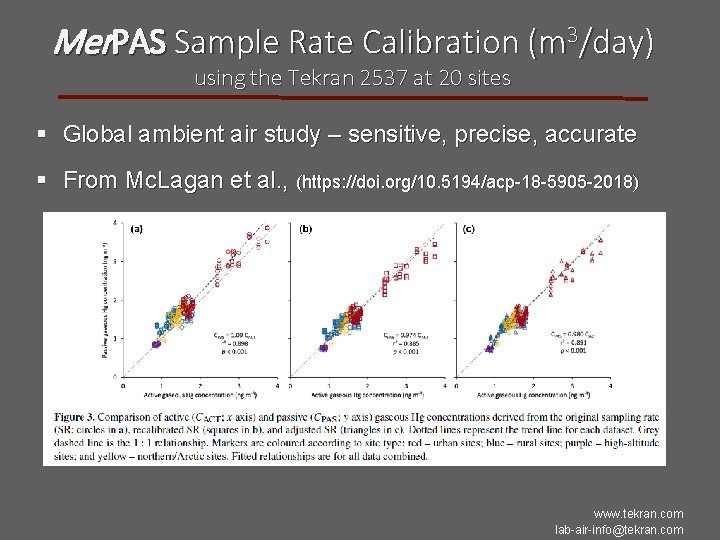
Mer. PAS Sample Rate Calibration (m 3/day) using the Tekran 2537 at 20 sites § Global ambient air study – sensitive, precise, accurate § From Mc. Lagan et al. , (https: //doi. org/10. 5194/acp-18 -5905 -2018) www. tekran. com lab-air-info@tekran. com

Former Hg Mine Site Mapping Mc. Lagan et al. , 2018 (submitted) § Values in ng/m 3 § Area of ~0. 6 km 2 § Survey around mine site buildings § 1 -week sample deployment § Seasonal differences www. tekran. com lab-air-info@tekran. com
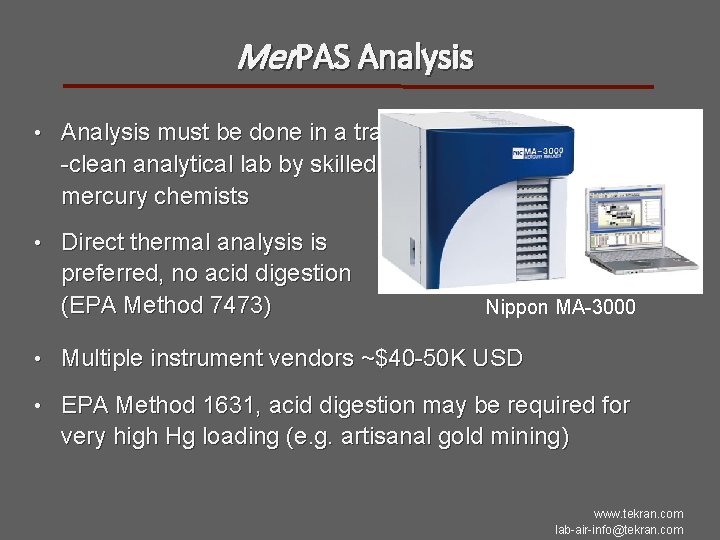
Mer. PAS Analysis • Analysis must be done in a trace -clean analytical lab by skilled mercury chemists • Direct thermal analysis is preferred, no acid digestion (EPA Method 7473) Nippon MA-3000 • Multiple instrument vendors ~$40 -50 K USD • EPA Method 1631, acid digestion may be required for very high Hg loading (e. g. artisanal gold mining) www. tekran. com lab-air-info@tekran. com

Tekran Mer. PAS Analysis • Tekran is offering Mer. PAS Analysis Service using the direct thermal analysis method (EPA method 7473) • Our analysis team has over 90 years of experience all focused on mercury measurement • Tekran will offer to be an independent reference laboratory for national and international networks www. tekran. com lab-air-info@tekran. com
Mer. PAS Analysis Challenges - I • The sulfur rich carbon sorbent is a tough matrix that can cause low bias, catalyst failure and gold trap degradation • Matrix issues are mitigated with addition of sodium bicarbonate and limiting amount of sorbent for each analytical run • Typical ambient air sample split into 2 or more runs of sorbent • Many quality assurance samples must be run to maintain high quality results www. tekran. com lab-air-info@tekran. com
Mer. PAS Analysis Challenges - II • Direct thermal analysis is destructive − − − Must transfer 100% of sorbent to analysis boat for accurate results Easy to spill sorbent during preparation, weighing and transfer – loss of results can cause large data gaps Easy for analytical run to go bad >> data gaps • Blank control − Field blanks, trips blanks and material blanks are necessary to evaluate accuracy and performance of the site operator, shipping/storage and analyst. www. tekran. com lab-air-info@tekran. com
Sample Range and Conditions § Carbon media capable of adsorbing Hg up to 10% by weight § Proven for ambient air (~1 -20 ng/m 3). Integrated sample time of 1 week minimum up to 1 year maximum. § Proven former mercury mine site and surrounding area. Integrated sample time of 1 -week for low ug/m 3 levels § For sites with mean air Hg > 100 ug/m 3 • • • Short sample times may be necessary (hours) For longer sample times, analysis will require more analytical runs or may be done using EPA Method 1631 E. Depending on project goals, obtaining a representative result may necessitate using multiple Mer. PAS samplers for each measurement location www. tekran. com lab-air-info@tekran. com
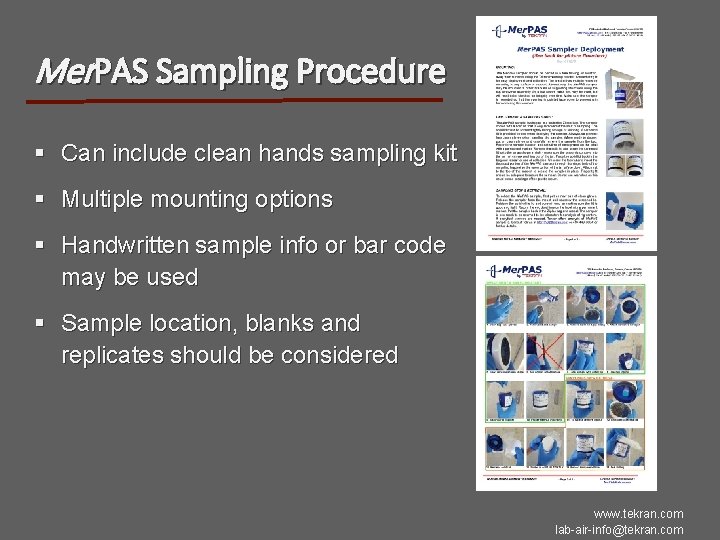
Mer. PAS Sampling Procedure § Can include clean hands sampling kit § Multiple mounting options § Handwritten sample info or bar code may be used § Sample location, blanks and replicates should be considered www. tekran. com lab-air-info@tekran. com
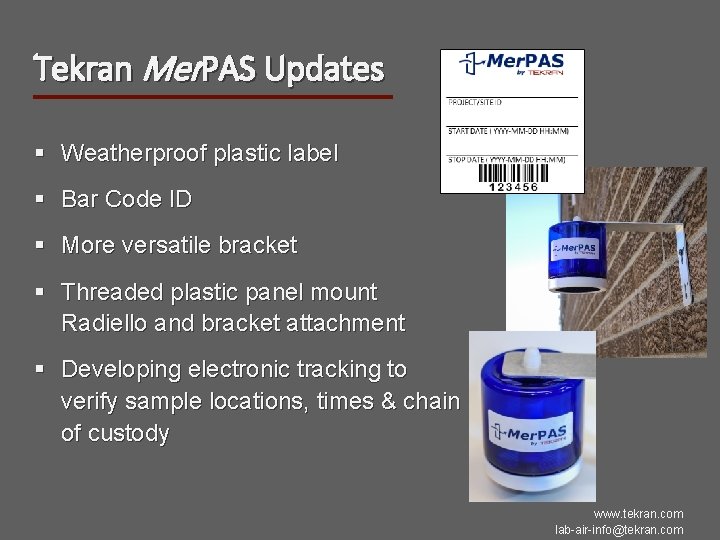
Tekran Mer. PAS Updates § Weatherproof plastic label § Bar Code ID § More versatile bracket § Threaded plastic panel mount Radiello and bracket attachment § Developing electronic tracking to verify sample locations, times & chain of custody www. tekran. com lab-air-info@tekran. com
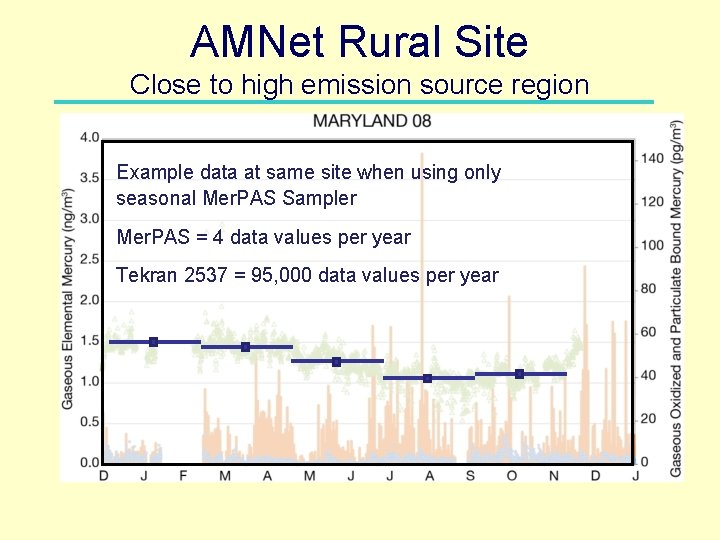
AMNet Rural Site Close to high emission source region Example data at same site when using only seasonal Mer. PAS Sampler Mer. PAS = 4 data values per year Tekran 2537 = 95, 000 data values per year
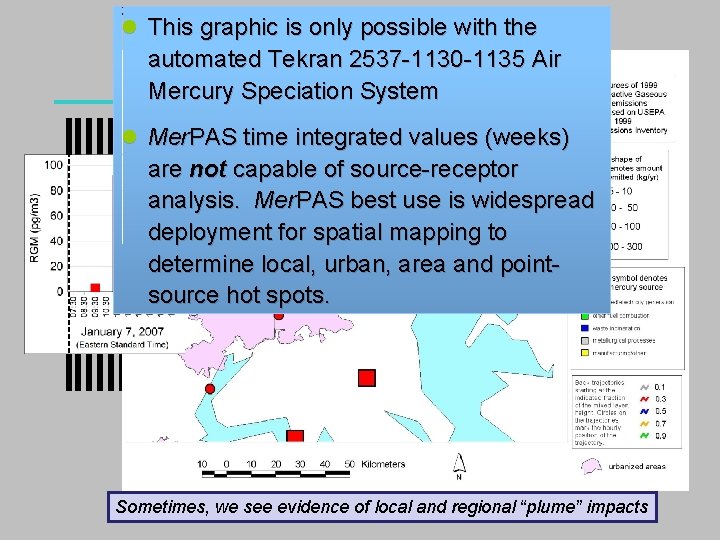
Real-Time Hg Speciation Monitoring Example l This Winston graphic. Luke is only possible with the & Mark Cohen NOAA-ARL automated Tekran 2537 -1130 -1135 Air Mercury Speciation System l Mer. PAS time integrated values (weeks) are not capable of source-receptor analysis. Mer. PAS best use is widespread deployment for spatial mapping to determine local, urban, area and pointsource hot spots. Sometimes, we see evidence of local and regional “plume” impacts
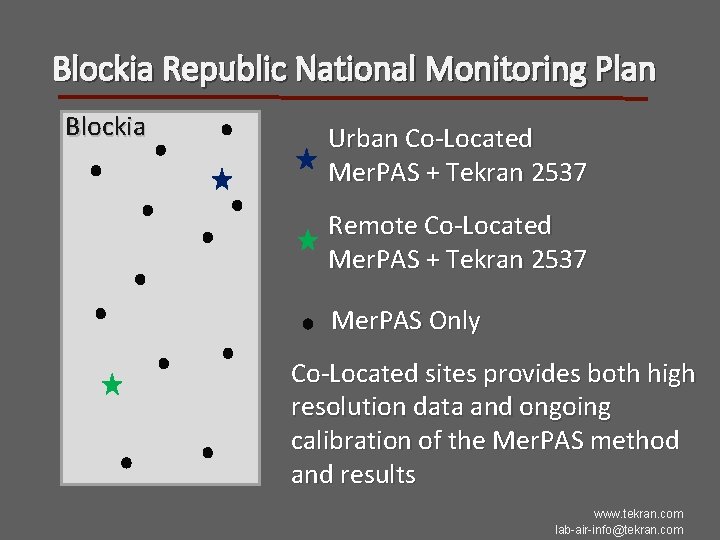
Blockia Republic National Monitoring Plan Blockia Urban Co-Located Mer. PAS + Tekran 2537 Remote Co-Located Mer. PAS + Tekran 2537 Mer. PAS Only Co-Located sites provides both high resolution data and ongoing calibration of the Mer. PAS method and results www. tekran. com lab-air-info@tekran. com
Why Use Mer. PAS § Radial diffusive surface has better performance than 2 -D badge type passive air samplers § Proven to be highly accurate and precise § Media has low consistent blanks and massive uptake capacity § Robust packaging and simple to deploy § Direct thermal analysis can be faster, easier and lower cost compared to liquid acid digestion and analysis www. tekran. com lab-air-info@tekran. com

For Mer. PAS Project Design, Planning, and Budgeting contact Lucas Hawkins or Eric Prestbo at Mer. PAS@Tekran. com or call +1 -416 -449 -3084 www. tekran. com lab-air-info@tekran. com
- Slides: 21