
Mercury Mean Distance from Sun 57 909 175
- Slides: 24
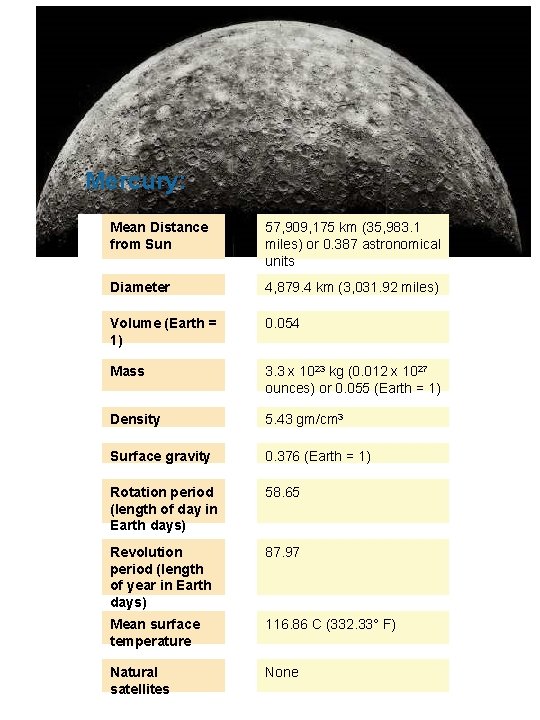
Mercury: Mean Distance from Sun 57, 909, 175 km (35, 983. 1 miles) or 0. 387 astronomical units Diameter 4, 879. 4 km (3, 031. 92 miles) Volume (Earth = 0. 054 1) Mass 3. 3 x 10²³ kg (0. 012 x 1027 ounces) or 0. 055 (Earth = 1) 5. 43 gm/cm 3 Density Surface gravity 0. 376 (Earth = 1) Rotation period 58. 65 (length of day in Earth days) Revolution 87. 97 period (length of year in Earth days) 116. 86 C (332. 33° F) Mean surface temperature Natural None satellites
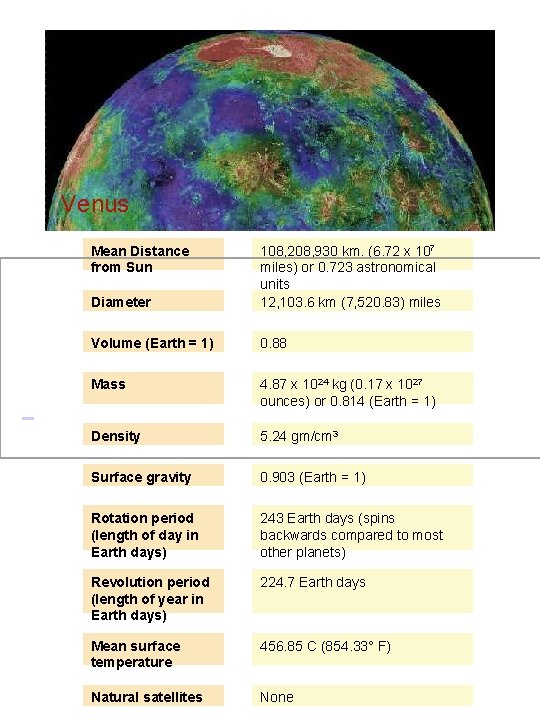
Venus: Mean Distance 108, 208, 930 km. (6. 72 x 107 from Sun miles) or 0. 723 astronomical units Diameter 12, 103. 6 km (7, 520. 83) miles Volume (Earth = 1) 0. 88 4. 87 x 1024 kg (0. 17 x 1027 Mass ounces) or 0. 814 (Earth = 1) Density 5. 24 gm/cm 3 0. 903 (Earth = 1) Surface gravity Rotation period 243 Earth days (spins (length of day in backwards compared to most Earth days) other planets) Revolution period 224. 7 Earth days (length of year in Earth days) Mean surface 456. 85 C (854. 33° F) temperature None Natural satellites
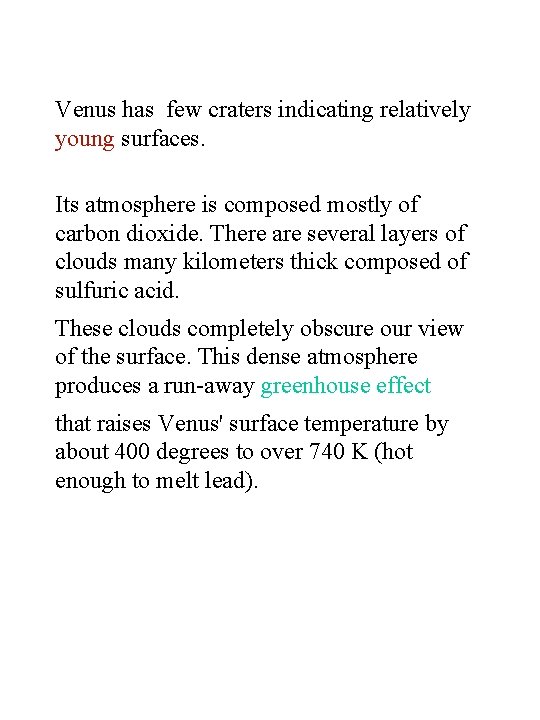
Venus has few craters indicating relatively young surfaces. Its atmosphere is composed mostly of carbon dioxide. There are several layers of clouds many kilometers thick composed of sulfuric acid. These clouds completely obscure our view of the surface. This dense atmosphere produces a run-away greenhouse effect that raises Venus' surface temperature by about 400 degrees to over 740 K (hot enough to melt lead).
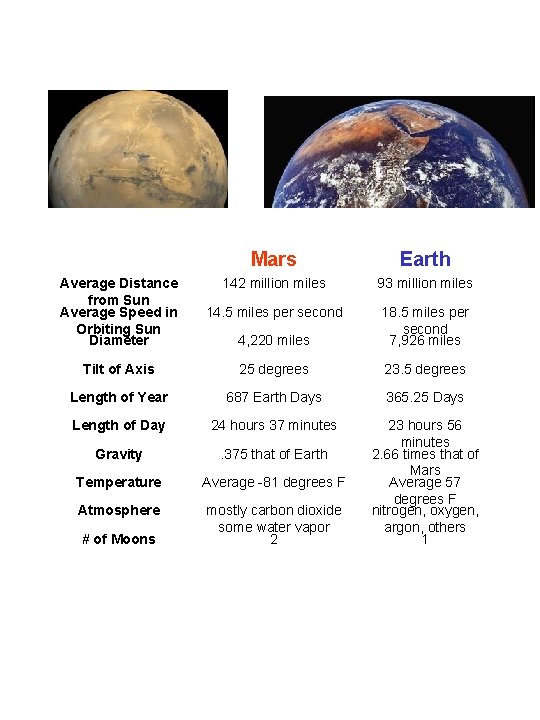
Mars Earth Average Distance from Sun Average Speed in Orbiting Sun Diameter 142 million miles 93 million miles 14. 5 miles per second 4, 220 miles 18. 5 miles per second 7, 926 miles Tilt of Axis 25 degrees 23. 5 degrees Length of Year 687 Earth Days 365. 25 Days Length of Day 24 hours 37 minutes Gravity . 375 that of Earth Temperature Average -81 degrees F Atmosphere mostly carbon dioxide some water vapor 2 23 hours 56 minutes 2. 66 times that of Mars Average 57 degrees F nitrogen, oxygen, argon, others 1 # of Moons
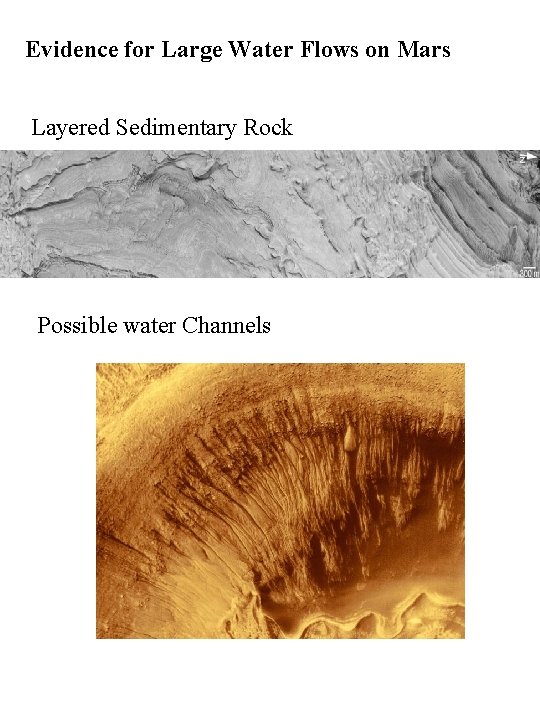
Evidence for Large Water Flows on Mars Layered Sedimentary Rock Possible water Channels
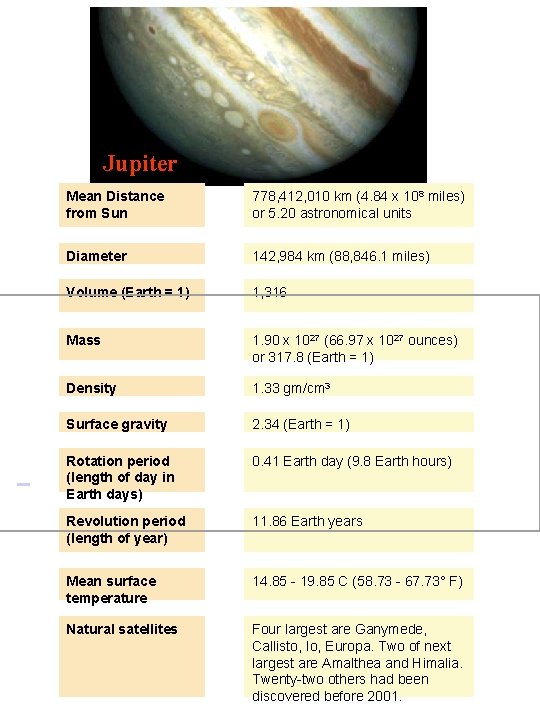
Jupiter Mean Distance from Sun 778, 412, 010 km (4. 84 x 108 miles) or 5. 20 astronomical units Diameter 142, 984 km (88, 846. 1 miles) (Earth = 1) 1, 316 Volume Mass 1. 90 x 1027 (66. 97 x 1027 ounces) or 317. 8 (Earth = 1) Density 1. 33 gm/cm 3 gravity Surface 2. 34 (Earth = 1) period 0. 41 Earth day (9. 8 Earth hours) Rotation (length of day in Earth days) Revolution period 11. 86 Earth years (length of year) surface 14. 85 - 19. 85 C (58. 73 - 67. 73° F) Mean temperature satellites Natural Four largest are Ganymede, Callisto, Io, Europa. Two of next largest are Amalthea and Himalia. Twenty-two others had been discovered before 2001.
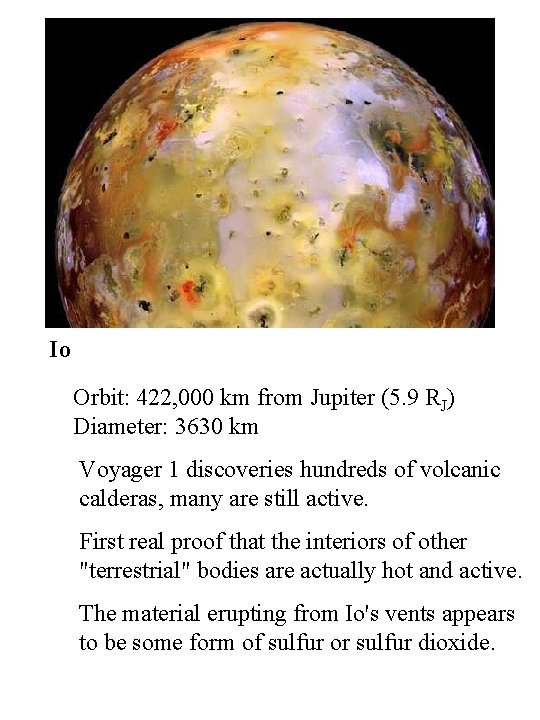
Io Orbit: 422, 000 km from Jupiter (5. 9 RJ) Diameter: 3630 km Voyager 1 discoveries hundreds of volcanic calderas, many are still active. First real proof that the interiors of other "terrestrial" bodies are actually hot and active. The material erupting from Io's vents appears to be some form of sulfur or sulfur dioxide.
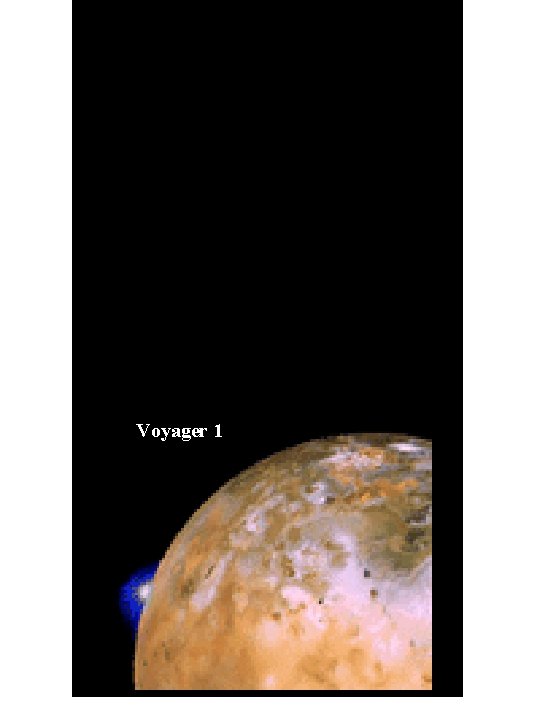
Voyager 1
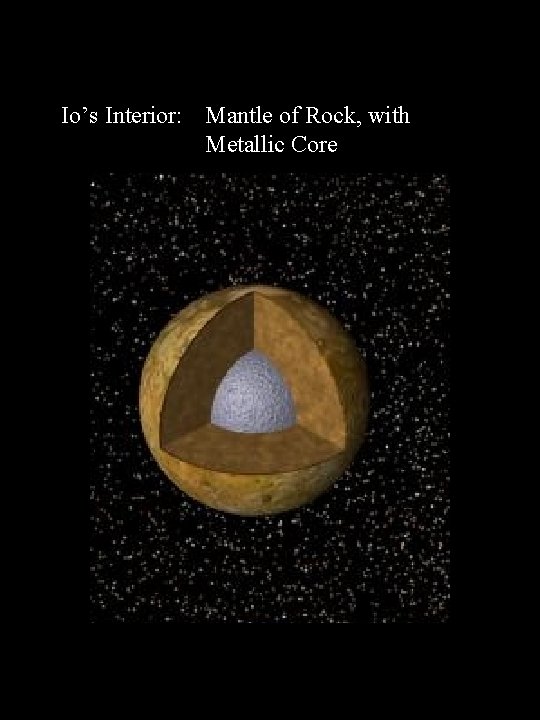
Io’s Interior: Mantle of Rock, with Metallic Core
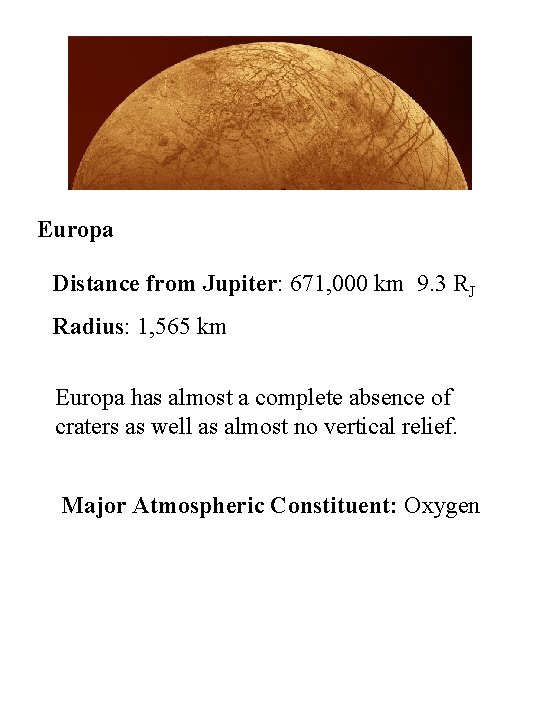
Europa Distance from Jupiter: 671, 000 km 9. 3 RJ Radius: 1, 565 km Europa has almost a complete absence of craters as well as almost no vertical relief. Major Atmospheric Constituent: Oxygen
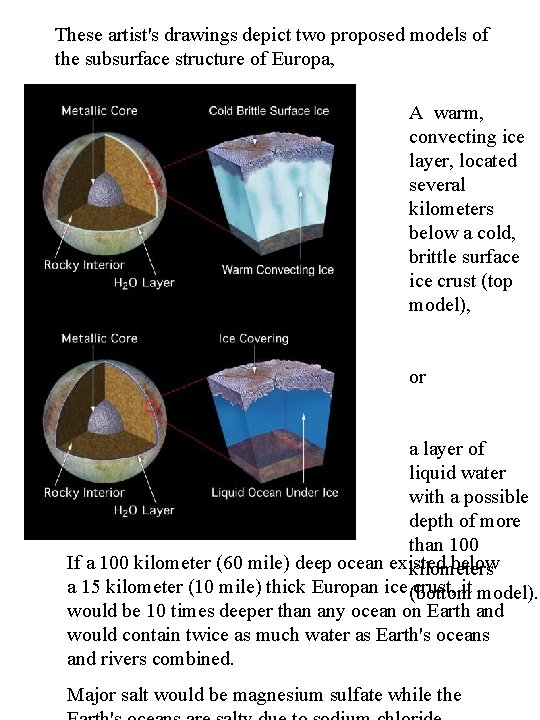
These artist's drawings depict two proposed models of the subsurface structure of Europa, A warm, convecting ice layer, located several kilometers below a cold, brittle surface ice crust (top model), or a layer of liquid water with a possible depth of more than 100 If a 100 kilometer (60 mile) deep ocean existed below kilometers a 15 kilometer (10 mile) thick Europan ice crust, it (bottom model). would be 10 times deeper than any ocean on Earth and would contain twice as much water as Earth's oceans and rivers combined. Major salt would be magnesium sulfate while the
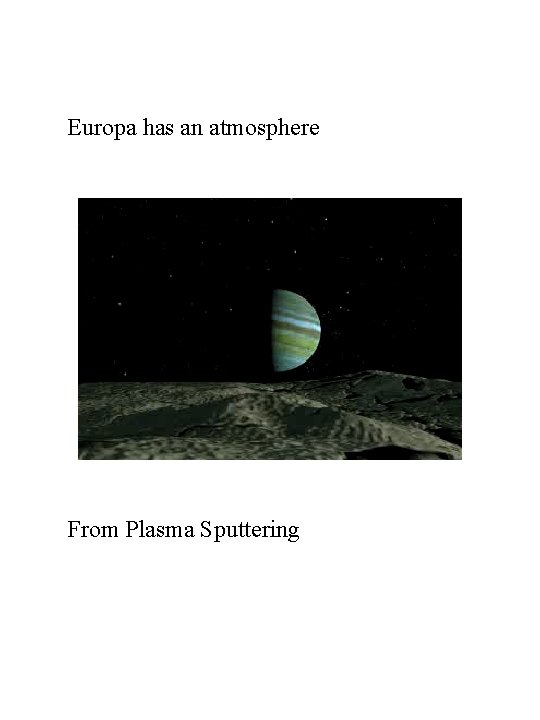
Europa has an atmosphere From Plasma Sputtering
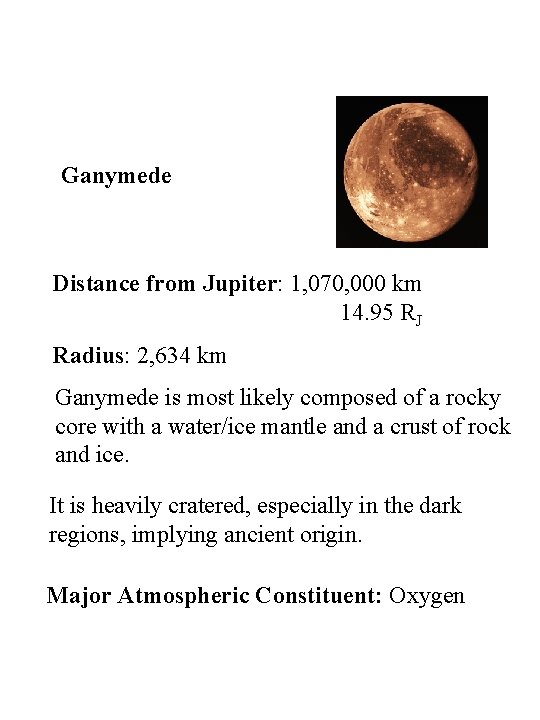
Ganymede Distance from Jupiter: 1, 070, 000 km 14. 95 RJ Radius: 2, 634 km Ganymede is most likely composed of a rocky core with a water/ice mantle and a crust of rock and ice. It is heavily cratered, especially in the dark regions, implying ancient origin. Major Atmospheric Constituent: Oxygen
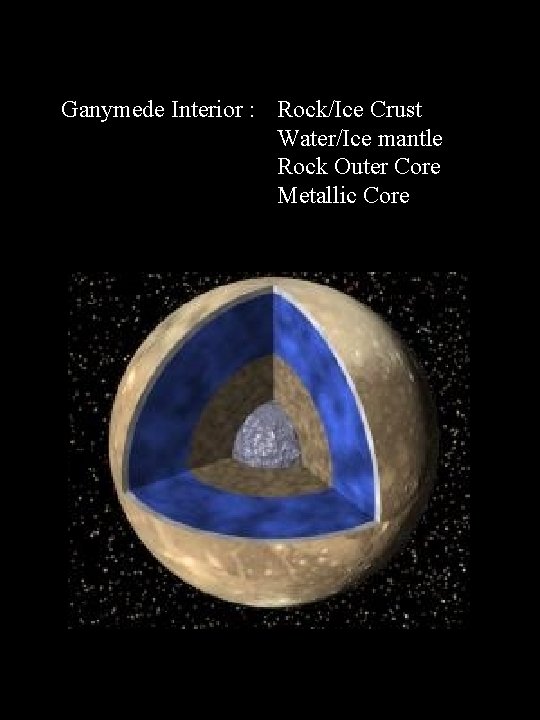
Ganymede Interior : Rock/Ice Crust Water/Ice mantle Rock Outer Core Metallic Core
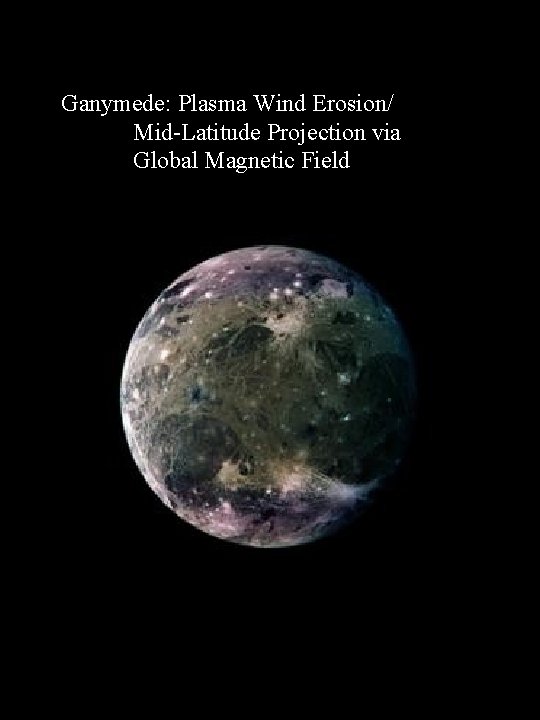
Ganymede: Plasma Wind Erosion/ Mid-Latitude Projection via Global Magnetic Field
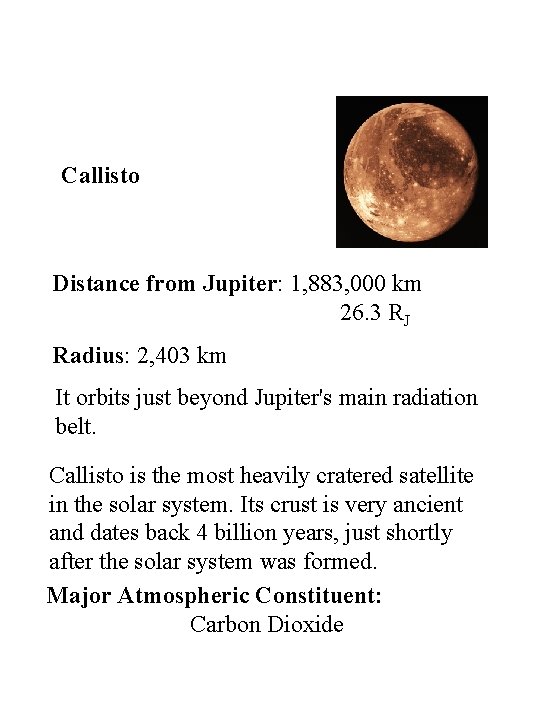
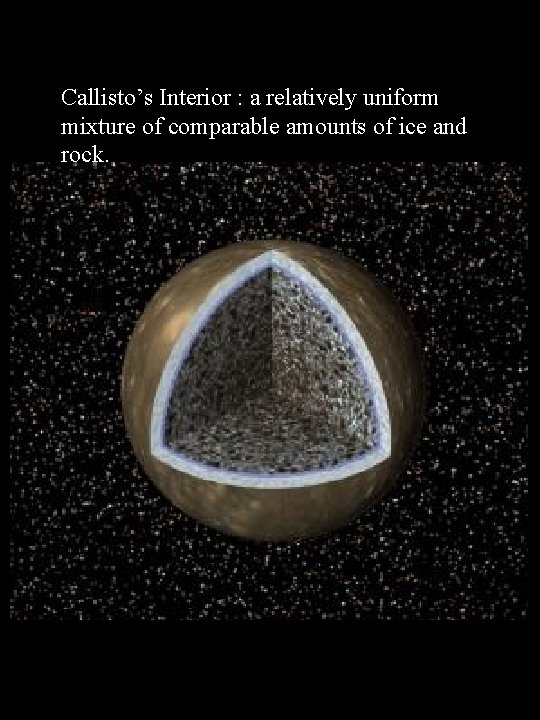
Callisto Distance from Jupiter: 1, 883, 000 km 26. 3 RJ Radius: 2, 403 km It orbits just beyond Jupiter's main radiation belt. Callisto is the most heavily cratered satellite in the solar system. Its crust is very ancient and dates back 4 billion years, just shortly after the solar system was formed. Major Atmospheric Constituent: Carbon Dioxide
Callisto’s Interior : a relatively uniform mixture of comparable amounts of ice and rock.
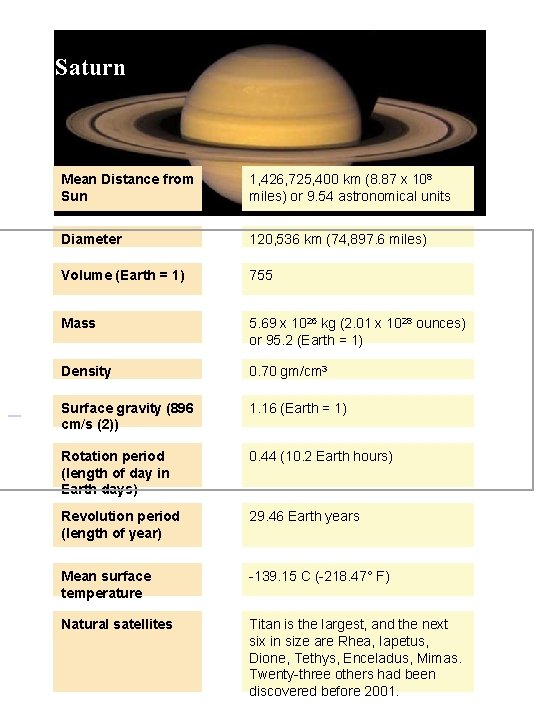
Saturn Mean Distance from Sun 1, 426, 725, 400 km (8. 87 x 108 miles) or 9. 54 astronomical units Diameter 120, 536 km (74, 897. 6 miles) (Earth = 1) Volume 755 Mass 5. 69 x 1026 kg (2. 01 x 1028 ounces) or 95. 2 (Earth = 1) 0. 70 gm/cm 3 Density gravity (896 Surface 1. 16 (Earth = 1) cm/s (2)) period Rotation 0. 44 (10. 2 Earth hours) (length of day in Earth days) Revolution period 29. 46 Earth years (length of year) surface -139. 15 C (-218. 47° F) Mean temperature satellites Natural Titan is the largest, and the next six in size are Rhea, Iapetus, Dione, Tethys, Enceladus, Mimas. Twenty-three others had been discovered before 2001.
Like Jupiter, Saturn is about 75% hydrogen and 25% helium with traces of water, methane, ammonia and "rock", similar to the composition of the primordial solar system Both planets also generate more energy than they absorb from the Sun – Brown Dwarfs The rings are actually composed of innumerable small particles, ranging in size from a centimeter or so to several meters. A few kilometer-sized objects are also likely. Saturn's rings are extraordinarily thin: though they're 250, 000 km or more in diameter they're less than one kilometer thick.
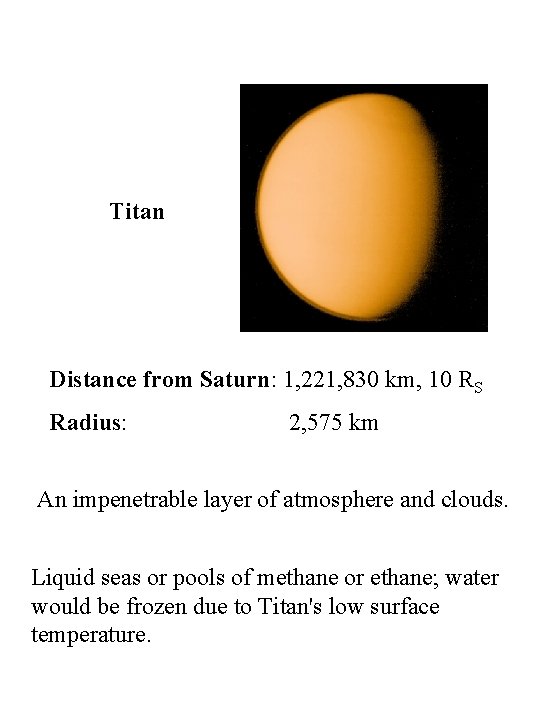
Titan Distance from Saturn: 1, 221, 830 km, 10 RS Radius: 2, 575 km An impenetrable layer of atmosphere and clouds. Liquid seas or pools of methane or ethane; water would be frozen due to Titan's low surface temperature.
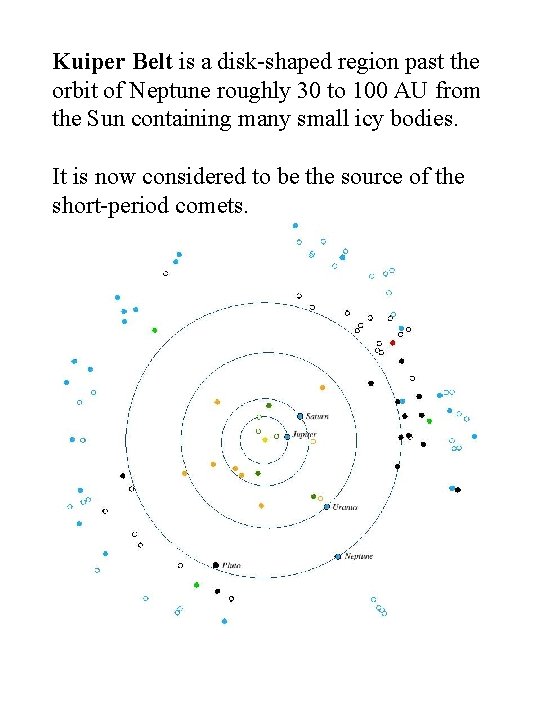
Kuiper Belt is a disk-shaped region past the orbit of Neptune roughly 30 to 100 AU from the Sun containing many small icy bodies. It is now considered to be the source of the short-period comets.
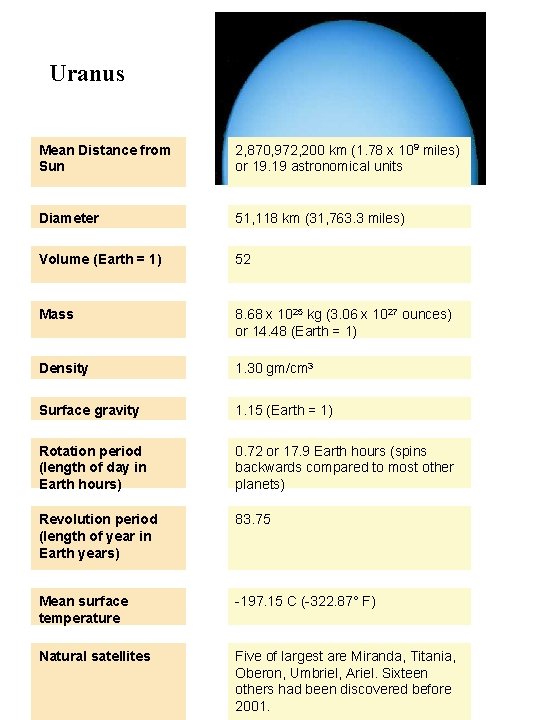
Uranus Mean Distance from Sun 2, 870, 972, 200 km (1. 78 x 109 miles) or 19. 19 astronomical units Diameter 51, 118 km (31, 763. 3 miles) Volume (Earth = 1) 52 Mass 8. 68 x 1025 kg (3. 06 x 1027 ounces) or 14. 48 (Earth = 1) 1. 30 gm/cm 3 Density 1. 15 (Earth = 1) Surface gravity Rotation period 0. 72 or 17. 9 Earth hours (spins (length of day in backwards compared to most other Earth hours) planets) Revolution period 83. 75 (length of year in Earth years) -197. 15 C (-322. 87° F) Mean surface temperature Natural satellites Five of largest are Miranda, Titania, Oberon, Umbriel, Ariel. Sixteen others had been discovered before 2001.
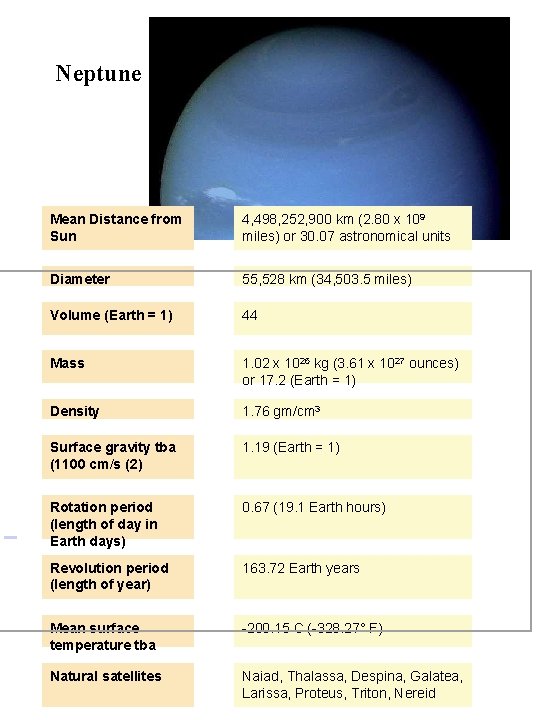
Neptune Mean Distance from Sun 4, 498, 252, 900 km (2. 80 x 109 miles) or 30. 07 astronomical units Diameter 55, 528 km (34, 503. 5 miles) Volume (Earth = 1) 44 Mass 1. 02 x 1026 kg (3. 61 x 1027 ounces) or 17. 2 (Earth = 1) 1. 76 gm/cm 3 Density 1. 19 (Earth = 1) Surface gravity tba (1100 cm/s (2) Rotation period 0. 67 (19. 1 Earth hours) (length of day in Earth days) Revolution period 163. 72 Earth years (length of year) surface -200. 15 C (-328. 27° F) Mean temperature tba Natural satellites Naiad, Thalassa, Despina, Galatea, Larissa, Proteus, Triton, Nereid
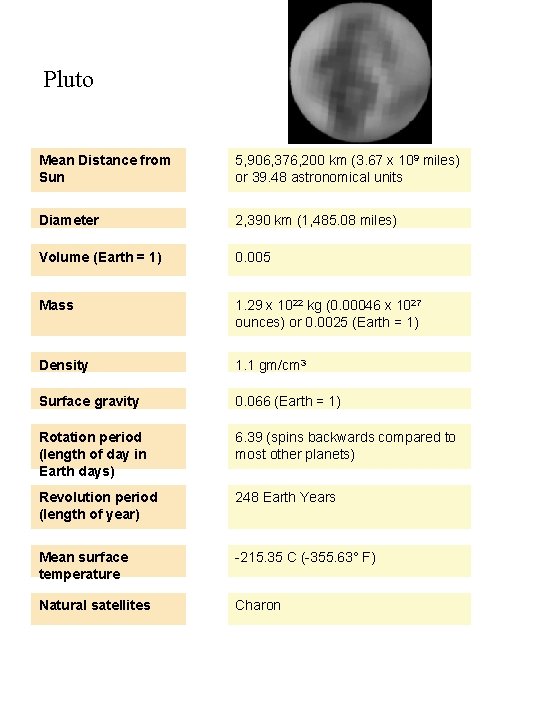
Pluto Mean Distance from Sun 5, 906, 376, 200 km (3. 67 x 109 miles) or 39. 48 astronomical units Diameter 2, 390 km (1, 485. 08 miles) Volume (Earth = 1) 0. 005 Mass 1. 29 x 1022 kg (0. 00046 x 1027 ounces) or 0. 0025 (Earth = 1) Density 1. 1 gm/cm 3 Surface gravity 0. 066 (Earth = 1) Rotation period 6. 39 (spins backwards compared to (length of day in most other planets) Earth days) Revolution period 248 Earth Years (length of year) -215. 35 C (-355. 63° F) Mean surface temperature Natural satellites Charon