
MERCURY IN THE ATMOSPHERE BIOSPHERE AND POLICY SPHERE
MERCURY IN THE ATMOSPHERE, BIOSPHERE, AND POLICY SPHERE: Constraints from a global 3 D land-ocean-atmosphere model on mercury sources, cycling and deposition Noelle Eckley Selin Harvard University Department of Earth and Planetary Sciences Atmospheric Chemistry Modeling Group Coauthors: D. J. Jacob, R. J. Park, R. M. Yantosca (Harvard) S. Strode, L. Jaegle, D. Jaffe, P. Swartzendruber (U. Washington) Princeton University 24 May 2007
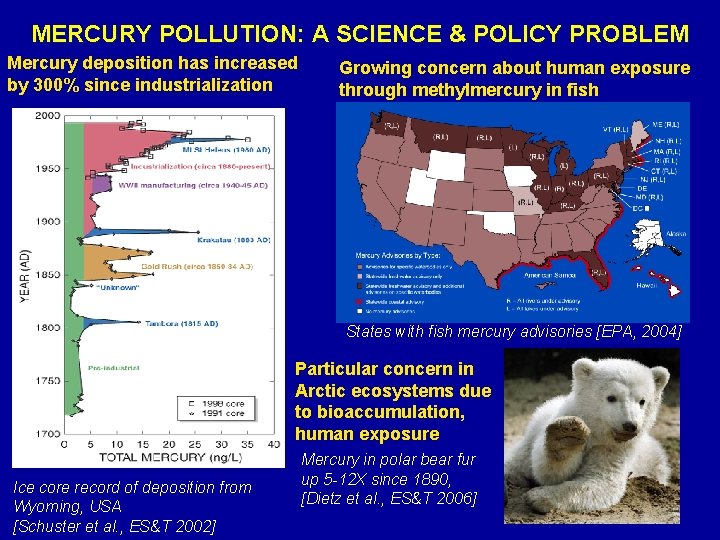
MERCURY POLLUTION: A SCIENCE & POLICY PROBLEM Mercury deposition has increased by 300% since industrialization Growing concern about human exposure through methylmercury in fish States with fish mercury advisories [EPA, 2004] Particular concern in Arctic ecosystems due to bioaccumulation, human exposure Ice core record of deposition from Wyoming, USA [Schuster et al. , ES&T 2002] Mercury in polar bear fur up 5 -12 X since 1890, [Dietz et al. , ES&T 2006]
POLITICAL ACTIONS AND UNCERTAINTIES GLOBAL: 2002: Global Mercury Assessment: sufficient evidence to warrant international action 2003, 2005, 2007: UNEP Governing Council meetings reject proposed global mercury agreement. Mercury Programme and voluntary partnerships established. REGIONAL: -U. S. /Mexico/Canada regional action plan under Commission for Environmental Cooperation (1997, 2000) -U. S. /Canada/Europe/former Soviet Union countries agreement on heavy metals under Convention on Long Range Transboundary Air Pollution (1998) U. S. : 2005: CLEAN AIR MERCURY RULE establishes a “cap and trade” approach to regulating mercury from coal-fired power plants • What are the relative contributions of global, regional and domestic sources to deposition? • What is the impact of anthropogenic emissions (past & present) on the global mercury cycle? [Selin, Environment, 2005; Selin and Selin, RECIEL, 2006]
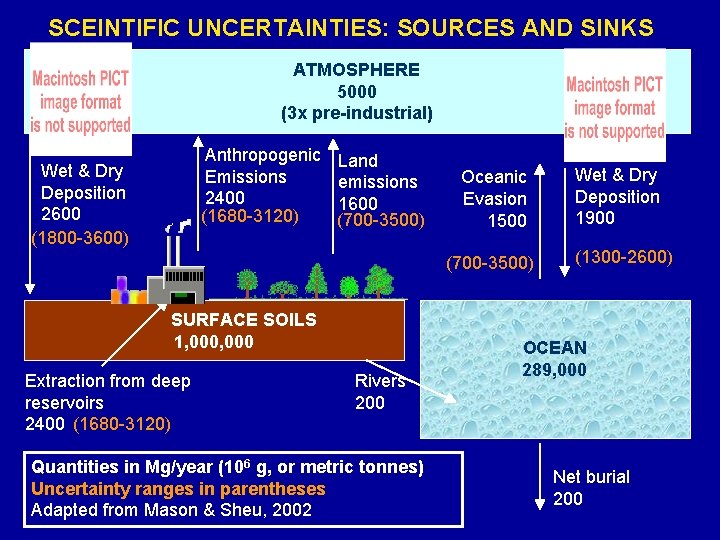
SCEINTIFIC UNCERTAINTIES: SOURCES AND SINKS ATMOSPHERE 5000 (3 x pre-industrial) Anthropogenic Emissions 2400 (1680 -3120) Wet & Dry Deposition 2600 (1800 -3600) Land emissions 1600 (700 -3500) Oceanic Evasion 1500 (700 -3500) SURFACE SOILS 1, 000 Extraction from deep reservoirs 2400 (1680 -3120) Rivers 200 Quantities in Mg/year (106 g, or metric tonnes) Uncertainty ranges in parentheses Adapted from Mason & Sheu, 2002 Wet & Dry Deposition 1900 (1300 -2600) OCEAN 289, 000 Net burial 200
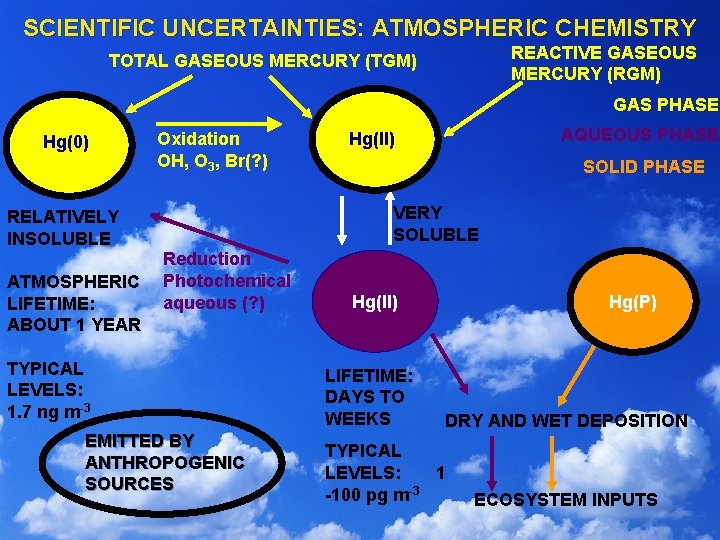
SCIENTIFIC UNCERTAINTIES: ATMOSPHERIC CHEMISTRY REACTIVE GASEOUS MERCURY (RGM) TOTAL GASEOUS MERCURY (TGM) GAS PHASE Hg(0) Oxidation OH, O 3, Br(? ) SOLID PHASE VERY SOLUBLE RELATIVELY INSOLUBLE ATMOSPHERIC LIFETIME: ABOUT 1 YEAR AQUEOUS PHASE Hg(II) Reduction Photochemical aqueous (? ) TYPICAL LEVELS: 1. 7 ng m-3 EMITTED BY ANTHROPOGENIC SOURCES Hg(II) LIFETIME: DAYS TO WEEKS Hg(P) DRY AND WET DEPOSITION TYPICAL LEVELS: 1 -100 pg m-3 ECOSYSTEM INPUTS
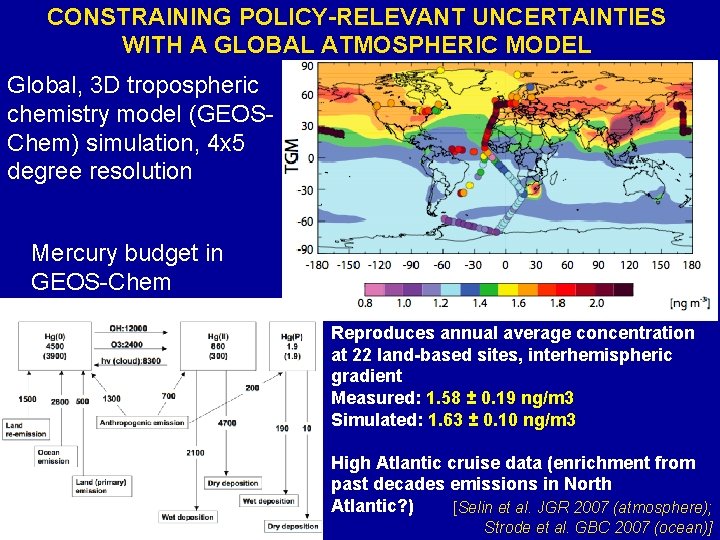
CONSTRAINING POLICY-RELEVANT UNCERTAINTIES WITH A GLOBAL ATMOSPHERIC MODEL Global, 3 D tropospheric chemistry model (GEOSChem) simulation, 4 x 5 degree resolution Mercury budget in GEOS-Chem Reproduces annual average concentration at 22 land-based sites, interhemispheric gradient Measured: 1. 58 ± 0. 19 ng/m 3 Simulated: 1. 63 ± 0. 10 ng/m 3 High Atlantic cruise data (enrichment from past decades emissions in North Atlantic? ) [Selin et al. JGR 2007 (atmosphere); Strode et al. GBC 2007 (ocean)]
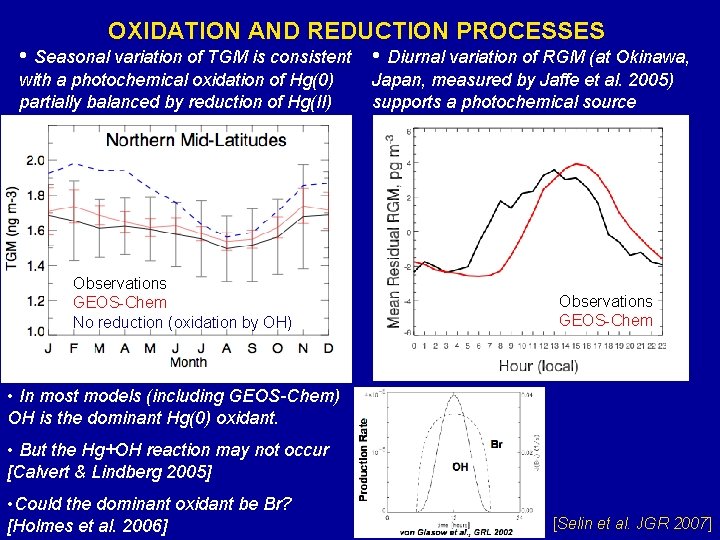
OXIDATION AND REDUCTION PROCESSES • Seasonal variation of TGM is consistent • Diurnal variation of RGM (at Okinawa, with a photochemical oxidation of Hg(0) partially balanced by reduction of Hg(II) Observations GEOS-Chem No reduction (oxidation by OH) Japan, measured by Jaffe et al. 2005) supports a photochemical source Observations GEOS-Chem • In most models (including GEOS-Chem) OH is the dominant Hg(0) oxidant. • But the Hg+OH reaction may not occur [Calvert & Lindberg 2005] • Could the dominant oxidant be Br? [Holmes et al. 2006] [Selin et al. JGR 2007]
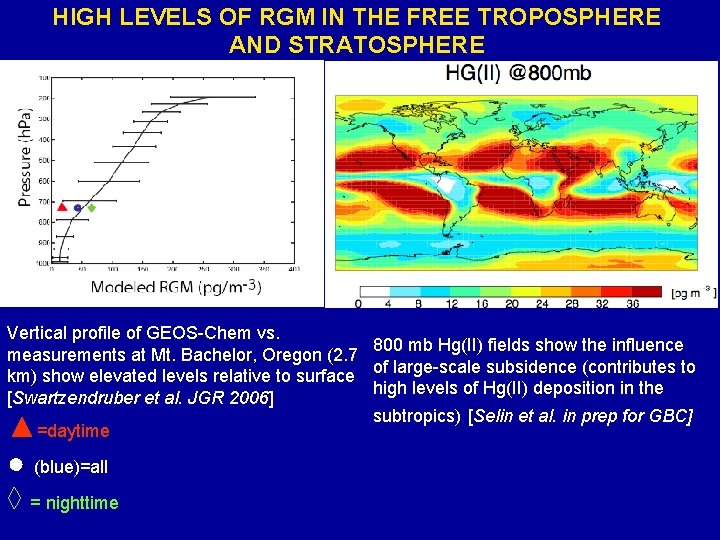
HIGH LEVELS OF RGM IN THE FREE TROPOSPHERE AND STRATOSPHERE Vertical profile of GEOS-Chem vs. 800 mb Hg(II) fields show the influence measurements at Mt. Bachelor, Oregon (2. 7 of large-scale subsidence (contributes to km) show elevated levels relative to surface high levels of Hg(II) deposition in the [Swartzendruber et al. JGR 2006] subtropics) [Selin et al. in prep for GBC] =daytime ▲ ● (blue)=all ◊ = nighttime
DEPOSITION: LOCAL VS. GLOBAL SOURCES Two patterns of mercury wet deposition over the U. S. (background=model, dots=measured) 1) Latitudinal gradient (higher in the subtropics). From oxidation of global pool of Hg(0) and subsequent rainout; influence of subsidence. 2) Near-source wet deposition of locally-emitted Hg(II) and Hg(P) (underestimated in GEOS-Chem) % contribution of North American sources to total (wet + dry) deposition GEOS-Chem model U. S. mean: 20% Reflects influence of locally-deposited Hg(II) and Hg(P) in source regions Measurements [Mercury Deposition Network, 2006]; GEOS-Chem [Selin et al. , JGR, 2007]
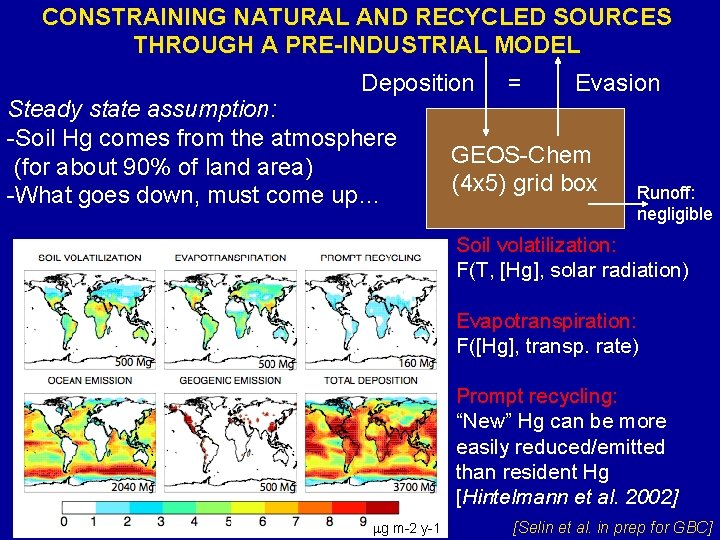
CONSTRAINING NATURAL AND RECYCLED SOURCES THROUGH A PRE-INDUSTRIAL MODEL Deposition Steady state assumption: -Soil Hg comes from the atmosphere (for about 90% of land area) -What goes down, must come up… = Evasion GEOS-Chem (4 x 5) grid box Runoff: negligible Soil volatilization: F(T, [Hg], solar radiation) Evapotranspiration: F([Hg], transp. rate) Prompt recycling: “New” Hg can be more easily reduced/emitted than resident Hg [Hintelmann et al. 2002] g m-2 y-1 [Selin et al. in prep for GBC]
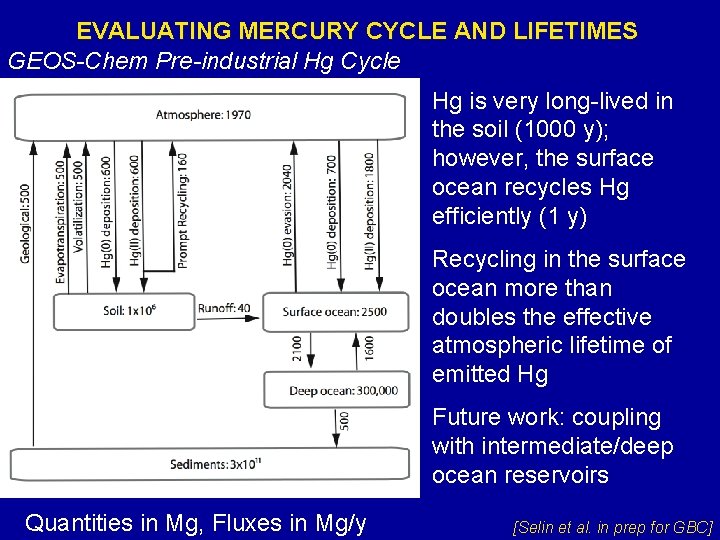
EVALUATING MERCURY CYCLE AND LIFETIMES GEOS-Chem Pre-industrial Hg Cycle Hg is very long-lived in the soil (1000 y); however, the surface ocean recycles Hg efficiently (1 y) Recycling in the surface ocean more than doubles the effective atmospheric lifetime of emitted Hg Future work: coupling with intermediate/deep ocean reservoirs Quantities in Mg, Fluxes in Mg/y [Selin et al. in prep for GBC]
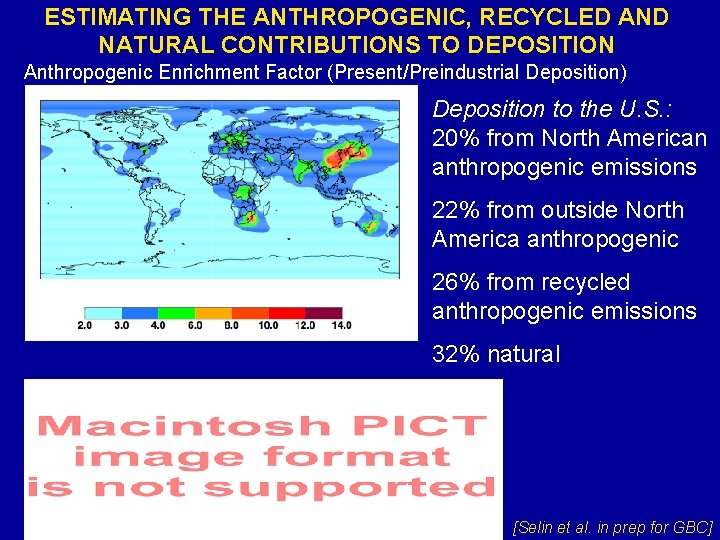
ESTIMATING THE ANTHROPOGENIC, RECYCLED AND NATURAL CONTRIBUTIONS TO DEPOSITION Anthropogenic Enrichment Factor (Present/Preindustrial Deposition) Deposition to the U. S. : 20% from North American anthropogenic emissions 22% from outside North America anthropogenic 26% from recycled anthropogenic emissions 32% natural [Selin et al. in prep for GBC]
TAKE-HOME MESSAGES FOR POLICY • Domestic, regional, and global regulation are all important in addressing the mercury problem vs. In the US, Florida and Ohio both see high deposition -- but the source patterns are very different • Hg(0), Hg(II) and Hg(P) emissions have different deposition patterns, and may need different regulatory strategies • Need for better understanding of redox chemistry, and cycling in land & ocean reservoirs (will climate change have an effect? ) • Need for improved cross-scale governance
- Slides: 13