
Mercantilism and the Colonies Reasons why England valued






- Slides: 14
Mercantilism and the Colonies
Reasons why England valued its North American colonies 1. The colonies supplied food and raw materials - $$$ 2. The colonies purchased large amounts of finished English goods - $$$
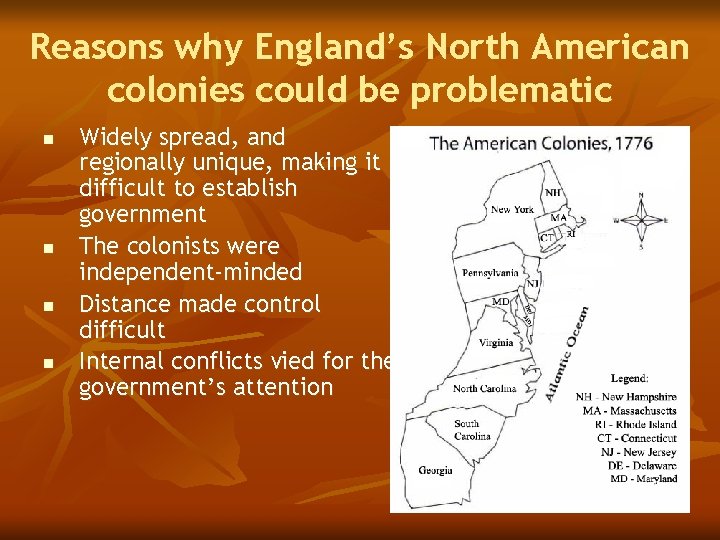
Reasons why England’s North American colonies could be problematic n n Widely spread, and regionally unique, making it difficult to establish government The colonists were independent-minded Distance made control difficult Internal conflicts vied for the government’s attention
Speaking of Internal Conflicts. The English Civil War and The “Glorious Revolution” n n n n Civil War from 1640 -1660 Fought between King Charles I and Parliament King limited the powers of Parliament by demanding taxes of the people King is beheaded! (by Parliament’s orders) Oliver Cromwell takes over, unrest ensues Finally King Charles II takes the throne in 1660, restored stability 1688 The “Glorious Revolution” overthrows King James, puts Protestant William and Mary on the throne
Economics n n War debt emphasized the need for the colonies to contribute to England’s overall economic health. The theory of Mercantilism was starting to become popular among the nations of Western Europe.
Mercantilism n n n A theory that a country should try to collect as much bullion (gold and silver) as possible, creating wealth and power. If a country sold more goods to other countries than it bought from them, it would acquire this bullion. Put Simply: To become rich, exports should exceed imports
England’s relationship with the colonies: n n Believed the Colonies existed to benefit the “Mother Country” England had started the Colonies and had the right to benefit from them And, Coming Soon… n England would provide armies and ships during the French and Indian War to the Colonies. n England developed a large debt during the French and Indian War to defend the Colonies.
Specific Purposes of the Colonies n To establish British Naval Power n n building ships providing England with ship-related supplies providing sailors Keep money in the empire!! n n Providing raw materials Providing other goods England could not produce n n n Tobacco Sugar Etc.
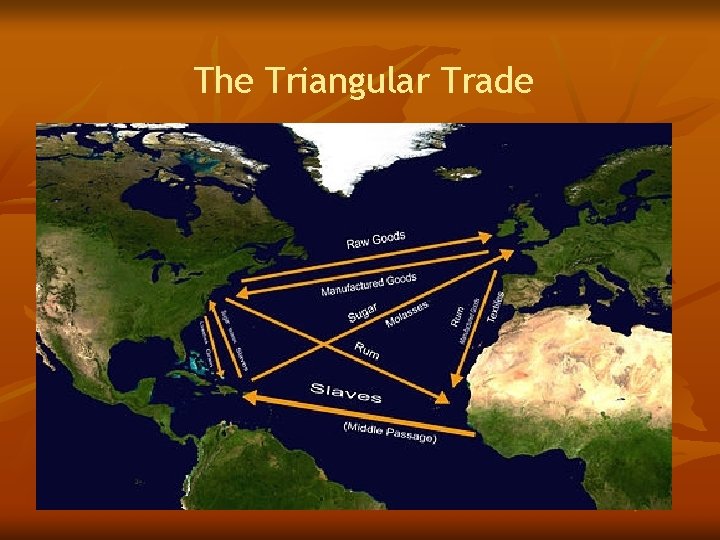
The Triangular Trade
The Relationship Changes n n England at first paid little attention to the colonies (civil war) England began exercising power over the colonies after Charles II comes to power
Navigation Acts 1651, 1660, 1663, and 1673 n n n Reinforced Mercantilism Colonies exports go only to England her other Colonies Imports from elsewhere must go through England n n extra tax will be added All goods (imports, exports) for the Colonies must be delivered by English ships.
Navigation Acts 1651, 1660, 1663, and 1673 England restricted the colonies from producing any goods also made in England! England decided could be produced in the colonies. n Colonies are to complement England, NOT compete with England!! n
The Dominion of New England the start of Salutary Neglect n n King Charles II directly punishes Massachusetts for being too impertinent (and for being Puritans - personal grudge) by using King Phillips’ War as an excuse to pull their charter, establishes the Dominion of New England in 1684 headed by cruel and unpopular Sir Edmond Andros In 1689, the Dominion is overthrown by the colonists, and a period of Salutary Neglect begins under William and Mary- they (and those who follow) will take a hands-off approach to the colonies as long as they make money for the homeland- the Navigation Acts will stay on the books, but are loosely enforced
Legacy of Mercantilism and Salutary Neglect n n Over time, the colonists would grow accustomed to minimal English oversight Many colonists felt Mercantilism put them at a disadvantage economically England regarded its colonies as a source of wealth, not a full partner politically England often saw the colonists as “unruly children” or “backward frontiersmen” to be appeased or controlled