
Menus Recipes chapter 4 Describe 4 types of

Menus & Recipes- chapter 4 • • Describe 4 types of menus Identify the purpose of a menu Purpose of standardized recipe Calculate AS and AP, convert recipes from one yield to another, determine yield at different portion sizes, determine amount to purchase Calculate recipe cost & cost per portion Make vs Buy decisions – consider alternative Write a meat specification List factors that determine selling cost

Steps in menu & production planning Given an event, a setting, number of guests: • Choose the type of menu • Select the recipes or foods to be offered • Determine the amount needed (AS) • Determine the amount needed to purchase (AP or AS) • Compare the cost of make vs buy • Decide if you will make or buy items

Purpose of a menu • Communicate with customer • Sell the products Menus can be: • Spoken • Posted - board • Printed
Types of Menus • Static: all patrons offered same foods each day; may change every 6 months • Cycle: developed for a set period and then repeated – 21 days, 28 days • Market menu: based on availability of local products – produce/fish; may change daily • Hybrid – static menu with daily special
Menu courses/pricing • North America: appetizer or soup or salad, entrée, dessert • European: entrée, main, salad, dessert Pricing: • À la carte – each food item ordered and priced separately • Semi à la carte – entrée priced to include side order • Table d’hôte or prix fixe – complete meal at set price
Menu Language • includes preparation method, main ingredients, cut, quality, service method “Summer Vegetables with Tarragon Aïoli” • Accurate in stated cut, quality, quantity, nutritional content, ingredients, 11 million estimated prevalence of diagnosed people with food allergy 1 Food Allergy News, February-March 2005
Benefit of standardized recipe: • Produces a know quality & quantity of food for a specific operation specifies: type & amt of each ingredient prep & cooking procedures yield & portion size • Help train cooks, educate service staff, customers get consistent product, result in accurate food costing & menu pricing • Unless a site purchases a product, they must test recipes to standardize
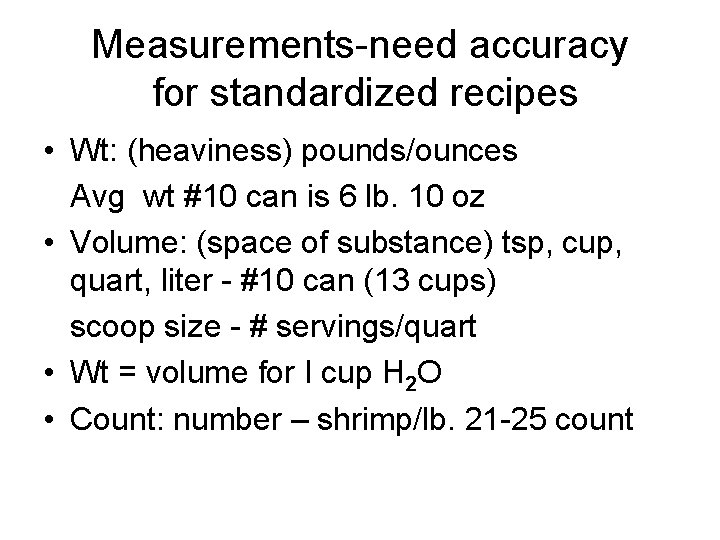
Measurements-need accuracy for standardized recipes • Wt: (heaviness) pounds/ounces Avg wt #10 can is 6 lb. 10 oz • Volume: (space of substance) tsp, cup, quart, liter - #10 can (13 cups) scoop size - # servings/quart • Wt = volume for I cup H 2 O • Count: number – shrimp/lb. 21 -25 count
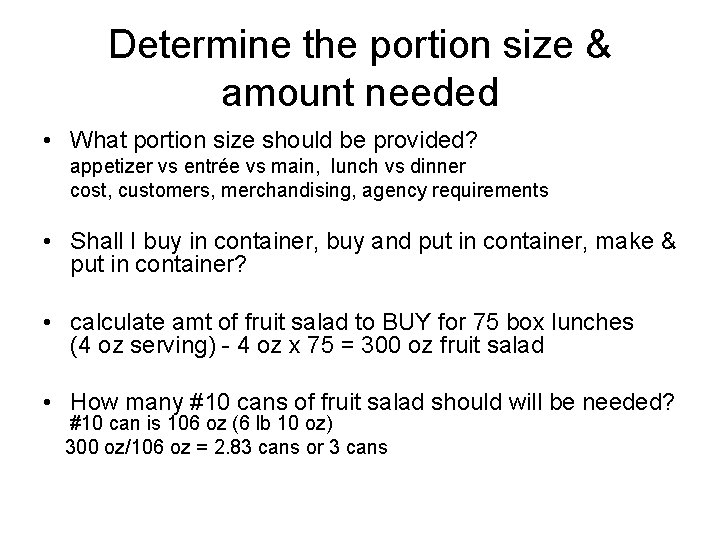
Determine the portion size & amount needed • What portion size should be provided? appetizer vs entrée vs main, lunch vs dinner cost, customers, merchandising, agency requirements • Shall I buy in container, buy and put in container, make & put in container? • calculate amt of fruit salad to BUY for 75 box lunches (4 oz serving) - 4 oz x 75 = 300 oz fruit salad • How many #10 cans of fruit salad should will be needed? #10 can is 106 oz (6 lb 10 oz) 300 oz/106 oz = 2. 83 cans or 3 cans
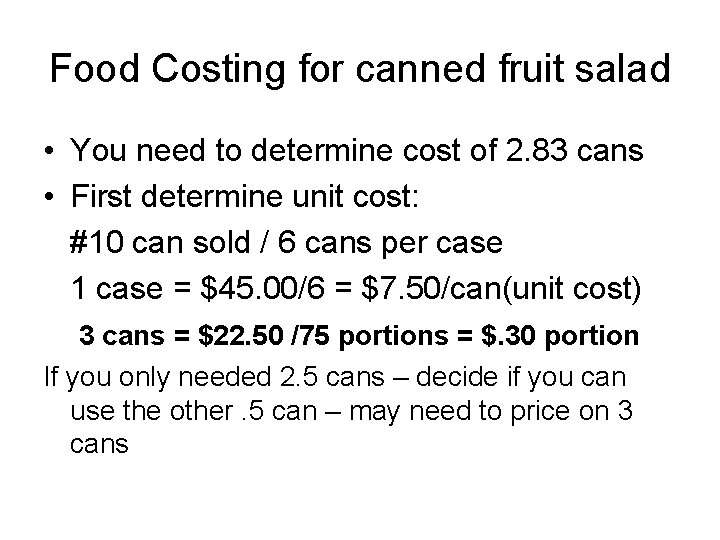
Food Costing for canned fruit salad • You need to determine cost of 2. 83 cans • First determine unit cost: #10 can sold / 6 cans per case 1 case = $45. 00/6 = $7. 50/can(unit cost) 3 cans = $22. 50 /75 portions = $. 30 portion If you only needed 2. 5 cans – decide if you can use the other. 5 can – may need to price on 3 cans
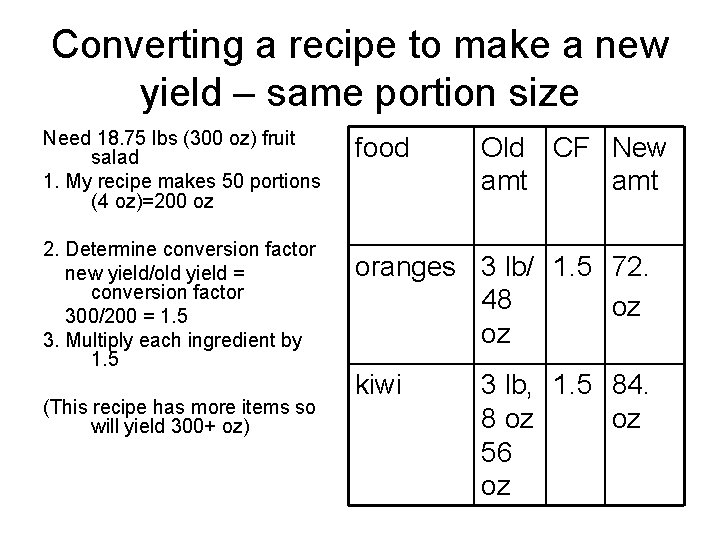
Converting a recipe to make a new yield – same portion size Need 18. 75 lbs (300 oz) fruit salad 1. My recipe makes 50 portions (4 oz)=200 oz 2. Determine conversion factor new yield/old yield = conversion factor 300/200 = 1. 5 3. Multiply each ingredient by 1. 5 (This recipe has more items so will yield 300+ oz) food Old CF New amt oranges 3 lb/ 1. 5 72. 48 oz oz kiwi 3 lb, 1. 5 84. 8 oz oz 56 oz
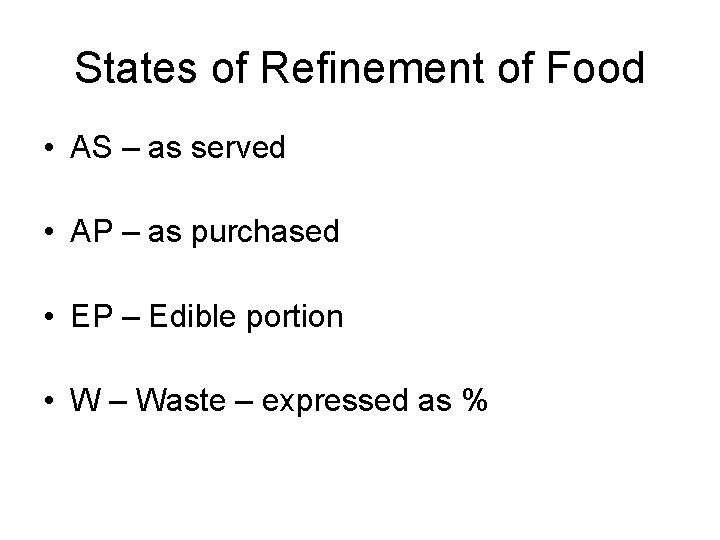
States of Refinement of Food • AS – as served • AP – as purchased • EP – Edible portion • W – Waste – expressed as %
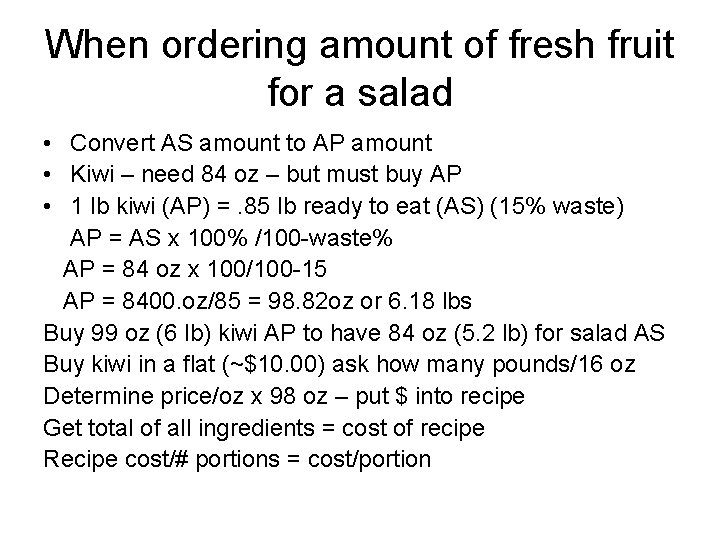
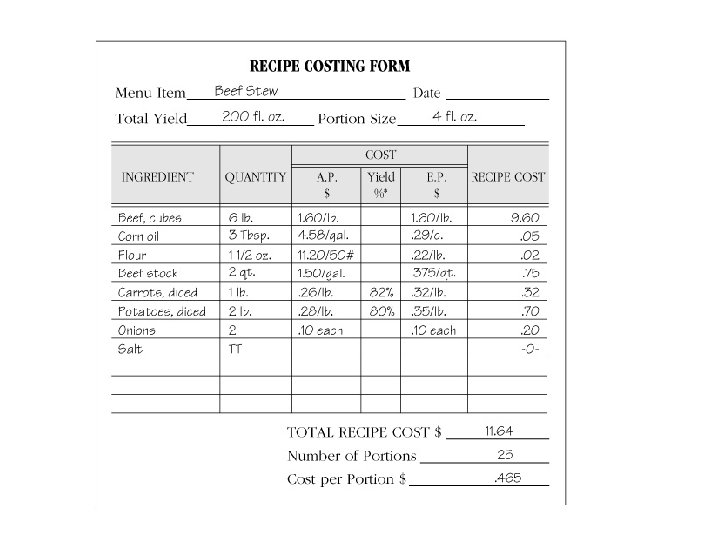
When ordering amount of fresh fruit for a salad • Convert AS amount to AP amount • Kiwi – need 84 oz – but must buy AP • 1 lb kiwi (AP) =. 85 lb ready to eat (AS) (15% waste) AP = AS x 100% /100 -waste% AP = 84 oz x 100/100 -15 AP = 8400. oz/85 = 98. 82 oz or 6. 18 lbs Buy 99 oz (6 lb) kiwi AP to have 84 oz (5. 2 lb) for salad AS Buy kiwi in a flat (~$10. 00) ask how many pounds/16 oz Determine price/oz x 98 oz – put $ into recipe Get total of all ingredients = cost of recipe Recipe cost/# portions = cost/portion
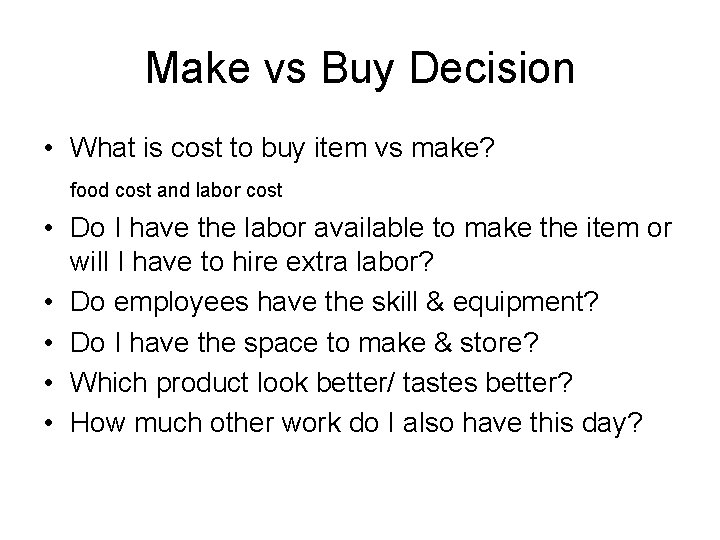
Make vs Buy Decision • What is cost to buy item vs make? food cost and labor cost • Do I have the labor available to make the item or will I have to hire extra labor? • Do employees have the skill & equipment? • Do I have the space to make & store? • Which product look better/ tastes better? • How much other work do I also have this day?
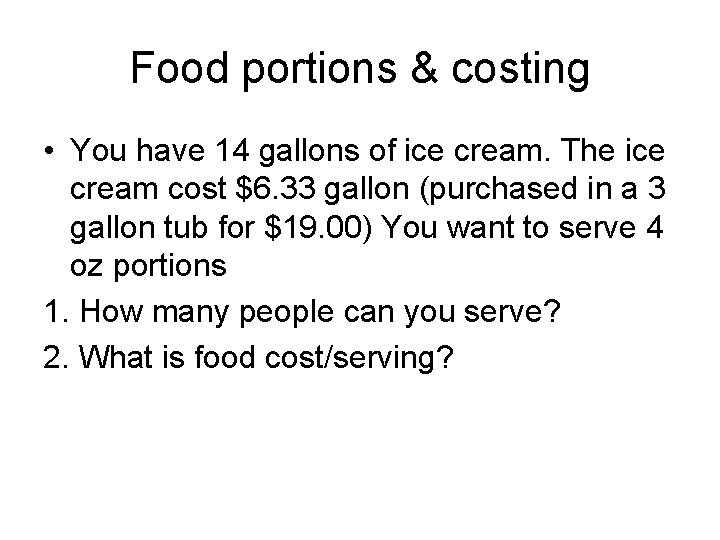
Food portions & costing • You have 14 gallons of ice cream. The ice cream cost $6. 33 gallon (purchased in a 3 gallon tub for $19. 00) You want to serve 4 oz portions 1. How many people can you serve? 2. What is food cost/serving?
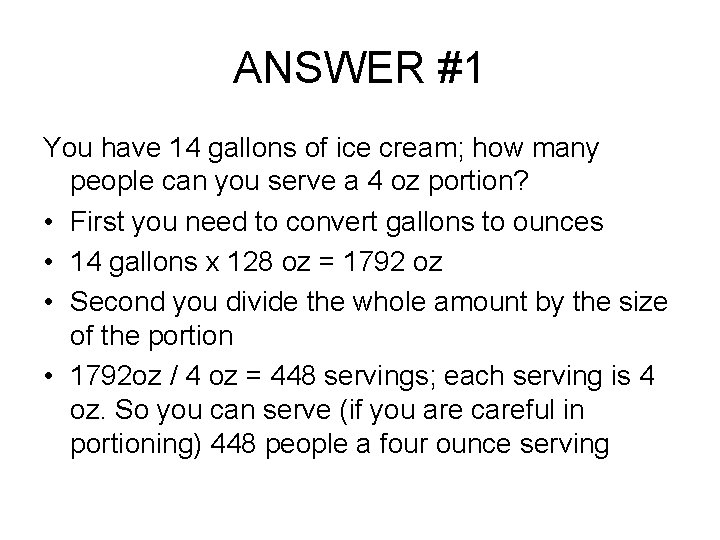
ANSWER #1 You have 14 gallons of ice cream; how many people can you serve a 4 oz portion? • First you need to convert gallons to ounces • 14 gallons x 128 oz = 1792 oz • Second you divide the whole amount by the size of the portion • 1792 oz / 4 oz = 448 servings; each serving is 4 oz. So you can serve (if you are careful in portioning) 448 people a four ounce serving
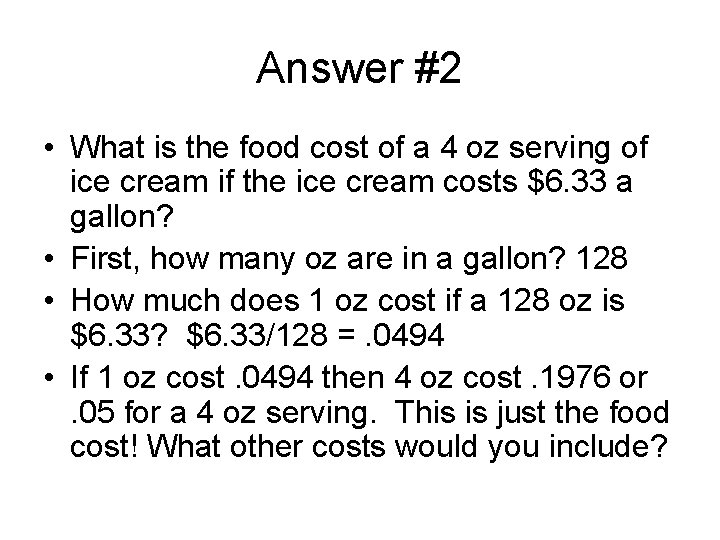
Answer #2 • What is the food cost of a 4 oz serving of ice cream if the ice cream costs $6. 33 a gallon? • First, how many oz are in a gallon? 128 • How much does 1 oz cost if a 128 oz is $6. 33? $6. 33/128 =. 0494 • If 1 oz cost. 0494 then 4 oz cost. 1976 or. 05 for a 4 oz serving. This is just the food cost! What other costs would you include?
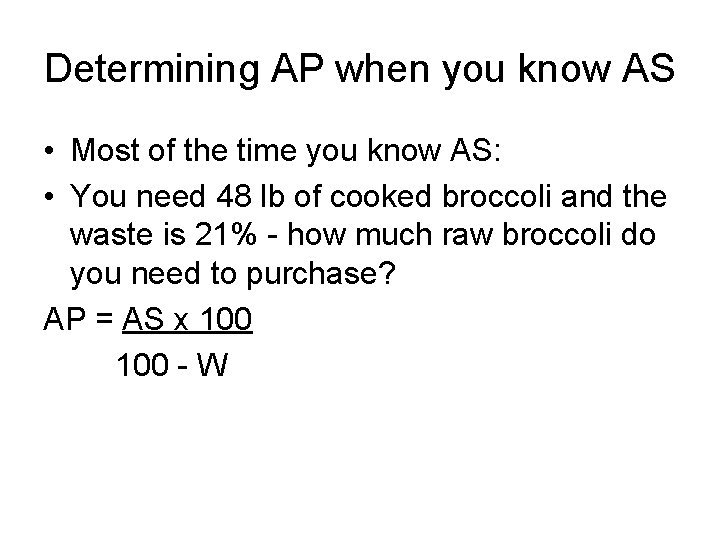
Determining AP when you know AS • Most of the time you know AS: • You need 48 lb of cooked broccoli and the waste is 21% - how much raw broccoli do you need to purchase? AP = AS x 100 - W
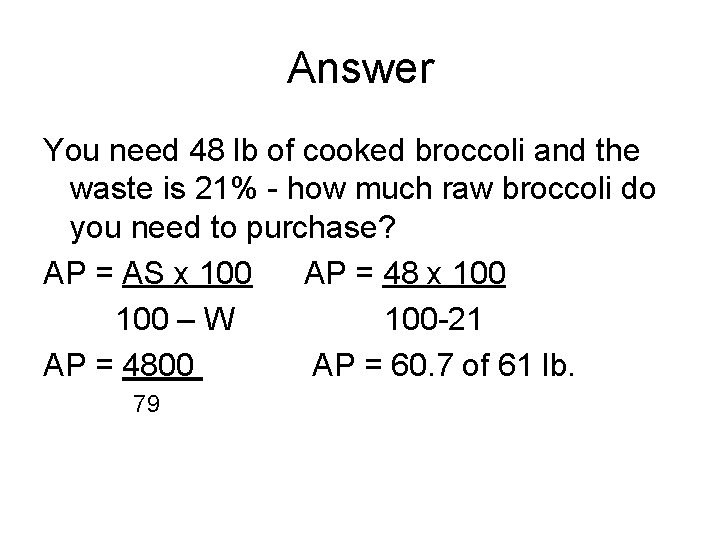
Answer You need 48 lb of cooked broccoli and the waste is 21% - how much raw broccoli do you need to purchase? AP = AS x 100 AP = 48 x 100 – W 100 -21 AP = 4800 AP = 60. 7 of 61 lb. 79
- Slides: 20