
MENU OF TOOL TOPICS CHOOSE 4 OUT OF
- Slides: 6
MENU OF TOOL TOPICS (CHOOSE 4 OUT OF THE 11 LISTED)
GOAL #1: SUPPORT THE RURAL LANDSCAPE STRATEGY D: LINK RURAL LAND PRESERVATION STRATEGIES TO GREAT NEIGHBORHOODS
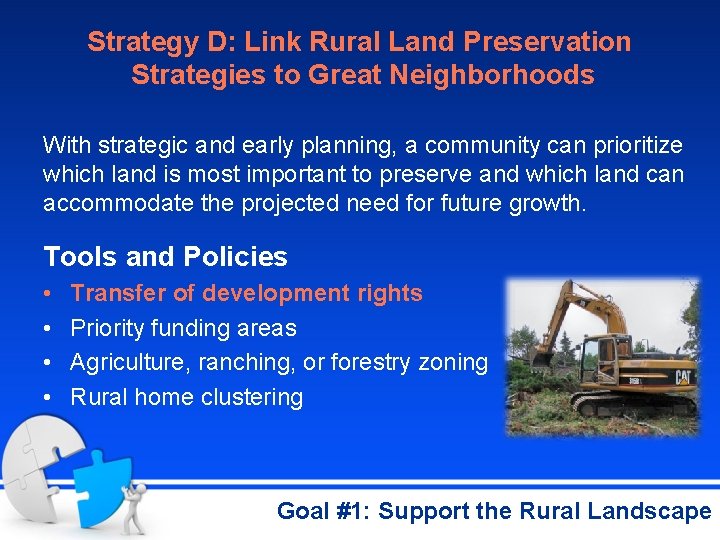
Strategy D: Link Rural Land Preservation Strategies to Great Neighborhoods With strategic and early planning, a community can prioritize which land is most important to preserve and which land can accommodate the projected need for future growth. Tools and Policies • • Transfer of development rights Priority funding areas Agriculture, ranching, or forestry zoning Rural home clustering Goal #1: Support the Rural Landscape
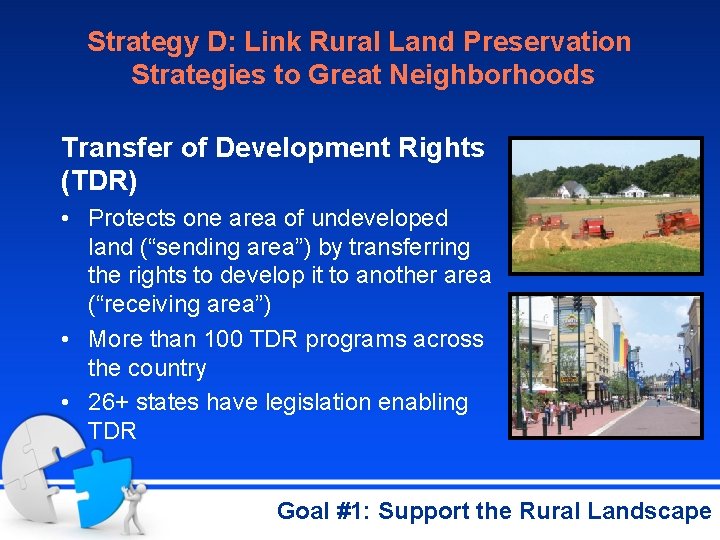
Strategy D: Link Rural Land Preservation Strategies to Great Neighborhoods Transfer of Development Rights (TDR) • Protects one area of undeveloped land (“sending area”) by transferring the rights to develop it to another area (“receiving area”) • More than 100 TDR programs across the country • 26+ states have legislation enabling TDR Goal #1: Support the Rural Landscape
Strategy D: Link Rural Land Preservation Strategies to Great Neighborhoods Benefits of Transfer of Development Rights • Provides an economic incentive to preserve land – Rural landowners have a financial incentive to not develop critical working lands (they can sell the development rights) – Allows developers to build at higher densities in desired development areas than they would normally be allowed • Provides an economic mechanism to fund conservation – TDR dollars fund the local government purchase of selected rural conservation easements to protect farms, forests, or ranches elsewhere Goal #1: Support the Rural Landscape
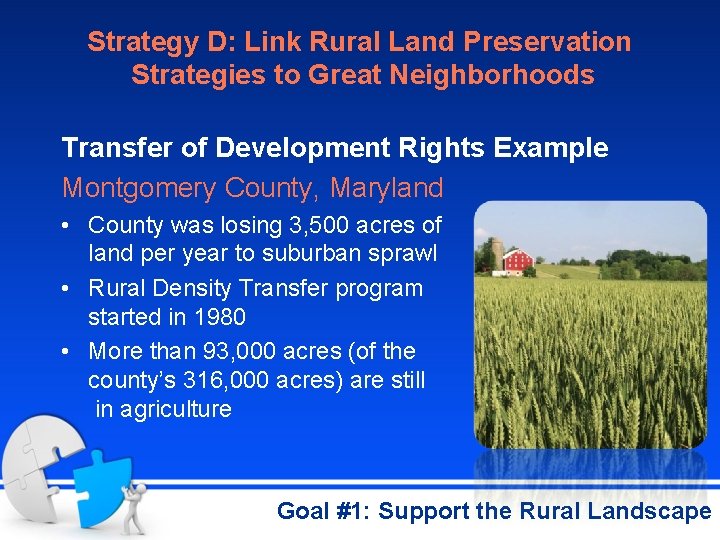
Strategy D: Link Rural Land Preservation Strategies to Great Neighborhoods Transfer of Development Rights Example Montgomery County, Maryland • County was losing 3, 500 acres of land per year to suburban sprawl • Rural Density Transfer program started in 1980 • More than 93, 000 acres (of the county’s 316, 000 acres) are still in agriculture Goal #1: Support the Rural Landscape