
Mentoring Cambridge Professional Development Qualifications Presenter Name Job
Mentoring Cambridge Professional Development Qualifications Presenter Name Job title Date
Contents 4 What are the Cambridge PDQs? 4 How is the Cambridge PDQ structured? 4 What is a mentor? 4 What’s in it for me? 4 The role of the mentor in the Cambridge PDQ. 4 The mentor-mentee relationship. 4 Models of mentoring 4 Additional resources
What are the Cambridge PDQs? Cambridge Professional Development Qualifications (Cambridge PDQs) are for practicing teachers and education leaders and are designed to enrich teaching and leadership. They are based on research evidence about the kinds of professional development that have real impact and value. Cambridge PDQs help practising teachers and education leaders to: 4 engage critically with relevant educational thinking and international best practices 4 apply new ideas and approaches in their own practice 4 reflect on and share experiences and outcomes to plan further development 4 improve the quality of their students’ learning.
Cambridge International Certificate and Diploma in Teaching and Learning Taking this programme will enable teachers to: 4 improve their teaching to enhance the quality of their students’ learning 4 integrate new ideas and approaches in their own practice and context 4 focus on developing effective and reflective practice to promote active learning.

Cambridge International Certificate and Diploma in Educational Leadership Taking this programme will enable leaders to: 4 improve their leadership of the quality of learning and teaching 4 increase their understanding of successful leadership to develop their leadership skills 4 focus on developing effective and reflective leadership practice to develop their schools.
Cambridge International Certificate and Diploma in Teaching Bilingual Learners Taking this programme will enable teachers to: 4 focus on helping bilingual learners to achieve both content and language learning objectives 4 develop effective and reflective practice in leading learning in curricular subjects through an additional language 4 contribute actively to the school’s development of bilingual education policy and practice.

Cambridge International Certificate and Diploma in Teaching with Digital Technologies Taking this programme will enable teachers to: 4 focus on understanding the potential and use of digital technologies for best impact in teaching and learning 4 experiment and innovate in their own context with the opportunities offered by digital technologies 4 develop effective and reflective practice in leading learning using digital technologies.

How is the Cambridge PDQ Structured? The design of the PDQ syllabuses encourages a 'spiral of learning' by providing opportunities to plan, practice and reflect in an active and dynamic way. We can think of the professional development spiral as having four aspects: identifying an area of practice to be developed and researching this planning and developing a practical application of the skills to be developed putting this into practice with learners and/or colleagues reflecting on and evaluating the real world practice with a mentor. By reflecting on and evaluating on the experience further areas for development are identified – and the cycle begins again, this time incorporating new understanding and capabilities. By consciously engaging with this ‘spiral of development’ it results in higher quality teaching and leadership.

How is the Cambridge PDQ Structured? The Cambridge PDQ is carefully structured to make the most of the spiral of learning and to ensure that candidates have the benefit of a range of different learning. The learning for the Certificate is split equally so that candidates can be introduced to theory in their guided learning sessions, apply theory in their work-based learning sessions and reflect upon their experiences and extend their research and discussion in their individual and collaborative learning. This is where the mentor comes in. Mentor’s support The spiral of professional learning is applied when working with the mentor and it depends on three processes: Candidate is observed Candidate reflects on feedback Receives feedback from mentor • Observation • Reflection • Learning with and from mentors It is crucial that learners receive feedback from observations to inform their continuous reflection on their learning experiences.

Mentors and the PDQ “Every learner in every Cambridge PDQ programme is required to have the continuing support of an experienced and trusted colleague, who acts as their mentor. This guide will help you to prepare for mentoring and to mentor your mentees successfully to meet everyone’s needs and expectations. ” Cambridge PDQ A Guide for Mentors
What is a mentor? ‘A mentor is someone who takes on the role of a trusted adviser, supporter, teacher and wise counsel to another person. A mentor adopts a primarily selfless role in supporting the learning, development and ultimate success of another person … mentoring is most effective when focused clearly on the needs, goals and challenges of the person you are mentoring …’ Starr, J. (2014: 3)
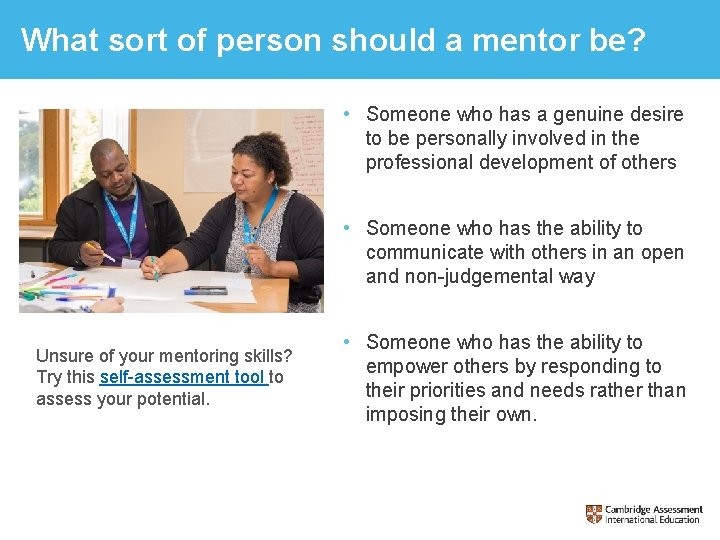
What sort of person should a mentor be? • Someone who has a genuine desire to be personally involved in the professional development of others • Someone who has the ability to communicate with others in an open and non-judgemental way Unsure of your mentoring skills? Try this self-assessment tool to assess your potential. • Someone who has the ability to empower others by responding to their priorities and needs rather than imposing their own.
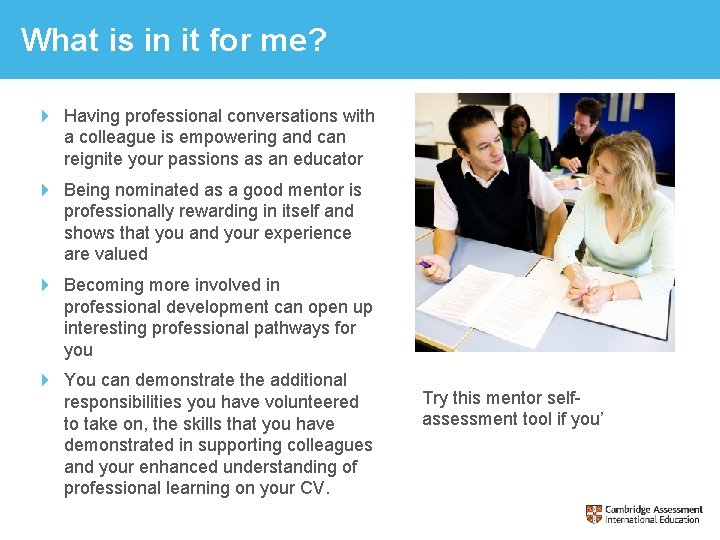
What is in it for me? 4 Having professional conversations with a colleague is empowering and can reignite your passions as an educator 4 Being nominated as a good mentor is professionally rewarding in itself and shows that you and your experience are valued 4 Becoming more involved in professional development can open up interesting professional pathways for you 4 You can demonstrate the additional responsibilities you have volunteered to take on, the skills that you have demonstrated in supporting colleagues and your enhanced understanding of professional learning on your CV. Try this mentor selfassessment tool if you’
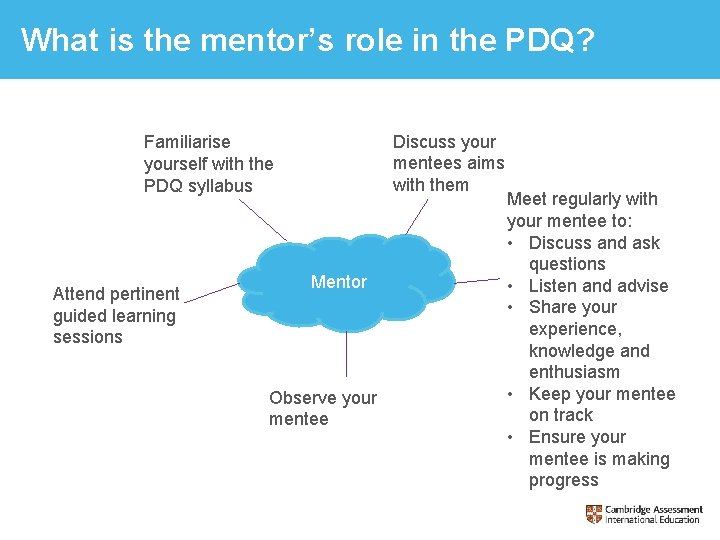
What is the mentor’s role in the PDQ? Discuss your mentees aims with them Familiarise yourself with the PDQ syllabus Attend pertinent guided learning sessions Mentor Observe your mentee Meet regularly with your mentee to: • Discuss and ask questions • Listen and advise • Share your experience, knowledge and enthusiasm • Keep your mentee on track • Ensure your mentee is making progress
What will I need to do? 4 Develop a relationship with your mentee. Get to know them, the PDQ and what they are hoping to achieve. 4 Decide upon a meeting schedule. When and where will you meet and for how long? * 4 Decide upon the tools you will use to structure your meetings. There are examples of these at the end of this presentation. * 4 Go with your mentee to observe an experienced practitioner. Spend time discussing how the lesson was effective in helping the students to learn 4 Observe your mentee teaching 4 Help your mentee to reflect on their teaching in your mentor sessions * Your programme leader will guide you in this.
Spotlight on Observation is a core feature of the Cambridge PDQs. Being observed enables the mentee to develop greater awareness of their strengths and areas for development, and provides a stimulus for professional dialogue. As a mentor you will want to create a learning environment that: • offers challenge • supports risk taking • permits failure as a learning experience • encourages experimentation and trying out new things • involves reflection before, in and on practice.
The Structure of the Observation When Cambridge examines the portfolio, we do look for evidence of the effectiveness of the observation and feedback for the further development of the candidate. Pre-observation discussion When you meet your mentee before the observation clarify with them the intended outcomes for observation (not the lesson). Agree a focus for the observation: This focus will partly be guided by the assessment requirements. Ask them for their lesson plan and any other relevant resources
The Structure of the Observation The Observation In the observation you should focus more on what the learners are doing and their learning rather than on the ‘teaching’. For example if the timekeeping or voice projection is an issue you should state this, but these issues of delivery should not be the focus of the observation. Remember to focus on the learning more than the teaching activities. Consider: 4 what the learners are doing – are they engaged, attentive, thinking? 4 how the teacher interacts with the learners – are they contributing, relaxed? 4 what is going on and why – you can note ‘this happened… because…’. 4 are the learners contributing and actively engaged with their learning? 4 are all learners included, are they challenged and supported? 4 were the resources appropriate? 4 how did the teacher check understanding throughout the lesson (formative assessment)? 4 did the teacher ask for learner feedback? If so, how and how are they using the feedback? NB – to repeat: Observation for the PDQs is formative, for the benefit of your mentee’s professional learning and development. You should not assess your mentee summatively, nor share the observation report for the purpose of a performance appraisal.
The Structure of the Observation Post-observation Discussion. 4 Schedule your post-observation discussion soon after the observation. Give your comments in a way that assists your mentee to discuss and reflect on the lesson. Ask questions and be curious about how and why they approached aspects of the lesson. Encourage your mentee to be articulate and clear about their thinking. Approach the post-observation discussion as a chance for selfreflection and sharing of experience. 4 Your mentee will want your feedback on the lesson and you should aim to provide this in a way that will benefit and encourage their practice. Always start with the positives! Be specific and be prepared to enter into a conversation. Check that your mentee understands your comments– and whether they agree.
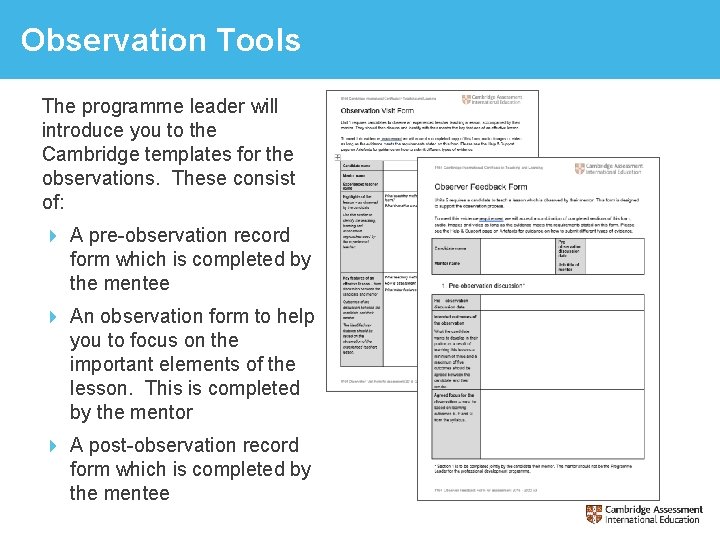
Observation Tools The programme leader will introduce you to the Cambridge templates for the observations. These consist of: 4 A pre-observation record form which is completed by the mentee 4 An observation form to help you to focus on the important elements of the lesson. This is completed by the mentor 4 A post-observation record form which is completed by the mentee
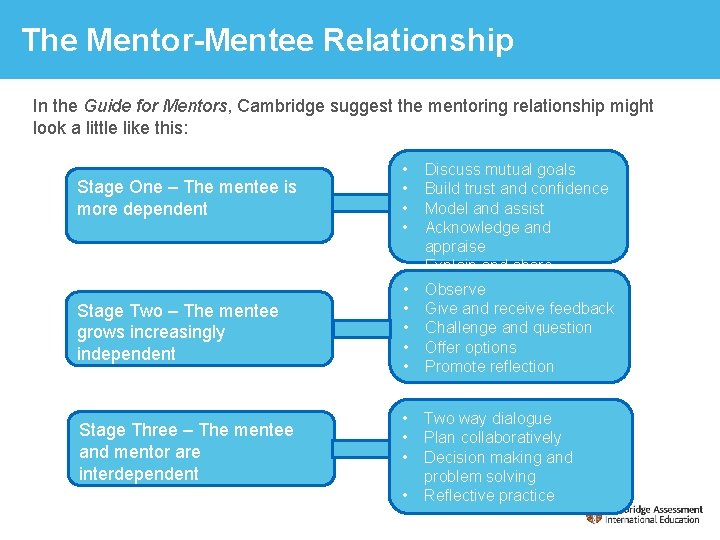
The Mentor-Mentee Relationship In the Guide for Mentors, Cambridge suggest the mentoring relationship might look a little like this: Stage One – The mentee is more dependent Stage Two – The mentee grows increasingly independent Stage Three – The mentee and mentor are interdependent • • • • Discuss mutual goals Build trust and confidence Model and assist Acknowledge and appraise Explain and share strategies Observe Give and receive feedback Challenge and question Offer options Promote reflection Two way dialogue Plan collaboratively Decision making and problem solving Reflective practice
Models of Mentoring During your mentor meetings the GROW model might help to guide your discussions by providing a structure for your questions: G – Goal – what do you want to achieve? R – Reality – where are you now, what will you need to do? O – Options – how can you approach this challenge? W – Will – how committed are you to the challenge?
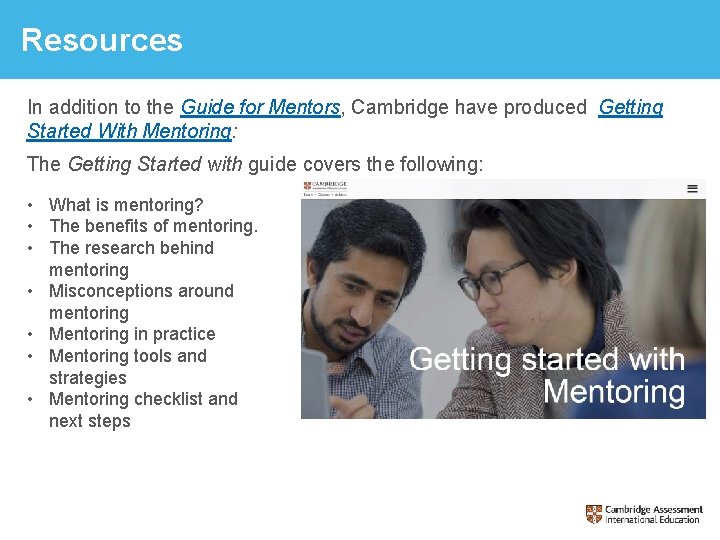
Resources In addition to the Guide for Mentors, Cambridge have produced Getting Started With Mentoring: The Getting Started with guide covers the following: • What is mentoring? • The benefits of mentoring. • The research behind mentoring • Misconceptions around mentoring • Mentoring in practice • Mentoring tools and strategies • Mentoring checklist and next steps
Bibliography Bartell C (2014: 135) in Murray J (2014) Designing and Implementing Effective Professional Learning. London: Corwin Press ISBN: 978 -1452257792 Starr, J. (2014) The mentoring manual: your step by step guide to becoming a better mentor. Harlow: Pearson Education. ISBN: 978 -1292017891 Clutterbuck D (2004) Everyone Needs a Mentor: fostering talent in your organisation, 4 th ed. London: Chartered Institute of Personnel and Development Cambridge Professional Development Qualifications: A Guide for Mentors (2015) Cambridge International Examinations. Available at: http: //www. cie. org. uk/images/304230 -a-guide-for-mentors. pdf
Thank you
- Slides: 25