
Mentor Training and Guidance Role of a mentor




- Slides: 28
Mentor Training and Guidance • • • Role of a mentor Placement timeline Paperwork Discussion points Concerns
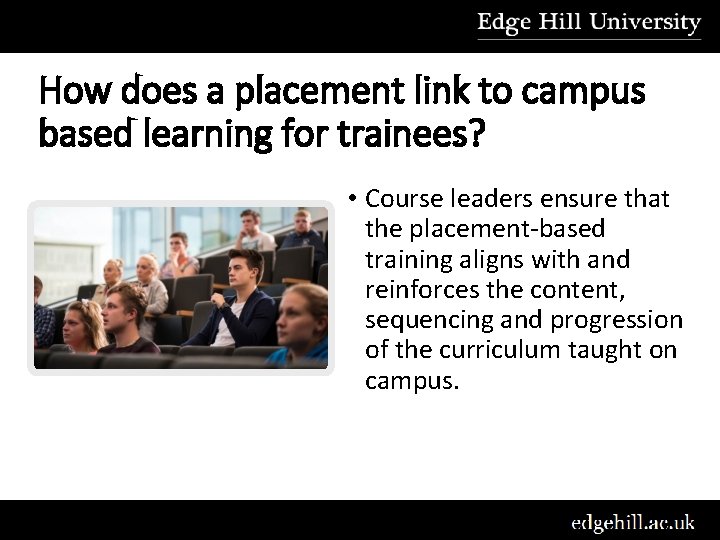
How does a placement link to campus based learning for trainees? • Course leaders ensure that the placement-based training aligns with and reinforces the content, sequencing and progression of the curriculum taught on campus.
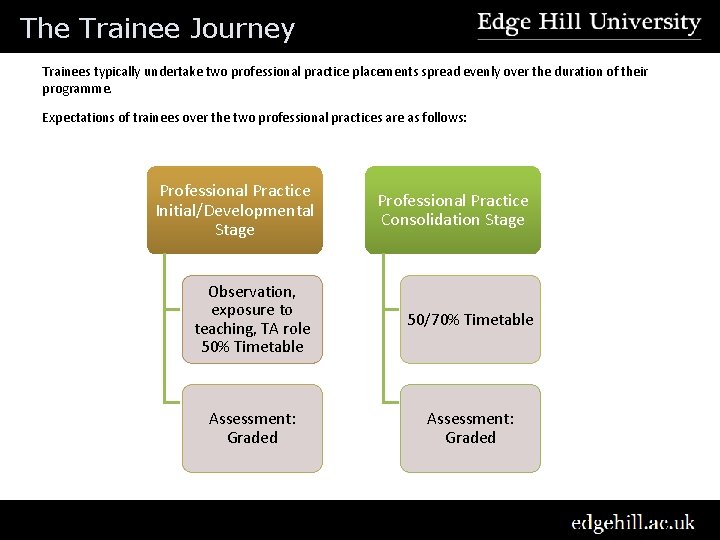
The Trainee Journey Trainees typically undertake two professional practice placements spread evenly over the duration of their programme. typically undertake three professional practice placements spread evenly over Trainees the duration of their programme. Expectations of trainees over the two professional practices are as follows: • Undergraduate trainees complete one professional practice per year. • PGCE trainees complete all professional practices in one year. Professional Practice Expectations of trainees over the three professional practices are as follows: Initial/Developmental Consolidation Stage Observation, exposure to teaching, TA role 50% Timetable 50/70% Timetable Assessment: Graded
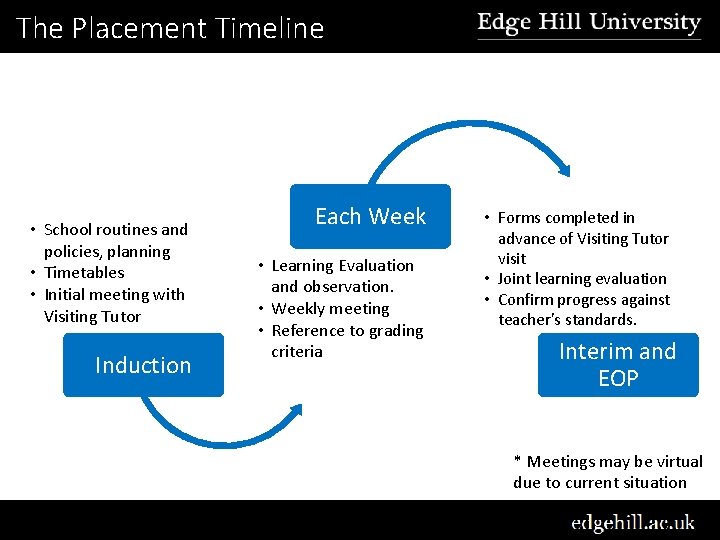
The Placement Timeline • School routines and policies, planning • Timetables • Initial meeting with Visiting Tutor Induction Each Week • Learning Evaluation and observation. • Weekly meeting • Reference to grading criteria • Forms completed in advance of Visiting Tutor visit • Joint learning evaluation • Confirm progress against teacher's standards. Interim and EOP * Meetings may be virtual due to current situation
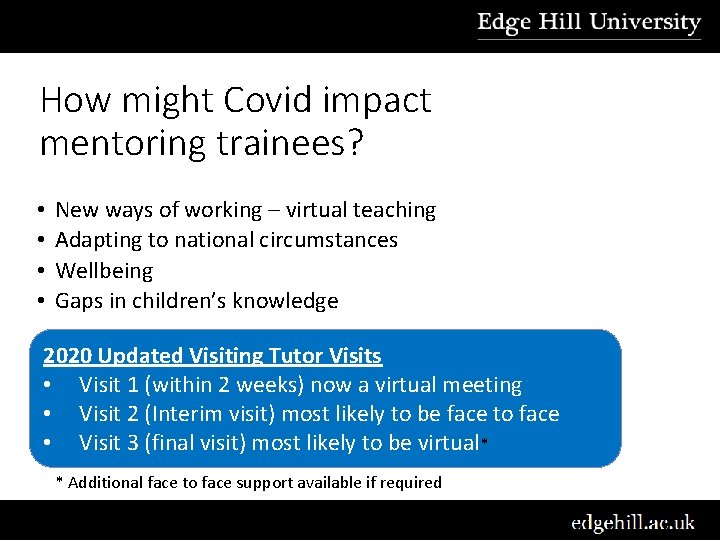
How might Covid impact mentoring trainees? • • New ways of working – virtual teaching Adapting to national circumstances Wellbeing Gaps in children’s knowledge 2020 Updated Visiting Tutor Visits • Visit 1 (within 2 weeks) now a virtual meeting • Visit 2 (Interim visit) most likely to be face to face • Visit 3 (final visit) most likely to be virtual* * Additional face to face support available if required
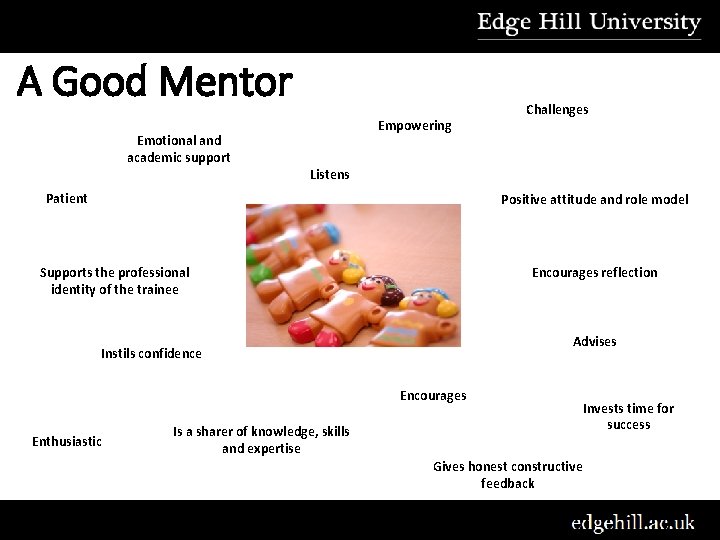
A Good Mentor Emotional and academic support Empowering Challenges Listens Patient Positive attitude and role model Encourages reflection Supports the professional identity of the trainee Advises Instils confidence Encourages Enthusiastic Is a sharer of knowledge, skills and expertise Gives honest constructive feedback Invests time for success
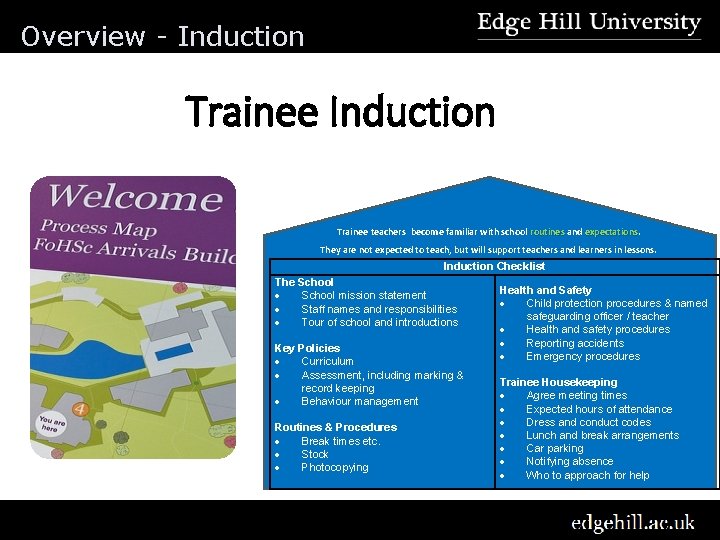
Overview - Induction Trainee Induction Inductio n period Trainee teachers become familiar with school routines and expectations They are not expected to teach, but will support teachers and learners in lessons. Induction Checklist The School mission statement Staff names and responsibilities Tour of school and introductions Key Policies Curriculum Assessment, including marking & record keeping Behaviour management Routines & Procedures Break times etc. Stock Photocopying Health and Safety Child protection procedures & named safeguarding officer / teacher Health and safety procedures Reporting accidents Emergency procedures Trainee Housekeeping Agree meeting times Expected hours of attendance Dress and conduct codes Lunch and break arrangements Car parking Notifying absence Who to approach for help
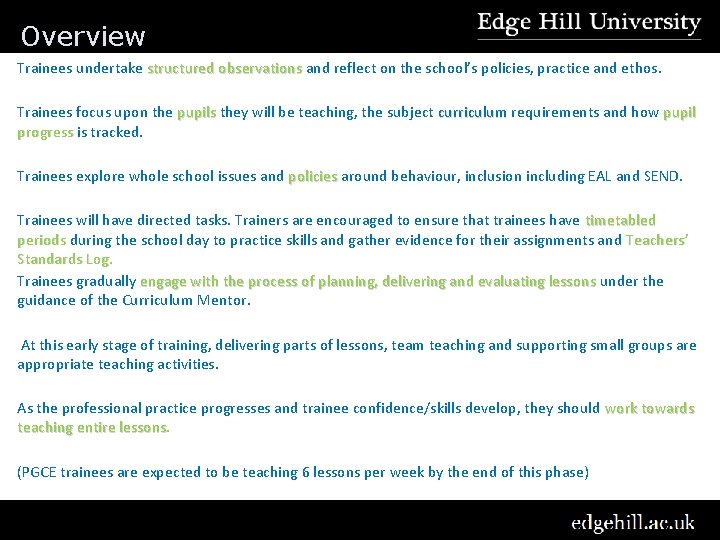
Overview Trainees undertake structured observations and reflect on the school’s policies, practice and ethos. Trainees focus upon the pupils they will be teaching, the subject curriculum requirements and how pupil progress is tracked. Trainees explore whole school issues and policies around behaviour, inclusion including EAL and SEND. Trainees will have directed tasks. Trainers are encouraged to ensure that trainees have timetabled periods during the school day to practice skills and gather evidence for their assignments and Teachers’ Standards Log Trainees gradually engage with the process of planning, delivering and evaluating lessons under the guidance of the Curriculum Mentor. At this early stage of training, delivering parts of lessons, team teaching and supporting small groups are appropriate teaching activities. As the professional practice progresses and trainee confidence/skills develop, they should work towards teaching entire lessons (PGCE trainees are expected to be teaching 6 lessons per week by the end of this phase)
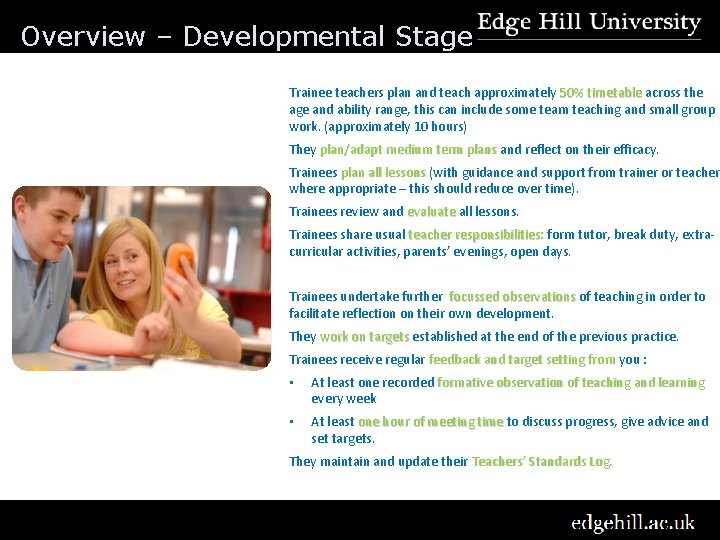
Overview – Developmental Stage Trainee teachers plan and teach approximately 50% timetable across the age and ability range, this can include some team teaching and small group work. (approximately 10 hours) They plan/adapt medium term plans and reflect on their efficacy. Trainees plan all lessons (with guidance and support from trainer or teacher where appropriate – this should reduce over time). Trainees review and evaluate all lessons. Trainees share usual teacher responsibilities: responsibilities form tutor, break duty, extracurricular activities, parents’ evenings, open days. Trainees undertake further focussed observations of teaching in order to facilitate reflection on their own development. They work on targets established at the end of the previous practice. Trainees receive regular feedback and target setting from you : • At least one recorded formative observation of teaching and learning every week • At least one hour of meeting time to discuss progress, give advice and set targets. They maintain and update their Teachers’ Standards Log.
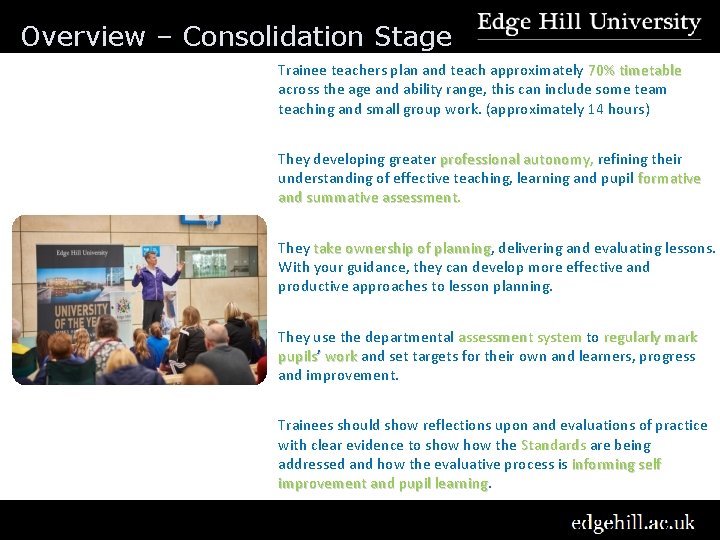
Overview – Consolidation Stage Trainee teachers plan and teach approximately 70% timetable across the age and ability range, this can include some team teaching and small group work. (approximately 14 hours) They developing greater professional autonomy, autonomy refining their understanding of effective teaching, learning and pupil formative and summative assessment They take ownership of planning, planning delivering and evaluating lessons. With your guidance, they can develop more effective and productive approaches to lesson planning. They use the departmental assessment system to regularly mark pupils’ work and set targets for their own and learners, progress and improvement. Trainees should show reflections upon and evaluations of practice with clear evidence to show the Standards are being addressed and how the evaluative process is informing self improvement and pupil learning
Overview – End of Professional Practice Report • Towards the end of professional practice the visiting tutor, trainee and curriculum mentor will agree targets for the trainee’s development. • These are recorded using an end of professional practice report form. • All parties also complete an evaluation of the professional practice process.
Workload • High workload is one of the most commonly cited drivers for teachers leaving the profession • Together, we are looking to strike the balance between realistic work expectations and cumbersome workloads The primary focus of all activities that trainees are asked to undertake should always be on those which contribute directly to pupil outcomes and effective development of the trainee
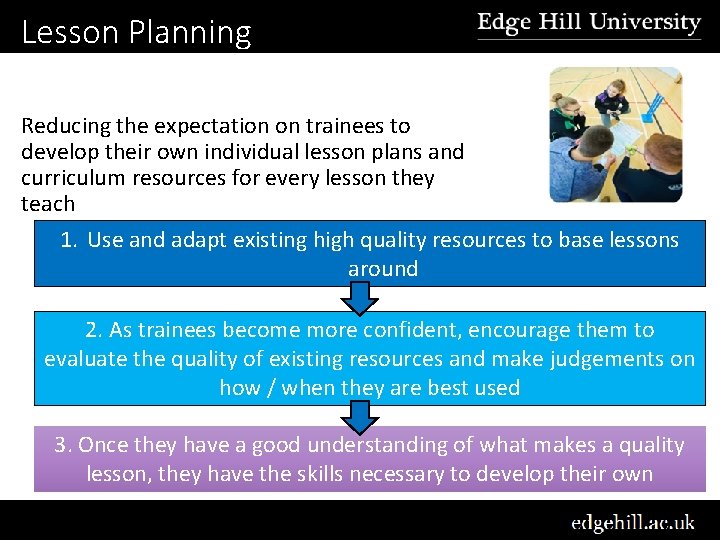
Lesson Planning Reducing the expectation on trainees to develop their own individual lesson plans and curriculum resources for every lesson they teach 1. Use and adapt existing high quality resources to base lessons around 2. As trainees become more confident, encourage them to evaluate the quality of existing resources and make judgements on how / when they are best used 3. Once they have a good understanding of what makes a quality lesson, they have the skills necessary to develop their own
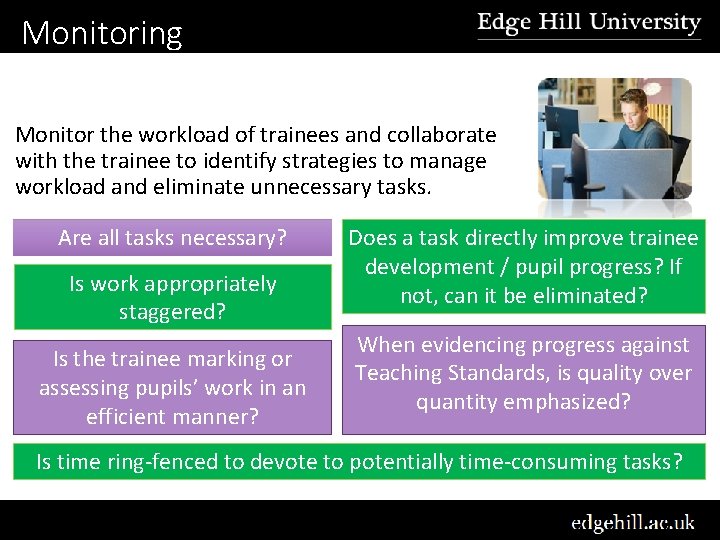
Monitoring Monitor the workload of trainees and collaborate with the trainee to identify strategies to manage workload and eliminate unnecessary tasks. Are all tasks necessary? Is work appropriately staggered? Is the trainee marking or assessing pupils’ work in an efficient manner? Does a task directly improve trainee development / pupil progress? If not, can it be eliminated? When evidencing progress against Teaching Standards, is quality over quantity emphasized? Is time ring-fenced to devote to potentially time-consuming tasks?
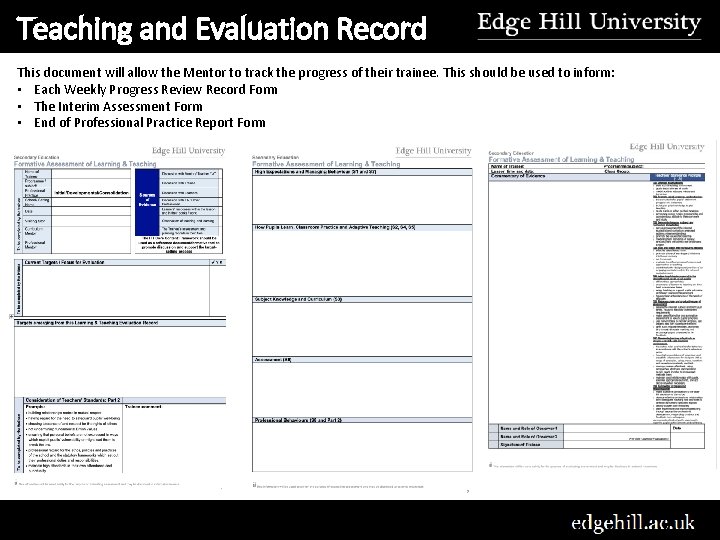
Teaching and Evaluation Record This document will allow the Mentor to track the progress of their trainee. This should be used to inform: • Each Weekly Progress Review Record Form • The Interim Assessment Form • End of Professional Practice Report Form
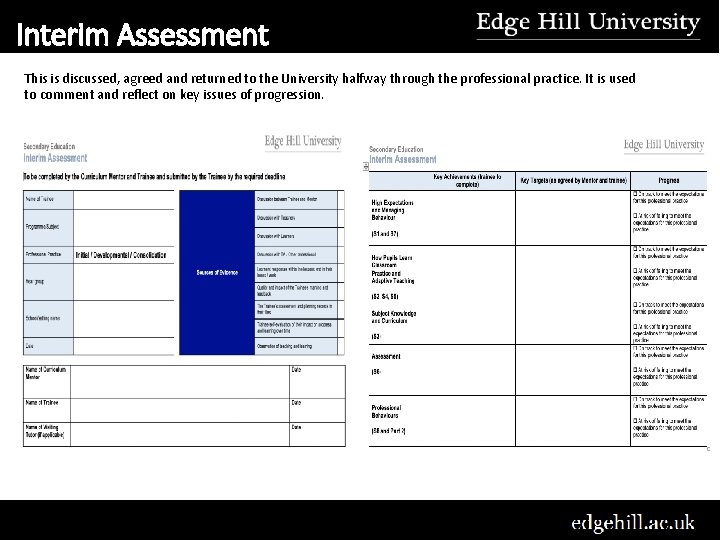
Interim Assessment This is discussed, agreed and returned to the University halfway through the professional practice. It is used to comment and reflect on key issues of progression.
End of Professional Practice Report Form The End of Professional Practice Report Form is completed in advance and then signed off by the Trainee, School. Based Mentor and Visiting Tutor at the end of the professional practice. It reflects the progression of the trainee throughout the duration of the professional practice.
End of Professional Practice Report Form
End of Professional Practice Report Form
Reflective Practice Reflective practice is a personal tool that teachers can use to observe and evaluate their experiences. It can be both a private process as well as one that you discuss with colleagues. When you collect information regarding what have experienced in school or on virtual placement, take the time to analyse it from a distance, you can identify more than just what works well but also how it relates to your practice. You will be able to look at the underlying principles and beliefs that define the way that you want work. This kind of self-awareness is a powerful tool for a teacher. Reflective practice is a quieter and more systemic approach to looking at what happened which can then inform future choices, planning and practice. Examples of Reflective Cycles (Theory) are provided later in this Power. Point. A possible tool to aid the reflective process is the use of a ‘Reflective Diary’. This tool will allow the Trainee to record thoughts, experiences and practice that they might find useful when building their teaching philosophy and teaching practice. Use of a ‘Reflective Diary’ might aid the student when completing the Weekly Progress Review Record.
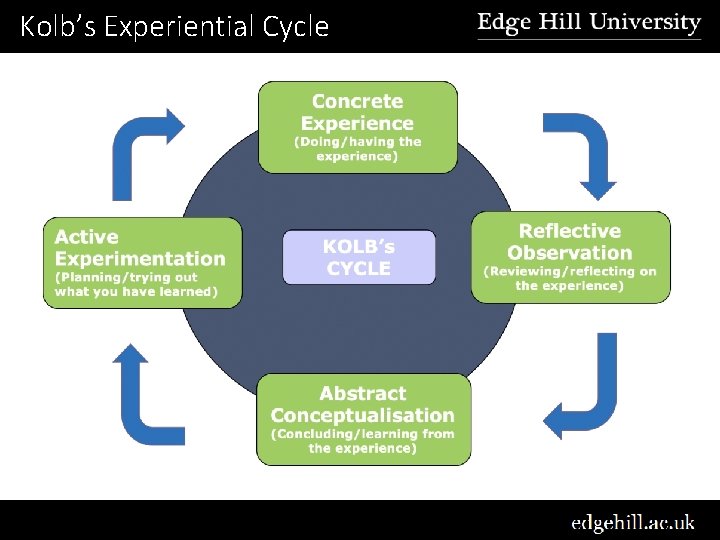
Kolb’s Experiential Cycle
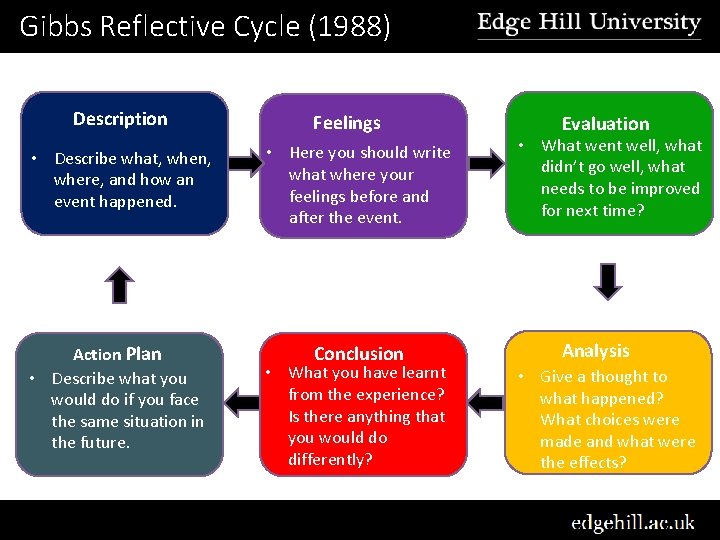
Gibbs Reflective Cycle (1988) Description Feelings • Describe what, when, where, and how an event happened. • Here you should write what where your feelings before and after the event. Action Plan • Describe what you would do if you face the same situation in the future. Conclusion • What you have learnt from the experience? Is there anything that you would do differently? Evaluation • What went well, what didn’t go well, what needs to be improved for next time? Analysis • Give a thought to what happened? What choices were made and what were the effects?
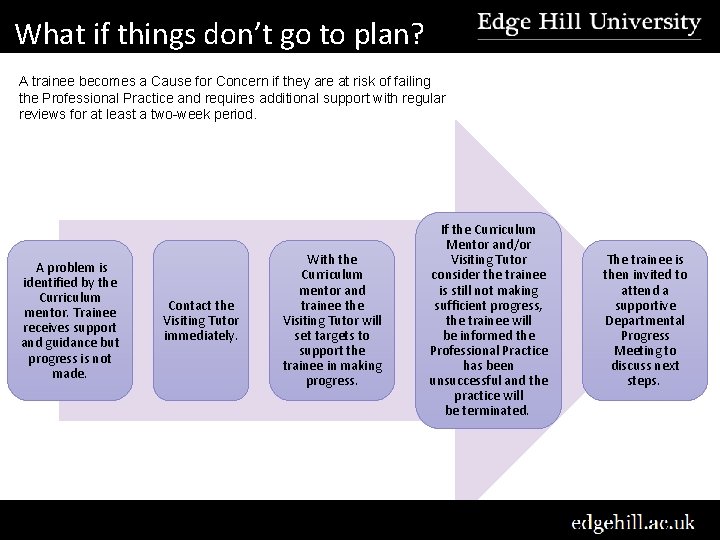
What if things don’t go to plan? A trainee becomes a Cause for Concern if they are at risk of failing the Professional Practice and requires additional support with regular reviews for at least a two-week period. A problem is identified by the Curriculum mentor. Trainee receives support and guidance but progress is not made. Contact the Visiting Tutor immediately. With the Curriculum mentor and trainee the Visiting Tutor will set targets to support the trainee in making progress. If the Curriculum Mentor and/or Visiting Tutor consider the trainee is still not making sufficient progress, the trainee will be informed the Professional Practice has been unsuccessful and the practice will be terminated. The trainee is then invited to attend a supportive Departmental Progress Meeting to discuss next steps.
Your Perspective… • What challenges as a mentor have you experienced? • What methods did you employ to overcome those challenges?
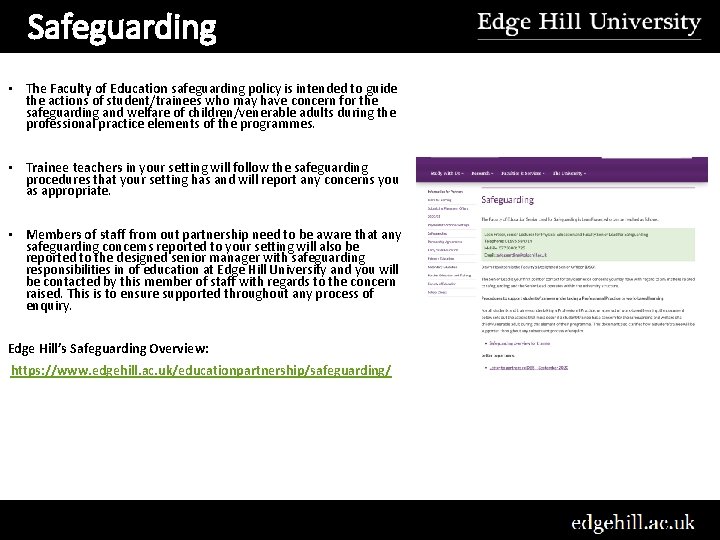
Safeguarding • The Faculty of Education safeguarding policy is intended to guide the actions of student/trainees who may have concern for the safeguarding and welfare of children/venerable adults during the professional practice elements of the programmes. • Trainee teachers in your setting will follow the safeguarding procedures that your setting has and will report any concerns you as appropriate. • Members of staff from out partnership need to be aware that any safeguarding concerns reported to your setting will also be reported to the designed senior manager with safeguarding responsibilities in of education at Edge Hill University and you will be contacted by this member of staff with regards to the concern raised. This is to ensure supported throughout any process of enquiry. Edge Hill’s Safeguarding Overview: https: //www. edgehill. ac. uk/educationpartnership/safeguarding/
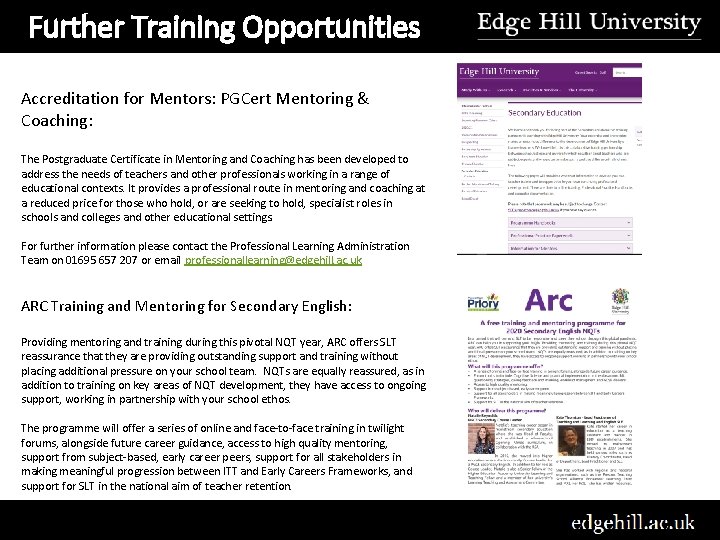
Further Training Opportunities Accreditation for Mentors: PGCert Mentoring & Coaching: The Postgraduate Certificate in Mentoring and Coaching has been developed to address the needs of teachers and other professionals working in a range of educational contexts. It provides a professional route in mentoring and coaching at a reduced price for those who hold, or are seeking to hold, specialist roles in schools and colleges and other educational settings. For further information please contact the Professional Learning Administration Team on 01695 657 207 or email professionallearning@edgehill. ac. uk ARC Training and Mentoring for Secondary English: Providing mentoring and training during this pivotal NQT year, ARC offers SLT reassurance that they are providing outstanding support and training without placing additional pressure on your school team. NQTs are equally reassured, as in addition to training on key areas of NQT development, they have access to ongoing support, working in partnership with your school ethos. The programme will offer a series of online and face-to-face training in twilight forums, alongside future career guidance, access to high quality mentoring, support from subject-based, early career peers, support for all stakeholders in making meaningful progression between ITT and Early Careers Frameworks, and support for SLT in the national aim of teacher retention.
Mentor Training Feedback Survey Thank you for taking the time to take part in Edge Hill University Mentor Training. Please complete the Online Mentor Training Feedback Survey via the link: https: //edgehill. onlinesurveys. ac. uk/mentor-trainingfeedback-survey
Contact Us: Lorraine Partington (Head of Partnership Development Team) 01695 650899 partingl@edgehill. ac. uk Jen Mc. Kown (Partnership Development Officer – Secondary Education) 01695 584399 jenniffer. mckown@edgehill. ac. uk Mike Pennington (Partnership Quality Officer) 01695 584403 penningm@edgehill. ac. uk Ian Molyneux (Partnership Quality Officer) 07928 128787 Molynia@edgehill. ac. uk