
Mentor Support during Reflection Last month we discussed




- Slides: 22
Mentor Support during Reflection Last month, we discussed the importance of reflection for ourselves and for our mentees. We designed questions to help our mentees reflect on the whole year. With an elbow partner, discuss opportunities you have had to reflect on your own growth and/or to help your mentee(s) reflect on the year?
OSPI MENTOR ROUNDTABLE PROFESSIONAL DEVELOPMENT FOR THOSE WHO SUPPORT THE GROWTH OF NOVICE EDUCATORS May 16, 2017 Lisa Pitcher-Facilitator
Roundtable purposes: • to connect • to learn • to refine • to give and receive coaching • to improve through reflection
4 Logistics for Learning • Advocate for your own learning. • Tend to your needs. • Be fully present. • Be ready to move often. • Give yourself permission to learn. It is impossible to get better and look good at the same time. - Julia Cameron in The Artist’s Way
Today: • End of year food for thought • Reflection/coaching conversations w/feedback • Celebration
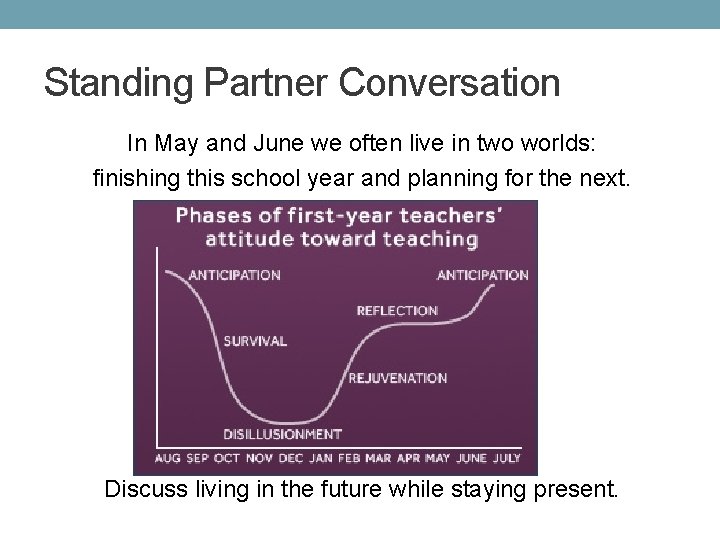
Standing Partner Conversation In May and June we often live in two worlds: finishing this school year and planning for the next. Discuss living in the future while staying present.
End of year organization Checklists: • Help you stay organized and focused • Help us avoid forgetting items. • Are invaluable when things get busy/crazy. • Allow new teachers to be more independent. Use sample templates to create your own end-of-year checklist for mentoring and for teaching that fits your site. Don’t reinvent the wheel. If your building has a checklist already, ask if you can add some items, if needed. Or get a copy early and sit down with your mentee to discuss and add notes and useful info.
Table Group Conversation Look at the checklist. Consider: • What is outdated? • What is relevant? • What else might you add? • What unwritten expectations do we have at our site? • What end-of-year activities and procedures might be challenging for new teachers? • What will be your priorities when talking with new teachers?
Mentor Skill Development • Mentoring requires a different set of skills and dispositions from teaching. • Mentors need to intentionally practice these skills until the use of them is automatic. • Mentor skills include: listening, paraphrasing, questioning, avoiding personal referencing, and using invitational verbals and non-verbals. • Roles we attend to include supporting, creating challenge, and facilitating vision for new teachers. • We fluidly use these stances: coaching, collaborating and consulting.
Mentor Standards • A team of educators from across the state developed these Washington State standards for mentoring using current best practices and research. • Standards are to support our growth as mentors and to help districts plan for on-going professional learning for mentors. • These were rolled out at the Convening. This version is a DRAFT form. Final form will be printed in June.
Self-assessment • Review the standard. • Rate your current performance. • Write in evidence that you used to determine your current performance.
Standing conversation Find a partner and discuss the evidence you listed. Consider: The value of that evidence and ideas you have for evidence you might collect in the future to show growth around this standard.
Individual Reflection Write your response to the following: • What skills did you learn or improve this year? • In skills would you like to grow/develop next year? • How will those skills benefit you or new teachers? • What evidence might you collect to show growth you make as a mentor?
Mentor professional learning BEST Opportunities for professional learning include: • Regional Roundtables • New mentor academies - 201, 301 • Possibly a Mentor Academy 151 next year which will give participants opportunities to practice 101 skills and address updates in the new Mentoring Matters book. • Facilitating Adult Learning workshop • Yearly Mentor Conference in March
Mentor professional learning A few ideas from around the state: Mentors get together weekly to practice coaching with each other (some attend formal meetings and some meet for dinner on their own). Mentors observe instruction together in real classrooms and/or on video. These observations can be used to practice scripting, discuss possible topics for the post conference, give each other feedback on scripting, etc. Mentors participate in a book study.
Ideas from around the West Sound Region!
Learning-Focused Conversation Practice The focus for today’s conversation – your choice.
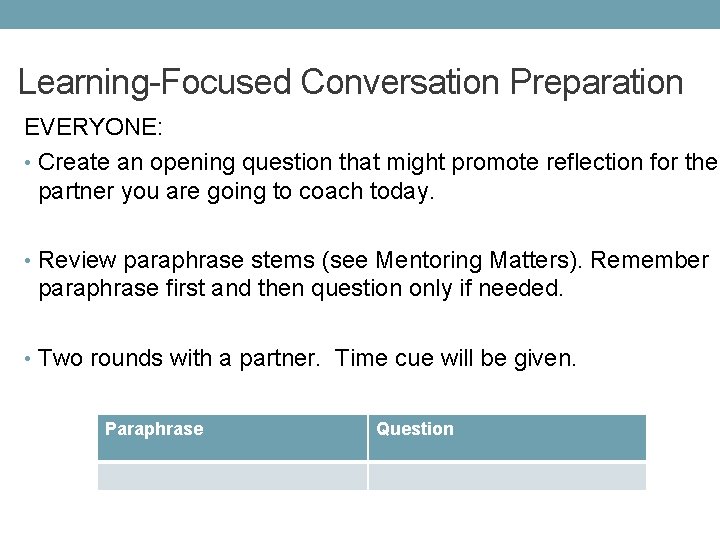
Learning-Focused Conversation Preparation EVERYONE: • Create an opening question that might promote reflection for the partner you are going to coach today. • Review paraphrase stems (see Mentoring Matters). Remember paraphrase first and then question only if needed. • Two rounds with a partner. Time cue will be given. Paraphrase Question
Partner Debrief What did your partner do or say that helped your thinking and how did it help? Share this with your partner.
Whole Group Debrief • As table groups discuss what you noticed and learned. • Be prepared to share one or two items w/the whole group.
P. S. Consider the following and jot one or both on a sticky note: Principle—A big idea you are thinking about Skill—Something specific you will work on next year. Choose one to share in a “Whip Around”
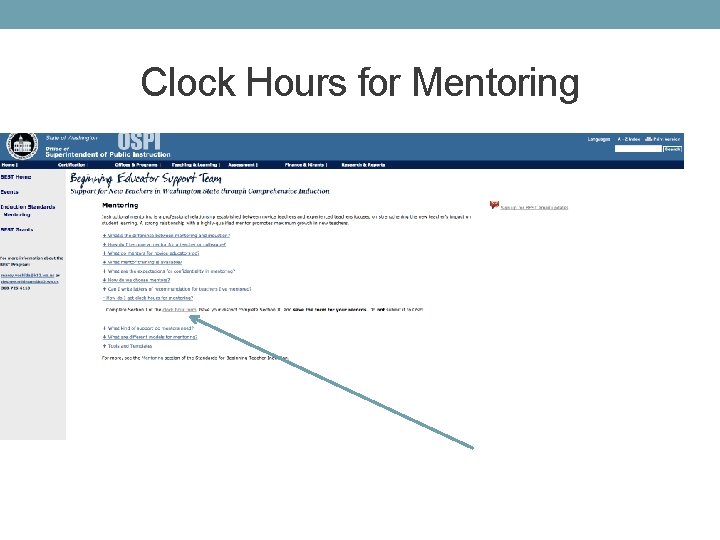
Clock Hours for Mentoring