
Mental status Language For distribution The mental status
Mental status & Language For distribution
The mental status and language examination consists of: 1. 2. 3. 4. 5. 6. 7. 8. Level of consciousness (alert, drowsy, coma) Appearance and behavior/affect Orientation (person, place, and time) – “oriented x 3” Memory/recall Attention and calculation (serial 7 s test) Language (expressive and receptive language) Abstract thought Visual-spatial
“alert and oriented x 3” “speech is fluent and meaningful”
Mental status and language assessment is usually performed in an informal manner In general practice, the mental status and language exam is usually performed in an informal manner – if the patient is alert, oriented, and coherent in relating the details of their clinical history, the patient is considered WNL. If a slightly more formal evaluation is desired, several mini-mental status exams are available. Each consists of a number of simple questions; inability to achieve a certain score suggests dysfunction.
Folstein mini-mental status exam (1)
Interpretation of Folstein mini-mental status exam Scores less than 23 out of 30 represent dysfunction. Scores less than 20 out of 30 are usually found in psychosis, delirium (acute brain failure), dementia (chronic brain failure). False positives can result from: *linguistic difficulties or low education level *depression or other psychiatric problems *inattention due to distraction *etc.

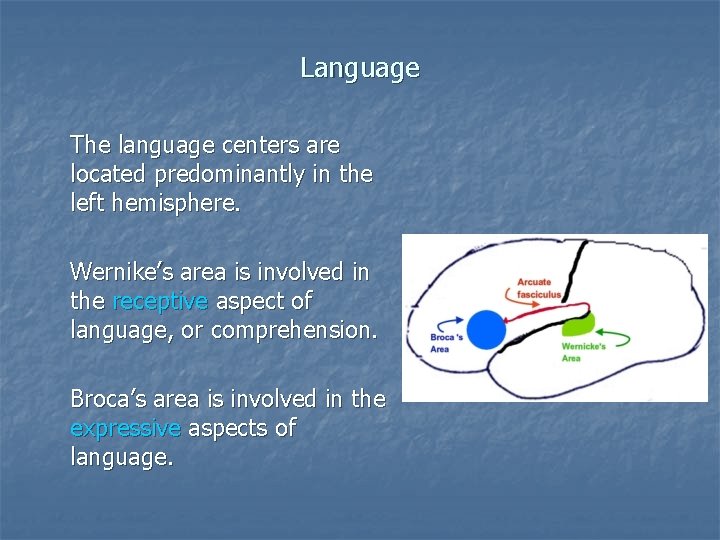
Language The language centers are located predominantly in the left hemisphere. Wernike’s area is involved in the receptive aspect of language, or comprehension. Broca’s area is involved in the expressive aspects of language.
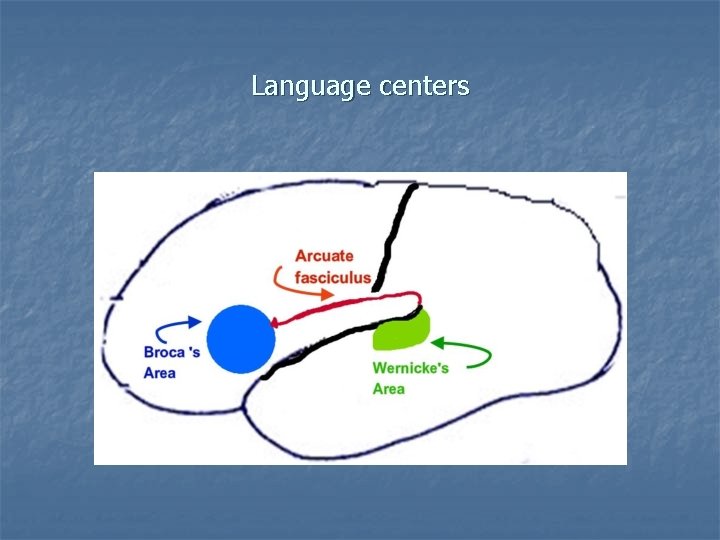
Language centers
Language centers Figure 19. 2 A
Network of areas involved in language Figure 19. 2 B

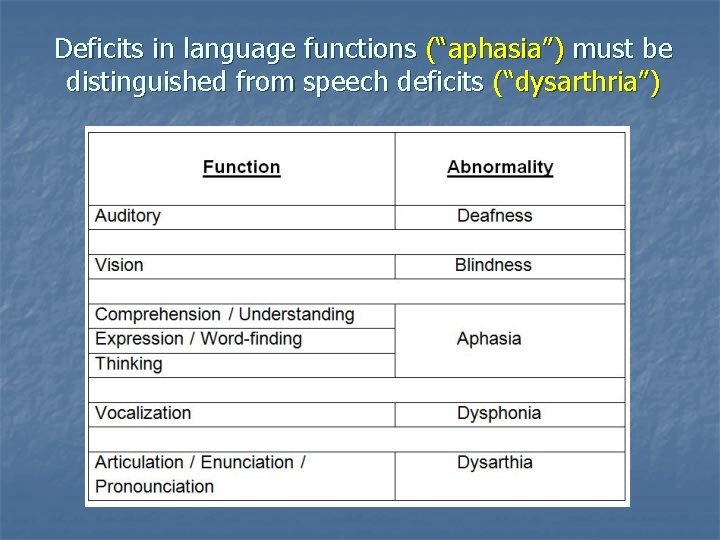
Deficits in language functions (“aphasia”) must be distinguished from speech deficits (“dysarthria”)
Dysarthria refers to problems in articulating speech. Dysarthria may result from lesions involving the brainstem and cerebellum: 1. CN V 3 (mandibular): jaw movement 2. CN VII: cheek muscles 3. CN IX/X: soft palate 4. CN XII: tongue movement 5. Cerebellum: coordinates all the movements.

language deficit = “aphasia” Broca’s aphasia = motor aphasia = expressive aphasia = non-fluent aphasia Wernike’s aphasia = sensory aphasia = receptive aphasia = fluent aphasia
Wernike’s aphasia (receptive, sensory, fluent aphasia) 1. comprehension: poor 2. speech: fluent, but meaningless a. normal or even excessively rapid rate of word production b. words are often difficult to recognize (1) wrong words (paraphrasia) (2) new words (neologism) c. repetition is abnormal
Broca’s aphasia (expressive, motor, non-fluent aphasia) 1. Comprehension: OK 2. Speech: non-fluent a. patient makes a great effort to speak b. speech produced is sparse in amount c. frequent pauses while patient searches for a word d. repetition is abnormal
Conductive aphasia Lesion of the connection between Wernike’s and Broca’s areas (arcuate fasciculus). Loss of repetition, with preservation of comprehension and output.
Transcortical sensory aphasia Similar to Wernike’s aphasia, but with preserved repetition. Lesion in middle temporal gyrus, inferior and posterior to Wernike’s area.
Transcortical motor aphasia Similar to Broca’s aphasia, but with preserved repetition. Lesion anterior to Broca’s area.
Global aphasia Lesion in both Wernike’s and Broca’s areas.
Aphasia flowchart
Classification of language disorders Figure 19. 4
Vascular territories of the language centers Figure 19. 3
Functions of the dominant & non-dominant hemispheres Table 19. 3
Right hemisphere functions 1. Being the non-dominant hemisphere for language, the right hemisphere isn’t involved with the words, but rather with the tones, cadences, and emphasis on words and syllables that contribute to conveying thoughts, or “prosody”; the emotion conveyed by tone of voice. 2. Musical activities (singing, playing musical instruments, recognition and appreciation of music). Some patients with severe aphasia associated with left hemisphere lesion retain the ability to sing. 3 -dimensional or spatial perception
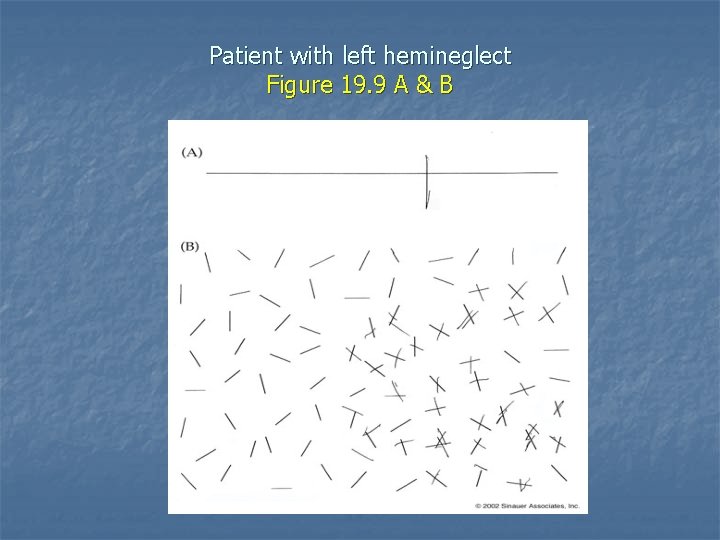
Patient with left hemineglect Figure 19. 9 A & B
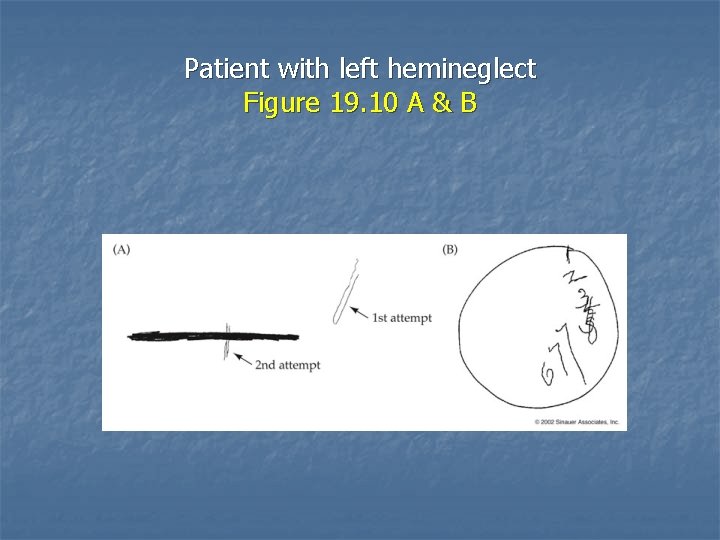
Patient with left hemineglect Figure 19. 10 A & B
- Slides: 28