
Mental Processing By Dayna Jones What Is It
Mental Processing By Dayna Jones
What Is It? ¢ Refers to cognitive skills such as memory, attention, and perception.
Thinking About Your Thinking l CONCENTRATION l DISTRACTIONS
Receptive ¢ Developmental Receptive Language Disorder ¢ Some people have trouble understanding certain aspects of speech. Listening is often referred to as being the receptive mode of oral language ¢ There's a toddler who doesn't respond to his name, a preschooler who hands you a bell when you asked for a ball, or a worker who consistently can't follow simple directions. Their hearing is fine, but they can't make sense of certain sounds, words, or sentences they hear. They may even seem inattentive. These people have a receptive language disorder.

Receptive Language Disorder ¢ Difficulties in the ability to attend to, process, comprehend, retain, or integrate spoken language.
Receptive : Causes, incidence, and risk factors ¢ The cause is unknown, but there may be genetic factors, and malnutrition may play a role. ¢ Three to five percent of all children have either receptive or expressive language disorder, or both. These children have difficulty understanding speech (language receptivity) and using language (language expression). ¢ Problems with receptive language skills usually begin before the age of 4. Some mixed language disorders are caused by brain injury and these are sometimes misdiagnosed as developmental disorders.
Receptive: Signs and Symptoms… ¢ ¢ ¢ Echolalia (repeating back words or phrases either immediately or at a later time. ) Inability to follow directions. (Following of routine, repetitive directions may be OK. ) Inappropriate, off-target responses to "wh" questions. Re-auditorization (repeating back a question first and then responding to it. Difficulty responding appropriately to: l l ¢ ¢ Yes/no questions either/or questions who/what/where questions when/why/how questions Not attending to spoken language High activity level and not attending to spoken language Jargon (sounds like "unintelligible speech") Using "memorized" phrases and sentences.
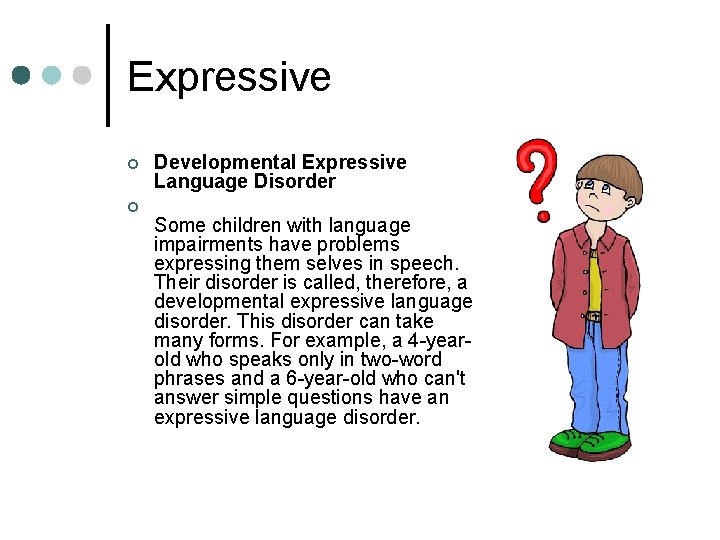
Expressive ¢ ¢ Developmental Expressive Language Disorder Some children with language impairments have problems expressing them selves in speech. Their disorder is called, therefore, a developmental expressive language disorder. This disorder can take many forms. For example, a 4 -yearold who speaks only in two-word phrases and a 6 -year-old who can't answer simple questions have an expressive language disorder.
Expressive: Causes, incidence, and risk factors ¢ Three to ten percent of all school age children have expressive language disorder. The cause of this disorder is unknown, and may vary in different cases. Cerebral damage and malnutrition may cause some cases -- perhaps in combination with genetic factors.
Expressive: Signs and Symptoms. . below average vocabulary skills ¢ improper use of correct tenses ¢ problems in the production of complex sentences ¢ problems in recalling words ¢
Mixed receptive-expressive language disorder ¢ a language disability which causes impairment of both the understanding and the expression of language
Signs and tests ¢ ¢ Standardized receptive and expressive language tests can be given to any child suspected of having this disorder. An audiogram should also be given to rule out the possibility of deafness, as it is one of the most common causes of language problems.
Resources http: //www. ldonline. org/abcs_info/ld_t ypes. html ¢ http: //www. nlm. nih. gov/medlineplus/e ncy/article/001545. htm ¢ http: //www. kidspeech. com/signs_rece pt. html ¢ http: //www. nlm. nih. gov/medlineplus/e ncy/article/001544. htm ¢
- Slides: 13