
Mental Health Services CONCEPTS PROCEDURES CREATED BY A

Mental Health Services CONCEPTS & PROCEDURES CREATED BY: A BERRYHILL HS 2, FALL 2016
Concepts & Procedures Mental health concepts & Psychoneurosis procedures we will discuss: Suicide Therapeutic Forms Physical restraints Chemical Reality communication restraints orientation Psychosis (Bipolar) (Phobia) prevention of therapy
Therapeutic Communication Process in which the nurse consciously influences a pt or helps the pt to a better understanding through verbal or nonverbal communication It involves the use of specific strategies that encourage the pt to express feelings and ideas and that convey acceptance and respect Many different techniques (Reflecting, Giving recognition, Placing he event in time or sequence)
Therapeutic Communication Other Therapeutic Communication Techniques include: Giving recognition=acknowledging, indicating awareness ("I notice you combed your hair. “) Offering self=making oneself available ("I'll sit with you awhile. “) Using Broad Opening=allows client to select the topic ("What would you like to talk about? “) (10 min) https: //www. youtube. com/watch? v=s 4 xb. G 2 LSDWw&ebc=ANy. Px. Krlui. W 2 Yf. FZOZC 1 V 5 VIEnon_2 KMahrr. JTY 38 a. PNr. E 9 hm. A 5 L 381 B 52 Gr. Wb. EXROh. EZ 4 Fu. Up. Ro. C 006 K_GS 6 -ac 6 PJwkws 9 g
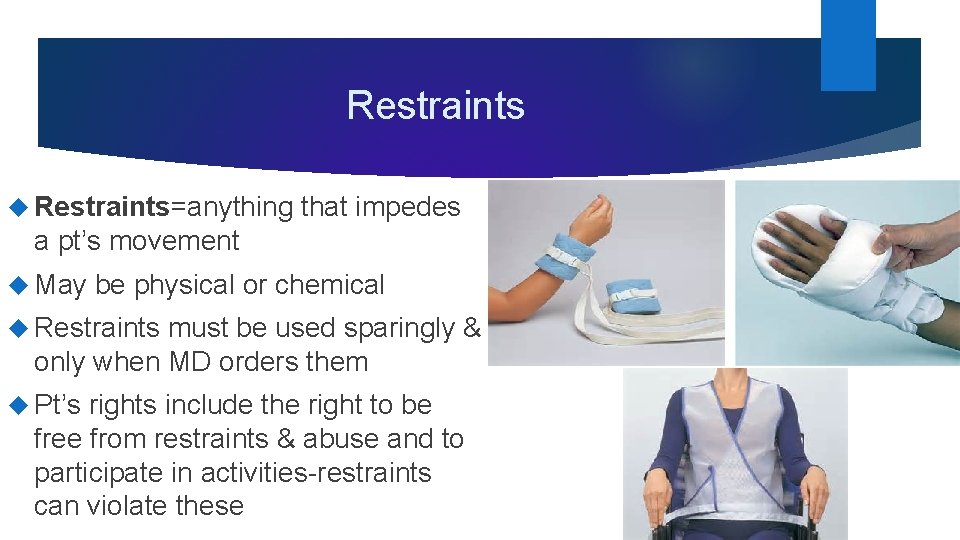
Restraints Restraints=anything that impedes a pt’s movement May be physical or chemical Restraints must be used sparingly & only when MD orders them Pt’s rights include the right to be free from restraints & abuse and to participate in activities-restraints can violate these
Physical Restraints Used to protect the pt or others from harm (prevent pt from falling OOB, falling while walking, scratching at wounds, pulling out IV’s, harming themselves or others) Should never be used as a punishment for behavior or for caregiver’s convenience Bedside rails can be considered restraints, use quarter side rails when appropriate Before restraining pt, all other methods of ensuring pt’s safety must be attempted (moving close to nurse’s station, 1: 1 observation) (1: 45) https: //www. youtube. com/watch? v=DDXNDdxbi. WM
Physical Restraints Safety rules: Use right size and type of restraint Ensure pt is in comfortable position after restraint is applied Check circulation below the restraint-notify supervisor with any problems (coolness, cyanosis) 2 fingers should be able to slide between the wrist/ankle & restraint Make sure pt can move the part that is restrained Make sure pt’s needs are taken care of while they are restrained
Physical Restraints Safety rules: Restraints Never Use must be loosened or taken off at least q 2 h tie restraint to side rail quick-release tie Never leave pt unattended or turn your back when restraints are temporarily removed Document all info concerning restraints
Chemical Restraints AKA medications used to calm pts who are agitated or anxious Physician Check Don’t must prescribe the medication the ID bracelet before administering leave the med at the bedside or assume the pt has swallowed it
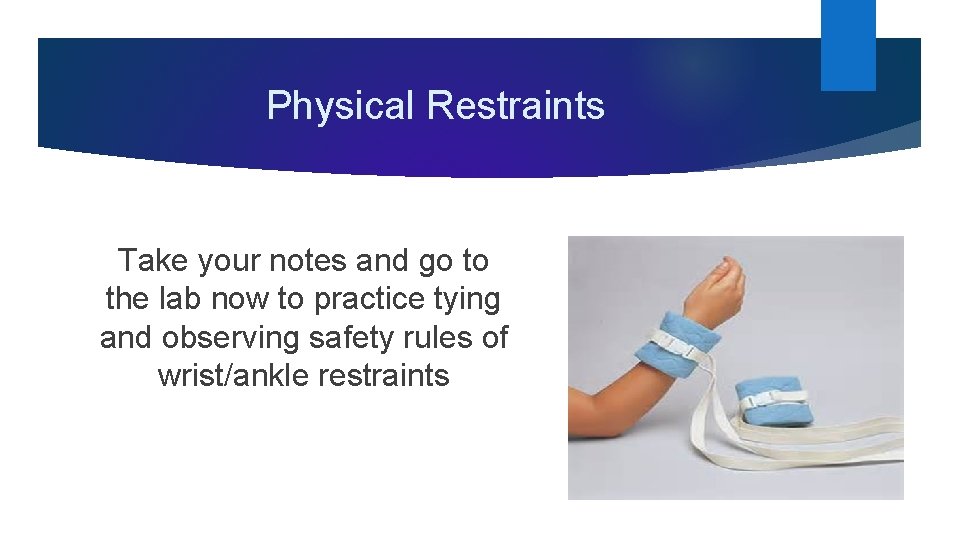
Physical Restraints Take your notes and go to the lab now to practice tying and observing safety rules of wrist/ankle restraints
Reality Orientation Reality orientation=helping pts to become aware of his or her surroundings, the date & time, & other pertinent info about their present situation Examples: calendars, color-coding areas, & clocks It can help pts who can become confused or unable to focus on what they are doing It can help pts who become lost & wander or have trouble following directions It can help pts who become confused due to Alzheimer’s, depression, illness, pain, dehydration, or new surroundings
Suicide Prevention (3: 47) https: //www. youtube. com/watch? v=3 BByqa 7 bhto Reach Out - Ask them directly if they are thinking about suicide. It needs to be a direct question that can’t be misinterpreted. "Are you thinking about suicide? " Most people with thoughts of suicide want to talk about it. They want to live – but desperately need someone to hear their pain and offer them help to keep safe. Don’t be afraid to ask them if they are thinking about suicide. This shows you care and they’re not alone.
Suicide Prevention Listen to them - Allow them to express their feelings. Let them do most of the talking. They will often feel a great sense of relief someone wants to talk to them about their darkest thoughts. Check their safety - If you are really worried don’t leave them alone. Remove any means of suicide including weapons, medications, drugs, alcohol, even access to a car. Get help by calling 911. You can also take them to the local hospital emergency department.
Suicide Prevention Decide what to do and take action - Talk about steps you can take together to keep them safe. Don’t agree to keep it a secret, you shouldn’t be the only one supporting this person. Ask for a promise - Thoughts of suicide may return, so ask them to promise to reach out and tell someone. Asking them to promise makes it more likely they will tell someone.
Suicide Prevention Get help - There are lots of services and people that can help and provide assistance. (doctor, Counsellor, psychologist, social worker, School Counsellor , Community Health Centers, Seek support from family and friends, youth group leader, sports coach, priest, minister or religious leader etc. ) In some situations they may refuse help and you can’t force them to get help. You need to ensure the appropriate people are aware of the situation. Don’t shoulder this responsibility yourself.
Forms of Therapy Cognitive Behavioral Therapy-helps pt learn to recognize negative patterns of thought, evaluate their validity, & replace them with healthier ways of thinking (4: 35) https: //www. youtube. com/watch? v=b. UOa. Hsxe 8 OQ Interpersonal Therapy-most often used on a one-on-one basis to treat depression; based on the idea that improving communication patterns & the ways people relate to others will effectively treat depression
Forms of Therapy Family-focused Therapy-includes family members in therapy sessions to improve family relationships, which may support better treatment results Play Therapy-used with children, involves the use of toys and games to help a child identify and talk about his or her feelings, as well as establish communication with a therapist.
Psychosis Psychotic disorders are severe mental disorders that cause abnormal thinking and perceptions. People with psychosis lose touch with reality. Two of the main symptoms are delusions and hallucinations. Delusions are false beliefs, such as thinking that someone is plotting against you or thinking that the TV is sending you secret messages Hallucinations are false perceptions, such as hearing, seeing, or feeling something that is not there (3: 01) https: //www. youtube. com/watch? v=_v. YQ 6 pb. Jt 2 k
Psychosis Treatment - depends on the cause of the psychosis. It might involve drugs to control symptoms and talk therapy. Hospitalization is an option for serious cases where a person might be dangerous to himself or others. Bipolar, Disorder & schizophrenia are psychotic disorders AKA manic-depressive illness, causes unusual shifts in mood, energy, activity levels, and the ability to carry out day-to-day tasks.
Psychoneurosis Psycho-neurotic disorders - refers to a class of mental disorders involving distress but not delusions or hallucinations (phobias & anxiety disorders) (11: 31) https: //www. youtube. com/watch? v=a. X 7 jn. VXXG 5 o Symptoms = anxiety and fear are common symptoms Treatment = varies depending on severity of the condition Psychoneurotic disorders can negatively affect a person's ability to function effectively in ADL’s, such as going to work and school, caring for family, and taking care of basic needs.
- Slides: 20