
Mental Health Nursing Self Concept Disorders By Mary
Mental Health Nursing: Self. Concept Disorders By Mary B. Knutson, RN, MS, FCP
A Definition of Self-concept n All notions, beliefs, and convictions that constitute an individual’s knowledge of self and influence relationships with others
Self-esteem is a person’s personal judgment of his or her own worth, based on how well behavior matches up with self-ideal n Threatened in adolescence when self-concepts change and selfdecisions made n Low self-esteem indicates selfrejection and self-hate (a conscious or unconscious process) expressed in direct or indirect ways n
Identity Diffusion- Failure to integrate various childhood identifications into a harmonious adult psychosocial identity n Personality Fusion- A person’s attempt to establish a sense of self by fusing with, attaching to, or belonging to someone else n
Depersonalization n A feeling of unreality and alienation from oneself n Subjective experience of the partial or total disruption of one’s ego n Disintegration and disorientation of one’s self-concept
Ego Defense Mechanisms Fantasy n Dissociation n Isolation n Projection n Displacement n Splitting n Turning anger against self n Acting out n
Developmental Influences Interpersonal and cultural experiences that generate positive feelings and a sense of worth n Perceived competence in areas valued by the individual and society n Self-actualization, or the implementation and realization of a person’s true potential n
Self-concept Development Gradual process beginning in infancy with self-differentiation n Influenced by: n Significant others n Cultural and socialization practices n Self-perceptions n
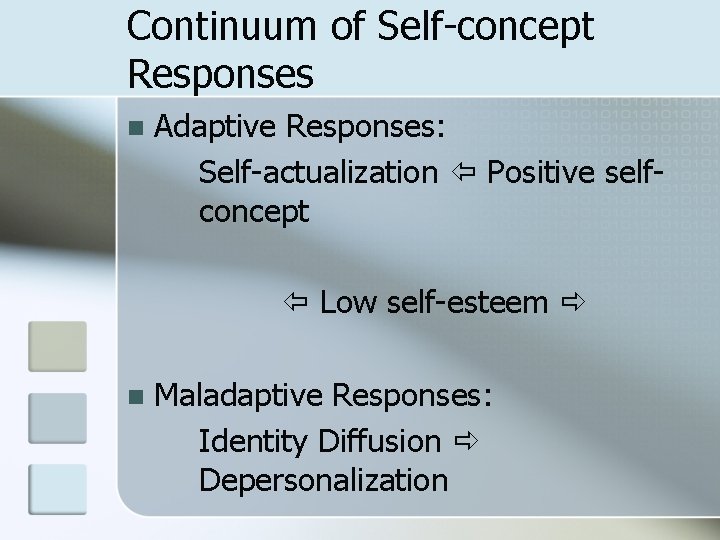
Continuum of Self-concept Responses n Adaptive Responses: Self-actualization Positive selfconcept Low self-esteem n Maladaptive Responses: Identity Diffusion Depersonalization
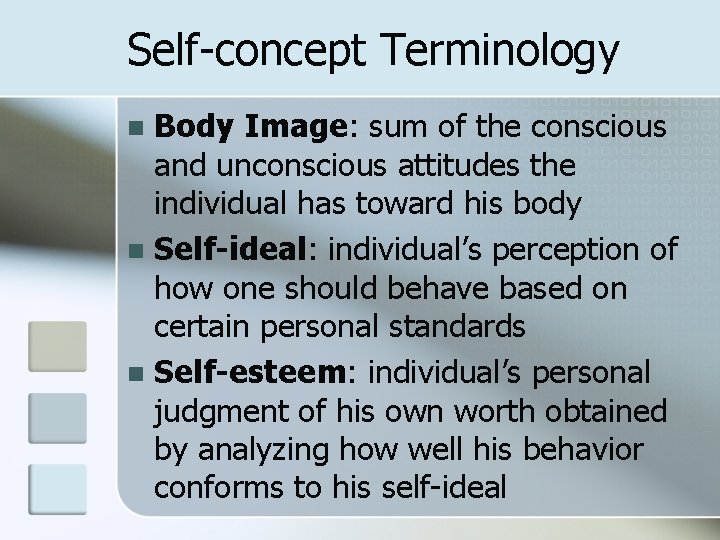
Self-concept Terminology Body Image: sum of the conscious and unconscious attitudes the individual has toward his body n Self-ideal: individual’s perception of how one should behave based on certain personal standards n Self-esteem: individual’s personal judgment of his own worth obtained by analyzing how well his behavior conforms to his self-ideal n
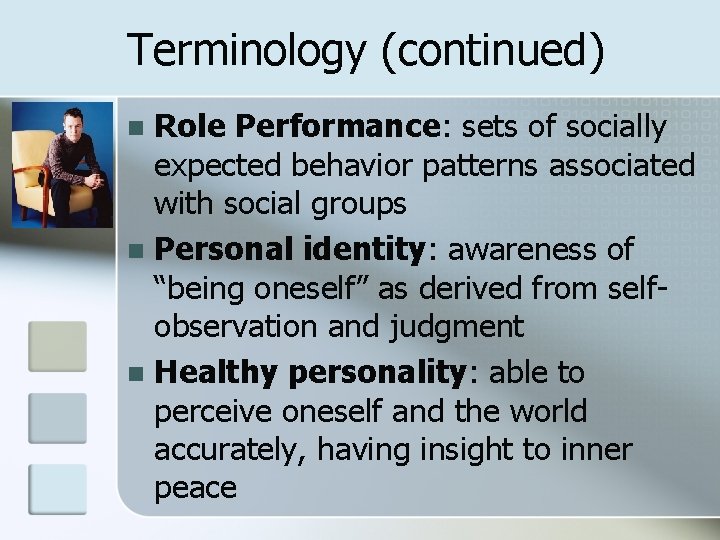
Terminology (continued) Role Performance: sets of socially expected behavior patterns associated with social groups n Personal identity: awareness of “being oneself” as derived from selfobservation and judgment n Healthy personality: able to perceive oneself and the world accurately, having insight to inner peace n
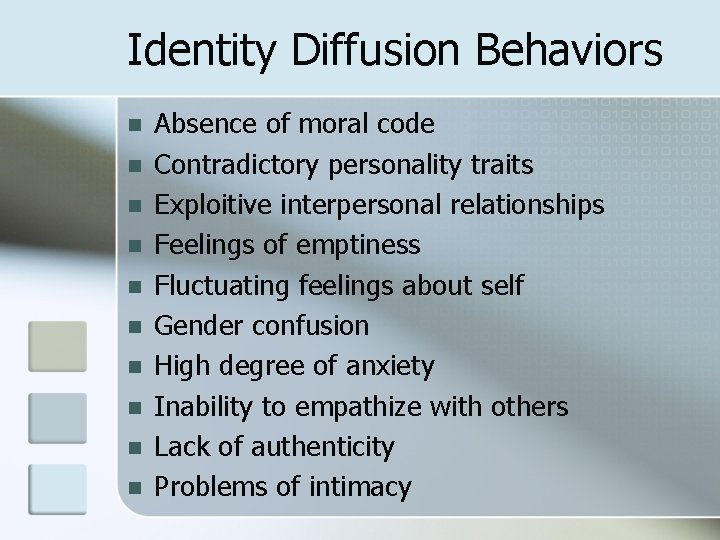
Identity Diffusion Behaviors n n n n n Absence of moral code Contradictory personality traits Exploitive interpersonal relationships Feelings of emptiness Fluctuating feelings about self Gender confusion High degree of anxiety Inability to empathize with others Lack of authenticity Problems of intimacy
Nursing Care Self-concept is intimately related to states of anxiety and depression, problems in relationships, acting out, and self-destructive behavior n Maladaptive responses to integrity of self-system can be seen in all nursing settings n
Predisposing Factors Response to parents’ self-hate n Parental rejection, internalization of failure n Unrealistic self-ideals n Role strain, ambiguity, work or sexual role conflict n Precipitating stressors include emotional trauma n Role strain –developmental, situational, or health-illness transitions n
Alleviating Factors Sports or outdoor activities, hobbies and crafts, expressive arts, health and self-care, education or training, work, vocation, job, or position, special aptitudes, intelligence, imagination and creativity, and interpersonal relationships n Social supports to point out positive aspects of individual, and increase self -awareness n
Medical Diagnosis Identity problem n Dissociative amnesia n Dissociative fugue n Dissociative identity disorder (multiple personality disorder) n Depersonalization disorder n
Nursing Care Assess subjective and objective responses n Assessment begins with observing pt’s appearance, eating, sleeping, and hygiene habits n Compare pt responses to questions with his/her behavior and affective response n Recognize defense mechanisms n
n People with negative self-concepts believe their illnesses have a greater negative impact on their lives, less hope for the future, and are more anxious about their illness
Examples: Nursing Diagnosis n n Body image disturbance related to CVA as e/b not accepting of body limitations Self-esteem disturbance r/t overly high ideals e/b depressed mood and withdrawal from activities Role performance, altered r/t incongruency of cultural and self-role expectations about aging e/b self-criticism and frustration Personal identity disturbance r/t drug toxicity e/b confusion and loss of impulse control
Implementation n n Establish an open, trusting relationship Work with pt’s ego strength as it is participation in therapeutic process May need interventions relating to anxiety as well
Nursing Interventions n n n Level 1 - Expanded self-awareness (using accepting attitude and activity) Level 2 - Self-exploration (examine feelings, behavior, beliefs, and current stressful situation) n Respond with empathy, not sympathy n Group or family therapy can be helpful Level 3 - Self-evaluation of faulty perceptions (exploring solutions and goals) Level 4 - Realistic planning Level 5 - Commitment to action
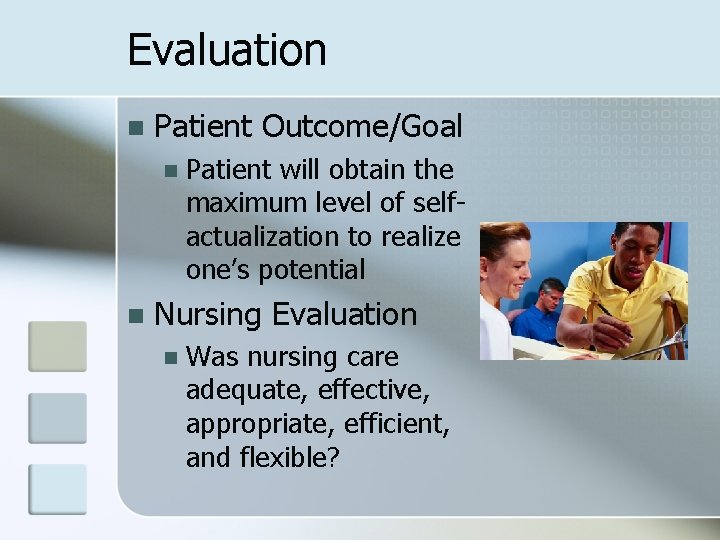
Evaluation n Patient Outcome/Goal n n Patient will obtain the maximum level of selfactualization to realize one’s potential Nursing Evaluation n Was nursing care adequate, effective, appropriate, efficient, and flexible?
References n Stuart, G. & Laraia, M. (2005). Principles & practice of psychiatric nursing (8 th Ed. ). St. Louis: Elsevier Mosby n Stuart, G. & Sundeen, S. (1995). Principles & practice of psychiatric nursing (5 th Ed. ). St. Louis: Mosby
- Slides: 23