
Mental Health First Aid MHFA England 2016 MHFA


- Slides: 13
Mental Health First Aid MHFA England™ © 2016 MHFA. All rights reserved.
Aims of MHFA 2 To preserve life where a person may be at risk of harm to themselves or others To provide help to prevent the mental health issue from becoming more serious before professional help arrives To promote the recovery of good mental health To provide comfort to a person with a mental health issue To raise awareness of mental health issues in the community To reduce stigma and discrimination To improve own health and wellbeing
Why Mental Health First Aid? - Mental health issues are common - We discriminate against people with mental ill health - We are not well informed about mental health or mental ill health - We may lack the insight to realise that we need help or that help is available - Professional help is not always on hand - The majority of us don’t know how to respond 3
Mental health issues are common. - 676 million people are affected by mental health issues worldwide - Mental illness is the largest single source of burden of disease in the UK. No other health condition matches mental illness in the combined extent of prevalence, persistence and breadth of impact 4
Mental health and perceptions - The public believe that people with a mental health issue are likely to be violent. - People with severe mental illness are more likely to be the victims, rather than the perpetrators of violent crime - Poor mental health impacts on individuals and their families in lost income, lower educational attainment, quality of life and a much shorter life span. 5
Mental Health Diagnoses. WHAT DO YOU KNOW? Activity 1 6
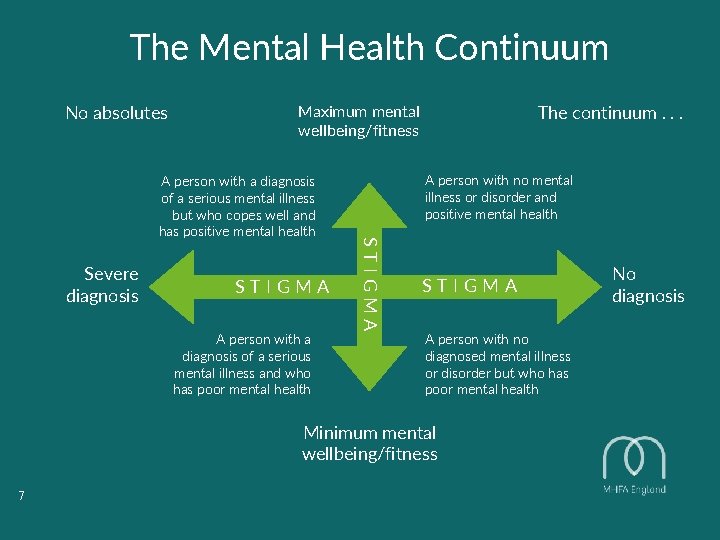
The Mental Health Continuum No absolutes Maximum mental wellbeing/fitness Severe diagnosis STIGMA A person with a diagnosis of a serious mental illness and who has poor mental health A person with no mental illness or disorder and positive mental health STIGMA A person with a diagnosis of a serious mental illness but who copes well and has positive mental health The continuum. . . STIGMA A person with no diagnosed mental illness or disorder but who has poor mental health Minimum mental wellbeing/fitness 7 No diagnosis
How to risk assess Opening the session. Setting expectations and assessing what the current mental state is. • • How are you? How are you feeling today? How do you feel your current mental health is today? How are you coping with life at the moment? THEN REALLY LISTEN TO THE OUTCOME – Can you move forward? ACTIVITY 2 - WHAT ARE THE POSSIBLE ANSWERS TO THE ABOVE QUESTIONS AND WHAT CAN WE DO ABOUT IT? 8
“Talking to somebody and having them truly listen is an extremely powerful connection that not only encourages openness and expression but also allows for a trust to develop. This in itself could be key in helping a person to make positive steps towards decisions and processes which could have an enormous impact on a their life” Miss G Bruce – Approved Mental Health Professional (AMHP) and Social Worker - NHS Trust Hertfordshire 9
A LESSON IN LISTENING……… 10
CRISIS? Main crises associated with anxiety are panic attacks and experiences of a traumatic event. First Aid for Panic Attack What are the possible signs and symptoms? Heart Attack? Slow breathing? History? What worked before? 11
CRISIS continued… Main crises associated with anxiety are panic attacks and experiences of a traumatic event. First Aid for Traumatic Event – HOW CAN I SUPPORT? - Do not force them to tell their story – You are not a therapist. - They may wish to repeatedly talk about the trauma. You need to listen. - Avoid trivialising a persons feeling i. e. ‘don’t cry’, ‘calm down’ or ‘It could be worse’ – Survivors guilt is a real experience. - Encourage a person to take care of themselves - Discourage use of alcohol or other drugs or any other self destructive behaviour. 12
Signposting and support planning Build a comprehensive list of local services that a person can access either face to face or by phone - 111 and option 2 for mental health crisis support in Cambs and Peterborough - CPSL Mind – Support to recovery program and a page dedicated to Helplines and information links - Riverside – Cambs Mental Health Community Support – Not already supported by NHS services - Samaritans – 116 123 available 24 hours a day See Support planning handout 13