
Mental Health Employment the Disability Discrimination Act 1995
Mental Health & Employment & the Disability Discrimination Act 1995 presenter: Ciaran Trainor, Equality Commission date: 8 December 2020
Good Mental Health “A state of wellbeing in which every individual realises his or her own potential, can cope with the normal stresses of life, can work productively and fruitfully and is able to make a contribution to her or his community. ” World Health Organisation
• Around 15% of those in work in England have symptoms of a mental health problem • Individuals with long-term mental health conditions are far less likely to be in work than o those without any health conditions, or o those with a physical health condition Source: Thriving at Work: the Stevenson / Farmer Review of mental health and employers, October 2017 www. mentalhealthatwork. org. uk/resource
• mental health is one of the greatest causes of sickness absence in the UK • while the overall rate of sickness absence has fallen by 15%-20% since 2009, absence due to mental health reasons in this period has actually risen by around 5% • people with a mental health condition are also three times more likely to have a long term period of sickness • those with a long-term mental health condition lose their jobs every year at around double the rate of those o without a mental health condition and o at a much higher rate than those with a physical health condition Source: Thriving at Work: the Stevenson / Farmer Review of mental health and employers. October 2017 www. mentalhealthatwork. org. uk/resource
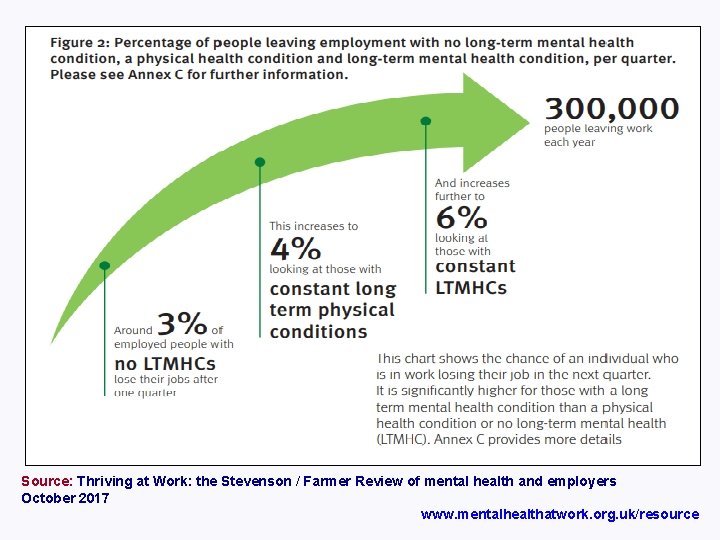
Source: Thriving at Work: the Stevenson / Farmer Review of mental health and employers October 2017 www. mentalhealthatwork. org. uk/resource
WHO IS DISABLED ?
WHO IS DISABLED? Definitely ! People who have (or had) • • cancer multiple sclerosis HIV infection severe disfigurements
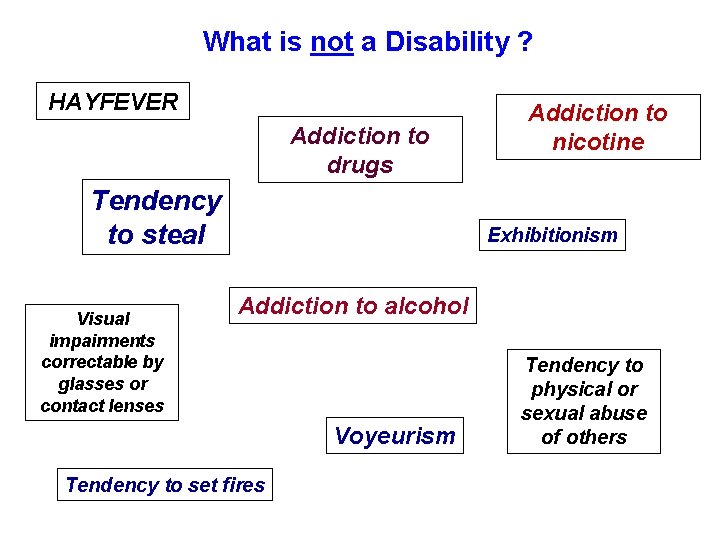
What is not a Disability ? HAYFEVER Addiction to drugs Tendency to steal Visual impairments correctable by glasses or contact lenses Addiction to nicotine Exhibitionism Addiction to alcohol Voyeurism Tendency to set fires Tendency to physical or sexual abuse of others
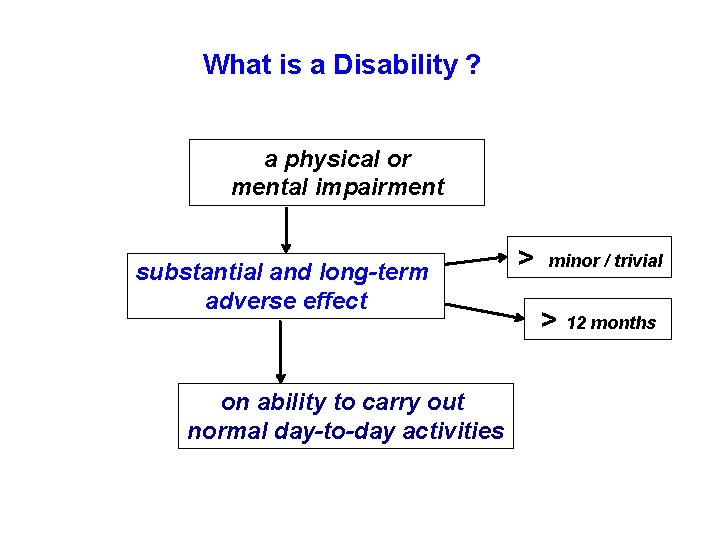
What is a Disability ? a physical or mental impairment substantial and long-term adverse effect on ability to carry out normal day-to-day activities > minor / trivial > 12 months
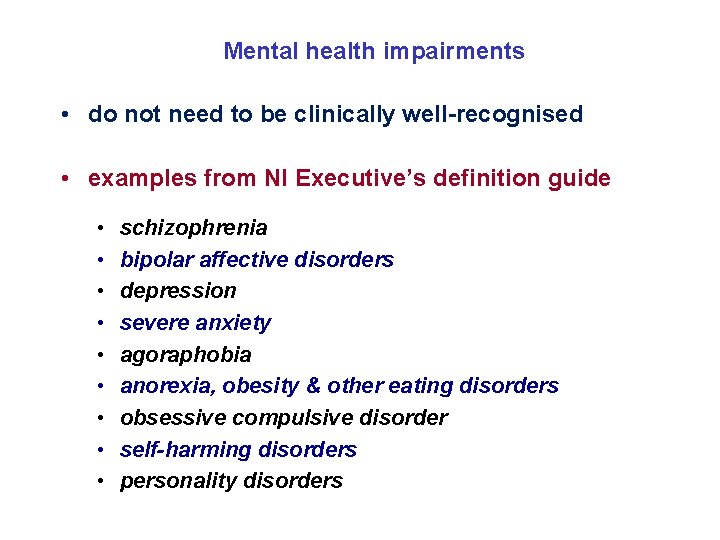
Mental health impairments • do not need to be clinically well-recognised • examples from NI Executive’s definition guide • • • schizophrenia bipolar affective disorders depression severe anxiety agoraphobia anorexia, obesity & other eating disorders obsessive compulsive disorder self-harming disorders personality disorders
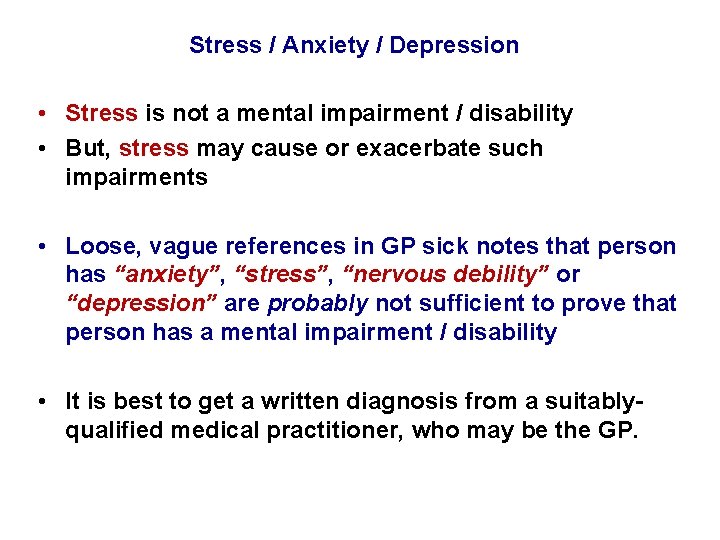
Stress / Anxiety / Depression • Stress is not a mental impairment / disability • But, stress may cause or exacerbate such impairments • Loose, vague references in GP sick notes that person has “anxiety”, “stress”, “nervous debility” or “depression” are probably not sufficient to prove that person has a mental impairment / disability • It is best to get a written diagnosis from a suitablyqualified medical practitioner, who may be the GP.
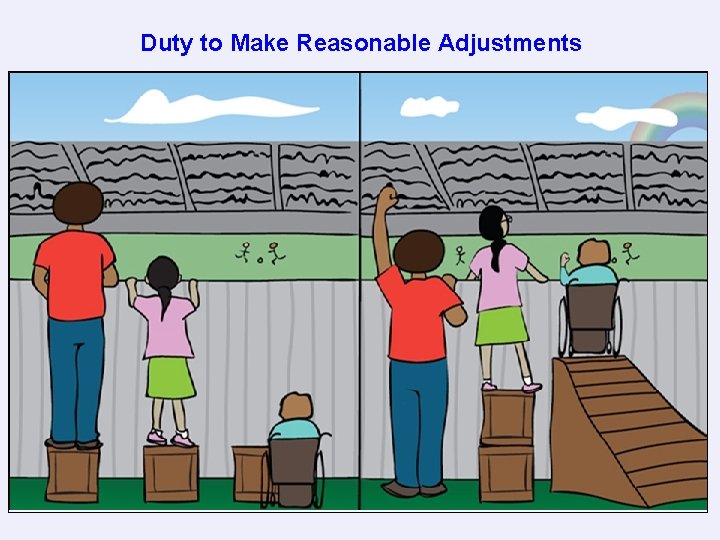
Duty to Make Reasonable Adjustments
![City of York Council –v- Grosset [2018] • Teacher (Head of English dept) with](http://slidetodoc.com/presentation_image_h2/a24157ad5f4e21fbe58efee11b641075/image-14.jpg "City of York Council –v- Grosset [2018] • Teacher (Head of English dept) with")
City of York Council –v- Grosset [2018] • Teacher (Head of English dept) with cystic fibrosis: needed adjustments to help reduce his workload and work-related stress. Employer initially made these, but later a new principal removed them, not believing that they were needed • As a result of those failures, his workload and his stress levels increased significantly. As a result of that, he committed an act of gross misconduct – he showed an 18 -rated film to a class of 15 year olds [the horror movie “Halloween”] • He was dismissed and sued for disability discrimination and unfair dismissal and won! English Court of Appeal upheld that finding. “A particularly strong factor underlying the [finding that the dismissal was unjustified] was [the] unchallenged assessment that if [the relevant reasonable adjustments had been made], he would not have been subjected to the same level of stress…and it would have been “unlikely in the extreme” that the incident of the film would have occurred. ”

Employer should not penalise an employee for his own failure to comply with the Reasonable Adjustment Duty • where the employee’s behaviour (absences or poor performance) are attributable to the employer’s failure to make reasonable adjustments • the employer should be very slow and careful about • taking disciplinary action, or • subjecting the employee to any other detriment • e. g. reducing sick pay
Knowledge of Disability To trigger the reasonable adjustment duty, it is necessary to show that the employer knew that the job applicant or employee is disabled and suffering the alleged disadvantage. ________________________ Knowledge may be- • actual • constructive / imputed • where the employer may not actually know but can be deemed to know because he had sufficient information from which he could reasonably have concluded that the employee is disabled and suffering a disadvantage
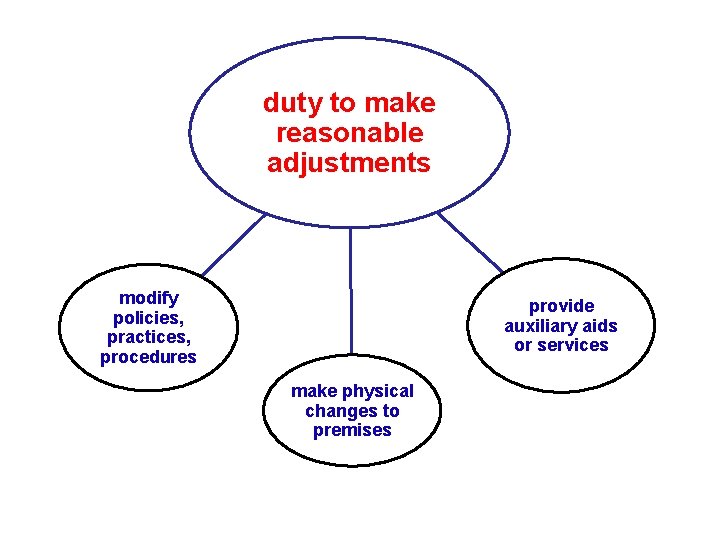
duty to make reasonable adjustments modify policies, practices, procedures provide auxiliary aids or services make physical changes to premises
adjustments to policies / practices / procedures • allocating some of his/her duties to another person • transferring him/her to an existing vacancy • changing the place of work or training • allowing him/her time off to receive medical treatment, assessment or rehabilitation • modifying procedures for testing or assessment • altering the hours of work or training
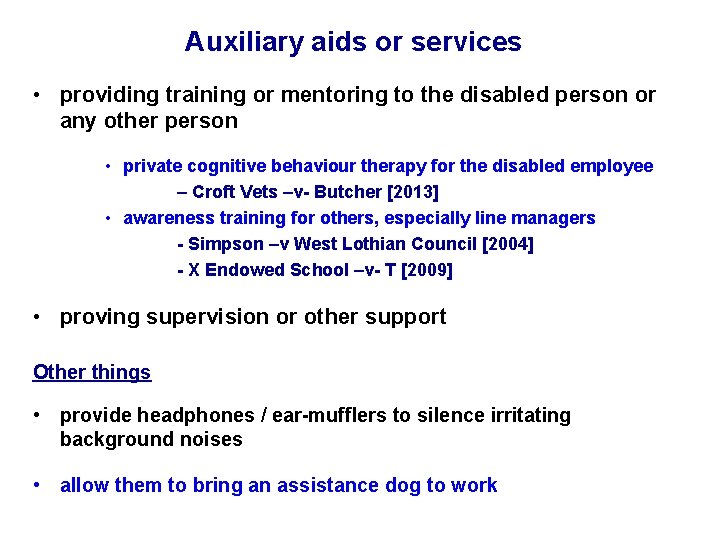
Auxiliary aids or services • providing training or mentoring to the disabled person or any other person • private cognitive behaviour therapy for the disabled employee – Croft Vets –v- Butcher [2013] • awareness training for others, especially line managers - Simpson –v West Lothian Council [2004] - X Endowed School –v- T [2009] • proving supervision or other support Other things • provide headphones / ear-mufflers to silence irritating background noises • allow them to bring an assistance dog to work
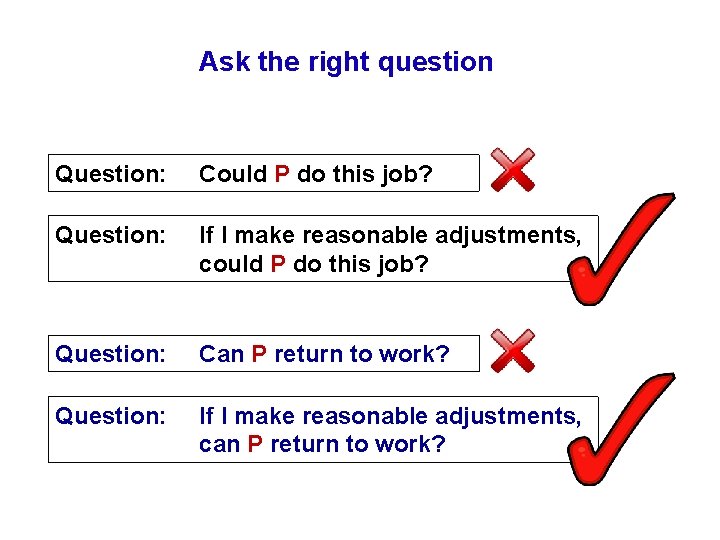
Ask the right question Question: Could P do this job? Question: If I make reasonable adjustments, could P do this job? Question: Can P return to work? Question: If I make reasonable adjustments, can P return to work?
![Gardner -v- West Yorkshire Police [2014] • Police Constable – disabled due to anxiety](http://slidetodoc.com/presentation_image_h2/a24157ad5f4e21fbe58efee11b641075/image-21.jpg "Gardner -v- West Yorkshire Police [2014] • Police Constable – disabled due to anxiety")
Gardner -v- West Yorkshire Police [2014] • Police Constable – disabled due to anxiety • attended a return-to-work interview with his Sergeant after a 6 weeks absence to illness • the Sergeant noted that the man’s absence was because he “went a bit doolally” • he also made a reference to the film One Flew Over the Cuckoo’s Nest • these caused the man to feel uncomfortable and awkward as he perceived them to be derogatory about his illness • an employment tribunal ruled that this amounted to disability -related harassment
![Wickers -v- Colchester Visionplus Ltd [2016] • Optician’s Assistant – disabled due to depression](http://slidetodoc.com/presentation_image_h2/a24157ad5f4e21fbe58efee11b641075/image-22.jpg "Wickers -v- Colchester Visionplus Ltd [2016] • Optician’s Assistant – disabled due to depression")
Wickers -v- Colchester Visionplus Ltd [2016] • Optician’s Assistant – disabled due to depression • she was often late for work and sometimes failed to comply with the firm’s absence notification procedure • she eventually resigned when informed that she was to be disciplined • she had tried to explain to her manager that the cause of these incidents was that she was struggling with depression and was on medication • he responded that he had “no sympathy for this kind of thing” and added “you just have to pull yourself together” • an employment tribunal ruled that these comments amounted to disability-related harassment
When are adjustments reasonable ?
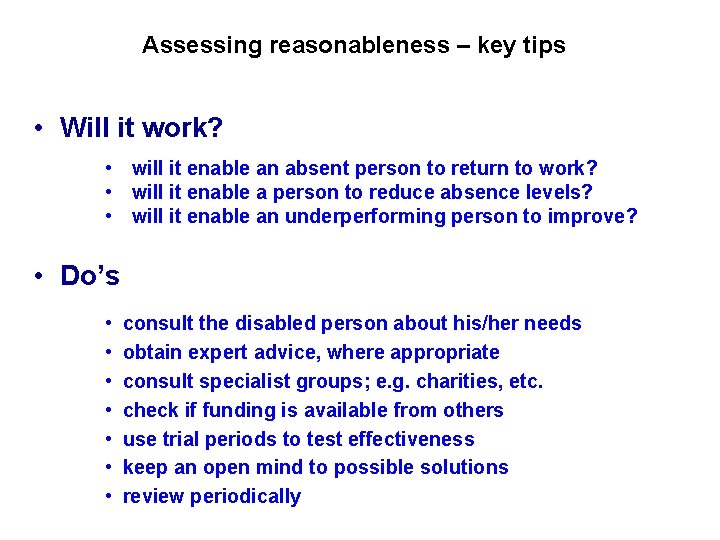
Assessing reasonableness – key tips • Will it work? • will it enable an absent person to return to work? • will it enable a person to reduce absence levels? • will it enable an underperforming person to improve? • Do’s • • consult the disabled person about his/her needs obtain expert advice, where appropriate consult specialist groups; e. g. charities, etc. check if funding is available from others use trial periods to test effectiveness keep an open mind to possible solutions review periodically
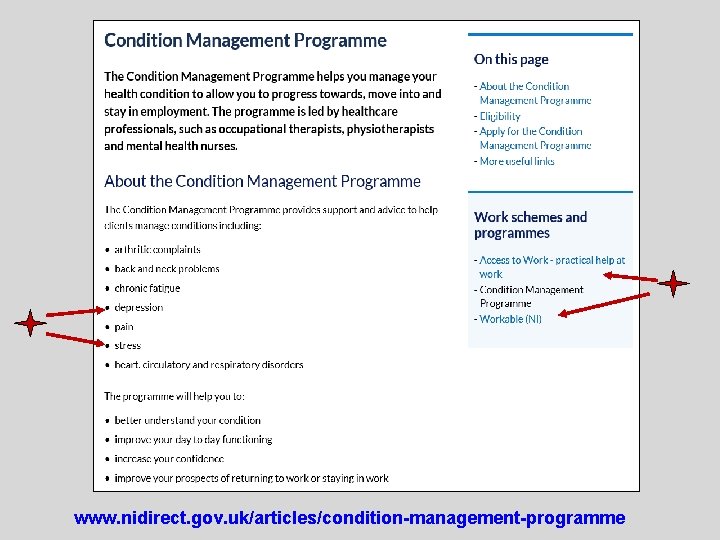
www. nidirect. gov. uk/articles/condition-management-programme
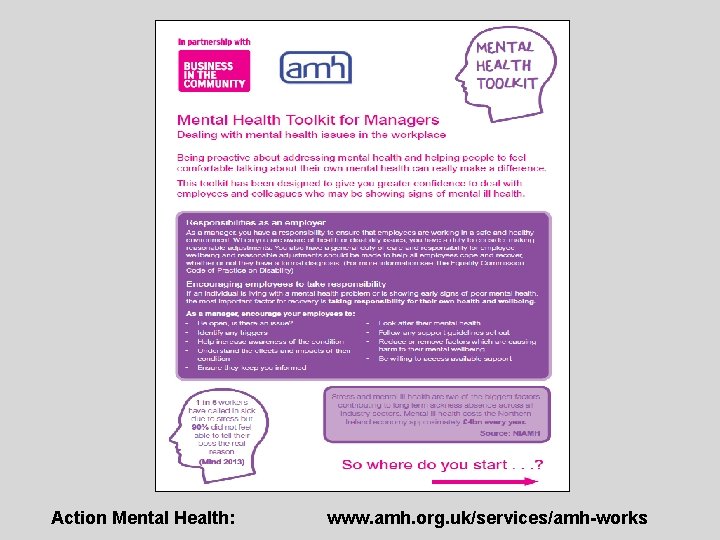
Action Mental Health: www. amh. org. uk/services/amh-works

Change your Mind www. changeyourmindni. org/ “Approximately 1 in 5 people in Northern Ireland will experience a problem with their mental health at some stage in life. ”
Trades Union Congress www. tuc. org. uk/resource/mental-health-and-workplace

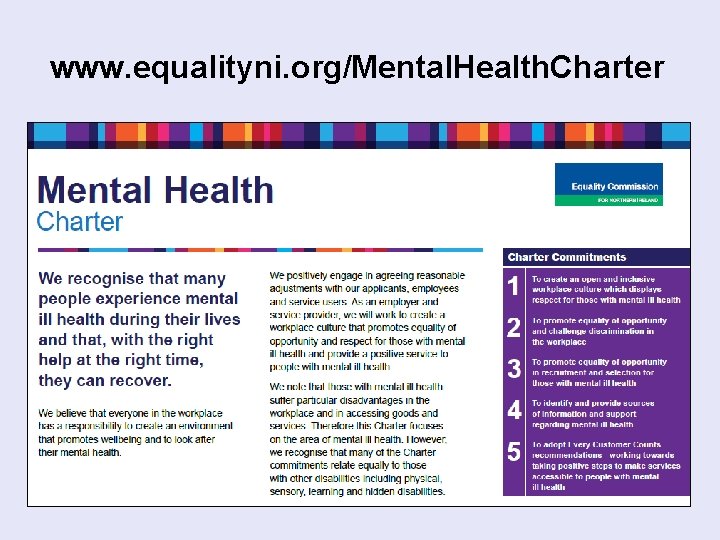
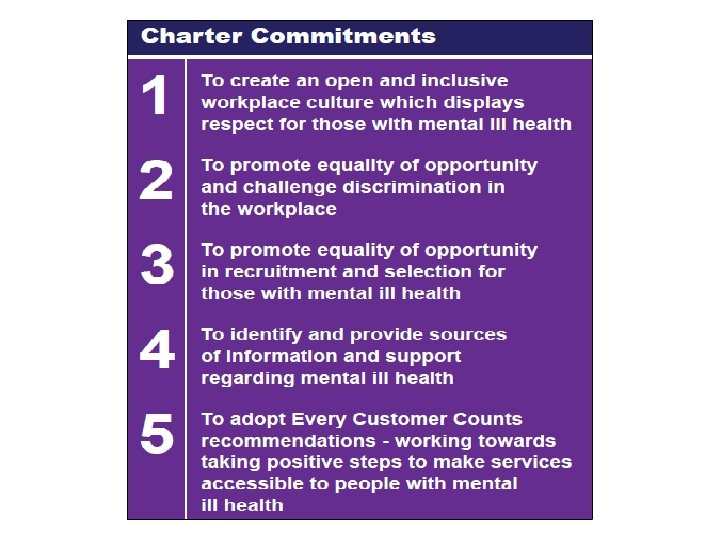
www. equalityni. org/Mental. Health. Charter
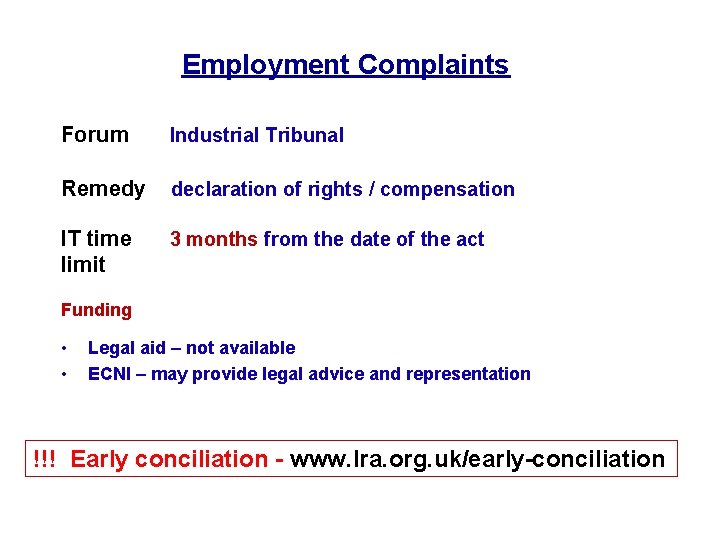
Employment Complaints Forum Industrial Tribunal Remedy declaration of rights / compensation IT time limit 3 months from the date of the act Funding • • Legal aid – not available ECNI – may provide legal advice and representation !!! Early conciliation - www. lra. org. uk/early-conciliation
- Slides: 33