
Mental Health By Eman Ramadan Ghazawy Mental Health
Mental Health By Eman Ramadan Ghazawy
Mental Health All of us have mental health and, like our bodies, our minds can become unwell. 1 in 10 young people will experience a mental health problem. These include depression, anxiety disorder, eating disorders, psychosis or bipolar disorder. It’s important to talk about mental health and get help early if things don’t feel right, just like we would for our physical health.
Time to Change No one should feel ashamed about having a mental health problem, they wouldn’t if they had a broken leg. Mental illness occurs in all societies and cultures
We are all vulnerable 4
Definition of mental health "The capacity to live a full, productive life as well as the flexibility to deal with its ups and downs. In children and young people it is especially about the capacity to learn, enjoy friendships, to meet challenges, to develop talents and capabilities. ” Mental health can be defined as a state of well-being enabling individuals to realize their abilities, cope with normal stresses of life, work productively and fruitfully, and make contribution to their communities Source: WHO; Young Minds 1999
Domains of Mental Health Emotional well-being: perceived life satisfaction, happiness and peacefulness � Psychological well-being: self-acceptance, control of ons environment, positive relationships �Social well-being: acceptance: beliefs in the potential of people and society as a whole, personal self-worth and usefulness to society and sense of community
The magnitude and burdens of mental disorders "Contrary to general belief, mental disorders are not rare. WHO estimates that about 450 million people in the world suffer some form of mental disorder, that one in every four families has at least one member with a mental or behavioral disorder and that one in every four people is likely to develop a mental disorder at some point in his or her lifetime
What is Mental Health? ? Mental health refers to the maintenance of activity. successful mental q This includes maintaining productive daily maintaining fulfilling relationships with others. activities and q It also includes maintaining the abilities to adapt to change and to cope with stresses.
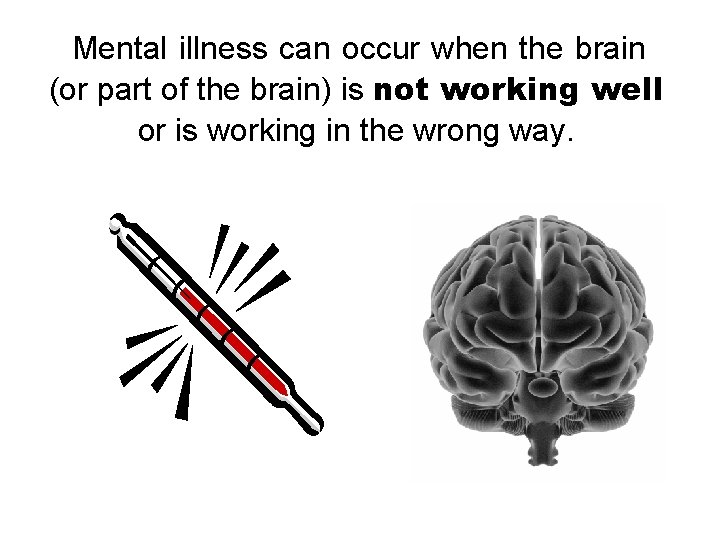
Mental illness can occur when the brain (or part of the brain) is not working well or is working in the wrong way.
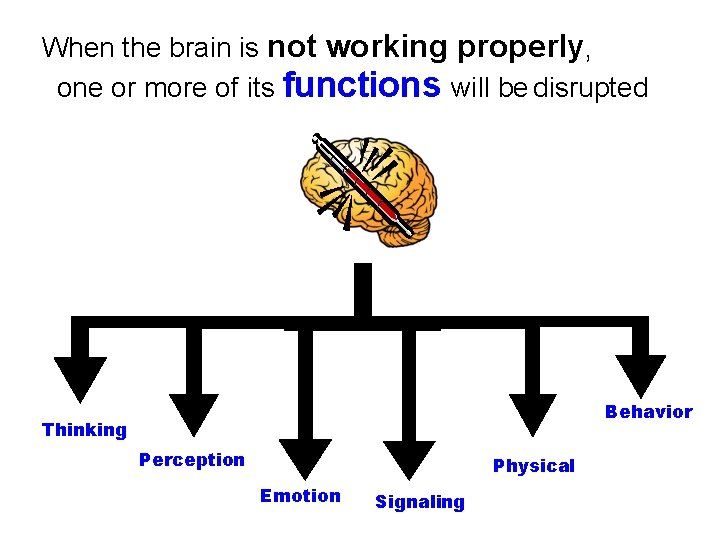
When the brain is not working properly, one or more of its functions will be disrupted Behavior Thinking Perception Physical Emotion Signaling
When these symptoms significantly disrupt a person’s life, we say that the person has a mental disorder or mental illness.
What causes mental illness? There is no single cause for mental illness. Multiple social, psychological, and biological factors determine the level of mental health of a person at any point of time. A number of factors can contribute to risk for mental illness, such as • Early adverse life experiences, such as trauma or a history of abuse (for example, child abuse, sexual assault, witnessing violence, etc. ) • Experiences related to other ongoing (chronic) medical condition, such as cancer or diabetes. • Biological factors, such as genes or chemical imbalances in the brain • Use of alcohol or recreational drugs • Having feeling of loneliness or isolation
Mental Health Services in Egypt There a number of challenges in the area of mental health and psychiatric services in Egypt. Most resources are allocated to a few large centralized psychiatric hospitals. However, the number of beds available for psychiatric patients is still inadequate for provision of acute inpatient care, particularly as 60% of the beds are occupied by long stay patients. The number of hours given for training in mental health in medical schools and other health training institutions is limited and does not reflect the importance of this field as a contributor to morbidity.
Mental Health Program Aim to Promote mental health in the community. 2) Maintain -if possible- the mentally ill within the community. 3) Avoid unnecessary admission and restraint in special hospitals. 4) Provide social therapy. 1)
Mental Health Program Although etiological causation of mental illness can hardly be avoided, the field of action for prevention includes Ø Protection of the very young, through promotion of family life. Ø Prevention of social stress and insecurity. Ø Protection of the aged; who may suffer from cerebral degeneration, depression and or psychopathic states. Ø Prevention of brain damage e. g. control of syphilis and alcoholism. Ø Public education in mental hygiene. Ø Pre-marital consultations and medical examinations. Ø Provision of suitable institutions for the care and after care of the mentally ill. Ø Legislation as regards drug abuse, compulsory admission to residential hospitals and guardianship. Ø Rehabilitation

- Slides: 16