
Mental Health Awareness By the end of the
Mental Health Awareness
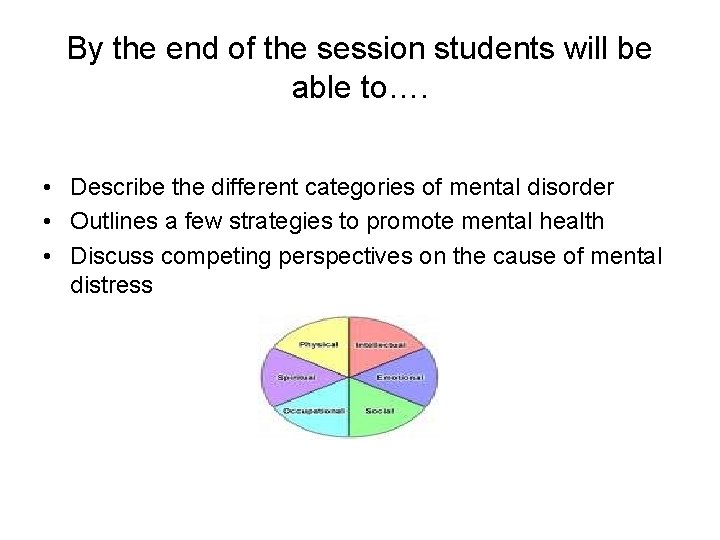
By the end of the session students will be able to…. • Describe the different categories of mental disorder • Outlines a few strategies to promote mental health • Discuss competing perspectives on the cause of mental distress
Small group exercise 1. Have a short discussion about how you would define the term ‘mental illness’. 2. What you feel to be the causes of psychological distress. You may wish to think about a client you’ve worked with or even a family member. Make list of your findings.
How we perceive mental illness Mental health (wellness) (Illness) Mental Ill health
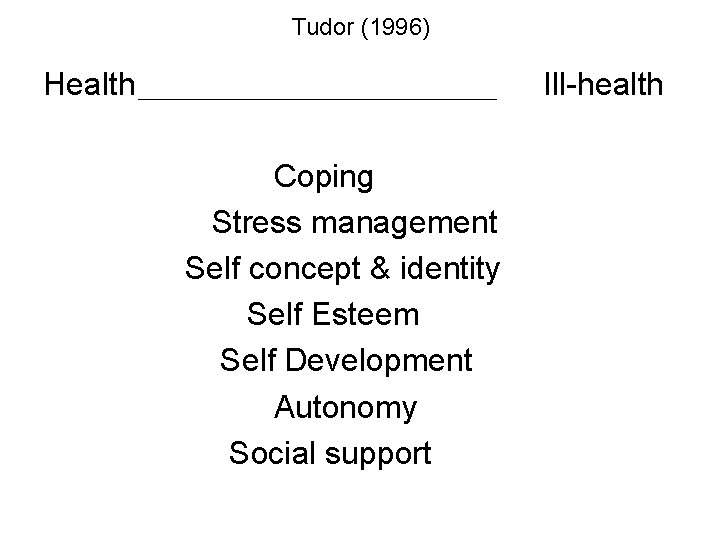
Tudor (1996) Health Ill-health Coping Stress management Self concept & identity Self Esteem Self Development Autonomy Social support
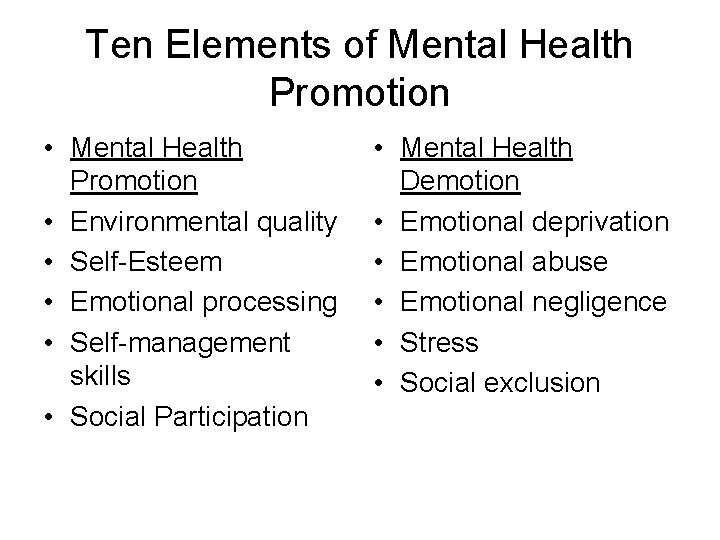
Ten Elements of Mental Health Promotion • Environmental quality • Self-Esteem • Emotional processing • Self-management skills • Social Participation • Mental Health Demotion • Emotional deprivation • Emotional abuse • Emotional negligence • Stress • Social exclusion
Which mental illness is most common? • Depression with anxiety affects 9. 2% of the population • 1 in 20 experience severe depression
How common are mental health problems? • One in four people will experience mental health problems in their lifetime • In every year 300 people per 1000 experience a mental health problem.
Group exercise • Write down five factors that help you cope with the stress of life. • How might you feel if you couldn’t rely on these strategies?
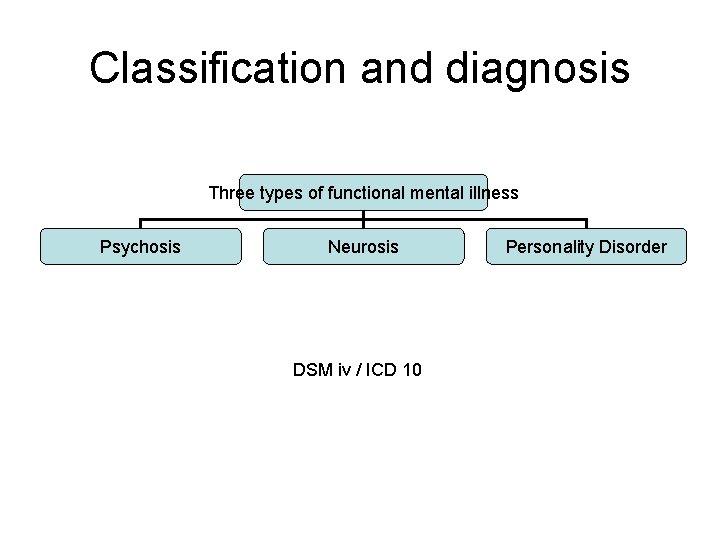
Classification and diagnosis Three types of functional mental illness Psychosis Neurosis DSM iv / ICD 10 Personality Disorder
Psychotic Scale • Otherwise referred to as severe and enduring mental illness • Psychosis • Bi polar illness • Severe depression
Neurotic scale • • • Generalized anxiety disorder Obsessive compulsive disorder (OCD) Post traumatic stress disorder Specific phobia Agoraphobia • http: //www. youtube. com/watch? v=Qm 8 sp. ZG 8 d. Ac& feature=related
Organic Mental Illness • Alzheimer's • Vascular Dementia • Acquired Brain Injury • http: //www. youtube. com/watch? v=7 wb. YE K 7 O 14 E
Violence and Mental Health • In 1996 – 46% of all national press coverage linked mental health to violence and criminality • In fact only 8% of homicides are committed by people with mental illness • 100 times more likely to kill themselves than another person. • The link is constantly being made between mental illness and dangerous or unpredictable behaviour.
Stigma and mental health • 2/3 of organisations setting up facilities said they faced resistance from the community • Concerns were: • 1. Fear for children’s safety • 2. Fear of violence • Concerns usually dissipate once services are up and running
Victimisation • Kelly & Mc. Kenna (1997) – surveyed one hundred people with mental health problems: • 15 had stones thrown at windows • 14 were verbally abused • 5 had offensive graffiti ( ‘peodo’, pervert) • 12 harassed outside home
Socio cultural differences • South Asian – lower rates of psychiatric morbidity, men identified feelings of powerlessness, women isolation. • Chinese – report a degree of stigma attached to mental health services • Vietnamese – research terms culturally inadequate.
• Notable disparities between ethnic minority groups and majority populations in the rates of mental ill health, service experience and service outcome. • ‘provision for patients from minority ethnic communities remains basic, insensitive and piecemeal, leading to patients feeling alienated and isolated’.
References • ‘The art and science of mental health nursing’, Norman I and Ryman I. • www. mind. org • www. ucel. ac. uk/medsoc/smh • www. psychology. org • www. rcpsych. org • www. nimhe. org. uk • www. lho. org. uk
- Slides: 19