
Mental Health and Custody Insp Steve Baker Force

Mental Health and Custody Insp. Steve Baker Force Mental Health lead Michael Blakey Criminal Justice Liaison and Diversion Team Manager

Aims & Objectives • Mental Health facts • Causes of Mental Health • Partners • Liaison and Diversion service • Overview of the Mental Health Act and Mental Capacity Act

Warning…
Mental Health – some facts • 1 in 4 people will experience a mental health problem in any given year • 1 in 10 young people will experience a mental health problem • The majority of violent crimes and homicides are committed by people who do not have mental health problems • People with mental health problems are more dangerous to themselves than they are to others: 90 per cent of people who die through suicide in the UK are experiencing mental distress • We probably all work with someone experiencing a mental health problem
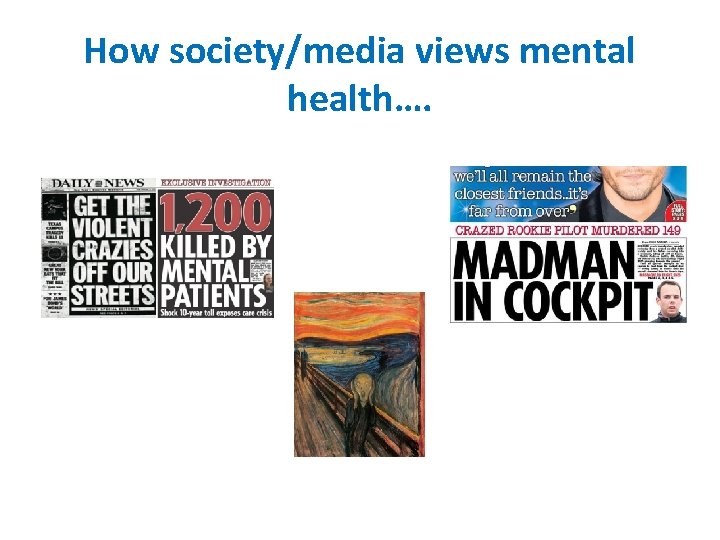
How society/media views mental health….
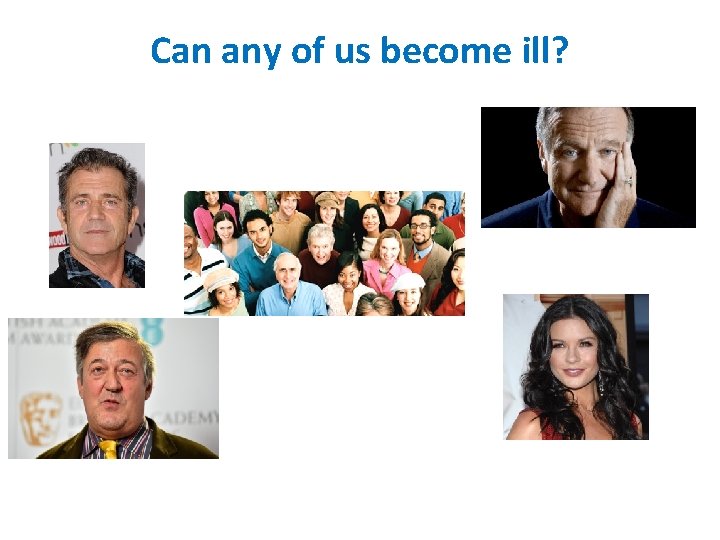
Can any of us become ill?
What is Mental Health? MIND (www. mind. org. uk) states: Mental wellbeing describes your mental state – how you are feeling and how well you can cope with day-to-day life. Our mental wellbeing can change, from day to day, month to month or year to year We all have times when we have low mental wellbeing – when we feel sad or stressed, or find it difficult to cope. For example, when we suffer some sort of loss; experience loneliness or relationships problems; or are worried about work or money. Sometimes, there is no clear reason why we experience a period of poor mental health
What is Mental Health? Legal Definition: The Mental Health Act Code of Practice (2015) states: Mental Disorder is defined for the purposes of the Act as ‘any disorder or disability of the mind’ MIND state: “Mental health problems can affect the way you think, feel and behave. They affect around one in four people in Britain, and range from common mental health problems, such as depression and anxiety, to more rare problems such as schizophrenia and bipolar disorder. A mental health problem can feel just as bad, or worse, as any other physical illness – only you cannot see it”
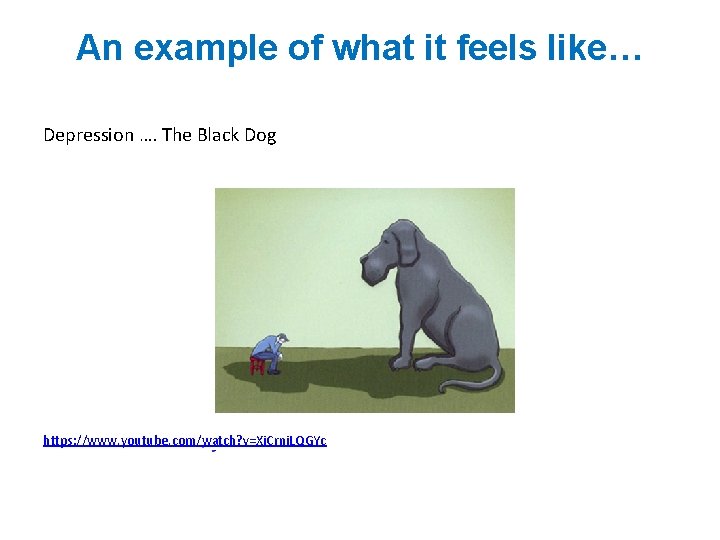
An example of what it feels like… Depression …. The Black Dog https: //www. youtube. com/watch? v=Xi. Crni. LQGYc
Communication – Special Talent? • Explain who you are and what your role is • Acknowledge and respect how they are feeling • Listen sensitively using a calm and reassuring tone • Ask short, simple and open questions • Reflect back the issues and summarise – why? • Be honest and transparent with what is going on
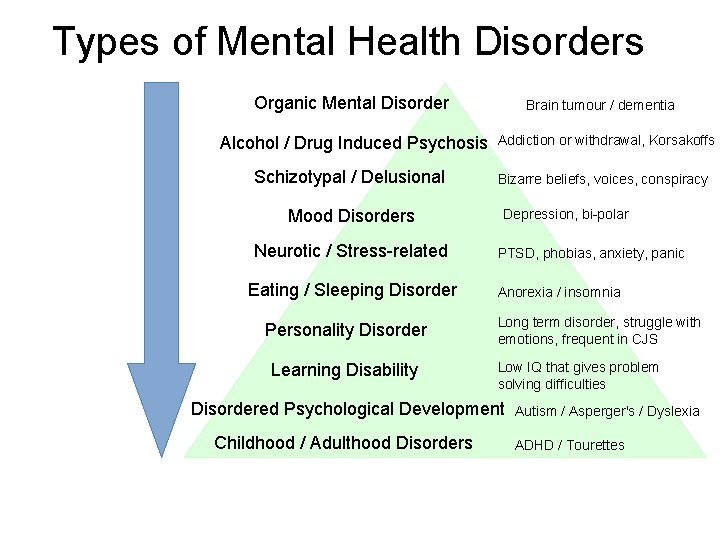
Types of Mental Health Disorders Organic Mental Disorder Alcohol / Drug Induced Psychosis Schizotypal / Delusional Mood Disorders Neurotic / Stress-related Eating / Sleeping Disorder Personality Disorder Learning Disability Brain tumour / dementia Addiction or withdrawal, Korsakoffs Bizarre beliefs, voices, conspiracy Depression, bi-polar PTSD, phobias, anxiety, panic Anorexia / insomnia Long term disorder, struggle with emotions, frequent in CJS Low IQ that gives problem solving difficulties Disordered Psychological Development Childhood / Adulthood Disorders Autism / Asperger's / Dyslexia ADHD / Tourettes
What is a Learning Disability? IQ of less than 70 with a reduced ability to cope independently and to adapt to the daily demands of a normal social environment. A learning disability is a lifelong condition and not an illness. A learning disability cannot be ‘cured’ A learning disability affects the way a person understands information and how they communicate. This means they can have difficulty: • • • understanding new or complex information learning new skills coping independently A Learning Disability is defined as a significant reduced ability to understand new or complex information, to learn new skills (impaired intelligence), with a reduced ability to cope independently (impaired social functioning), which started before adulthood” (Department of Health, 2001).
What can cause a Learning Disability? Learning disabilities can be caused by any one of a variety of factors, or by a combination. Sometimes the specific cause is not known. Possible causes include the following: • An inherited condition, meaning that certain genes passed from the parents affected the brain development, for example Fragile X • Chromosome abnormalities such as Down’s syndrome or Turner syndrome • Complications during birth resulting in a lack of oxygen to the brain /A very premature birth • The mother drinking during pregnancy, for example Foetal Alcohol Syndrome • A debilitating illness or injury in early childhood affecting brain development, for example a road traffic accident or child abuse
What is Autism? • Autism is a lifelong developmental disability that affects how people perceive the world and interact with others. • Autistic people see, hear and feel the world differently to other people. If you are autistic, you are autistic for life; autism is not an illness or disease and cannot be 'cured'. Often people feel being autistic is a fundamental aspect of their identity. • Its important Police understand autism and how to communicate effectively, there is some guidance available. • Top Tips from a Police Officer…… https: //www. youtube. com/watch? v=N 5 ot_Dgr. Wo
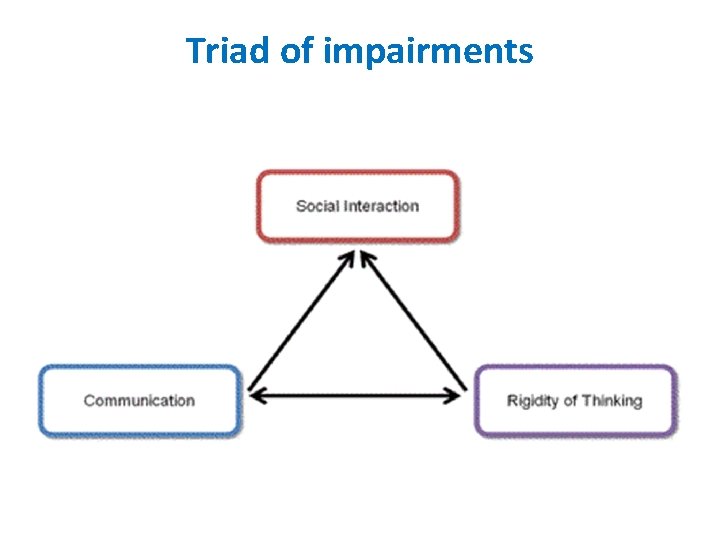
Triad of impairments
Deficits/Difficulties • • • • Difficult to discern when someone is annoyed or upset (this works both ways) Difficulties in understanding how other people think, feel and react What might happen in the future Not paying attention to others Aloof, distant and uninterested Being alone and withdrawn Lack of social skills Inappropriate social behaviour Lack of understanding about friendship or strangers Difficulty in understanding that other people may have a different point of view Difficulty in generalising concepts Inflexibility in application of rules THEORY OF MIND
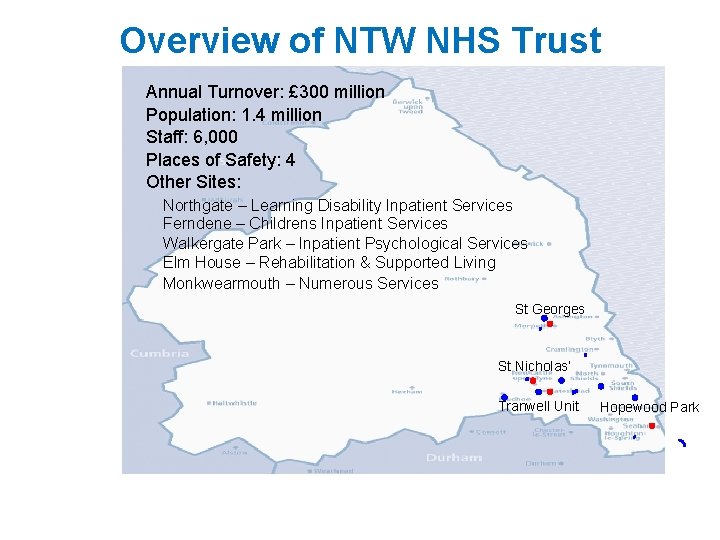
Overview of NTW NHS Trust Annual Turnover: £ 300 million Population: 1. 4 million Staff: 6, 000 Places of Safety: 4 Other Sites: Northgate – Learning Disability Inpatient Services Ferndene – Childrens Inpatient Services Walkergate Park – Inpatient Psychological Services Elm House – Rehabilitation & Supported Living Monkwearmouth – Numerous Services St Georges St Nicholas’ Tranwell Unit Hopewood Park
Liaison and Diversion service Mental Health and Learning Disability nurses who work in police custody and the magistrates courts. We offer screening to: • Identify needs as early as possible in the offender pathway (including prevention and early intervention). • Inform subsequent decisions about where an individual is best placed to receive treatment, taking into account public safety, safety of the individual and punishment of an offence. (Bradley, 2009).
Liaison and Diversion service • • • • Complex, severe or persistent health needs Learning disabilities Substance misuse Acquired brain injury Severe or complex emotional/behavioural difficulties Repeat offenders Veterans Homelessness Social vulnerability Risk – including Domestic Violence, MAPPA, safeguarding Those in acute crisis including depression, psychosis, escalating self- harm Those from a ethnic or minority cultural background Female
Mental Health Act • • • What is Section 2? What is Section 3? Section 37 & 37/41 Capacity issues Fitness for interview
Section 136 MHA Section 136 is a police emergency power which allows for the removal of a person for a mental health act assessment. If a person appears to a constable to be suffering from mental disorder and to be in immediate need of care or control, the constable may, if he thinks it necessary to do so in the interests of that person or for the protection of other persons— (a)remove the person to a place of safety within the meaning of section 135, or (b)if the person is already at a place of safety within the meaning of that section, keep the person at that place or remove the person to another place of safety.
Section 136 MHA The power of a constable under S 136 may be exercised where the mentally disordered person is at any place, other than— any house, flat or room where that person, or any other person, is living, or any yard, garden, garage or outhouse that is used in connection with the house, flat or room, other than one that is also used in connection with one or more other houses, flats or rooms. For the purpose of exercising the power a constable may enter any place where the power may be exercised, if need be by force.
Section 136 MHA There is now a requirement for police to consult with an AMHP, medical practitioner, nurse, occupational therapist or paramedic before using S. 136 (if practicable). Shorter detention now 24 hours – possible extension up to 12 hours. Changes to what constitutes a Place of Safety. Police Station – New regulations – Unlawful for Under 18 years old. Power to keep someone at a Place of Safety
Mental Capacity Act 2005 Allows officers to detain, restrain and use force to prevent self harm or serious deterioration of health and remove a person to hospital (includes from private premises)
Multi-agency mental health simulation training
MIND Bluelight – the facts MIND independent research shows that members of the emergency services are even more at risk of experiencing a mental health problem than the general population, but are less likely to seek support. 91% of police have experienced stress and poor mental health at work. Mind is delivering the Blue Light Programme to provide mental health support for emergency services staff and volunteers from police, search and rescue, fire and ambulance services across England https: //youtu. be/hvg. ARRg 81 m. U

Any Questions?
- Slides: 28