
Mental disorders Nonorganic psychogenic functional Psychosis Neurosis autoplastic


- Slides: 40
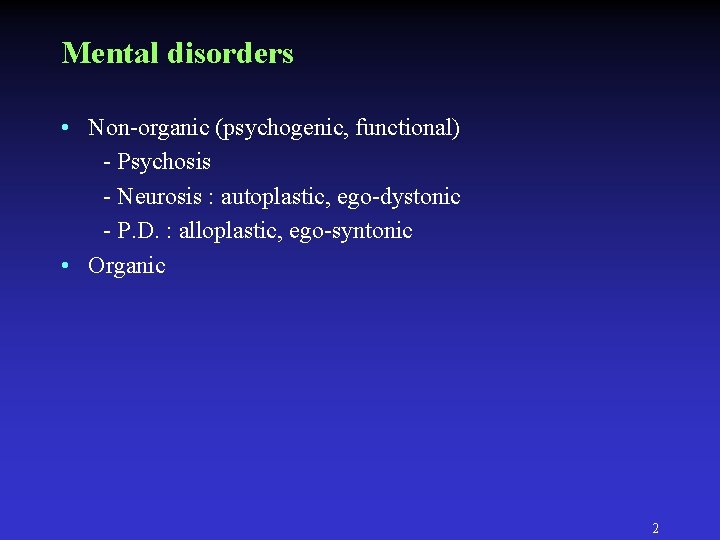
Mental disorders • Non-organic (psychogenic, functional) - Psychosis - Neurosis : autoplastic, ego-dystonic - P. D. : alloplastic, ego-syntonic • Organic 2
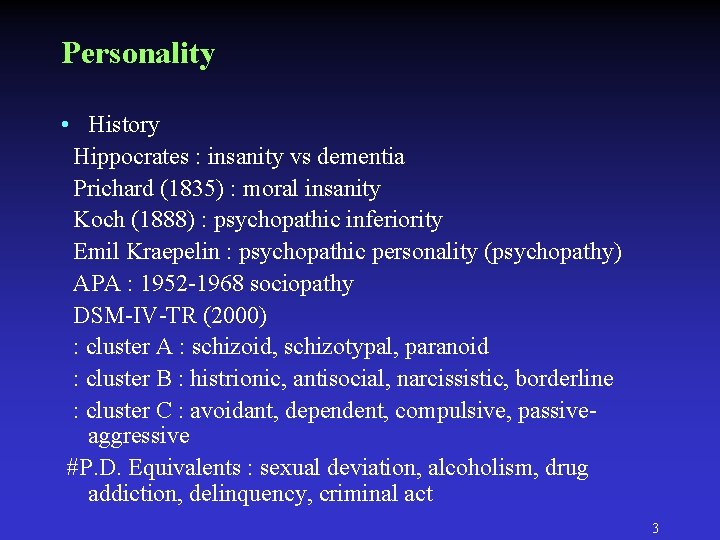
Personality • History Hippocrates : insanity vs dementia Prichard (1835) : moral insanity Koch (1888) : psychopathic inferiority Emil Kraepelin : psychopathic personality (psychopathy) APA : 1952 -1968 sociopathy DSM-IV-TR (2000) : cluster A : schizoid, schizotypal, paranoid : cluster B : histrionic, antisocial, narcissistic, borderline : cluster C : avoidant, dependent, compulsive, passiveaggressive #P. D. Equivalents : sexual deviation, alcoholism, drug addiction, delinquency, criminal act 3
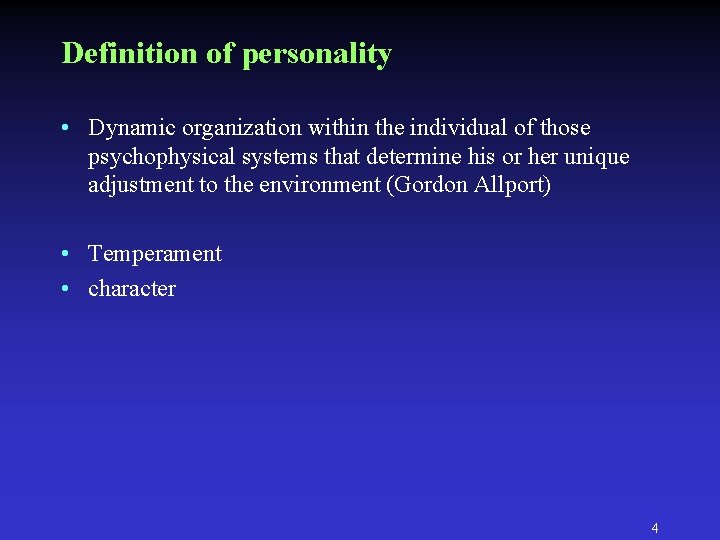
Definition of personality • Dynamic organization within the individual of those psychophysical systems that determine his or her unique adjustment to the environment (Gordon Allport) • Temperament • character 4
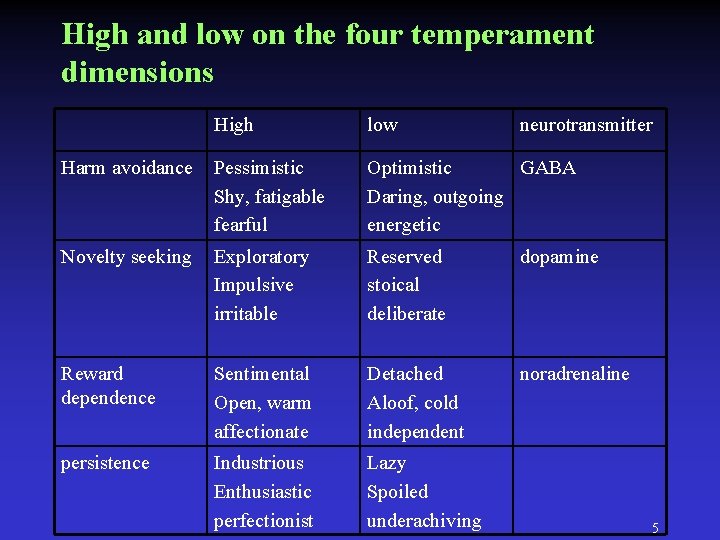
High and low on the four temperament dimensions High low neurotransmitter Harm avoidance Pessimistic Shy, fatigable fearful Optimistic GABA Daring, outgoing energetic Novelty seeking Exploratory Impulsive irritable Reserved stoical deliberate dopamine Reward dependence Sentimental Open, warm affectionate Detached Aloof, cold independent noradrenaline persistence Industrious Enthusiastic perfectionist Lazy Spoiled underachiving 5
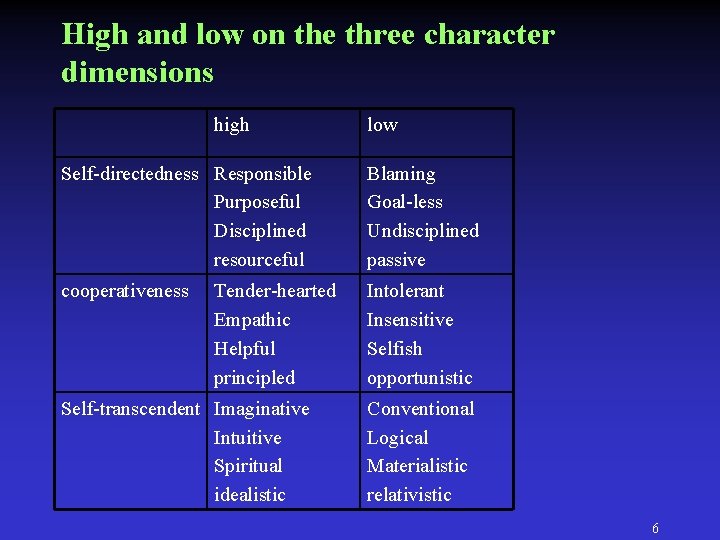
High and low on the three character dimensions high low Self-directedness Responsible Purposeful Disciplined resourceful Blaming Goal-less Undisciplined passive cooperativeness Intolerant Insensitive Selfish opportunistic Tender-hearted Empathic Helpful principled Self-transcendent Imaginative Intuitive Spiritual idealistic Conventional Logical Materialistic relativistic 6
Personality: an integrated psychobiological schema • Personality 7
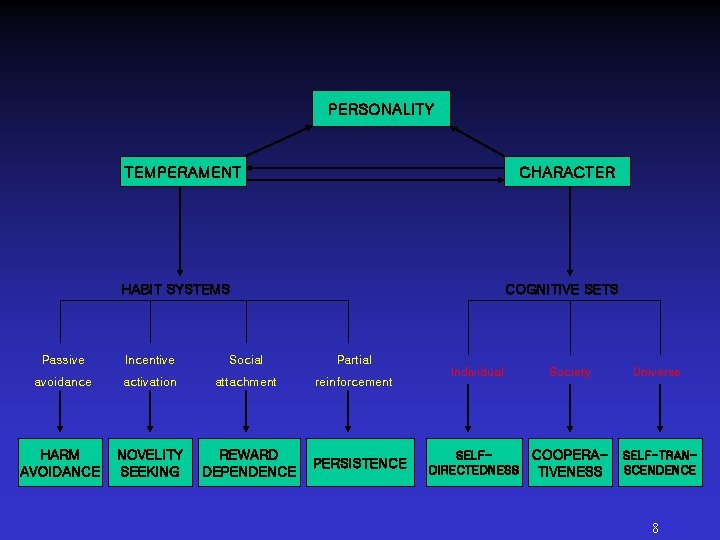
PERSONALITY TEMPERAMENT CHARACTER HABIT SYSTEMS COGNITIVE SETS Passive Incentive Social Partial avoidance activation attachment reinforcement HARM AVOIDANCE NOVELITY SEEKING REWARD DEPENDENCE PERSISTENCE Individual Society Universe SELFDIRECTEDNESS COOPERATIVENESS SELF-TRANSCENDENCE 8
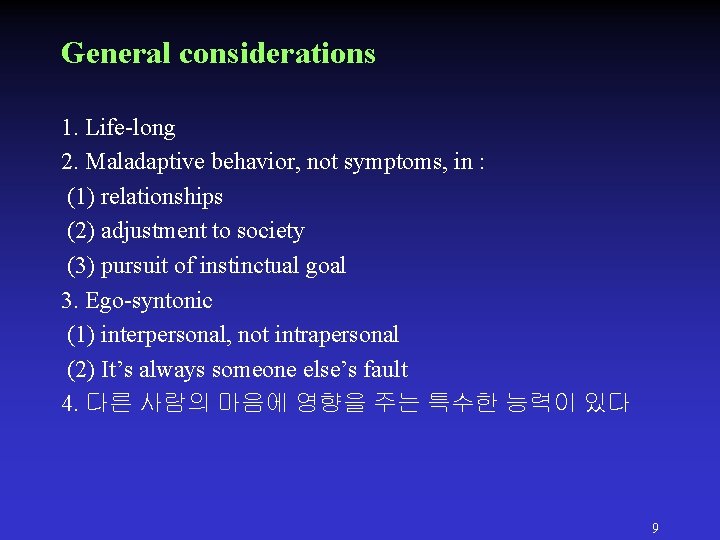
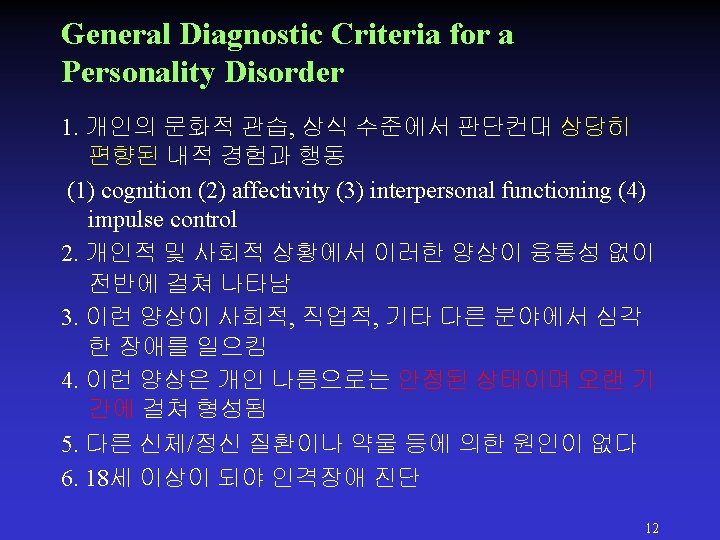
General considerations 1. Life-long 2. Maladaptive behavior, not symptoms, in : (1) relationships (2) adjustment to society (3) pursuit of instinctual goal 3. Ego-syntonic (1) interpersonal, not intrapersonal (2) It’s always someone else’s fault 4. 다른 사람의 마음에 영향을 주는 특수한 능력이 있다 9
10
11
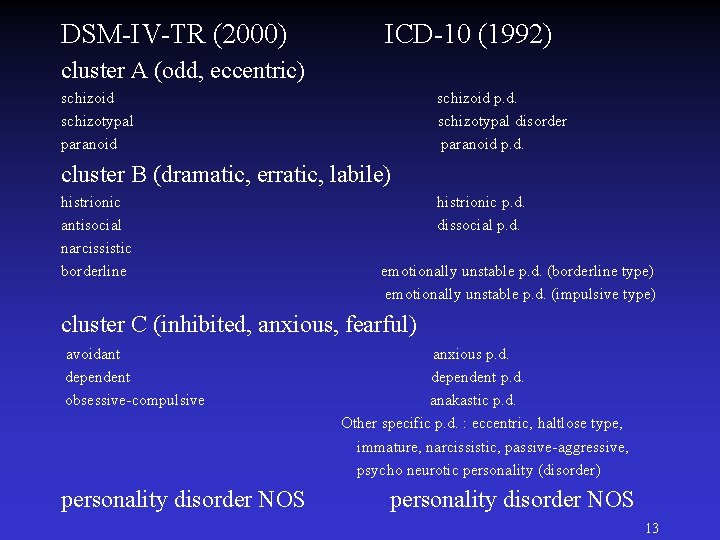
DSM-IV-TR (2000) ICD-10 (1992) cluster A (odd, eccentric) schizoid schizotypal paranoid schizoid p. d. schizotypal disorder paranoid p. d. cluster B (dramatic, erratic, labile) histrionic antisocial narcissistic borderline histrionic p. d. dissocial p. d. emotionally unstable p. d. (borderline type) emotionally unstable p. d. (impulsive type) cluster C (inhibited, anxious, fearful) avoidant dependent obsessive-compulsive personality disorder NOS anxious p. d. dependent p. d. anakastic p. d. Other specific p. d. : eccentric, haltlose type, immature, narcissistic, passive-aggressive, psycho neurotic personality (disorder) personality disorder NOS 13
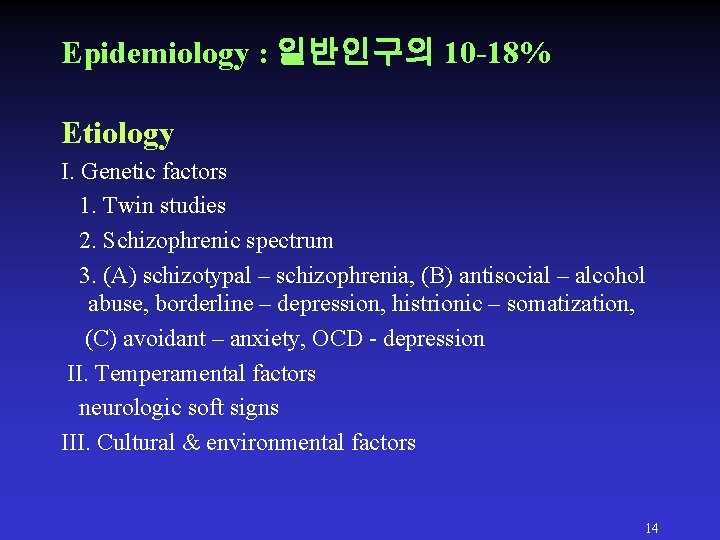
Epidemiology : 일반인구의 10 -18% Etiology I. Genetic factors 1. Twin studies 2. Schizophrenic spectrum 3. (A) schizotypal – schizophrenia, (B) antisocial – alcohol abuse, borderline – depression, histrionic – somatization, (C) avoidant – anxiety, OCD - depression II. Temperamental factors neurologic soft signs III. Cultural & environmental factors 14
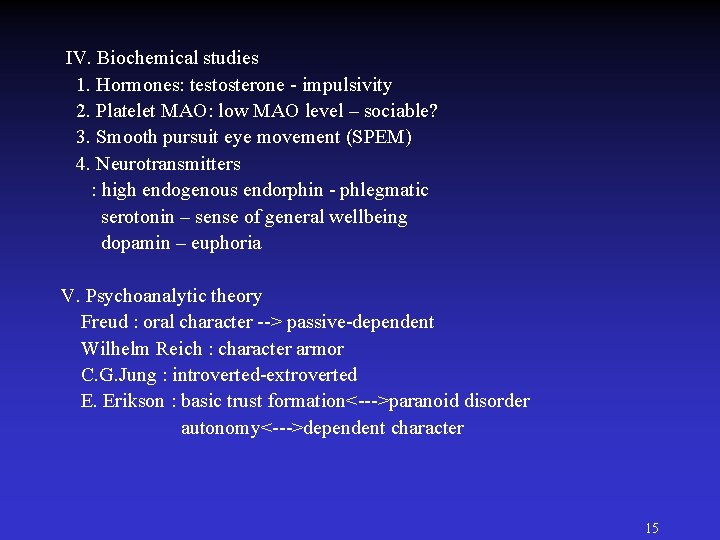
IV. Biochemical studies 1. Hormones: testosterone - impulsivity 2. Platelet MAO: low MAO level – sociable? 3. Smooth pursuit eye movement (SPEM) 4. Neurotransmitters : high endogenous endorphin - phlegmatic serotonin – sense of general wellbeing dopamin – euphoria V. Psychoanalytic theory Freud : oral character --> passive-dependent Wilhelm Reich : character armor C. G. Jung : introverted-extroverted E. Erikson : basic trust formation<--->paranoid disorder autonomy<--->dependent character 15
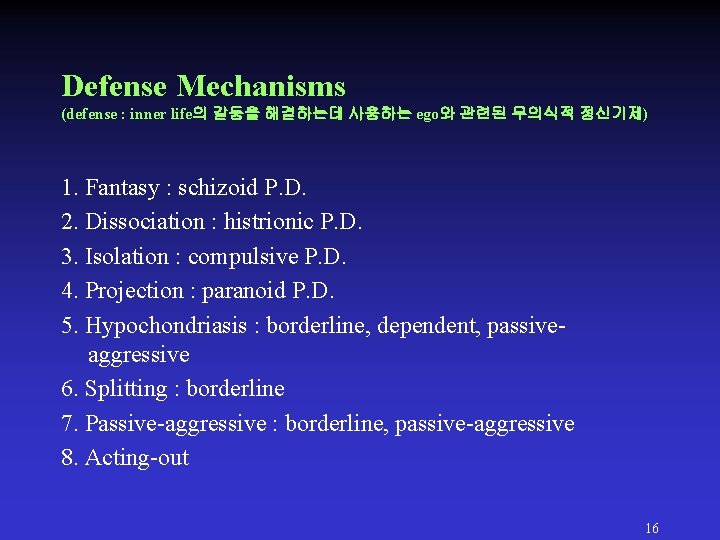
Defense Mechanisms (defense : inner life의 갈등을 해결하는데 사용하는 ego와 관련된 무의식적 정신기제) 1. Fantasy : schizoid P. D. 2. Dissociation : histrionic P. D. 3. Isolation : compulsive P. D. 4. Projection : paranoid P. D. 5. Hypochondriasis : borderline, dependent, passiveaggressive 6. Splitting : borderline 7. Passive-aggressive : borderline, passive-aggressive 8. Acting-out 16
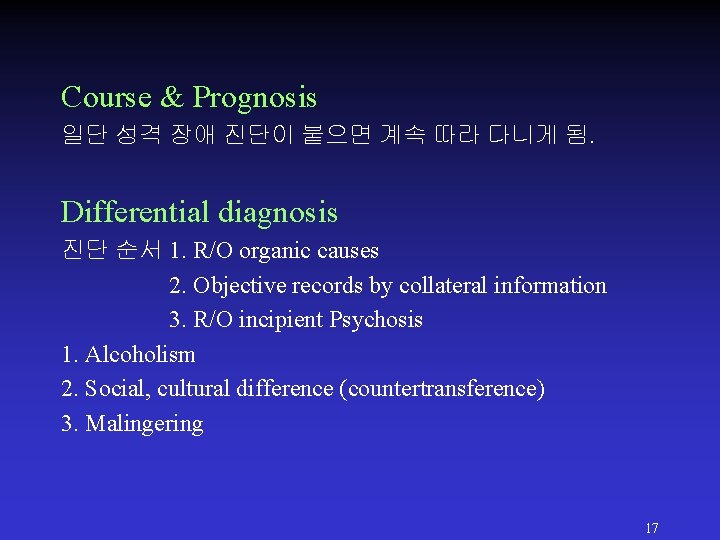
Course & Prognosis 일단 성격 장애 진단이 붙으면 계속 따라 다니게 됨. Differential diagnosis 진단 순서 1. R/O organic causes 2. Objective records by collateral information 3. R/O incipient Psychosis 1. Alcoholism 2. Social, cultural difference (countertransference) 3. Malingering 17
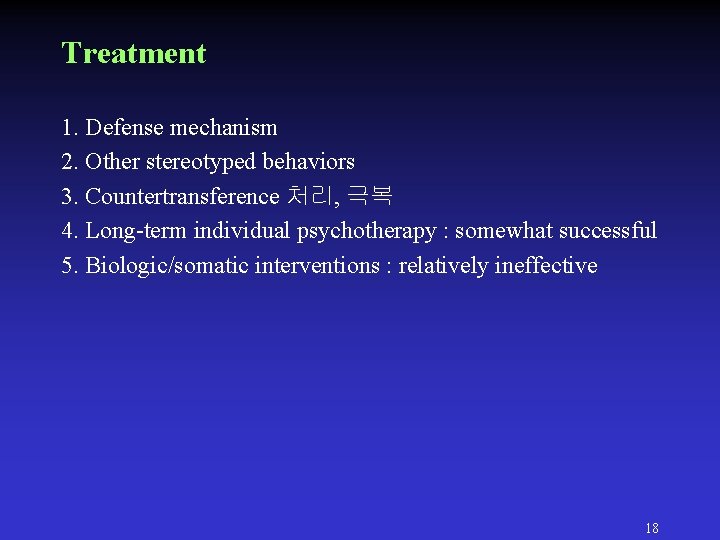
Treatment 1. Defense mechanism 2. Other stereotyped behaviors 3. Countertransference 처리, 극복 4. Long-term individual psychotherapy : somewhat successful 5. Biologic/somatic interventions : relatively ineffective 18
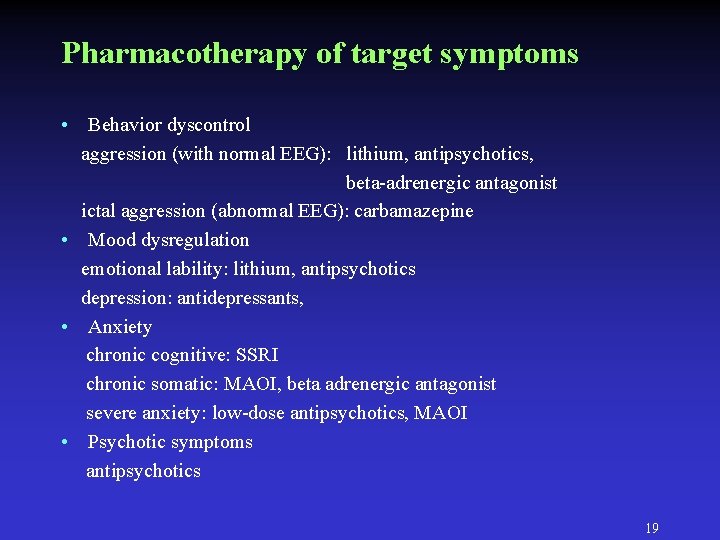
Pharmacotherapy of target symptoms • Behavior dyscontrol aggression (with normal EEG): lithium, antipsychotics, beta-adrenergic antagonist ictal aggression (abnormal EEG): carbamazepine • Mood dysregulation emotional lability: lithium, antipsychotics depression: antidepressants, • Anxiety chronic cognitive: SSRI chronic somatic: MAOI, beta adrenergic antagonist severe anxiety: low-dose antipsychotics, MAOI • Psychotic symptoms antipsychotics 19
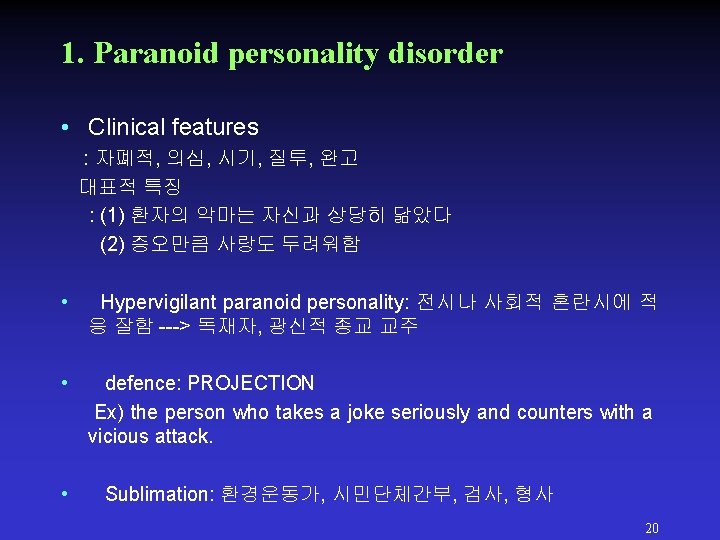
1. Paranoid personality disorder • Clinical features : 자폐적, 의심, 시기, 질투, 완고 대표적 특징 : (1) 환자의 악마는 자신과 상당히 닮았다 (2) 증오만큼 사랑도 두려워함 • Hypervigilant paranoid personality: 전시나 사회적 혼란시에 적 응 잘함 ---> 독재자, 광신적 종교 교주 • defence: PROJECTION Ex) the person who takes a joke seriously and counters with a vicious attack. • Sublimation: 환경운동가, 시민단체간부, 검사, 형사 20
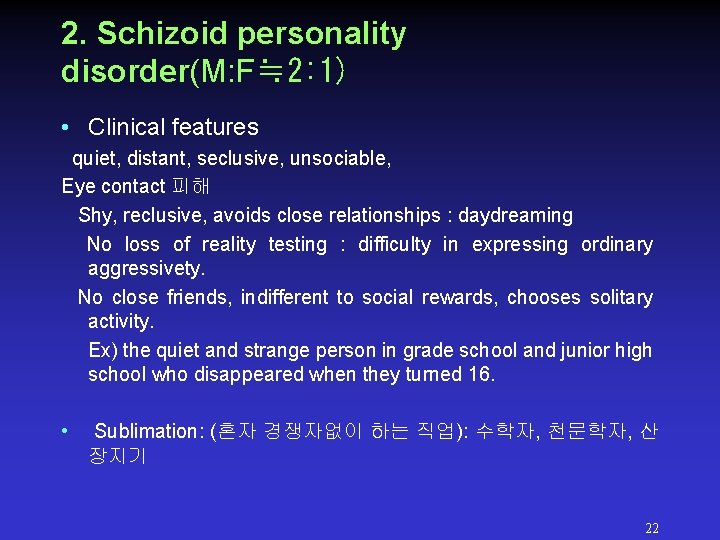
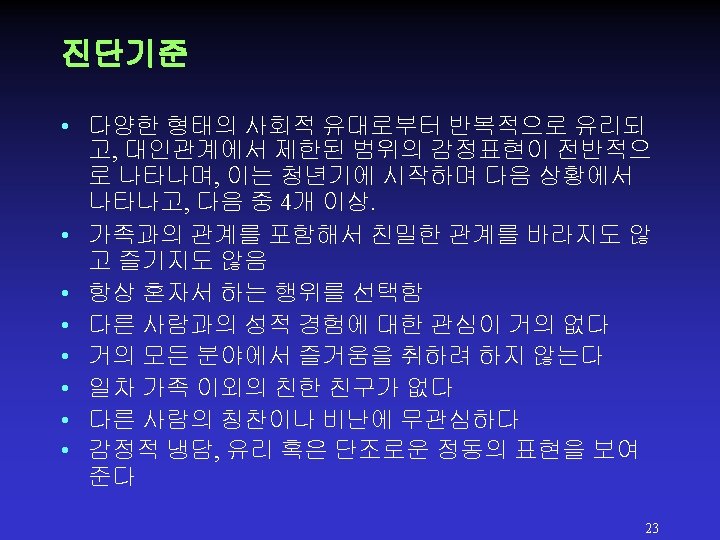
2. Schizoid personality disorder(M: F≒ 2: 1) • Clinical features quiet, distant, seclusive, unsociable, Eye contact 피해 Shy, reclusive, avoids close relationships : daydreaming No loss of reality testing : difficulty in expressing ordinary aggressivety. No close friends, indifferent to social rewards, chooses solitary activity. Ex) the quiet and strange person in grade school and junior high school who disappeared when they turned 16. • Sublimation: (혼자 경쟁자없이 하는 직업): 수학자, 천문학자, 산 장지기 22
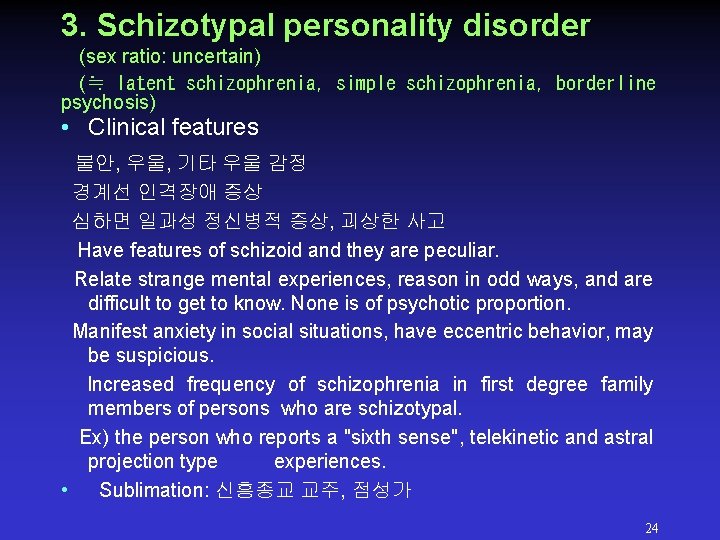
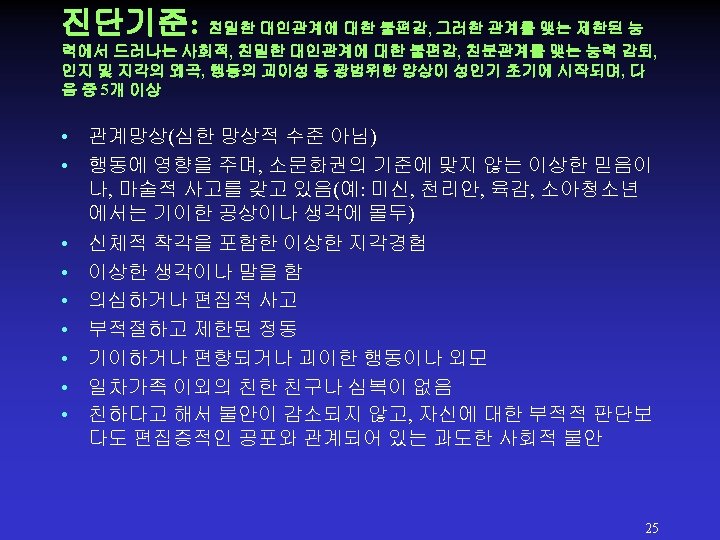
3. Schizotypal personality disorder (sex ratio: uncertain) (≒ latent schizophrenia, simple schizophrenia, borderline psychosis) • Clinical features 불안, 우울, 기타 우울 감정 경계선 인격장애 증상 심하면 일과성 정신병적 증상, 괴상한 사고 Have features of schizoid and they are peculiar. Relate strange mental experiences, reason in odd ways, and are difficult to get to know. None is of psychotic proportion. Manifest anxiety in social situations, have eccentric behavior, may be suspicious. Increased frequency of schizophrenia in first degree family members of persons who are schizotypal. Ex) the person who reports a "sixth sense", telekinetic and astral projection type experiences. • Sublimation: 신흥종교 교주, 점성가 24
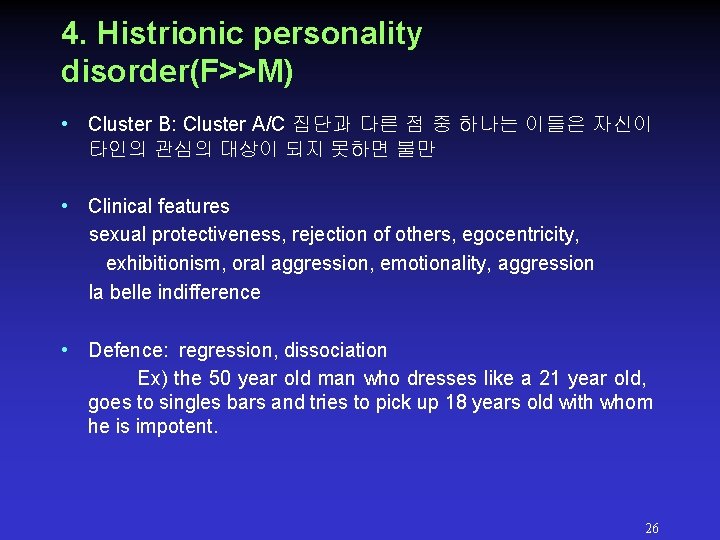
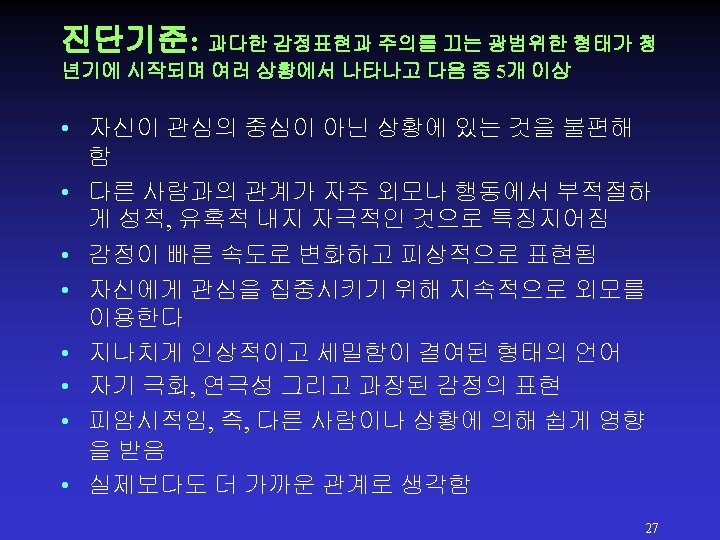
4. Histrionic personality disorder(F>>M) • Cluster B: Cluster A/C 집단과 다른 점 중 하나는 이들은 자신이 타인의 관심의 대상이 되지 못하면 불만 • Clinical features sexual protectiveness, rejection of others, egocentricity, exhibitionism, oral aggression, emotionality, aggression la belle indifference • Defence: regression, dissociation Ex) the 50 year old man who dresses like a 21 year old, goes to singles bars and tries to pick up 18 years old with whom he is impotent. 26
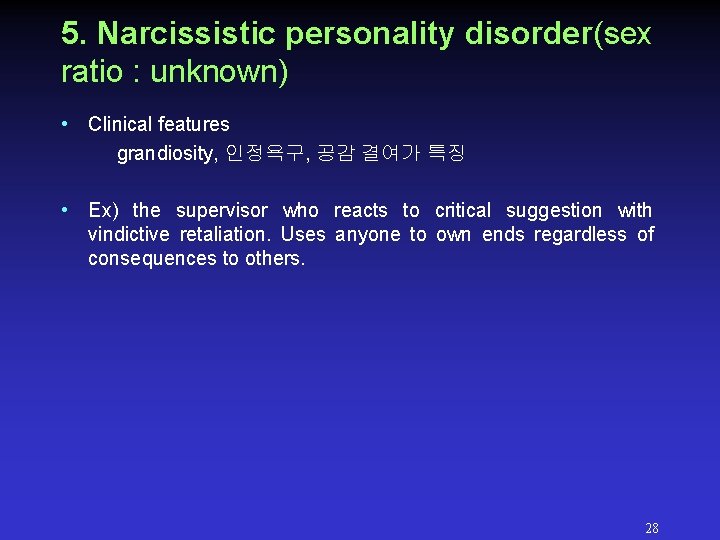
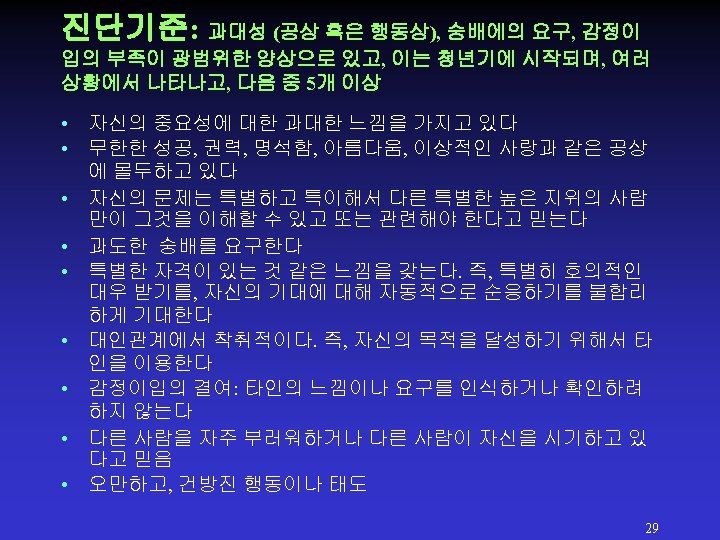
5. Narcissistic personality disorder(sex ratio : unknown) • Clinical features grandiosity, 인정욕구, 공감 결여가 특징 • Ex) the supervisor who reacts to critical suggestion with vindictive retaliation. Uses anyone to own ends regardless of consequences to others. 28
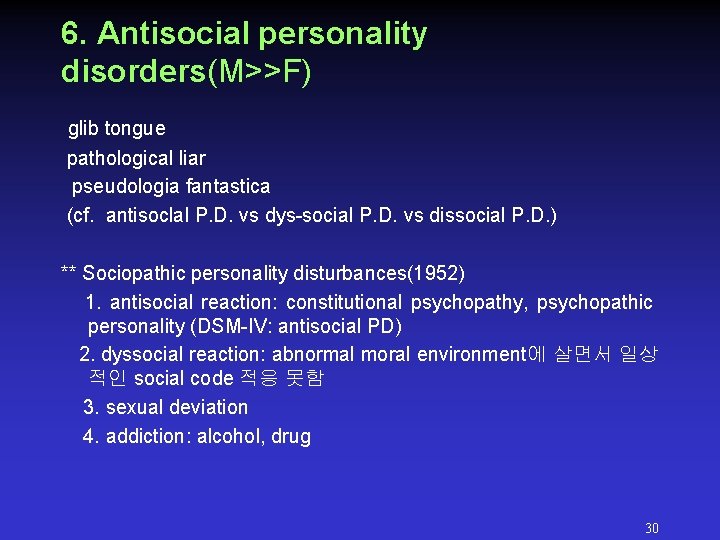
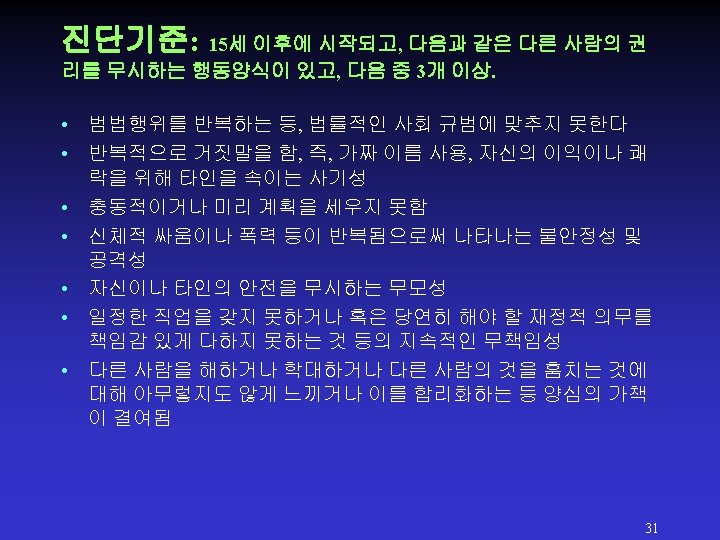
6. Antisocial personality disorders(M>>F) glib tongue pathological liar pseudologia fantastica (cf. antisoclal P. D. vs dys-social P. D. vs dissocial P. D. ) ** Sociopathic personality disturbances(1952) 1. antisocial reaction: constitutional psychopathy, psychopathic personality (DSM-IV: antisocial PD) 2. dyssocial reaction: abnormal moral environment에 살면서 일상 적인 social code 적응 못함 3. sexual deviation 4. addiction: alcohol, drug 30
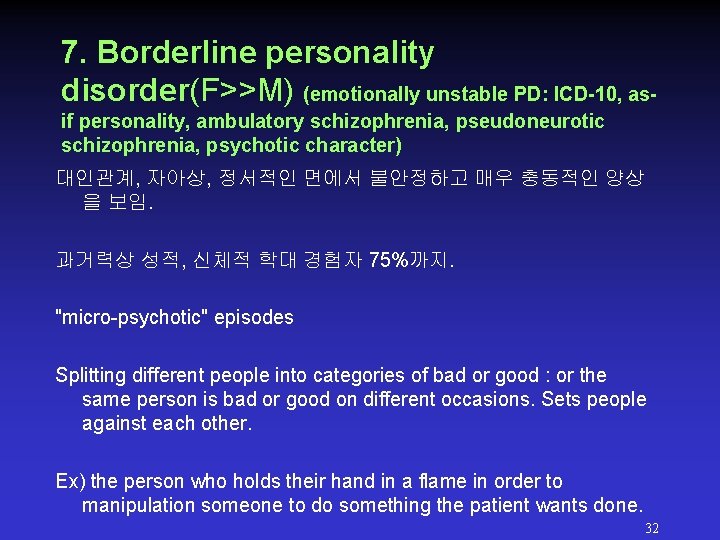
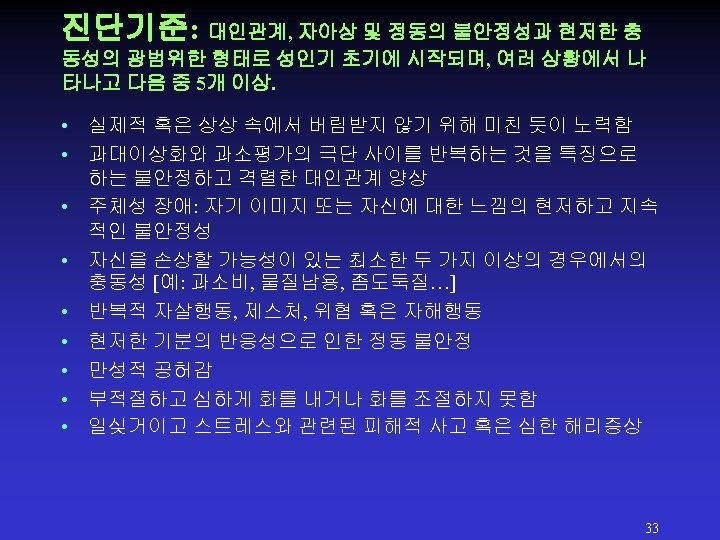
7. Borderline personality disorder(F>>M) (emotionally unstable PD: ICD-10, asif personality, ambulatory schizophrenia, pseudoneurotic schizophrenia, psychotic character) 대인관계, 자아상, 정서적인 면에서 불안정하고 매우 충동적인 양상 을 보임. 과거력상 성적, 신체적 학대 경험자 75%까지. "micro-psychotic" episodes Splitting different people into categories of bad or good : or the same person is bad or good on different occasions. Sets people against each other. Ex) the person who holds their hand in a flame in order to manipulation someone to do something the patient wants done. 32
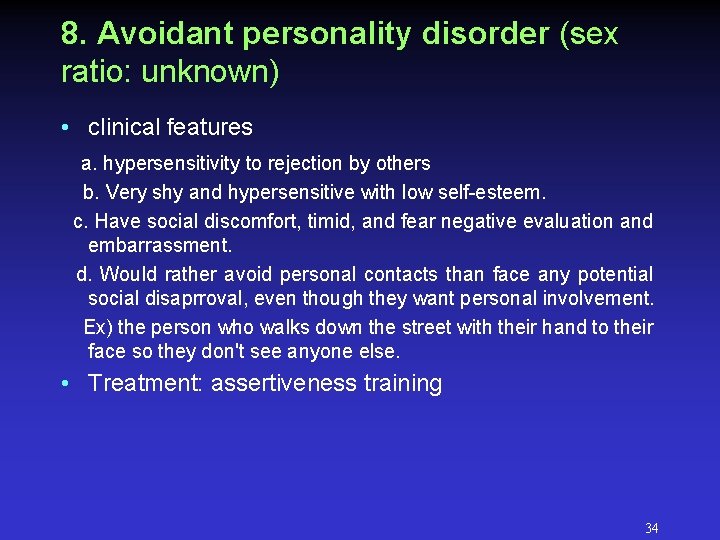
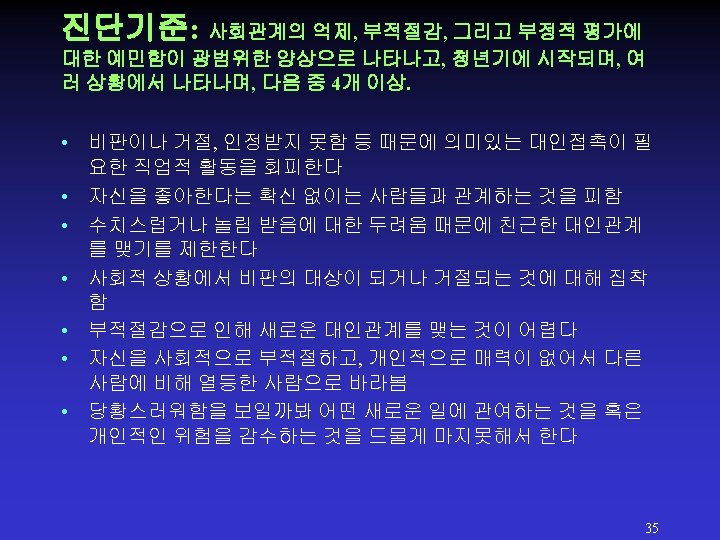
8. Avoidant personality disorder (sex ratio: unknown) • clinical features a. hypersensitivity to rejection by others b. Very shy and hypersensitive with low self-esteem. c. Have social discomfort, timid, and fear negative evaluation and embarrassment. d. Would rather avoid personal contacts than face any potential social disaprroval, even though they want personal involvement. Ex) the person who walks down the street with their hand to their face so they don't see anyone else. • Treatment: assertiveness training 34
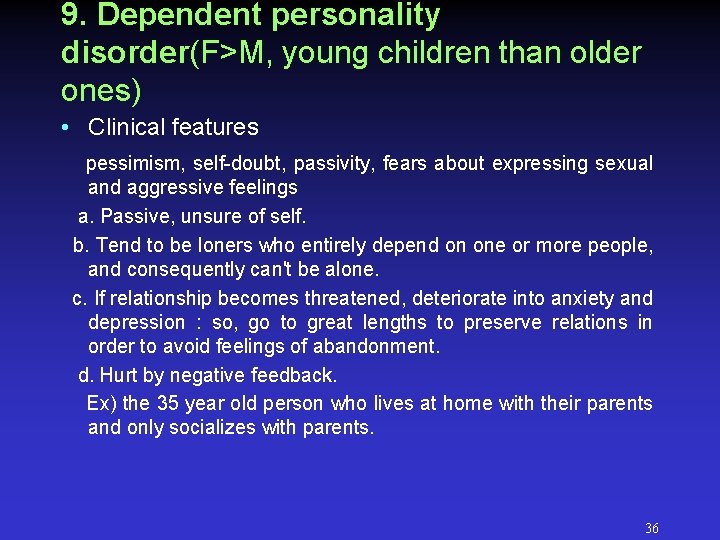
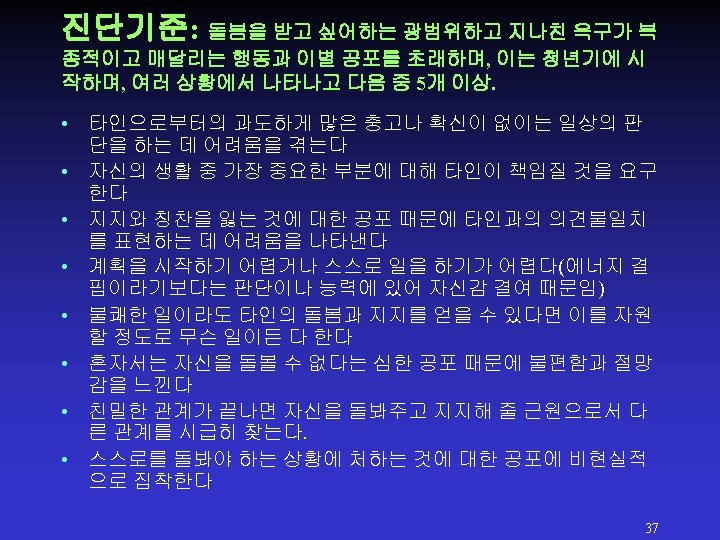
9. Dependent personality disorder(F>M, young children than older ones) • Clinical features pessimism, self-doubt, passivity, fears about expressing sexual and aggressive feelings a. Passive, unsure of self. b. Tend to be loners who entirely depend on one or more people, and consequently can't be alone. c. If relationship becomes threatened, deteriorate into anxiety and depression : so, go to great lengths to preserve relations in order to avoid feelings of abandonment. d. Hurt by negative feedback. Ex) the 35 year old person who lives at home with their parents and only socializes with parents. 36
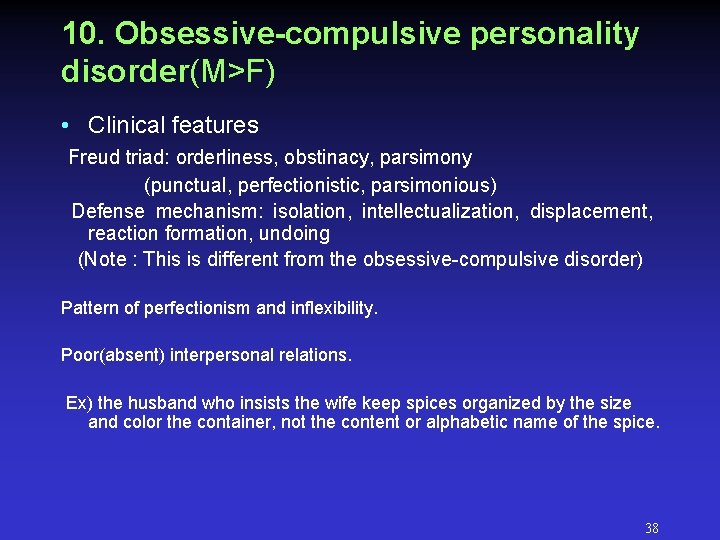
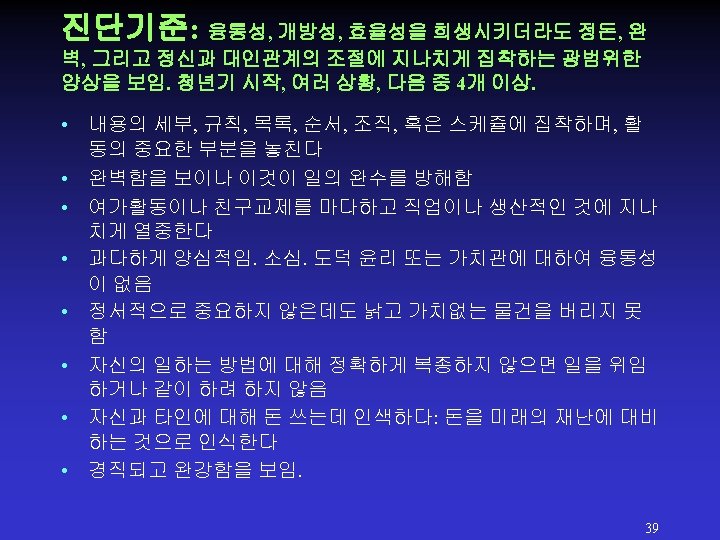
10. Obsessive-compulsive personality disorder(M>F) • Clinical features Freud triad: orderliness, obstinacy, parsimony (punctual, perfectionistic, parsimonious) Defense mechanism: isolation, intellectualization, displacement, reaction formation, undoing (Note : This is different from the obsessive-compulsive disorder) Pattern of perfectionism and inflexibility. Poor(absent) interpersonal relations. Ex) the husband who insists the wife keep spices organized by the size and color the container, not the content or alphabetic name of the spice. 38
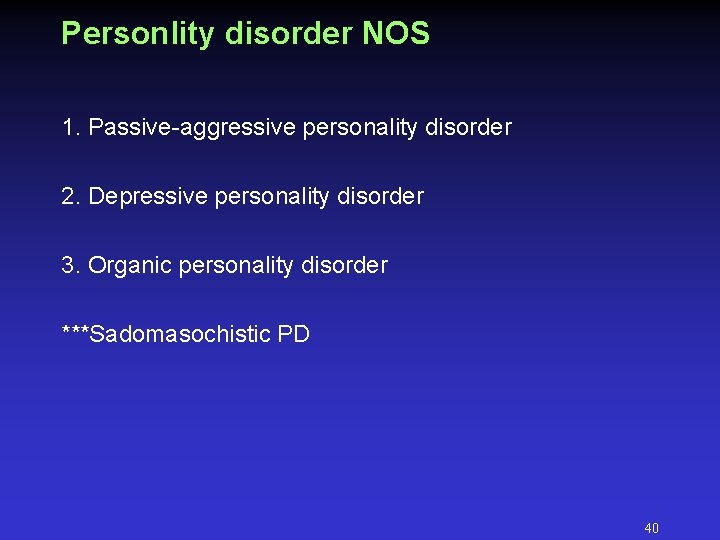
Personlity disorder NOS 1. Passive-aggressive personality disorder 2. Depressive personality disorder 3. Organic personality disorder ***Sadomasochistic PD 40