
Mendels Genetics Monohybrid Cross Gregor Mendel As discussed
Mendel’s Genetics Monohybrid Cross
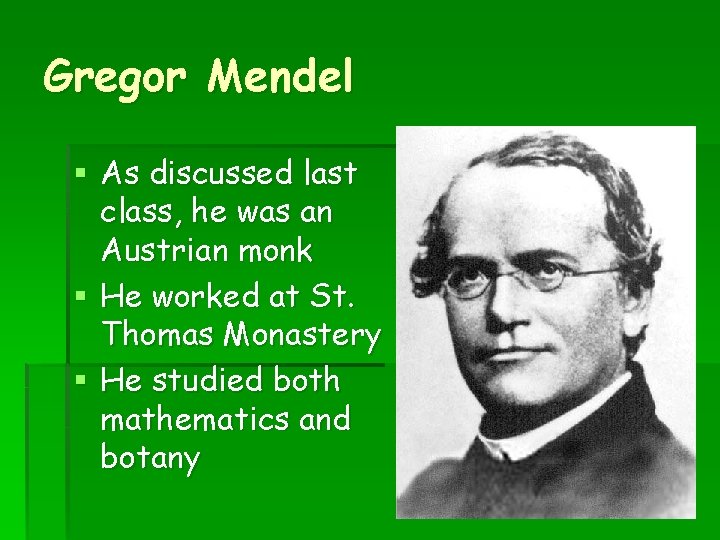
Gregor Mendel § As discussed last class, he was an Austrian monk § He worked at St. Thomas Monastery § He studied both mathematics and botany
Why did he actually Succeed? § He chose the appropriate organism to study § He designed and performed his experiments correctly § Analysis of the data was done properly
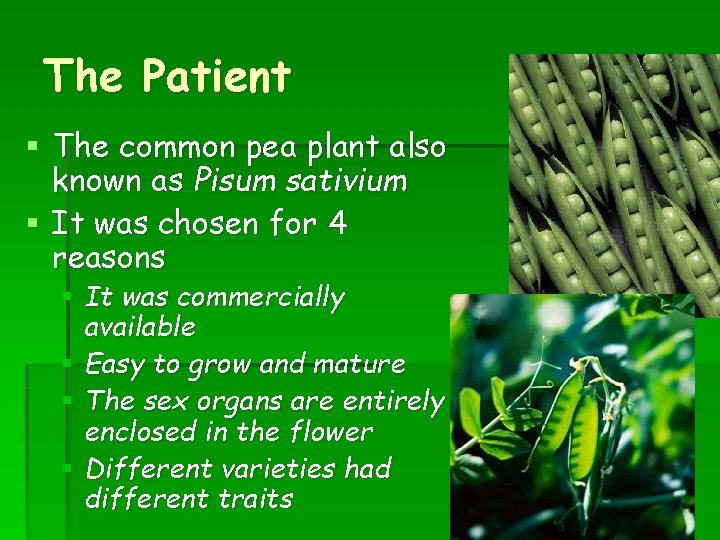
The Patient § The common pea plant also known as Pisum sativium § It was chosen for 4 reasons § It was commercially available § Easy to grow and mature § The sex organs are entirely enclosed in the flower § Different varieties had different traits
Purebred § What is a purebred organism? § It is an organism that has descended from ancestors of a distinct type or breed § Why was this important to Mendel and his pea plants? § This is because he used purebred plants to conduct all of his experiments
How did he make sure? § How did Mendel make sure that his organisms (pea plant) were pure bred? § He bred them as everyone else bred plants, and he looked at one trait at a time § He selected from the progeny, only the plants that had the trait that he was looking for § He then bred them together (F 1 x F 1) and then he continued this for several generations until no more of the other trait showed up
What happened Next? § He repeated this for all the other traits until he had pure bred plants with each trait.
The first of the Crosses § So what did he end up doing next? § He started to cross breed § He designated the parents as the “p” generations and crossed a true-breeding tall pea plant, with a true-breeding short pea plant § The offspring were of course the F 1 generation and he also denoted them as Hybrids
That F 1 Generation § What do you think he saw? § What was the phenotype of the plants? § All of the plants were tall § What is this type of crossing is called?
Cross? § Well what is the Greek word for a single unit? § Well, think back to the first unit, what did we call a single sugar § MONOSACCARIDE § So now what is the Greek word for a single unit? § MONO (Greek word for single or alone)
Creatively § Creatively the name given to this type of cross is Monohybrid § It is a single cross between two purebred plants giving us a hybrid species
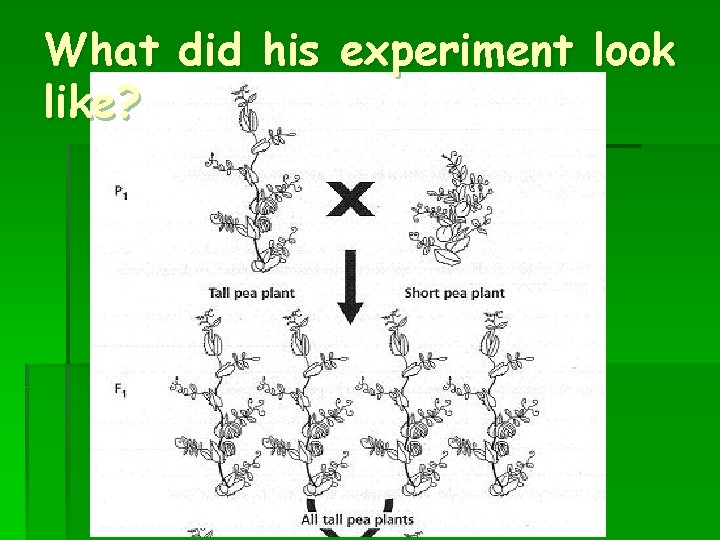
What did his experiment look like?
That’s the Phenotype § We have now seen the phenotype § All of the F 1 generations plants were tall § What do you think that the genotype must be of the offspring? § First we have to learn some more terms
Terms § Homozygous Dominant (TT) – Two alleles for a trait that are the same as a result of pure breeding § Heterozygous (Tt) – Having two alleles for a trait that are different § Homozygous Recessive (tt) - Two alleles for a trait that are the same as a result of pure breeding
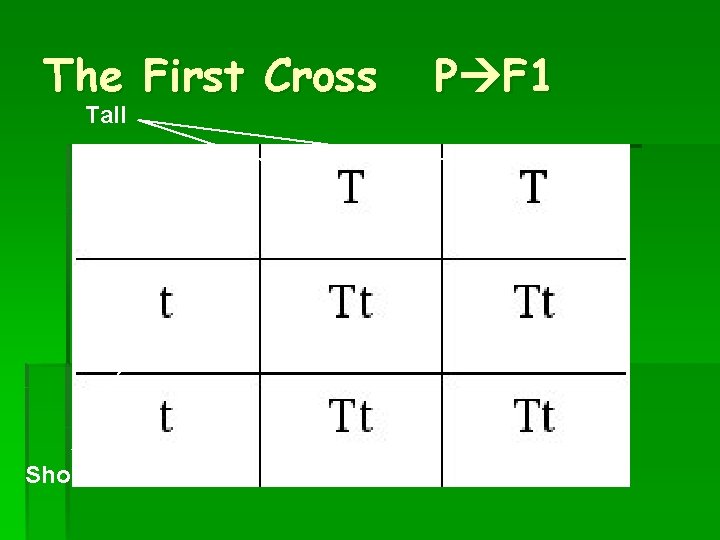
The First Cross Tall Short P F 1

Lets back track § Yesterday we looked at the different combinations of alleles that an individual can have § We also talked about dominance and recessiveness § What did we say the dominant allele was? § What about the recessive allele
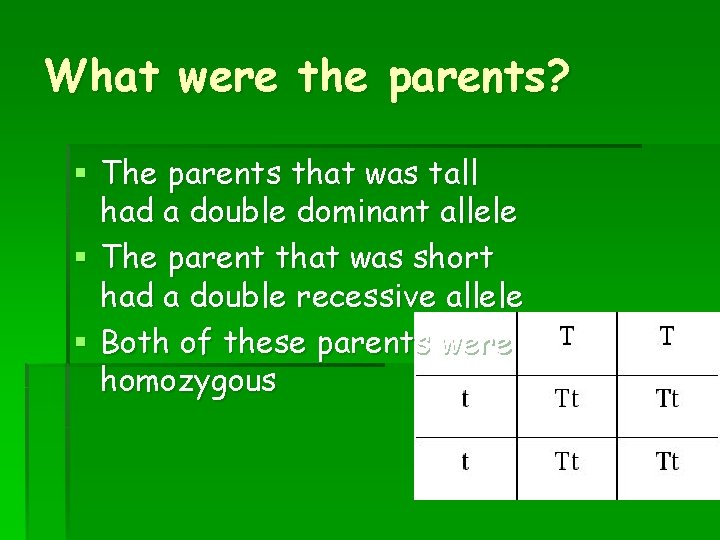
What were the parents? § The parents that was tall had a double dominant allele § The parent that was short had a double recessive allele § Both of these parents were homozygous
When he Crossed § When the parents were crossed, the F 1 generation was completely heterozygous § They all expressed the dominant trait, but why? § This was because the dominant allele trumps the recessive allele
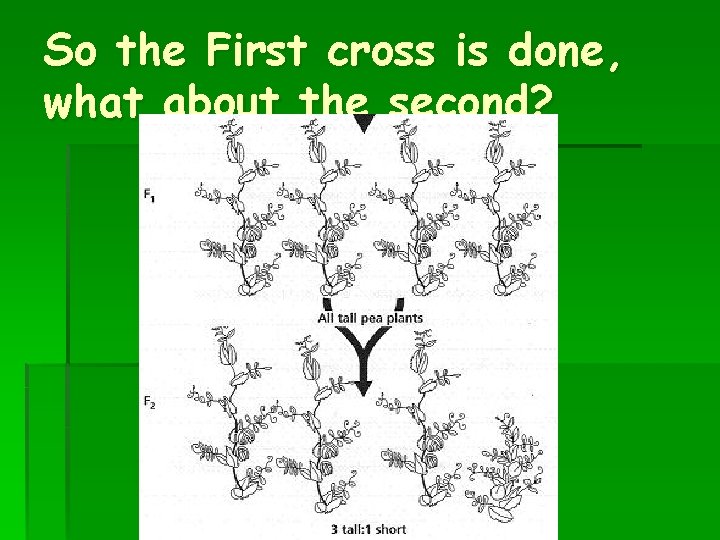
So the First cross is done, what about the second?
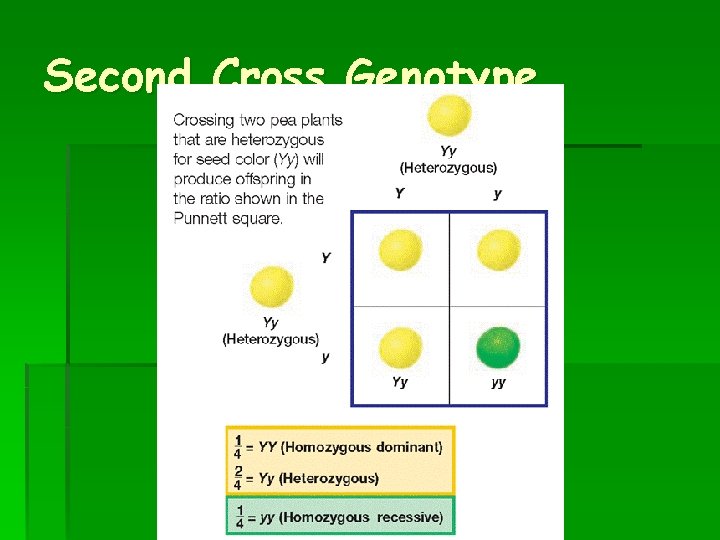
Second Cross Genotype
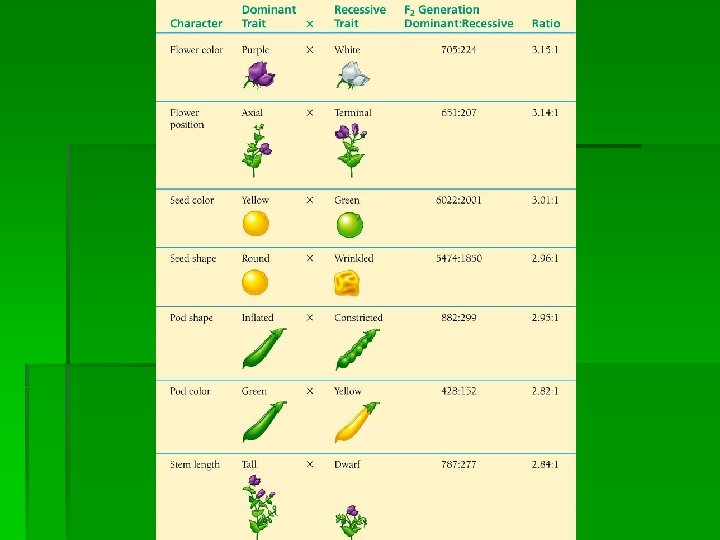
Mendelian Ratio § As Mendel completed the experiment, he found that 75% of the offspring of the F 1 cross were the dominant (tall) and 25% were the recessive (short) § The Ratio of 3: 1 is known as the Mendelian ratio
Based on observations, Why did this happen? § Each parent in his F 1 Generation starts with two hereditary “factors. ” One factor is dominant and the other recessive § The factors separate out in the and only one of the two factors contribute to the phenotype of the offspring
Why did this happen? § The offspring inherit one factor from mom and one from dad. If the dominant factor is present, it will be expressed, even if the recessive one is present § The recessive factors will be express only if the recessive factors are present
The first Law of heredity § His results gave rise to his first law The law of Segregation
The law of segregation § His law of segregation states that inherited traits are determined by pairs of “factors” § These factors segregate in the gametes (after meiosis) § Mendel did not know that his factors were actually genes, we know this today
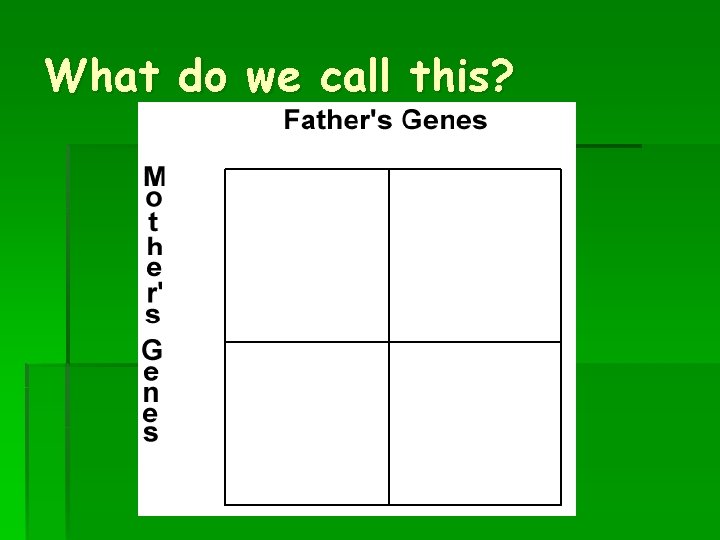
What do we call this?
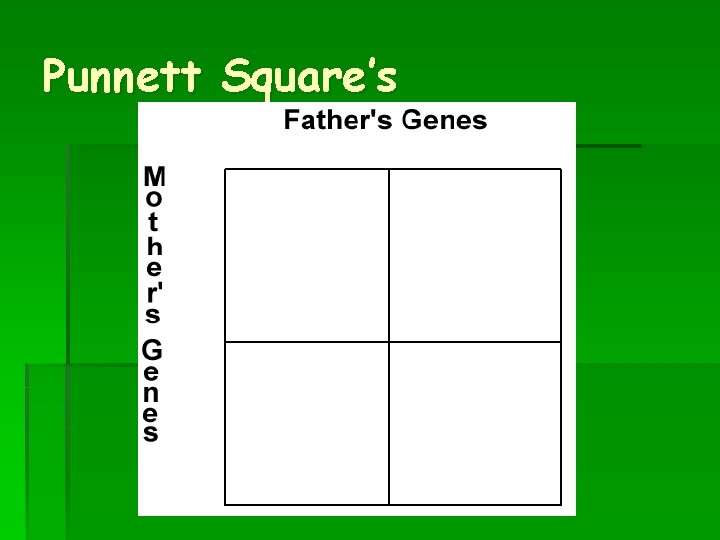
Punnett Square’s
What do they do for us? § Well, they are used by geneticists so that they can calculate the expected ratio (probability) and to suggest possible combinations of alleles in the offspring § They also tell us something about the phenotype (the appearance of a trait in an organism)
So we saw TT x tt § And for that cross we ended up having a ratio of? § All were Heterozygous (100% - 0%) § What about when we cross the F 1 x F 1 generations?
F 1 X F 1 § What’s the ratio when we are talking about phenotype? § 3: 1 as well, three of the offspring will present the dominant gene while the fourth will present the recessive gene § What about the genotype ratio? § 1: 2: 1 (one homozygous dominant, two heterozygous, and one homozygous recessive)

Example

Class Work § Read Pages 123 – 129 § Complete Questions P 135, 1 -6, 8 -16
- Slides: 33