
Mendels Experiment Mendel looked for traits that did
- Slides: 15
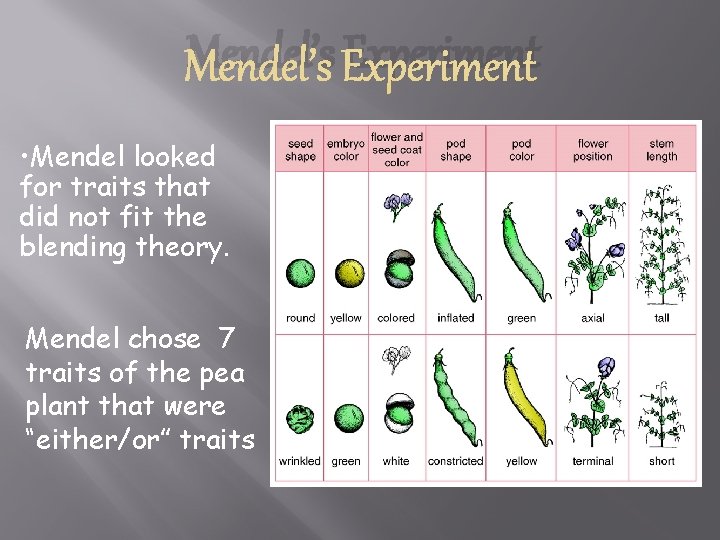
Mendel’s Experiment • Mendel looked for traits that did not fit the blending theory. Mendel chose 7 traits of the pea plant that were “either/or” traits
� � � Allowed each variety to self-pollinate over several generations. This created plants that were all truebreeding – created same offspring every time they self -pollinated. � P (Parental) generation Cross-pollinated two varieties from the P generation with contrasting traits. � F 1 (first filial) generation Allowed the F 1 generation to self-pollinate… � F 2 (second filial) generation
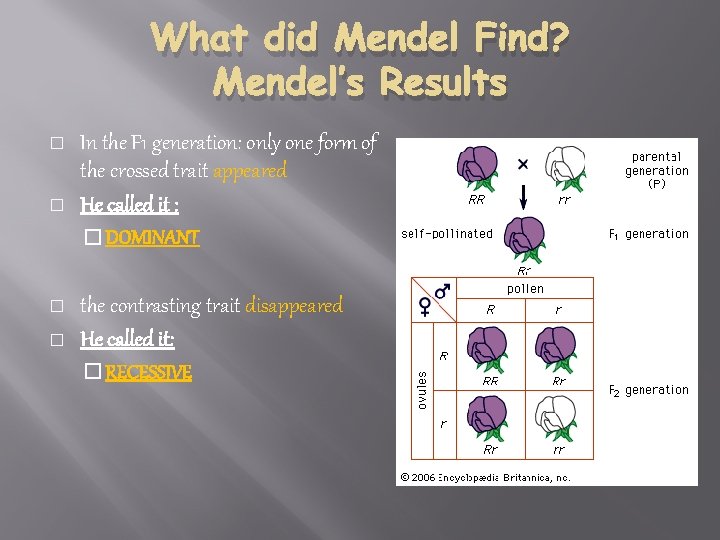
What did Mendel Find? Mendel’s Results � � In the F 1 generation: only one form of the crossed trait appeared He called it : � DOMINANT � � the contrasting trait disappeared He called it: � RECESSIVE
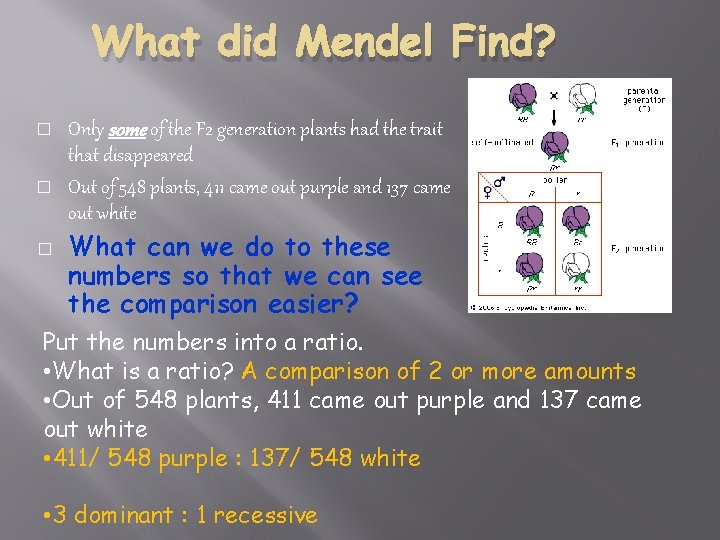
What did Mendel Find? � � � Only some of the F 2 generation plants had the trait that disappeared Out of 548 plants, 411 came out purple and 137 came out white What can we do to these numbers so that we can see the comparison easier? Put the numbers into a ratio. • What is a ratio? A comparison of 2 or more amounts • Out of 548 plants, 411 came out purple and 137 came out white • 411/ 548 purple : 137/ 548 white • 3 dominant : 1 recessive
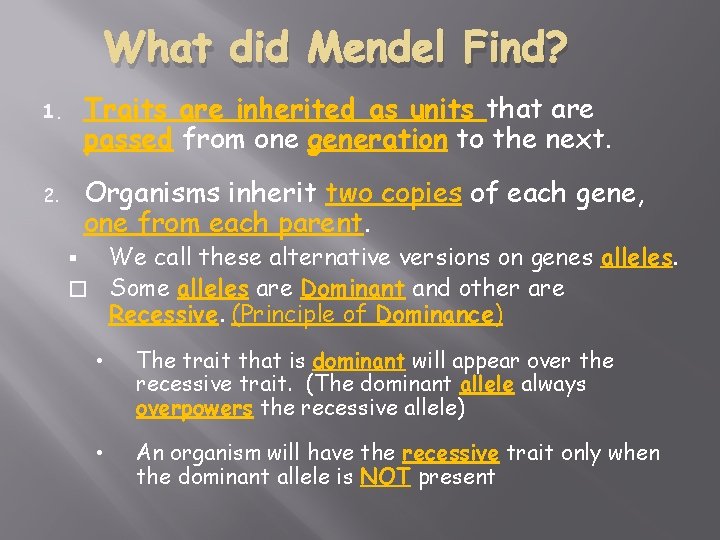
What did Mendel Find? Traits are inherited as units that are passed from one generation to the next. 1. Organisms inherit two copies of each gene, one from each parent. 2. We call these alternative versions on genes alleles. � Some alleles are Dominant and other are Recessive. (Principle of Dominance) § • The trait that is dominant will appear over the recessive trait. (The dominant allele always overpowers the recessive allele) • An organism will have the recessive trait only when the dominant allele is NOT present
What did Mendel Find? 3. Organisms donate one gene to their gametes (sperm /egg) � Thus, 2 genes separate during gamete formation - Law of Segregation
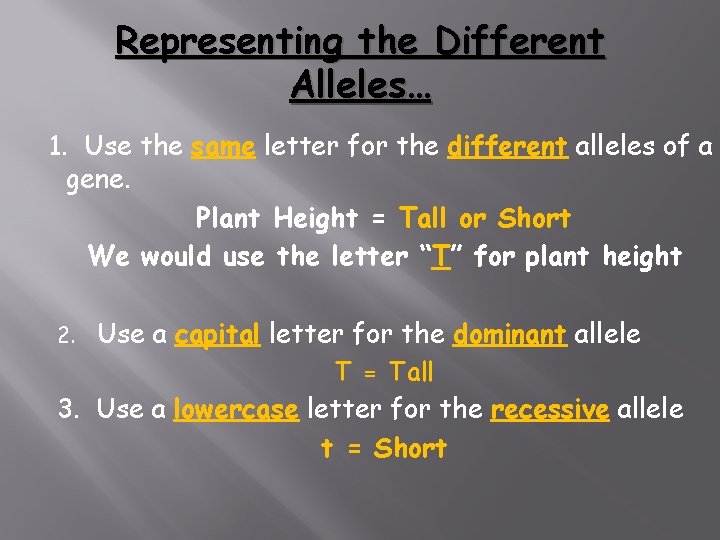
Representing the Different Alleles… 1. Use the same letter for the different alleles of a gene. Plant Height = Tall or Short We would use the letter “T” for plant height 2. Use a capital letter for the dominant allele T = Tall 3. Use a lowercase letter for the recessive allele t = Short
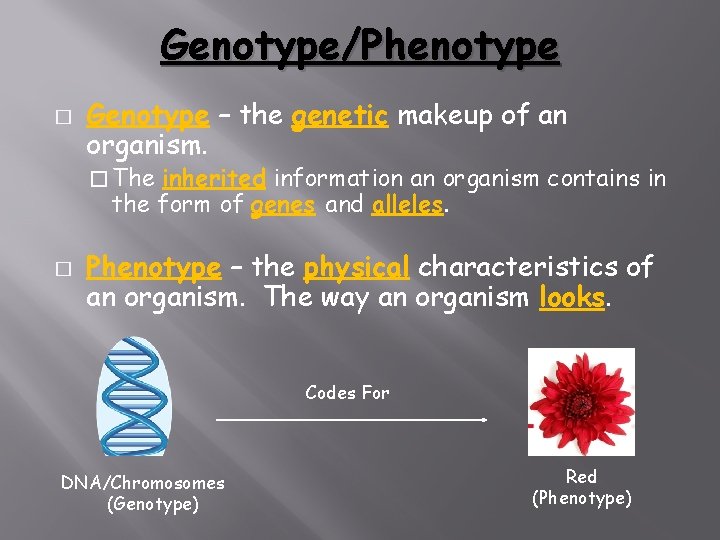
Genotype/Phenotype � Genotype – the genetic makeup of an organism. � The inherited information an organism contains in the form of genes and alleles. � Phenotype – the physical characteristics of an organism. The way an organism looks. Codes For DNA/Chromosomes (Genotype) Red (Phenotype)
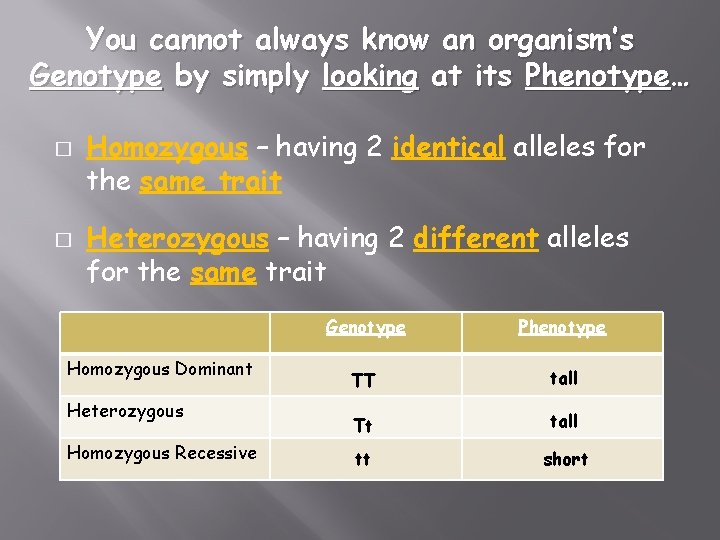
You cannot always know an organism’s Genotype by simply looking at its Phenotype… � � Homozygous – having 2 identical alleles for the same trait Heterozygous – having 2 different alleles for the same trait Homozygous Dominant Heterozygous Homozygous Recessive Genotype Phenotype TT tall Tt tall tt short
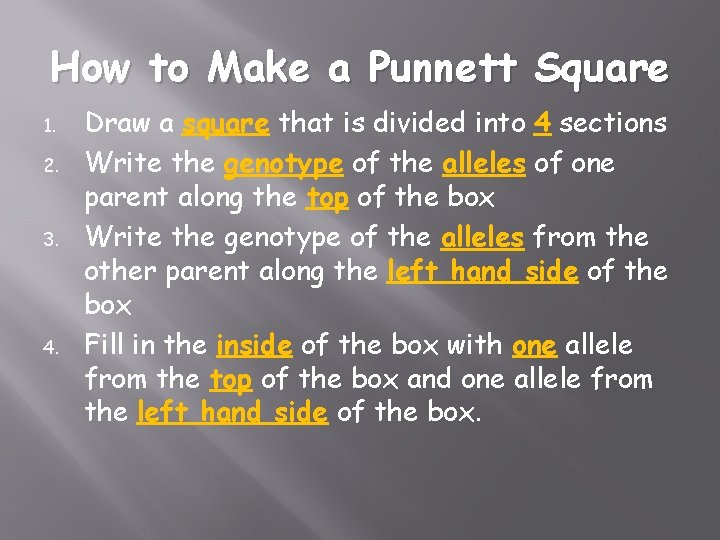
How to Make a Punnett Square 1. 2. 3. 4. Draw a square that is divided into 4 sections Write the genotype of the alleles of one parent along the top of the box Write the genotype of the alleles from the other parent along the left hand side of the box Fill in the inside of the box with one allele from the top of the box and one allele from the left hand side of the box.
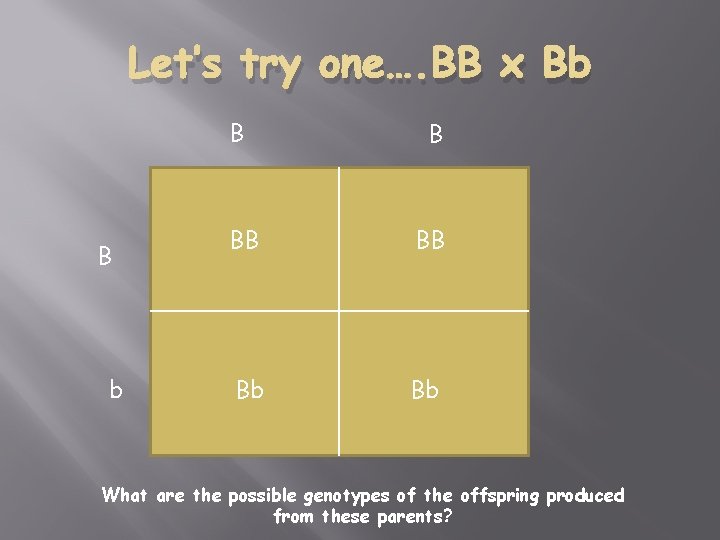
Let’s try one…. BB x Bb B BB BB Bb Bb What are the possible genotypes of the offspring produced from these parents?
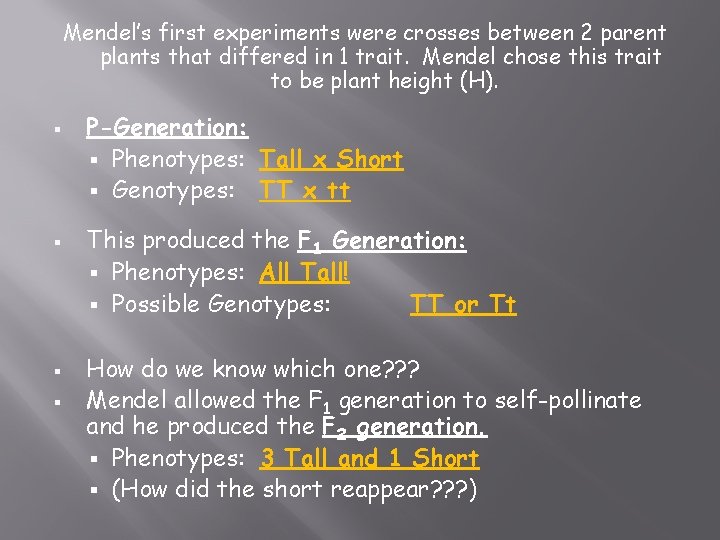
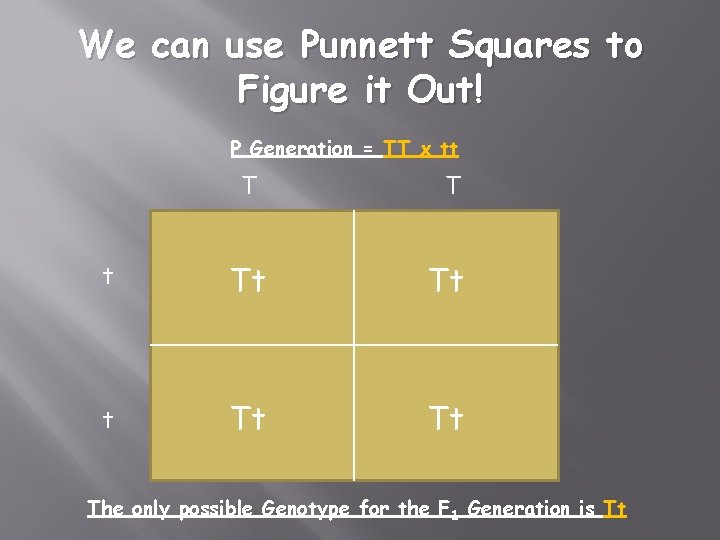
Mendel’s first experiments were crosses between 2 parent plants that differed in 1 trait. Mendel chose this trait to be plant height (H). § § P-Generation: § Phenotypes: Tall x Short § Genotypes: TT x tt This produced the F 1 Generation: § Phenotypes: All Tall! § Possible Genotypes: TT or Tt How do we know which one? ? ? Mendel allowed the F 1 generation to self-pollinate and he produced the F 2 generation. § Phenotypes: 3 Tall and 1 Short § (How did the short reappear? ? ? )
We can use Punnett Squares to Figure it Out! P Generation = TT x tt T T t Tt Tt The only possible Genotype for the F 1 Generation is Tt
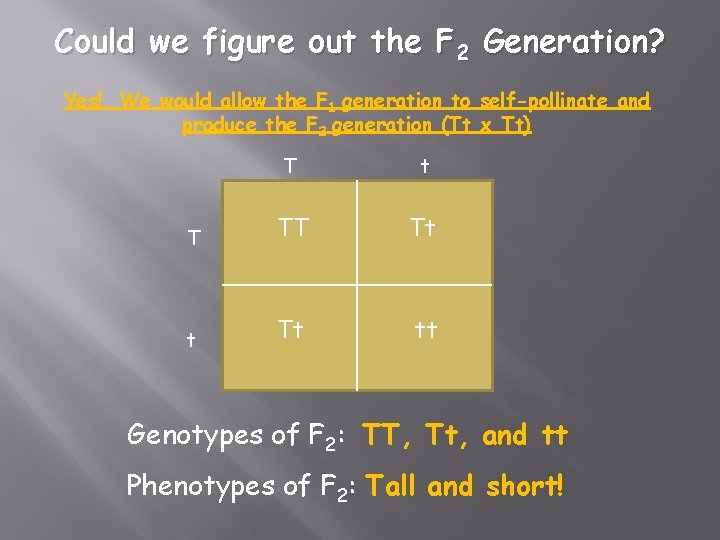
Could we figure out the F 2 Generation? Yes! We would allow the F 1 generation to self-pollinate and produce the F 2 generation (Tt x Tt) T t T TT Tt tt Genotypes of F 2: TT, Tt, and tt Phenotypes of F 2: Tall and short!
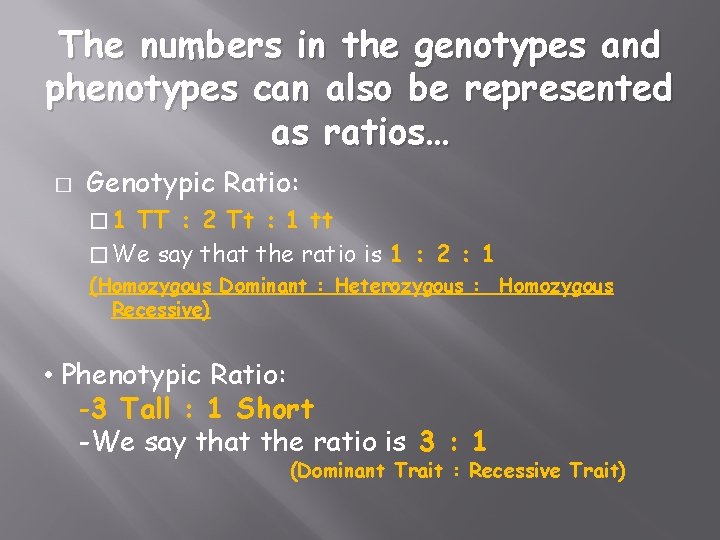
The numbers in the genotypes and phenotypes can also be represented as ratios… � Genotypic Ratio: � 1 TT : 2 Tt : 1 tt � We say that the ratio is 1 : 2 : 1 (Homozygous Dominant : Heterozygous : Homozygous Recessive) • Phenotypic Ratio: -3 Tall : 1 Short -We say that the ratio is 3 : 1 (Dominant Trait : Recessive Trait)