
Mendelian Genetics Organisms inherit genetic information in a


- Slides: 68
Mendelian Genetics
• Organisms inherit genetic information in a variety of ways that result in continuity of structure and function between parents and offspring – Coded instructions called Genes are passed on from parent to offspring • Remember: Genes are specific sequences of DNA that code for a protein.
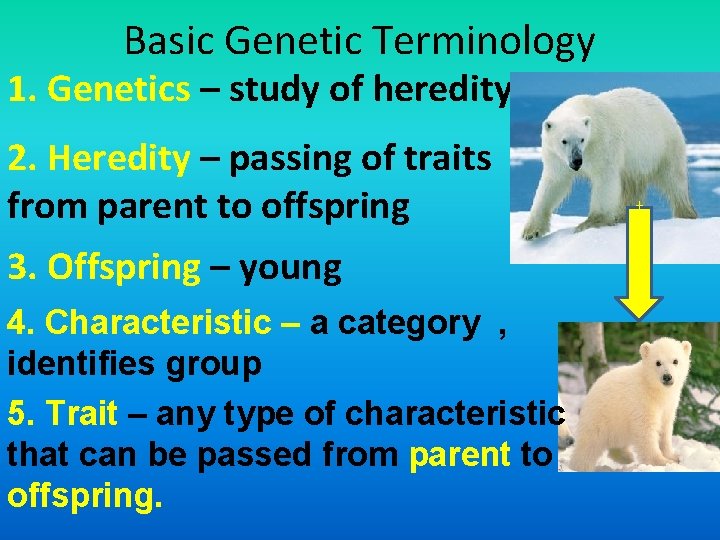
Basic Genetic Terminology 1. Genetics – study of heredity 2. Heredity – passing of traits from parent to offspring 3. Offspring – young 4. Characteristic – a category , identifies group 5. Trait – any type of characteristic that can be passed from parent to offspring. + + +
Basic Genetic Terminology 6. Paternal – father (or from father’s side) 7. Maternal – mother (or from mother’s side) 8. “N”= number of chromosomes 9 Haploid – N (half the amount of DNA or chromosomes) Sex cells 10. Diploid – 2 N (the full amount of DNA or chromosomes) Ex: skin and blood cells (autosomal cells)
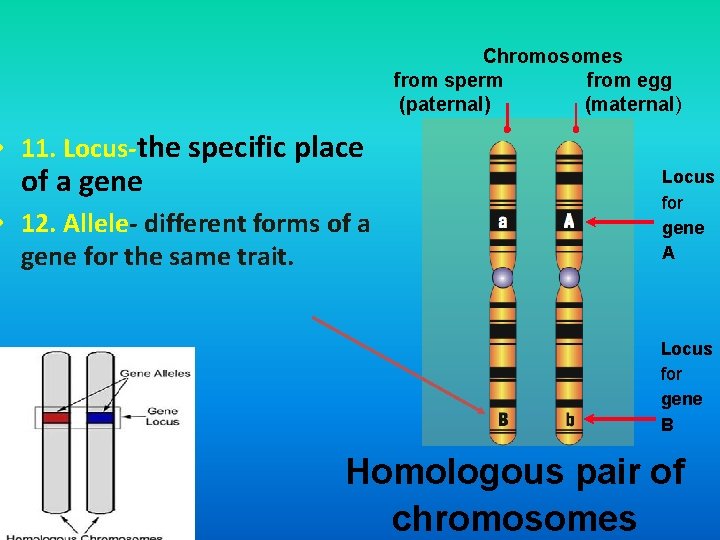
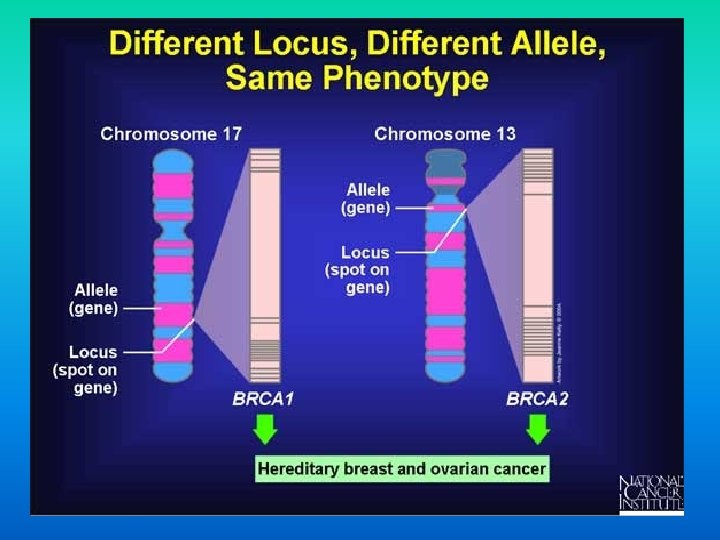
Chromosomes from sperm from egg (paternal) (maternal) • 11. Locus-the specific place of a gene • 12. Allele- different forms of a gene for the same trait. Locus for gene A Locus for gene B Homologous pair of chromosomes
The “Father of Genetics” Gregor Mendel • Austrian monk in mid 1800 s • Studied the inheritance of traits in pea plants • Developed the laws of inheritance • Mendel’s work was not recognized until the turn of the 20 th century • Fertilized pea plants with different traits
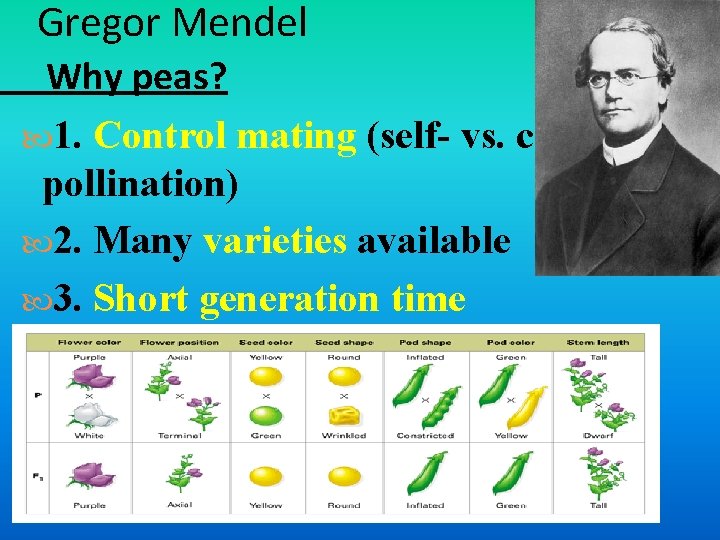
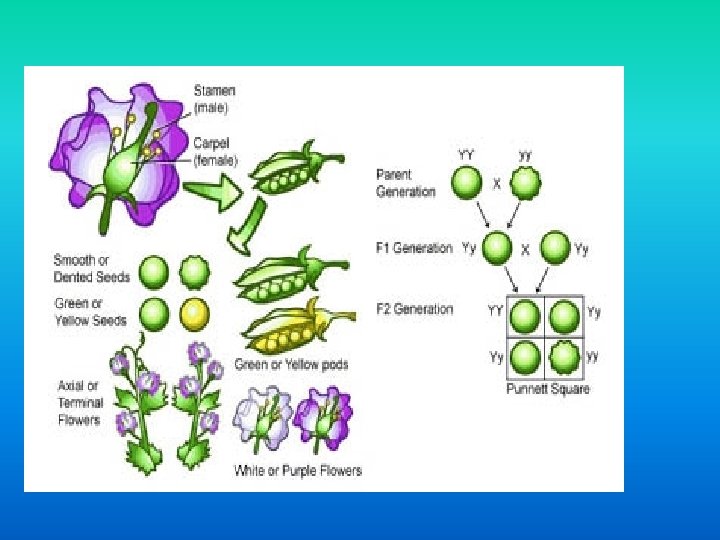
Gregor Mendel Why peas? 1. Control mating (self- vs. crosspollination) 2. Many varieties available 3. Short generation time
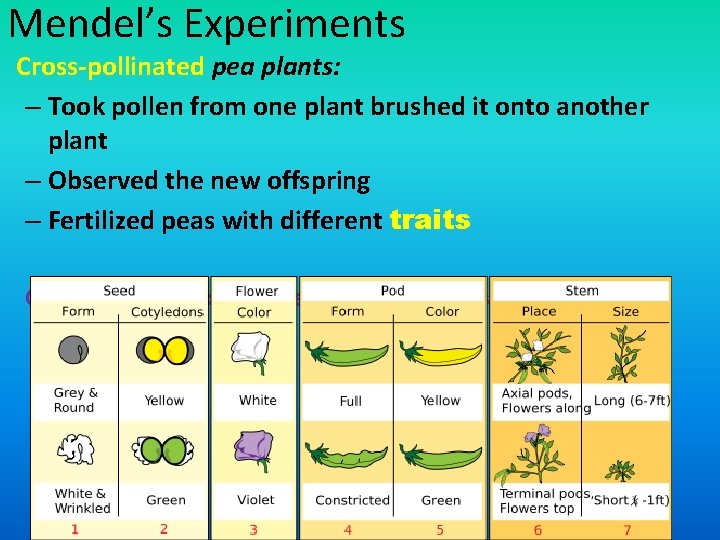
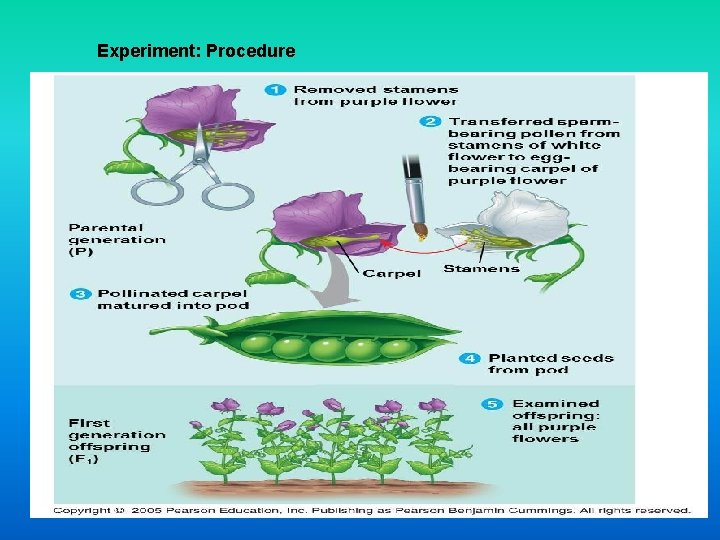
Mendel’s Experiments Cross-pollinated pea plants: – Took pollen from one plant brushed it onto another plant – Observed the new offspring – Fertilized peas with different traits Characteristic (categories) vs Traits (possibilities)
Experiment: Procedure
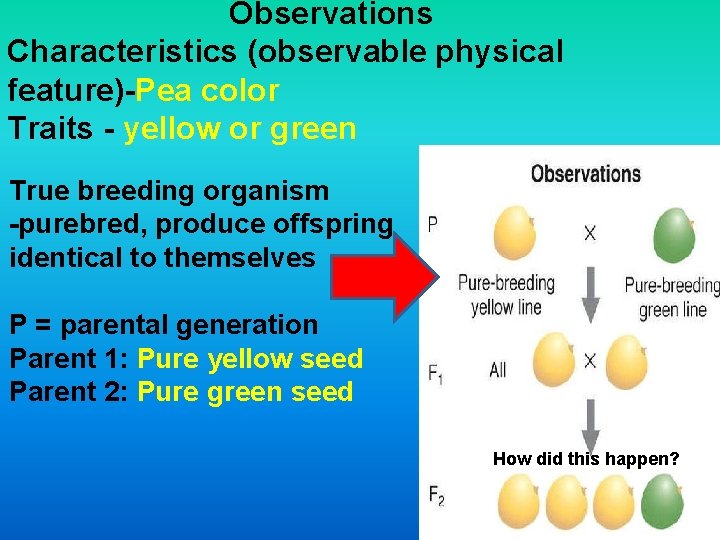
Observations Characteristics (observable physical feature)-Pea color Traits - yellow or green True breeding organism -purebred, produce offspring identical to themselves P = parental generation Parent 1: Pure yellow seed Parent 2: Pure green seed How did this happen?
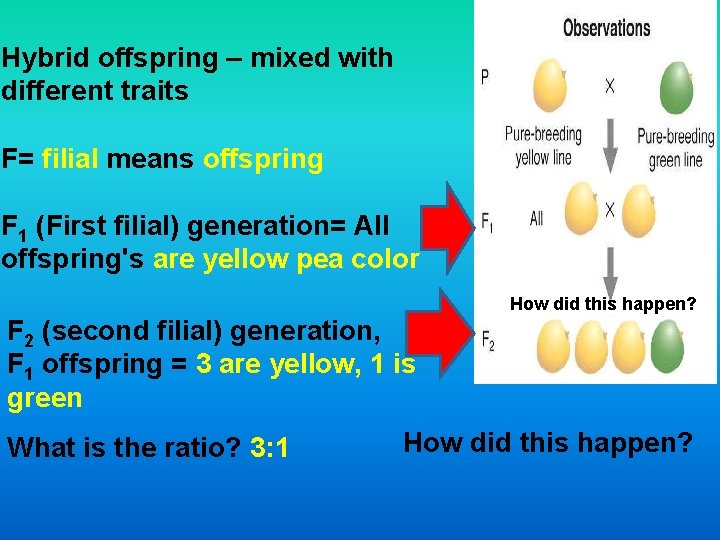
Hybrid offspring – mixed with different traits F= filial means offspring F 1 (First filial) generation= All offspring's are yellow pea color How did this happen? F 2 (second filial) generation, F 1 offspring = 3 are yellow, 1 is green What is the ratio? 3: 1 How did this happen?
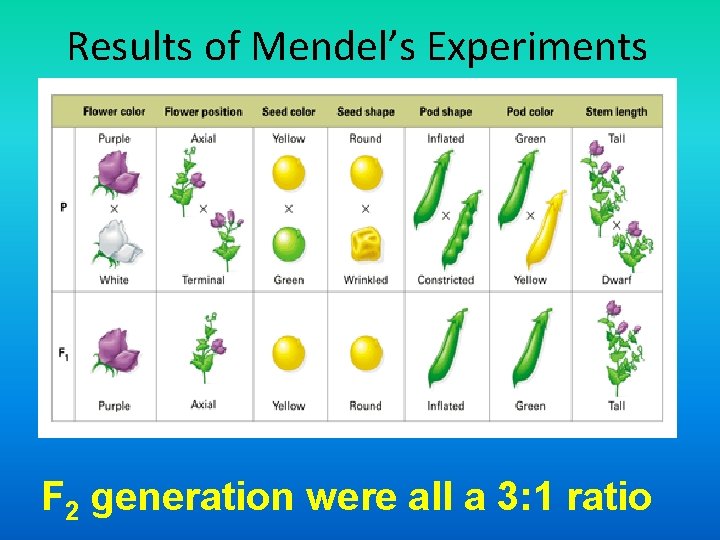
Results of Mendel’s Experiments F 2 generation were all a 3: 1 ratio
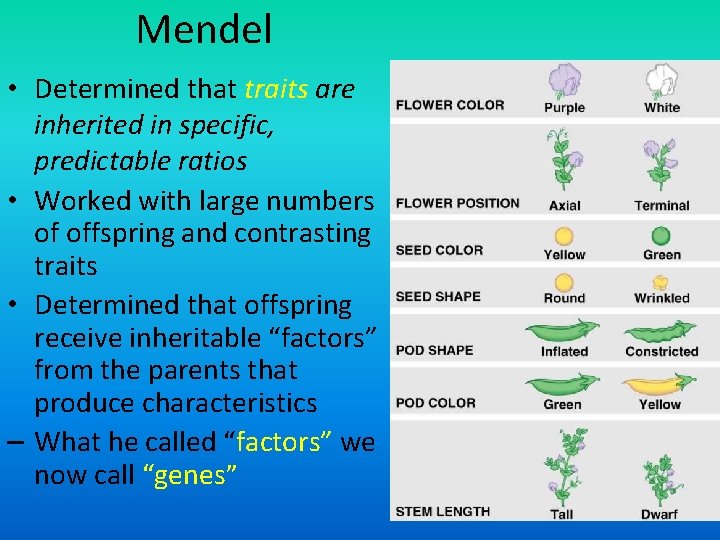
Mendel • Determined that traits are inherited in specific, predictable ratios • Worked with large numbers of offspring and contrasting traits • Determined that offspring receive inheritable “factors” from the parents that produce characteristics – What he called “factors” we now call “genes”
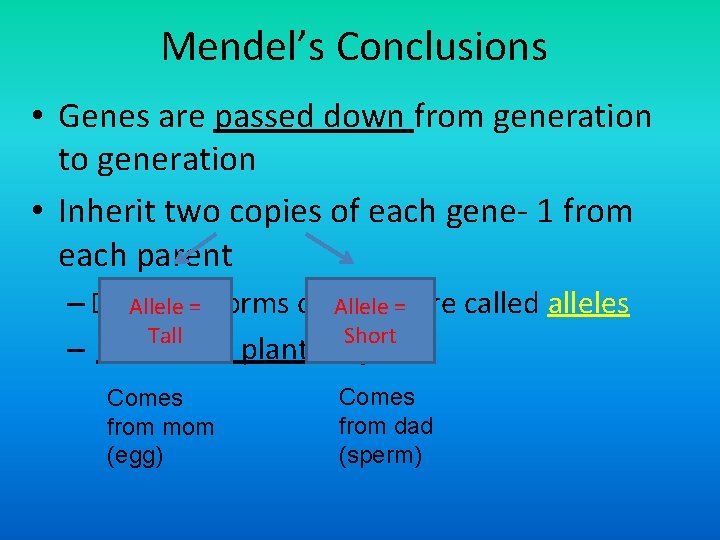
Mendel’s Conclusions • Genes are passed down from generation to generation • Inherit two copies of each gene- 1 from each parent – Different Allele = forms of genes Allele = are called alleles Tall Short – Ex: Gene = plant height Comes from mom (egg) Comes from dad (sperm)
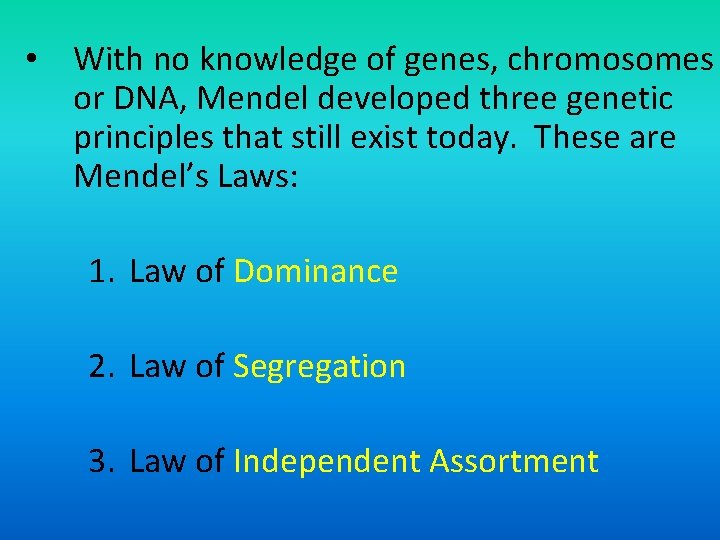
• With no knowledge of genes, chromosomes or DNA, Mendel developed three genetic principles that still exist today. These are Mendel’s Laws: 1. Law of Dominance 2. Law of Segregation 3. Law of Independent Assortment
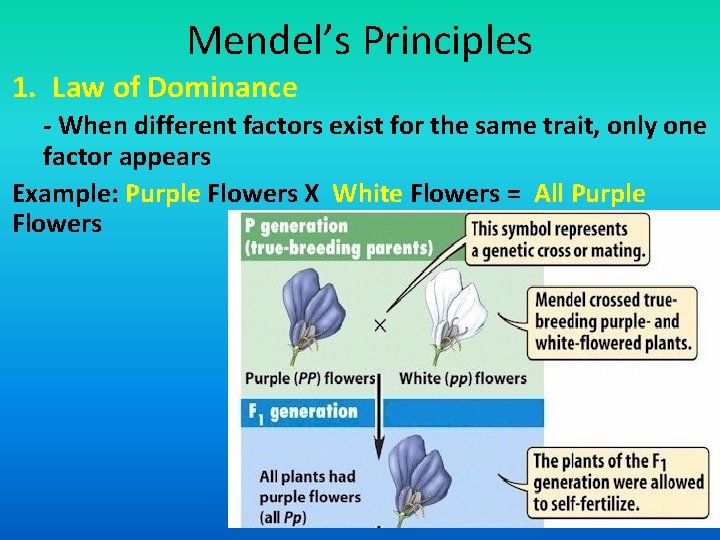
Mendel’s Principles 1. Law of Dominance - When different factors exist for the same trait, only one factor appears Example: Purple Flowers X White Flowers = All Purple Flowers
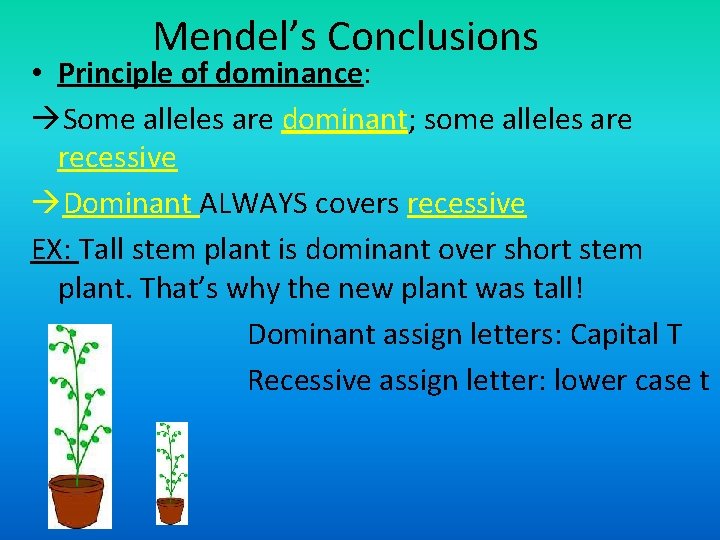
Mendel’s Conclusions • Principle of dominance: Some alleles are dominant; some alleles are recessive Dominant ALWAYS covers recessive EX: Tall stem plant is dominant over short stem plant. That’s why the new plant was tall! Dominant assign letters: Capital T Recessive assign letter: lower case t
Homozygous versus Heterozygous • Homozygous – 2 copies of the same allele –AA, aa, TT, ZZ, zz • Heterozygous –One copy of each allele –Aa, Tt, Zz
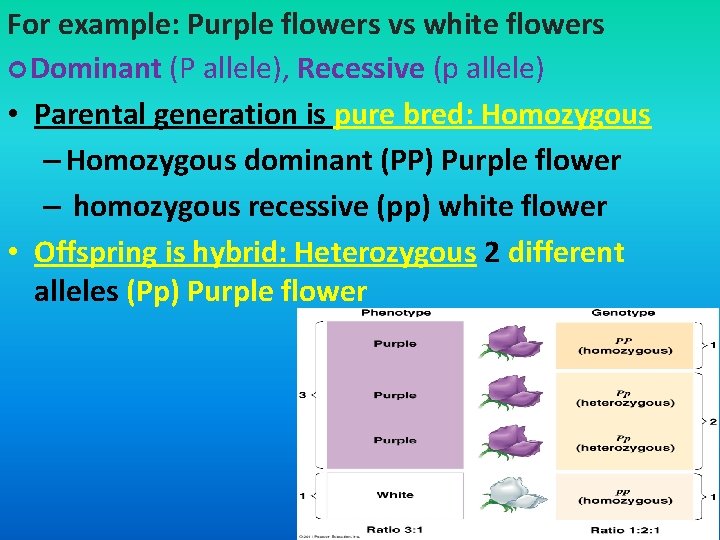
For example: Purple flowers vs white flowers Dominant (P allele), Recessive (p allele) • Parental generation is pure bred: Homozygous – Homozygous dominant (PP) Purple flower – homozygous recessive (pp) white flower • Offspring is hybrid: Heterozygous 2 different alleles (Pp) Purple flower
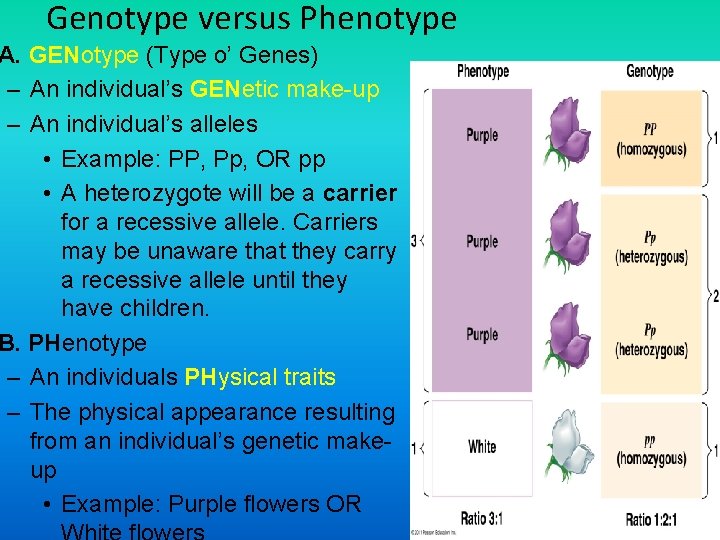
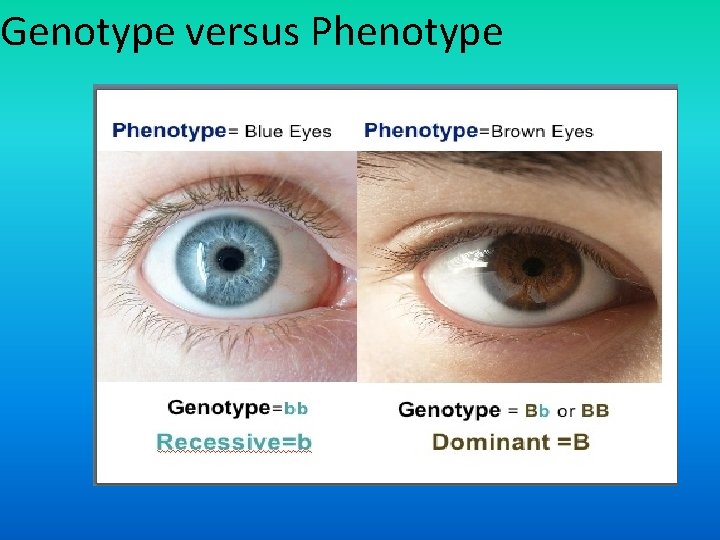
Genotype versus Phenotype A. GENotype (Type o’ Genes) – An individual’s GENetic make-up – An individual’s alleles • Example: PP, Pp, OR pp • A heterozygote will be a carrier for a recessive allele. Carriers may be unaware that they carry a recessive allele until they have children. B. PHenotype – An individuals PHysical traits – The physical appearance resulting from an individual’s genetic makeup • Example: Purple flowers OR
Genotype versus Phenotype
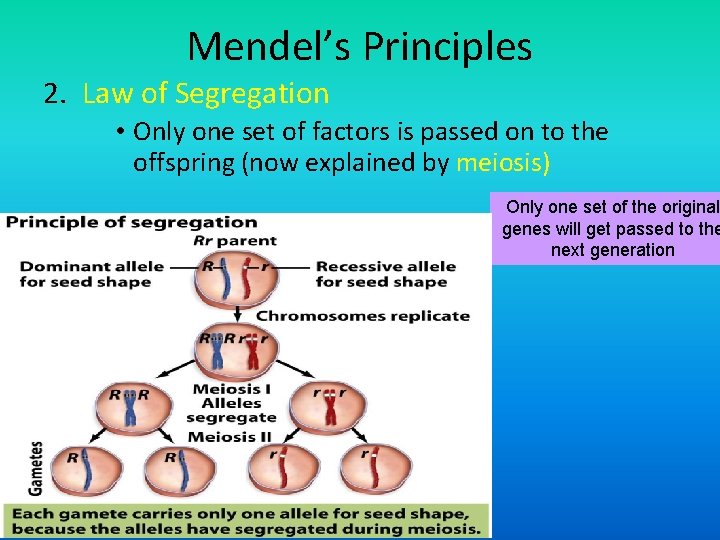
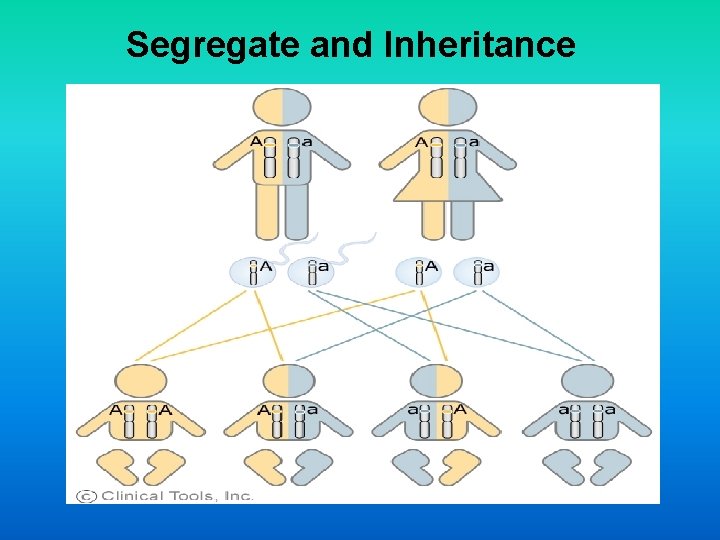
Mendel’s Principles 2. Law of Segregation • Only one set of factors is passed on to the offspring (now explained by meiosis) Only one set of the original genes will get passed to the next generation
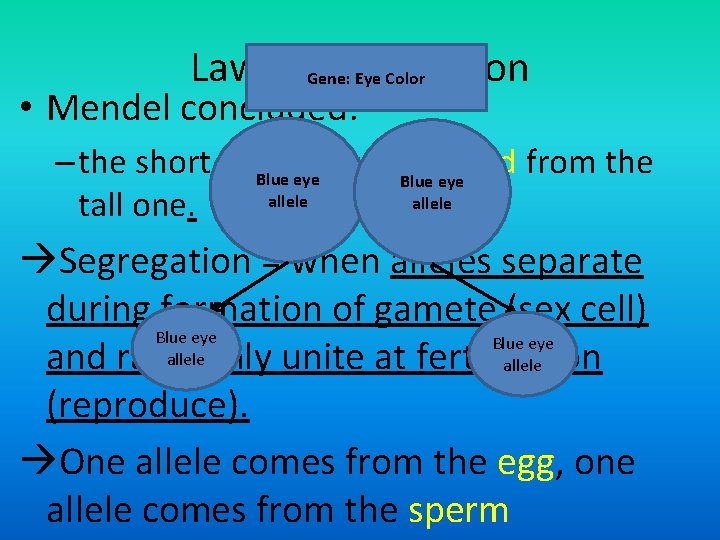
Law of. Gene: Segregation Eye Color • Mendel concluded: – the short allele was separated from the Blue eye allele tall one. Segregation = when alleles separate during formation of gamete (sex cell) Blue eye allele and randomly unite at fertilization allele (reproduce). One allele comes from the egg, one allele comes from the sperm
What meiosis process relates to Mendels law of segregation? Separation of homologous chromosomes
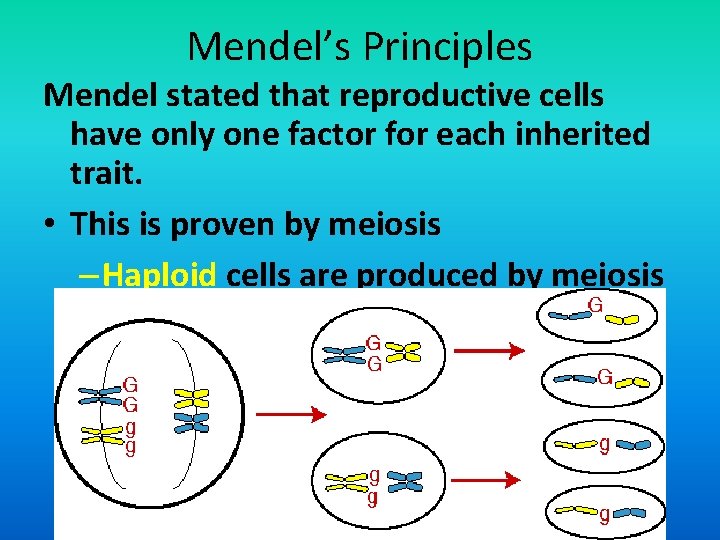
Mendel’s Principles Mendel stated that reproductive cells have only one factor for each inherited trait. • This is proven by meiosis – Haploid cells are produced by meiosis
Segregate and Inheritance
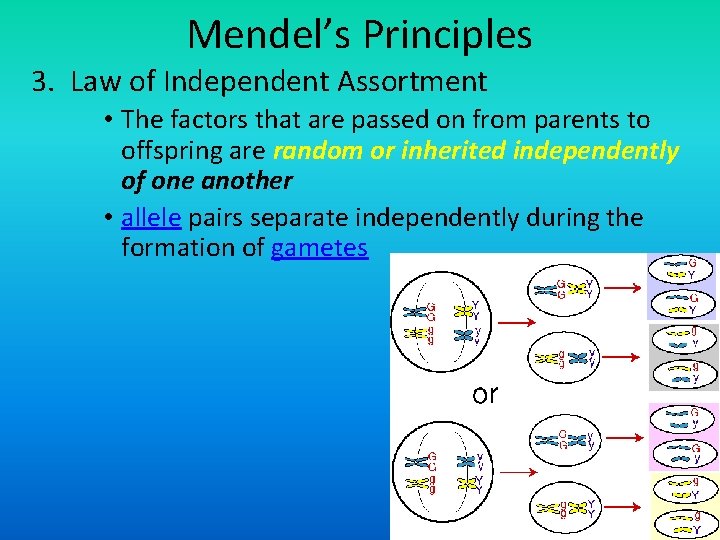
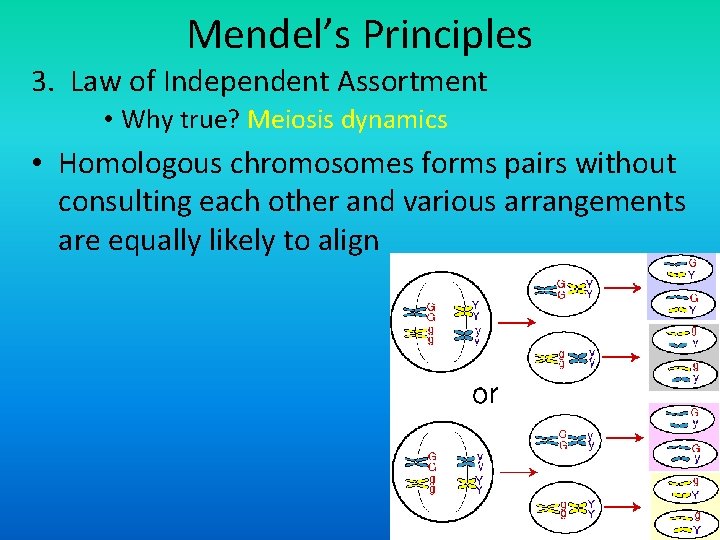
Mendel’s Principles 3. Law of Independent Assortment • The factors that are passed on from parents to offspring are random or inherited independently of one another • allele pairs separate independently during the formation of gametes
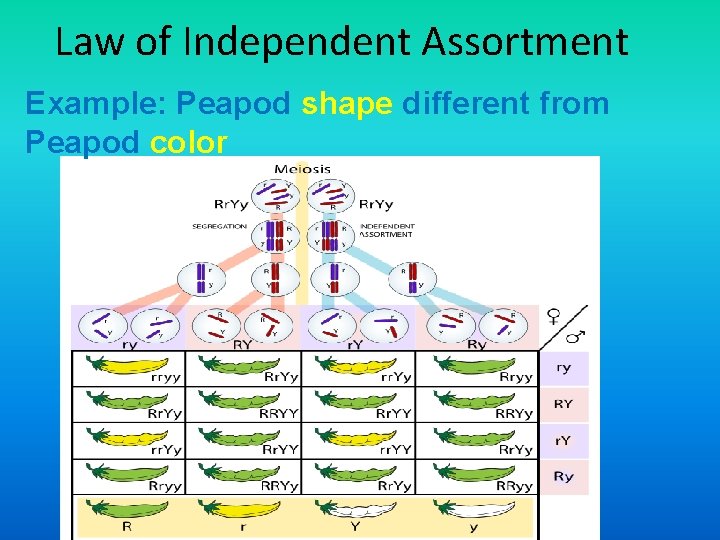
Law of Independent Assortment Example: Peapod shape different from Peapod color
Mendel’s Principles 3. Law of Independent Assortment • Why true? Meiosis dynamics • Homologous chromosomes forms pairs without consulting each other and various arrangements are equally likely to align
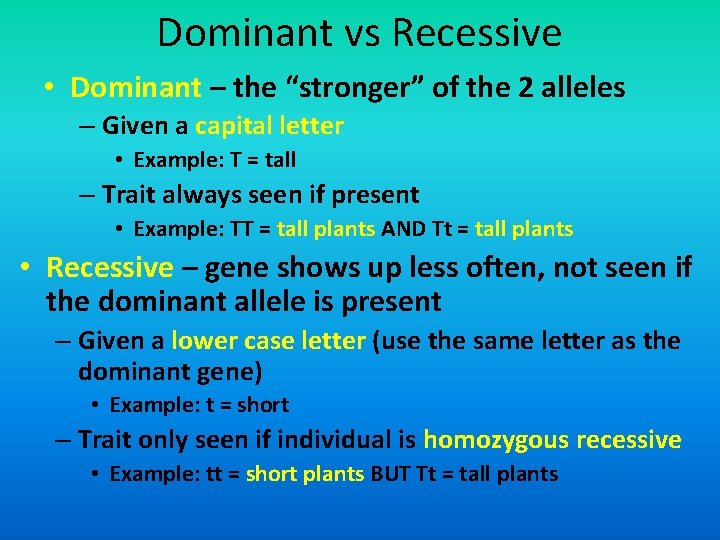
Dominant vs Recessive • Dominant – the “stronger” of the 2 alleles – Given a capital letter • Example: T = tall – Trait always seen if present • Example: TT = tall plants AND Tt = tall plants • Recessive – gene shows up less often, not seen if the dominant allele is present – Given a lower case letter (use the same letter as the dominant gene) • Example: t = short – Trait only seen if individual is homozygous recessive • Example: tt = short plants BUT Tt = tall plants
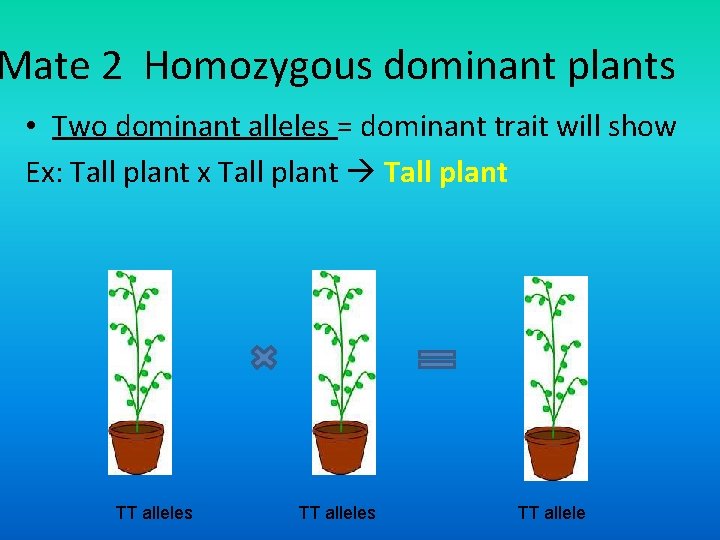
Mate 2 Homozygous dominant plants • Two dominant alleles = dominant trait will show Ex: Tall plant x Tall plant TT alleles TT allele
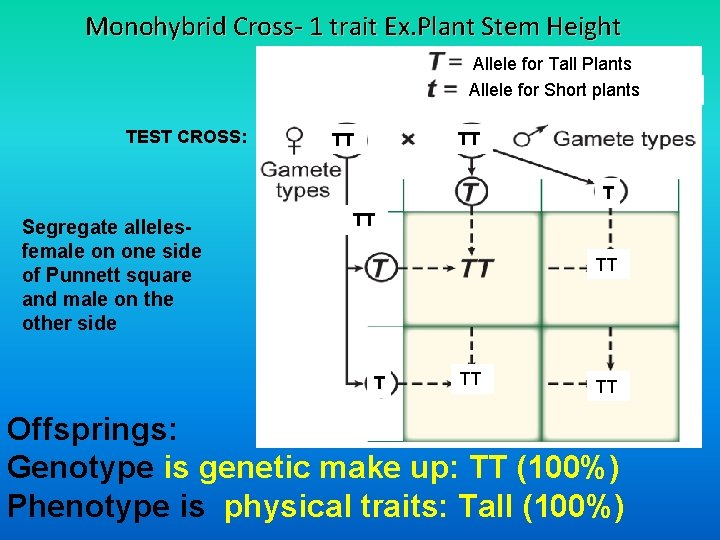
Monohybrid Cross- 1 trait Ex. Plant Stem Height Allele for Tall Plants Allele for Short plants TEST CROSS: TT TT T Segregate allelesfemale on one side of Punnett square and male on the other side TT TT TT Offsprings: Genotype is genetic make up: TT (100%) Phenotype is physical traits: Tall (100%)
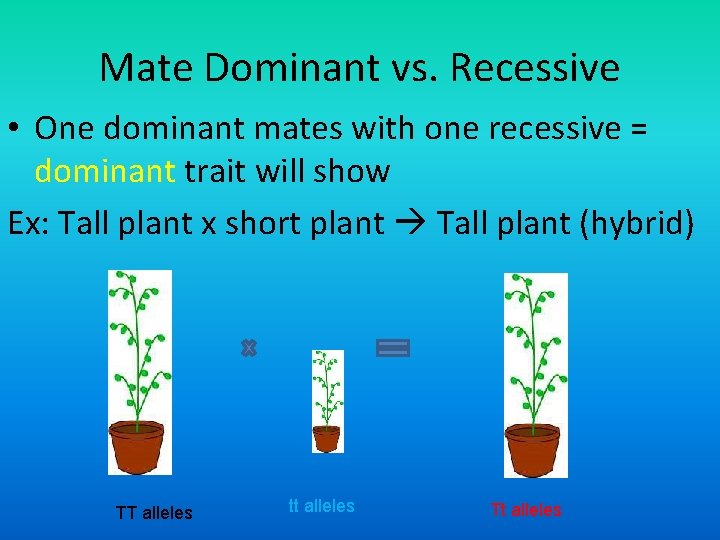
Mate Dominant vs. Recessive • One dominant mates with one recessive = dominant trait will show Ex: Tall plant x short plant Tall plant (hybrid) TT alleles tt alleles Tt alleles
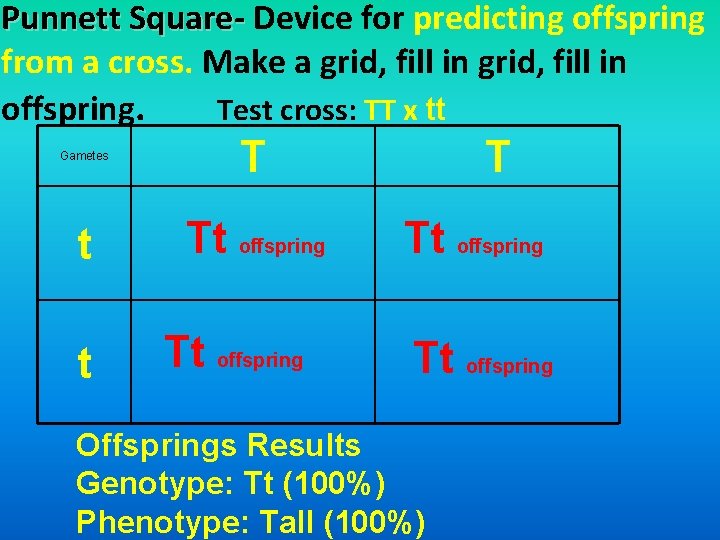
Punnett Square- Device for predicting offspring from a cross. Make a grid, fill in offspring. Test cross: TT x tt Gametes t t T Tt offspring Offsprings Results Genotype: Tt (100%) Phenotype: Tall (100%)
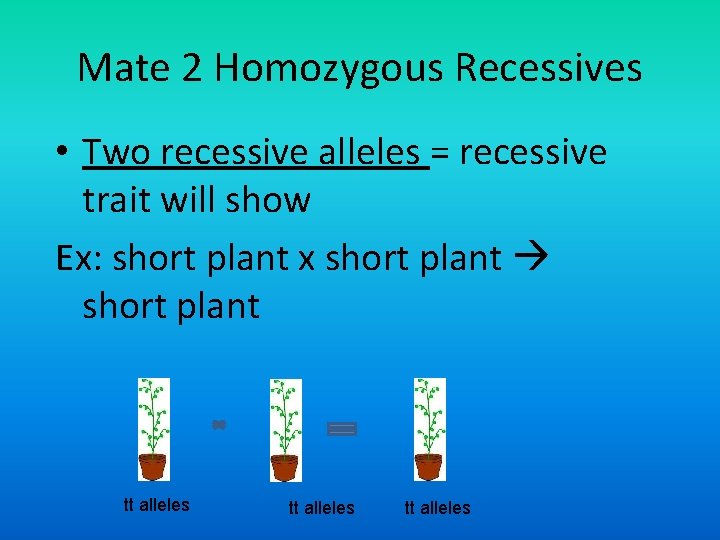
Mate 2 Homozygous Recessives • Two recessive alleles = recessive trait will show Ex: short plant x short plant tt alleles
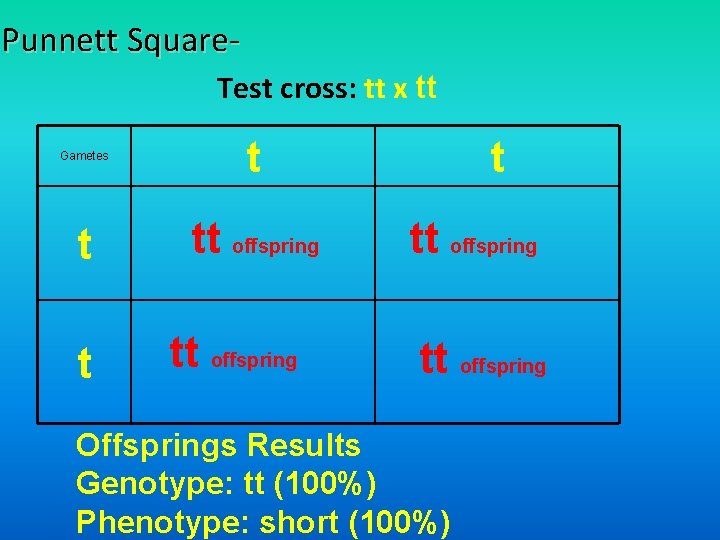
Punnett Square. Test cross: tt x tt Gametes t tt offspring Offsprings Results Genotype: tt (100%) Phenotype: short (100%)
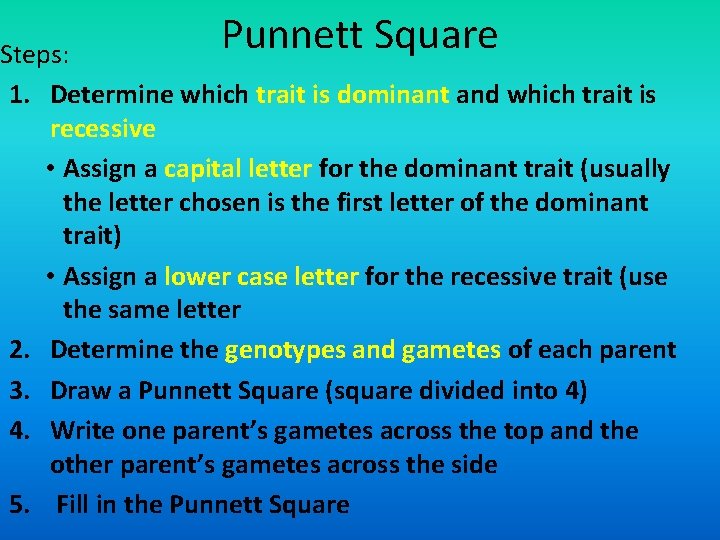
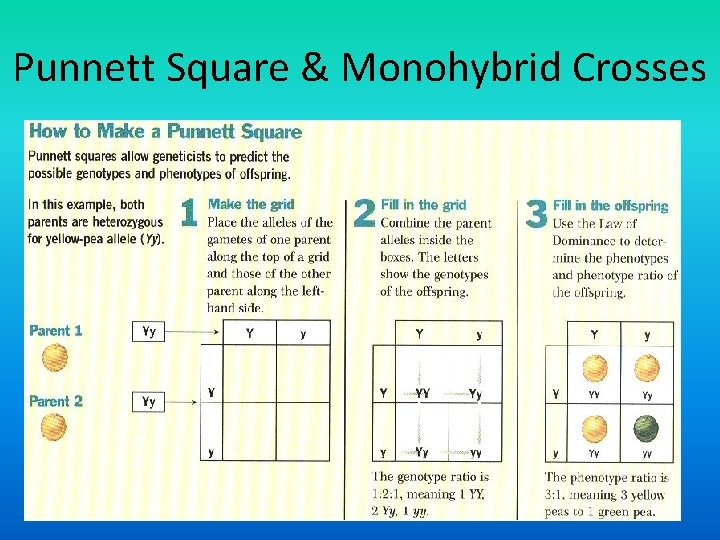
Punnett Square Steps: 1. Determine which trait is dominant and which trait is recessive • Assign a capital letter for the dominant trait (usually the letter chosen is the first letter of the dominant trait) • Assign a lower case letter for the recessive trait (use the same letter 2. Determine the genotypes and gametes of each parent 3. Draw a Punnett Square (square divided into 4) 4. Write one parent’s gametes across the top and the other parent’s gametes across the side 5. Fill in the Punnett Square
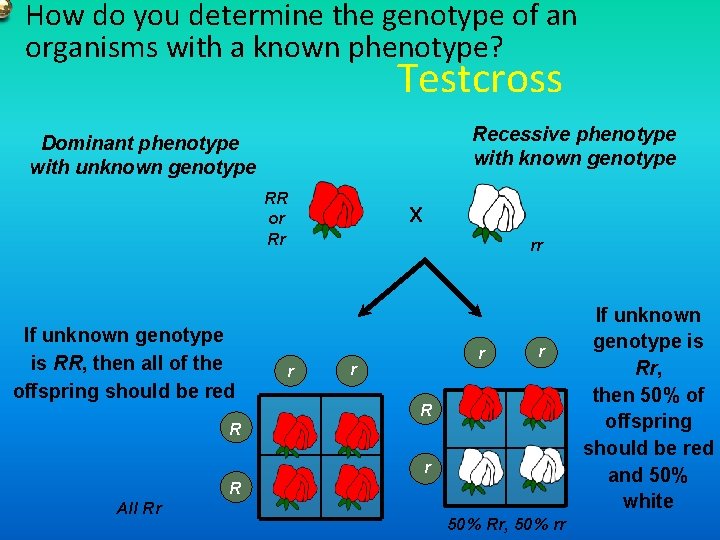
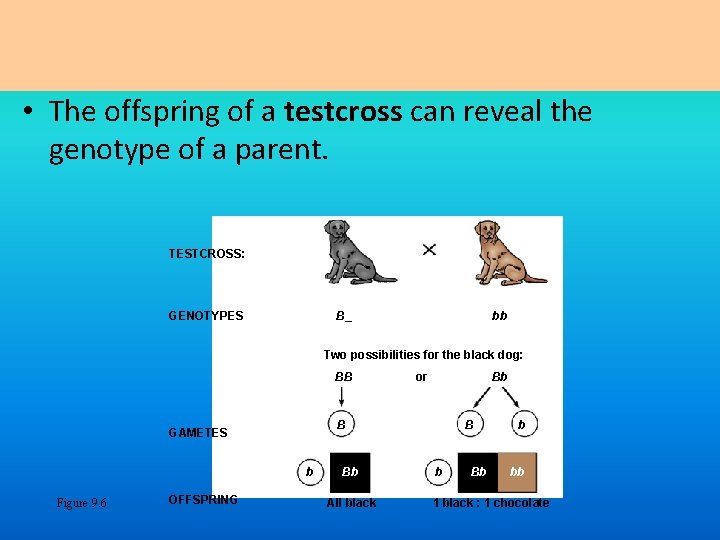
How do you determine the genotype of an organisms with a known phenotype? Testcross Recessive phenotype with known genotype Dominant phenotype with unknown genotype RR or Rr If unknown genotype is RR, then all of the offspring should be red R r X rr r R r R All Rr 50% Rr, 50% rr If unknown genotype is Rr, then 50% of offspring should be red and 50% white
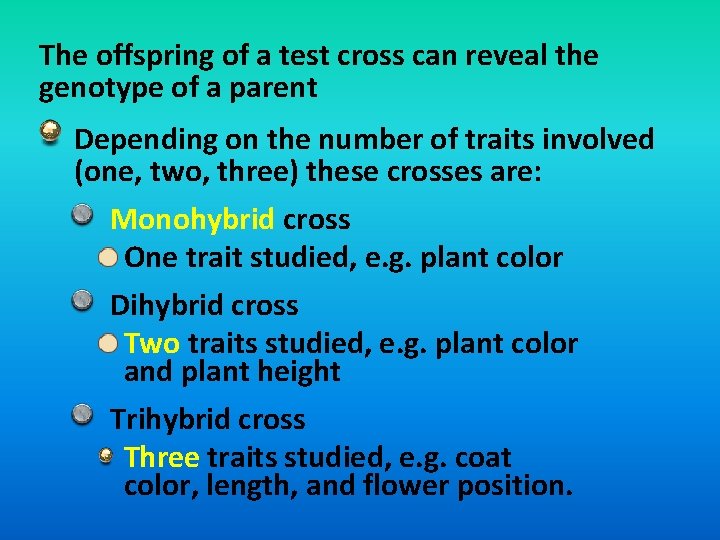
The offspring of a test cross can reveal the genotype of a parent Depending on the number of traits involved (one, two, three) these crosses are: Monohybrid cross One trait studied, e. g. plant color Dihybrid cross Two traits studied, e. g. plant color and plant height Trihybrid cross Three traits studied, e. g. coat color, length, and flower position.
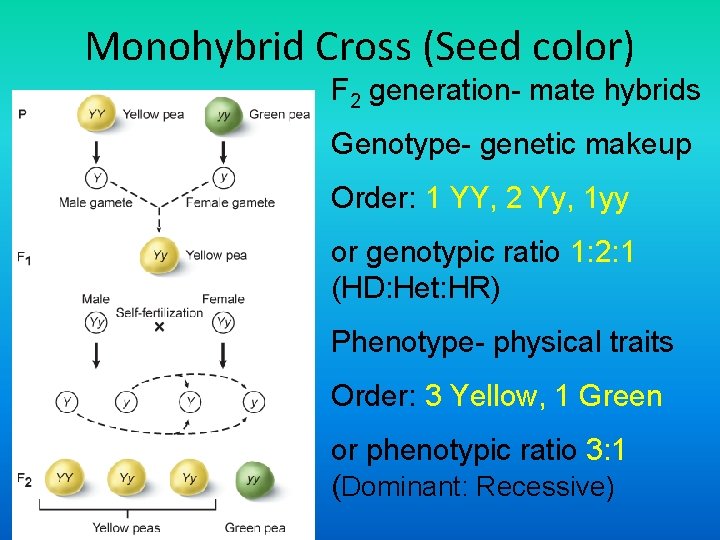
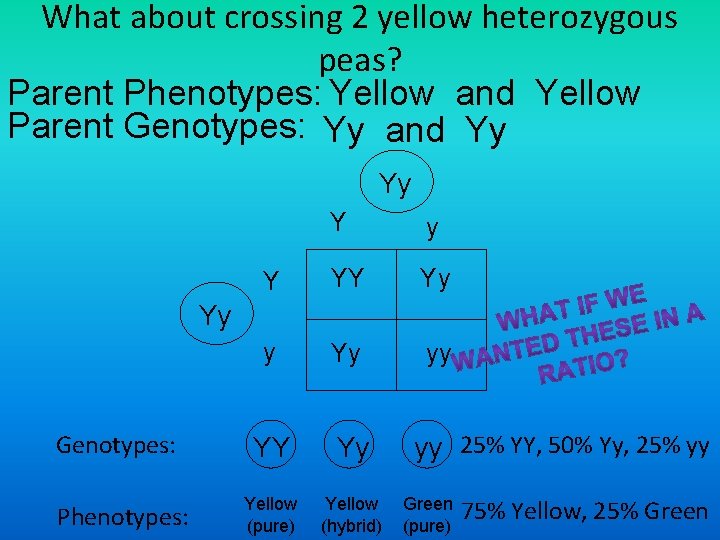
Monohybrid Cross (Seed color) F 2 generation- mate hybrids Genotype- genetic makeup Order: 1 YY, 2 Yy, 1 yy or genotypic ratio 1: 2: 1 (HD: Het: HR) Phenotype- physical traits Order: 3 Yellow, 1 Green or phenotypic ratio 3: 1 (Dominant: Recessive)
What about crossing 2 yellow heterozygous peas? Parent Phenotypes: Yellow and Yellow Parent Genotypes: Yy and Yy Yy Y YY Yy yy YY Yy Yellow (pure) Yellow (hybrid) Yy Genotypes: Phenotypes: yy 25% YY, 50% Yy, 25% yy Green (pure) 75% Yellow, 25% Green
The End
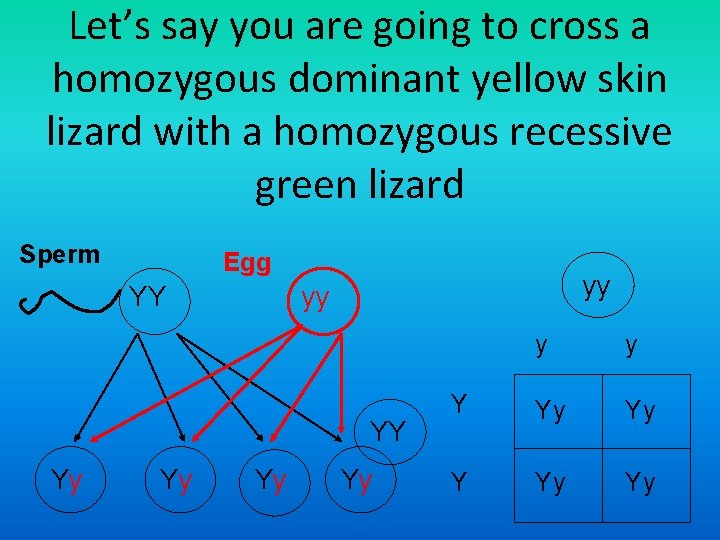
Let’s say you are going to cross a homozygous dominant yellow skin lizard with a homozygous recessive green lizard Sperm Egg YY yy yy YY Yy Yy y y Y Yy Yy
Punnett Squares • 1905, Reginald Punnett, an English biologist, devised the shorthand way of finding the expected proportions of possible genotypes in the offspring of a cross • Used to predict the possible genotypes of offspring • In reality, you don’t get the exact ratio of results shown in the square
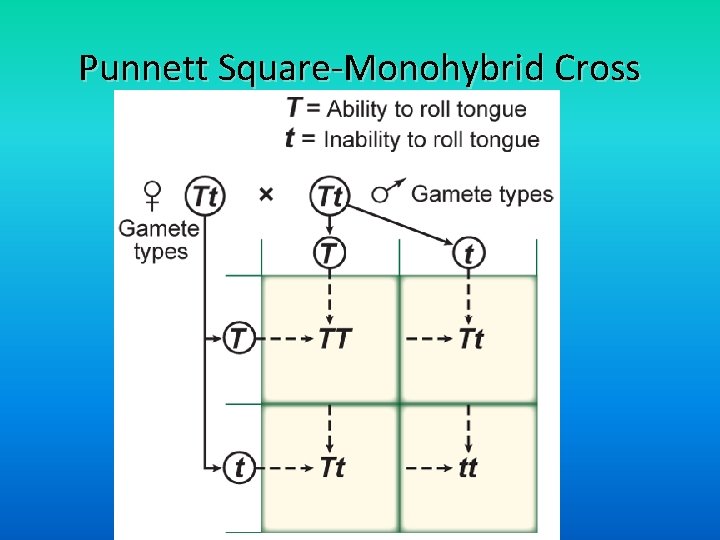
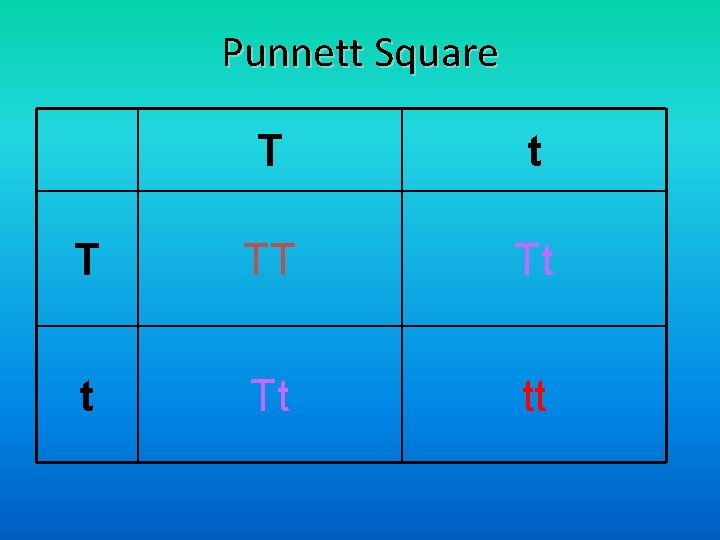
Punnett Square-Monohybrid Cross
Punnett Square T t T TT Tt tt
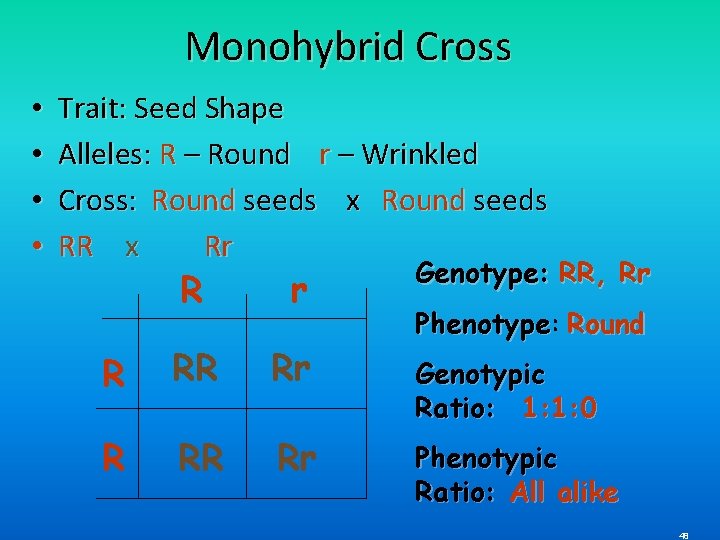
Monohybrid Cross • • Trait: Seed Shape Alleles: R – Round r – Wrinkled Cross: Round seeds x Round seeds RR x Rr R RR Rr Genotype: RR, Rr Phenotype: Phenotype Round Genotypic Ratio: 1: 1: 0 Phenotypic Ratio: All alike 48
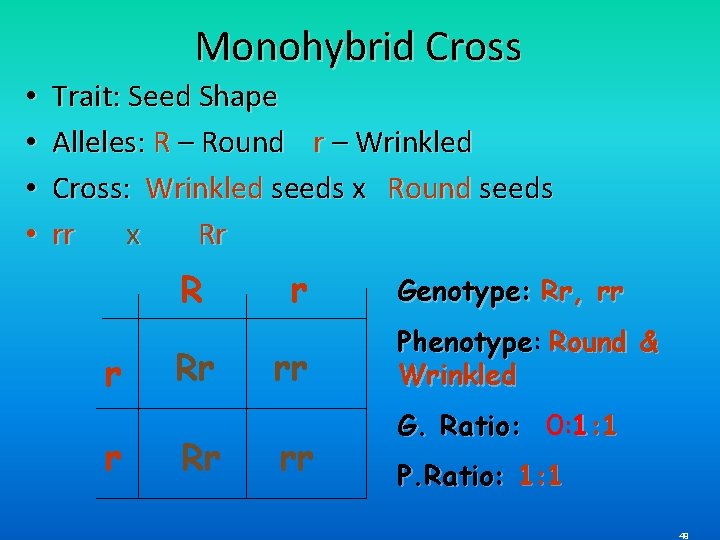
Monohybrid Cross • • Trait: Seed Shape Alleles: R – Round r – Wrinkled Cross: Wrinkled seeds x Round seeds rr x Rr R r r Rr Rr r rr rr Genotype: Rr, rr Phenotype: Phenotype Round & Wrinkled G. Ratio: 0: 1: 1 P. Ratio: 1: 1 49
Genes are found where?
Chromosomes REMEMBER: genes control traits
Punnett Square Practice Let’s try some practice! • Punnett Square Practice
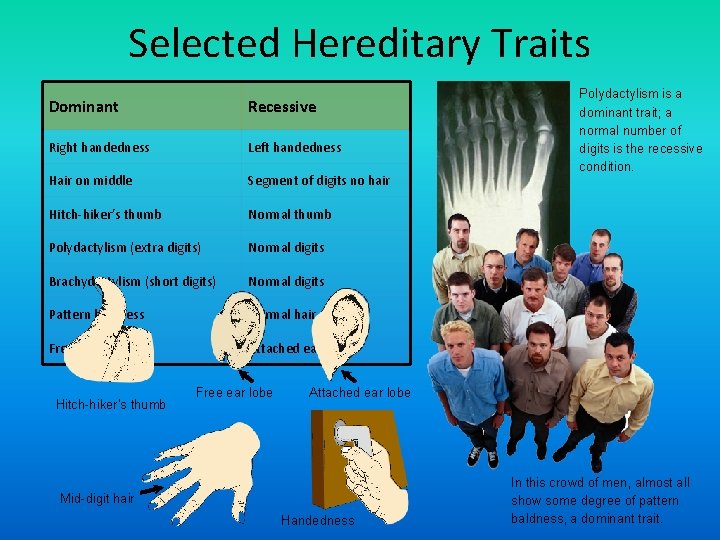
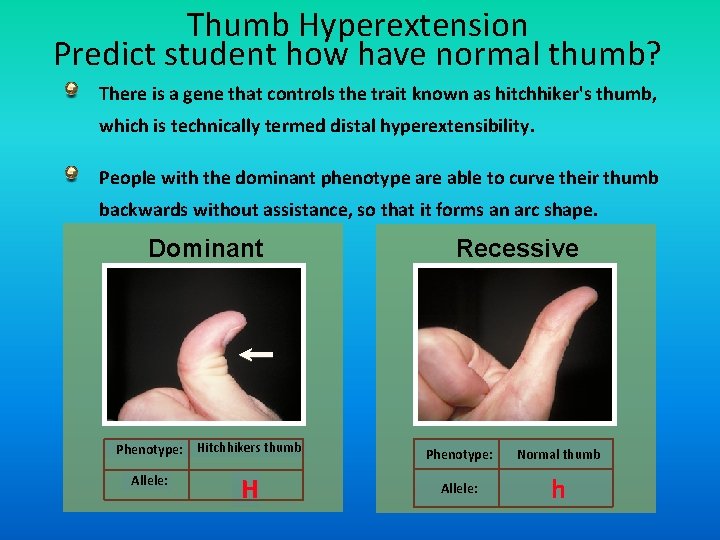
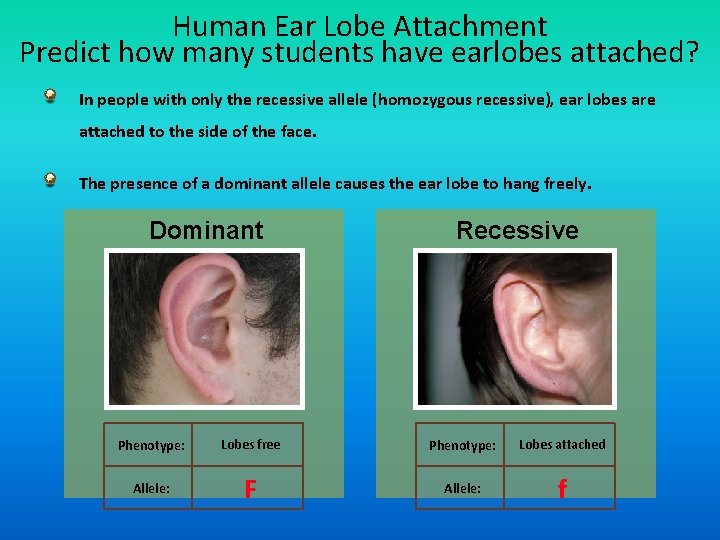
Selected Hereditary Traits Dominant Recessive Right handedness Left handedness Hair on middle Segment of digits no hair Hitch-hiker’s thumb Normal thumb Polydactylism (extra digits) Normal digits Brachydactylism (short digits) Normal digits Pattern baldness Normal hair Free ear lobes Attached ear lobes Hitch-hiker’s thumb Free ear lobe Polydactylism is a dominant trait; a normal number of digits is the recessive condition. Attached ear lobe Mid-digit hair Handedness In this crowd of men, almost all show some degree of pattern baldness, a dominant trait.
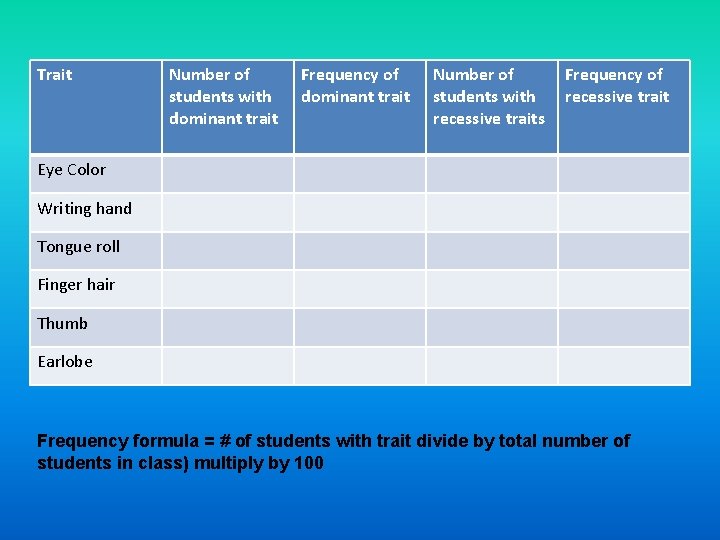
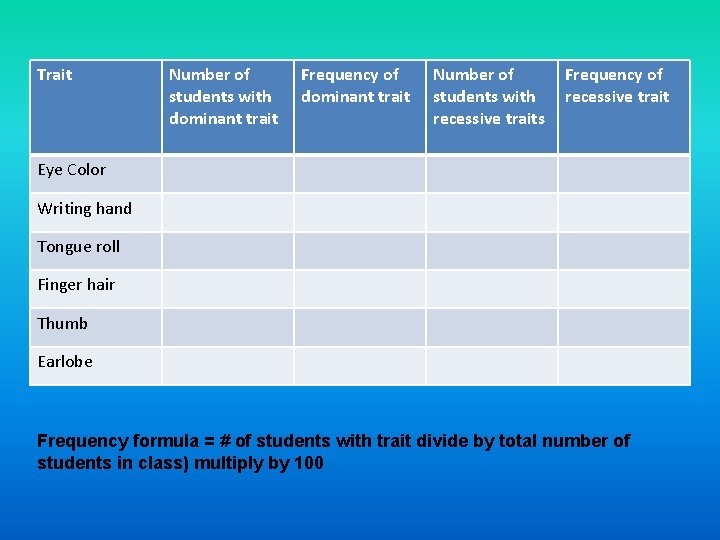
Trait Number of students with dominant trait Frequency of dominant trait Number of students with recessive traits Frequency of recessive trait Eye Color Writing hand Tongue roll Finger hair Thumb Earlobe Frequency formula = # of students with trait divide by total number of students in class) multiply by 100
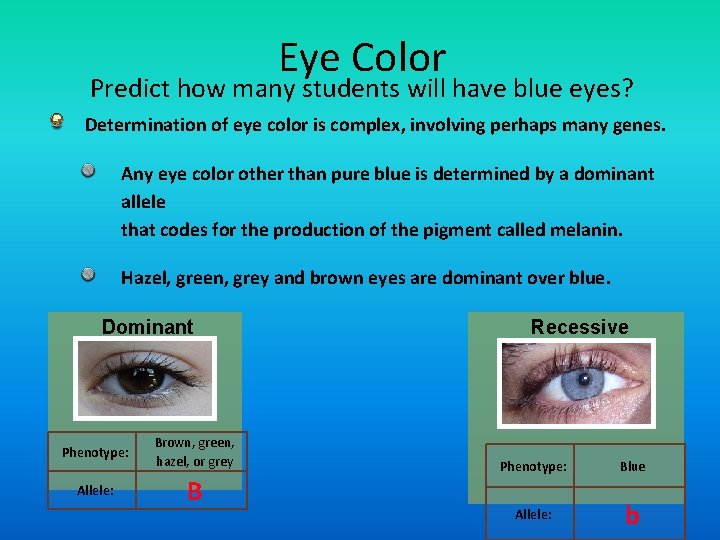
Eye Color Predict how many students will have blue eyes? Determination of eye color is complex, involving perhaps many genes. Any eye color other than pure blue is determined by a dominant allele that codes for the production of the pigment called melanin. Hazel, green, grey and brown eyes are dominant over blue. Dominant Phenotype: Brown, green, hazel, or grey Allele: B Recessive Phenotype: Blue Allele: b
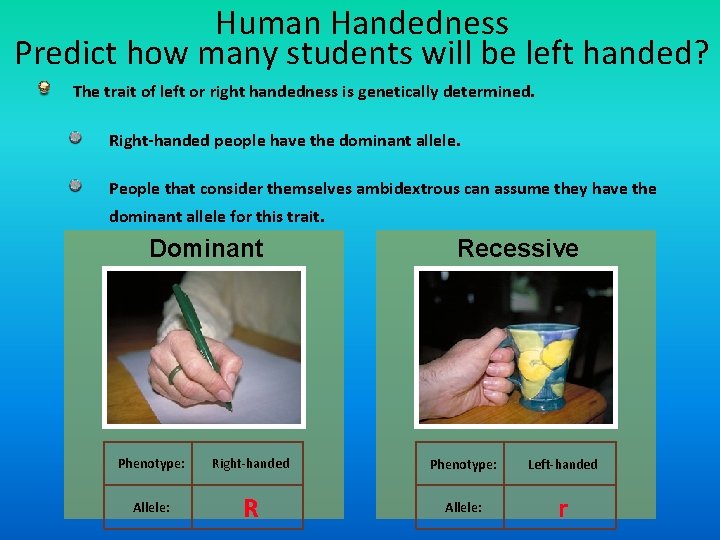
Human Handedness Predict how many students will be left handed? The trait of left or right handedness is genetically determined. Right-handed people have the dominant allele. People that consider themselves ambidextrous can assume they have the dominant allele for this trait. Dominant Recessive Phenotype: Right-handed Phenotype: Left-handed Allele: R Allele: r
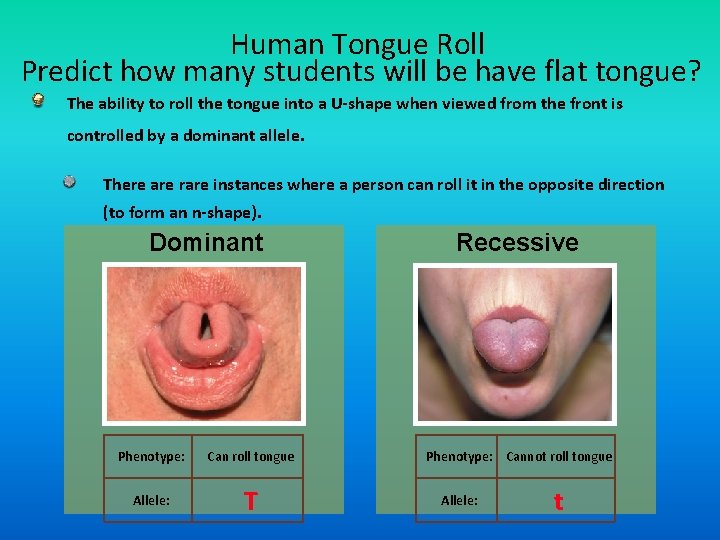
Human Tongue Roll Predict how many students will be have flat tongue? The ability to roll the tongue into a U-shape when viewed from the front is controlled by a dominant allele. There are rare instances where a person can roll it in the opposite direction (to form an n-shape). Dominant Phenotype: Can roll tongue Allele: T Recessive Phenotype: Cannot roll tongue Allele: t
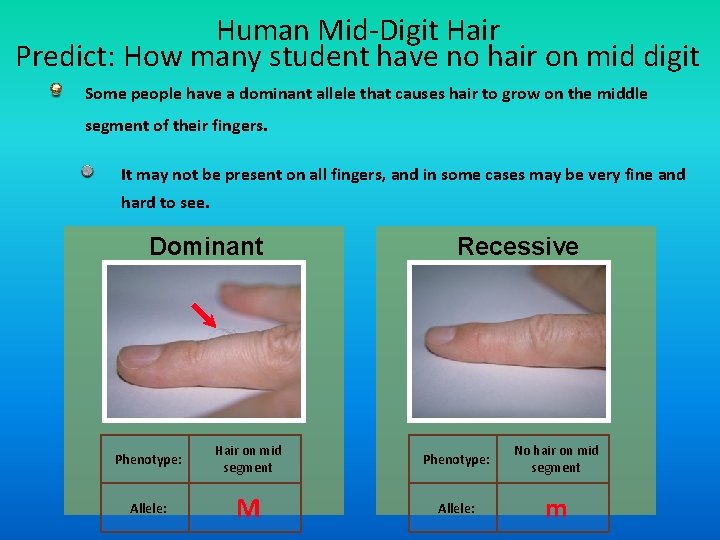
Human Mid-Digit Hair Predict: How many student have no hair on mid digit Some people have a dominant allele that causes hair to grow on the middle segment of their fingers. It may not be present on all fingers, and in some cases may be very fine and hard to see. Dominant Recessive Phenotype: Hair on mid segment Phenotype: No hair on mid segment Allele: M Allele: m
Thumb Hyperextension Predict student how have normal thumb? There is a gene that controls the trait known as hitchhiker's thumb, which is technically termed distal hyperextensibility. People with the dominant phenotype are able to curve their thumb backwards without assistance, so that it forms an arc shape. Dominant Phenotype: Hitchhikers thumb Allele: H Recessive Phenotype: Normal thumb Allele: h
Human Ear Lobe Attachment Predict how many students have earlobes attached? In people with only the recessive allele (homozygous recessive), ear lobes are attached to the side of the face. The presence of a dominant allele causes the ear lobe to hang freely. Dominant Recessive Phenotype: Lobes free Phenotype: Lobes attached Allele: F Allele: f
Trait Number of students with dominant trait Frequency of dominant trait Number of students with recessive traits Frequency of recessive trait Eye Color Writing hand Tongue roll Finger hair Thumb Earlobe Frequency formula = # of students with trait divide by total number of students in class) multiply by 100
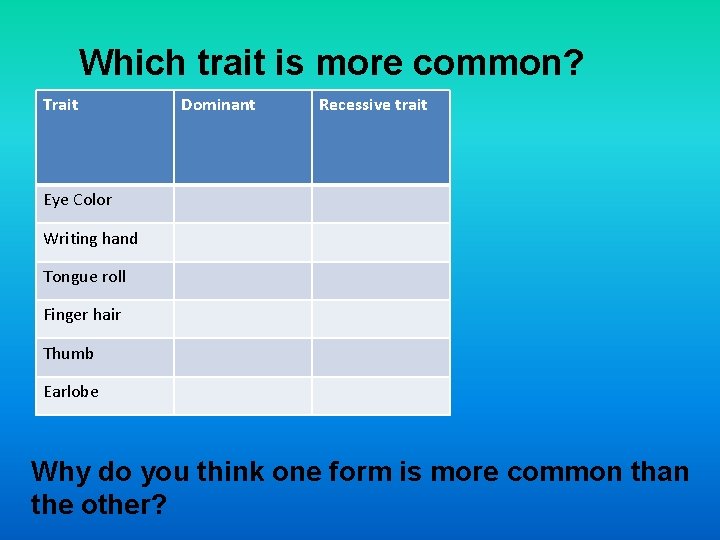
Which trait is more common? Trait Dominant Recessive trait Eye Color Writing hand Tongue roll Finger hair Thumb Earlobe Why do you think one form is more common than the other?
• Do you think our classroom population is typical of a larger population such as your entire school or community? Explain your answer.
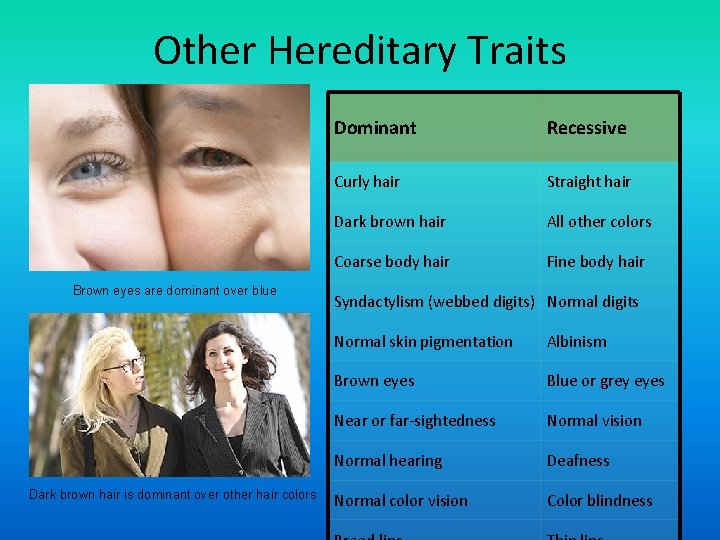
Other Hereditary Traits Brown eyes are dominant over blue Dark brown hair is dominant over other hair colors Dominant Recessive Curly hair Straight hair Dark brown hair All other colors Coarse body hair Fine body hair Syndactylism (webbed digits) Normal digits Normal skin pigmentation Albinism Brown eyes Blue or grey eyes Near or far-sightedness Normal vision Normal hearing Deafness Normal color vision Color blindness
• The offspring of a testcross can reveal the genotype of a parent. TESTCROSS: GENOTYPES B_ bb Two possibilities for the black dog: BB b OFFSPRING Bb B GAMETES Figure 9. 6 or Bb All black B b Bb b bb 1 black : 1 chocolate
Punnett Square & Monohybrid Crosses