
Mendelian Genetics Mendelian Genetics Heredity the passing of
- Slides: 64
Mendelian Genetics
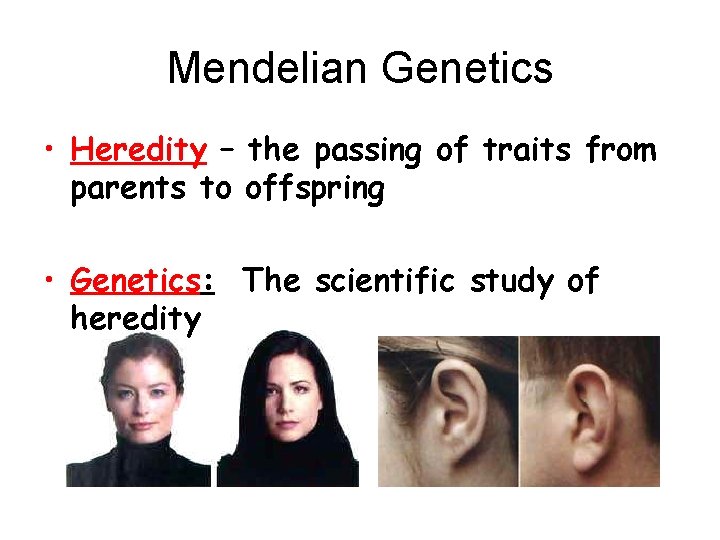
Mendelian Genetics • Heredity – the passing of traits from parents to offspring • Genetics: The scientific study of heredity
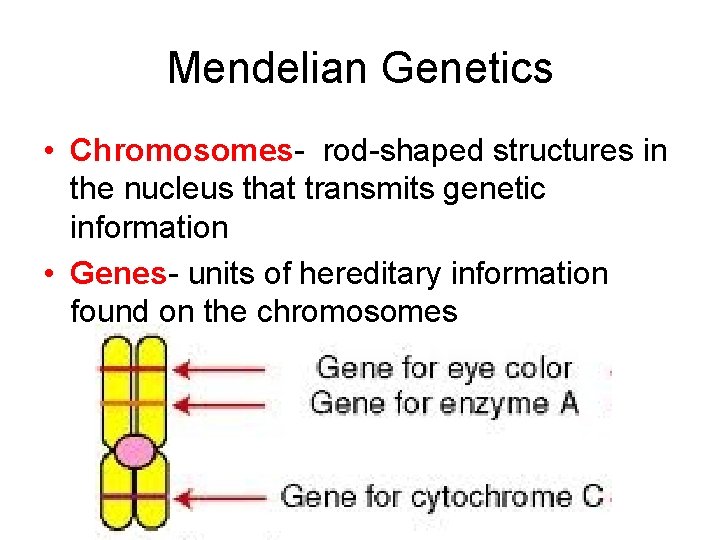
Mendelian Genetics • Chromosomes- rod-shaped structures in the nucleus that transmits genetic information • Genes- units of hereditary information found on the chromosomes
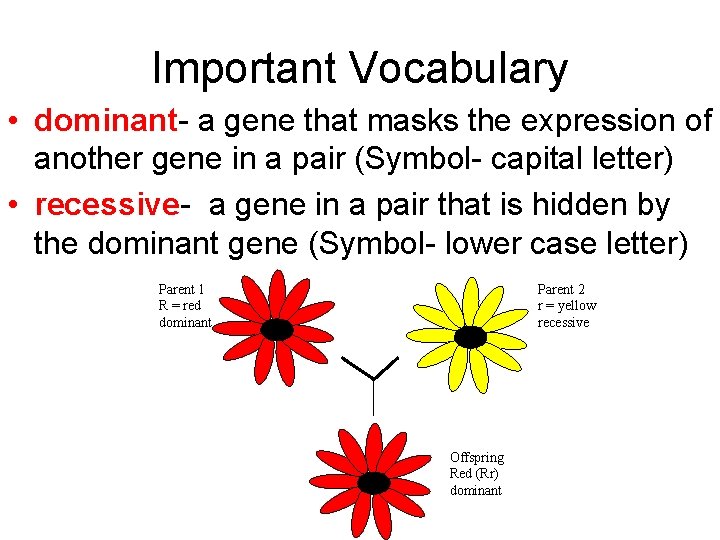
Important Vocabulary • dominant- a gene that masks the expression of another gene in a pair (Symbol- capital letter) • recessive- a gene in a pair that is hidden by the dominant gene (Symbol- lower case letter) Parent 1 R = red dominant Parent 2 r = yellow recessive Offspring Red (Rr) dominant
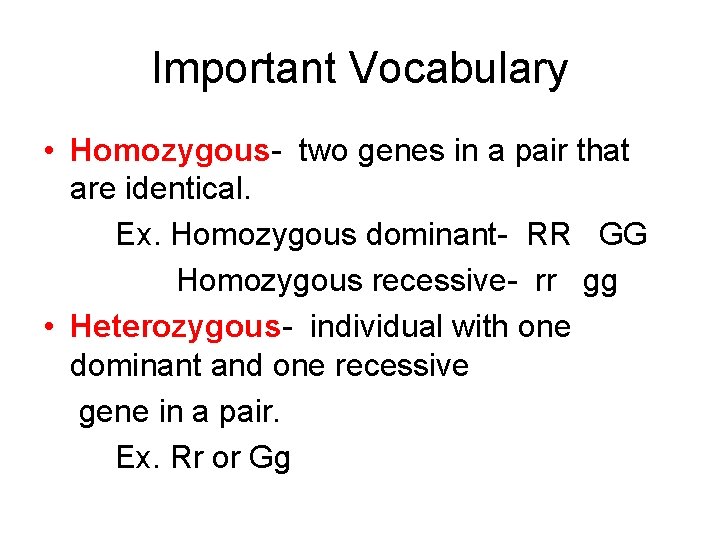
Important Vocabulary • Homozygous- two genes in a pair that are identical. Ex. Homozygous dominant- RR GG Homozygous recessive- rr gg • Heterozygous- individual with one dominant and one recessive gene in a pair. Ex. Rr or Gg
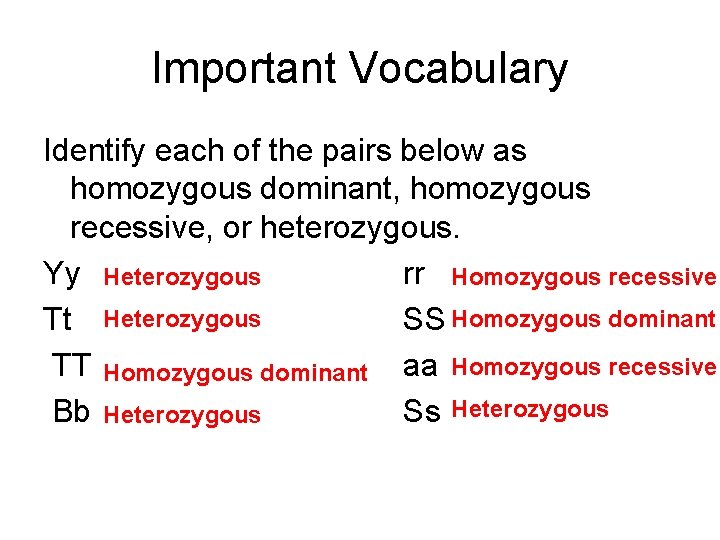
Important Vocabulary Identify each of the pairs below as homozygous dominant, homozygous recessive, or heterozygous. Yy Heterozygous rr Homozygous recessive Tt Heterozygous SS Homozygous dominant TT Homozygous dominant aa Homozygous recessive Bb Heterozygous Ss Heterozygous
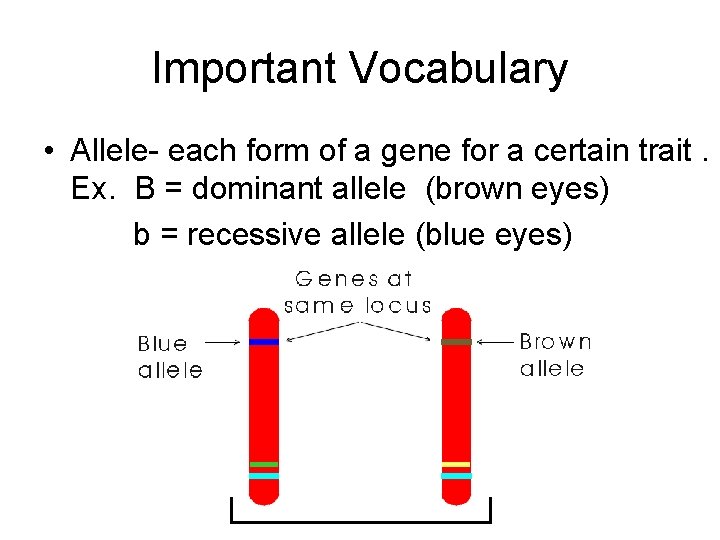
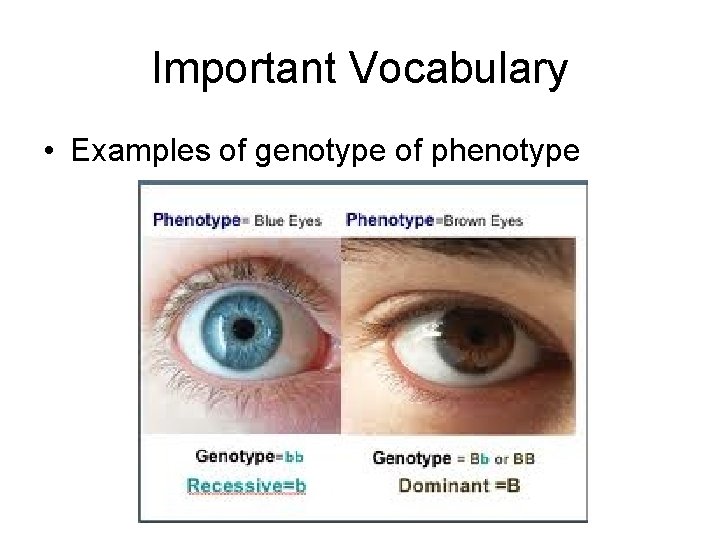
Important Vocabulary • Allele- each form of a gene for a certain trait. Ex. B = dominant allele (brown eyes) b = recessive allele (blue eyes)
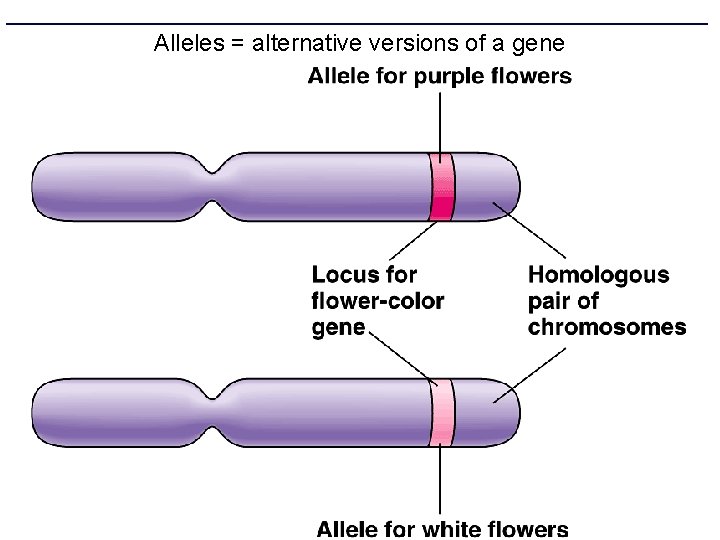
Alleles = alternative versions of a gene
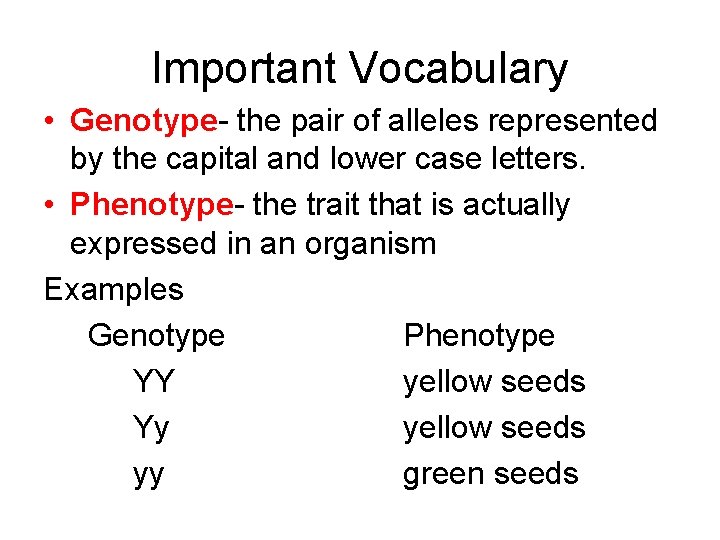
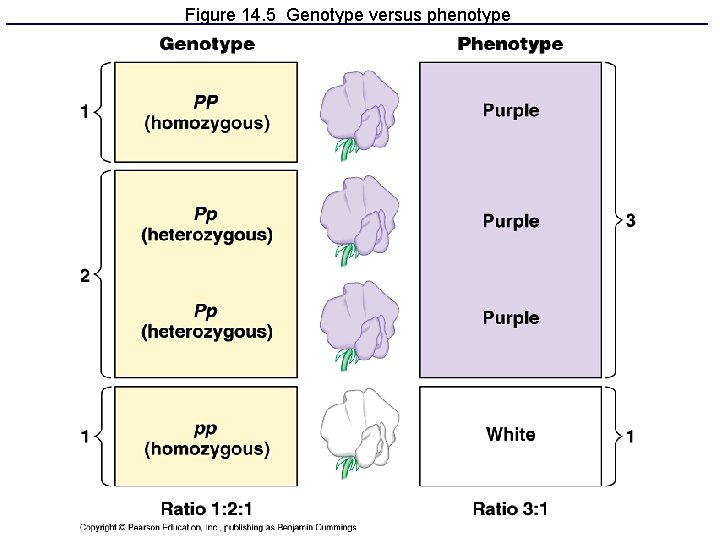
Important Vocabulary • Genotype- the pair of alleles represented by the capital and lower case letters. • Phenotype- the trait that is actually expressed in an organism Examples Genotype Phenotype YY yellow seeds Yy yellow seeds yy green seeds
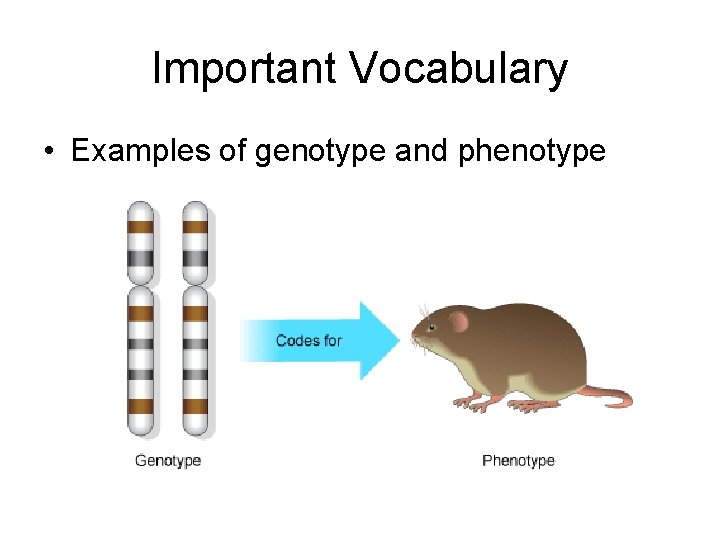
Important Vocabulary • Examples of genotype and phenotype
Important Vocabulary • Examples of genotype of phenotype
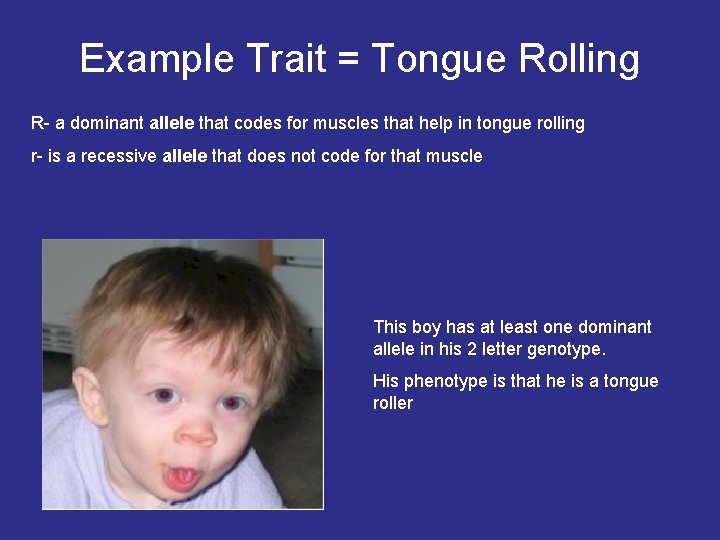
Example Trait = Tongue Rolling R- a dominant allele that codes for muscles that help in tongue rolling r- is a recessive allele that does not code for that muscle This boy has at least one dominant allele in his 2 letter genotype. His phenotype is that he is a tongue roller
Figure 14. 5 Genotype versus phenotype
Inheritance • You get your genes from your parents • In meiosis, half of the chromosomes in a pair come from the Dad, half come from the Mom • What we know today is based on the work of Gregor Mendel
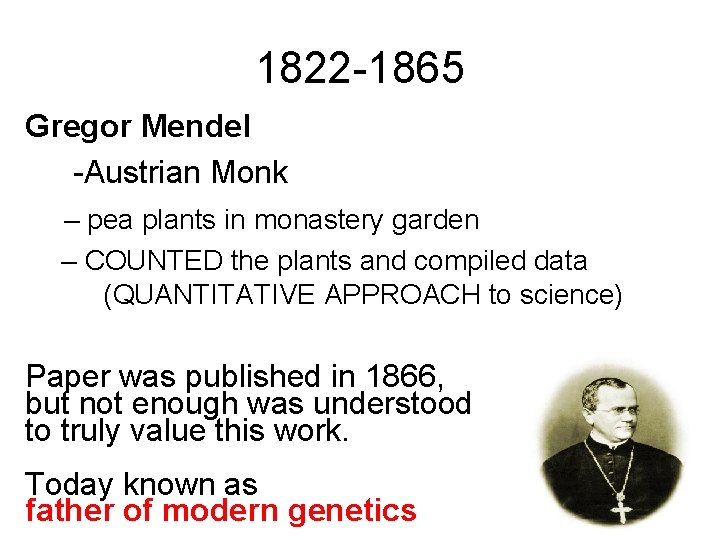
1822 -1865 Gregor Mendel -Austrian Monk – pea plants in monastery garden – COUNTED the plants and compiled data (QUANTITATIVE APPROACH to science) Paper was published in 1866, but not enough was understood to truly value this work. Today known as father of modern genetics
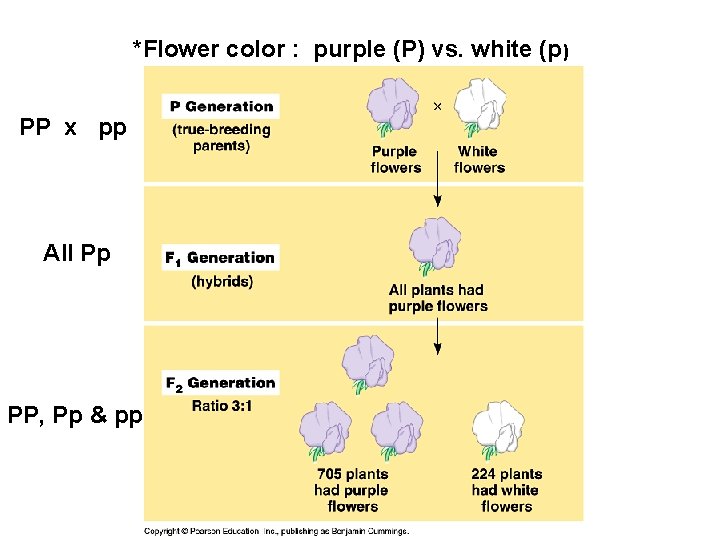
Mendel chose to use plants that were true-breeding… • P generation – parentals; true-breeding (On their own create identical offsprings) parents that were cross-pollinated • F 1 generation – hybrid offspring of parentals that were allowed to selfpollinate • F 2 generation – offspring of F 1’s
*Flower color : purple (P) vs. white (p) PP x pp All Pp PP, Pp & pp
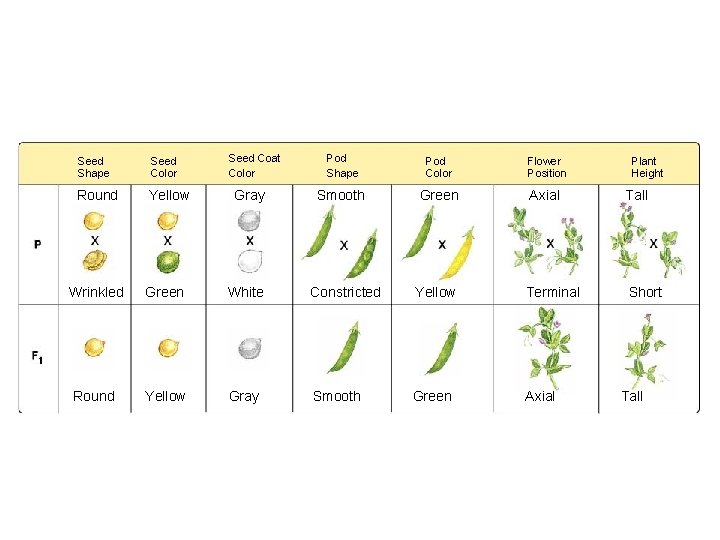
Figure 11 -3 Mendel’s Seven F 1 Crosses on Pea Plants Section 11 -1 Go to Section: Seed Shape Seed Color Round Yellow Seed Coat Color Gray Pod Shape Pod Color Flower Position Smooth Green Axial Tall Short Wrinkled Green White Constricted Yellow Terminal Round Yellow Gray Smooth Green Axial Plant Height Tall
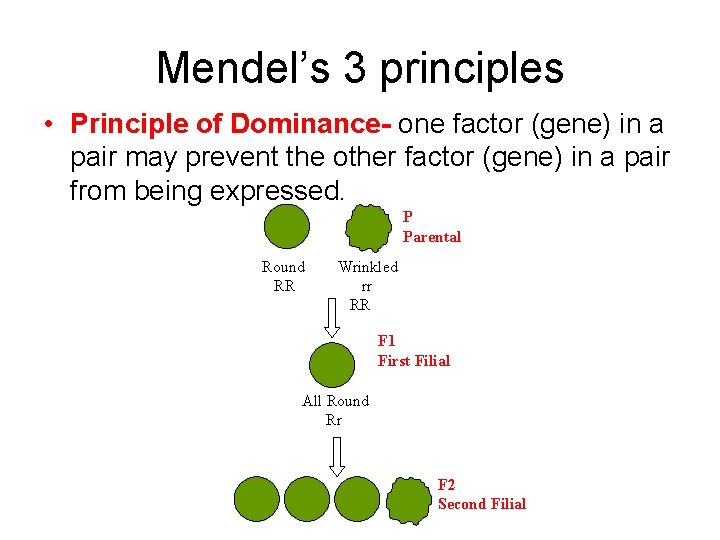
Mendel’s 3 principles • Principle of Dominance- one factor (gene) in a pair may prevent the other factor (gene) in a pair from being expressed. P Parental Round RR Wrinkled rr RR F 1 First Filial All Round Rr F 2 Second Filial
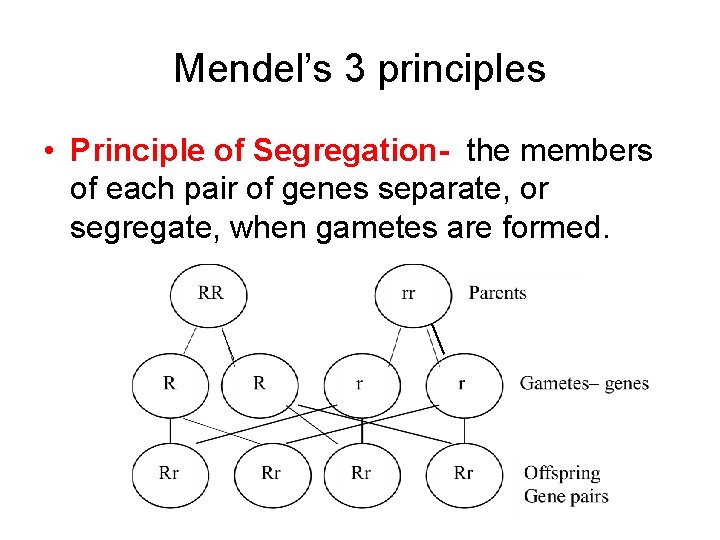
Mendel’s 3 principles • Principle of Segregation- the members of each pair of genes separate, or segregate, when gametes are formed.
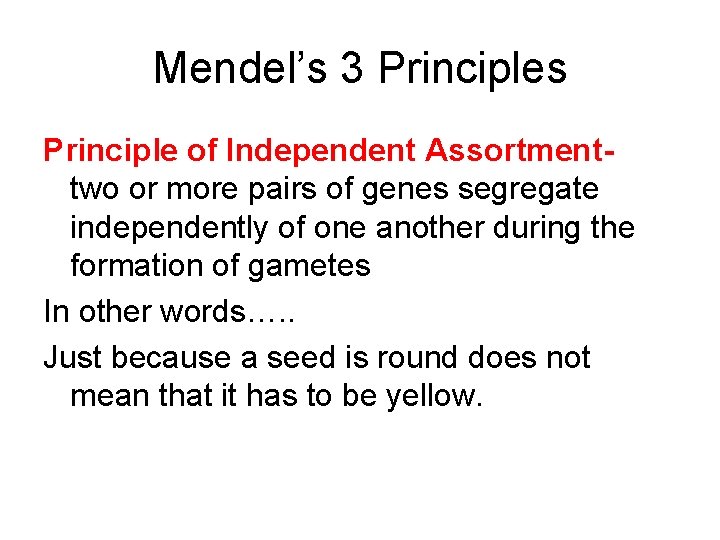
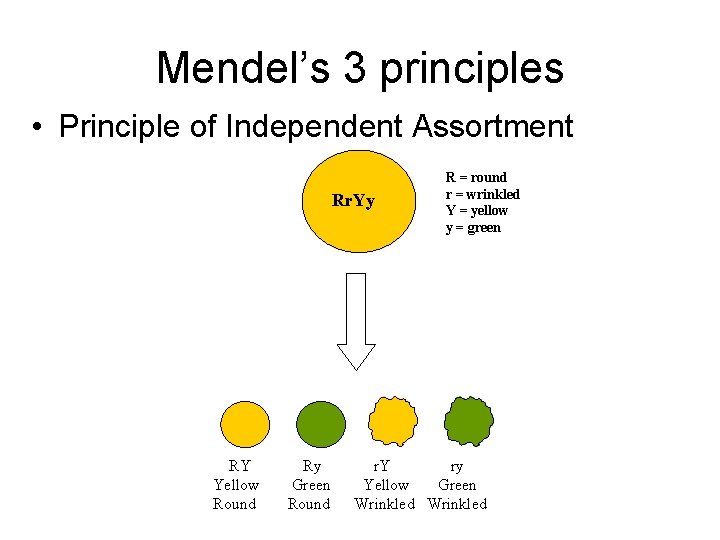
Mendel’s 3 Principles Principle of Independent Assortmenttwo or more pairs of genes segregate independently of one another during the formation of gametes In other words…. . Just because a seed is round does not mean that it has to be yellow.
Mendel’s 3 principles • Principle of Independent Assortment Rr. Yy RY Yellow Round Ry Green Round R = round r = wrinkled Y = yellow y = green r. Y ry Yellow Green Wrinkled
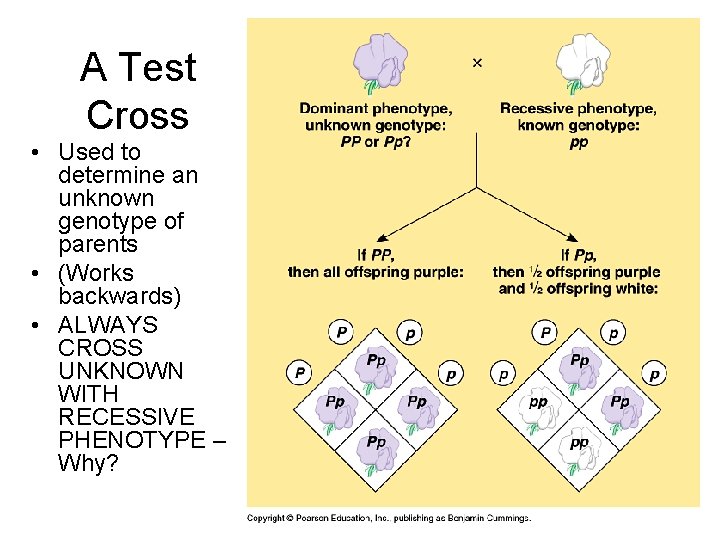
A Test Cross • Used to determine an unknown genotype of parents • (Works backwards) • ALWAYS CROSS UNKNOWN WITH RECESSIVE PHENOTYPE – Why?
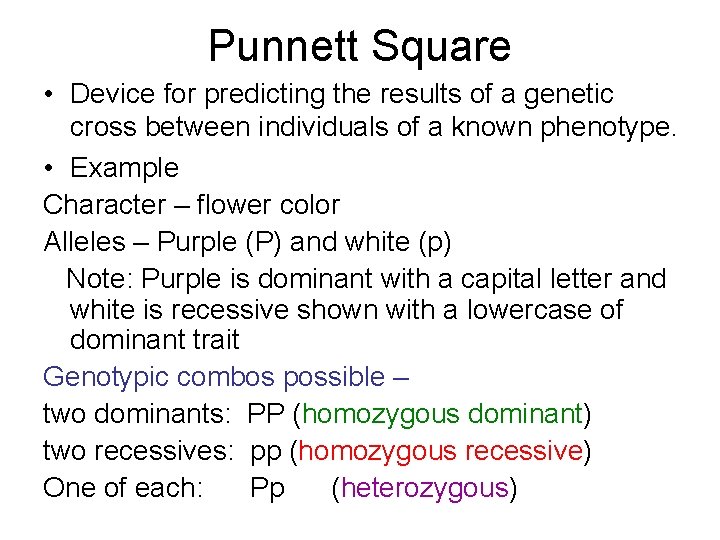
Punnett Square • Device for predicting the results of a genetic cross between individuals of a known phenotype. • Example Character – flower color Alleles – Purple (P) and white (p) Note: Purple is dominant with a capital letter and white is recessive shown with a lowercase of dominant trait Genotypic combos possible – two dominants: PP (homozygous dominant) two recessives: pp (homozygous recessive) One of each: Pp (heterozygous)
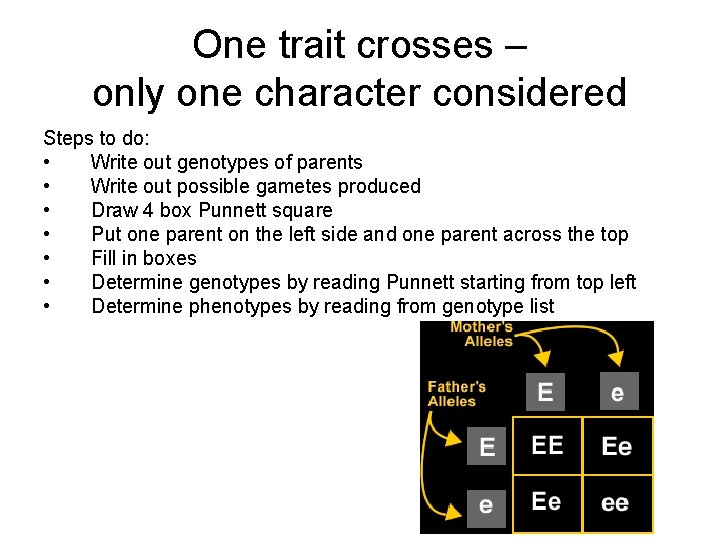
One trait crosses – only one character considered Steps to do: • Write out genotypes of parents • Write out possible gametes produced • Draw 4 box Punnett square • Put one parent on the left side and one parent across the top • Fill in boxes • Determine genotypes by reading Punnett starting from top left • Determine phenotypes by reading from genotype list
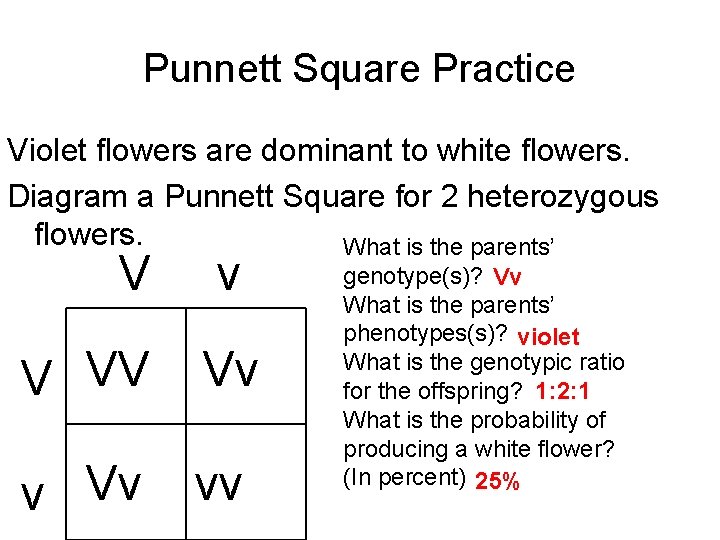
Punnett Square Practice Violet flowers are dominant to white flowers. Diagram a Punnett Square for 2 heterozygous flowers. What is the parents’ V v V VV Vv vv genotype(s)? Vv What is the parents’ phenotypes(s)? violet What is the genotypic ratio for the offspring? 1: 2: 1 What is the probability of producing a white flower? (In percent) 25%
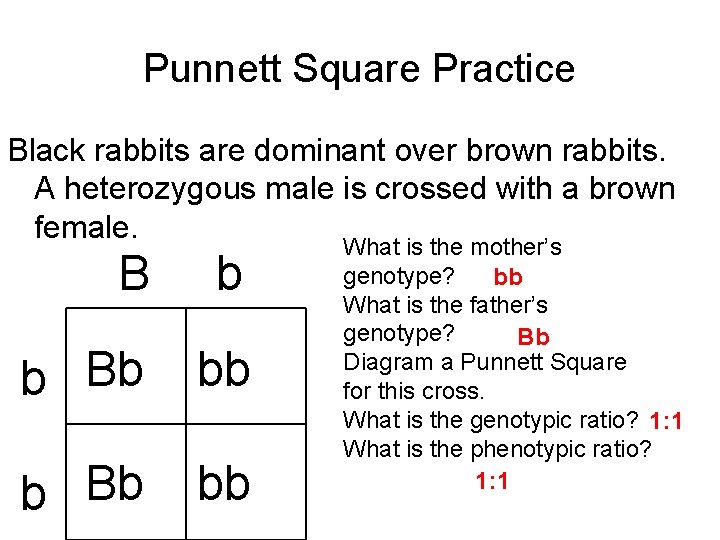
Punnett Square Practice Black rabbits are dominant over brown rabbits. A heterozygous male is crossed with a brown female. B b b Bb bb What is the mother’s genotype? bb What is the father’s genotype? Bb Diagram a Punnett Square for this cross. What is the genotypic ratio? 1: 1 What is the phenotypic ratio? 1: 1
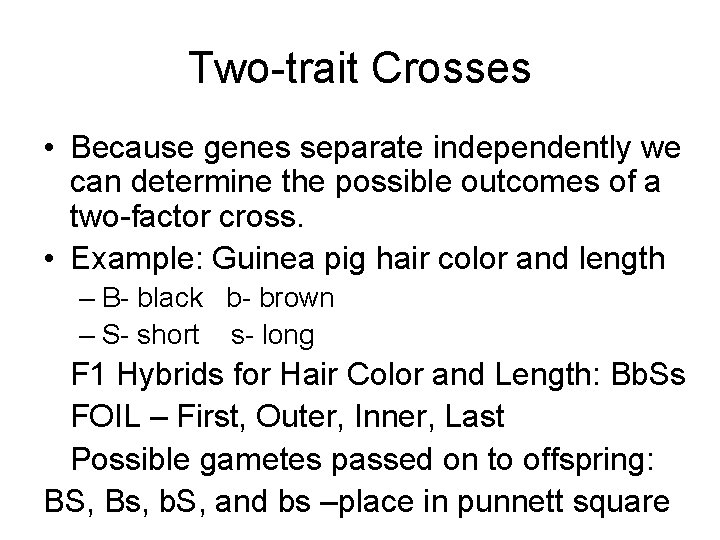
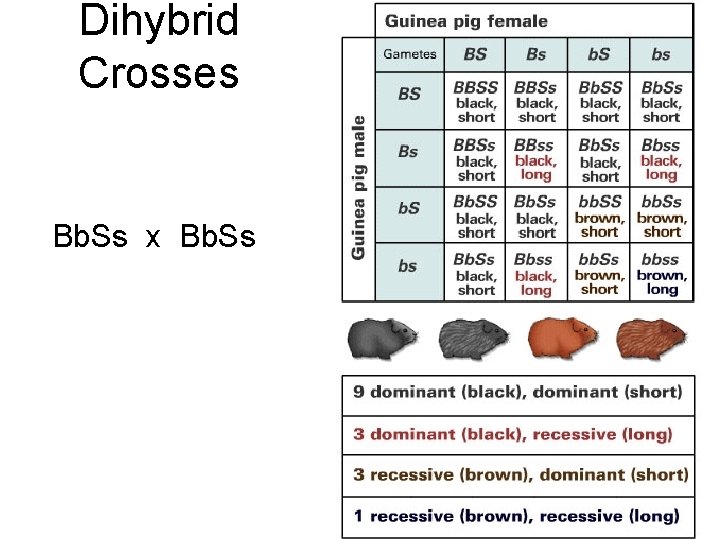
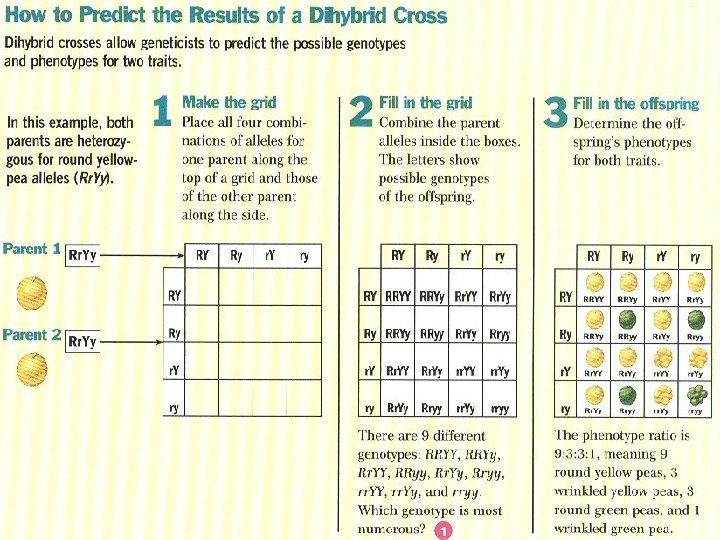
Two-trait Crosses • Because genes separate independently we can determine the possible outcomes of a two-factor cross. • Example: Guinea pig hair color and length – B- black b- brown – S- short s- long F 1 Hybrids for Hair Color and Length: Bb. Ss FOIL – First, Outer, Inner, Last Possible gametes passed on to offspring: BS, Bs, b. S, and bs –place in punnett square
Dihybrid Crosses Bb. Ss x Bb. Ss
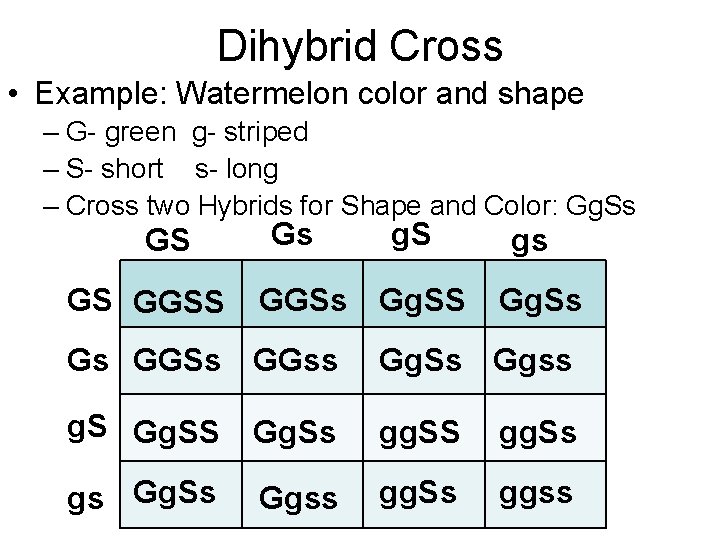
Dihybrid Cross • Example: Watermelon color and shape – G- green g- striped – S- short s- long – Cross two Hybrids for Shape and Color: Gg. Ss GS GS GGSS Gs g. S GGSs Gg. SS gs Gg. Ss Gs GGSs GGss Gg. Ss Ggss g. S Gg. Ss gg. SS gg. Ss gs Gg. Ss Ggss gg. Ss ggss
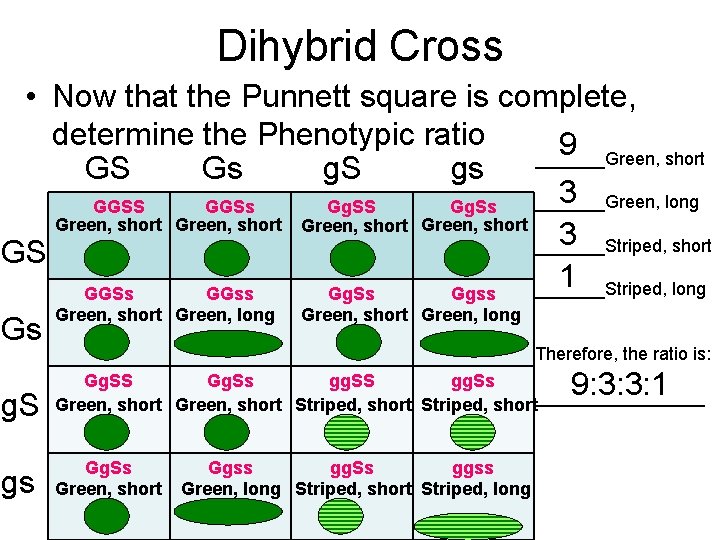
Dihybrid Cross • Now that the Punnett square is complete, determine the Phenotypic ratio 9 _______Green, short GS Gs g. S gs 3 _______Green, long GGSS GGSs Gg. SS Gg. Ss Green, short 3 _______Striped, short GS 1 _______Striped, long GGSs GGss Gg. Ss Ggss Gs Green, short Green, long Therefore, the ratio is: 9: 3: 3: 1 g. S Gg. Ss gg. SS gg. Ss Green, short Striped, short_________ gs Gg. Ss Green, short Ggss gg. Ss ggss Green, long Striped, short Striped, long
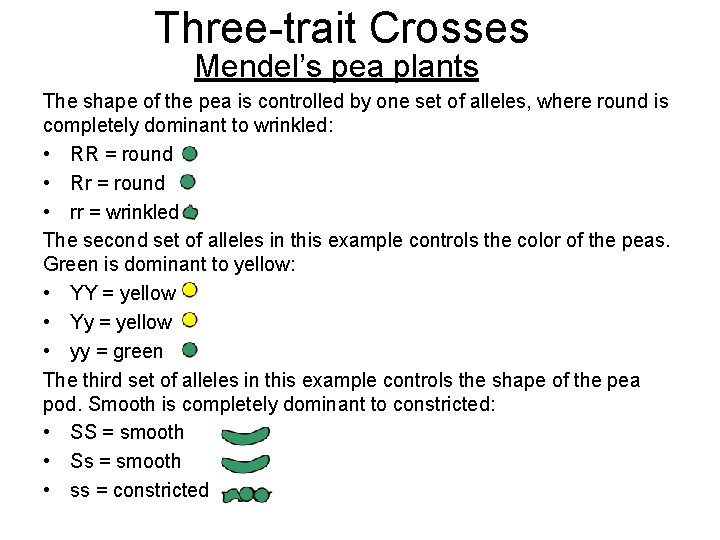
Three-trait Crosses Mendel’s pea plants The shape of the pea is controlled by one set of alleles, where round is completely dominant to wrinkled: • RR = round • Rr = round • rr = wrinkled The second set of alleles in this example controls the color of the peas. Green is dominant to yellow: • YY = yellow • Yy = yellow • yy = green The third set of alleles in this example controls the shape of the pea pod. Smooth is completely dominant to constricted: • SS = smooth • Ss = smooth • ss = constricted
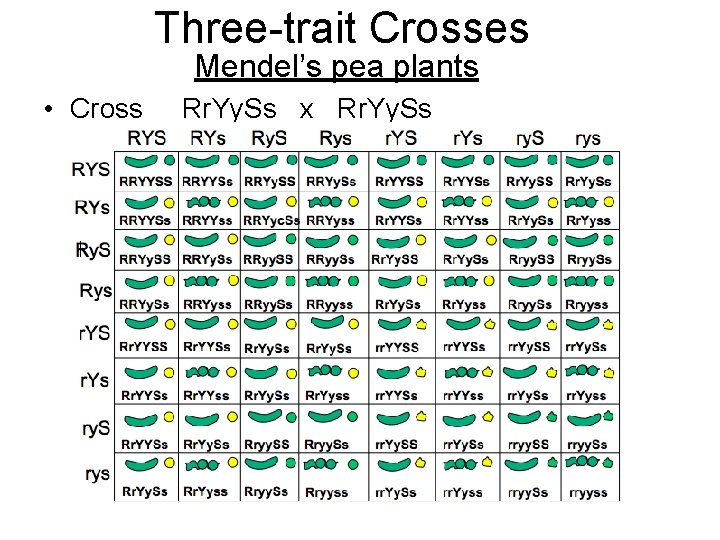
Three-trait Crosses Mendel’s pea plants • Cross Rr. Yy. Ss x Rr. Yy. Ss
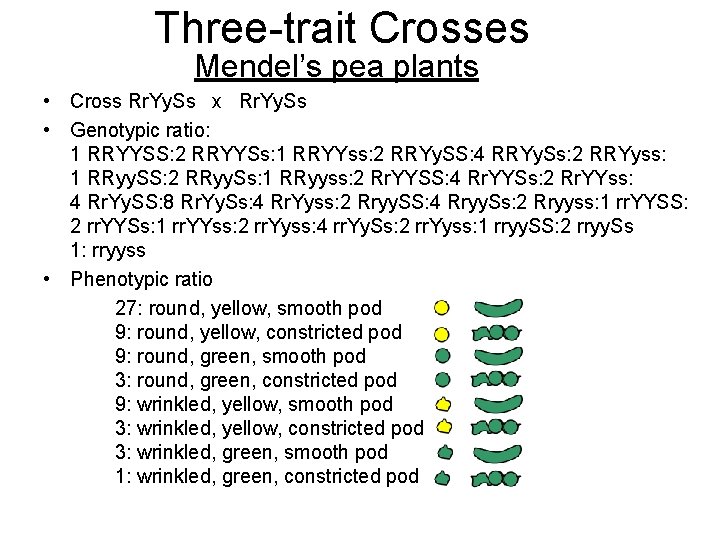
Three-trait Crosses Mendel’s pea plants • Cross Rr. Yy. Ss x Rr. Yy. Ss • Genotypic ratio: 1 RRYYSS: 2 RRYYSs: 1 RRYYss: 2 RRYy. SS: 4 RRYy. Ss: 2 RRYyss: 1 RRyy. SS: 2 RRyy. Ss: 1 RRyyss: 2 Rr. YYSS: 4 Rr. YYSs: 2 Rr. YYss: 4 Rr. Yy. SS: 8 Rr. Yy. Ss: 4 Rr. Yyss: 2 Rryy. SS: 4 Rryy. Ss: 2 Rryyss: 1 rr. YYSS: 2 rr. YYSs: 1 rr. YYss: 2 rr. Yyss: 4 rr. Yy. Ss: 2 rr. Yyss: 1 rryy. SS: 2 rryy. Ss 1: rryyss • Phenotypic ratio 27: round, yellow, smooth pod 9: round, yellow, constricted pod 9: round, green, smooth pod 3: round, green, constricted pod 9: wrinkled, yellow, smooth pod 3: wrinkled, yellow, constricted pod 3: wrinkled, green, smooth pod 1: wrinkled, green, constricted pod
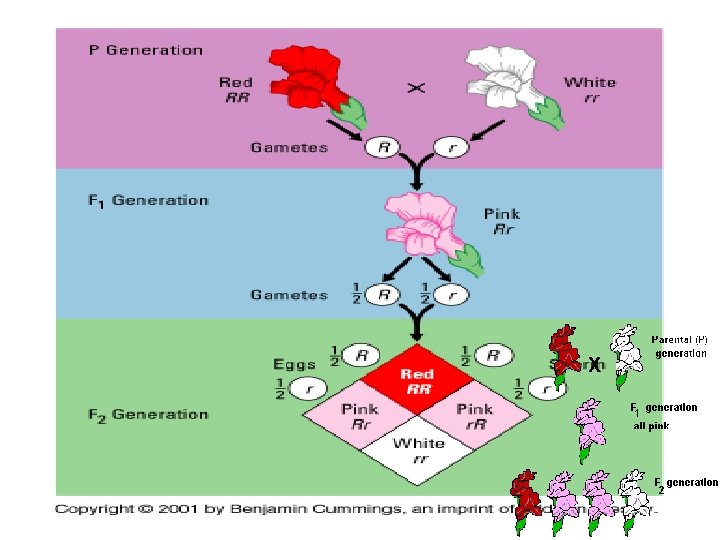
Beyond Dominant and Recessive • Incomplete Dominance One allele is not completely dominant over the other – something in the middle is expressed Ex. Red and White Snapdragons – Make Pink (Like mixing paints) Red – RR White – WW Pink – RW Only one phenotype for each one genotype
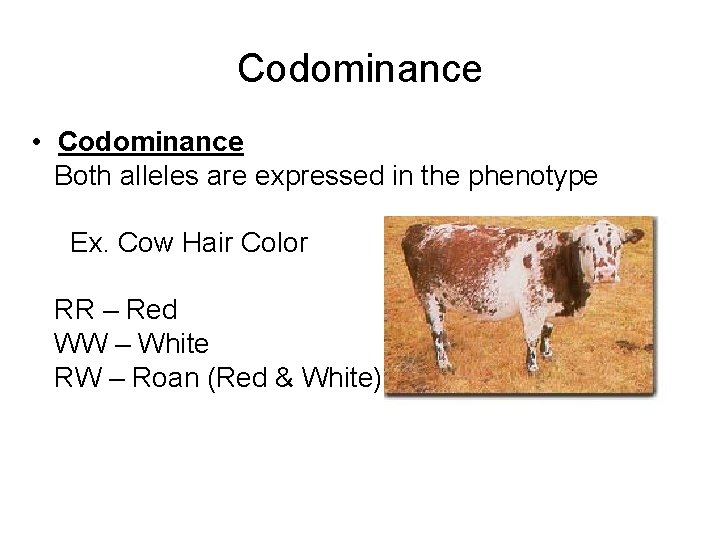
Codominance • Codominance Both alleles are expressed in the phenotype Ex. Cow Hair Color RR – Red WW – White RW – Roan (Red & White)
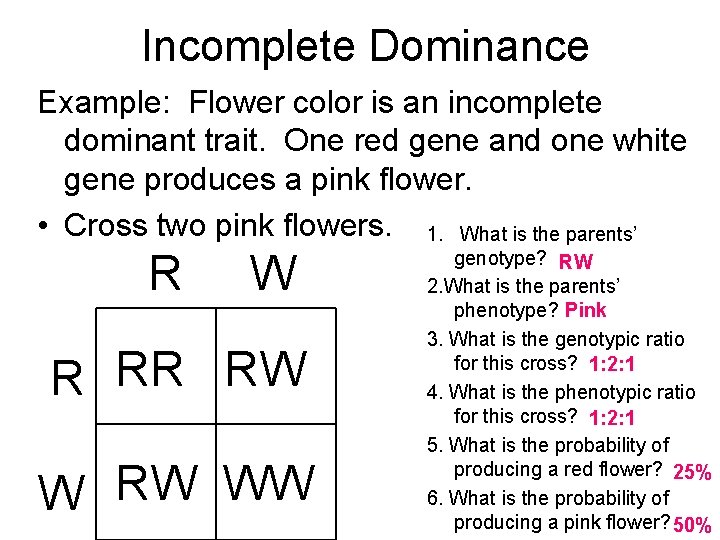
Incomplete Dominance Example: Flower color is an incomplete dominant trait. One red gene and one white gene produces a pink flower. • Cross two pink flowers. 1. What is the parents’ R W R RR RW WW genotype? RW 2. What is the parents’ phenotype? Pink 3. What is the genotypic ratio for this cross? 1: 2: 1 4. What is the phenotypic ratio for this cross? 1: 2: 1 5. What is the probability of producing a red flower? 25% 6. What is the probability of producing a pink flower? 50%
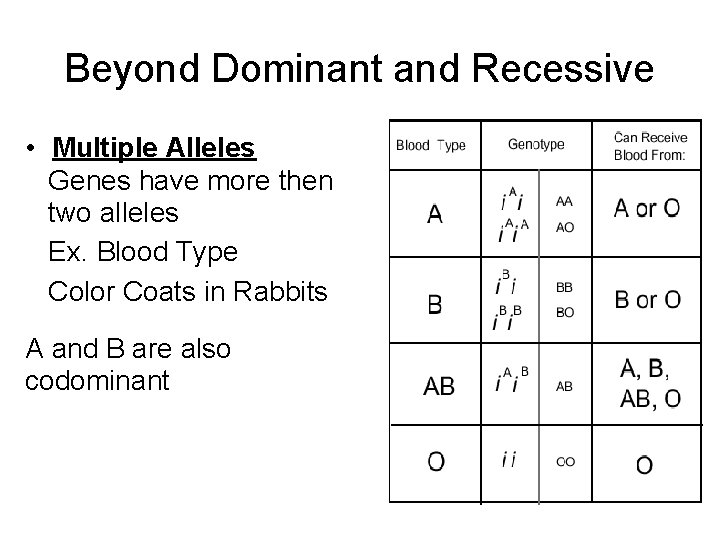
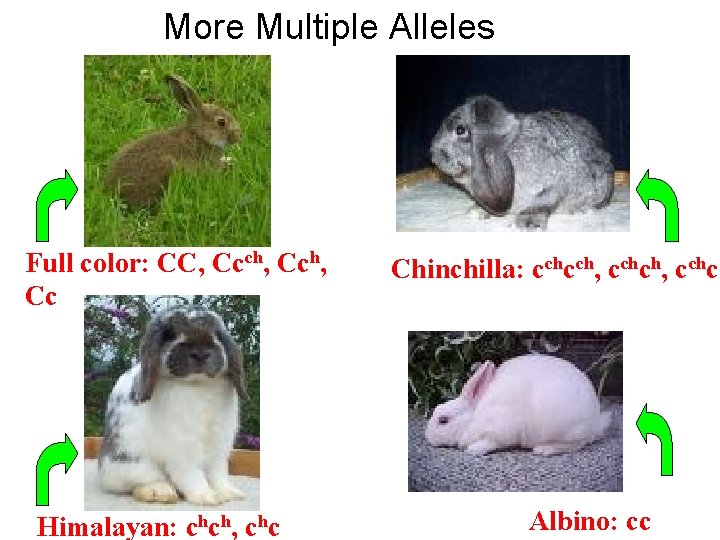
Beyond Dominant and Recessive • Multiple Alleles Genes have more then two alleles Ex. Blood Type Color Coats in Rabbits A and B are also codominant
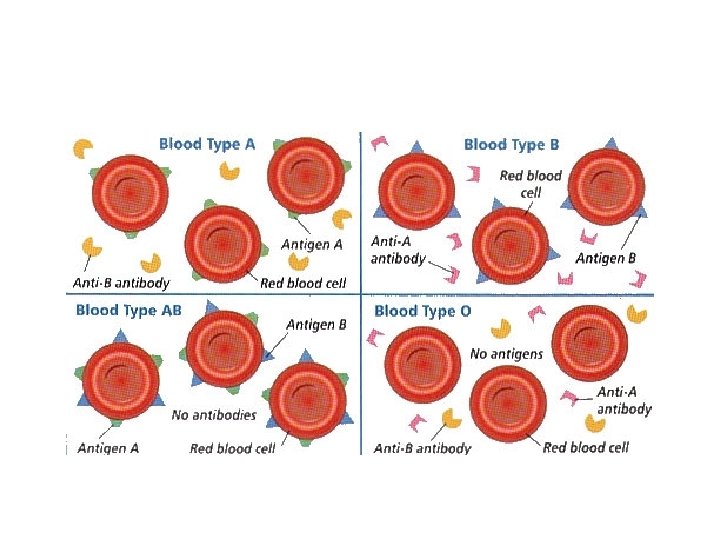
More on blood types…. . • The blood type determines what antibodies are located within the blood. Type A blood has type B antibodies. If type B blood is put into their bodies, their immune system reacts as if it were a foreign invader, the antibodies clump the blood - can cause death. • Type AB blood has no antibodies, any blood can be donated to them - they are called the "universal acceptors" • Type O blood has no surface markers on it, antibodies in the blood do not react to type O blood, they are called the "universal donors"
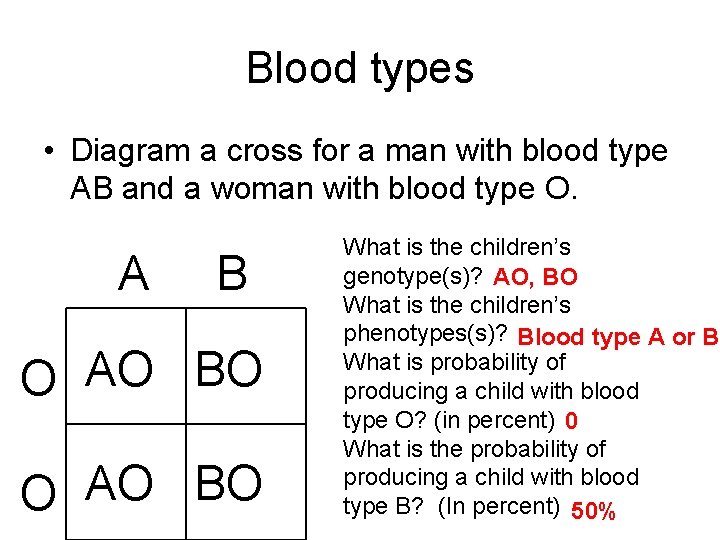
Blood types • Diagram a cross for a man with blood type AB and a woman with blood type O. A B O AO BO What is the children’s genotype(s)? AO, BO What is the children’s phenotypes(s)? Blood type A or B What is probability of producing a child with blood type O? (in percent) 0 What is the probability of producing a child with blood type B? (In percent) 50%
Rh Factor - +/ • A second main trait for blood exists • Rh = protein on the surface of a red blood cell • Rh + means has protein/Rh- does not • Rh+ is dominant; Rh- is recessive
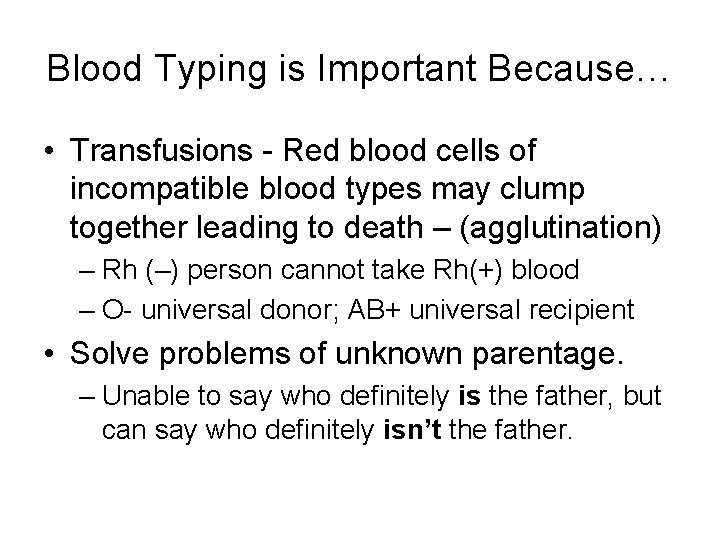
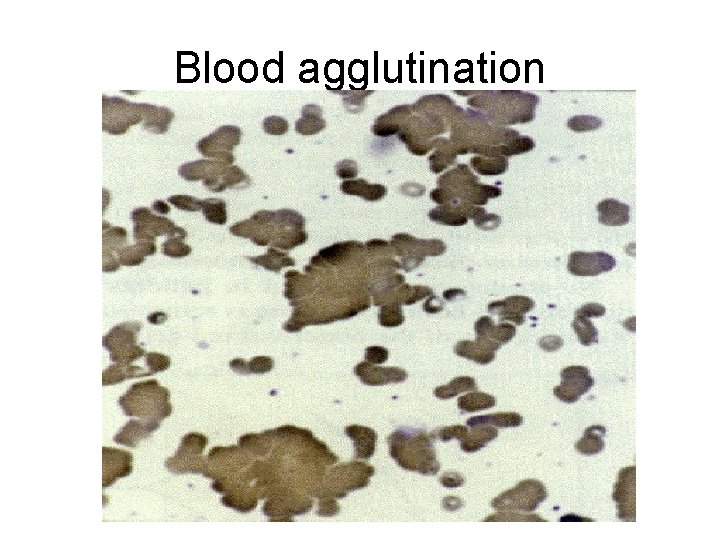
Blood Typing is Important Because… • Transfusions - Red blood cells of incompatible blood types may clump together leading to death – (agglutination) – Rh (–) person cannot take Rh(+) blood – O- universal donor; AB+ universal recipient • Solve problems of unknown parentage. – Unable to say who definitely is the father, but can say who definitely isn’t the father.
Blood agglutination
More Multiple Alleles Full color: CC, Ccch, Cc Himalayan: chch, chc Chinchilla: cchcch, cchc Albino: cc
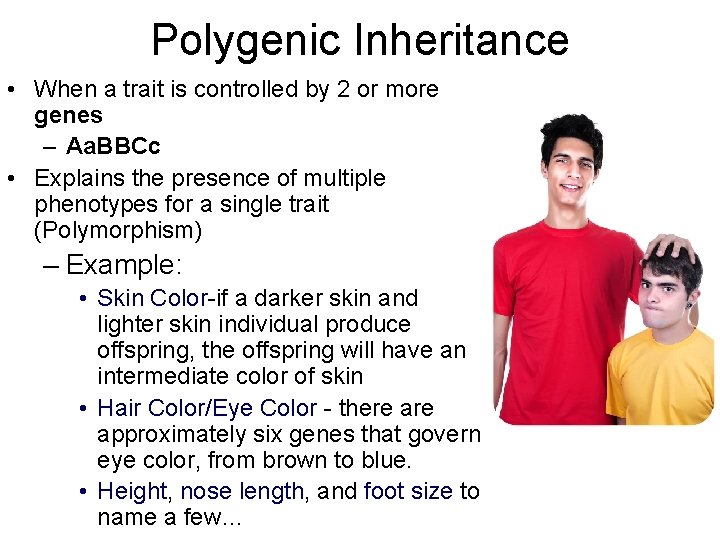
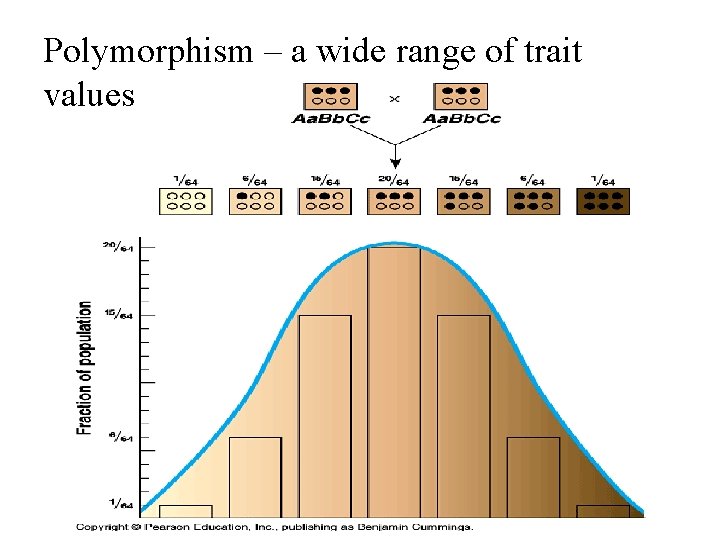
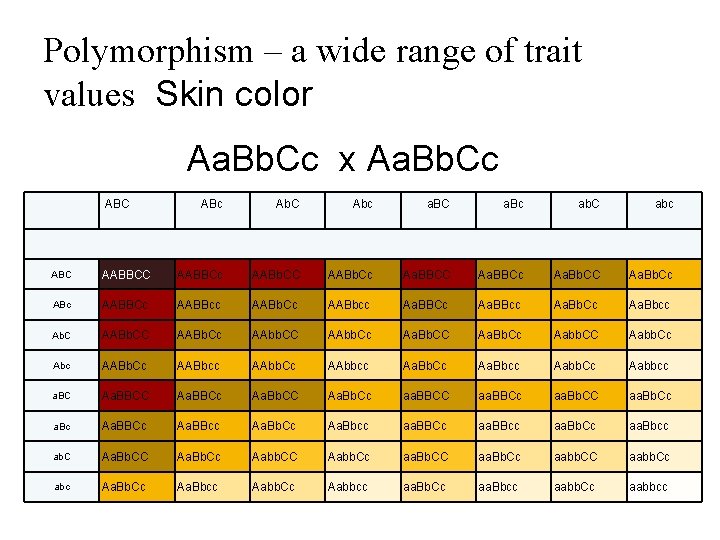
Polygenic Inheritance • When a trait is controlled by 2 or more genes – Aa. BBCc • Explains the presence of multiple phenotypes for a single trait (Polymorphism) – Example: • Skin Color-if a darker skin and lighter skin individual produce offspring, the offspring will have an intermediate color of skin • Hair Color/Eye Color - there approximately six genes that govern eye color, from brown to blue. • Height, nose length, and foot size to name a few…
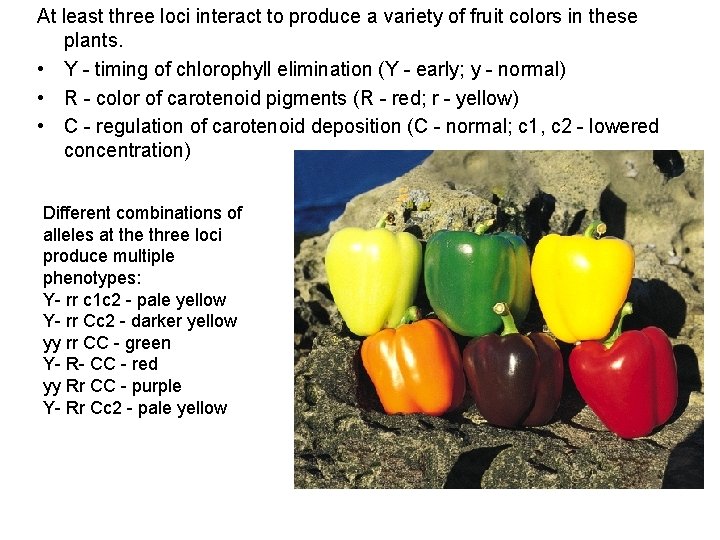
At least three loci interact to produce a variety of fruit colors in these plants. • Y - timing of chlorophyll elimination (Y - early; y - normal) • R - color of carotenoid pigments (R - red; r - yellow) • C - regulation of carotenoid deposition (C - normal; c 1, c 2 - lowered concentration) Different combinations of alleles at the three loci produce multiple phenotypes: Y- rr c 1 c 2 - pale yellow Y- rr Cc 2 - darker yellow yy rr CC - green Y- R- CC - red yy Rr CC - purple Y- Rr Cc 2 - pale yellow
Polymorphism – a wide range of trait values
Polymorphism – a wide range of trait values Skin color Aa. Bb. Cc x Aa. Bb. Cc ABC ABc Ab. C Abc a. BC a. Bc ab. C abc ABC AABBCc AABb. CC AABb. Cc Aa. BBCC Aa. BBCc Aa. Bb. CC Aa. Bb. Cc ABc AABBCc AABBcc AABb. Cc AABbcc Aa. BBCc Aa. BBcc Aa. Bb. Cc Aa. Bbcc Ab. C AABb. Cc AAbb. CC AAbb. Cc Aa. Bb. CC Aa. Bb. Cc Aabb. CC Aabb. Cc Abc AABb. Cc AABbcc AAbb. Cc AAbbcc Aa. Bb. Cc Aa. Bbcc Aabb. Cc Aabbcc a. BC Aa. BBCc Aa. Bb. CC Aa. Bb. Cc aa. BBCC aa. BBCc aa. Bb. CC aa. Bb. Cc a. Bc Aa. BBCc Aa. BBcc Aa. Bb. Cc Aa. Bbcc aa. BBCc aa. BBcc aa. Bb. Cc aa. Bbcc ab. C Aa. Bb. Cc Aabb. CC Aabb. Cc aa. Bb. CC aa. Bb. Cc aabb. CC aabb. Cc abc Aa. Bb. Cc Aa. Bbcc Aabb. Cc Aabbcc aa. Bb. Cc aa. Bbcc aabb. Cc aabbcc
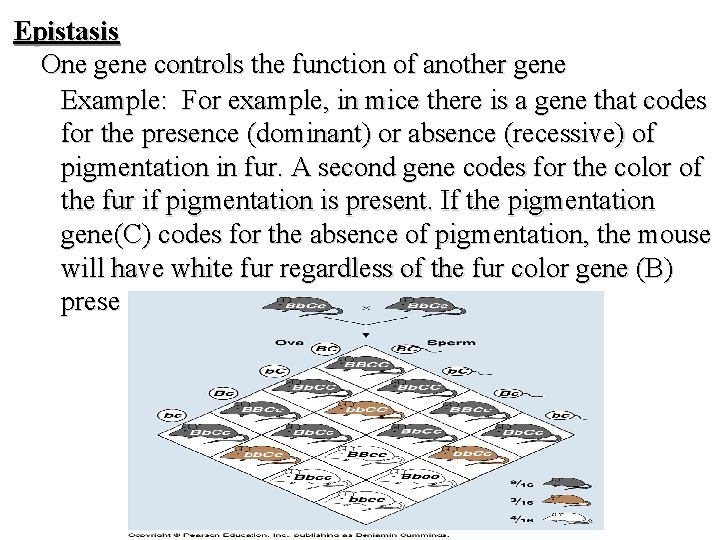
Epistasis One gene controls the function of another gene Example: For example, in mice there is a gene that codes for the presence (dominant) or absence (recessive) of pigmentation in fur. A second gene codes for the color of the fur if pigmentation is present. If the pigmentation gene(C) codes for the absence of pigmentation, the mouse will have white fur regardless of the fur color gene (B) present.
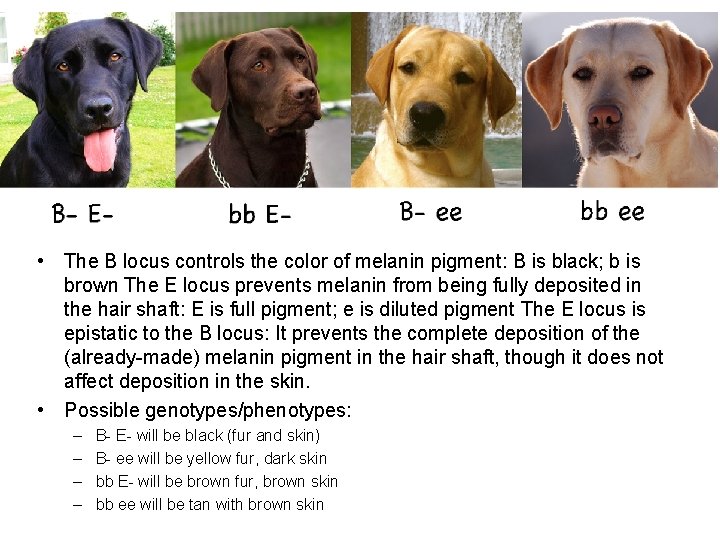
• The B locus controls the color of melanin pigment: B is black; b is brown The E locus prevents melanin from being fully deposited in the hair shaft: E is full pigment; e is diluted pigment The E locus is epistatic to the B locus: It prevents the complete deposition of the (already-made) melanin pigment in the hair shaft, though it does not affect deposition in the skin. • Possible genotypes/phenotypes: – – B- E- will be black (fur and skin) B- ee will be yellow fur, dark skin bb E- will be brown fur, brown skin bb ee will be tan with brown skin
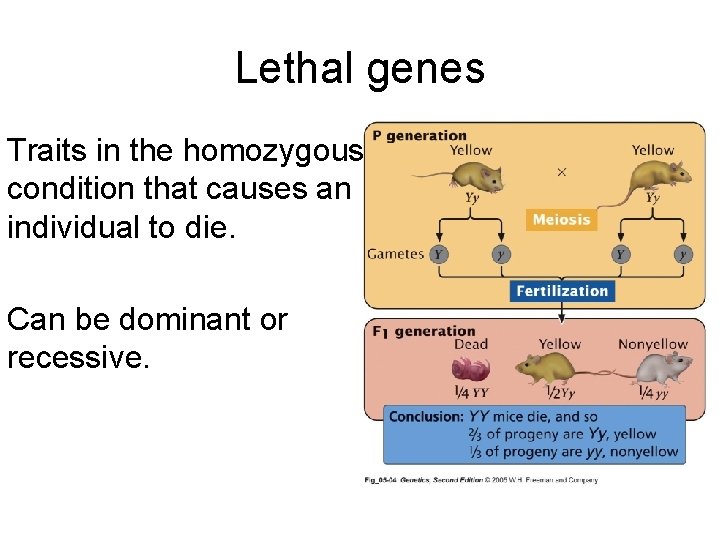
Lethal genes Traits in the homozygous condition that causes an individual to die. Can be dominant or recessive.
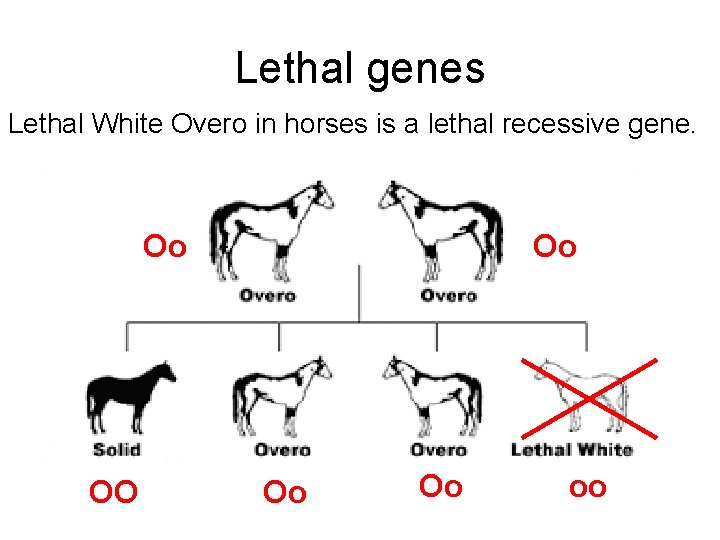
Lethal genes Lethal White Overo in horses is a lethal recessive gene. Oo OO Oo Oo Oo oo
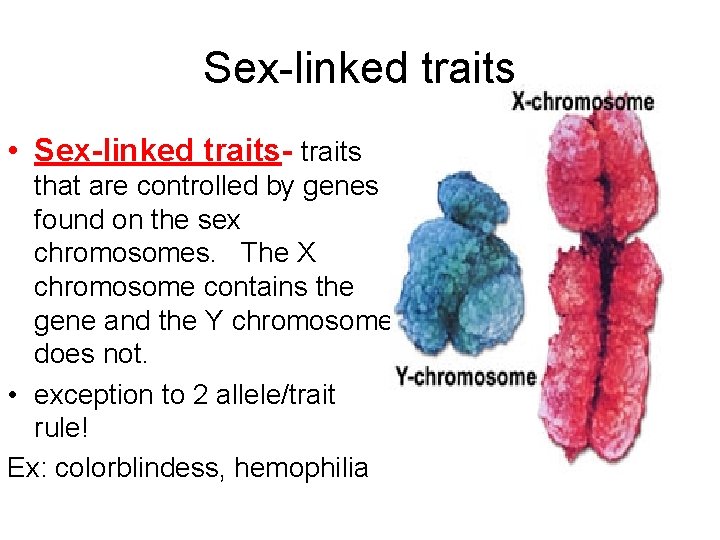
Sex-linked traits • Sex-linked traits- traits that are controlled by genes found on the sex chromosomes. The X chromosome contains the gene and the Y chromosome does not. • exception to 2 allele/trait rule! Ex: colorblindess, hemophilia
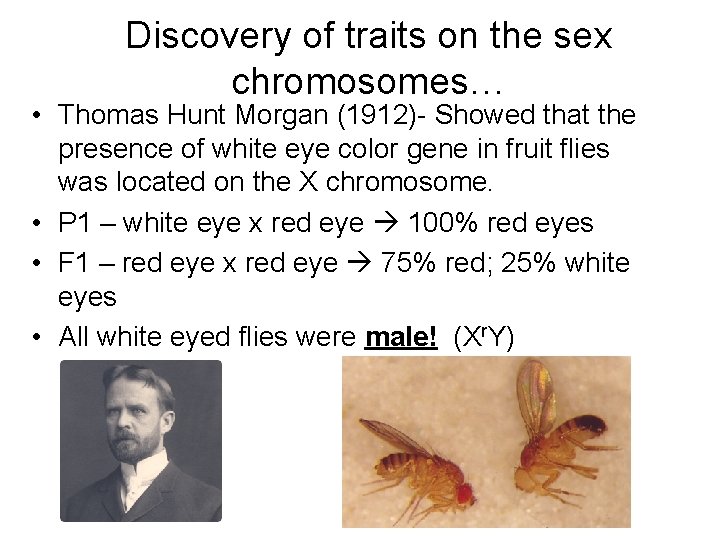
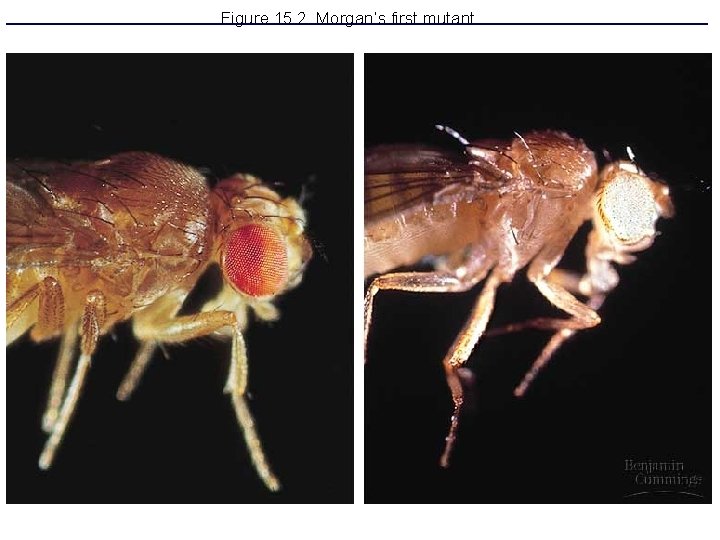
Discovery of traits on the sex chromosomes… • Thomas Hunt Morgan (1912)- Showed that the presence of white eye color gene in fruit flies was located on the X chromosome. • P 1 – white eye x red eye 100% red eyes • F 1 – red eye x red eye 75% red; 25% white eyes • All white eyed flies were male! (Xr. Y)
Figure 15. 2 Morgan’s first mutant
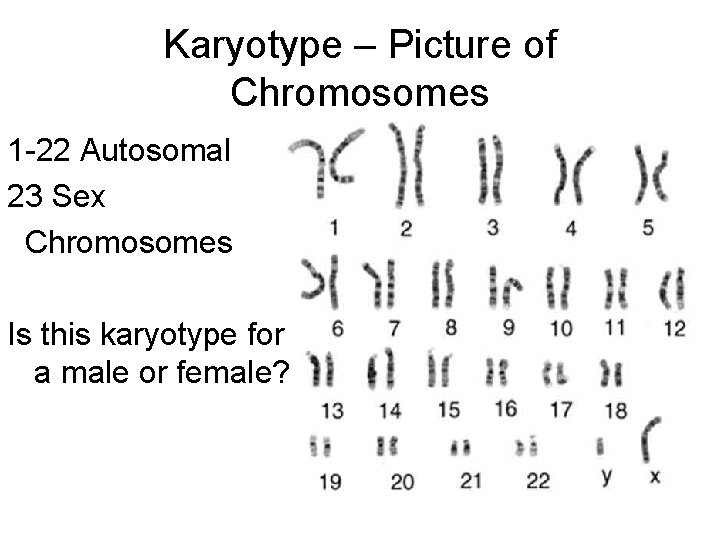
Karyotype – Picture of Chromosomes 1 -22 Autosomal 23 Sex Chromosomes Is this karyotype for a male or female?
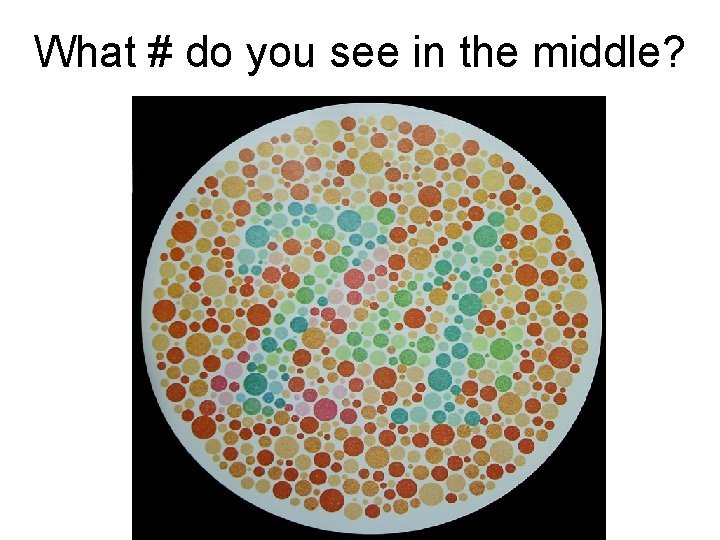
What # do you see in the middle?
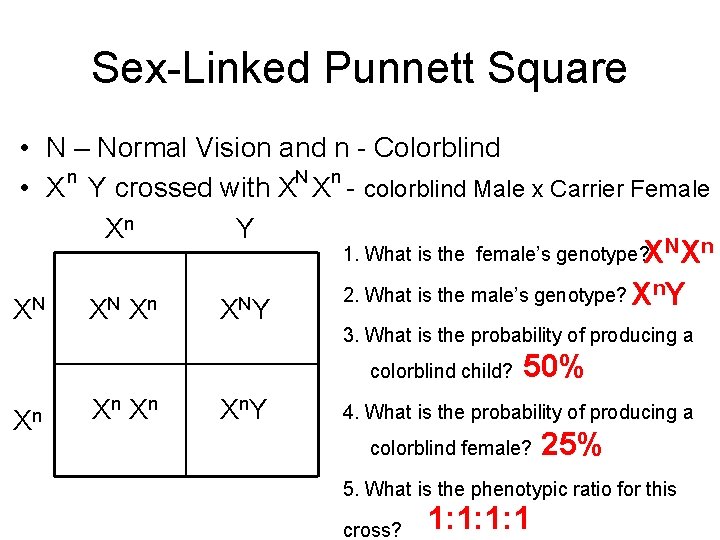
Sex-Linked Punnett Square • N – Normal Vision and n - Colorblind n N n • X Y crossed with X X - colorblind Male x Carrier Female Xn Y X Xn 2. What is the male’s genotype? Xn. Y 1. What is the female’s genotype? N XN X N Xn X NY 3. What is the probability of producing a colorblind child? Xn X n. Y 50% 4. What is the probability of producing a colorblind female? 25% 5. What is the phenotypic ratio for this cross? 1: 1: 1: 1
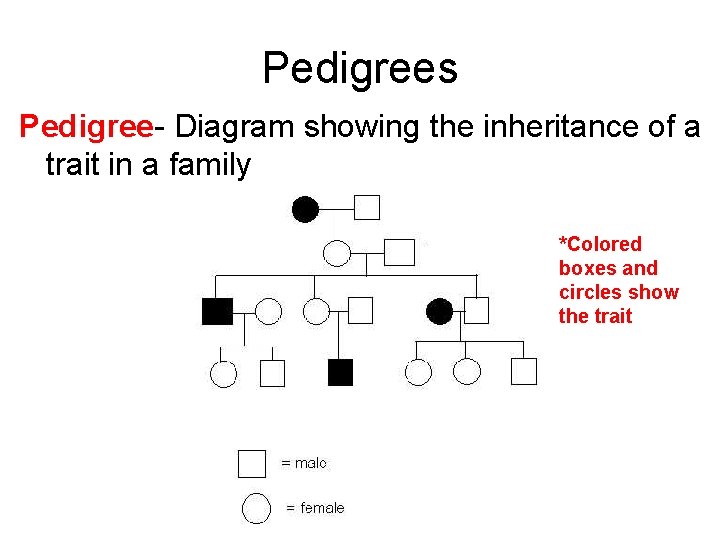
Pedigrees Pedigree- Diagram showing the inheritance of a trait in a family *Colored boxes and circles show the trait
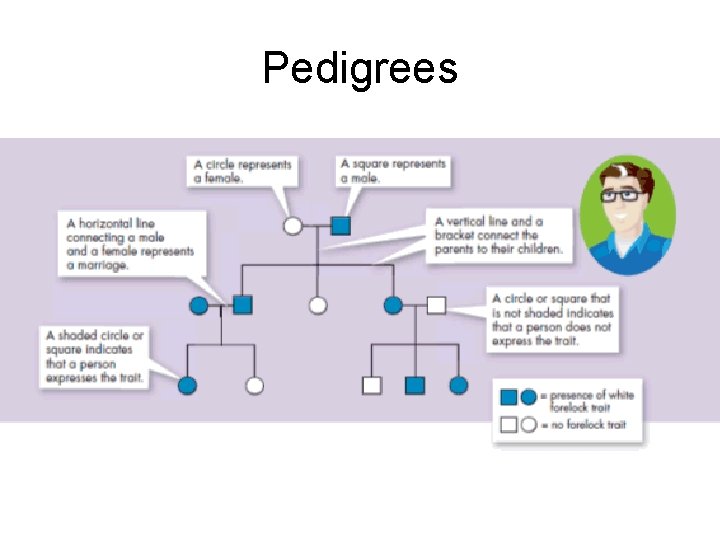
Pedigrees
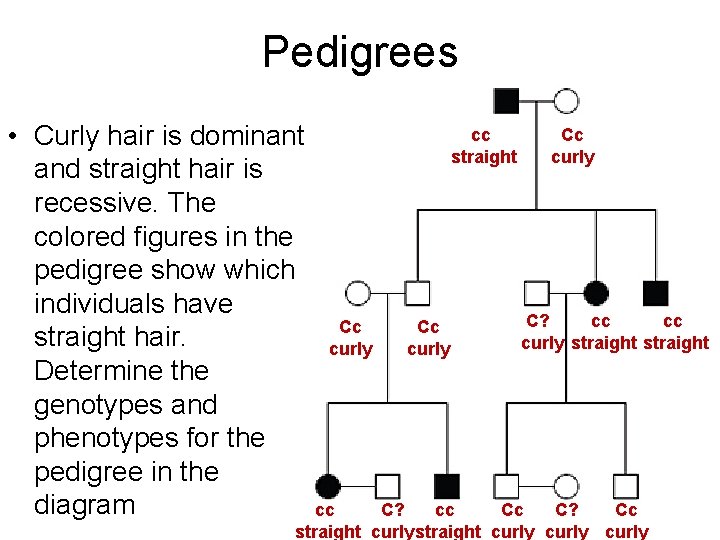
Pedigrees • Curly hair is dominant and straight hair is recessive. The colored figures in the pedigree show which individuals have straight hair. Determine the genotypes and phenotypes for the pedigree in the diagram cc straight Cc curly C? cc cc curly straight cc C? cc Cc C? Cc straight curly