
MENDELIAN GENETICS Gregor Mendel Hereditary Genetics Three Principles


- Slides: 27
MENDELIAN GENETICS
Gregor Mendel: Hereditary Genetics • Three Principles: • Principle of Dominance • Some alleles are dominant, others are recessive • Principle of Segregation • Alleles are separate from one another; each gamete only carries a single copy of each gene • Principle of Independent Assortment • Genes for different traits segregate independently of one another during the formation of gametes (sperm/egg) • Video clip: Alleles & Genes
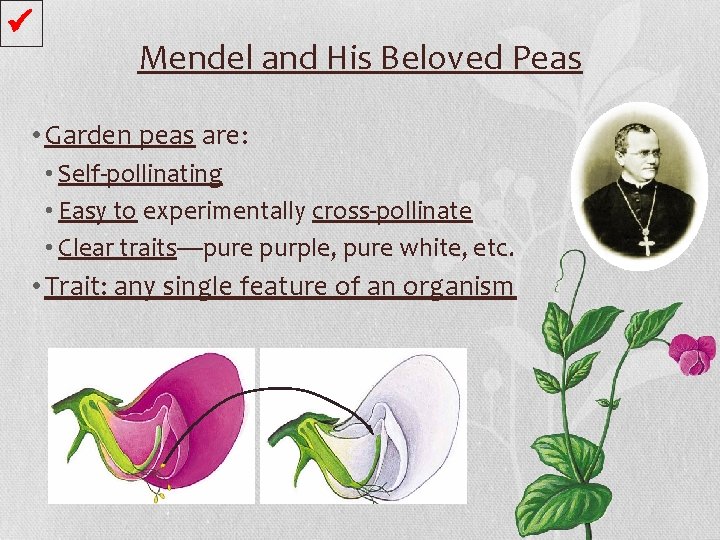
Mendel and His Beloved Peas • Garden peas are: • Self-pollinating • Easy to experimentally cross-pollinate • Clear traits—pure purple, pure white, etc. • Trait: any single feature of an organism
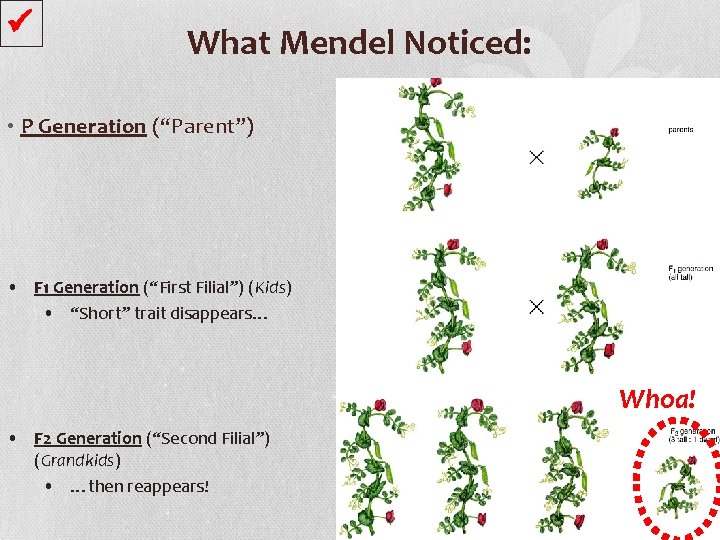
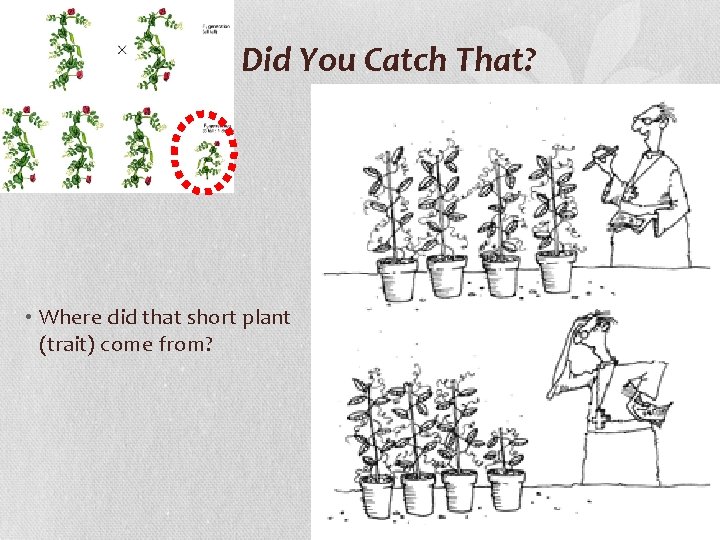
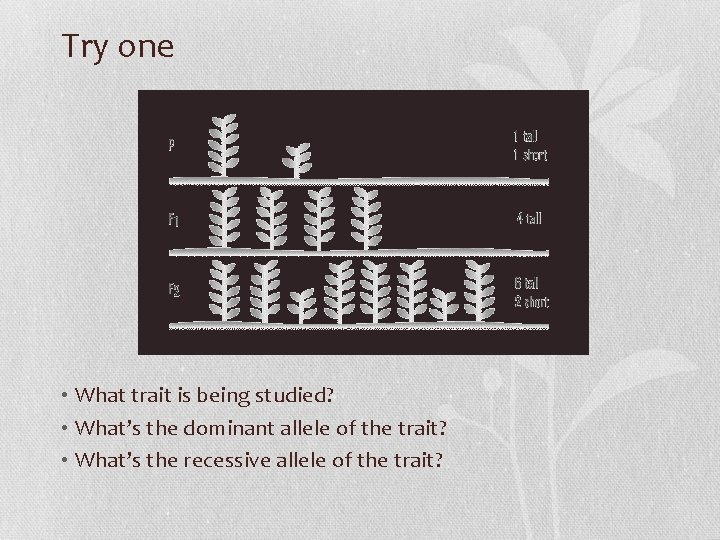
What Mendel Noticed: • P Generation (“Parent”) • F 1 Generation (“First Filial”) (Kids) • “Short” trait disappears… Whoa! • F 2 Generation (“Second Filial”) (Grandkids) • …then reappears!
Did You Catch That? • Where did that short plant (trait) come from?
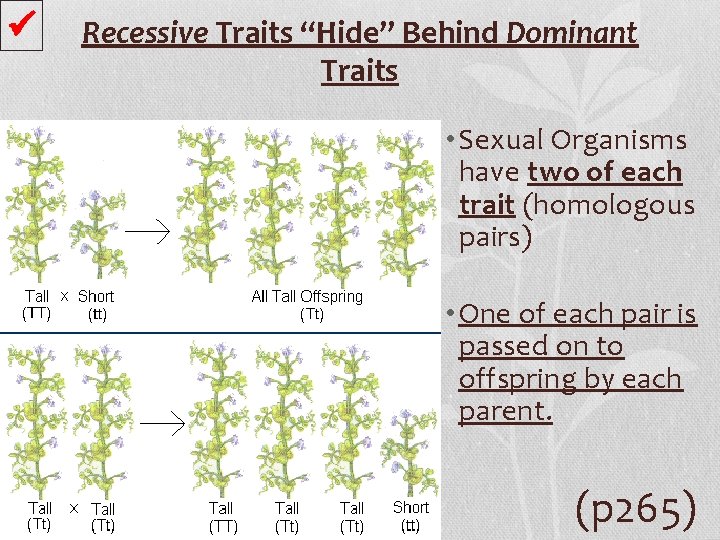
Recessive Traits “Hide” Behind Dominant Traits • Sexual Organisms have two of each trait (homologous pairs) • One of each pair is passed on to offspring by each parent. (p 265)
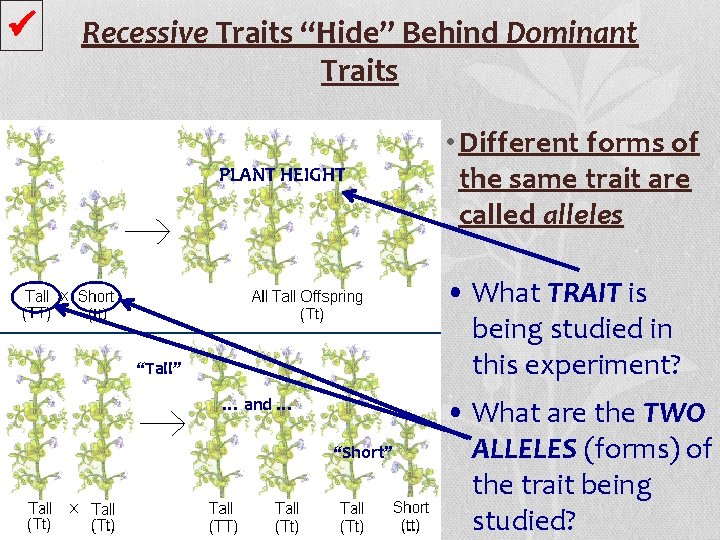
Recessive Traits “Hide” Behind Dominant Traits PLANT HEIGHT • Different forms of the same trait are called alleles • What TRAIT is being studied in this experiment? “Tall” … and … “Short” • What are the TWO ALLELES (forms) of the trait being studied?
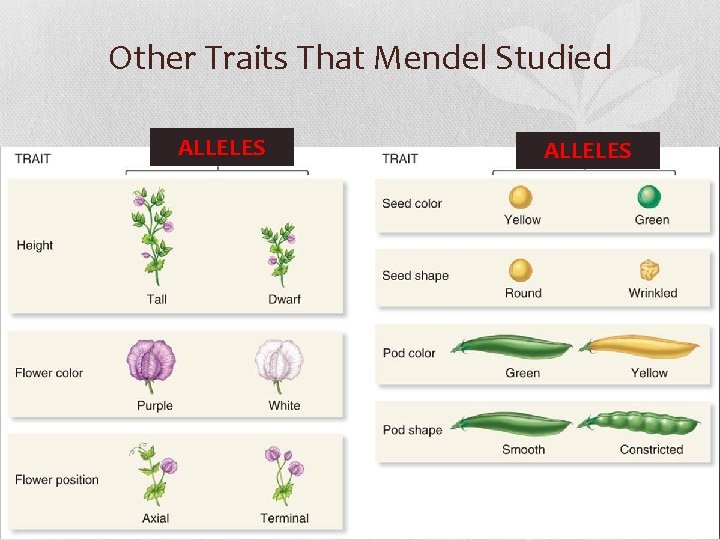
Other Traits That Mendel Studied ALLELES
Try one • What trait is being studied? • What’s the dominant allele of the trait? • What’s the recessive allele of the trait?
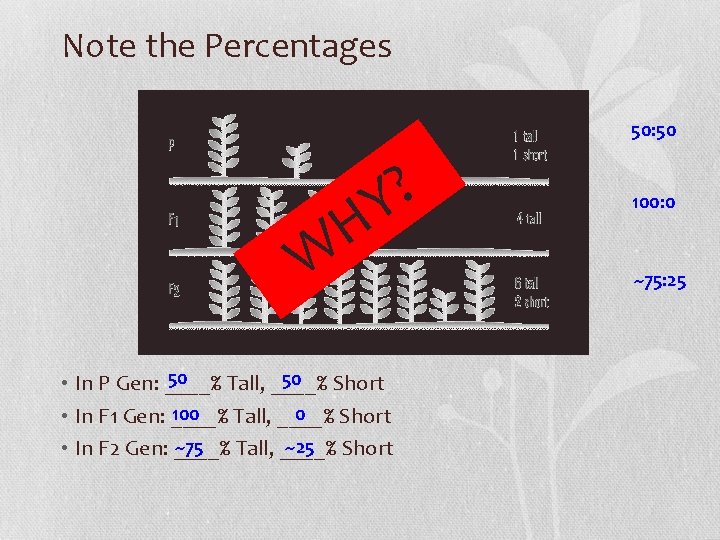
Note the Percentages 50: 50 W ? Y H 50 50 • In P Gen: ____% Tall, ____% Short 100 0 • In F 1 Gen: ____% Tall, ____% Short ~75 ~25 Short • In F 2 Gen: ____% Tall, ____% 100: 0 ~75: 25
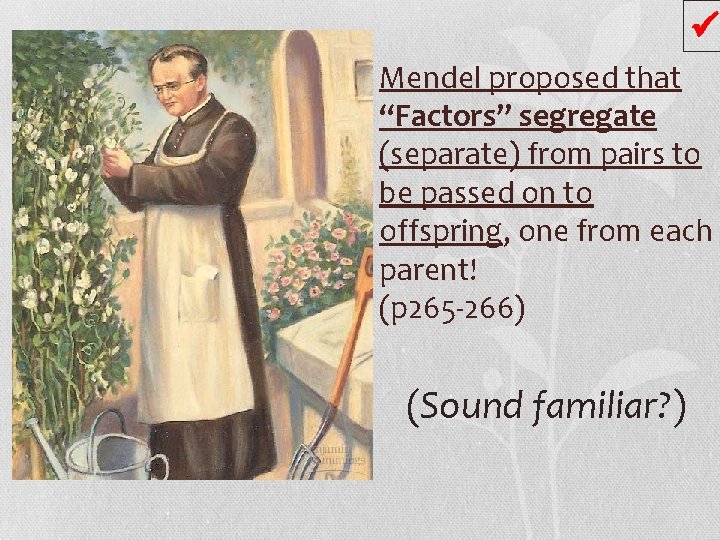
Mendel proposed that “Factors” segregate (separate) from pairs to be passed on to offspring, one from each parent! (p 265 -266) (Sound familiar? )
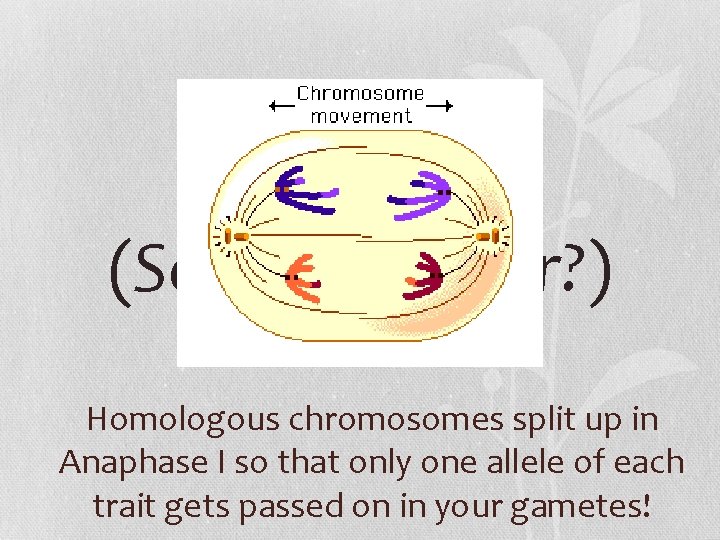
(Sound familiar? ) Homologous chromosomes split up in Anaphase I so that only one allele of each trait gets passed on in your gametes!
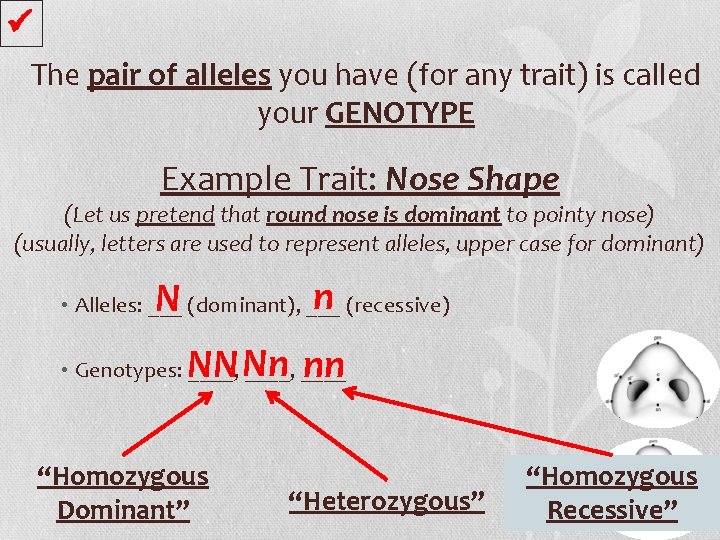
The pair of alleles you have (for any trait) is called your GENOTYPE Example Trait: Nose Shape (Let us pretend that round nose is dominant to pointy nose) (usually, letters are used to represent alleles, upper case for dominant) n N • Alleles: ___ (dominant), ___ (recessive) NN Nn nn • Genotypes: ____, ____ “Homozygous Dominant” “Heterozygous” “Homozygous Recessive”
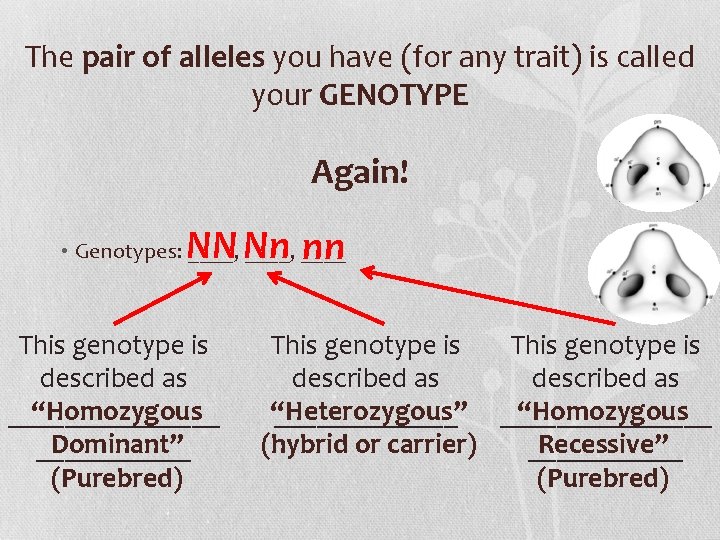
The pair of alleles you have (for any trait) is called your GENOTYPE Again! NN Nn nn • Genotypes: ____, ____ This genotype is described as “Homozygous ________ Dominant” ______ (Purebred) This genotype is described as “Heterozygous” “Homozygous _______________ (hybrid or carrier) Recessive” ______ (Purebred)
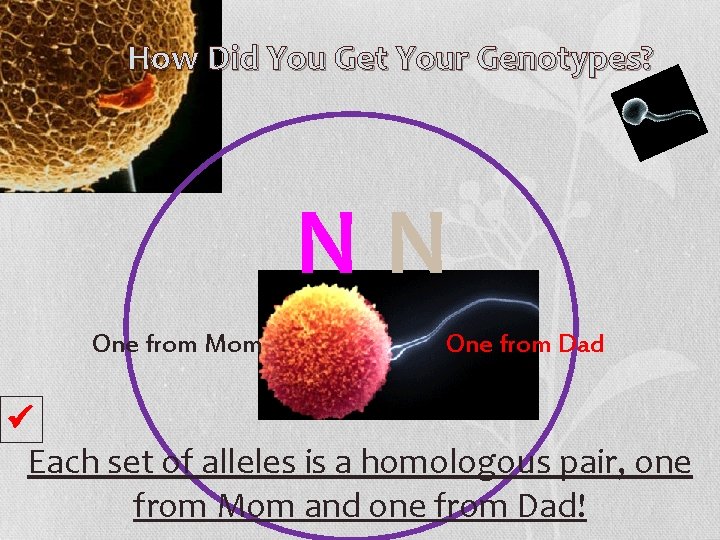
How Did You Get Your Genotypes? NN One from Mom One from Dad Each set of alleles is a homologous pair, one from Mom and one from Dad!
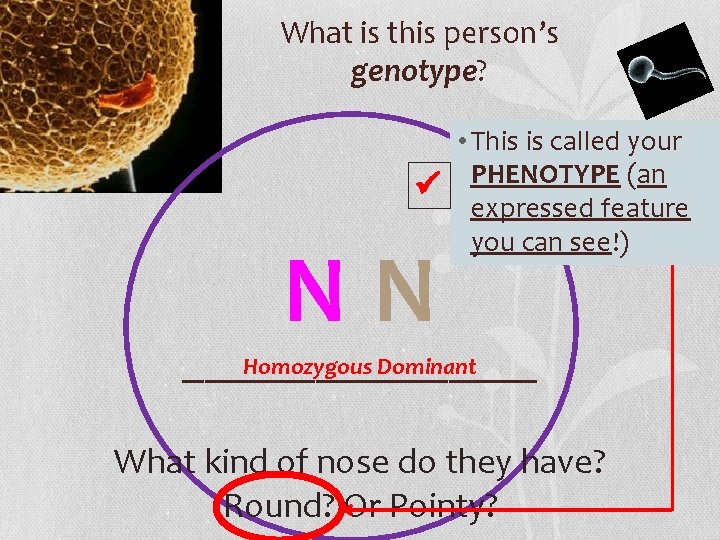
What is this person’s genotype? • This is called your PHENOTYPE (an expressed feature you can see!) NN ________ Homozygous Dominant What kind of nose do they have? Round? Or Pointy?
What is this person’s genotype? Nn • Remember: Dominant overshadows recessive! ________ Heterozygous What is this person’s PHENOTYPE? Round? Or Pointy?
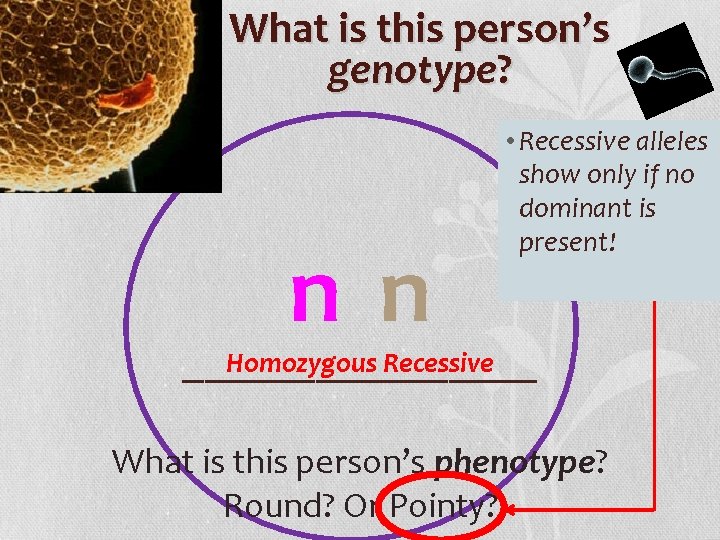
What is this person’s genotype? nn • Recessive alleles show only if no dominant is present! ________ Homozygous Recessive What is this person’s phenotype? Round? Or Pointy?
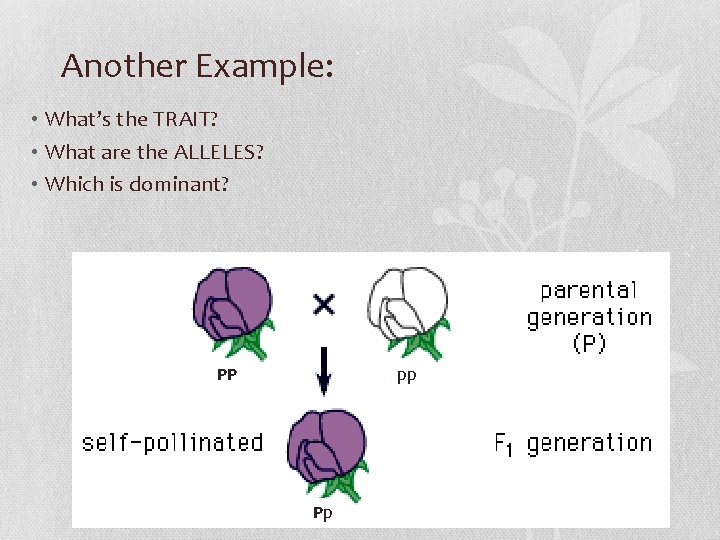
Another Example: • What’s the TRAIT? • What are the ALLELES? • Which is dominant? PP pp Pp
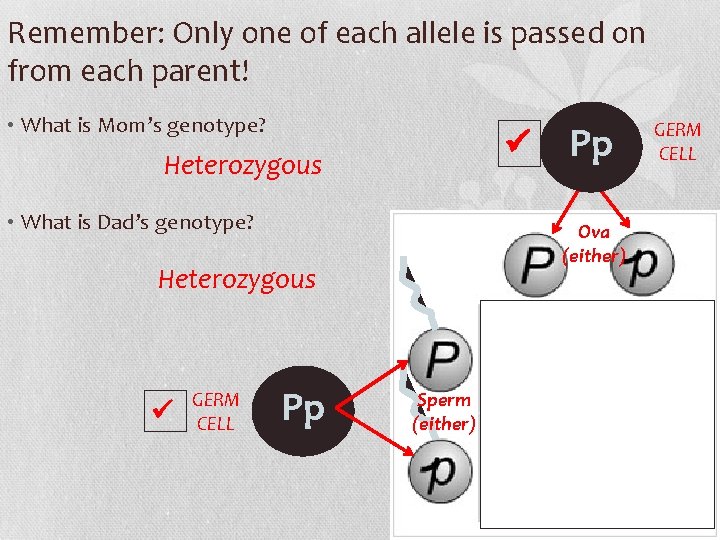
Remember: Only one of each allele is passed on from each parent! • What is Mom’s genotype? Heterozygous • What is Dad’s genotype? Ova (either) Heterozygous GERM CELL Pp Pp Sperm (either) GERM CELL
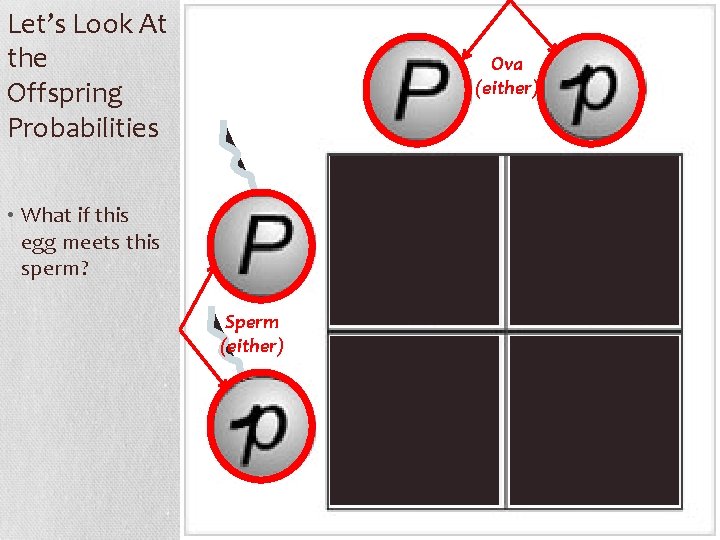
Let’s Look At the Offspring Probabilities Ova (either) • What if this egg meets this sperm? Sperm (either) What if this egg meets this sperm?
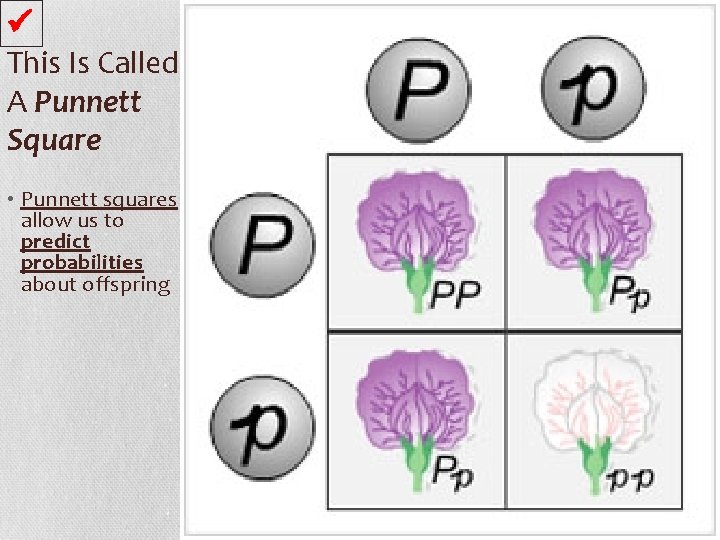
This Is Called A Punnett Square • Punnett squares allow us to predict probabilities about offspring
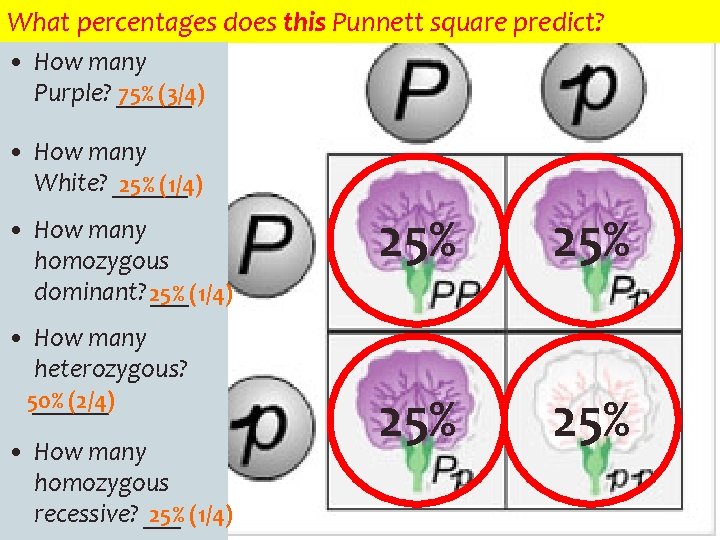
What percentages does this Punnett square predict? • How many 75% (3/4) Purple? ______ • How many White? ______ 25% (1/4) • How many homozygous dominant? 25% ___(1/4) • How many heterozygous? ______ 50% (2/4) • How many homozygous recessive? ___ 25% (1/4) 25% 25%
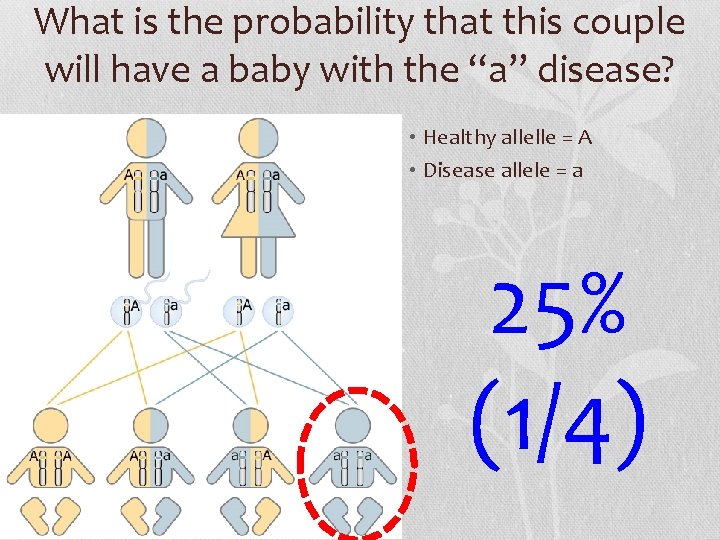
What is the probability that this couple will have a baby with the “a” disease? • Healthy allelle = A • Disease allele = a 25% (1/4)
What is the probability that this couple will have a baby who is a CARRIER for the “a” disease? • Healthy allelle = A • Disease allele = a 50% (2/4) A CARRIER is a heterozygote (he or she can “pass on” the trait but does not exhibit it)
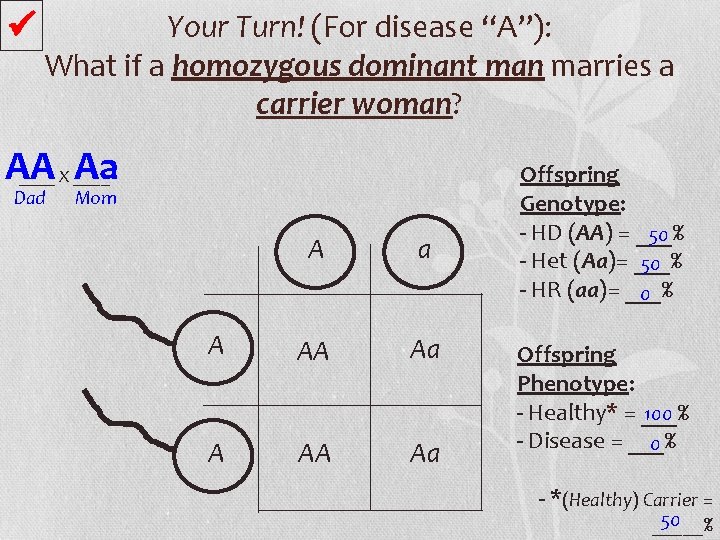
Your Turn! (For disease “A”): What if a homozygous dominant man marries a carrier woman? AA Aa ____ X ____ Dad Mom A a A AA Aa Offspring Genotype: - HD (AA) = ___% 50 - Het (Aa)= ___% 50 - HR (aa)= ___% 0 Offspring Phenotype: - Healthy* = ___% 100 - Disease = ___% 0 - *(Healthy) Carrier = 50 _____%
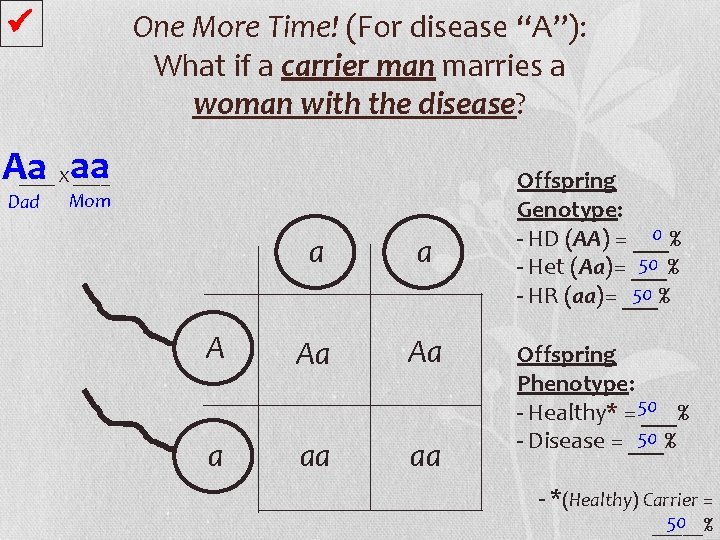
One More Time! (For disease “A”): What if a carrier man marries a woman with the disease? Aa ____ X aa ____ Dad Mom a a A Aa Aa a aa aa Offspring Genotype: 0 - HD (AA) = ___% 50 - Het (Aa)= ___% 50 - HR (aa)= ___% Offspring Phenotype: - Healthy* = 50 ___% 50 - Disease = ___% - *(Healthy) Carrier = 50 _____%