
Mendelian Genetics Dominant traits traits that are expressed
- Slides: 41
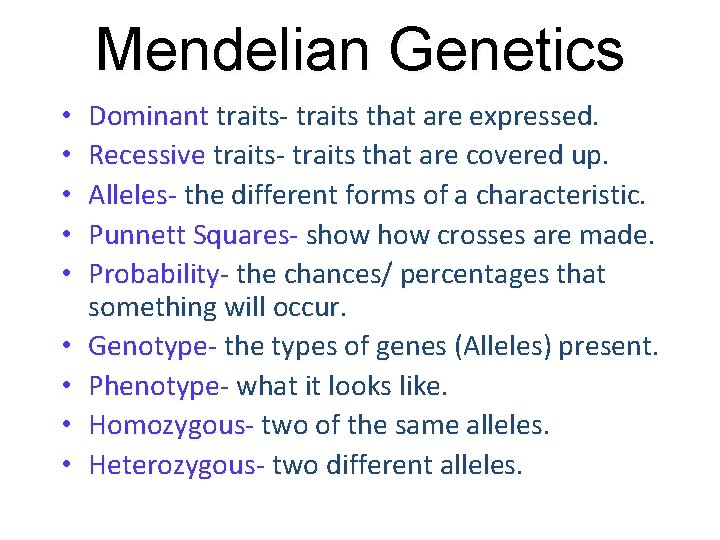
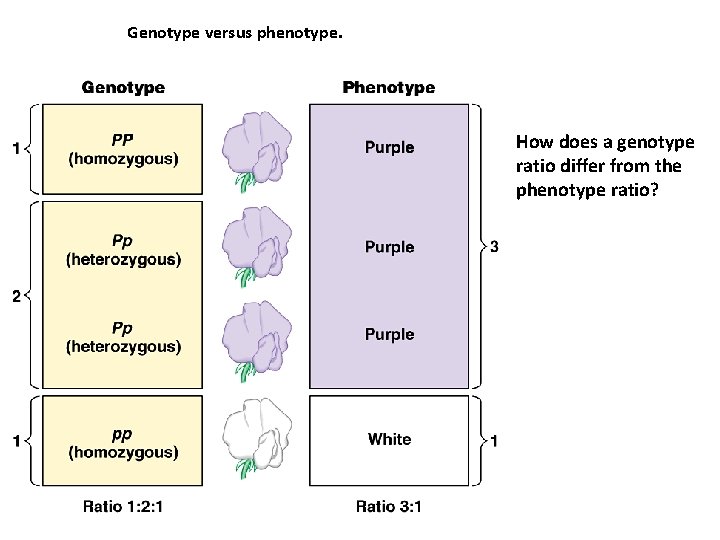
Mendelian Genetics • • • Dominant traits- traits that are expressed. Recessive traits- traits that are covered up. Alleles- the different forms of a characteristic. Punnett Squares- show crosses are made. Probability- the chances/ percentages that something will occur. Genotype- the types of genes (Alleles) present. Phenotype- what it looks like. Homozygous- two of the same alleles. Heterozygous- two different alleles.
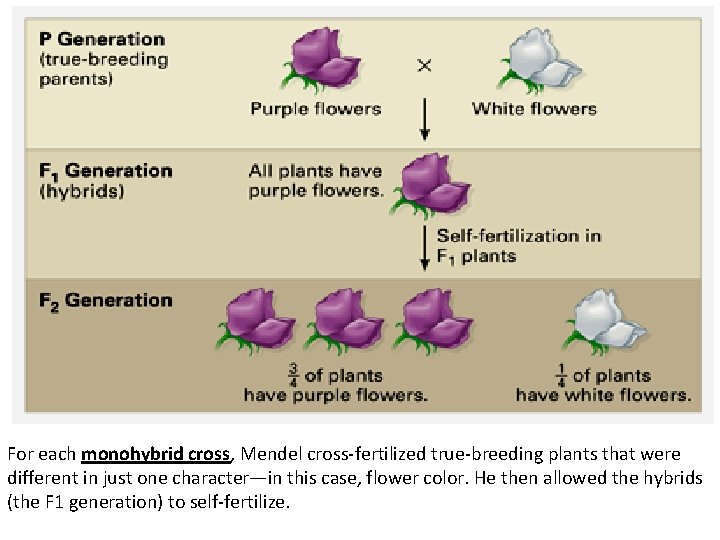
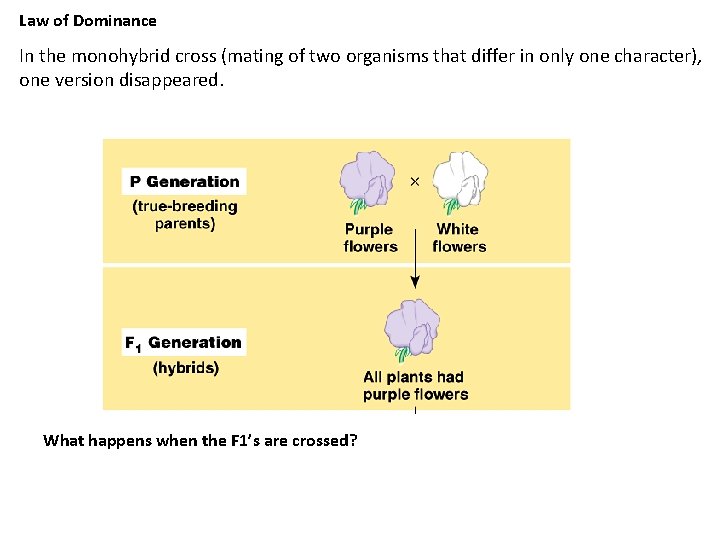
For each monohybrid cross, Mendel cross-fertilized true-breeding plants that were different in just one character—in this case, flower color. He then allowed the hybrids (the F 1 generation) to self-fertilize.
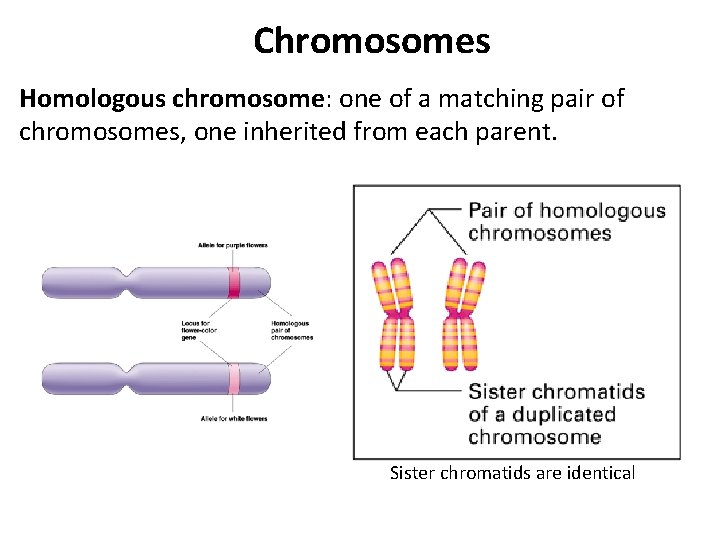
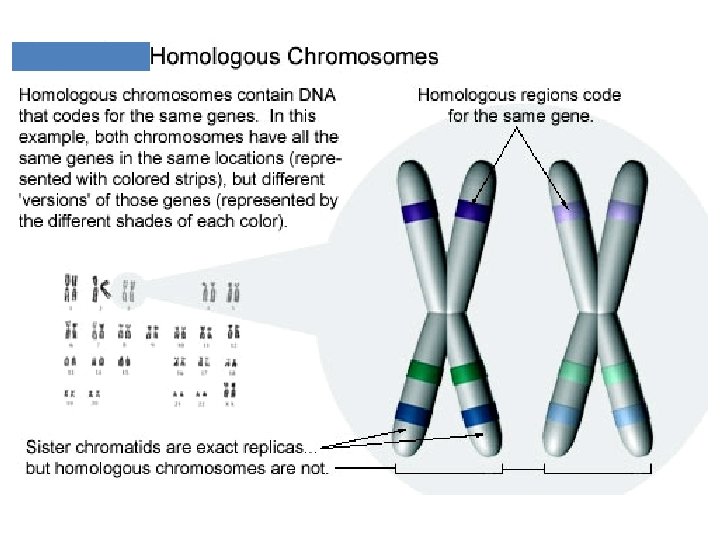
Chromosomes Homologous chromosome: one of a matching pair of chromosomes, one inherited from each parent. Sister chromatids are identical
Law of Dominance In the monohybrid cross (mating of two organisms that differ in only one character), one version disappeared. What happens when the F 1’s are crossed?
Genotype versus phenotype. How does a genotype ratio differ from the phenotype ratio?
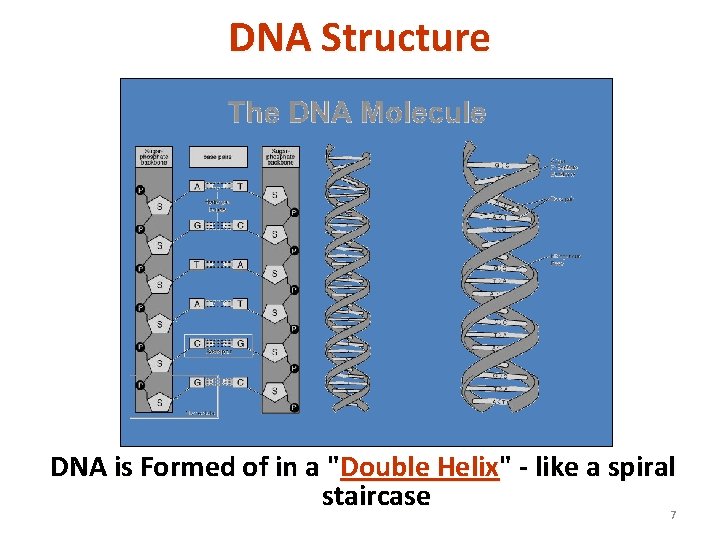
DNA Structure DNA is Formed of in a "Double Helix" - like a spiral staircase 7
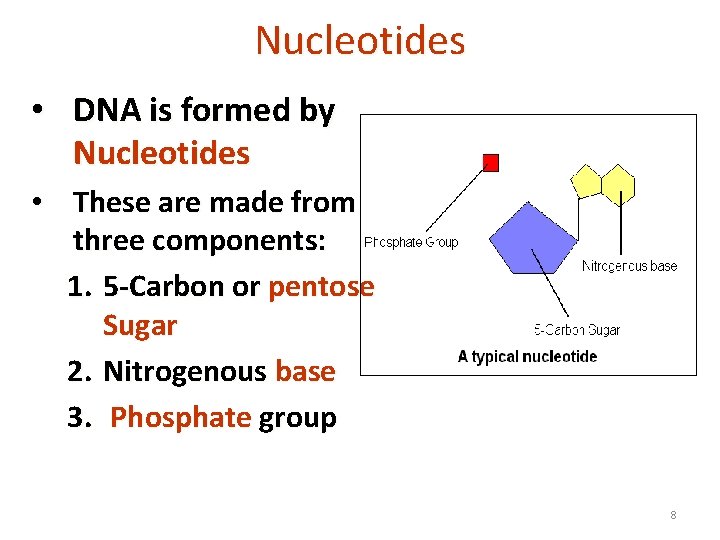
Nucleotides • DNA is formed by Nucleotides • These are made from three components: 1. 5 -Carbon or pentose Sugar 2. Nitrogenous base 3. Phosphate group 8
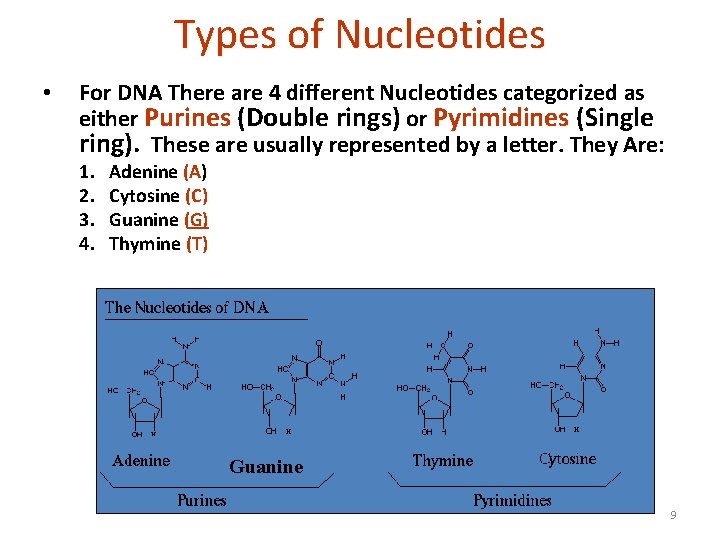
Types of Nucleotides • For DNA There are 4 different Nucleotides categorized as either Purines (Double rings) or Pyrimidines (Single ring). These are usually represented by a letter. They Are: 1. 2. 3. 4. Adenine (A) Cytosine (C) Guanine (G) Thymine (T) Guanine 9
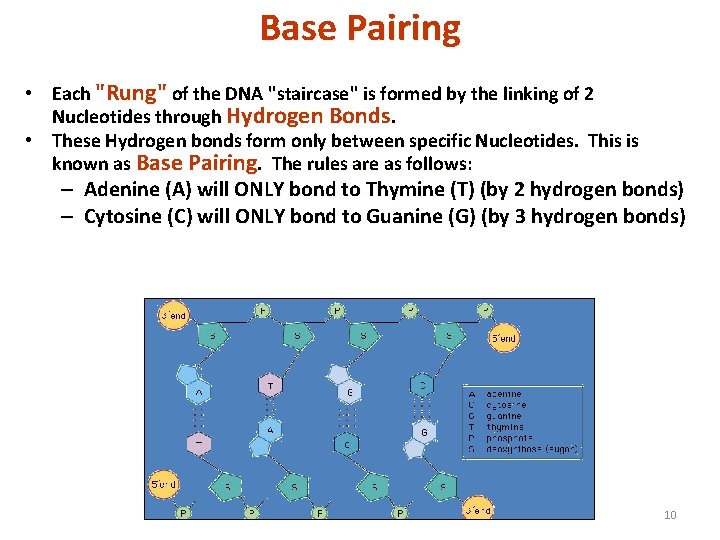
Base Pairing • Each "Rung" of the DNA "staircase" is formed by the linking of 2 Nucleotides through Hydrogen Bonds. • These Hydrogen bonds form only between specific Nucleotides. This is known as Base Pairing. The rules are as follows: – Adenine (A) will ONLY bond to Thymine (T) (by 2 hydrogen bonds) – Cytosine (C) will ONLY bond to Guanine (G) (by 3 hydrogen bonds) 10
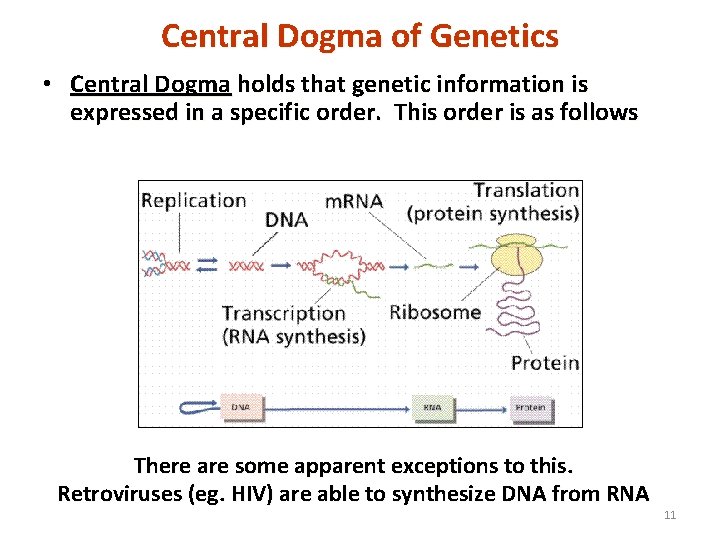
Central Dogma of Genetics • Central Dogma holds that genetic information is expressed in a specific order. This order is as follows There are some apparent exceptions to this. Retroviruses (eg. HIV) are able to synthesize DNA from RNA 11
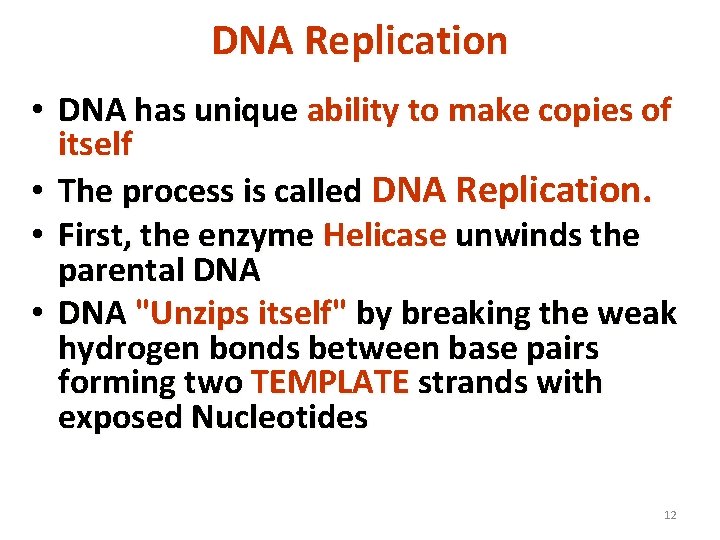
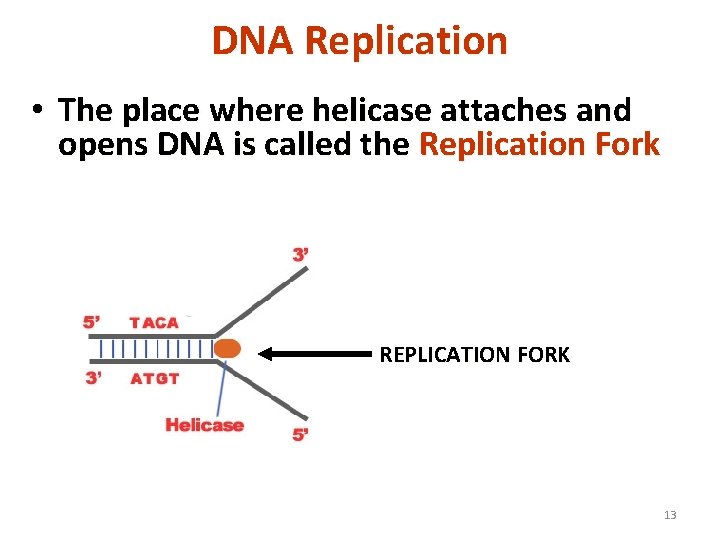
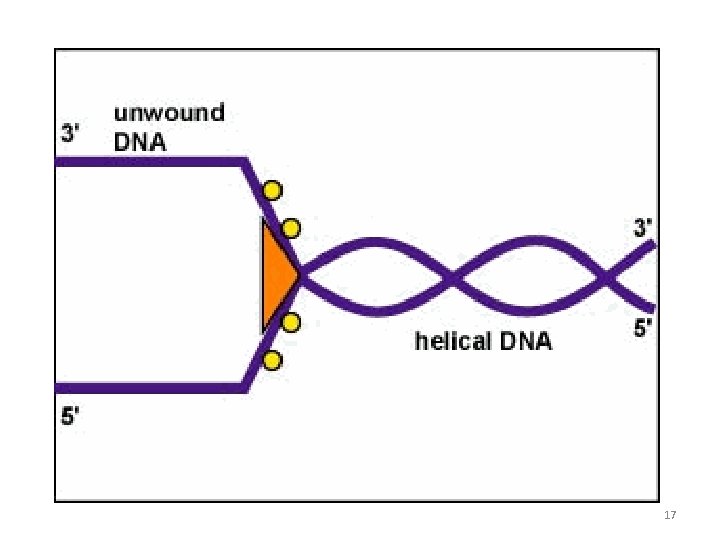
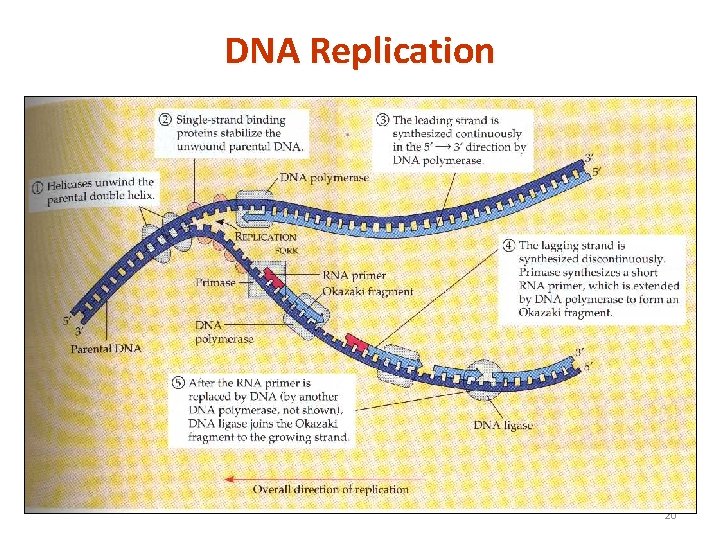
DNA Replication • DNA has unique ability to make copies of itself • The process is called DNA Replication. • First, the enzyme Helicase unwinds the parental DNA • DNA "Unzips itself" by breaking the weak hydrogen bonds between base pairs forming two TEMPLATE strands with exposed Nucleotides 12
DNA Replication • The place where helicase attaches and opens DNA is called the Replication Fork REPLICATION FORK 13
DNA Replication • Single-strand binding proteins attach & STABILIZE the 2 parental strands • DNA polymerase attaches to the 3’ end of the 5’ to 3’ parental strand • DNA polymerase attaches FREE nucleotides to the complementary nucleotide on the parental DNA • This new strand is synthesized continuously 5’ to 3’ (LEADING) 14
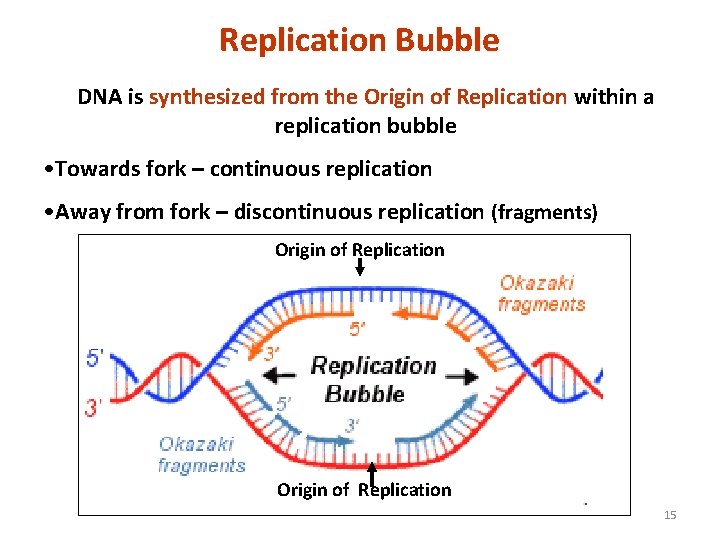
Replication Bubble DNA is synthesized from the Origin of Replication within a replication bubble • Towards fork – continuous replication • Away from fork – discontinuous replication (fragments) Origin of Replication 15
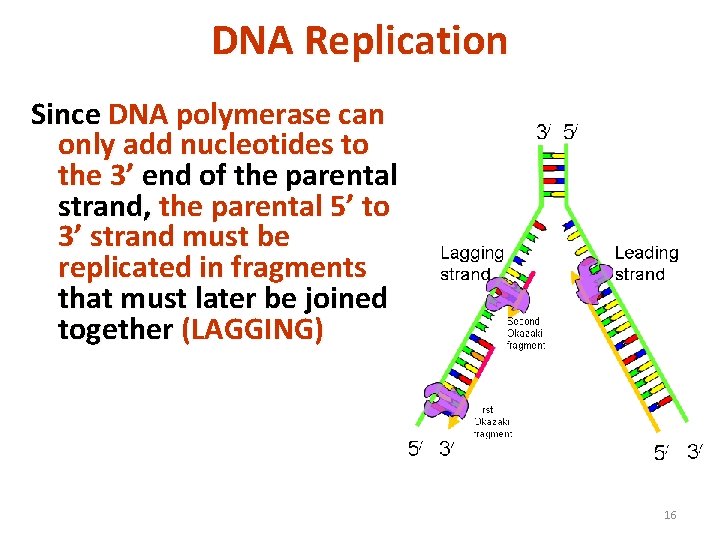
DNA Replication Since DNA polymerase can only add nucleotides to the 3’ end of the parental strand, the parental 5’ to 3’ strand must be replicated in fragments that must later be joined together (LAGGING) 16
17
DNA Replication • Transcription proceeds continuously along the 5' 3' direction (This is called the leading strand) • Proceeds in fragments in the other direction (called the lagging strand) in the following way • RNA primer is attached to a segment of the strand by the enzyme primase. 18
DNA Replication • Transcription now continues in the 5' 3' direction forming an okazaki fragment. Until it reaches the next fragment. • The two fragments are joined by the enzyme DNA ligase • Two, new, identical DNA strands are now formed 19
DNA Replication 20
Protein Synthesis Transcription and Translation 21
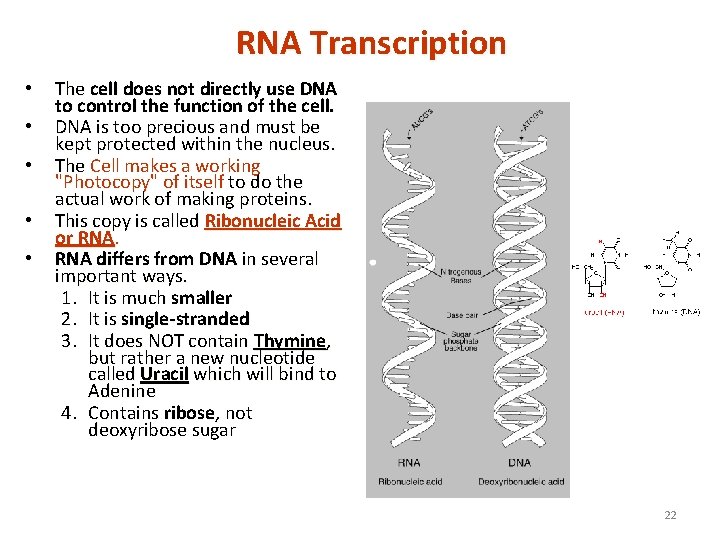
RNA Transcription • • • The cell does not directly use DNA to control the function of the cell. DNA is too precious and must be kept protected within the nucleus. The Cell makes a working "Photocopy" of itself to do the actual work of making proteins. This copy is called Ribonucleic Acid or RNA differs from DNA in several important ways. 1. It is much smaller 2. It is single-stranded 3. It does NOT contain Thymine, but rather a new nucleotide called Uracil which will bind to Adenine 4. Contains ribose, not deoxyribose sugar 22
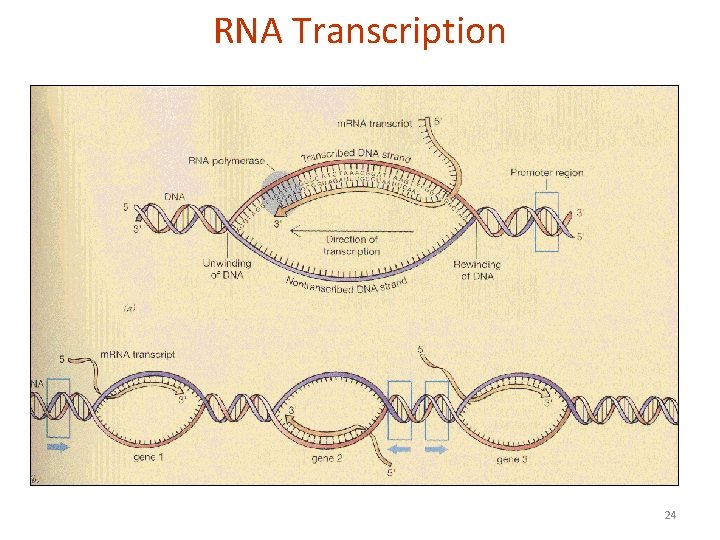
RNA Transcription • RNA is produced through a process called RNA Transcription. • Similar to DNA Replication. • Small area of DNA "Unzips" exposing Nucleotides • This area is acted on by an enzyme called RNA Polymerase, which binds nucleotides (using uracil) to their complementary base pair. • This releases a long strand of Messenger RNA (m. RNA) which is an important component of protein synthesis. 23
RNA Transcription 24
Protein Synthesis & The Genetic Code • The Sequence of nucleotides in an m. RNA strand determine the sequence of amino acids in a protein • Process requires m. RNA, t. RNA & ribosomes • Polypeptide chains are synthesized by linking amino acids together with peptide bonds 25
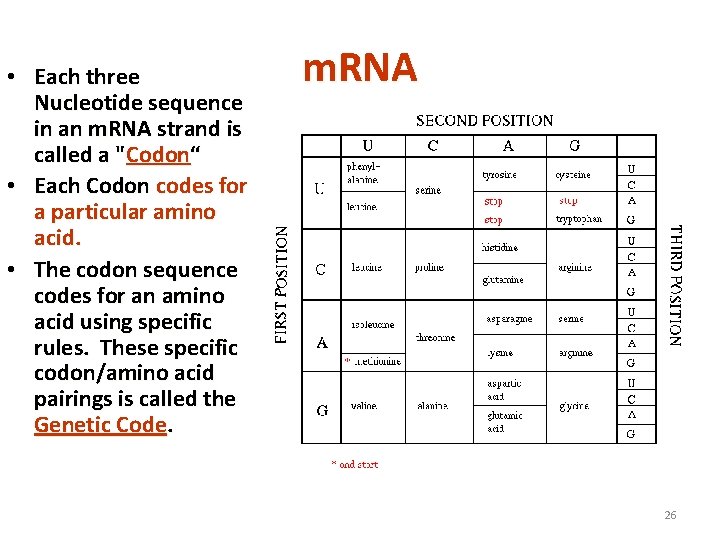
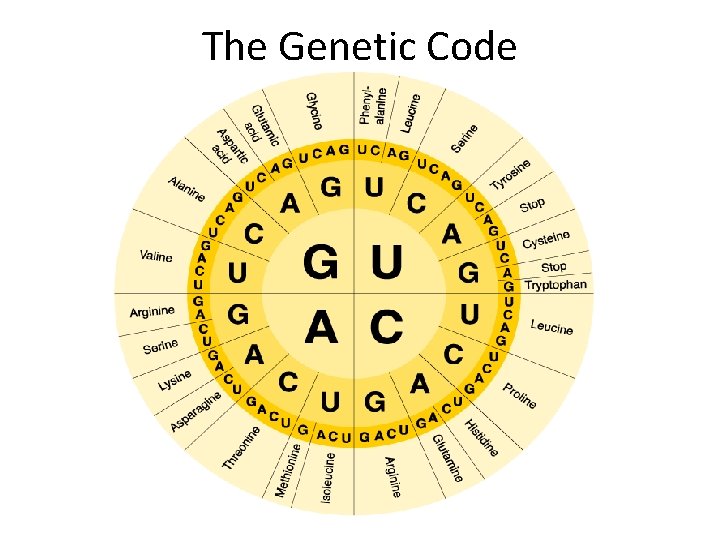
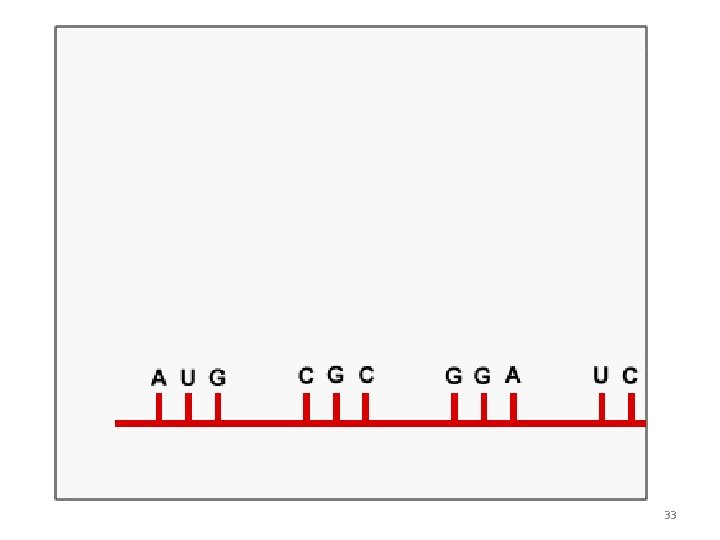
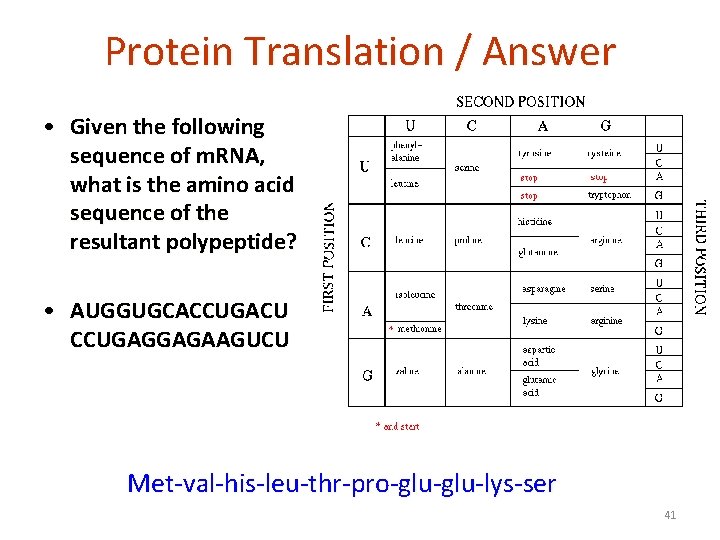
• Each three Nucleotide sequence in an m. RNA strand is called a "Codon“ • Each Codon codes for a particular amino acid. • The codon sequence codes for an amino acid using specific rules. These specific codon/amino acid pairings is called the Genetic Code. m. RNA 26
The Genetic Code
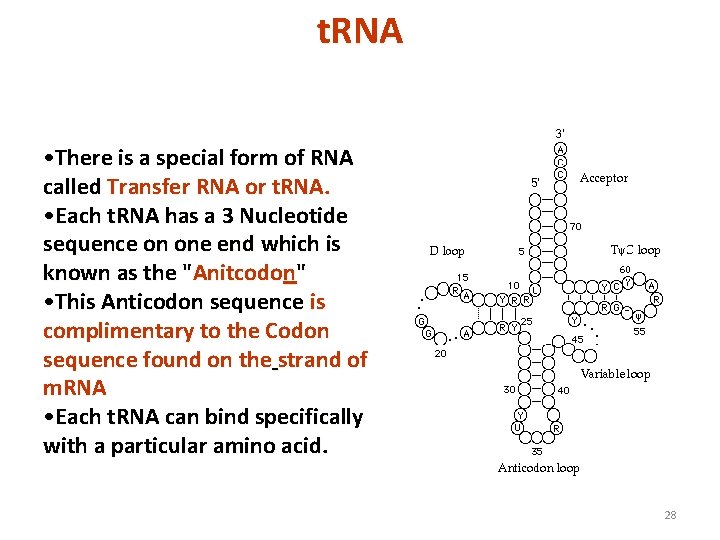
t. RNA • There is a special form of RNA called Transfer RNA or t. RNA. • Each t. RNA has a 3 Nucleotide sequence on one end which is known as the "Anitcodon" • This Anticodon sequence is complimentary to the Codon sequence found on the strand of m. RNA • Each t. RNA can bind specifically with a particular amino acid. 28
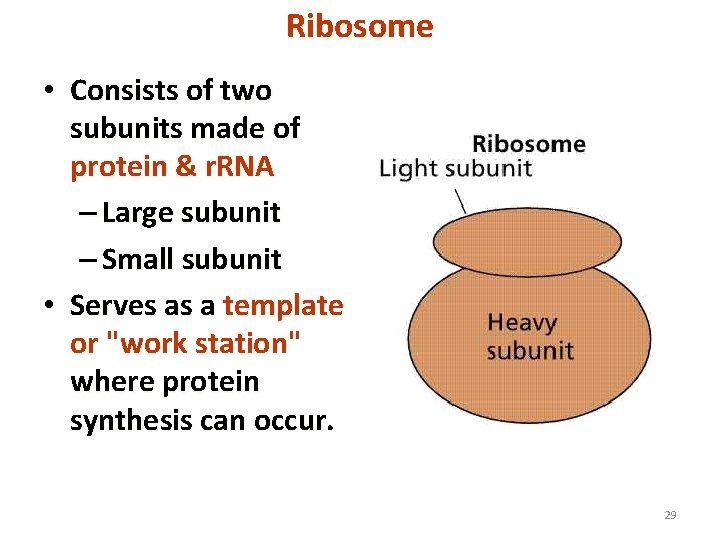
Ribosome • Consists of two subunits made of protein & r. RNA – Large subunit – Small subunit • Serves as a template or "work station" where protein synthesis can occur. 29
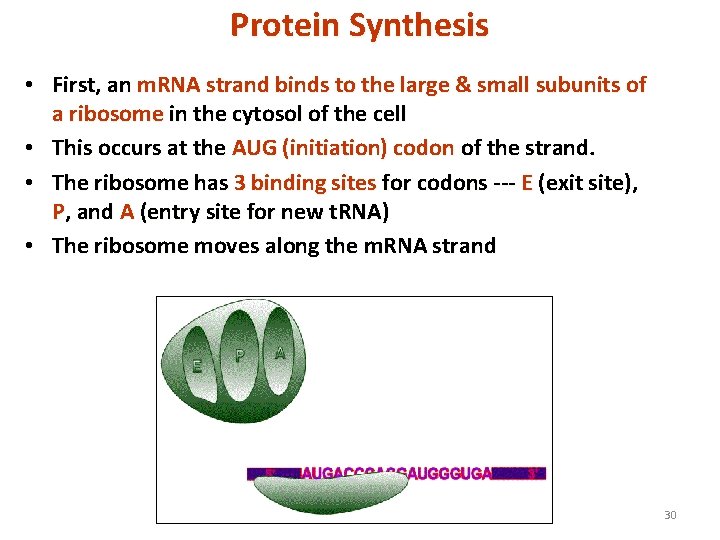
Protein Synthesis • First, an m. RNA strand binds to the large & small subunits of a ribosome in the cytosol of the cell • This occurs at the AUG (initiation) codon of the strand. • The ribosome has 3 binding sites for codons --- E (exit site), P, and A (entry site for new t. RNA) • The ribosome moves along the m. RNA strand 30
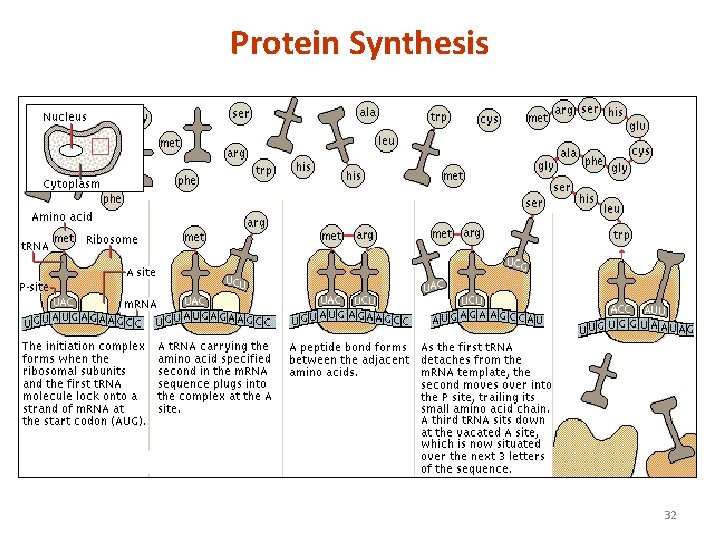
Protein Synthesis • An anticodon on t. RNA binds to a complementary codon on m. RNA. • The t. RNA carrying an amino acid enters the A site on the ribosome • The ribosome moves down the m. RNA so the t. RNA is now in the P site and another t. RNA enters the A site • A peptide bond is formed between the amino acids and the ribosome moves down again • The first t. RNA is released, and another t. RNA binds next to the second, another peptide bond is formed. • This process continues until a stop codon (UAG…) is reached. • The completed polypeptide is then released. 31
Protein Synthesis 32
33
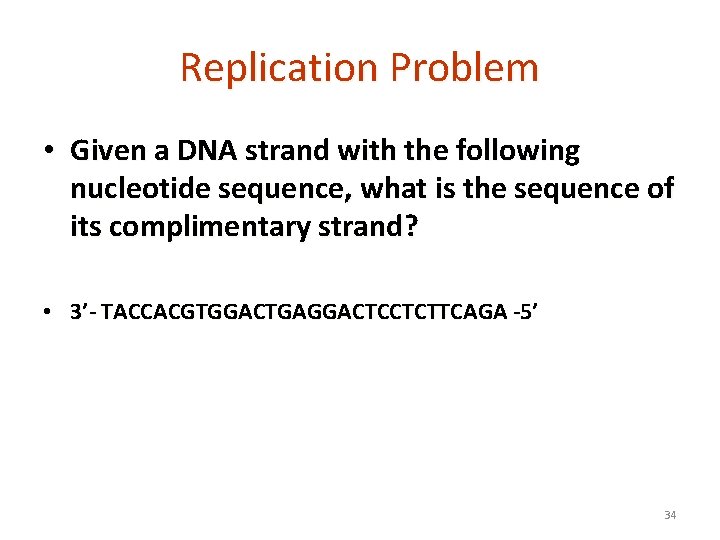
Replication Problem • Given a DNA strand with the following nucleotide sequence, what is the sequence of its complimentary strand? • 3’- TACCACGTGGACTGAGGACTCCTCTTCAGA -5’ 34
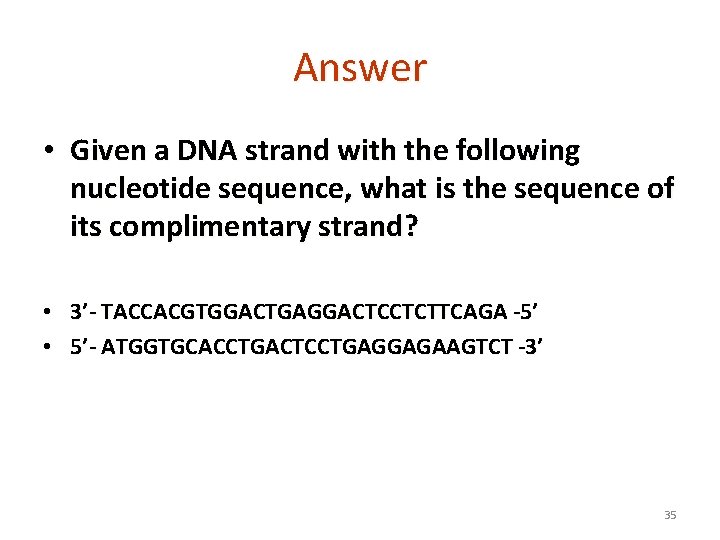
Answer • Given a DNA strand with the following nucleotide sequence, what is the sequence of its complimentary strand? • 3’- TACCACGTGGACTGAGGACTCCTCTTCAGA -5’ • 5’- ATGGTGCACCTGACTCCTGAGGAGAAGTCT -3’ 35
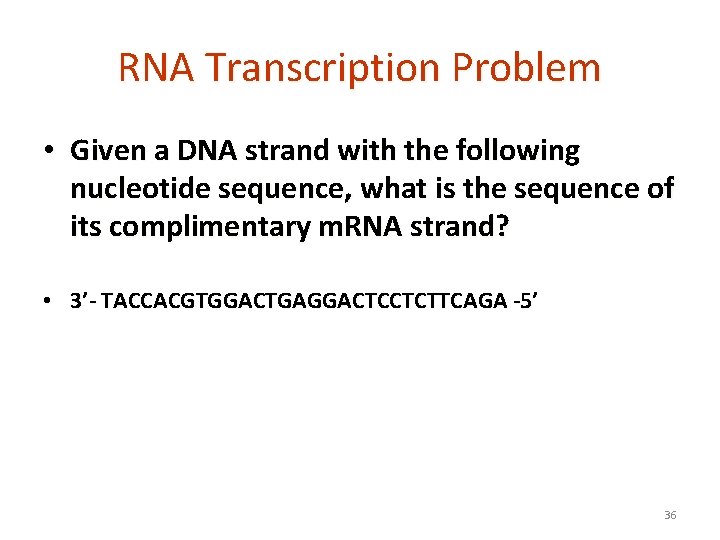
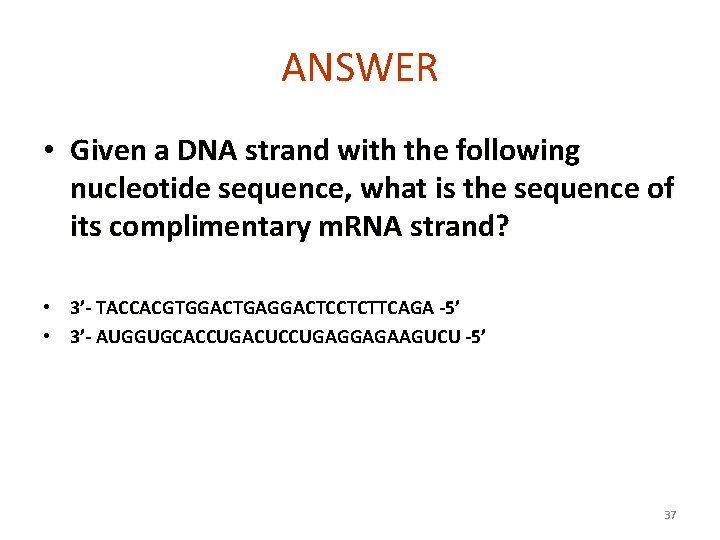
RNA Transcription Problem • Given a DNA strand with the following nucleotide sequence, what is the sequence of its complimentary m. RNA strand? • 3’- TACCACGTGGACTGAGGACTCCTCTTCAGA -5’ 36
ANSWER • Given a DNA strand with the following nucleotide sequence, what is the sequence of its complimentary m. RNA strand? • 3’- TACCACGTGGACTGAGGACTCCTCTTCAGA -5’ • 3’- AUGGUGCACCUGACUCCUGAGGAGAAGUCU -5’ 37
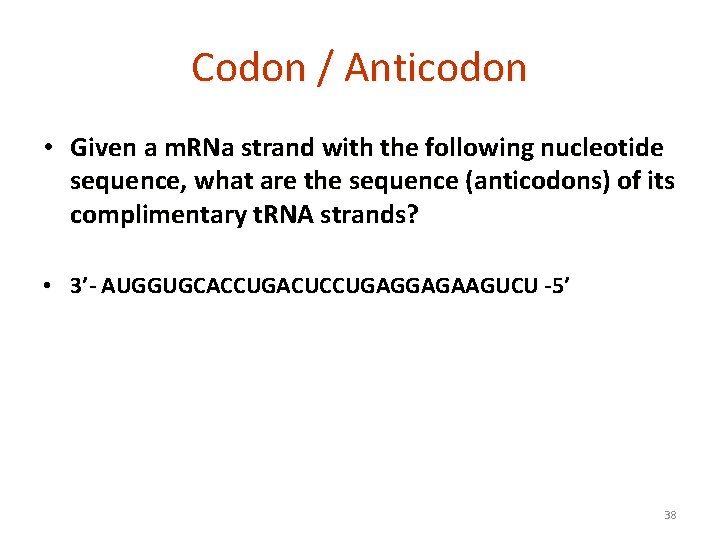
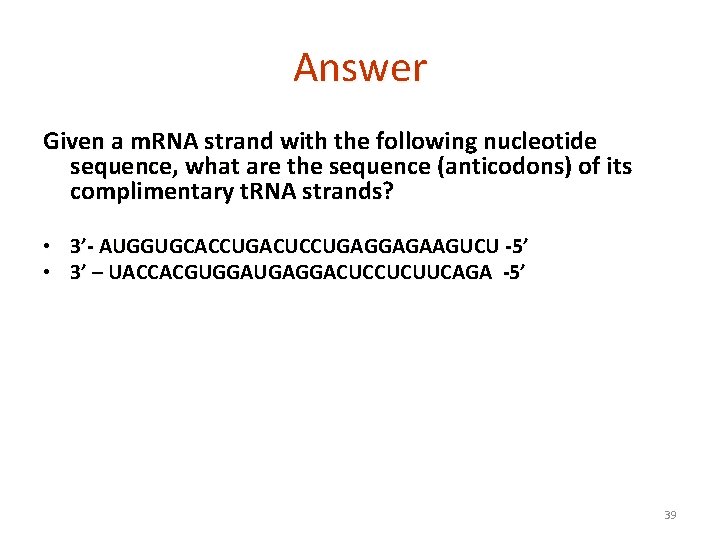
Codon / Anticodon • Given a m. RNa strand with the following nucleotide sequence, what are the sequence (anticodons) of its complimentary t. RNA strands? • 3’- AUGGUGCACCUGACUCCUGAGGAGAAGUCU -5’ 38
Answer Given a m. RNA strand with the following nucleotide sequence, what are the sequence (anticodons) of its complimentary t. RNA strands? • 3’- AUGGUGCACCUGACUCCUGAGGAGAAGUCU -5’ • 3’ – UACCACGUGGAUGAGGACUCCUCUUCAGA -5’ 39
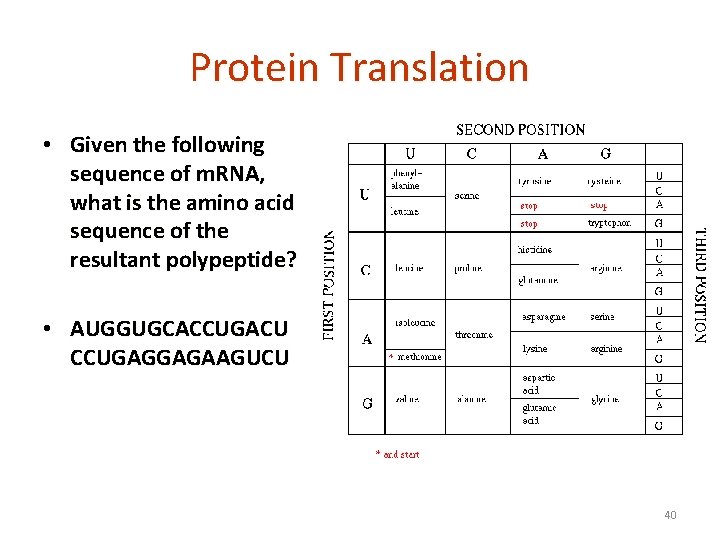
Protein Translation • Given the following sequence of m. RNA, what is the amino acid sequence of the resultant polypeptide? • AUGGUGCACCUGACU CCUGAGGAGAAGUCU 40
Protein Translation / Answer • Given the following sequence of m. RNA, what is the amino acid sequence of the resultant polypeptide? • AUGGUGCACCUGACU CCUGAGGAGAAGUCU Met-val-his-leu-thr-pro-glu-lys-ser 41