
Mendel Genetics Who is the Father of Genetics





- Slides: 57
Mendel & Genetics
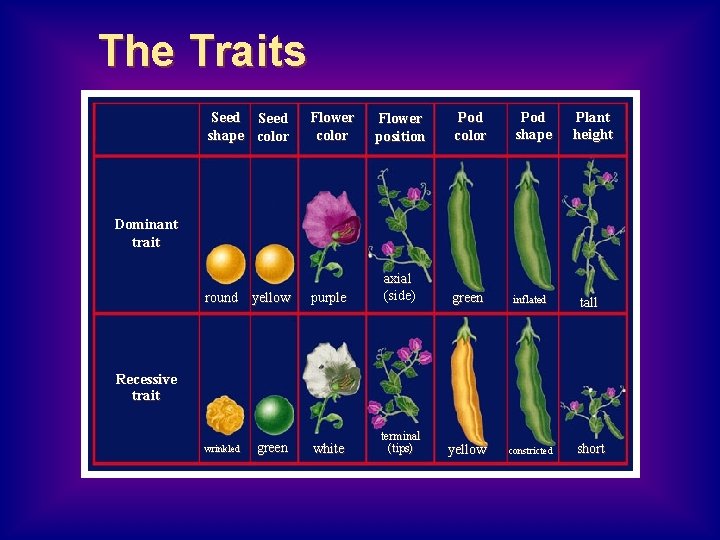
Who is the Father of Genetics? n n n Gregor Mendel-an Austrian Monk in charge of the gardens. Best known for experiments with pea plants Observed 7 traits or characteristics. Each trait has a contrast. Mendel used 2 methods in his experiments n Self pollination – same plant n Cross pollination – two different plants
Heredity The transmission of traits or characteristics from the parent to the offspring
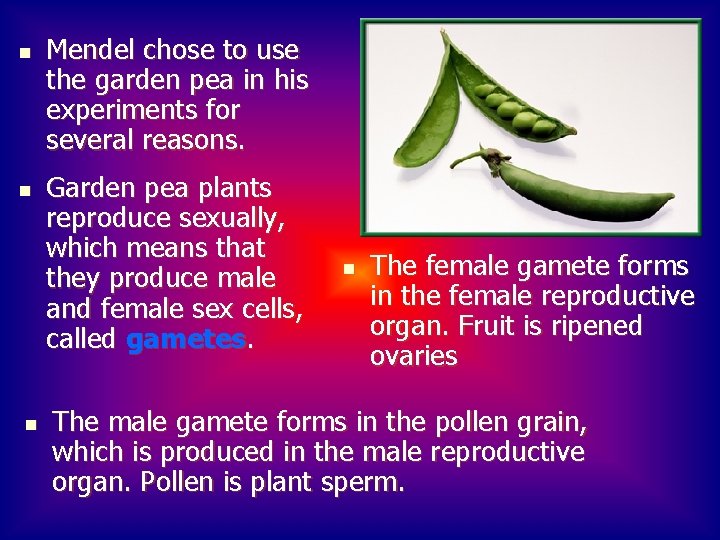
n n n Mendel chose to use the garden pea in his experiments for several reasons. Garden pea plants reproduce sexually, which means that they produce male and female sex cells, called gametes. n The female gamete forms in the female reproductive organ. Fruit is ripened ovaries The male gamete forms in the pollen grain, which is produced in the male reproductive organ. Pollen is plant sperm.
n n n In a process called fertilization, the male gamete unites with the female gamete. The resulting fertilized cell, called a zygote then develops into a seed. The transfer of pollen grains from a male reproductive organ to a female reproductive organ in a plant is called pollination.
The Traits Seed shape color Flower position Pod color Pod shape Plant height purple axial (side) green inflated tall white terminal (tips) yellow constricted short Dominant trait round yellow Recessive trait wrinkled green
Organisms that have the same traits as the parents & always produce the same type are pure or purebred. Example: BB or bb
Probability n n The likelihood a specific event will occur. Expressed in a decimal, % or fraction. Probability = # times an event is expected to happen # opportunities for the event to happen Predicted results are more likely to occur when there are many trials.
• P 1 generation (parental) – plants that are pure for their traits. When crossed yields hybrid offspring w/dominant traits masking recessive ones. n Hybrid – to carry both a dominant and a recessive trait. n Recessive – traits masked or covered up by the dominant. n Dominant – the overpowering trait that hides or masks the recessive.
F 1 Generation (first filial) The offspring of the P generation. When crossed yields 2 pure and 2 hybrid offspring. F 2 Generation (second filial) The offspring of the F 1 generation. Can yield several combinations.
The rule of unit factors n n Mendel concluded that each organism has two factors that control each of its traits. We now know that these factors are genes and that they are located on chromosomes. Genes exist in alternative forms. We call these different gene forms alleles. An organism’s two alleles are located on different copies of a chromosome—one inherited from the female parent and one from the male parent.
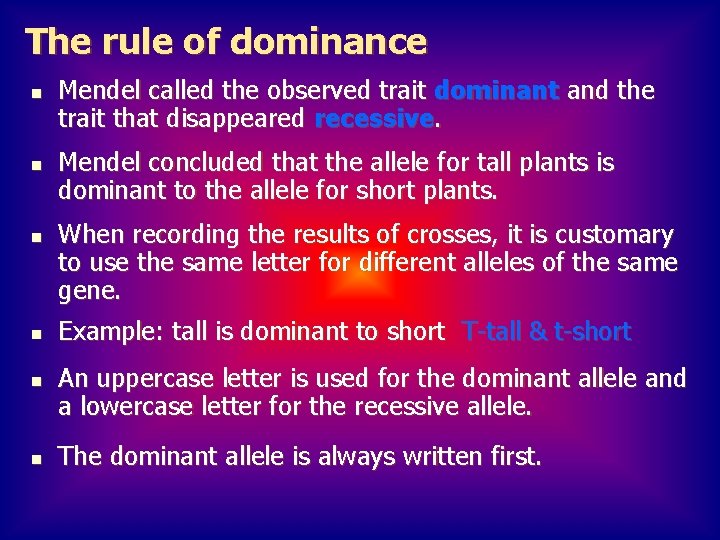
The rule of dominance n n n Mendel called the observed trait dominant and the trait that disappeared recessive. Mendel concluded that the allele for tall plants is dominant to the allele for short plants. When recording the results of crosses, it is customary to use the same letter for different alleles of the same gene. Example: tall is dominant to short T-tall & t-short An uppercase letter is used for the dominant allele and a lowercase letter for the recessive allele. The dominant allele is always written first.
The law of segregation States that a pair of factors or traits is segregated or separated during the formation of the gametes during spermatogenesis or oogenesis.
Phenotypes and Genotypes n n The way an organism looks and behaves is called its phenotype or physical characteristics. The allele combination an organism contains is known as its genotype or genetic makeup. An organism’s genotype can’t always be known by its phenotype. Two organisms can look alike but have different underlying allele combinations.
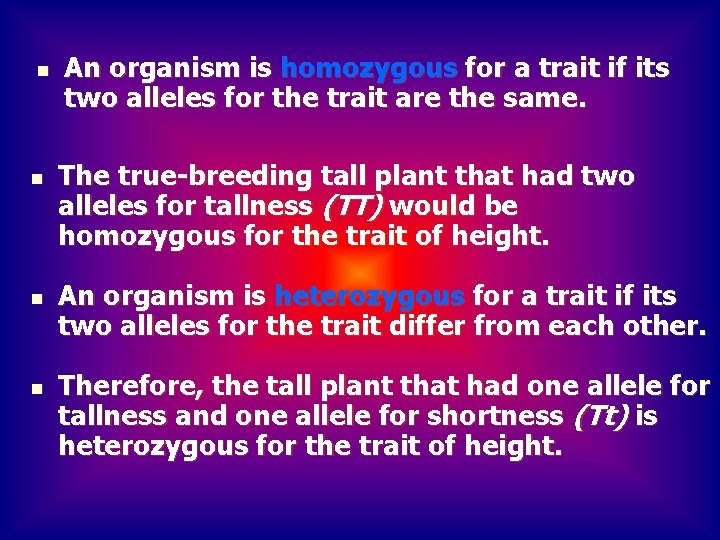
n n An organism is homozygous for a trait if its two alleles for the trait are the same. The true-breeding tall plant that had two alleles for tallness (TT) would be homozygous for the trait of height. An organism is heterozygous for a trait if its two alleles for the trait differ from each other. Therefore, the tall plant that had one allele for tallness and one allele for shortness (Tt) is heterozygous for the trait of height.
Punnett Squares n n n In 1905, Reginald Punnett, an English biologist, devised a shorthand way of finding the expected proportions of possible genotypes in the offspring of a cross. This method is called a Punnett square. If you know the genotypes of the parents, you can use a Punnett square to predict the possible genotypes of their offspring.
Mendel’s Monohybrid Crosses n n n A hybrid is the offspring of parents that have different forms of a trait, such as tall and short height. Mendel’s first experiments are called monohybrid crosses because mono means “one” and the two parent plants differed from each other by a single trait—height. A cross between individuals that involves a single allele type.
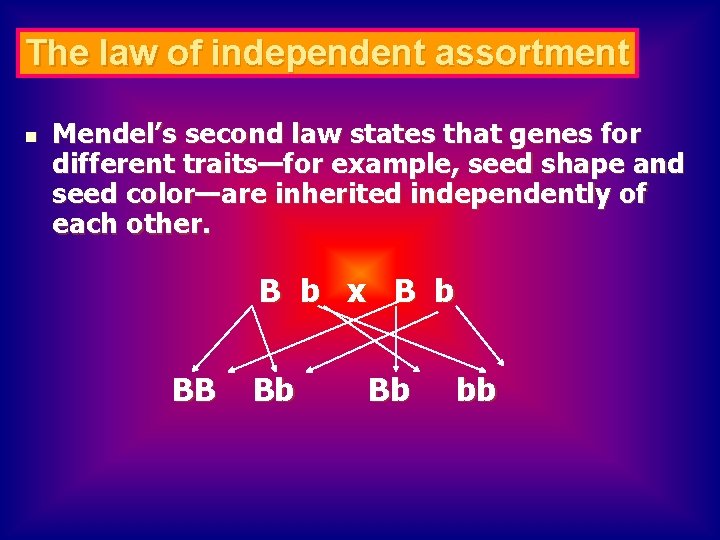
The law of independent assortment n Mendel’s second law states that genes for different traits—for example, seed shape and seed color—are inherited independently of each other. B b x B b BB Bb Bb bb
Mendel’s Dihybrid Crosses n n Mendel performed another set of crosses in which he used peas that differed from each other in two traits rather than only one. Such a cross involving two different traits is called a dihybrid cross.
Testcross Used to determine the genotype of any individual whose phenotype is dominant. Cross an unknown genotype with a homozygous recessive.
Complete Dominance This occurs when the dominant gene completely masks or covers up the recessive genes.
Patterns of Heredity and Human Genetics
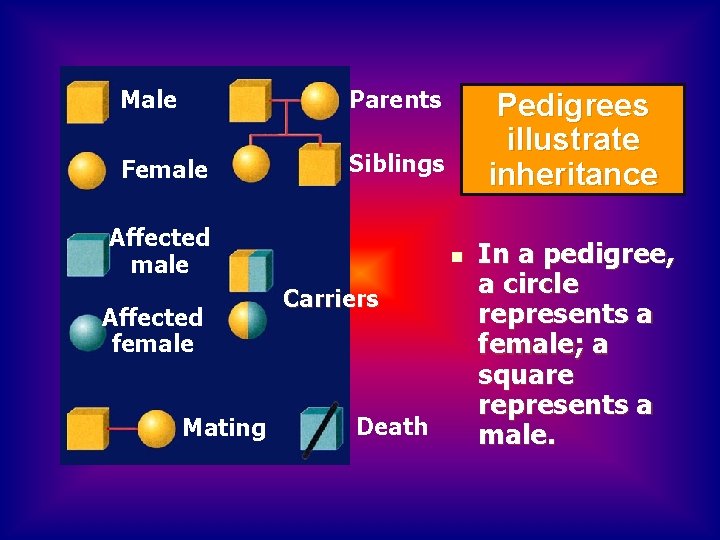
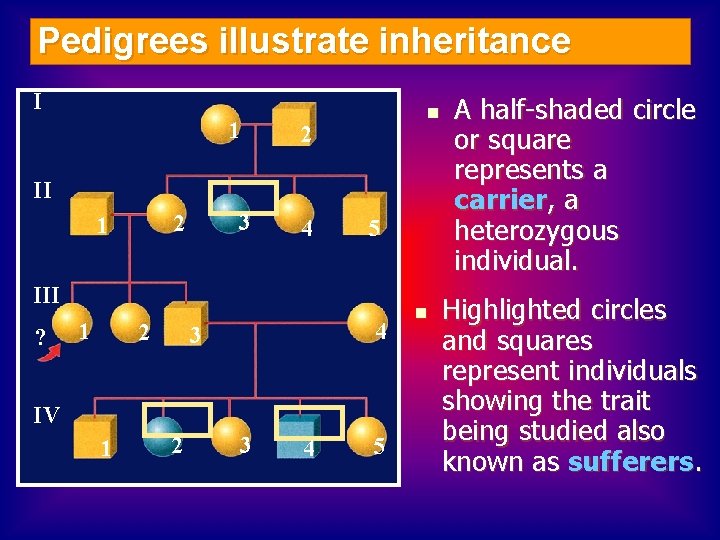
Making a Pedigree n n A family tree traces a family name and various family members through successive generations. Through a family tree, you can identify the relationships among your cousins, aunts, uncles, grandparents, and great-grandparents. A pedigree is a graphic representation of genetic inheritance. It is a diagram made up of a set of symbols that identify males and females, individuals affected by the trait being studied, and family relationships.
Male Parents Female Siblings Affected male Affected female Mating Pedigrees illustrate inheritance n Carriers Death In a pedigree, a circle represents a female; a square represents a male.
Pedigrees illustrate inheritance I 1 n 2 II 3 2 1 4 5 III ? 1 2 4 3 IV 1 2 3 4 5 n A half-shaded circle or square represents a carrier, a heterozygous individual. Highlighted circles and squares represent individuals showing the trait being studied also known as sufferers.
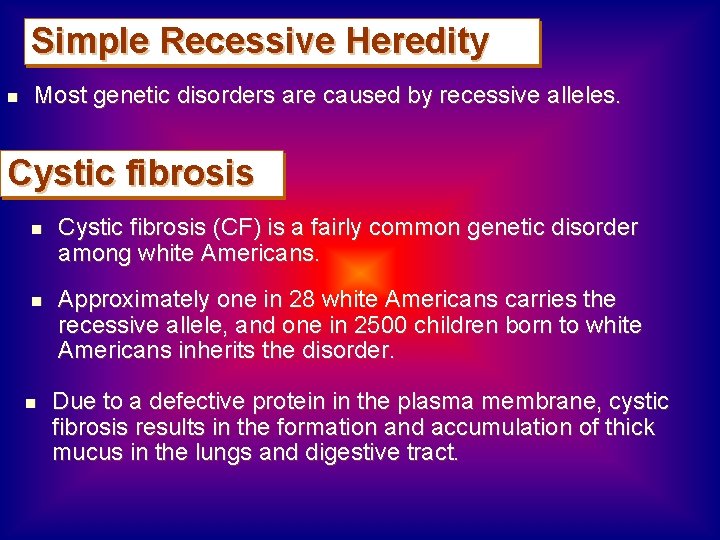
Simple Recessive Heredity n Most genetic disorders are caused by recessive alleles. Cystic fibrosis n n n Cystic fibrosis (CF) is a fairly common genetic disorder among white Americans. Approximately one in 28 white Americans carries the recessive allele, and one in 2500 children born to white Americans inherits the disorder. Due to a defective protein in the plasma membrane, cystic fibrosis results in the formation and accumulation of thick mucus in the lungs and digestive tract.
Tay-Sachs disease n n n Tay-Sachs disease is a recessive disorder of the central nervous system. In this disorder, a recessive allele results in the absence of an enzyme that normally breaks down a lipid produced and stored in tissues of the central nervous system. Because this lipid fails to break down properly, it accumulates in the cells.
Phenylketonuria n n Phenylketonuria, also called (PKU), is a recessive disorder that results from the absence of an enzyme that converts one amino acid, phenylalanine, to a different amino acid, tyrosine. Because phenylalanine cannot be broken down, it and its by-products accumulate in the body and result in severe damage to the central nervous system.
Phenylketonuria n n n A PKU test is normally performed on all infants a few days after birth. Infants affected by PKU are given a diet that is low in phenylalanine until their brains are fully developed. Ironically, the success of treating phenylketonuria infants has resulted in a new problem. If a female who is homozygous recessive for PKU becomes pregnant, the high phenylalanine levels in her blood can damage her fetus. This problem occurs even if the fetus is heterozygous and would be phenotypically normal.
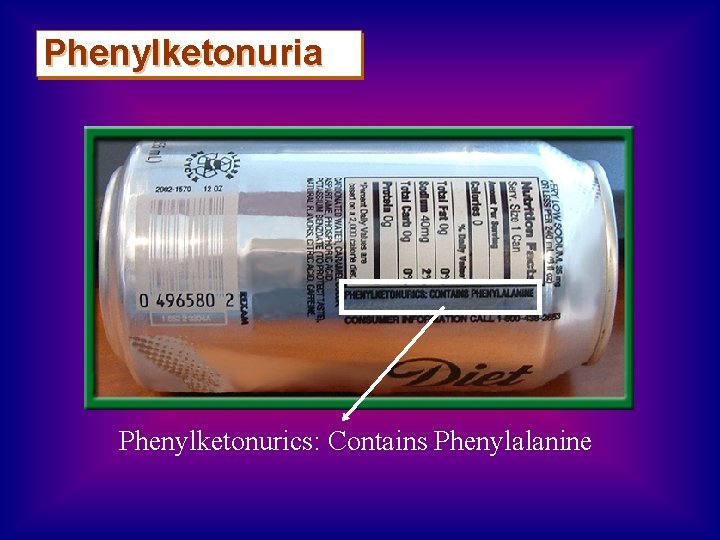
Phenylketonuria Phenylketonurics: Contains Phenylalanine
Simple Dominant Heredity n n n Many traits are inherited just as the rule of dominance predicts. Remember that in Mendelian inheritance, a single dominant allele inherited from one parent is all that is needed for a person to show the dominant trait. A cleft chin, widow’s peak hairline, hitchhiker’s thumb, almond shaped eyes, thick lips, and the presence of hair on the middle section of your fingers all are examples of dominant traits.
Huntington’s disease n n Huntington’s disease is a lethal genetic disorder caused by a rare dominant allele. It results in a breakdown of certain areas of the brain. Ordinarily, a dominant allele with such severe effects would result in death before the affected individual could have children and pass the allele on to the next generation. But because the onset of Huntington’s disease usually occurs between the ages of 30 and 50, an individual may already have had children before knowing whether he or she is affected.
Incomplete dominance: Appearance of a third phenotype n n When inheritance follows a pattern of dominance, heterozygous and homozygous dominant individuals both have the same phenotype. When traits are inherited in an incomplete dominance pattern, however, the phenotype of heterozygous individuals is intermediate between those of the two homozygotes.
Incomplete dominance: Appearance of a third phenotype n For example, if a homozygous red-flowered snapdragon plant (RR) is crossed with a homozygous white-flowered snapdragon plant (R′ R′), all of the F 1 offspring will have pink flowers.
Red White All pink Red (RR) White (R’R’) Pink (RR’) All pink flowers 1 red: 2 pink: 1 white
Co-dominance: Expression of both alleles n Co-dominant alleles cause the phenotypes of both homozygotes to be produced in heterozygous individuals. In co-dominance, both alleles are expressed equally. • In cows and horses there is a color known as roan. When a Red – RR is crossed with a white –R’R’ the result is a roan – RR’. Both the red and white genes are expressed in the individual.
Co-dominance in Humans n n Remember that in co-dominance, the phenotypes of both homozygotes are produced in the heterozygote. One example of this in humans is a group of inherited red blood cell disorders called sickle-cell disease. Sickle-cell anemia n n Individuals who are heterozygous for the allele produce both normal and sickled hemoglobin, an example of codominance. Individuals who are heterozygous are said to have the sickle-cell trait because they can show some signs of sickle-cell-related disorders if the availability of oxygen is reduced.
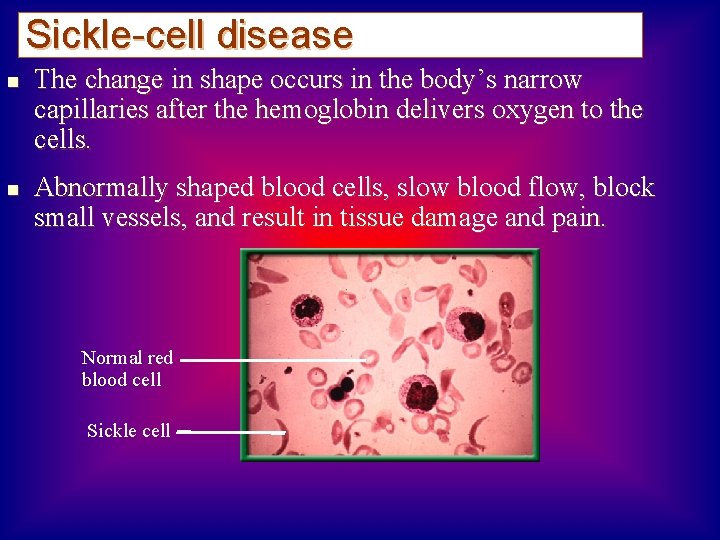
Sickle-cell disease n n In an individual who is homozygous for the sicklecell allele, the oxygen-carrying protein hemoglobin differs by one amino acid from normal hemoglobin. This defective hemoglobin forms crystal-like structures that change the shape of the red blood cells. Normal red blood cells are disc-shaped, but abnormal red blood cells are shaped like a sickle, or half-moon.
Sickle-cell disease n n The change in shape occurs in the body’s narrow capillaries after the hemoglobin delivers oxygen to the cells. Abnormally shaped blood cells, slow blood flow, block small vessels, and result in tissue damage and pain. Normal red blood cell Sickle cell
Multiple phenotypes from multiple alleles n n Although each trait has only two alleles in the patterns of heredity you have studied thus far, it is common for more than two alleles to control a trait in a population. Traits controlled by more than two alleles have multiple alleles.
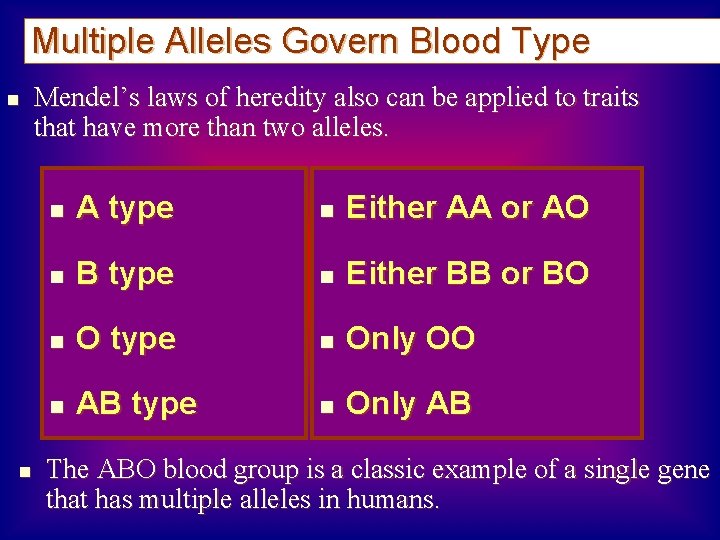
Multiple Alleles Govern Blood Type n n Mendel’s laws of heredity also can be applied to traits that have more than two alleles. n A type n Either AA or AO n B type n Either BB or BO n O type n Only OO n AB type n Only AB The ABO blood group is a classic example of a single gene that has multiple alleles in humans.
Sex-linked inheritance n n Traits controlled by genes located on sex chromosomes are called sex-linked traits. The alleles for sex-linked traits are written as superscripts of the X or Y chromosomes. Because the X and Y chromosomes are not homologous, the Y chromosome has no corresponding allele to one on the X chromosome and no superscript is used. Also remember that any recessive allele on the X chromosome of a male will not be masked by a corresponding dominant allele on the Y chromosome.
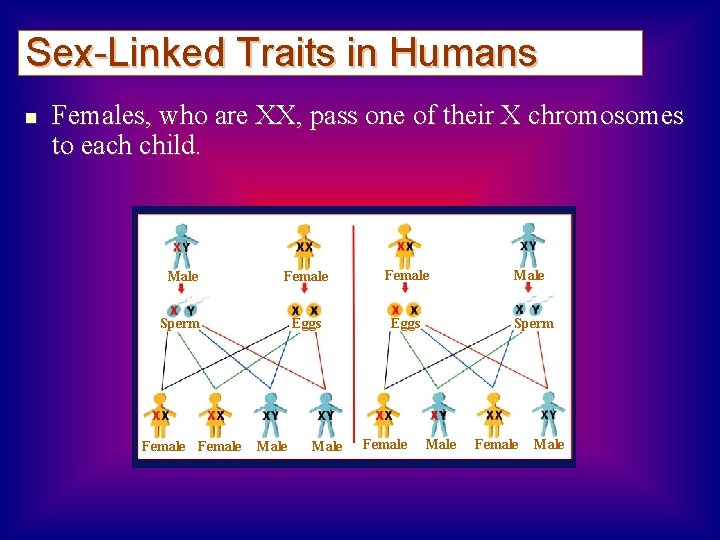
Sex-Linked Traits in Humans n Females, who are XX, pass one of their X chromosomes to each child. Male Female Sperm Eggs Female Male Sperm Male Female Male
Sex-Linked Traits in Humans n n Many human traits are determined by genes that are carried on the sex chromosomes; most of these genes are located on the X chromosome. The pattern of sex-linked inheritance is explained by the fact that males, who are XY, pass an X chromosome to each daughter and a Y chromosome to each son. If a son receives an X chromosome with a recessive allele, the recessive phenotype will be expressed because he does not inherit on the Y chromosome from his father a dominant allele that would mask the expression of the recessive allele. Two traits that are governed by X-linked recessive inheritance in humans are red-green color blindness and hemophilia.
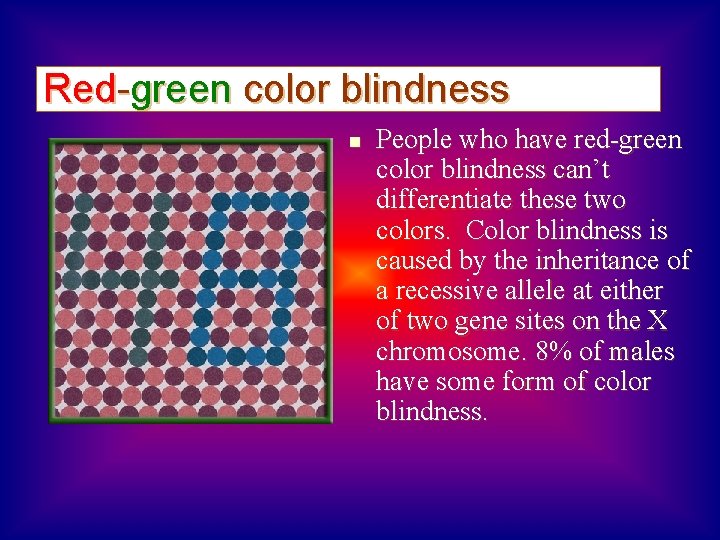
Red-green color blindness n People who have red-green color blindness can’t differentiate these two colors. Color blindness is caused by the inheritance of a recessive allele at either of two gene sites on the X chromosome. 8% of males have some form of color blindness.
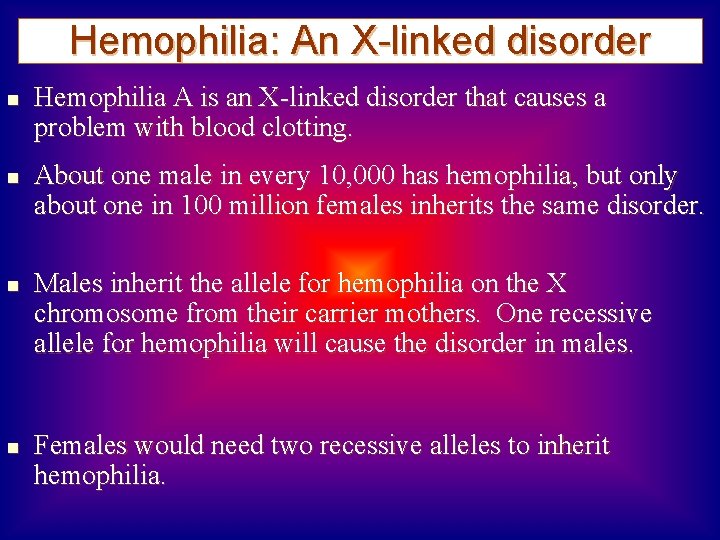
Hemophilia: An X-linked disorder n n Hemophilia A is an X-linked disorder that causes a problem with blood clotting. About one male in every 10, 000 has hemophilia, but only about one in 100 million females inherits the same disorder. Males inherit the allele for hemophilia on the X chromosome from their carrier mothers. One recessive allele for hemophilia will cause the disorder in males. Females would need two recessive alleles to inherit hemophilia.
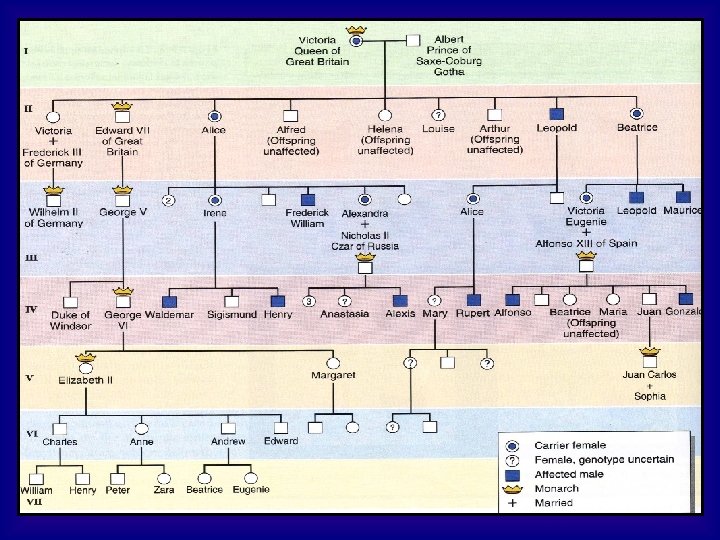
Pedigree Analysis Hemophilia The Royal Disease
Pedigree of Hemophilia
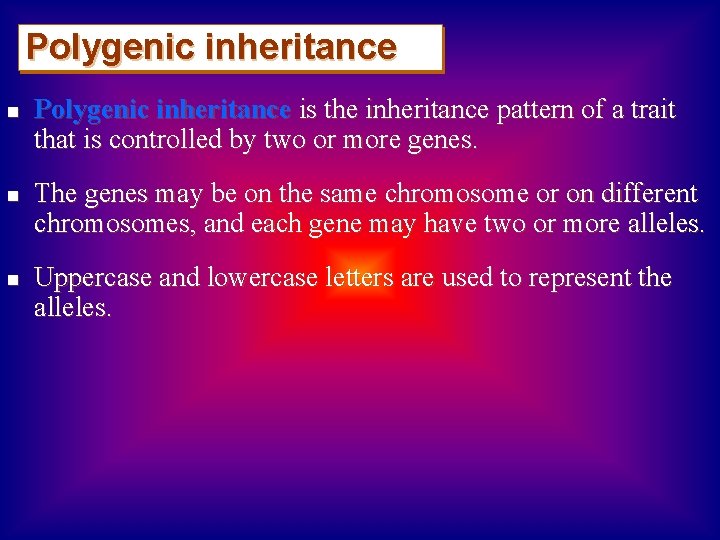
Polygenic inheritance n n n Polygenic inheritance is the inheritance pattern of a trait that is controlled by two or more genes. The genes may be on the same chromosome or on different chromosomes, and each gene may have two or more alleles. Uppercase and lowercase letters are used to represent the alleles.
Polygenic Inheritance in Humans n n n Although many of your traits were inherited through simple Mendelian patterns or through multiple alleles, many other human traits are determined by polygenic inheritance. In the early 1900 s, the idea that polygenic inheritance occurs in humans was first tested using data collected on skin color. Scientists found that when light-skinned people mate with dark-skinned people, their offspring have intermediate skin colors.
Changes in Chromosome Numbers n n n What would happen if an entire chromosome or part of a chromosome were missing from the complete set? As you have learned, abnormal numbers of chromosomes in offspring usually, but not always, result from accidents of meiosis. Many abnormal phenotypic effects result from such mistakes.
Abnormal numbers of autosomes n n Humans who have an extra whole or partial autosome are trisomic—that is, they have three of a particular autosomal chromosome instead of just two. In other words, they have 47 chromosomes. To identify an abnormal number of chromosomes, one of the following tests can be performed. n n n Genetic screening or counseling – consultation w/a geneticist to determine problems. Amniocentesis- the removal of a small amt. of amniotic fluid to make a karyotype of the baby. Happens b/t week 14 -16 Chorionic villi sampling – removal of small amount of tissue to make a karyotype. Happens b/t week 8 -10
n This chart of chromosome pairs is called a karyotype, and it is valuable in identifying unusual chromosome numbers in cells. A picture of the chromosomes.
Down syndrome: Trisomy 21 n n n Down syndrome is the only autosomal trisomy in which affected individuals survive to adulthood. Down syndrome is a group of symptoms that results from trisomy of chromosome 21. Individuals who have Down syndrome have at least some degree of mental retardation. The incidence of Down syndrome births is higher in older mothers, especially those over 40. It occurs in about one in 700 live births.
Abnormal numbers of sex chromosomes n n Many abnormalities in the number of sex chromosomes are known to exist. An X chromosome may be missing (designated as XO) or there may be an extra one (XXX or XXY). There may also be an extra Y chromosome (XYY). Any individual with at least one Y chromosome is a male, and any individual without a Y chromosome is a female. Most of these individuals lead normal lives, but they cannot have children and some have varying degrees of mental retardation.
Sex Chromosome Disorders n n n Klinefelter’s syndrome – (XXY) – males w/some feminine characteristics, infertility, and some mental impairment. Turner’s syndrome – (XO) – females that do not mature sexually & are infertile. Zygotes that only receive a Y chromosome do not survive, because the X is essential for development
Environmental Influences n n The genetic makeup of an organism at fertilization determines only the organism’s potential to develop and function. As the organism develops, many factors can influence how the gene is expressed, or even whether the gene is expressed at all. Two such influences are the organism’s external and internal environments. Temperature, nutrition, light, chemicals, and infectious agents all can influence gene expression.