
Mendel and the Gene Idea Lesson 6 3
- Slides: 24
Mendel and the Gene Idea Lesson 6. 3 14. 1 & 14. 2
Mendel Fun Facts! • Entered monastery at age 21 • Failed exam to become a teacher • Went onto study at U of V…University of Vienna • Studied under a scientist who taught him to use math to explain science • Mendel started breeding garden peas at the monastery
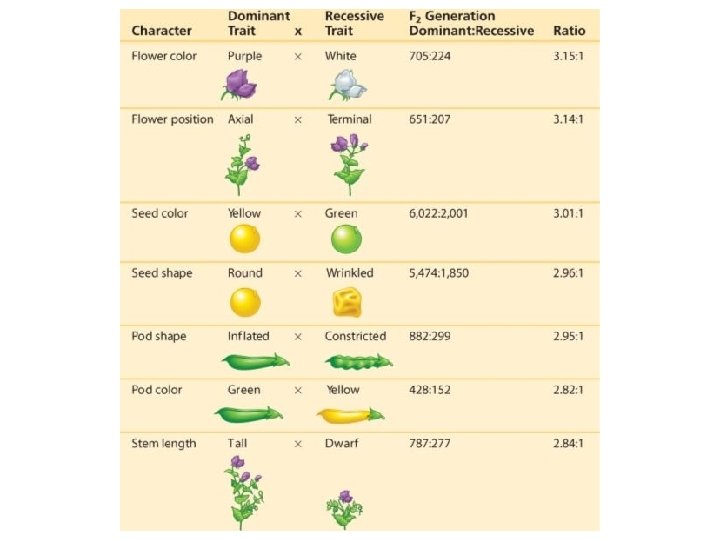
The Wonderful World of the Pea • Chosen by Mendel because it is available in many varieties – Character – heritable feature that varies among individuals (flower color) – Trait – each variant for a character (purple, white, etc. ) • Mendel could control breeding – Peas usually self-pollinate, so the only way to cross-pollinate them is to remove pollen and transfer by hand
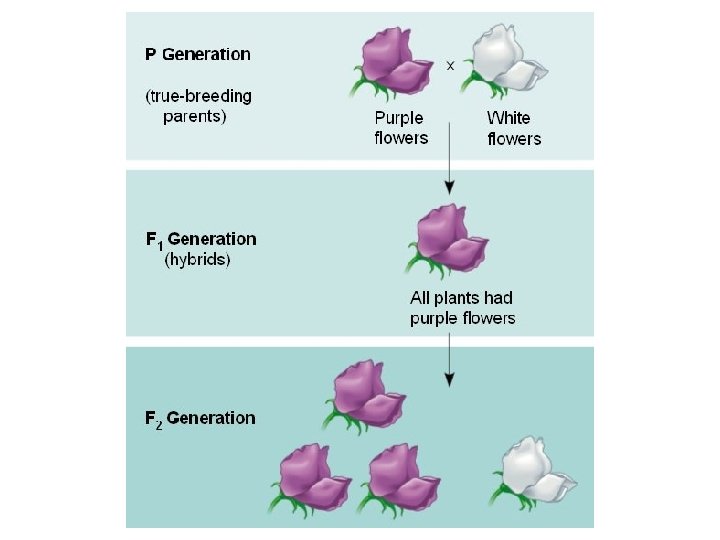
What Mendel Did • Tracked “either-or” characters, instead of “more-or-less” – Purple or white, not a lighter purple • First two plants he breeds are called the P generation (parent generation) – They yield the F 1 Generation (Filial – son). – F 1 Generation plants self-pollinating yields F 2 Generation
Making the Law • Mendel discovered two important laws during his pea-breeding experiments: – Law of Segregation – Law of Independent Assortment
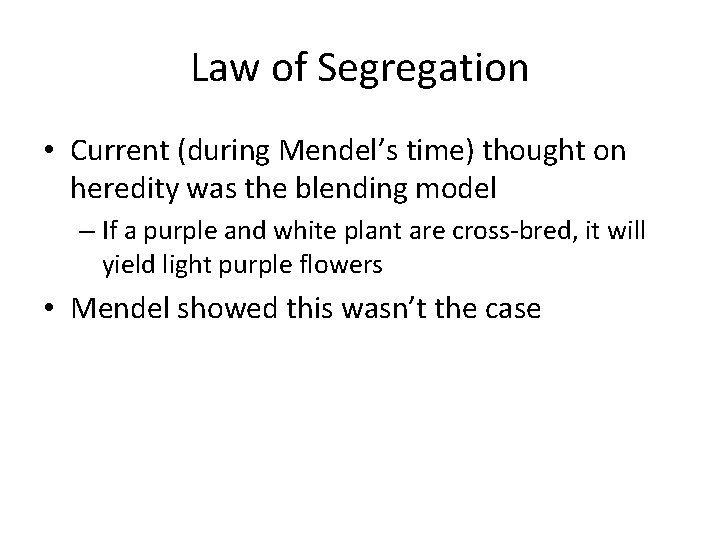
Law of Segregation • Current (during Mendel’s time) thought on heredity was the blending model – If a purple and white plant are cross-bred, it will yield light purple flowers • Mendel showed this wasn’t the case
Law of Segregation • Because of these results, Mendel figured the purple trait was just masking the white in the F 1 generation – In his notes, he used said that purple was “dominant, ” while white was “recessive”
Law of Segregation • What he discovered which led to the Law of Segregation: – Alternative versions of genes account for variations in inherited characters (now called alleles) – For each character, an organism inherits two alleles, one from each parent – If 2 alleles at a locus differ, then one, the dominant allele, determines the organism’s appearance; the other recessive allele has no noticeable effect on the organism’s appearance
Law of Segregation • “the two alleles for a heritable character separate (segregate) during gamete formation and end up in different gametes. ”
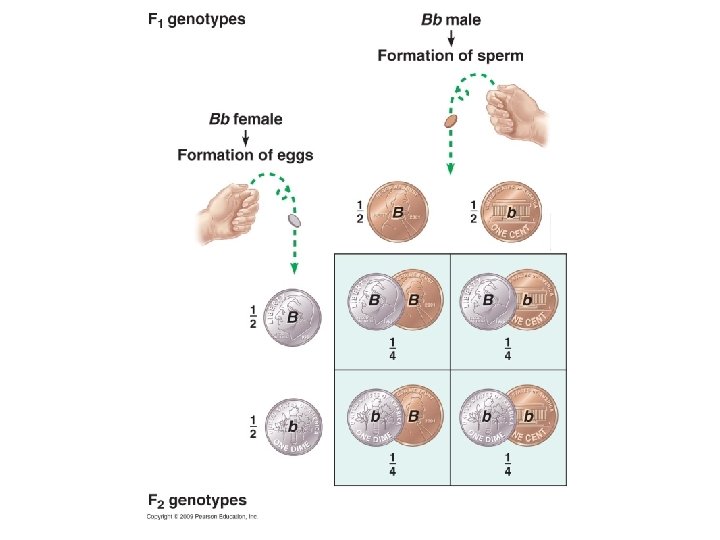
Punnett Squares • Used to show what different generation’s offspring will look like for different characters.
Genotype vs. Phenotype • Genotype is the genetic make – up, represented by two letters – Homozygous dominant - PP – Heterozygous – Pp – Homozygous recessive – pp • Phenotype is the visible trait caused by the genetic make up – Purple or white
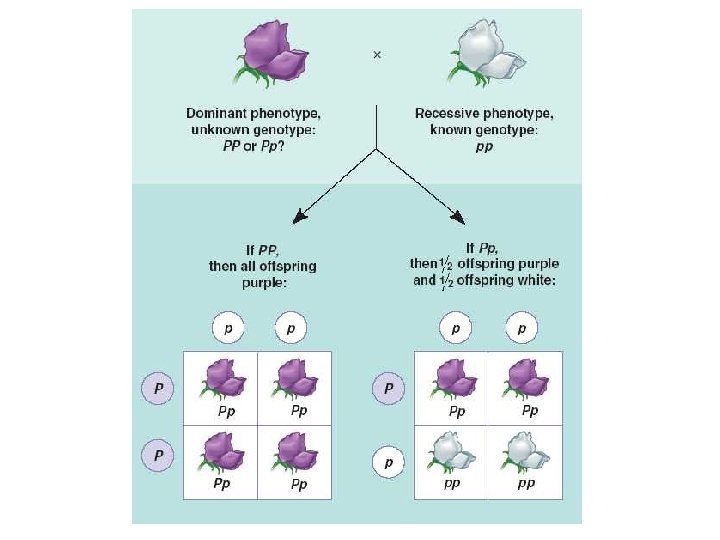
Testcross • Testcross – used to determine the genotype of a plant that has a dominant phenotype, but the scientist isn’t sure if it is homozygous dominant or heterozygous. – Crosses a homozygous recessive plant with the plant in question displaying a dominant character
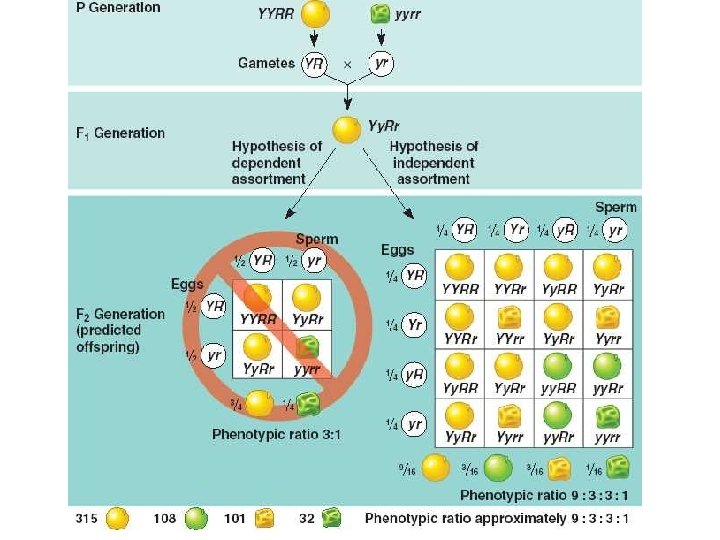
Law of Independent Assortment • Monohybrid cross – crossbreeding, looking only for one character • Dihybrid cross – crossbreeding, looking for two characters
Law of Independent Assortment • This tells us that traits don’t segregate together – In other words, a purple offspring won’t also ALWAYS yield a smooth pea. • “each pair of alleles segregates independently of other pairs of alleles during gamete formation
Probability • The same laws of probability apply to Mendelian genetics as apply to flipping a coin or drawing a card from a deck – An event that is certain to occur has a probability of 1 – An even that is certain NOT to occur has a probability of 0 • Probability of flipping a coin and it landing on heads is ½ • Probability of drawing the ace of spades from a deck of cards is 1/52 • The probabilities of all possible outcomes for an event must add up to 1
Probability • Independent Events – Each toss INDIVIDUALLY has a probability of ½ for getting heads. – The previous toss has no affect on the next toss, though • Two rules of probability: – Multiplication Rules – Addition Rules
Multiplication Rule • How do we determine the probability that 2 or more independent events will occur together in some specific combination? – Chance of 2 coins tossed simultaneously landing on heads? • To determine this probability, we multiply the probability of one event by the probability of the other event
Addition Rule • In an F 2 generation, a heterozygous individual has two possibilities: Ff or f. F, depending on who the recessive allele comes from • The probability that any ONE of two or more mutually exclusive events will occur is calculated by adding together their individual probabilities • Probability of an F 2 heterozygote having a dominant allele from the dad is ¼, and the from the mom is ¼. – Probability of getting an F 2 heterozygote is ¼ + ¼ = ½
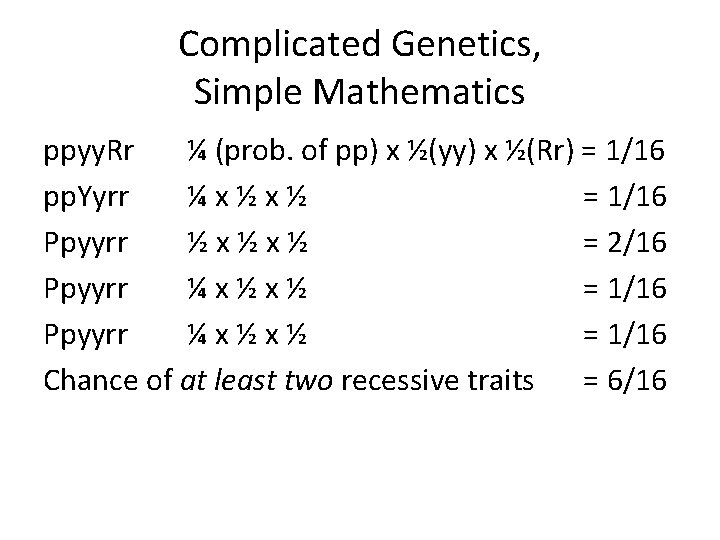
Complicated Genetics, Simple Mathematics ppyy. Rr ¼ (prob. of pp) x ½(yy) x ½(Rr) = 1/16 pp. Yyrr ¼x½x½ = 1/16 Ppyyrr ½x½x½ = 2/16 Ppyyrr ¼x½x½ = 1/16 Chance of at least two recessive traits = 6/16