
Mendel and Heredity Words to Know Trait Genetics
- Slides: 43
Mendel and Heredity • Words to Know: Trait, Genetics, Purebred, Cross, Law of Segregation • Traits are distinguishing characteristics that are inherited, such as eye color, leaf shape, and tail length. • Genetics is the study of biological inheritance patterns and variation in organisms.
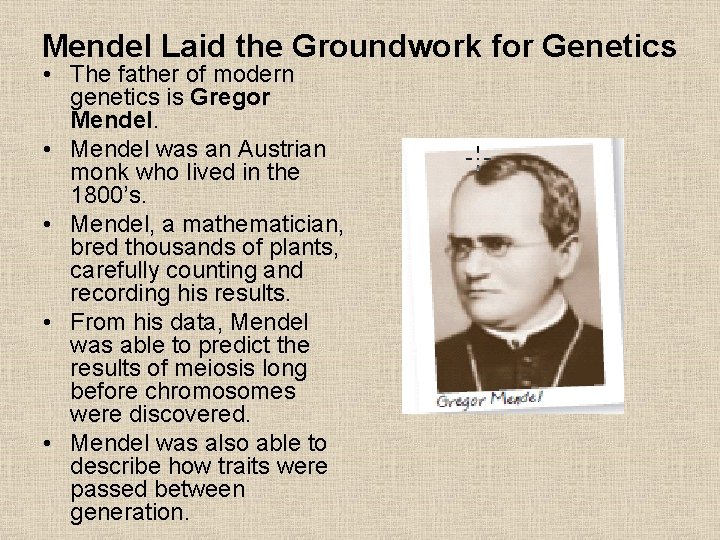
Mendel Laid the Groundwork for Genetics • The father of modern genetics is Gregor Mendel. • Mendel was an Austrian monk who lived in the 1800’s. • Mendel, a mathematician, bred thousands of plants, carefully counting and recording his results. • From his data, Mendel was able to predict the results of meiosis long before chromosomes were discovered. • Mendel was also able to describe how traits were passed between generation.
Mendel’s Data Revealed Patterns of Inheritance • Mendel worked with pea plants in the garden at the monastery. • He made three key choices in his work: – 1. He had control over breeding (no random mating) – 2. He used purebred plants. – 3. He observed “either or” traits that appeared in only 2 alternate forms.
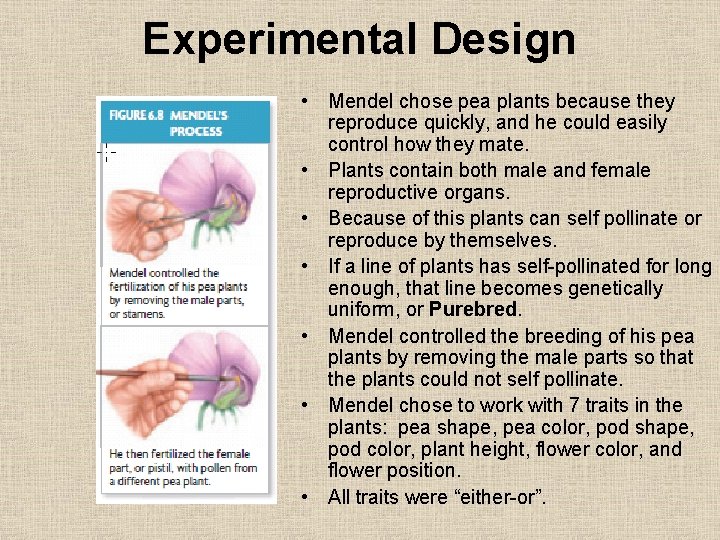
Experimental Design • Mendel chose pea plants because they reproduce quickly, and he could easily control how they mate. • Plants contain both male and female reproductive organs. • Because of this plants can self pollinate or reproduce by themselves. • If a line of plants has self pollinated for long enough, that line becomes genetically uniform, or Purebred. • Mendel controlled the breeding of his pea plants by removing the male parts so that the plants could not self pollinate. • Mendel chose to work with 7 traits in the plants: pea shape, pea color, pod shape, pod color, plant height, flower color, and flower position. • All traits were “either or”.
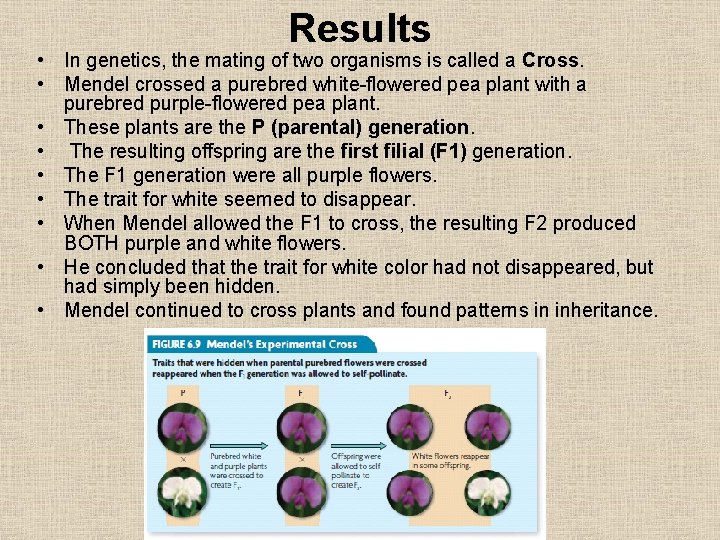
Results • In genetics, the mating of two organisms is called a Cross. • Mendel crossed a purebred white flowered pea plant with a purebred purple flowered pea plant. • These plants are the P (parental) generation. • The resulting offspring are the first filial (F 1) generation. • The F 1 generation were all purple flowers. • The trait for white seemed to disappear. • When Mendel allowed the F 1 to cross, the resulting F 2 produced BOTH purple and white flowers. • He concluded that the trait for white color had not disappeared, but had simply been hidden. • Mendel continued to cross plants and found patterns in inheritance.
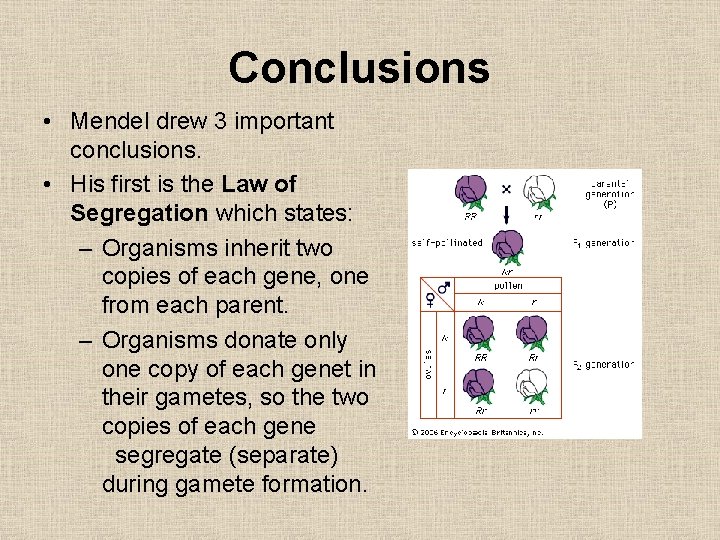
Conclusions • Mendel drew 3 important conclusions. • His first is the Law of Segregation which states: – Organisms inherit two copies of each gene, one from each parent. – Organisms donate only one copy of each genet in their gametes, so the two copies of each gene segregate (separate) during gamete formation.
Mendels Laws Cont. • The second law is The Law of Dominance – One trait shows while the other hides. – The dominant trait always shows itself. • The third law is The Law of Independent Assortment: o The inheritance of two different traits shows they are expressed independently of each other.
Traits, Genes, and Alleles • Words to Know: Gene, Allele, Homozygous, Heterozygous, Genome, Genotype, Phenotype, Dominant, Recessive.
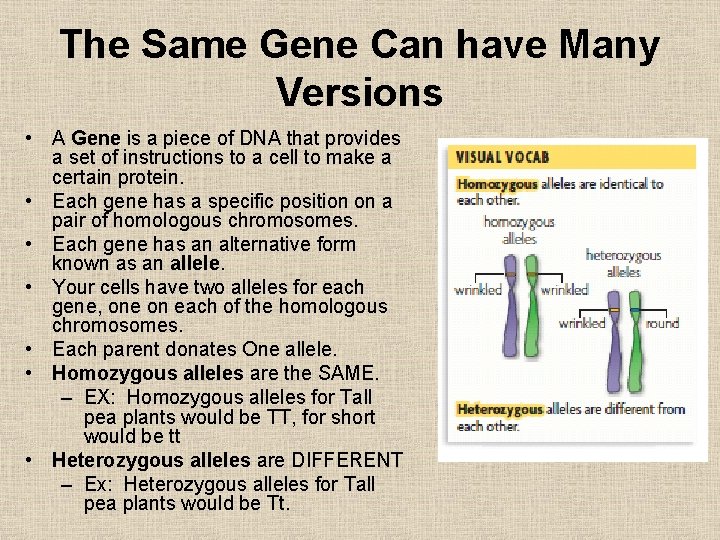
The Same Gene Can have Many Versions • A Gene is a piece of DNA that provides a set of instructions to a cell to make a certain protein. • Each gene has a specific position on a pair of homologous chromosomes. • Each gene has an alternative form known as an allele. • Your cells have two alleles for each gene, one on each of the homologous chromosomes. • Each parent donates One allele. • Homozygous alleles are the SAME. – EX: Homozygous alleles for Tall pea plants would be TT, for short would be tt • Heterozygous alleles are DIFFERENT – Ex: Heterozygous alleles for Tall pea plants would be Tt.
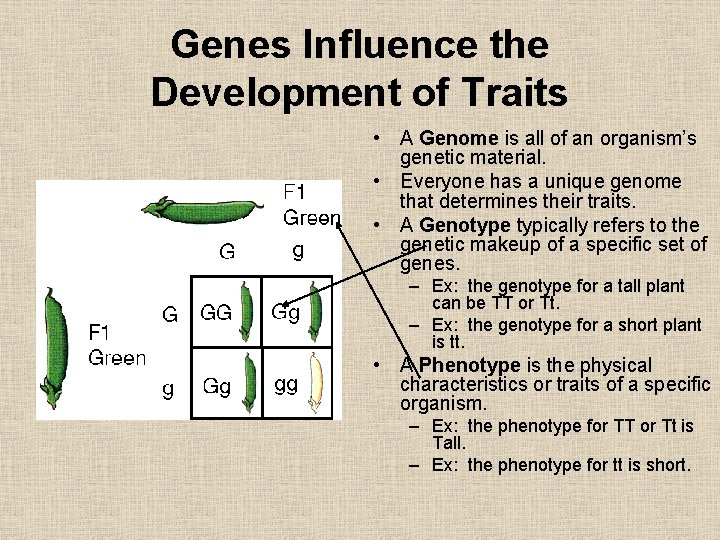
Genes Influence the Development of Traits • A Genome is all of an organism’s genetic material. • Everyone has a unique genome that determines their traits. • A Genotype typically refers to the genetic makeup of a specific set of genes. – Ex: the genotype for a tall plant can be TT or Tt. – Ex: the genotype for a short plant is tt. • A Phenotype is the physical characteristics or traits of a specific organism. – Ex: the phenotype for TT or Tt is Tall. – Ex: the phenotype for tt is short.
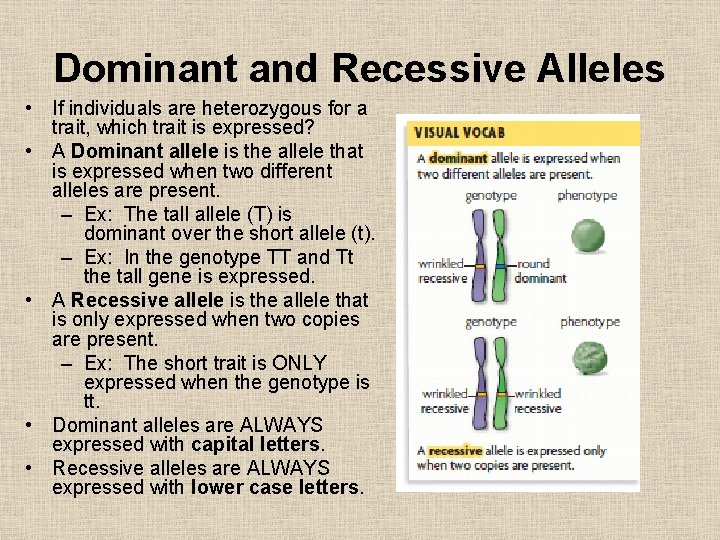
Dominant and Recessive Alleles • If individuals are heterozygous for a trait, which trait is expressed? • A Dominant allele is the allele that is expressed when two different alleles are present. – Ex: The tall allele (T) is dominant over the short allele (t). – Ex: In the genotype TT and Tt the tall gene is expressed. • A Recessive allele is the allele that is only expressed when two copies are present. – Ex: The short trait is ONLY expressed when the genotype is tt. • Dominant alleles are ALWAYS expressed with capital letters. • Recessive alleles are ALWAYS expressed with lower case letters.
Alleles and Phenotypes • Two genotypes can produce the dominant trait. • Homozygous dominant will display the dominant trait. • Heterozygous will also display the dominant trait. • The ONLY way to get the recessive trait is to be Homozygous Recessive.
Traits and Probability • Words to Know: Punnett Square, Monohybrid Cross, Testcross, Dihybrid Cross, Low of Independent Assortment, Probability.
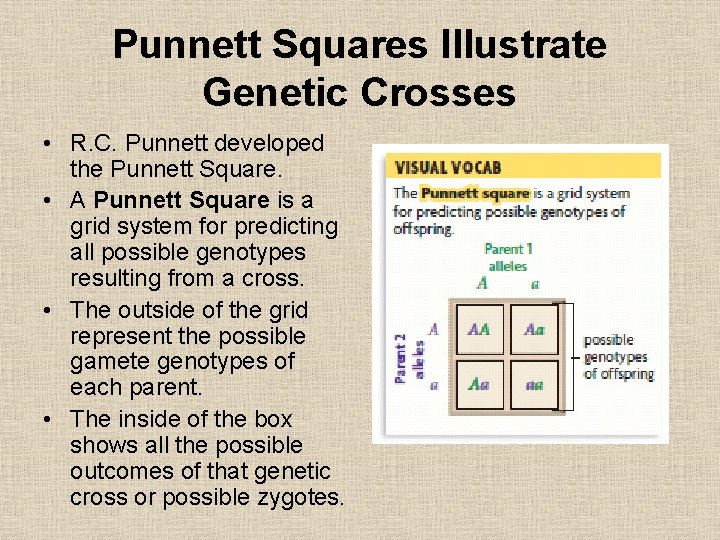
Punnett Squares Illustrate Genetic Crosses • R. C. Punnett developed the Punnett Square. • A Punnett Square is a grid system for predicting all possible genotypes resulting from a cross. • The outside of the grid represent the possible gamete genotypes of each parent. • The inside of the box shows all the possible outcomes of that genetic cross or possible zygotes.
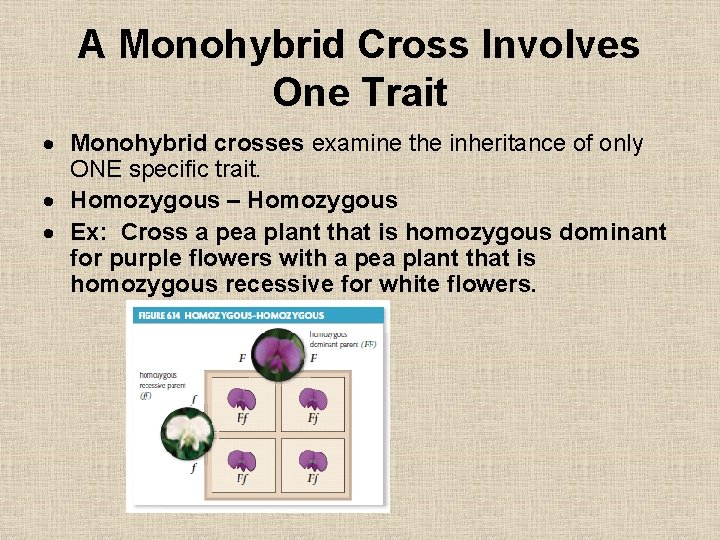
A Monohybrid Cross Involves One Trait Monohybrid crosses examine the inheritance of only ONE specific trait. Homozygous – Homozygous Ex: Cross a pea plant that is homozygous dominant for purple flowers with a pea plant that is homozygous recessive for white flowers.
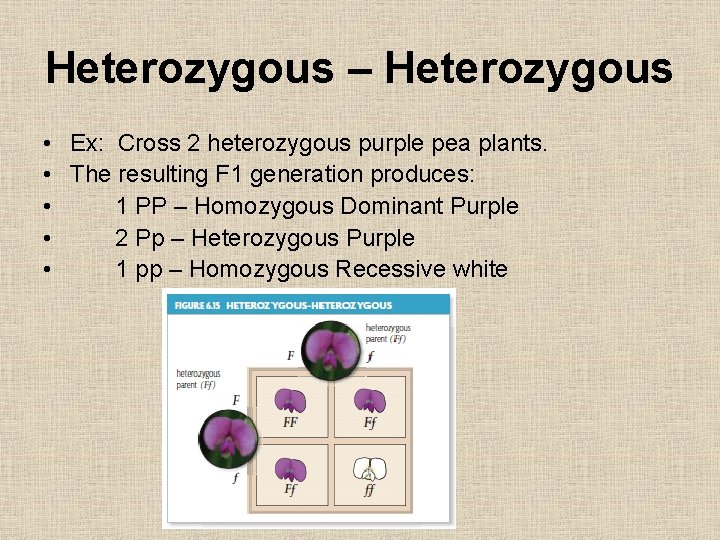
Heterozygous – Heterozygous • Ex: Cross 2 heterozygous purple pea plants. • The resulting F 1 generation produces: • 1 PP – Homozygous Dominant Purple • 2 Pp – Heterozygous Purple • 1 pp – Homozygous Recessive white
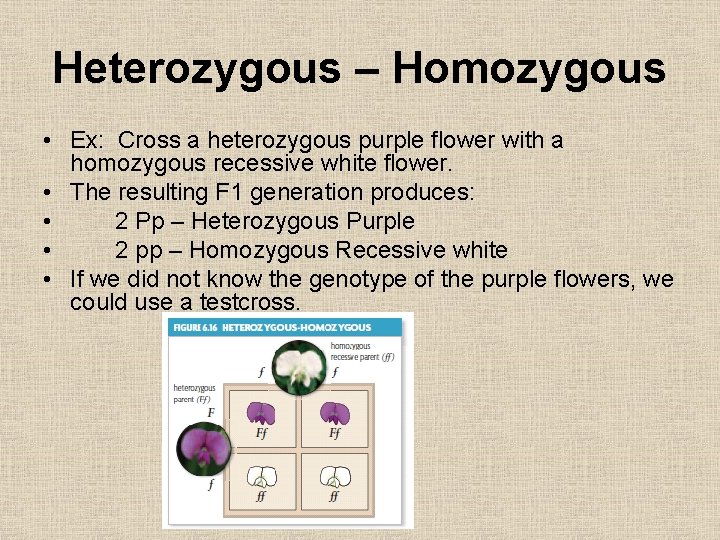
Heterozygous – Homozygous • Ex: Cross a heterozygous purple flower with a homozygous recessive white flower. • The resulting F 1 generation produces: • 2 Pp – Heterozygous Purple • 2 pp – Homozygous Recessive white • If we did not know the genotype of the purple flowers, we could use a testcross.
Test Cross • A Testcross is a cross between an organism with an unknown organism with the recessive phenotype • The offspring will show whether the unknown is homozygous or heterozygous. • From an PP * Pp cross, what percent of offspring would have purple flowers?
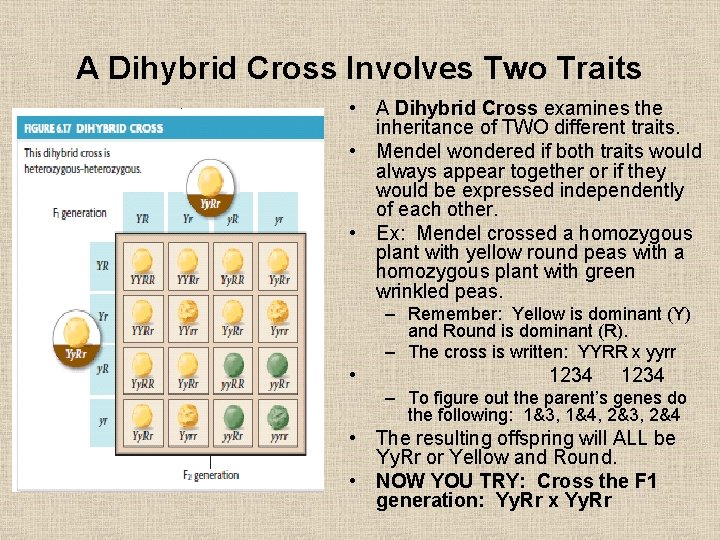
A Dihybrid Cross Involves Two Traits • A Dihybrid Cross examines the inheritance of TWO different traits. • Mendel wondered if both traits would always appear together or if they would be expressed independently of each other. • Ex: Mendel crossed a homozygous plant with yellow round peas with a homozygous plant with green wrinkled peas. – Remember: Yellow is dominant (Y) and Round is dominant (R). – The cross is written: YYRR x yyrr • 1234 – To figure out the parent’s genes do the following: 1&3, 1&4, 2&3, 2&4 • The resulting offspring will ALL be Yy. Rr or Yellow and Round. • NOW YOU TRY: Cross the F 1 generation: Yy. Rr x Yy. Rr
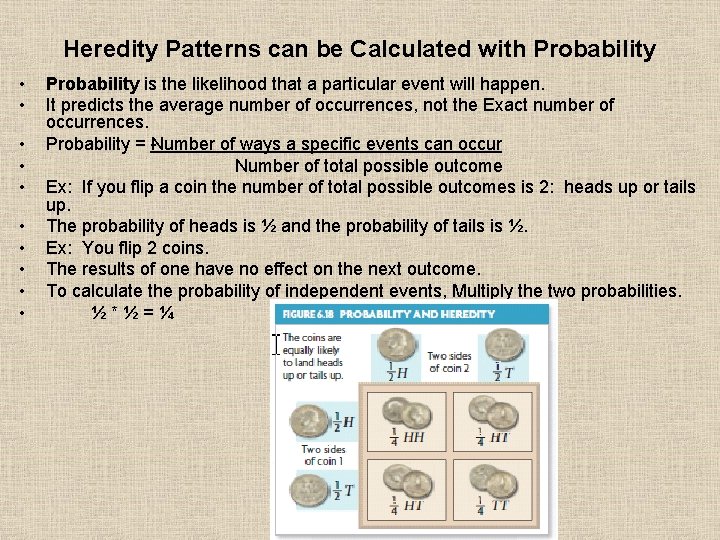
Heredity Patterns can be Calculated with Probability • • • Probability is the likelihood that a particular event will happen. It predicts the average number of occurrences, not the Exact number of occurrences. Probability = Number of ways a specific events can occur Number of total possible outcome Ex: If you flip a coin the number of total possible outcomes is 2: heads up or tails up. The probability of heads is ½ and the probability of tails is ½. Ex: You flip 2 coins. The results of one have no effect on the next outcome. To calculate the probability of independent events, Multiply the two probabilities. ½*½=¼
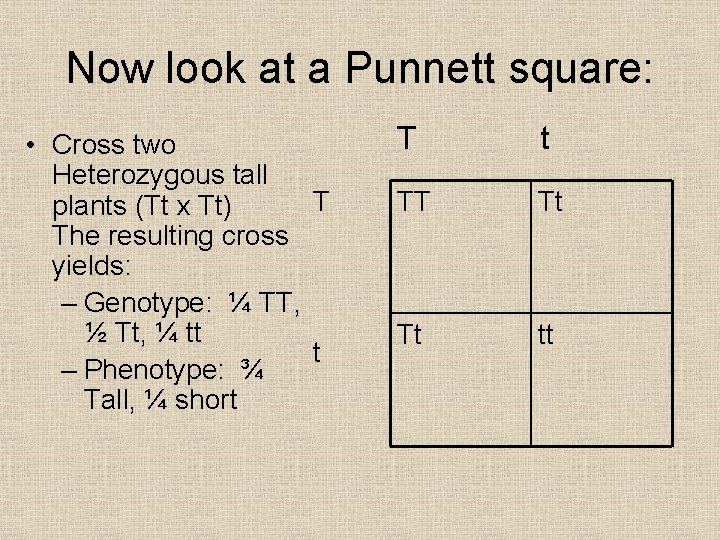
Now look at a Punnett square: • Cross two Heterozygous tall T plants (Tt x Tt) The resulting cross yields: – Genotype: ¼ TT, ½ Tt, ¼ tt t – Phenotype: ¾ Tall, ¼ short T t TT Tt Tt tt
Meiosis and Genetic Variation • Words to Know: Crossing Over, Genetic Linkage
Sexual Reproduction Creates Unique Gene Combinations • The major advantage of sexual reproduction is that is gives rise to a great deal of genetic variation within a species. • This variation results largely from: • 1. The independent assortment of chromosomes during meiosis. • 2. The random fertilization of gamete. • Independent assortment and fertilization play key roles in creating and maintaining genetic diversity in all sexually reproducing organisms. • The possible combinations vary from species to species.
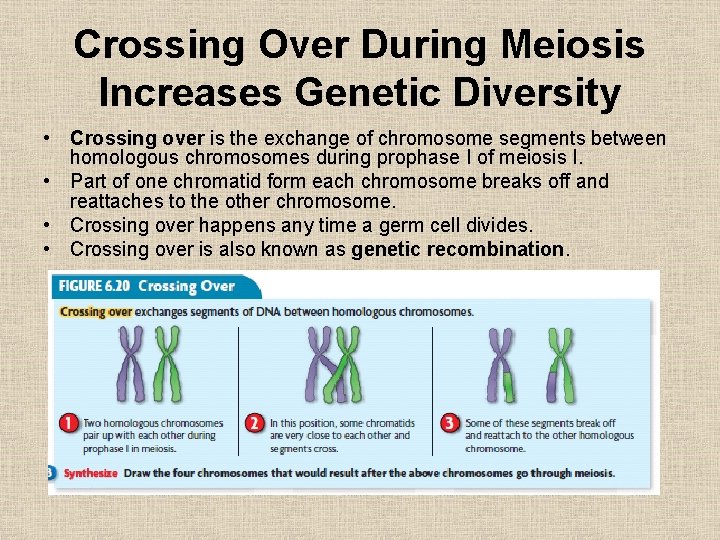
Crossing Over During Meiosis Increases Genetic Diversity • Crossing over is the exchange of chromosome segments between homologous chromosomes during prophase I of meiosis I. • Part of one chromatid form each chromosome breaks off and reattaches to the other chromosome. • Crossing over happens any time a germ cell divides. • Crossing over is also known as genetic recombination.
Chromosomes and Phenotype • Words to Know: Carrier, Sex-Linked Gene, X Chromosomes inactivation
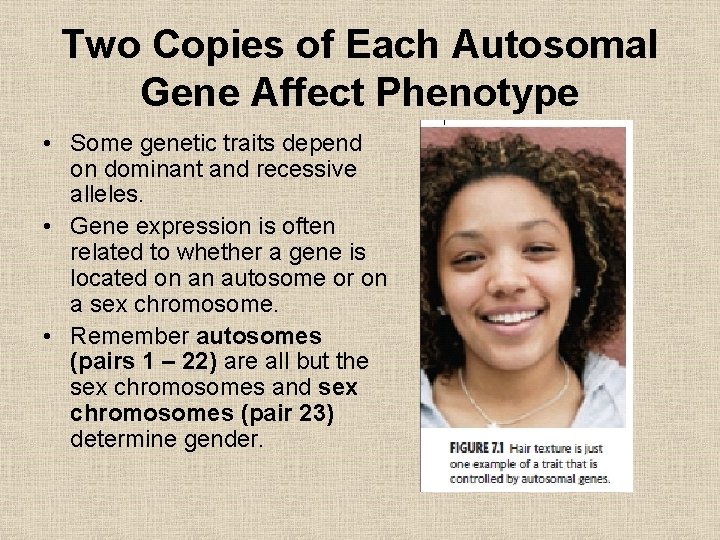
Two Copies of Each Autosomal Gene Affect Phenotype • Some genetic traits depend on dominant and recessive alleles. • Gene expression is often related to whether a gene is located on an autosome or on a sex chromosome. • Remember autosomes (pairs 1 – 22) are all but the sex chromosomes and sex chromosomes (pair 23) determine gender.
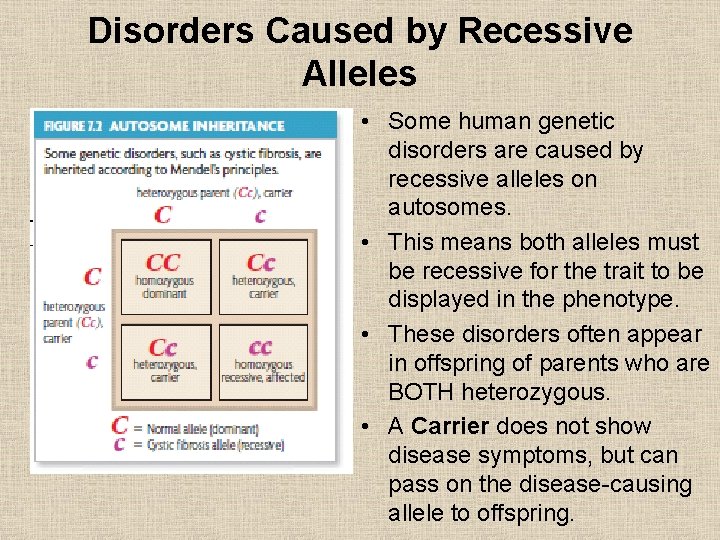
Disorders Caused by Recessive Alleles • Some human genetic disorders are caused by recessive alleles on autosomes. • This means both alleles must be recessive for the trait to be displayed in the phenotype. • These disorders often appear in offspring of parents who are BOTH heterozygous. • A Carrier does not show disease symptoms, but can pass on the disease causing allele to offspring.
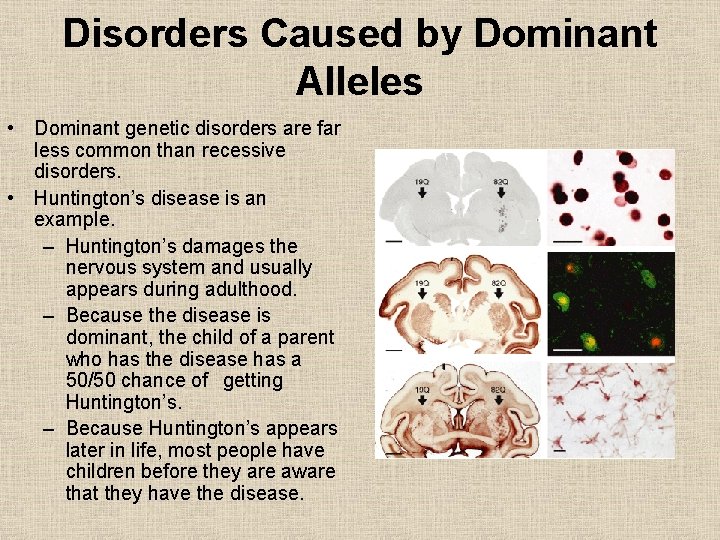
Disorders Caused by Dominant Alleles • Dominant genetic disorders are far less common than recessive disorders. • Huntington’s disease is an example. – Huntington’s damages the nervous system and usually appears during adulthood. – Because the disease is dominant, the child of a parent who has the disease has a 50/50 chance of getting Huntington’s. – Because Huntington’s appears later in life, most people have children before they are aware that they have the disease.
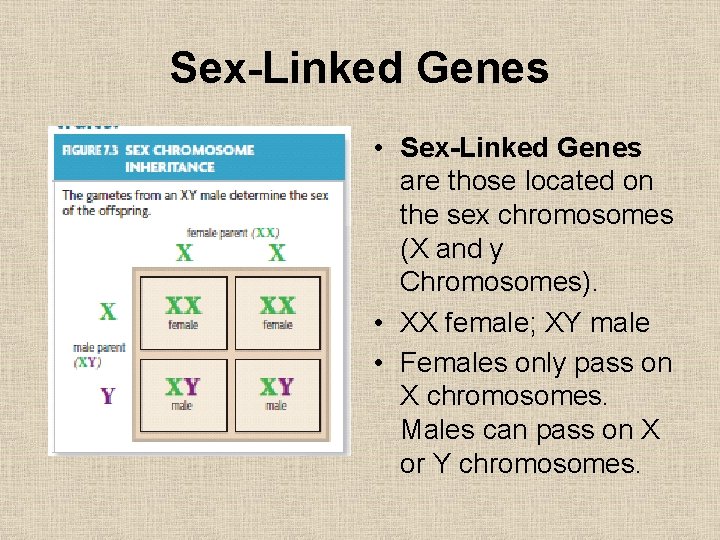
Sex-Linked Genes • Sex-Linked Genes are those located on the sex chromosomes (X and y Chromosomes). • XX female; XY male • Females only pass on X chromosomes. Males can pass on X or Y chromosomes.
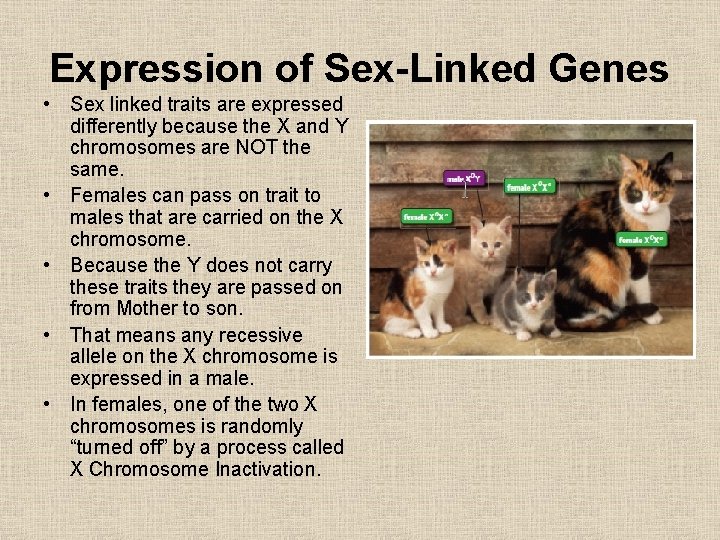
Expression of Sex-Linked Genes • Sex linked traits are expressed differently because the X and Y chromosomes are NOT the same. • Females can pass on trait to males that are carried on the X chromosome. • Because the Y does not carry these traits they are passed on from Mother to son. • That means any recessive allele on the X chromosome is expressed in a male. • In females, one of the two X chromosomes is randomly “turned off” by a process called X Chromosome Inactivation.
Complex Patterns of Inheritance • Words to Know: Incomplete Dominance, Codominance, Polygenic Traits
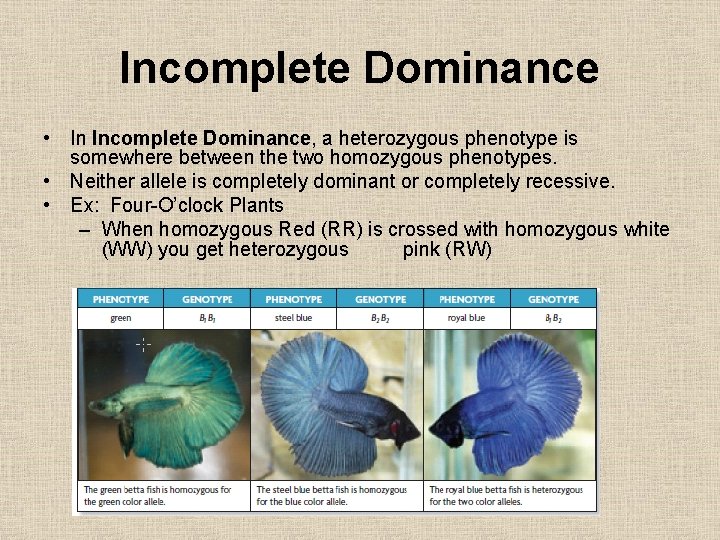
Incomplete Dominance • In Incomplete Dominance, a heterozygous phenotype is somewhere between the two homozygous phenotypes. • Neither allele is completely dominant or completely recessive. • Ex: Four O’clock Plants – When homozygous Red (RR) is crossed with homozygous white (WW) you get heterozygous pink (RW)
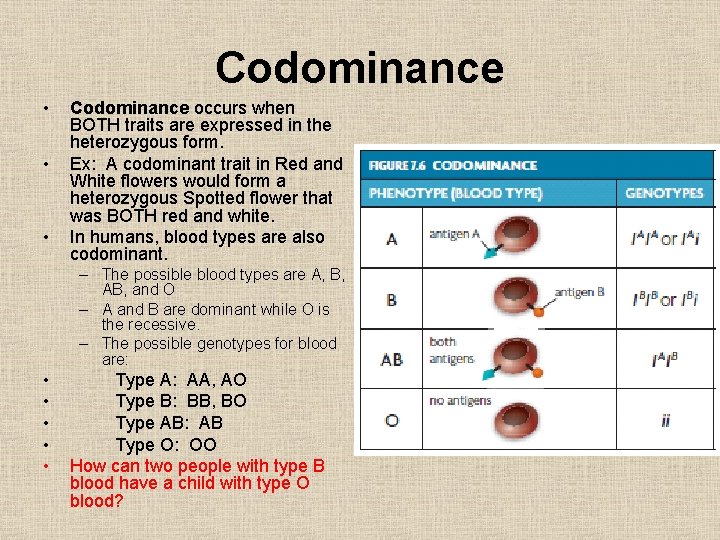
Codominance • • • Codominance occurs when BOTH traits are expressed in the heterozygous form. Ex: A codominant trait in Red and White flowers would form a heterozygous Spotted flower that was BOTH red and white. In humans, blood types are also codominant. – The possible blood types are A, B, AB, and O – A and B are dominant while O is the recessive. – The possible genotypes for blood are: • • • Type A: AA, AO Type B: BB, BO Type AB: AB Type O: OO How can two people with type B blood have a child with type O blood?
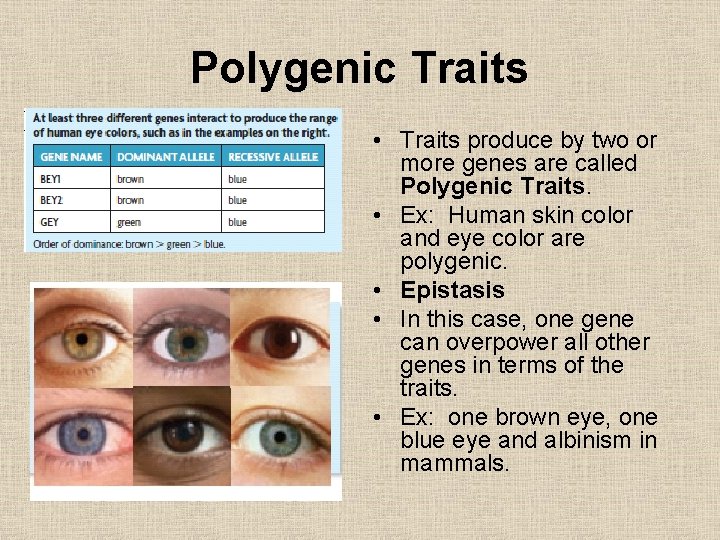
Polygenic Traits • Traits produce by two or more genes are called Polygenic Traits. • Ex: Human skin color and eye color are polygenic. • Epistasis • In this case, one gene can overpower all other genes in terms of the traits. • Ex: one brown eye, one blue eye and albinism in mammals.
The Environment Interacts with Genotype • Some traits are determined by both genes and environment. • Ex: sea turtle eggs become male or female turtles based on the temperature at which they incubate. • Nutrition can effect body growth and development in humans causing genotypes not to be expressed.
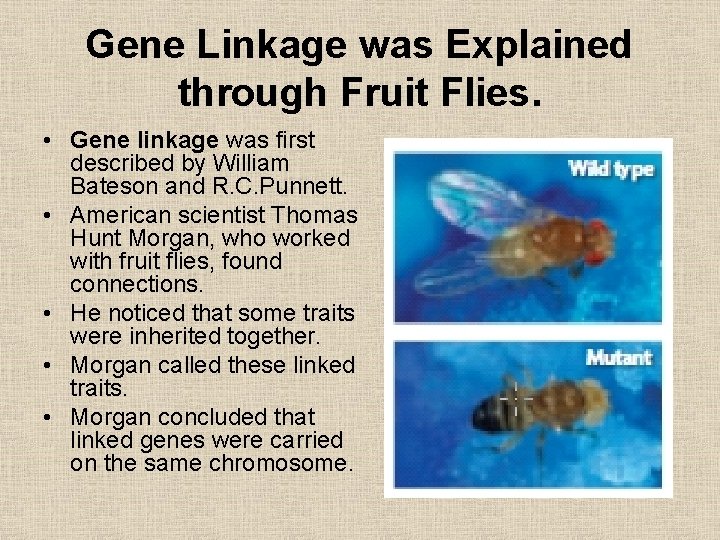
Gene Linkage was Explained through Fruit Flies. • Gene linkage was first described by William Bateson and R. C. Punnett. • American scientist Thomas Hunt Morgan, who worked with fruit flies, found connections. • He noticed that some traits were inherited together. • Morgan called these linked traits. • Morgan concluded that linked genes were carried on the same chromosome.
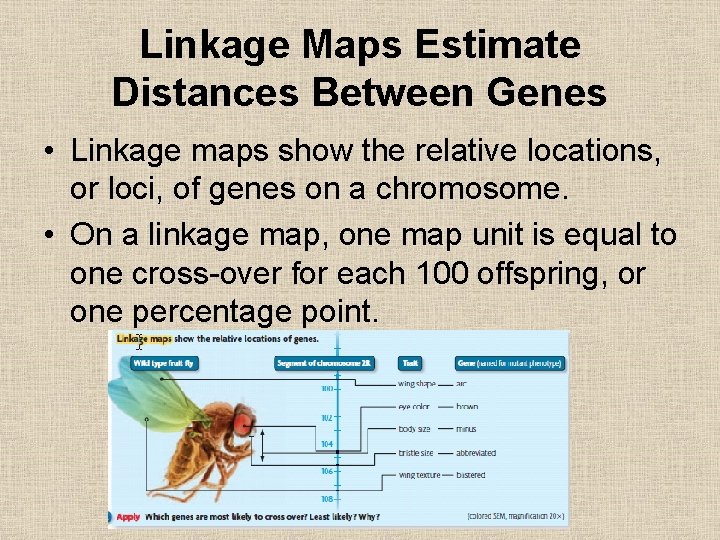
Linkage Maps Estimate Distances Between Genes • Linkage maps show the relative locations, or loci, of genes on a chromosome. • On a linkage map, one map unit is equal to one cross over for each 100 offspring, or one percentage point.
Human Genetics and Pedigrees • Words to Know: Pedigree, Karyotype
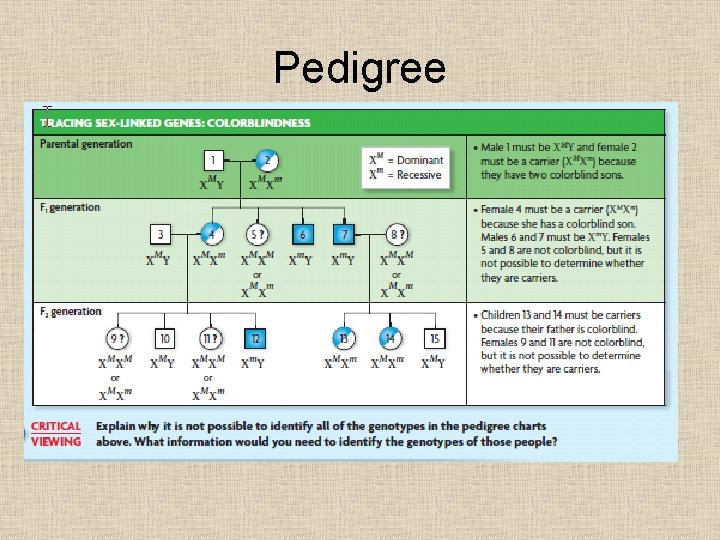
Females can Carry Sex-Linked Genetic Disorders • Remember, a carrier can carry a gene for a trait, but does NOT express the trait. • Only females can be carriers of sex linked disorders. • Ex: Colorblindness, hemophelia, male pattern baldness. • The royal family in England has many members with hemophelia because there was much inbreeding with cousins.
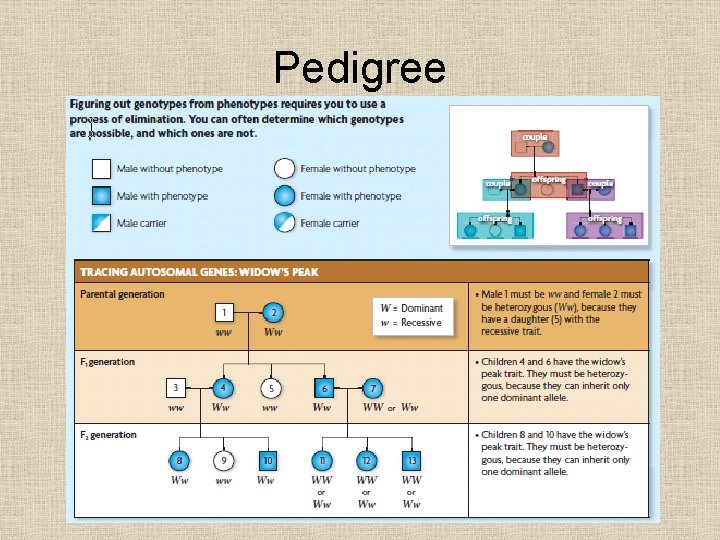
A Pedigree is a Chart for Tracing Genes in a Family. • A Pedigree chart can help trace the phenotypes and genotypes in a family to determine whether people carry recessive alleles. • When enough family phenotypes are known, genotypes can be figured out. • Tracing Autosomal or Sex-Linked Genes • Squares = males • Circles = Females • = mating (wed) • Shaded = has trait • Empty = no trait • Half shaded = Carrier
Pedigree
Pedigree
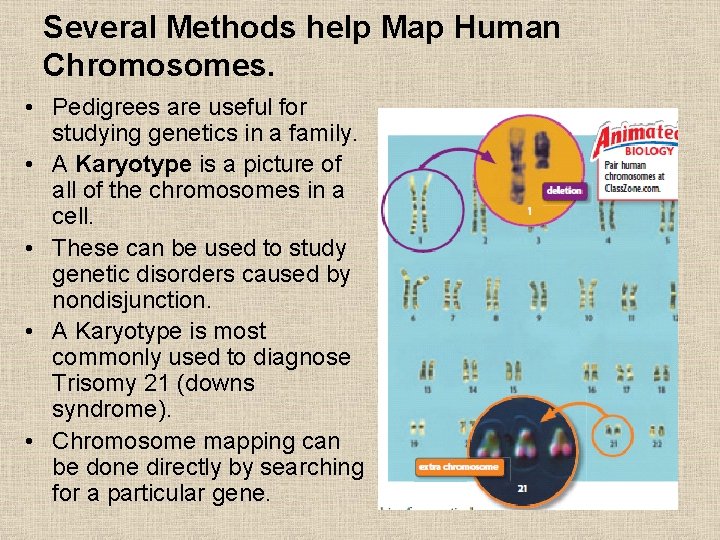
Several Methods help Map Human Chromosomes. • Pedigrees are useful for studying genetics in a family. • A Karyotype is a picture of all of the chromosomes in a cell. • These can be used to study genetic disorders caused by nondisjunction. • A Karyotype is most commonly used to diagnose Trisomy 21 (downs syndrome). • Chromosome mapping can be done directly by searching for a particular gene.