
Mendel and Autosomal Inheritance Complete Dominance Gregor Mendel
- Slides: 26
Mendel and Autosomal Inheritance Complete Dominance
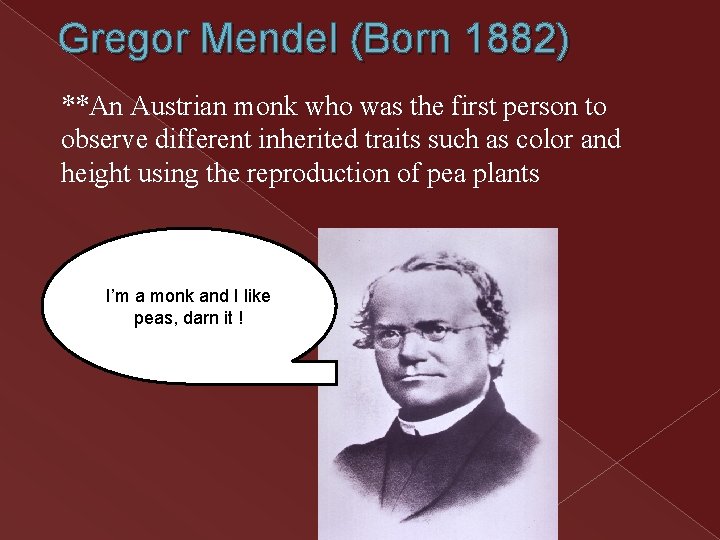
Gregor Mendel (Born 1882) **An Austrian monk who was the first person to observe different inherited traits such as color and height using the reproduction of pea plants I’m a monk and I like peas, darn it !
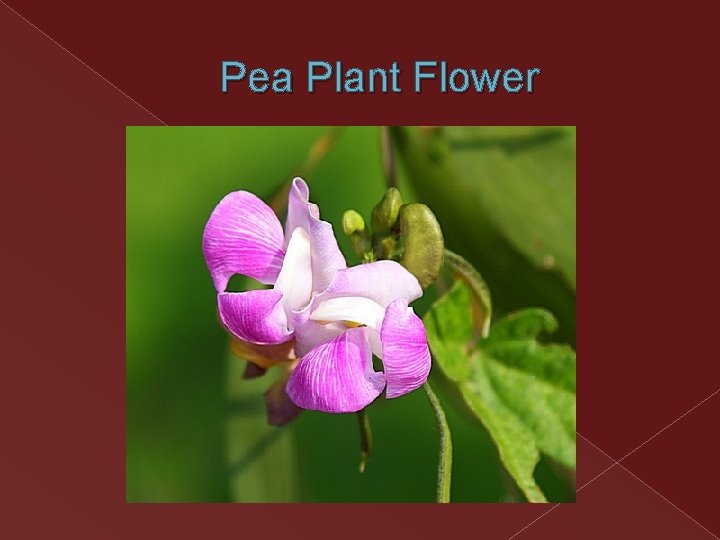
Pea Plant Flower
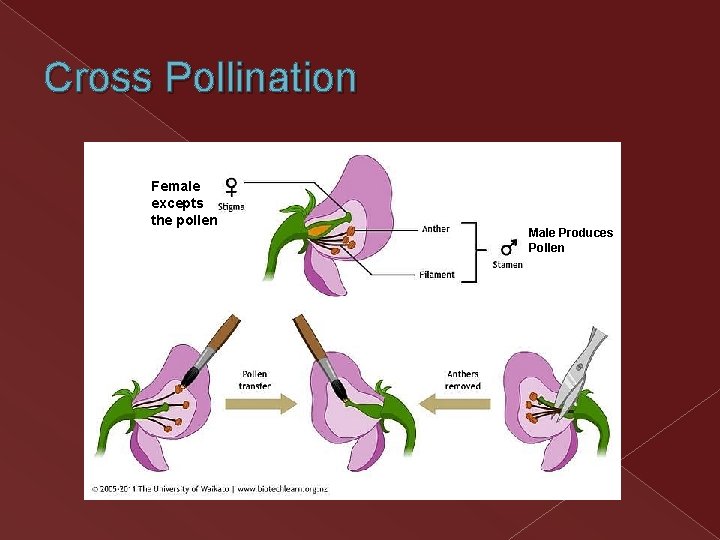
Sexual Reproduction In Plants **In plants, fertilization is called pollination (pollen from the male meets the female parts) Ø Self-pollination occurs when a plant is allowed to pollinate itself Ø Cross pollination – Different plants
Cross Pollination Female excepts the pollen Male Produces Pollen
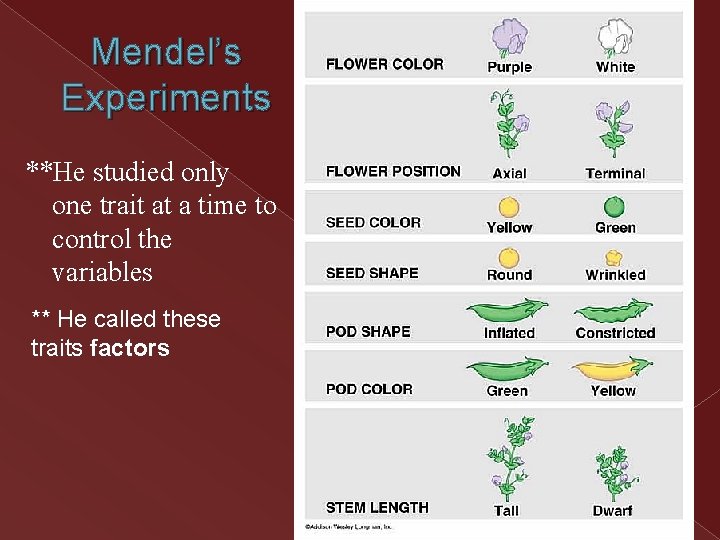
Mendel’s Experiments **He studied only one trait at a time to control the variables ** He called these traits factors
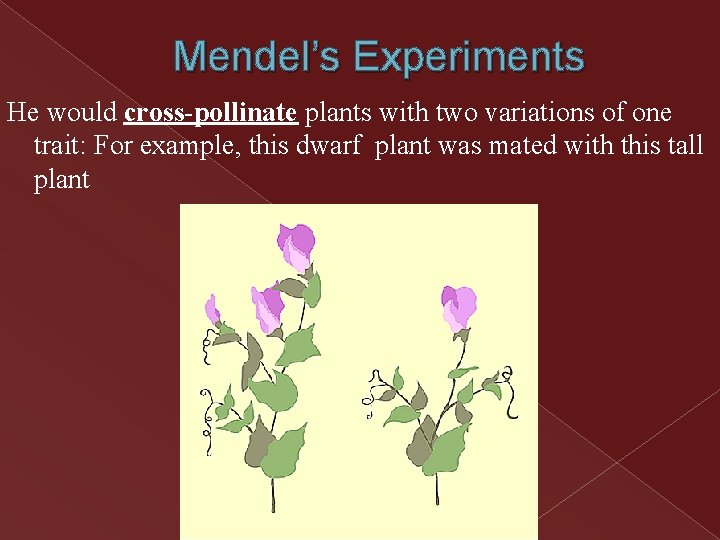
Mendel’s Experiments He would cross-pollinate plants with two variations of one trait: For example, this dwarf plant was mated with this tall plant
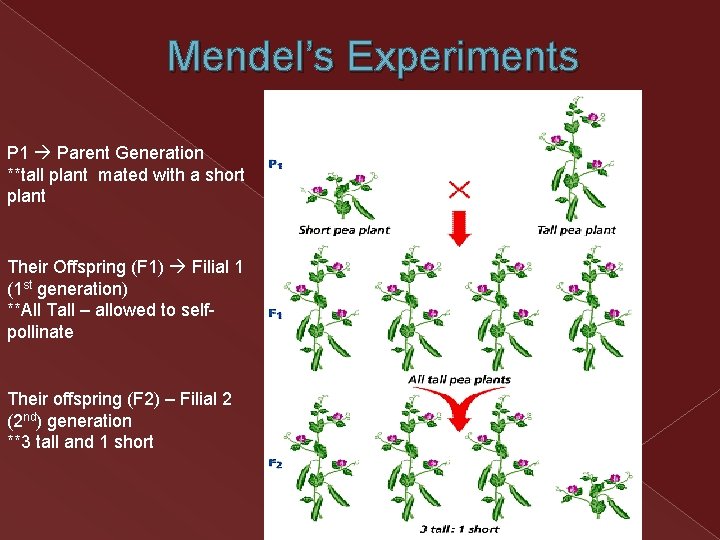
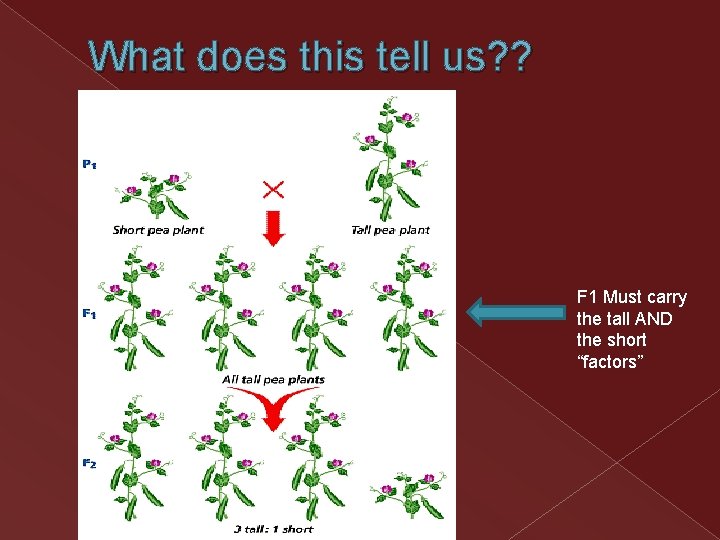
Mendel’s Experiments P 1 Parent Generation **tall plant mated with a short plant Their Offspring (F 1) Filial 1 (1 st generation) **All Tall – allowed to selfpollinate Their offspring (F 2) – Filial 2 (2 nd) generation **3 tall and 1 short
What does this tell us? ? F 1 Must carry the tall AND the short “factors”
What else does this tell us? ? ** Traits are inherited from generation to generation ** Also, a hybrid is the offspring that inherited both the tall “factor” and the short “factor”
Mendel’s Rules ~ Rule of Unit factors: Two factors (one from each parent) affect one trait in an individual ~ Rule of Dominance: The observed trait is called dominant and the trait that cannot be seen is recessive
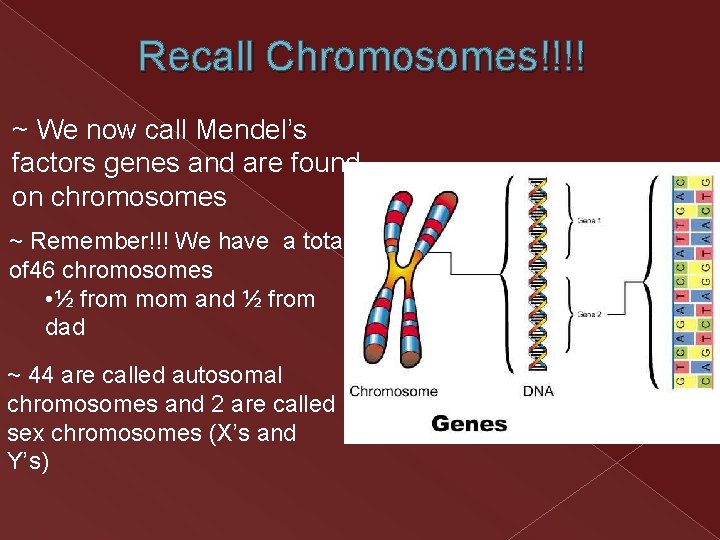
Recall Chromosomes!!!! ~ We now call Mendel’s factors genes and are found on chromosomes ~ Remember!!! We have a total of 46 chromosomes • ½ from mom and ½ from dad ~ 44 are called autosomal chromosomes and 2 are called sex chromosomes (X’s and Y’s)
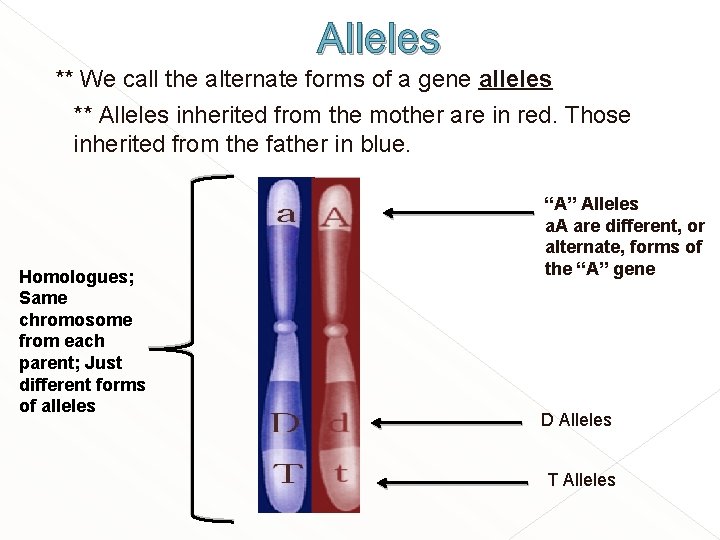
Alleles ** We call the alternate forms of a gene alleles ** Alleles inherited from the mother are in red. Those inherited from the father in blue. Homologues; Same chromosome from each parent; Just different forms of alleles “A” Alleles a. A are different, or alternate, forms of the “A” gene D Alleles T Alleles
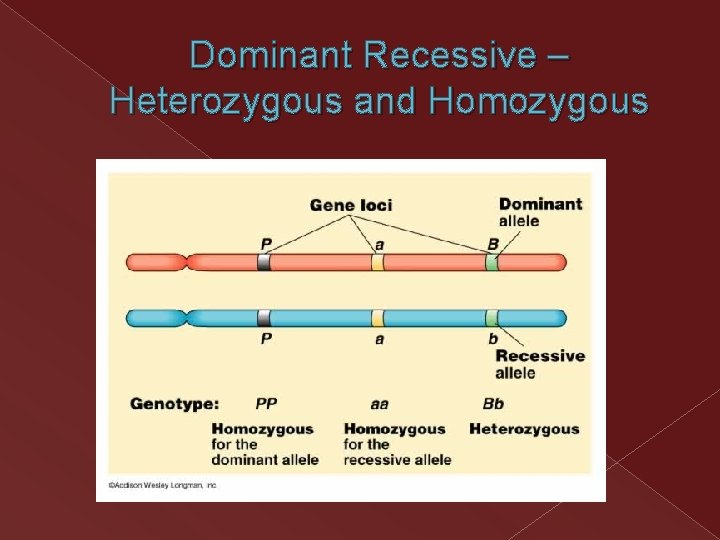
General Terms � Genotype pair of alleles denoted by letters › TT = homozygous dominant (Upper Case) › Tt = heterozygous (hybrid, carrier…the recessive “t” is not expressed; the “T” dominnates over the “t”; the “t” cannot be seen › tt = homozygous recessive � Phenotype how the alleles are expressed; what it “looks” like; such as tall and short or even a genetic disease or abnormality (like polydactyl fingers)
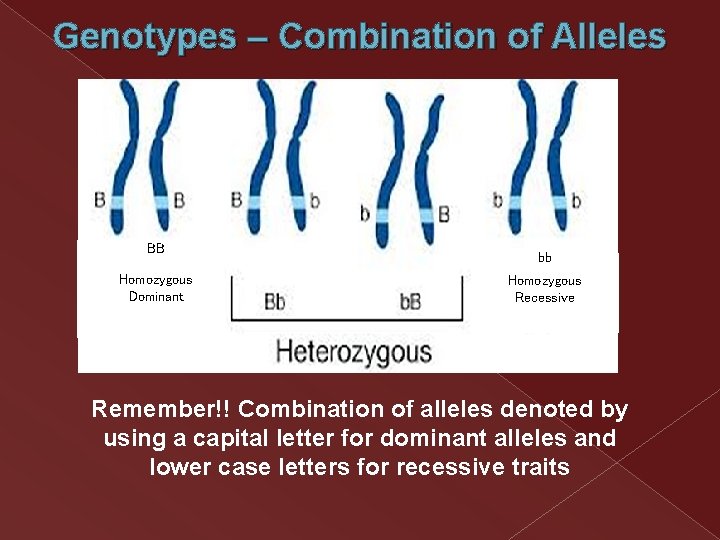
Genotypes – Combination of Alleles BB Homozygous Dominant bb Homozygous Recessive Remember!! Combination of alleles denoted by using a capital letter for dominant alleles and lower case letters for recessive traits
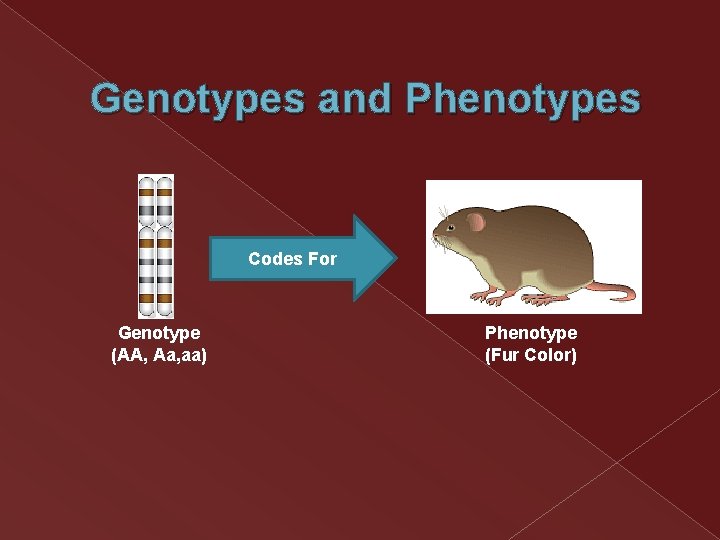
Genotypes and Phenotypes Codes For Genotype (AA, Aa, aa) Phenotype (Fur Color)
Dominant Recessive – Heterozygous and Homozygous
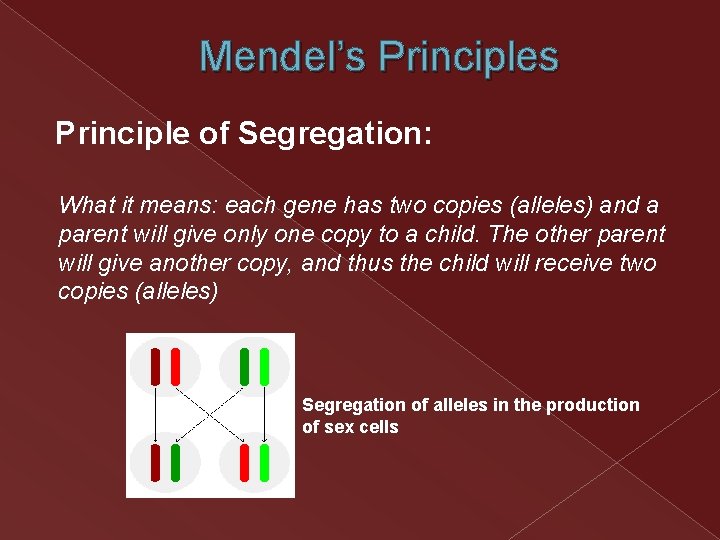
Mendel’s Principle of Segregation: What it means: each gene has two copies (alleles) and a parent will give only one copy to a child. The other parent will give another copy, and thus the child will receive two copies (alleles) Segregation of alleles in the production of sex cells
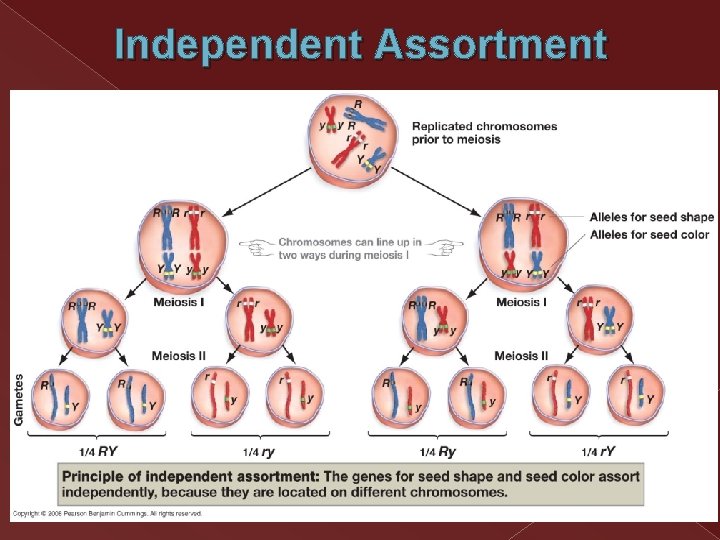
Mendel’s Principle Independent Assortment: Genes for different traits may assort independently of one another in gamete production Leads to genetic diversity What it means: different genes are inherited separately. For example, the gene which codes for eye color is inherited separately from the gene which codes for nose shape.
Independent Assortment
Punnett Squares � Table that shows probability of offspring having a particular trait � Shows a cross (mating)between a male’s gamete with the female’s
Punnett Squares
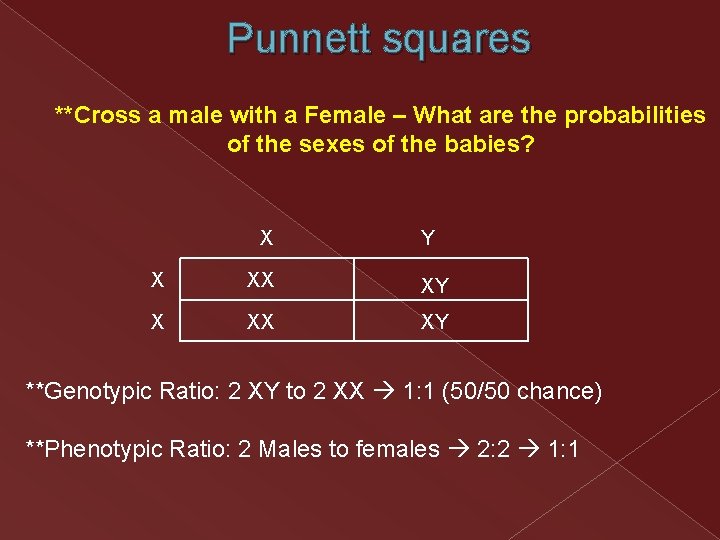
Punnett squares **Cross a male with a Female – What are the probabilities of the sexes of the babies? X Y X XX XY **Genotypic Ratio: 2 XY to 2 XX 1: 1 (50/50 chance) **Phenotypic Ratio: 2 Males to females 2: 2 1: 1
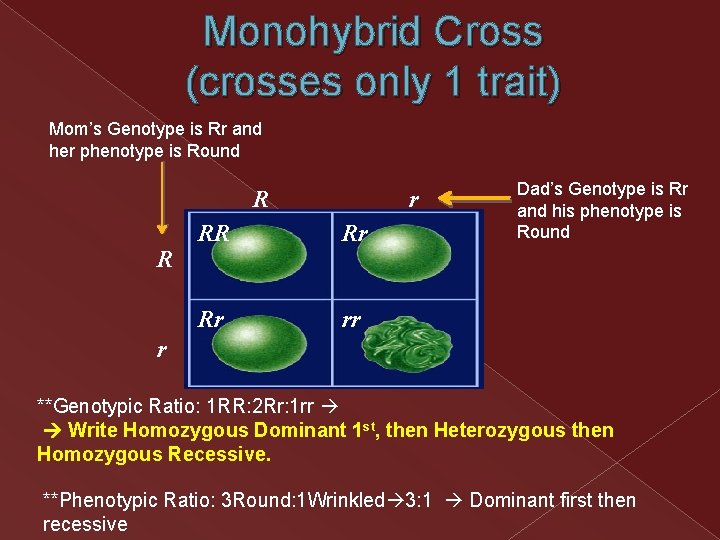
Monohybrid Cross (crosses only 1 trait) Mom’s Genotype is Rr and her phenotype is Round R R r RR Rr Rr rr Dad’s Genotype is Rr and his phenotype is Round r **Genotypic Ratio: 1 RR: 2 Rr: 1 rr Write Homozygous Dominant 1 st, then Heterozygous then Homozygous Recessive. **Phenotypic Ratio: 3 Round: 1 Wrinkled 3: 1 Dominant first then recessive
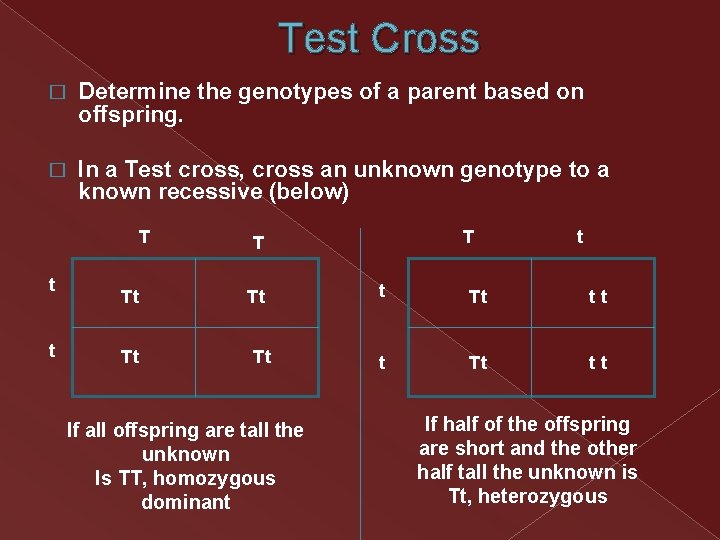
Test Cross � Determine the genotypes of a parent based on offspring. � In a Test cross, cross an unknown genotype to a known recessive (below) T t t Tt Tt T T Tt Tt If all offspring are tall the unknown Is TT, homozygous dominant t t Tt tt If half of the offspring are short and the other half tall the unknown is Tt, heterozygous
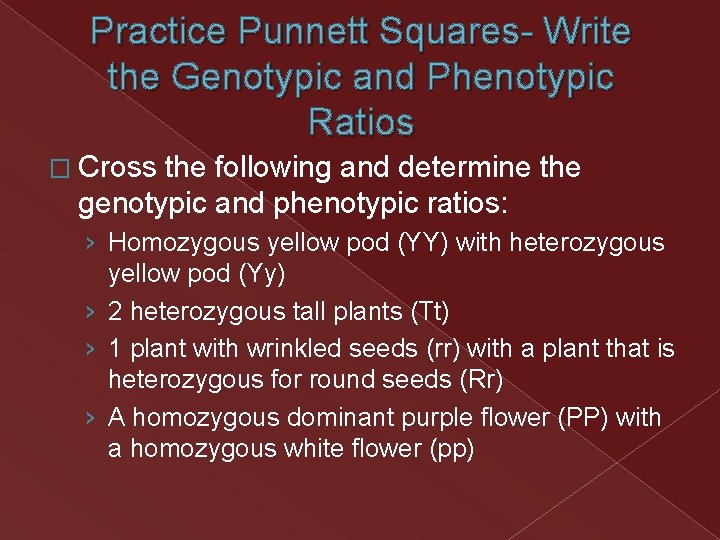
Practice Punnett Squares- Write the Genotypic and Phenotypic Ratios � Cross the following and determine the genotypic and phenotypic ratios: › Homozygous yellow pod (YY) with heterozygous yellow pod (Yy) › 2 heterozygous tall plants (Tt) › 1 plant with wrinkled seeds (rr) with a plant that is heterozygous for round seeds (Rr) › A homozygous dominant purple flower (PP) with a homozygous white flower (pp)