
MEMS Rotary Engine Power System Engine Fluid Management
- Slides: 10
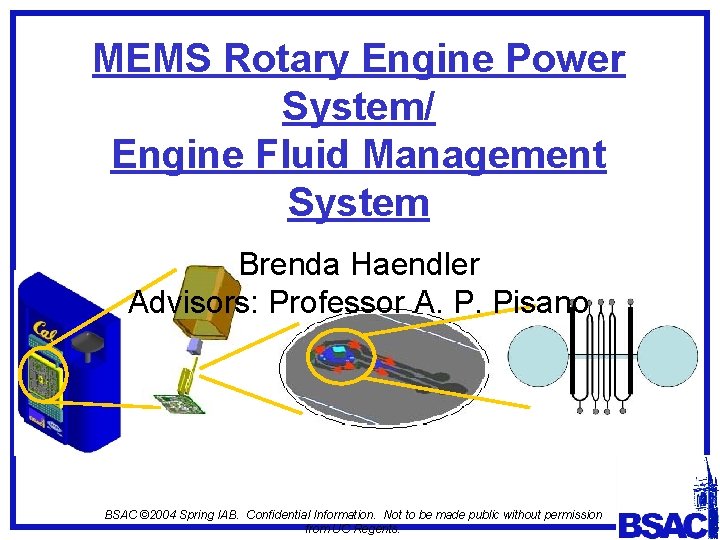
MEMS Rotary Engine Power System/ Engine Fluid Management System Brenda Haendler Advisors: Professor A. P. Pisano BSAC © 2004 Spring IAB. Confidential Information. Not to be made public without permission from UC Regents.
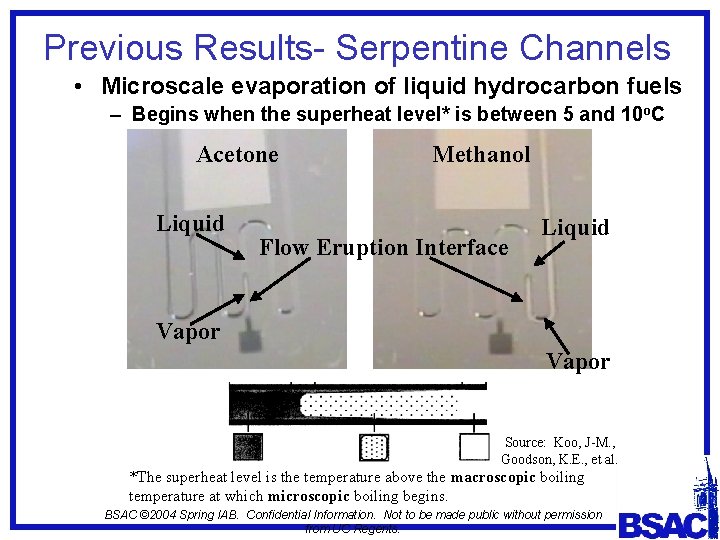
Previous Results- Serpentine Channels • Microscale evaporation of liquid hydrocarbon fuels – Begins when the superheat level* is between 5 and 10 o. C Acetone Liquid Methanol Flow Eruption Interface Liquid Vapor Source: Koo, J-M. , Goodson, K. E. , et al. *The superheat level is the temperature above the macroscopic boiling temperature at which microscopic boiling begins. BSAC © 2004 Spring IAB. Confidential Information. Not to be made public without permission from UC Regents.
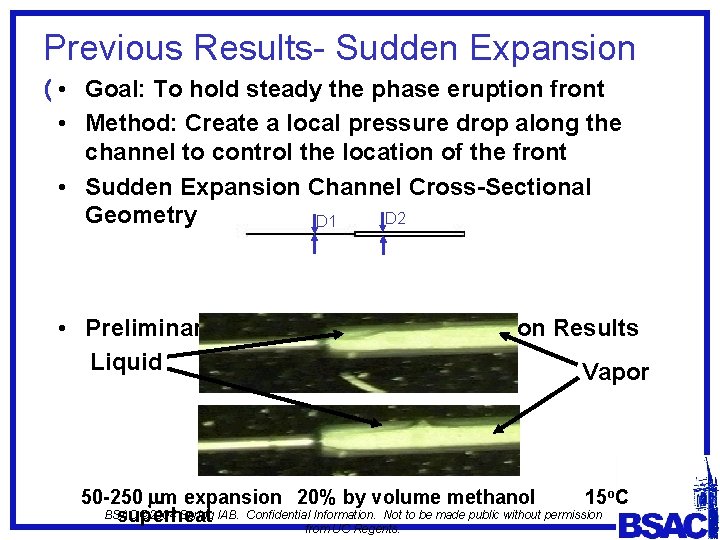
Previous Results- Sudden Expansion • Goal: To hold steady the phase eruption front Channels • Method: Create a local pressure drop along the channel to control the location of the front • Sudden Expansion Channel Cross-Sectional Geometry D 2 D 1 • Preliminary Phase Eruption Stabilization Results Liquid Vapor 50 -250 mm expansion 20% by volume methanol 15 o. C BSAC © 2004 Spring IAB. Confidential Information. Not to be made public without permission superheat from UC Regents.
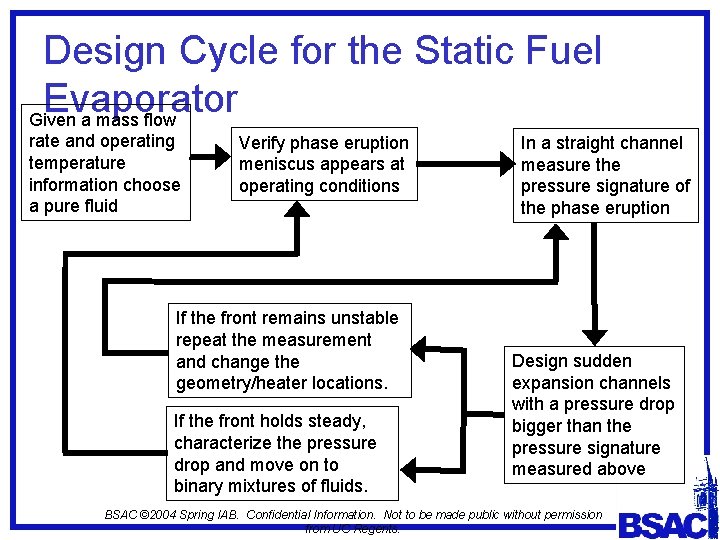
Design Cycle for the Static Fuel Evaporator Given a mass flow rate and operating temperature information choose a pure fluid Verify phase eruption meniscus appears at operating conditions If the front remains unstable repeat the measurement and change the geometry/heater locations. If the front holds steady, characterize the pressure drop and move on to binary mixtures of fluids. In a straight channel measure the pressure signature of the phase eruption Design sudden expansion channels with a pressure drop bigger than the pressure signature measured above BSAC © 2004 Spring IAB. Confidential Information. Not to be made public without permission from UC Regents.
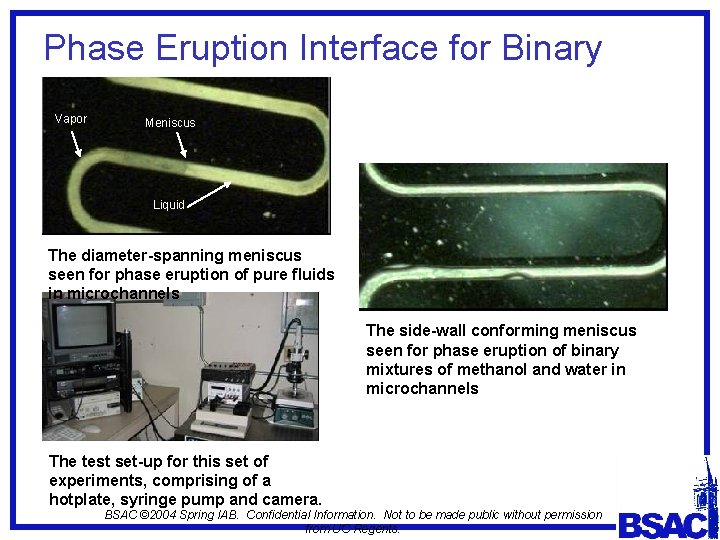
Phase Eruption Interface for Binary Mixtures Vapor Meniscus Liquid The diameter-spanning meniscus seen for phase eruption of pure fluids in microchannels The side-wall conforming meniscus seen for phase eruption of binary mixtures of methanol and water in microchannels The test set-up for this set of experiments, comprising of a hotplate, syringe pump and camera. BSAC © 2004 Spring IAB. Confidential Information. Not to be made public without permission from UC Regents.
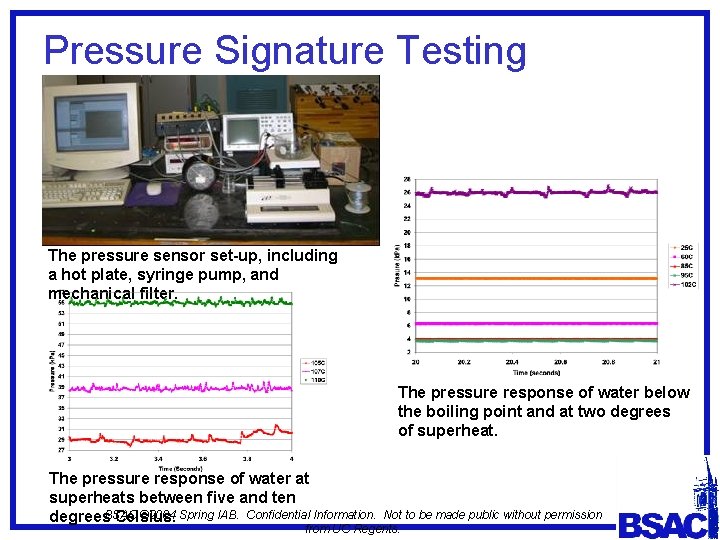
Pressure Signature Testing The pressure sensor set-up, including a hot plate, syringe pump, and mechanical filter. The pressure response of water below the boiling point and at two degrees of superheat. The pressure response of water at superheats between five and ten © 2004 Spring IAB. Confidential Information. degrees. BSAC Celsius. Not to be made public without permission from UC Regents.
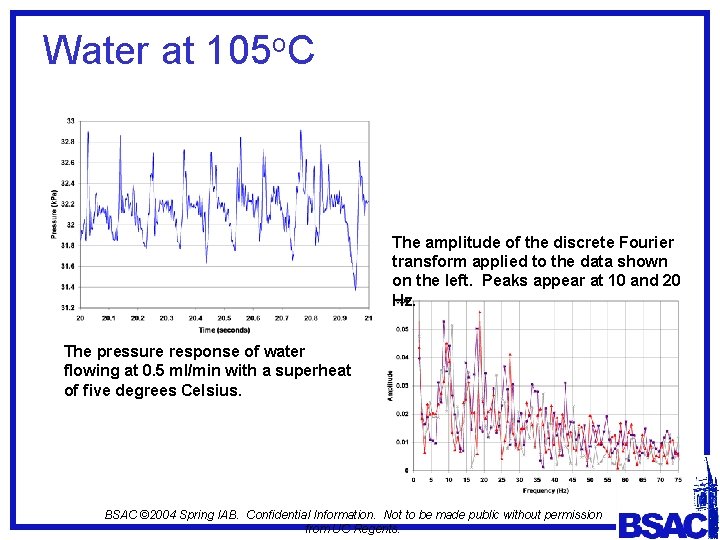
Water at 105 o. C The amplitude of the discrete Fourier transform applied to the data shown on the left. Peaks appear at 10 and 20 Hz. The pressure response of water flowing at 0. 5 ml/min with a superheat of five degrees Celsius. BSAC © 2004 Spring IAB. Confidential Information. Not to be made public without permission from UC Regents.
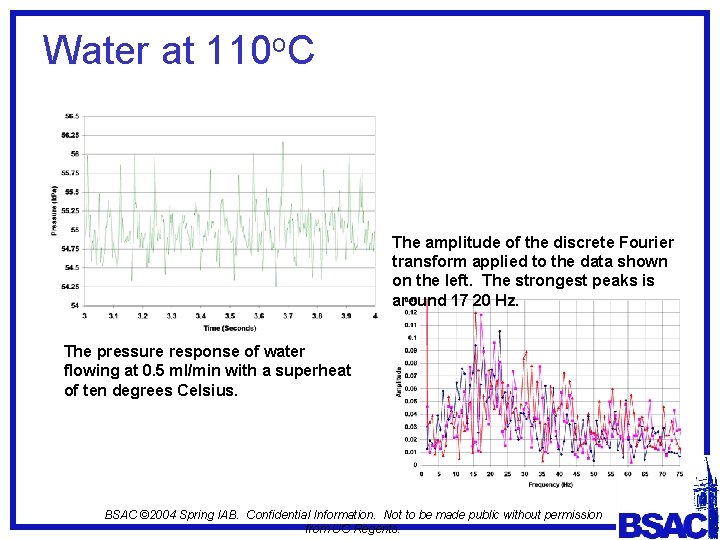
Water at 110 o. C The amplitude of the discrete Fourier transform applied to the data shown on the left. The strongest peaks is around 17 20 Hz. The pressure response of water flowing at 0. 5 ml/min with a superheat of ten degrees Celsius. BSAC © 2004 Spring IAB. Confidential Information. Not to be made public without permission from UC Regents.
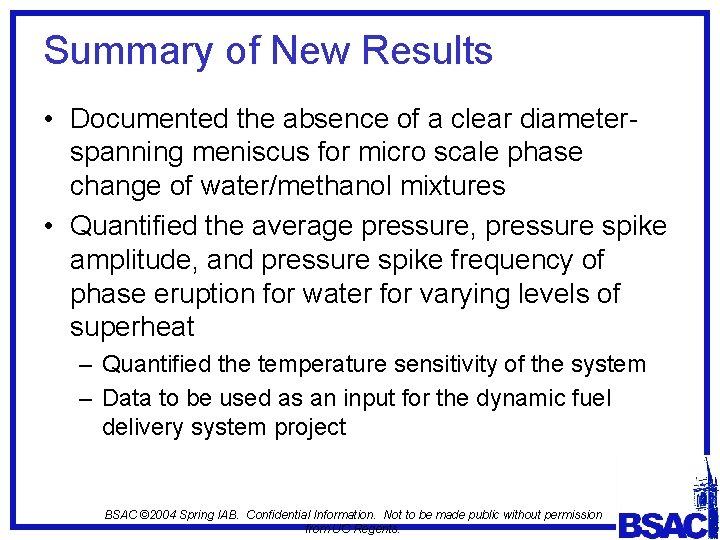
Summary of New Results • Documented the absence of a clear diameterspanning meniscus for micro scale phase change of water/methanol mixtures • Quantified the average pressure, pressure spike amplitude, and pressure spike frequency of phase eruption for water for varying levels of superheat – Quantified the temperature sensitivity of the system – Data to be used as an input for the dynamic fuel delivery system project BSAC © 2004 Spring IAB. Confidential Information. Not to be made public without permission from UC Regents.
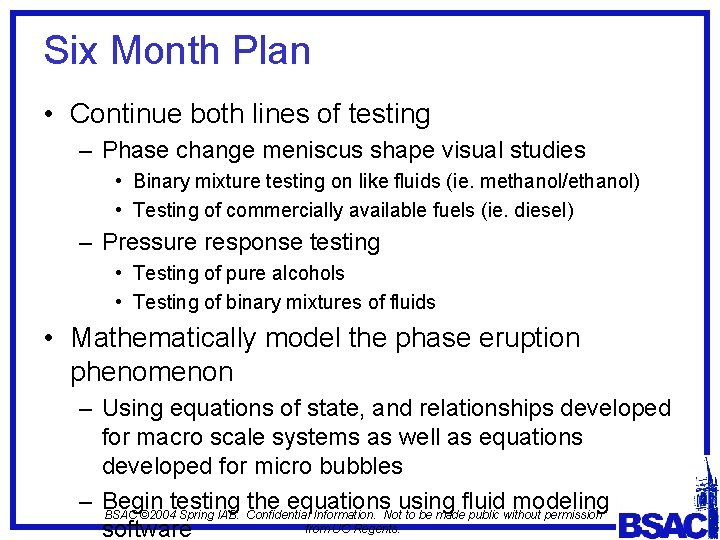
Six Month Plan • Continue both lines of testing – Phase change meniscus shape visual studies • Binary mixture testing on like fluids (ie. methanol/ethanol) • Testing of commercially available fuels (ie. diesel) – Pressure response testing • Testing of pure alcohols • Testing of binary mixtures of fluids • Mathematically model the phase eruption phenomenon – Using equations of state, and relationships developed for macro scale systems as well as equations developed for micro bubbles – Begin testing the equations using fluid modeling BSAC © 2004 Spring IAB. Confidential Information. Not to be made public without permission from UC Regents. software