
Memorycentric System Interconnect Design with Hybrid Memory Cubes
Memory-centric System Interconnect Design with Hybrid Memory Cubes Gwangsun Kim, John Kim Jung Ho Ahn, Jaeha Kim Korea Advanced Institute of Science and Technology Seoul National University
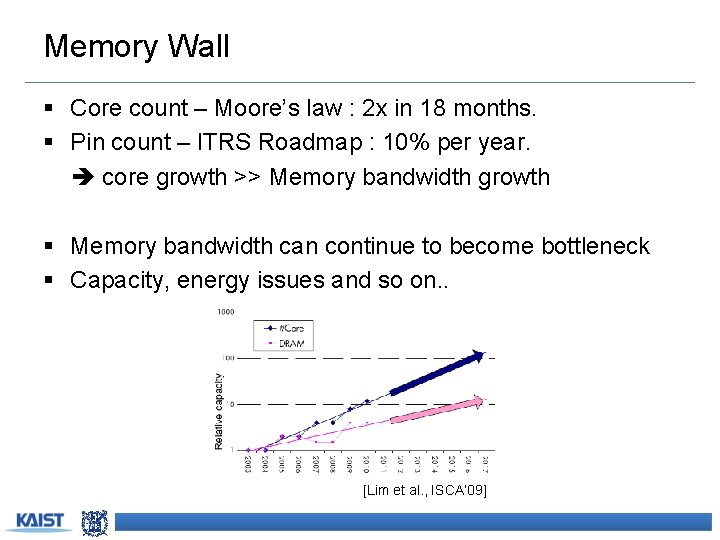
Memory Wall § Core count – Moore’s law : 2 x in 18 months. § Pin count – ITRS Roadmap : 10% per year. core growth >> Memory bandwidth growth § Memory bandwidth can continue to become bottleneck § Capacity, energy issues and so on. . [Lim et al. , ISCA’ 09]
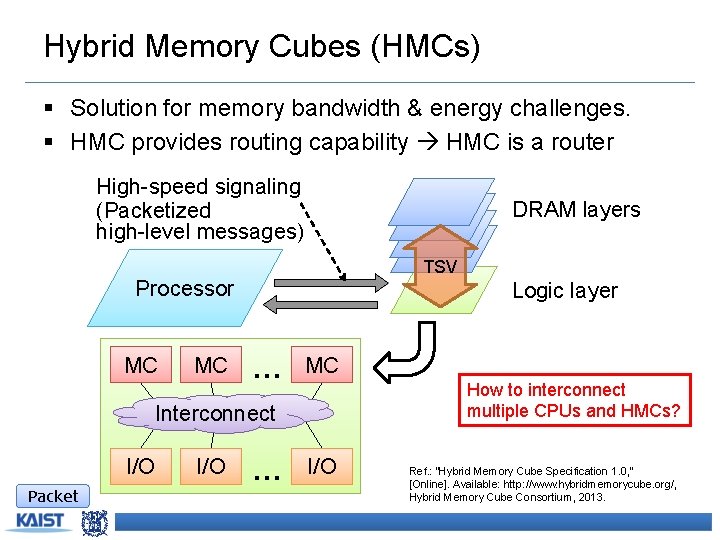
Hybrid Memory Cubes (HMCs) § Solution for memory bandwidth & energy challenges. § HMC provides routing capability HMC is a router High-speed signaling (Packetized high-level messages) DRAM layers TSV Processor MC MC Logic layer … MC How to interconnect multiple CPUs and HMCs? Interconnect I/O Packet I/O … I/O Ref. : “Hybrid Memory Cube Specification 1. 0, ” [Online]. Available: http: //www. hybridmemorycube. org/, Hybrid Memory Cube Consortium, 2013.
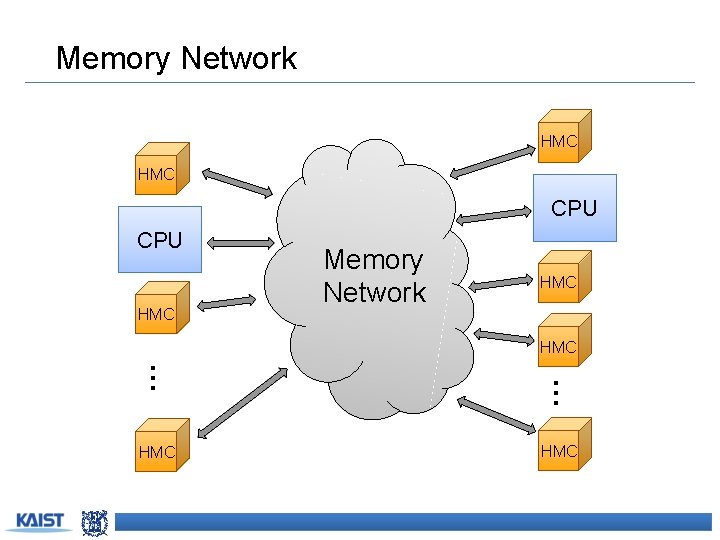
Memory Network HMC CPU HMC Memory Network HMC … … HMC
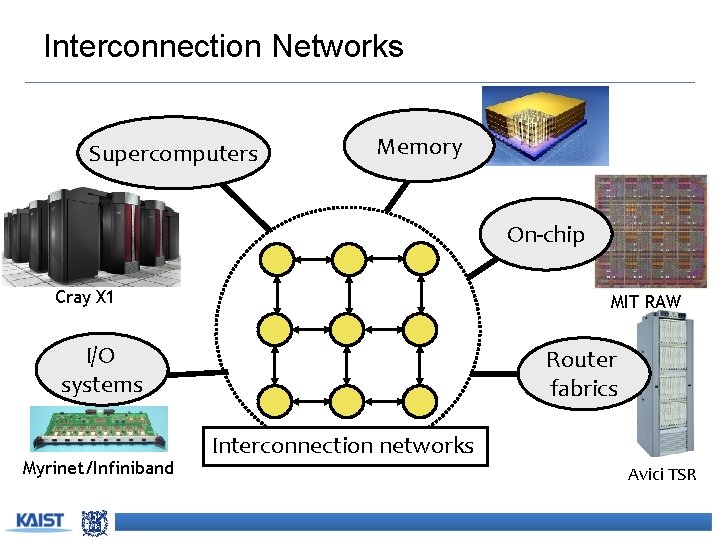
Interconnection Networks Supercomputers Memory On-chip Cray X 1 MIT RAW I/O systems Myrinet/Infiniband Router fabrics Interconnection networks Avici TSR

How Is It Different? Interconnection Networks (large-scale networks) Memory Network Nodes vs. Routers # Nodes ≥ # Routers # Nodes < # Routers (or HMCs) Network Organization Concentration Distribution Important Bandwidth Bisection Bandwidth CPU Bandwidth Cost Channel Others 1) Intra-HMC network 2) “Routers” generate traffic

Conventional System Interconnect § Intel Quick. Path Interconnect / AMD Hyper. Transport § Different interface to memory and other processors. Shared parallel bus CPU 0 CPU 1 CPU 2 CPU 3 High-speed P 2 P links

Adopting Conventional Design Approach § CPU can use the same interface for both memory/other CPUs. § CPU bandwidth is statically partitioned. HMC CPU 0 HMC HMC HMC CPU 1 HMC Same links HMC CPU 2 HMC CPU 3
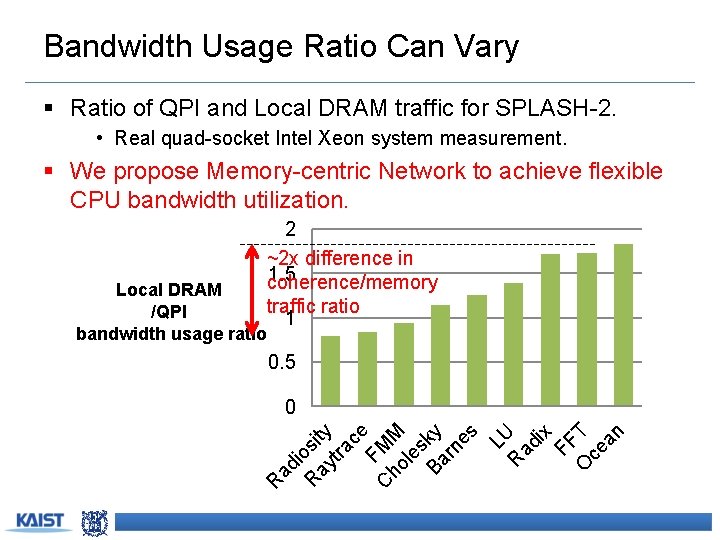
Bandwidth Usage Ratio Can Vary § Ratio of QPI and Local DRAM traffic for SPLASH-2. • Real quad-socket Intel Xeon system measurement. § We propose Memory-centric Network to achieve flexible CPU bandwidth utilization. 2 ~2 x difference in 1. 5 coherence/memory traffic ratio 1 Local DRAM /QPI bandwidth usage ratio 0. 5 R R ad ix FF O T ce an LU ad i R osit ay y tra ce F C MM ho le s Ba ky rn es 0
Contents § § § Background/Motivation Design space exploration Challenges and solutions Evaluation Conclusions
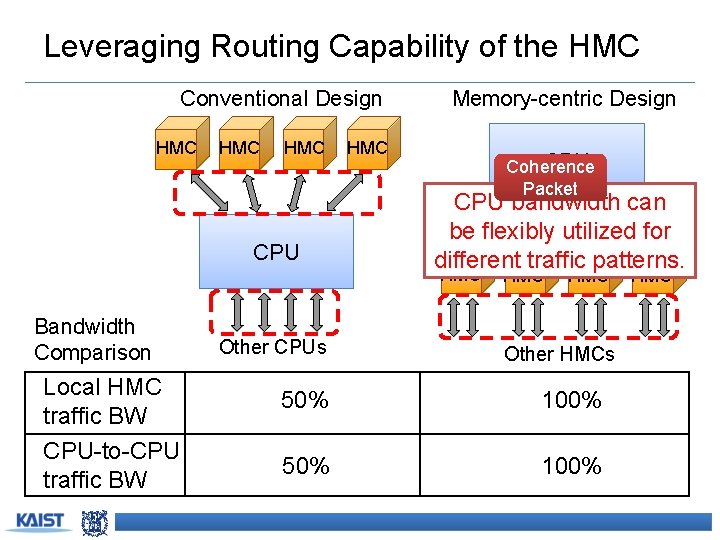
Leveraging Routing Capability of the HMC Conventional Design HMC HMC CPU Memory-centric Design HMC CPU Coherence Packet CPU bandwidth can be flexibly utilized for different traffic patterns. HMC Bandwidth Comparison Local HMC traffic BW CPU-to-CPU traffic BW Other CPUs HMC Other HMCs 50% 100% HMC
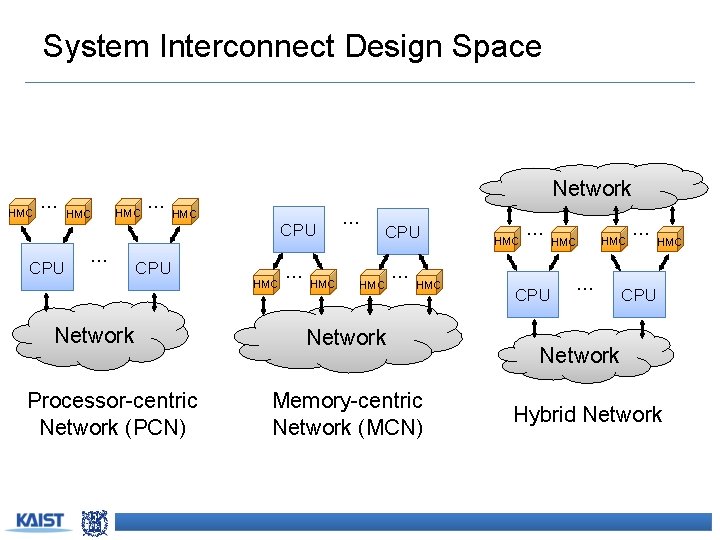
System Interconnect Design Space HMC … CPU HMC … … Network HMC CPU HMC Network Processor-centric Network (PCN) … HMC … CPU HMC … HMC Network Memory-centric Network (MCN) HMC … CPU HMC … … HMC CPU Network Hybrid Network
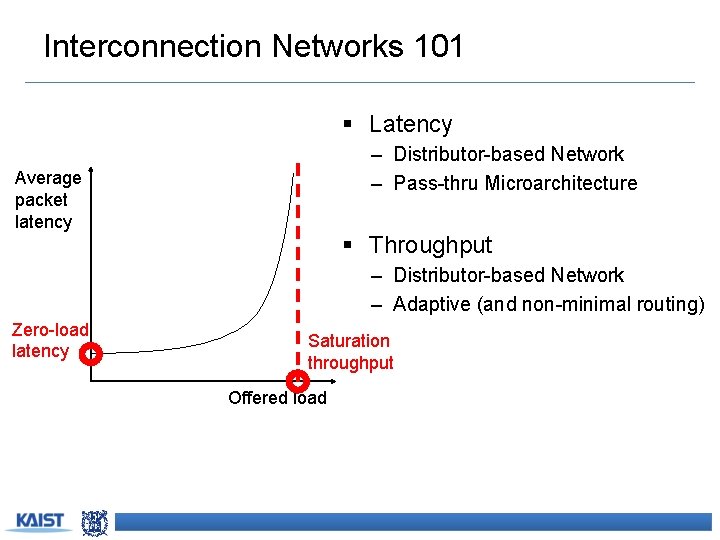
Interconnection Networks 101 § Latency – Distributor-based Network – Pass-thru Microarchitecture Average packet latency § Throughput – Distributor-based Network – Adaptive (and non-minimal routing) Zero-load latency Saturation throughput Offered load
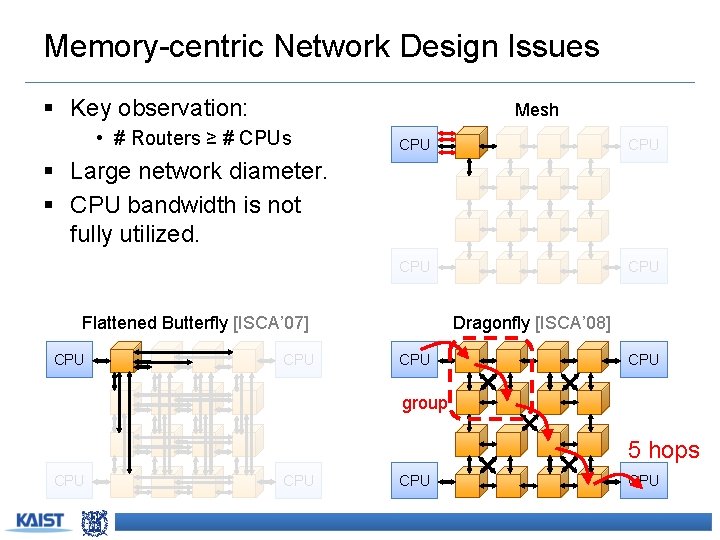
Memory-centric Network Design Issues § Key observation: Mesh • # Routers ≥ # CPUs CPU CPU § Large network diameter. § CPU bandwidth is not fully utilized. Dragonfly [ISCA’ 08] Flattened Butterfly [ISCA’ 07] CPU CPU group 5 hops CPU CPU
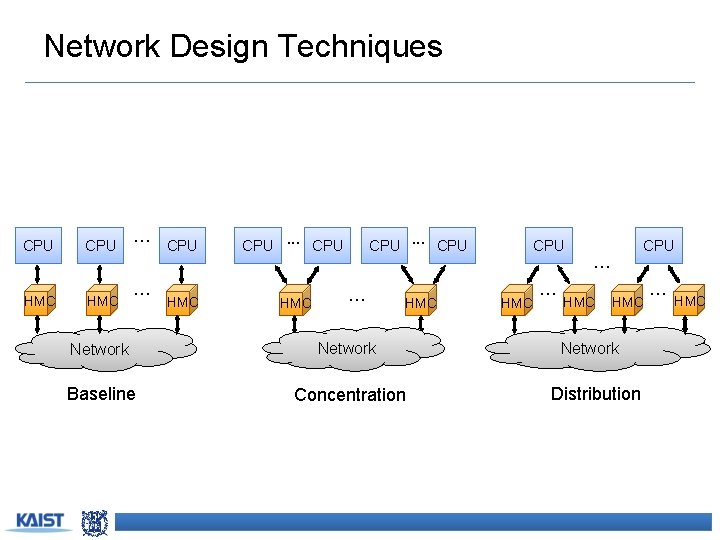
Network Design Techniques CPU CPU … CPU CPU … HMC HMC … HMC Network Baseline Concentration HMC … HMC Network Distribution … HMC
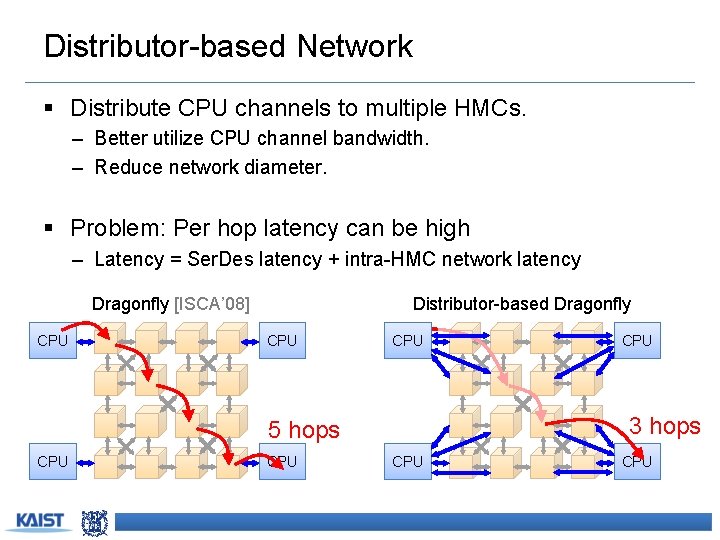
Distributor-based Network § Distribute CPU channels to multiple HMCs. – Better utilize CPU channel bandwidth. – Reduce network diameter. § Problem: Per hop latency can be high – Latency = Ser. Des latency + intra-HMC network latency Dragonfly [ISCA’ 08] CPU Distributor-based Dragonfly CPU 3 hops 5 hops CPU CPU CPU
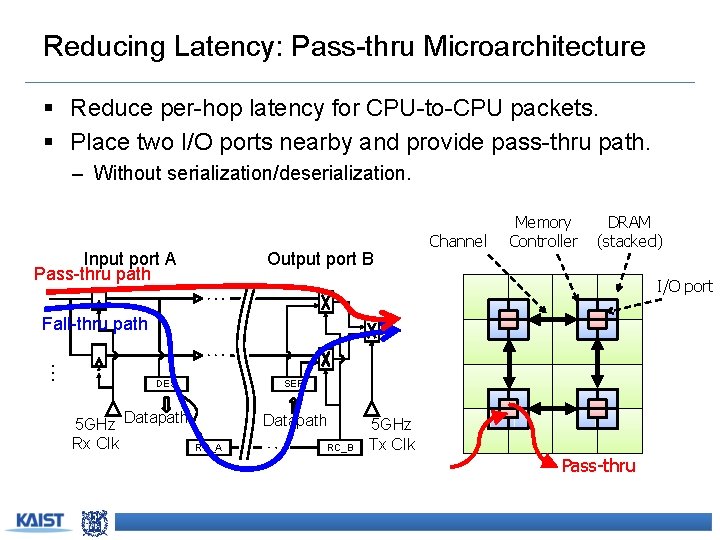
Reducing Latency: Pass-thru Microarchitecture § Reduce per-hop latency for CPU-to-CPU packets. § Place two I/O ports nearby and provide pass-thru path. – Without serialization/deserialization. Output port B Input port A Pass-thru path Channel Memory Controller DRAM (stacked) I/O port Fall-thru path DES 5 GHz Datapath Rx Clk SER Datapath RC_A RC_B 5 GHz Tx Clk Pass-thru
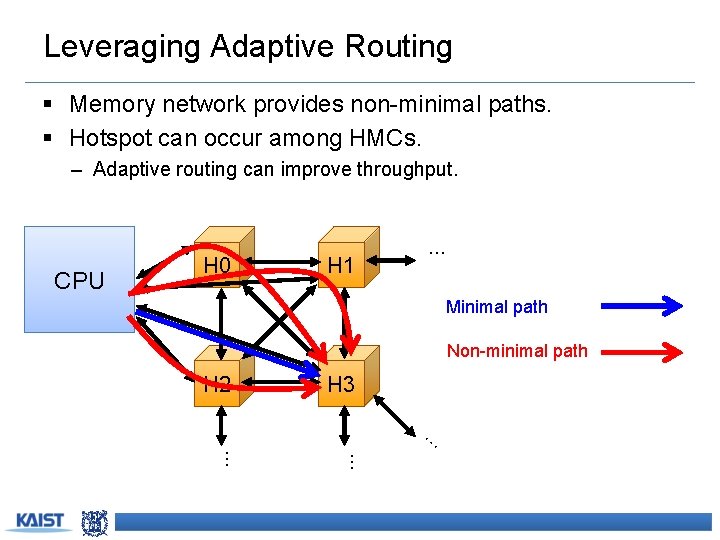
Leveraging Adaptive Routing § Memory network provides non-minimal paths. § Hotspot can occur among HMCs. – Adaptive routing can improve throughput. CPU H 0 H 1 … Minimal path Non-minimal path H 2 H 3 … … …
Methodology § Workload – Synthetic traffic: request-reply pattern – Real workload: SPLASH-2 § Performance – Cycle-accurate Pin-based simulator § Energy: – Mc. PAT (CPU) + CACTI-3 DD (DRAM) + Network energy § Configuration: – 4 CPU-64 HMC system – CPU: 64 Out-of-Order cores – HMC: 4 GB, 8 layers x 16 vaults
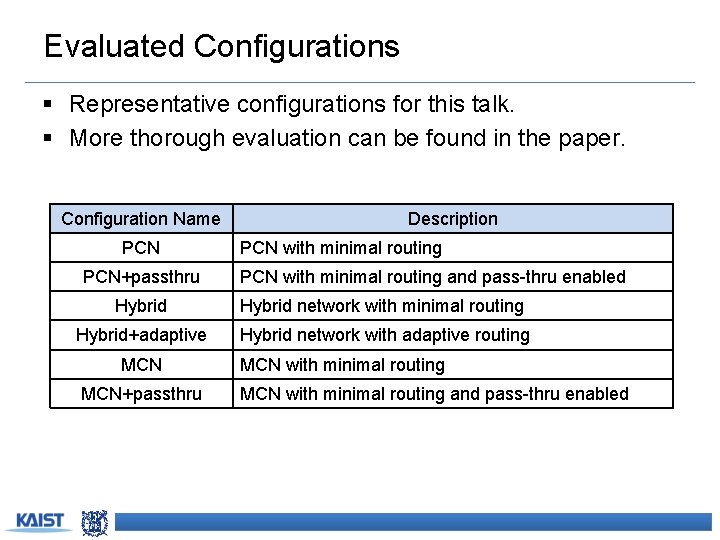
Evaluated Configurations § Representative configurations for this talk. § More thorough evaluation can be found in the paper. Configuration Name PCN+passthru Description PCN with minimal routing and pass-thru enabled Hybrid network with minimal routing Hybrid+adaptive Hybrid network with adaptive routing MCN+passthru MCN with minimal routing and pass-thru enabled
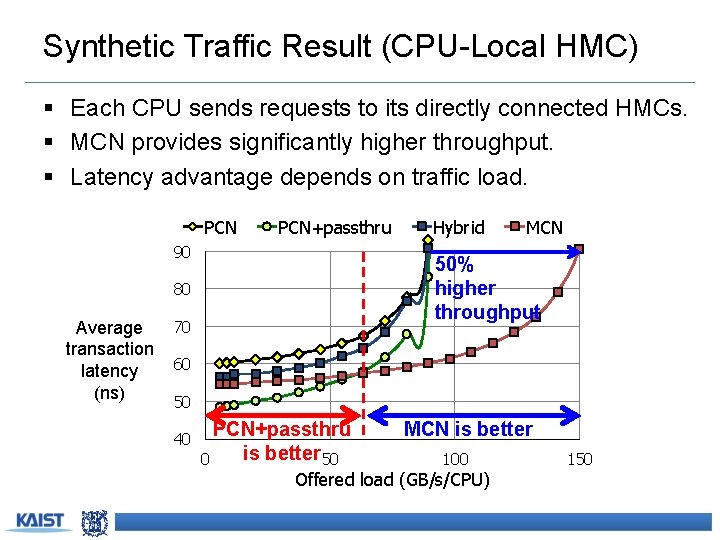
Synthetic Traffic Result (CPU-Local HMC) § Each CPU sends requests to its directly connected HMCs. § MCN provides significantly higher throughput. § Latency advantage depends on traffic load. PCN+passthru 90 MCN 50% higher throughput 80 Average transaction latency (ns) Hybrid 70 60 50 40 PCN+passthru is better 50 0 MCN is better 100 Offered load (GB/s/CPU) 150
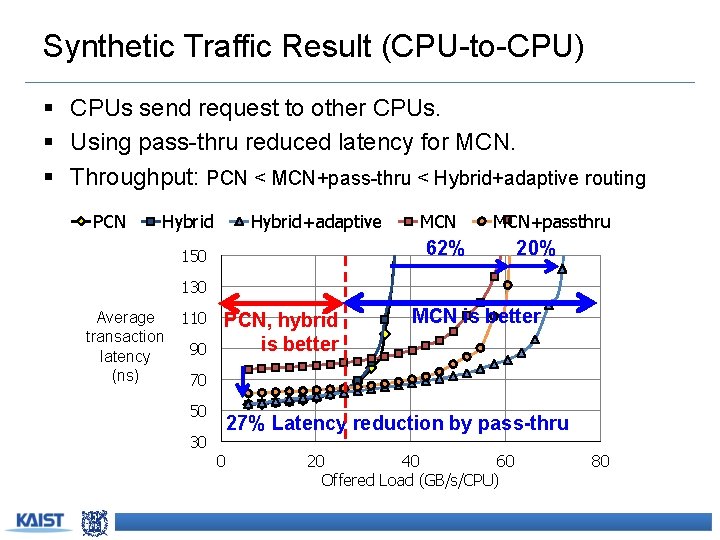
Synthetic Traffic Result (CPU-to-CPU) § CPUs send request to other CPUs. § Using pass-thru reduced latency for MCN. § Throughput: PCN < MCN+pass-thru < Hybrid+adaptive routing PCN Hybrid+adaptive MCN+passthru 62% 150 20% 130 Average transaction latency (ns) 110 90 PCN, hybrid is better MCN is better 70 50 27% Latency reduction by pass-thru 30 0 20 40 60 Offered Load (GB/s/CPU) 80
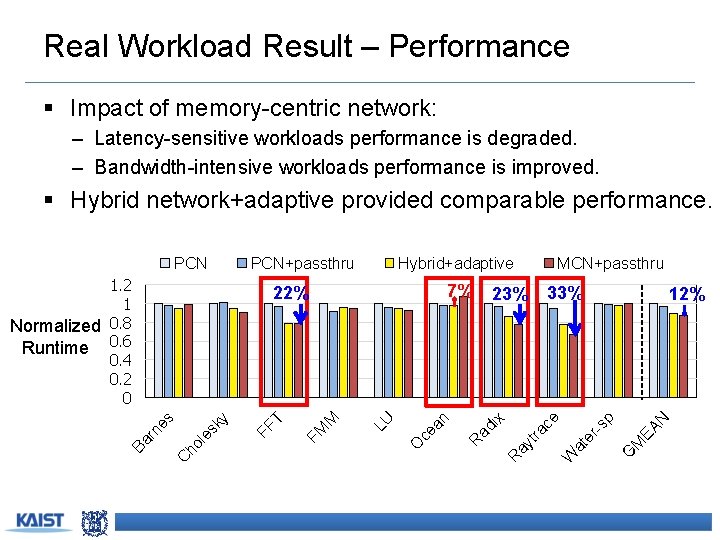
Real Workload Result – Performance § Impact of memory-centric network: – Latency-sensitive workloads performance is degraded. – Bandwidth-intensive workloads performance is improved. § Hybrid network+adaptive provided comparable performance. Hybrid+adaptive 33% M er at EA -s N p ce tra ay 12% G 23% R ce an O LU M FM T FF sk y ho le C rn es Ba MCN+passthru W 7% 22% ad ix 1. 2 1 Normalized 0. 8 Runtime 0. 6 0. 4 0. 2 0 PCN+passthru R PCN
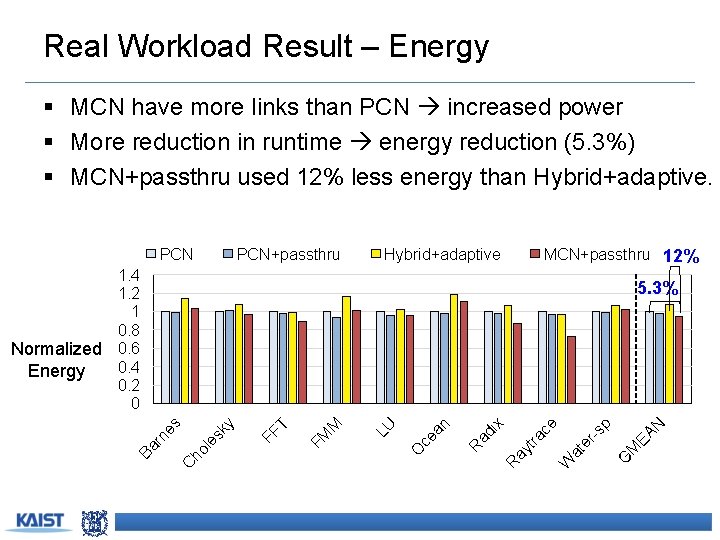
Real Workload Result – Energy § MCN have more links than PCN increased power § More reduction in runtime energy reduction (5. 3%) § MCN+passthru used 12% less energy than Hybrid+adaptive. PCN+passthru Hybrid+adaptive MCN+passthru 12% 1. 4 1. 2 1 0. 8 Normalized 0. 6 0. 4 Energy 0. 2 0 G M EA -s W at er tra ay R N p ce ix ad R ce an O LU M FM T FF sk y ho le C Ba rn es 5. 3%
Conclusions § Hybrid Memory Cubes (HMC) enable new opportunities for a “memory network” in system interconnect. § Distributor-based network proposed to reduce network diameter and efficiently utilize processor bandwidth § To improve network performance: – Latency : Pass-through uarch to minimize per-hop latency – Throughput : Exploit adaptive (non-minimal) routing § Intra-HMC network is another network that needs to be properly considered.
- Slides: 25