
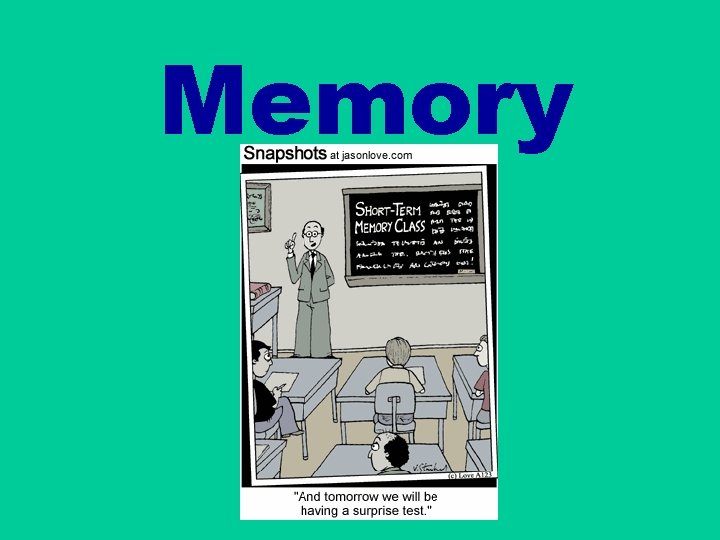
Memory What is memory The persistence of learning




































- Slides: 99
Memory
What is memory? The persistence of learning over time via storage and retrieval of information
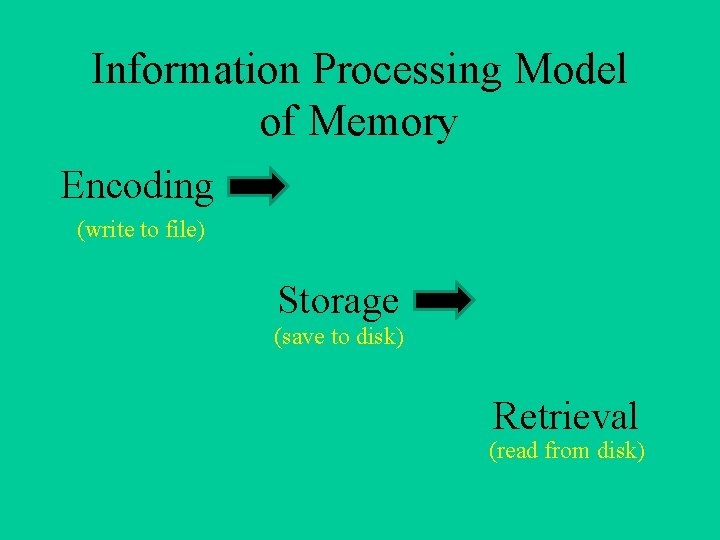
Information Processing Model of Memory Encoding (write to file) Storage (save to disk) Retrieval (read from disk)
Information Processing Model of Memory • Encoding – Processing information into the memory system (i. e. , extracting meaning) • Automatic vs. Effortful processing • Visual encoding – Encoding of picture images • Acoustic encoding – Encoding of sound (esp. of words) • Semantic encoding – Encoding of meaning (esp. of words) (#1)
Information Processing Model of Memory • Storage – The retention of encoded information over time • Retrieval – Process of getting information out of memory
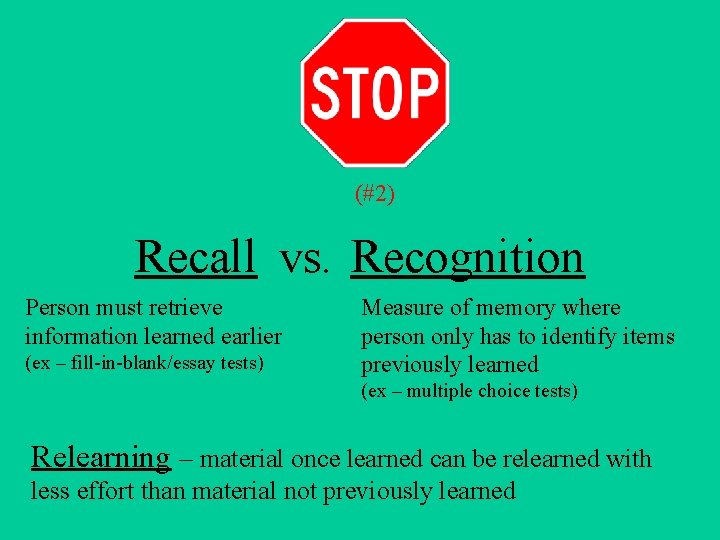
(#2) Recall vs. Recognition Person must retrieve information learned earlier (ex – fill-in-blank/essay tests) Measure of memory where person only has to identify items previously learned (ex – multiple choice tests) Relearning – material once learned can be relearned with less effort than material not previously learned
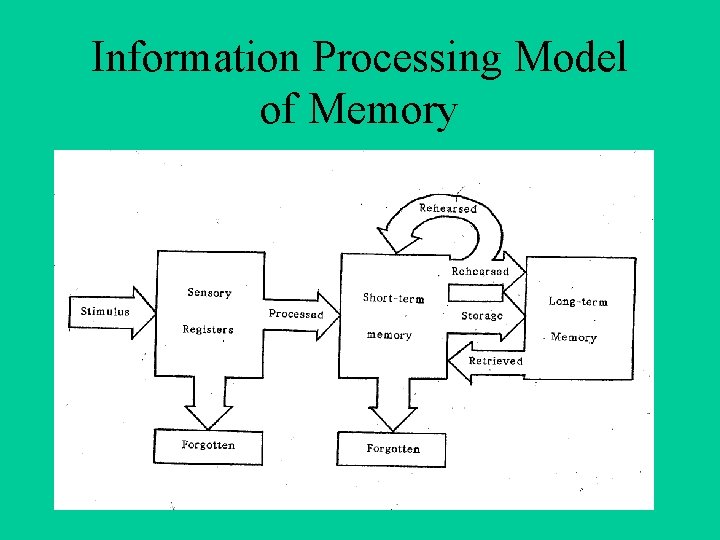
Information Processing Model of Memory
Information Processing Model of Memory • Sensory Register • Immediate, initial recording of sensory info in memory system – info is either processed or lost – Iconic • Visual – eyes register exact representation of scene in amazing, but fleeting detail (lasts ~ ¼ sec. ) (#3) – Eidetic – “photographic” memory (#4) – Echoic • Auditory – hold for 3 -6 sec.
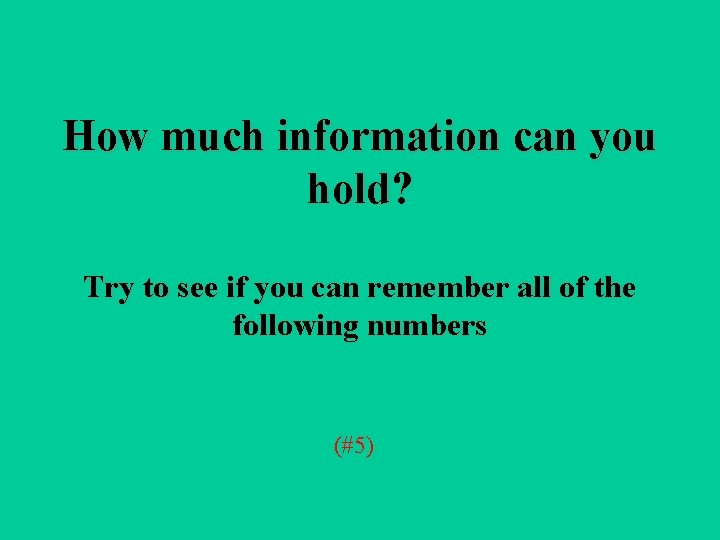
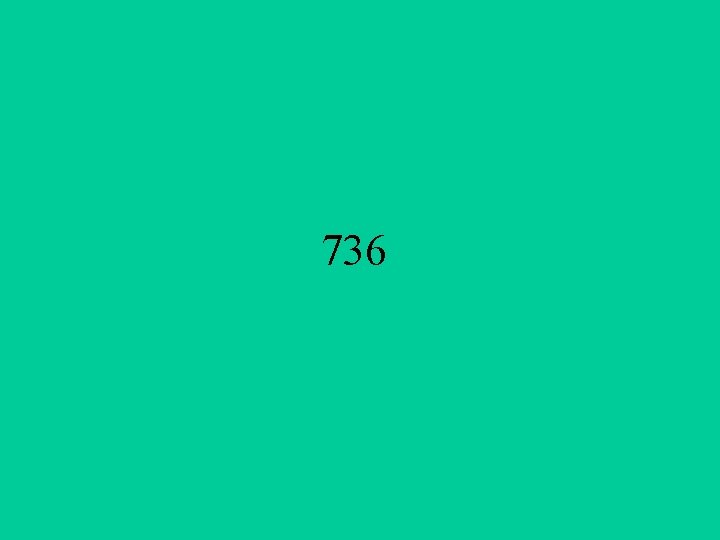
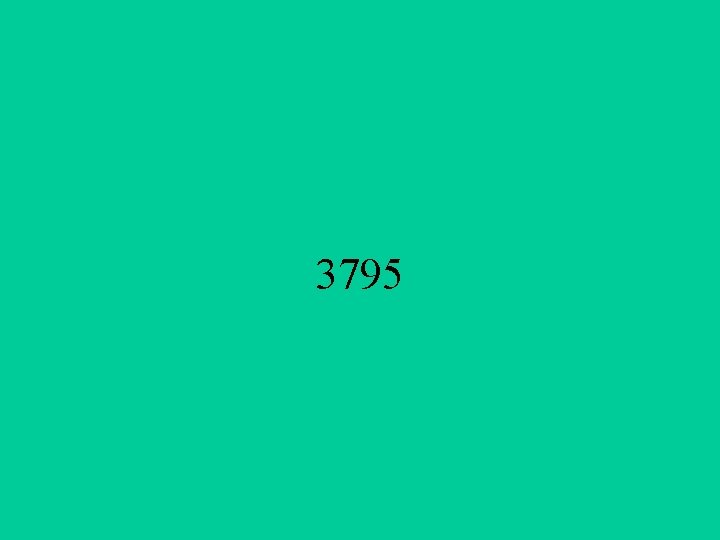
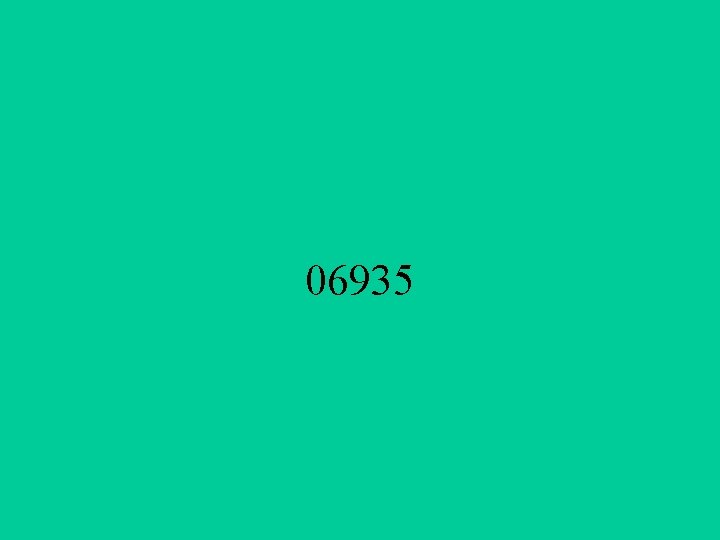
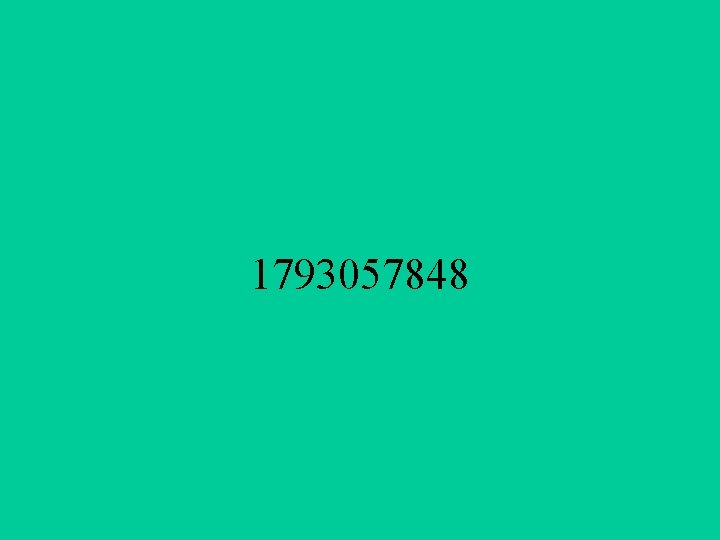
How much information can you hold? Try to see if you can remember all of the following numbers (#5)
736
3795
06935
759354
8340385
02148594
395076395
1793057848
Information Processing Model of Memory • Short Term Memory (STM) – a. k. a. – “working memory” – Limited capacity, but very accurate type of memory that lasts from a few seconds to ~ ½ min. • “Magic number” 7+/-2 – Varies by individual • Rehearsal – conscious repetition » Ex. – phone number – maintain in consciousness – encode for storage or will be forgotten » Ebbinghaus – nonsense syllables & relearning
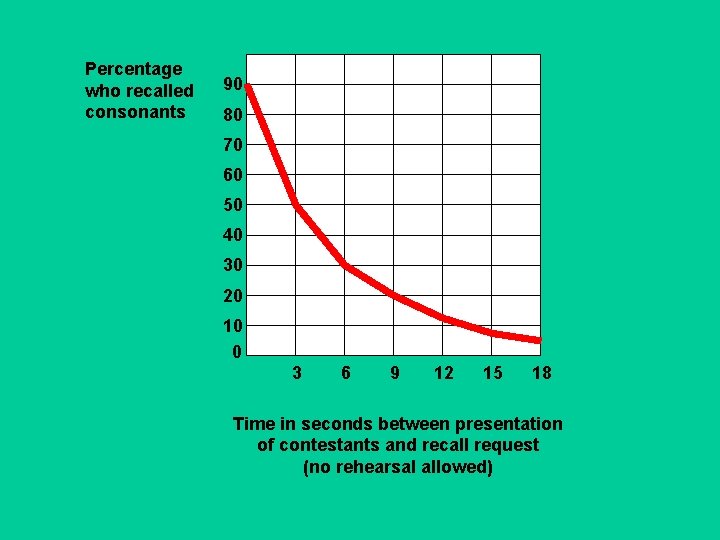
Percentage who recalled consonants 90 80 70 60 50 40 30 20 10 0 3 6 9 12 15 18 Time in seconds between presentation of contestants and recall request (no rehearsal allowed)
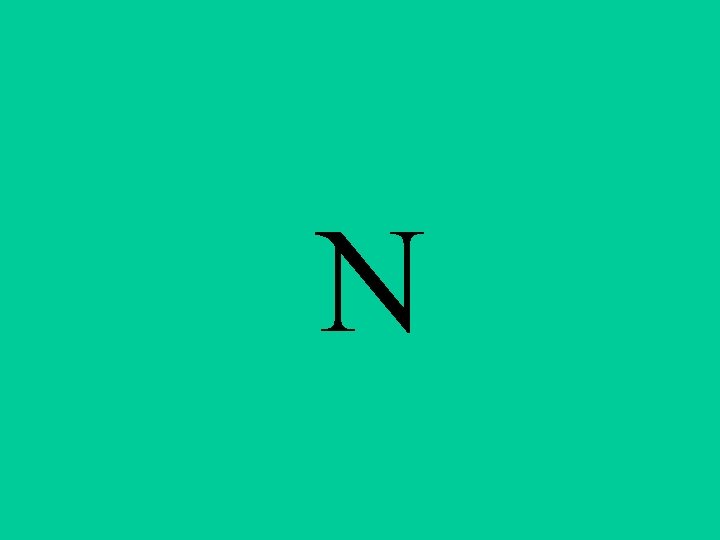
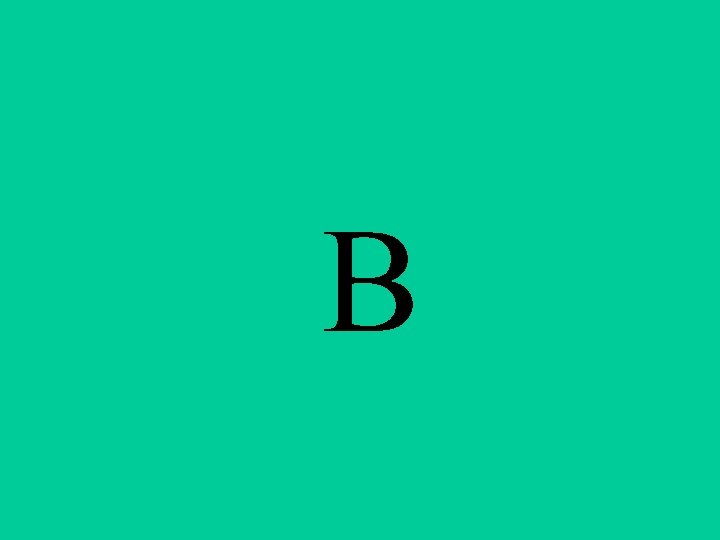
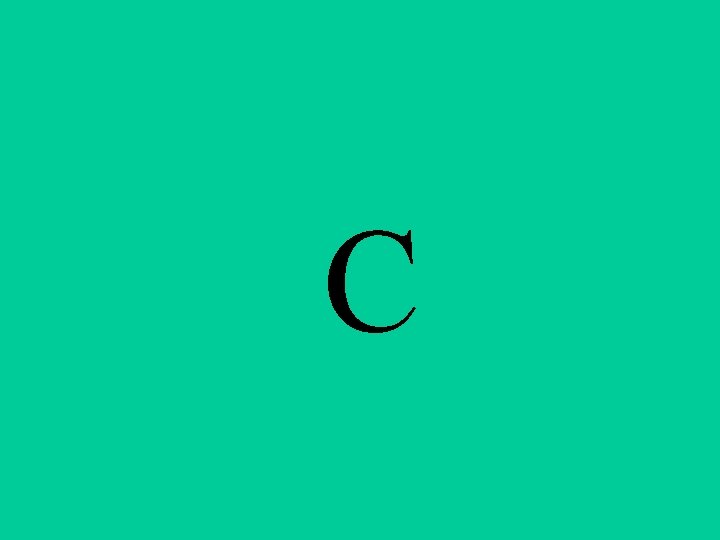
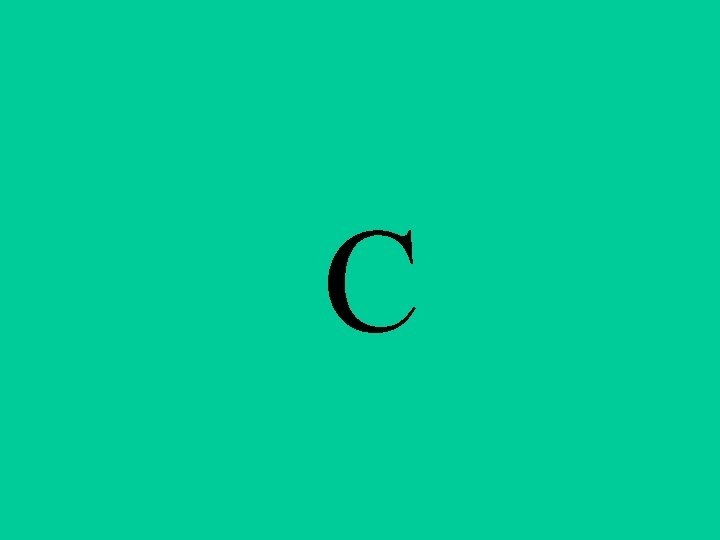
Yet another memory test Try to remember as much as possible of the following long string of letters. When I give you the cue, see how many you can write down. (Test #7)
N
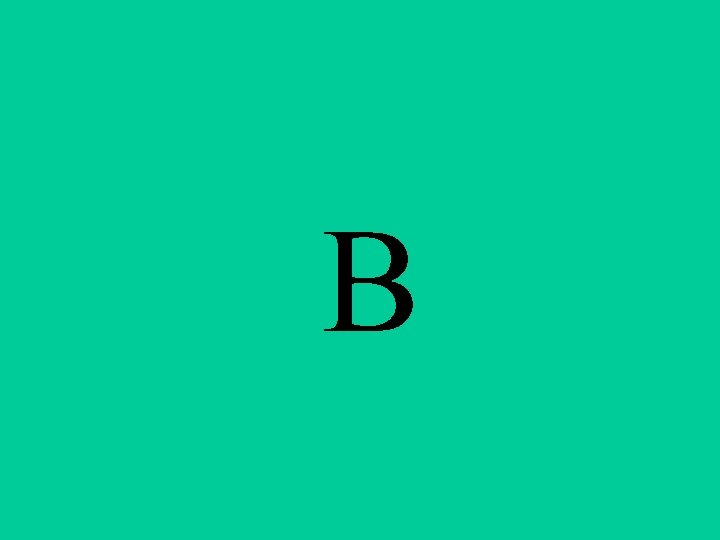
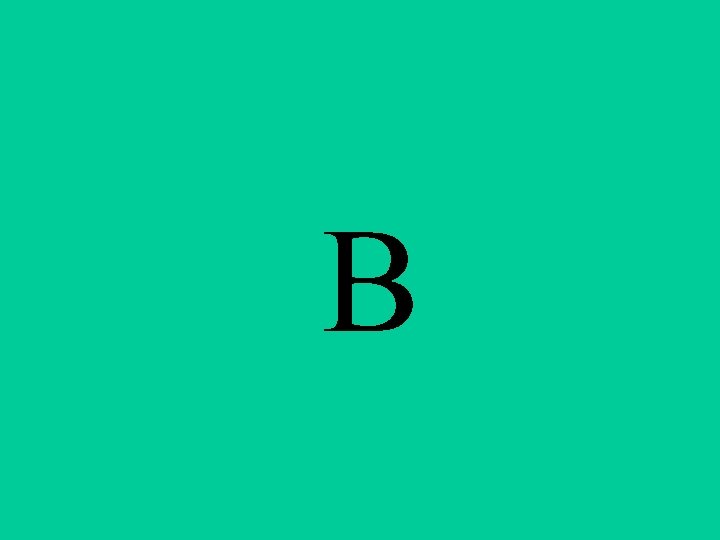
B
C
C
I
A
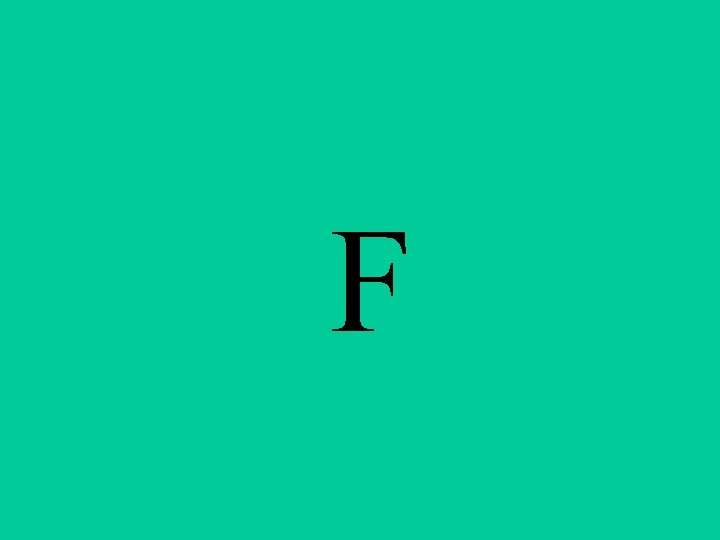
F
B
I
P
B
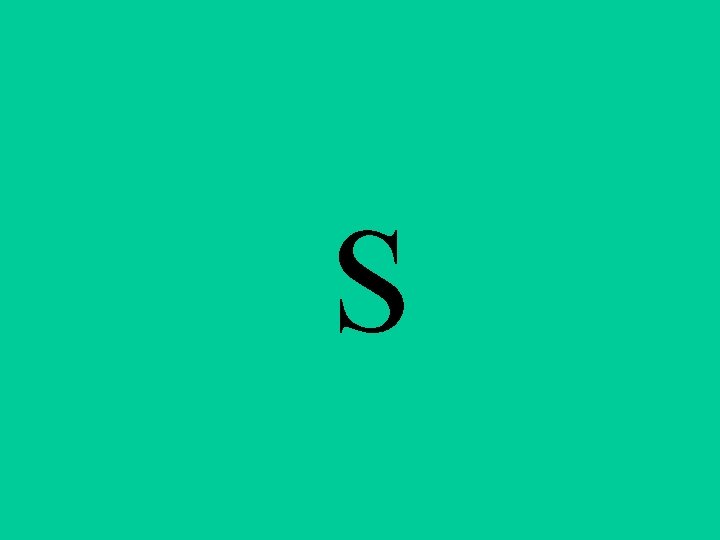
S
Write down what you remember.
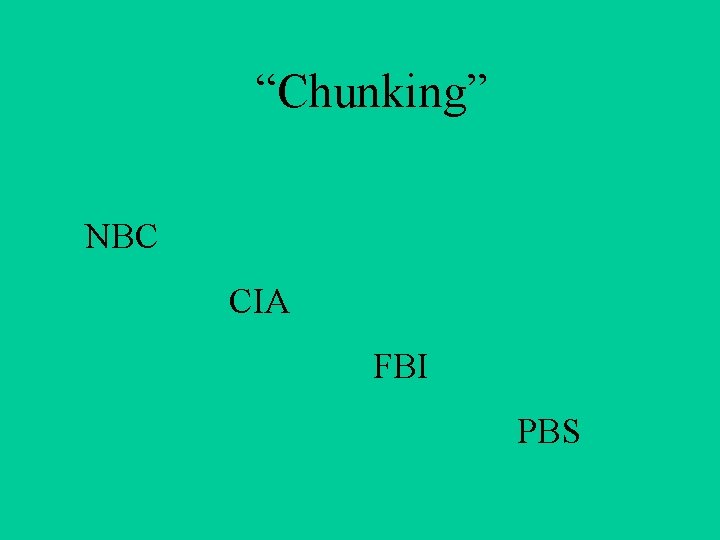
“Chunking” NBC CIA FBI PBS
Serial Position Test Listen to the list of words that I will read aloud. When I give you the cue, try to write down as many as you can remember. (#6)
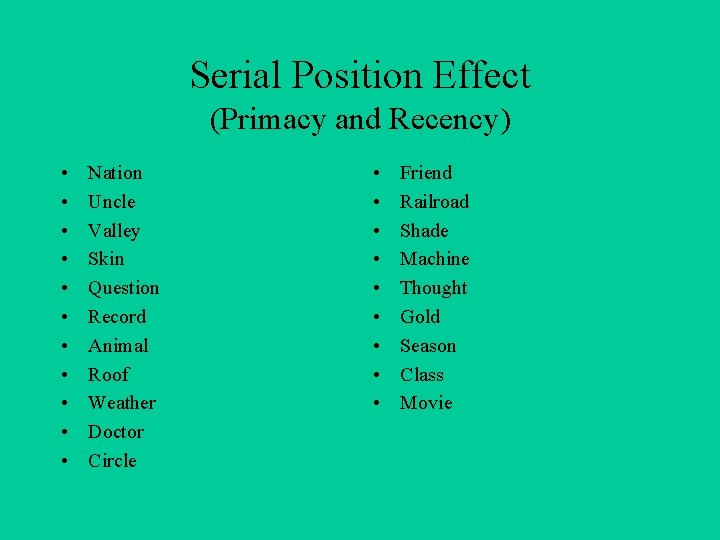
Serial Position Effect (Primacy and Recency) • • • Nation Uncle Valley Skin Question Record Animal Roof Weather Doctor Circle • • • Friend Railroad Shade Machine Thought Gold Season Class Movie
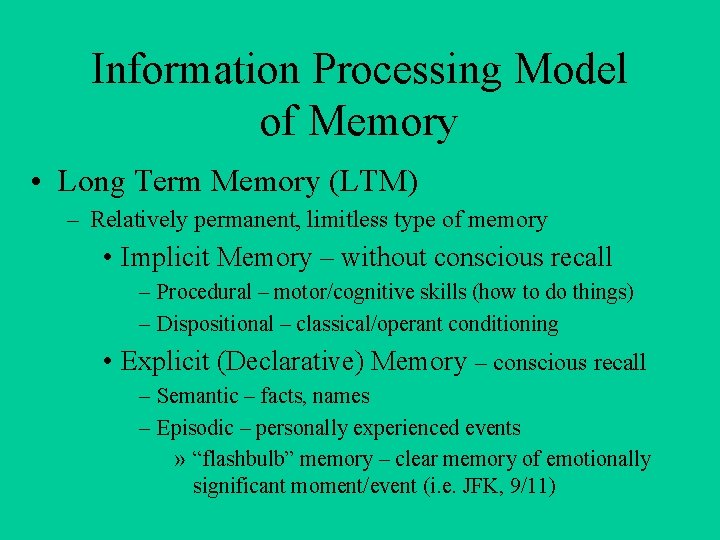
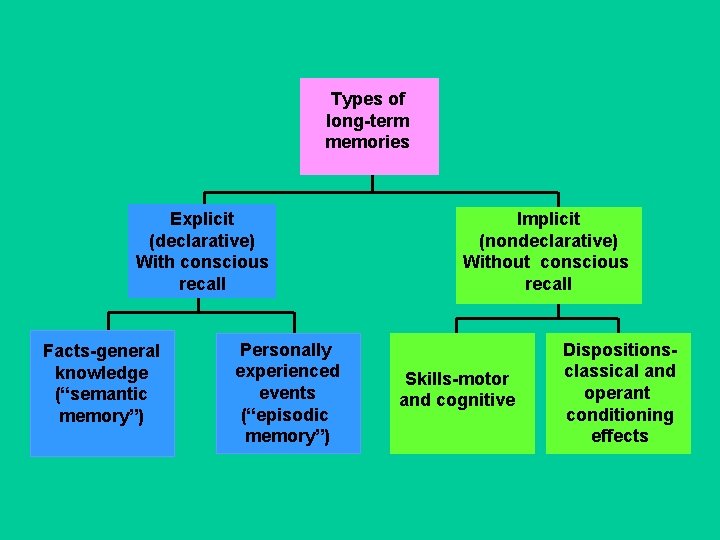
Information Processing Model of Memory • Long Term Memory (LTM) – Relatively permanent, limitless type of memory • Implicit Memory – without conscious recall – Procedural – motor/cognitive skills (how to do things) – Dispositional – classical/operant conditioning • Explicit (Declarative) Memory – conscious recall – Semantic – facts, names – Episodic – personally experienced events » “flashbulb” memory – clear memory of emotionally significant moment/event (i. e. JFK, 9/11)
Types of long-term memories Explicit (declarative) With conscious recall Facts-general knowledge (“semantic memory”) Personally experienced events (“episodic memory”) Implicit (nondeclarative) Without conscious recall Skills-motor and cognitive Dispositionsclassical and operant conditioning effects
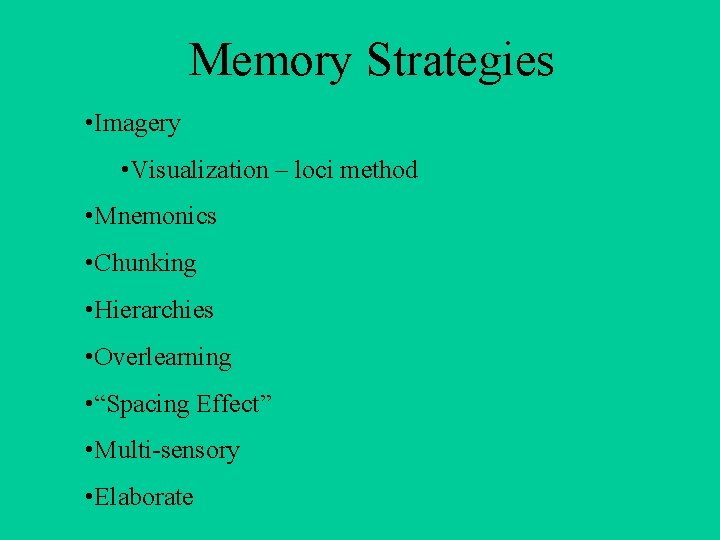
Memory Strategies • Imagery • Visualization – loci method • Mnemonics • Chunking • Hierarchies • Overlearning • “Spacing Effect” • Multi-sensory • Elaborate
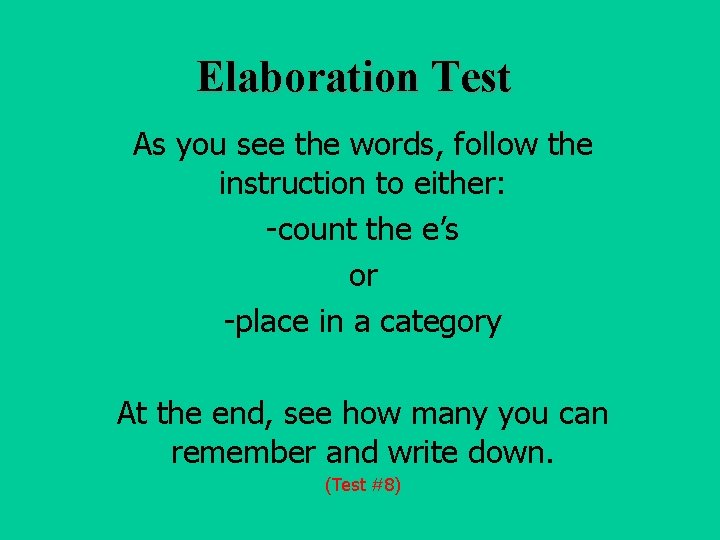
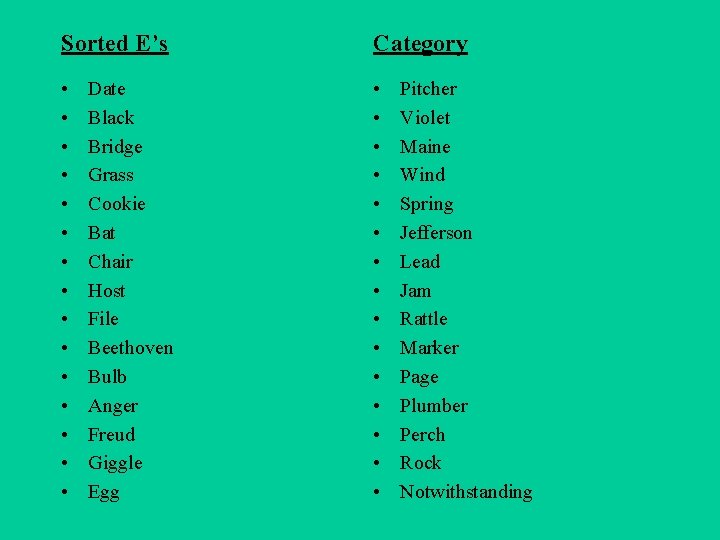
Elaboration Test As you see the words, follow the instruction to either: -count the e’s or -place in a category At the end, see how many you can remember and write down. (Test #8)
Date
Pitcher
Violet
Black
Maine
Wind
Spring
Bridge
Jefferson
Lead
Jam
Rattle
Grass
Marker
Page
Cookie
Bat
Plumber
Chair
Perch
Host
File
Beethoven
Bulb
Rock
Anger
Freud
Giggle
Egg
Notwithstanding
Sorted E’s Category • • • • • • • • Date Black Bridge Grass Cookie Bat Chair Host File Beethoven Bulb Anger Freud Giggle Egg Pitcher Violet Maine Wind Spring Jefferson Lead Jam Rattle Marker Page Plumber Perch Rock Notwithstanding
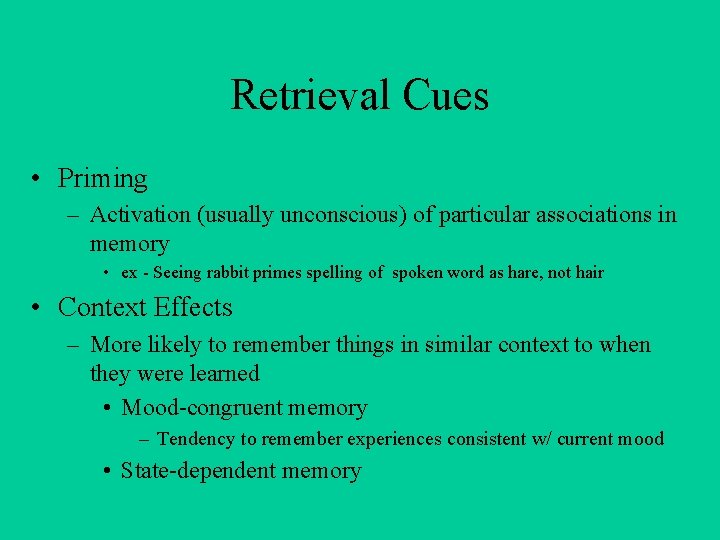
Retrieval Cues • Priming – Activation (usually unconscious) of particular associations in memory • ex - Seeing rabbit primes spelling of spoken word as hare, not hair • Context Effects – More likely to remember things in similar context to when they were learned • Mood-congruent memory – Tendency to remember experiences consistent w/ current mood • State-dependent memory
How about another memory test? I will read a list of words aloud. Try to remember as many of the words as possible and write them down when I give the cue. (#9)
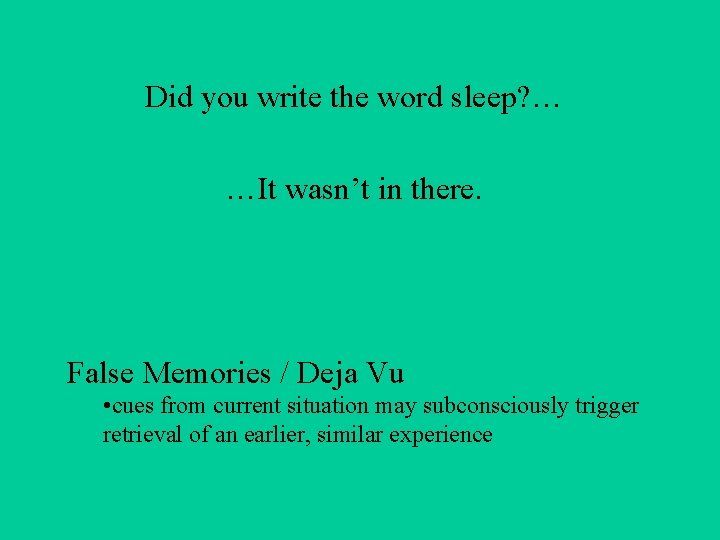
Did you write the word sleep? … …It wasn’t in there. False Memories / Deja Vu • cues from current situation may subconsciously trigger retrieval of an earlier, similar experience
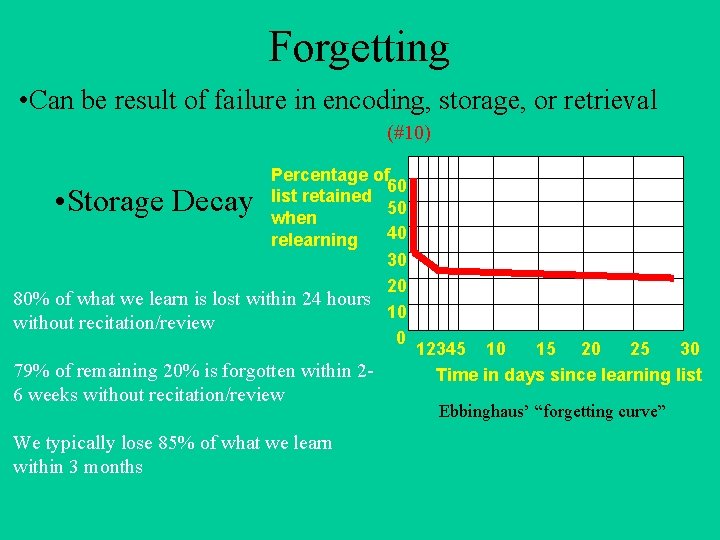
Forgetting • Can be result of failure in encoding, storage, or retrieval (#10) Percentage of 60 list retained 50 when 40 relearning 30 20 80% of what we learn is lost within 24 hours 10 without recitation/review 0 • Storage Decay 79% of remaining 20% is forgotten within 26 weeks without recitation/review We typically lose 85% of what we learn within 3 months 12345 10 15 20 25 30 Time in days since learning list Ebbinghaus’ “forgetting curve”
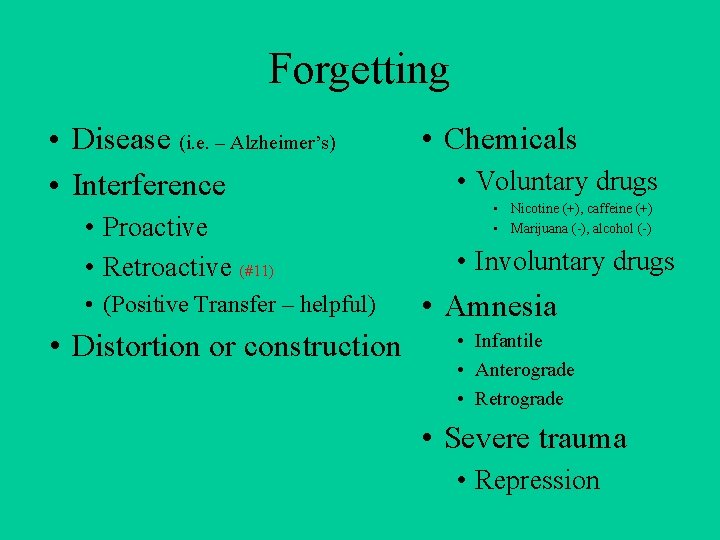
Forgetting • Disease (i. e. – Alzheimer’s) • Interference • Proactive • Retroactive (#11) • (Positive Transfer – helpful) • Distortion or construction • Chemicals • Voluntary drugs • Nicotine (+), caffeine (+) • Marijuana (-), alcohol (-) • Involuntary drugs • Amnesia • Infantile • Anterograde • Retrograde • Severe trauma • Repression