
Memory sensory and working memory Psychology ATAR Unit
- Slides: 21
Memory: sensory and working memory Psychology ATAR Unit 3 Chapter 11 pg. 260 -264 Chapter 14 pg. 340 -341
Memory
Memory systems Until recently, memory has been compared to a computer and defined by an informationprocessing model. In this model there are 3 stages: Encoding, storage & retrieval
Memory systems Encoding Information is changed from raw sensory data into a usable form that the brain can process Information is encoded visually, acoustically or semantically (word meaning) Storage The retention of information in the brain’s neural pathways Retrieval Information is retrieved/ taken out of storage when needed
Memory systems Atkinson and Shiffrin (1968) elaborated on this model and proposed that information goes through three stages: 1. Sensory memory 2. Short-term memory 3. Long-term memory Today, researchers have integrated these ideas and suggest that memory is created by a collection of systems, working interdependently. There is no one portion of the brain solely responsible for all memory, though there are certain regions related to specific memory sub-systems.
Multi-store model �Memory is made up of multiple systems that interact with each other. �Each memory system can also work independently. �Each system differs in function, capacity and duration.
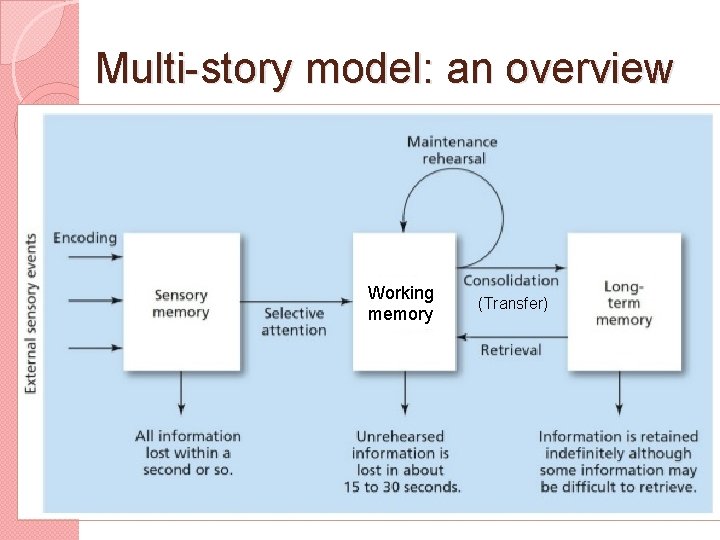
Multi-story model: an overview Working memory (Transfer)
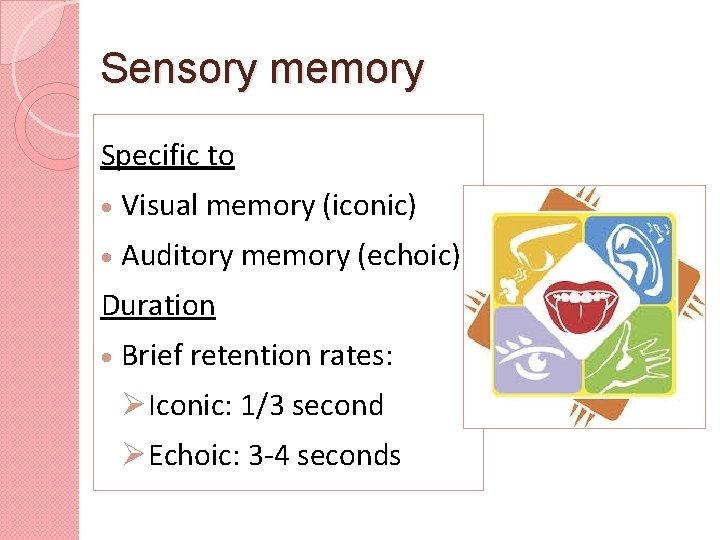
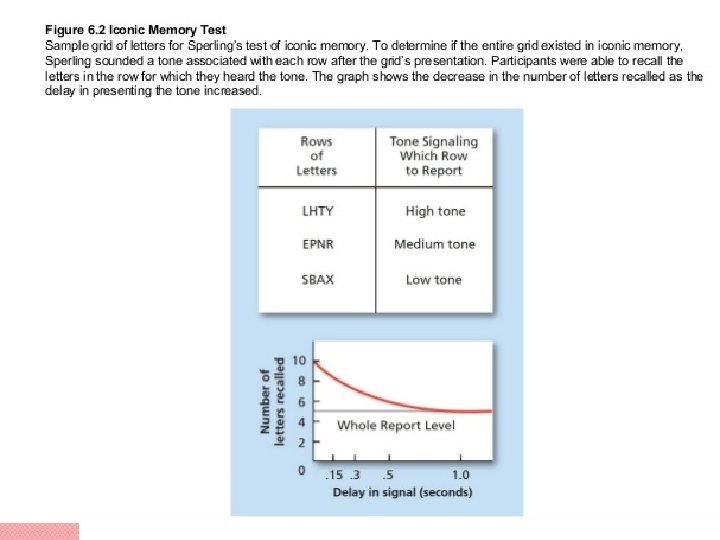
Sensory memory Specific to Visual memory (iconic) Auditory memory (echoic) Duration Brief retention rates: ØIconic: 1/3 second ØEchoic: 3 -4 seconds
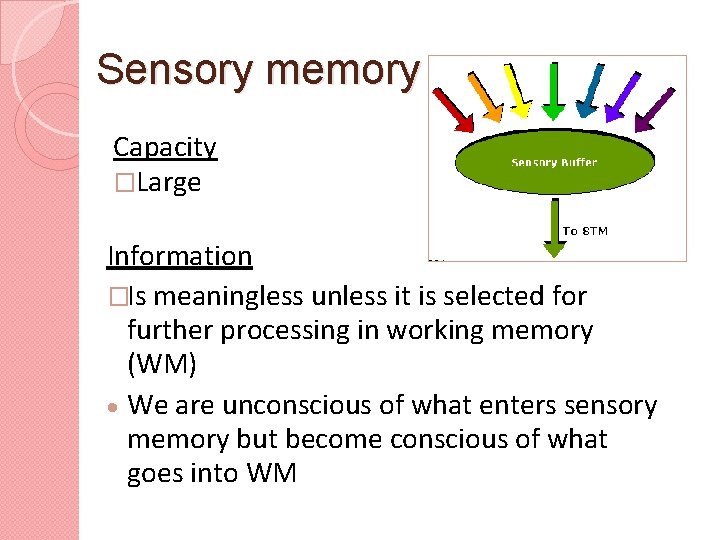
Sensory memory Capacity �Large Information �Is meaningless unless it is selected for further processing in working memory (WM) We are unconscious of what enters sensory memory but become conscious of what goes into WM
Working memory A short term memory system used to store and process the information that we are currently thinking about. Duration Stores information longer than sensory memory: ØLasts about 18 seconds Capacity �Small – 7 plus or minus 2 items (Miller, 1956)
Working memory Information Can be retained longer if it is reviewed and repeated consciously – information is encoded accoustically (sound) Imagining, problem solving, analysis, reasoning, comprehending, planning Chunking can increase WM capacity ie. looking for patterns or grouping information Examples Ø When we read we hold the first words in WM while we process the rest of the sentence Ø We also use it in mental maths e. g. 5+7+12=?
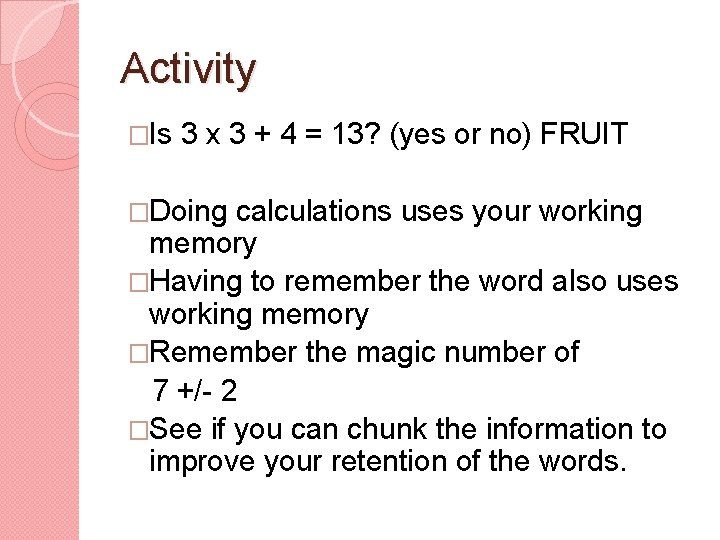
Activity �Is 3 x 3 + 4 = 13? (yes or no) FRUIT �Doing calculations uses your working memory �Having to remember the word also uses working memory �Remember the magic number of 7 +/- 2 �See if you can chunk the information to improve your retention of the words.
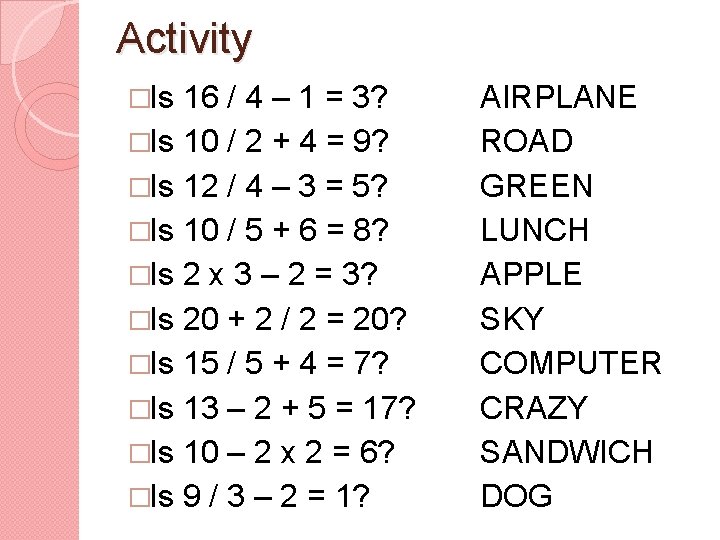
Activity �Is 16 / 4 – 1 = 3? �Is 10 / 2 + 4 = 9? �Is 12 / 4 – 3 = 5? �Is 10 / 5 + 6 = 8? �Is 2 x 3 – 2 = 3? �Is 20 + 2 / 2 = 20? �Is 15 / 5 + 4 = 7? �Is 13 – 2 + 5 = 17? �Is 10 – 2 x 2 = 6? �Is 9 / 3 – 2 = 1? AIRPLANE ROAD GREEN LUNCH APPLE SKY COMPUTER CRAZY SANDWICH DOG
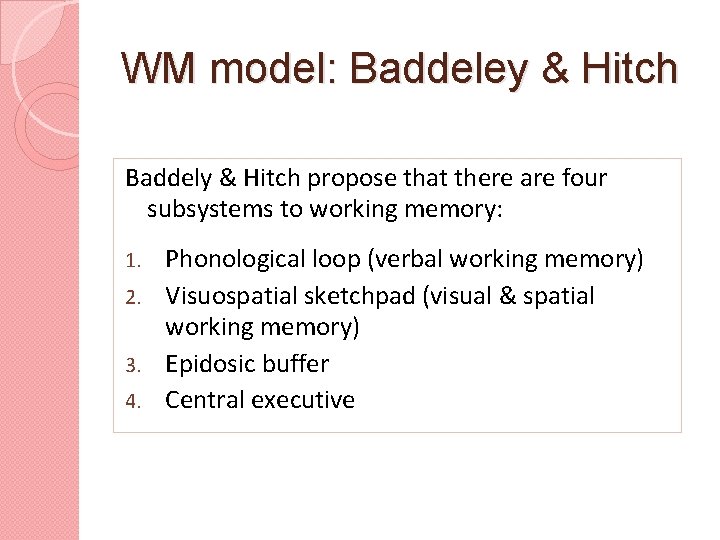
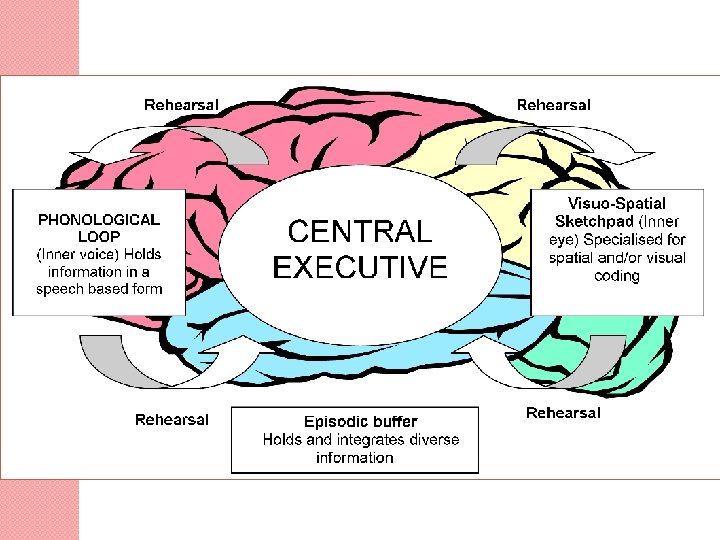
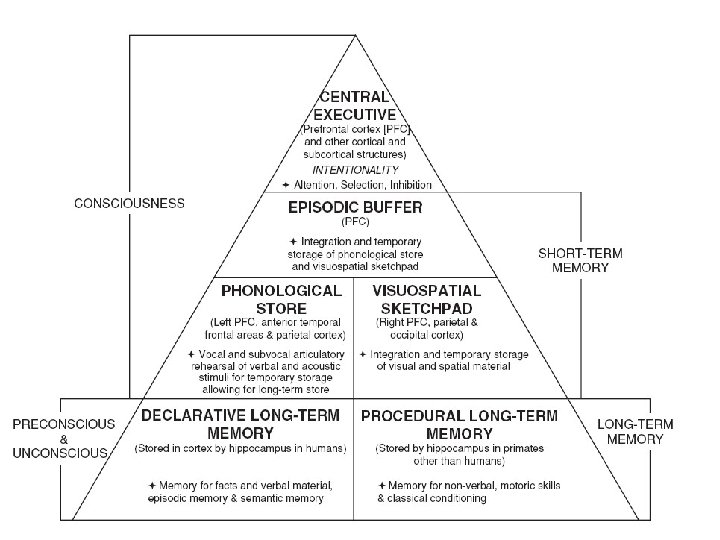
WM model: Baddeley & Hitch Baddely & Hitch propose that there are four subsystems to working memory: Phonological loop (verbal working memory) 2. Visuospatial sketchpad (visual & spatial working memory) 3. Epidosic buffer 4. Central executive 1.
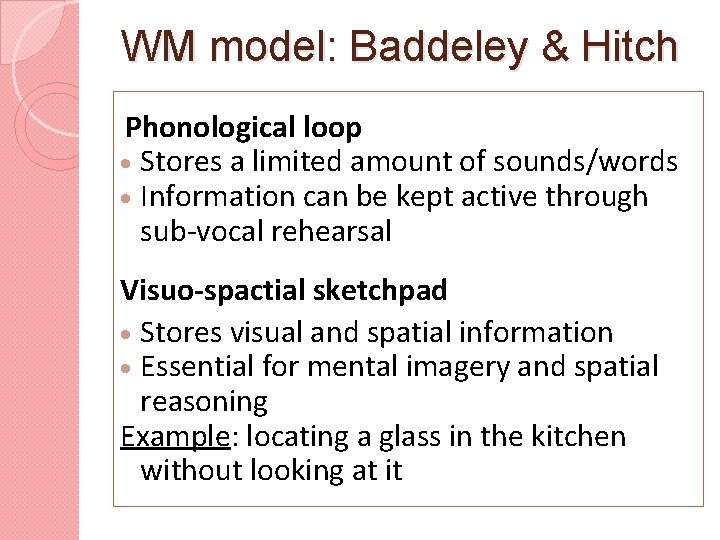
WM model: Baddeley & Hitch Phonological loop Stores a limited amount of sounds/words Information can be kept active through sub-vocal rehearsal Visuo-spactial sketchpad Stores visual and spatial information Essential for mental imagery and spatial reasoning Example: locating a glass in the kitchen without looking at it
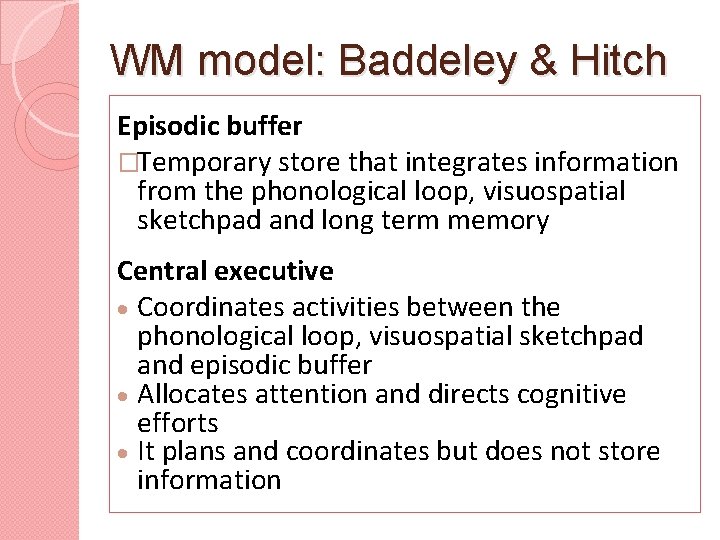
WM model: Baddeley & Hitch Episodic buffer �Temporary store that integrates information from the phonological loop, visuospatial sketchpad and long term memory Central executive Coordinates activities between the phonological loop, visuospatial sketchpad and episodic buffer Allocates attention and directs cognitive efforts It plans and coordinates but does not store information
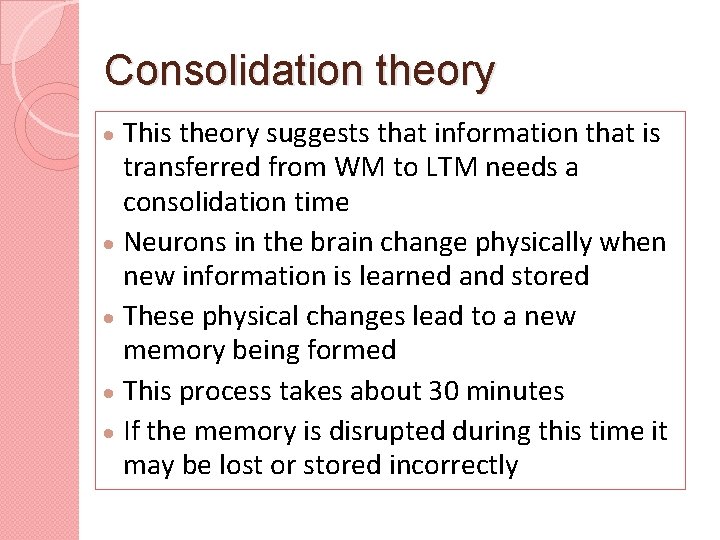
Consolidation theory This theory suggests that information that is transferred from WM to LTM needs a consolidation time Neurons in the brain change physically when new information is learned and stored These physical changes lead to a new memory being formed This process takes about 30 minutes If the memory is disrupted during this time it may be lost or stored incorrectly
Interaction between WM & LTM Serial position effect �The effect of an item’s position in the list on how well it is recalled. �In a long list of items, the first and last items are remembered best Primacy effect �First items on a list receive more rehearsal and are more likely to be transferred to long term memory (LTM) Recency effect �The last items are remembered because they are still in the person’s working memory