
Memory safety continued again With material from Mike
- Slides: 27
Memory safety, continued again With material from Mike Hicks, Dave Levin and Michelle Mazurek http: //images. myhardhatstickers. com/img/lg/H/Everybody-Safety-Hard-Ha
Last time • Buffer Overflows • Other memory attacks
Today • Principled defenses • Avoiding exploitation – Memory violations possible but not harmful
Time to switch hats We have seen many styles of attack How can we defend against them?
Defenses Against memory and buffer attacks http: //www. full-stop. net/wp-content/uploads/2012/05/Grea
Stepping back What do these attacks have in common? 1. The attacker is able to control some data that is used by the program 2. The use of that data permits unintentional access to some memory area in the program – Past a buffer – To arbitrary positions on the stack / in the heap
Outline • Memory safety and type safety – Properties that, if satisfied, ensure an application is immune to memory attacks • Automatic defenses –Stack canaries – Address space layout randomization (ASLR) • Return-oriented programming (ROP) attack – How Control Flow Integrity (CFI) can defeat it • Secure coding
Memory Safety https: //diarrheapolice. files. wordpress. com/2015/08/elephant-bicycle-never-forge
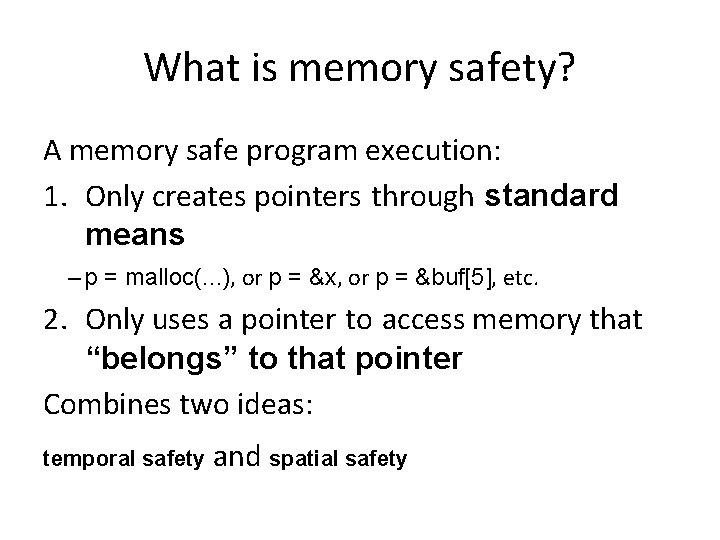
What is memory safety? A memory safe program execution: 1. Only creates pointers through standard means – p = malloc(. . . ), or p = &x, or p = &buf[5], etc. 2. Only uses a pointer to access memory that “belongs” to that pointer Combines two ideas: temporal safety and spatial safety
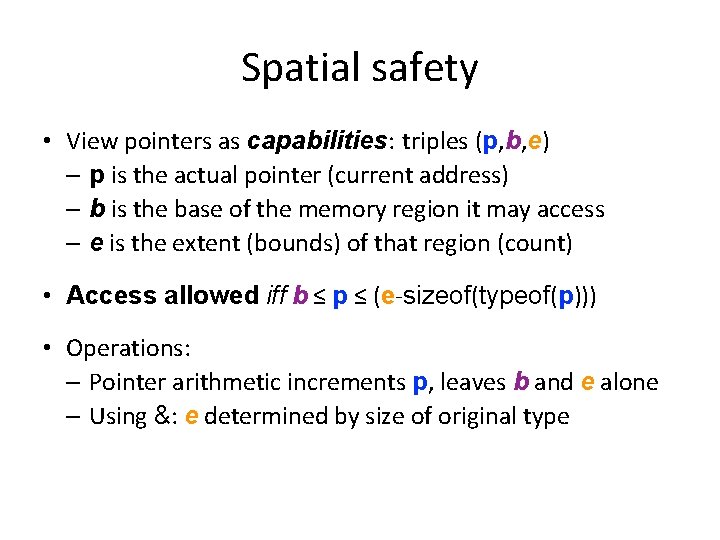
Spatial safety • View pointers as capabilities: triples (p, b, e) – p is the actual pointer (current address) – b is the base of the memory region it may access – e is the extent (bounds) of that region (count) • Access allowed iff b ≤ p ≤ (e-sizeof(typeof(p))) • Operations: – Pointer arithmetic increments p, leaves b and e alone – Using &: e determined by size of original type
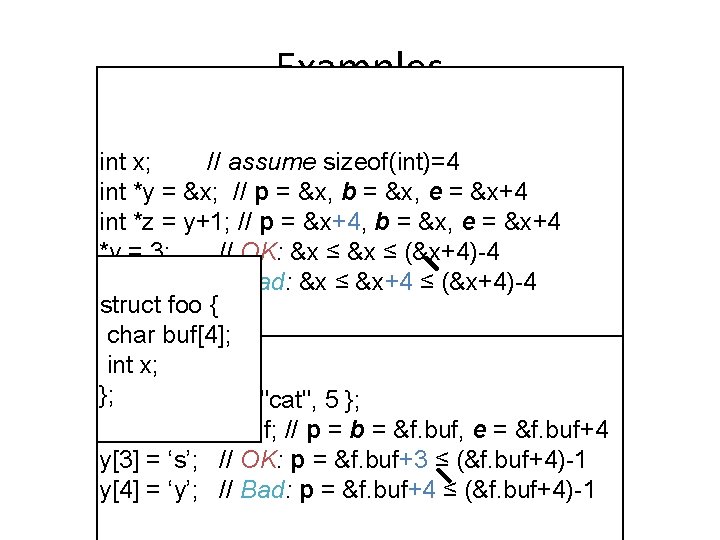
Examples int x; // assume sizeof(int)=4 int *y = &x; // p = &x, b = &x, e = &x+4 int *z = y+1; // p = &x+4, b = &x, e = &x+4 *y = 3; // OK: &x ≤ (&x+4)-4 *z = 3; // Bad: &x ≤ &x+4 ≤ (&x+4)-4 struct foo { char buf[4]; int x; }; struct foo f = { "cat", 5 }; char *y = &f. buf; // p = b = &f. buf, e = &f. buf+4 y[3] = ‘s’; // OK: p = &f. buf+3 ≤ (&f. buf+4)-1 y[4] = ‘y’; // Bad: p = &f. buf+4 ≤ (&f. buf+4)-1
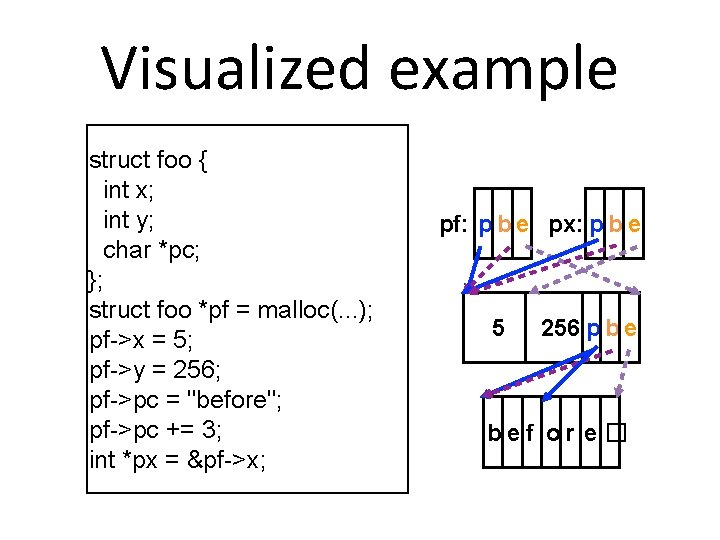
Visualized example struct foo { int x; int y; char *pc; }; struct foo *pf = malloc(. . . ); pf->x = 5; pf->y = 256; pf->pc = "before"; pf->pc += 3; int *px = &pf->x; pf: p b e px: p b e 5 256 p b e bef or e �
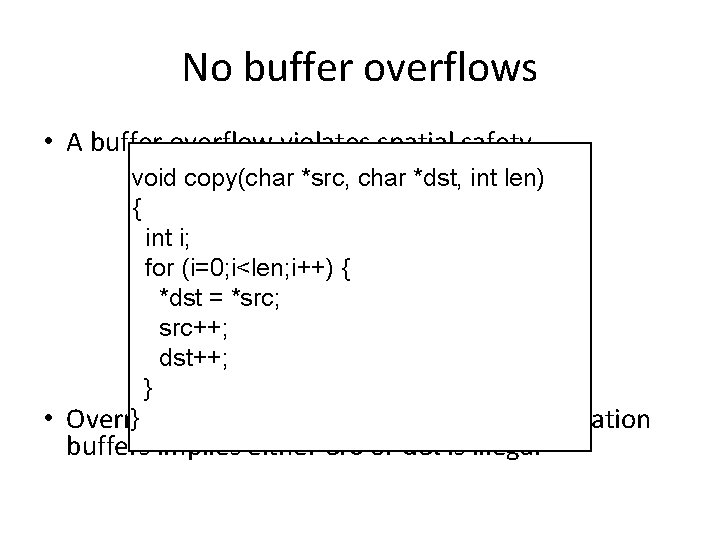
No buffer overflows • A buffer overflow violates spatial safety void copy(char *src, char *dst, int len) { int i; for (i=0; i<len; i++) { *dst = *src; src++; dst++; } } • Overrunning bounds of source and/or destination buffers implies either src or dst is illegal
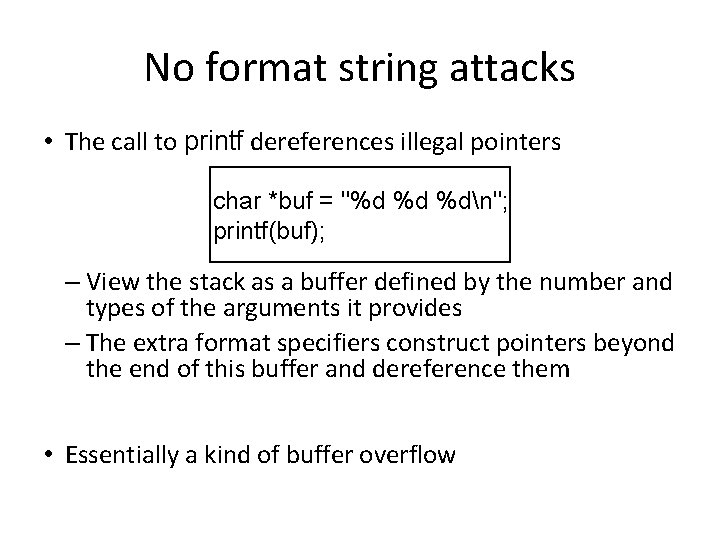
No format string attacks • The call to printf dereferences illegal pointers char *buf = "%d %d %dn"; printf(buf); – View the stack as a buffer defined by the number and types of the arguments it provides – The extra format specifiers construct pointers beyond the end of this buffer and dereference them • Essentially a kind of buffer overflow
Temporal safety • Violated when trying to access undefined memory – Spatial safety assures it was to a legal region – Temporal safety assures that region is still in play • Memory regions either defined or undefined – Defined means allocated (and active) – Undefined means unallocated, uninitialized, or deallocated • Pretend memory is infinitely large, no reuse
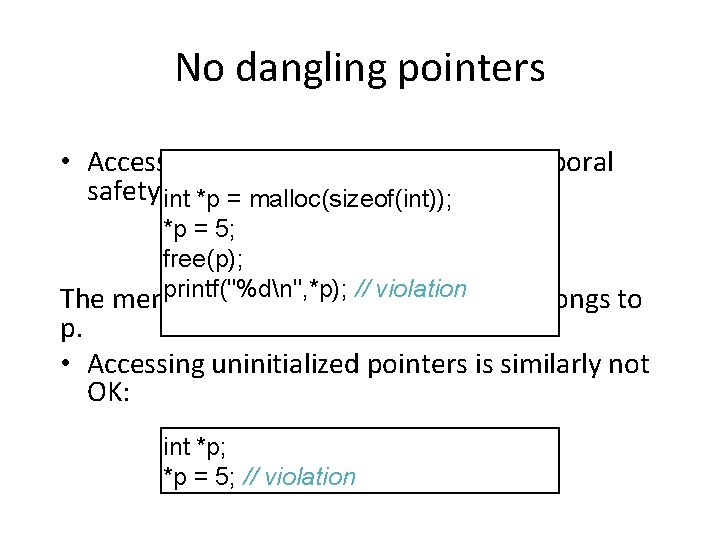
No dangling pointers • Accessing a freed pointer violates temporal safety int *p = malloc(sizeof(int)); *p = 5; free(p); printf("%dn", *p); // violation The memory dereferenced no longer belongs to p. • Accessing uninitialized pointers is similarly not OK: int *p; *p = 5; // violation
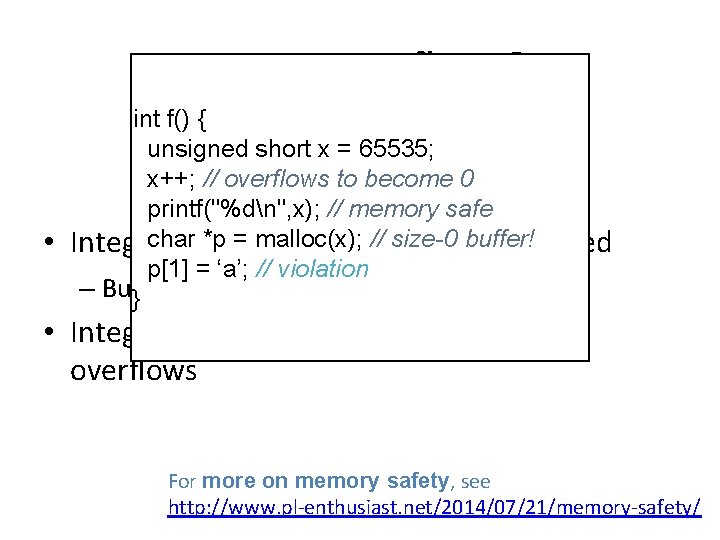
Integer overflows? • int f() { unsigned short x = 65535; x++; // overflows to become 0 printf("%dn", x); // memory safe char *p = malloc(x); // size-0 buffer! Integer overflows are themselves allowed p[1] = ‘a’; // violation – But} can’t become illegal pointers • Integer overflows often enable buffer overflows For more on memory safety, see http: //www. pl-enthusiast. net/2014/07/21/memory-safety/
How to get memory safety? • The easiest way to avoid all of these vulnerabilities is to use a memory-safe language • Modern languages are memory safe – Java, Python, C#, Ruby – Haskell, Scala, Go, Objective Caml, Rust • In fact, these languages are type safe, which is even better (more on this shortly)
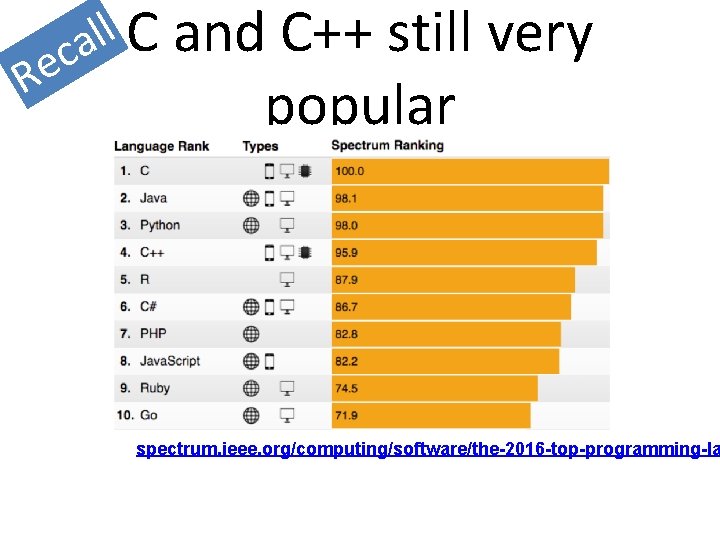
Re l l C and C++ still very a c popular spectrum. ieee. org/computing/software/the-2016 -top-programming-la
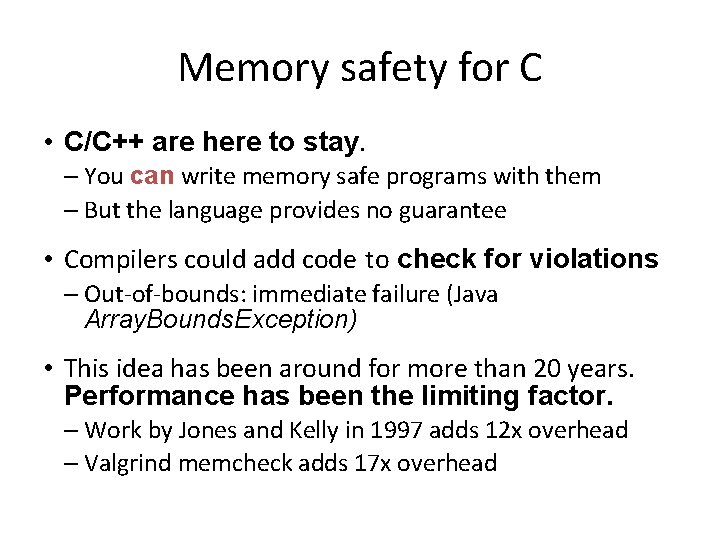
Memory safety for C • C/C++ are here to stay. – You can write memory safe programs with them – But the language provides no guarantee • Compilers could add code to check for violations – Out-of-bounds: immediate failure (Java Array. Bounds. Exception) • This idea has been around for more than 20 years. Performance has been the limiting factor. – Work by Jones and Kelly in 1997 adds 12 x overhead – Valgrind memcheck adds 17 x overhead
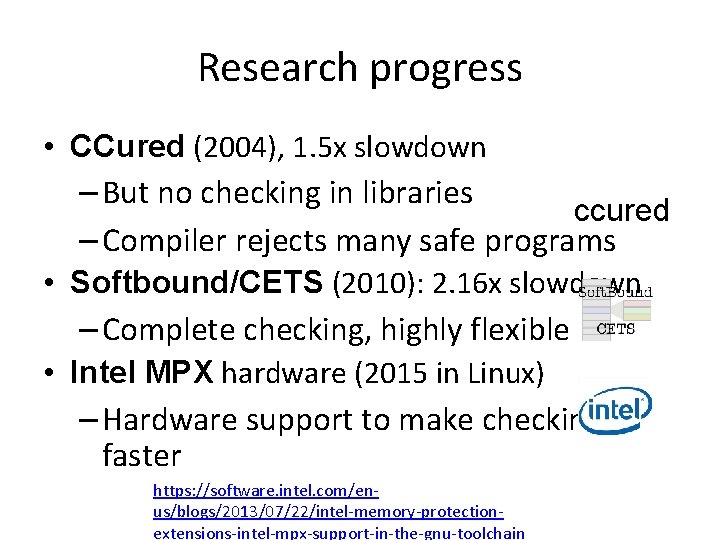
Research progress • CCured (2004), 1. 5 x slowdown – But no checking in libraries ccured – Compiler rejects many safe programs • Softbound/CETS (2010): 2. 16 x slowdown – Complete checking, highly flexible • Intel MPX hardware (2015 in Linux) – Hardware support to make checking faster https: //software. intel. com/enus/blogs/2013/07/22/intel-memory-protectionextensions-intel-mpx-support-in-the-gnu-toolchain
Type Safety https: //a. dilcdn. com/bl/wp-content/uploads/sites/8/2014/02/typ
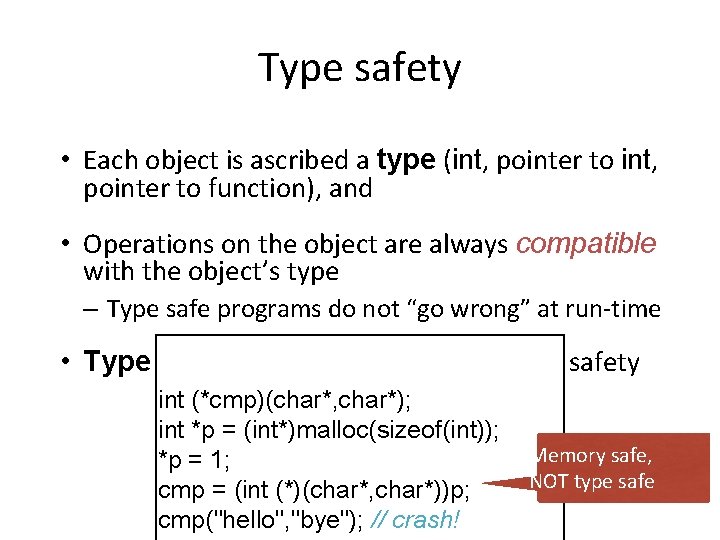
Type safety • Each object is ascribed a type (int, pointer to function), and • Operations on the object are always compatible with the object’s type – Type safe programs do not “go wrong” at run-time • Type safety is stronger than memory safety int (*cmp)(char*, char*); int *p = (int*)malloc(sizeof(int)); *p = 1; cmp = (int (*)(char*, char*))p; cmp("hello", "bye"); // crash! Memory safe, NOT type safe
Aside: Dynamic Typing • Dynamically typed languages – Don’t require type declaration – e. g. , Ruby and Python (typically interpreted languages) – Can be viewed as type safe – Type-checking is done at runtime not compile time!
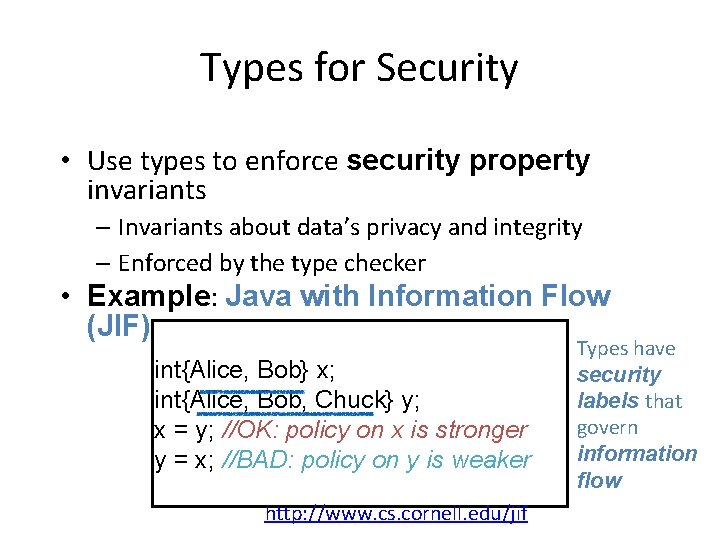
Types for Security • Use types to enforce security property invariants – Invariants about data’s privacy and integrity – Enforced by the type checker • Example: Java with Information Flow (JIF) int{Alice, Bob} x; int{Alice, Bob, Chuck} y; x = y; //OK: policy on x is stronger y = x; //BAD: policy on y is weaker http: //www. cs. cornell. edu/jif Types have security labels that govern information flow
Why not type safety? • C/C++ often chosen for performance reasons – Manual memory management – Tight control over object layouts – Interaction with low-level hardware • Enforcement of type safety is typically expensive – Garbage collection avoids temporal violations • Can be as fast as malloc/free, often uses much more memory – Bounds and null-pointer checks avoid spatial violations – Hiding representation may inhibit optimization • Many C-style casts, pointer arithmetic, & operator, not allowed
A new hope? • Many applications do not need C/C++ – Or the risks that come with it • New languages aim to provide similar features to C/C++ while remaining type safe – Google’s Go, Mozilla’s Rust, Apple’s Swift