
Memory Processes 3 Stage Model Memory Motivation Definition

- Slides: 26
Memory Processes & 3 Stage Model
Memory: Motivation / Definition • “Memory is the glue that binds our mental life together. ” – Eric Kandel https: //www. youtube. com/watch? v=ZKg 79 c. NCVzw • Memory – Differential responding to previously presented stimuli.
Memory Processes • Three Central Memory Processes – Encoding (or Acquisition) • Relies heavily on Sensation & Perception • Environmental stimulation must be “transduced” into action potentials in the nervous system. • Any stimulus that is not encoded cannot be stored – Storage • Any item that is not stored cannot be retrieved – Retrieval
Memory Processes • Encoding (or Acquisition) – The process of converting sensory information into a form that we can report. Or, the process of gaining new information. • Mantra – Information is the reduction of uncertainty. – Intentional Learning – deliberate effort to acquire knowledge for later use. – Incidental Learning – the acquisition of knowledge that occurs without deliberation or effort.
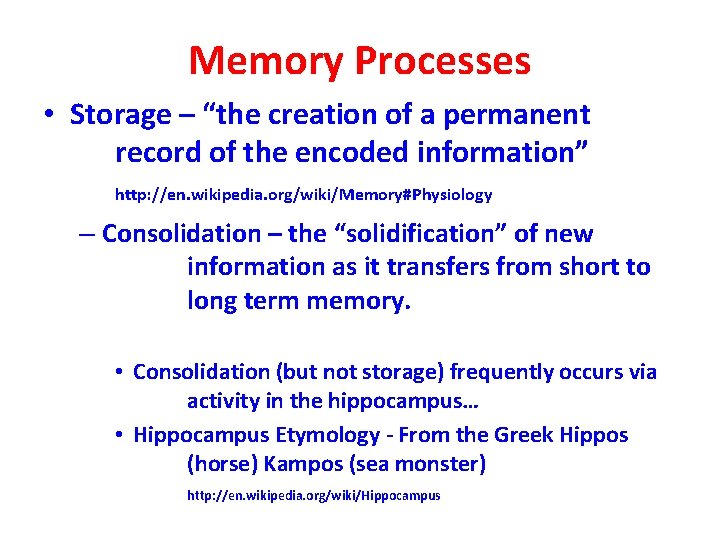
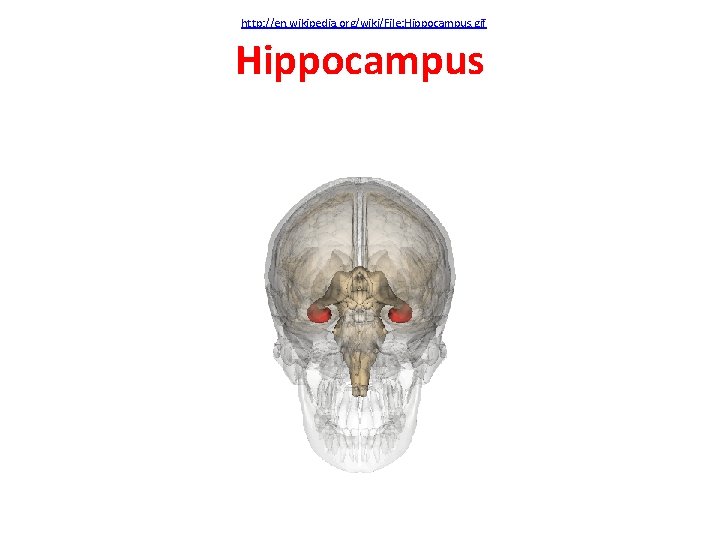
Memory Processes • Storage – “the creation of a permanent record of the encoded information” http: //en. wikipedia. org/wiki/Memory#Physiology – Consolidation – the “solidification” of new information as it transfers from short to long term memory. • Consolidation (but not storage) frequently occurs via activity in the hippocampus… • Hippocampus Etymology - From the Greek Hippos (horse) Kampos (sea monster) http: //en. wikipedia. org/wiki/Hippocampus
http: //en. wikipedia. org/wiki/File: Hippocampus_and_seahorse_cropped. JPG Hippocampus Named by Venetian anatomist Julius Caesar Aranzi (1587)
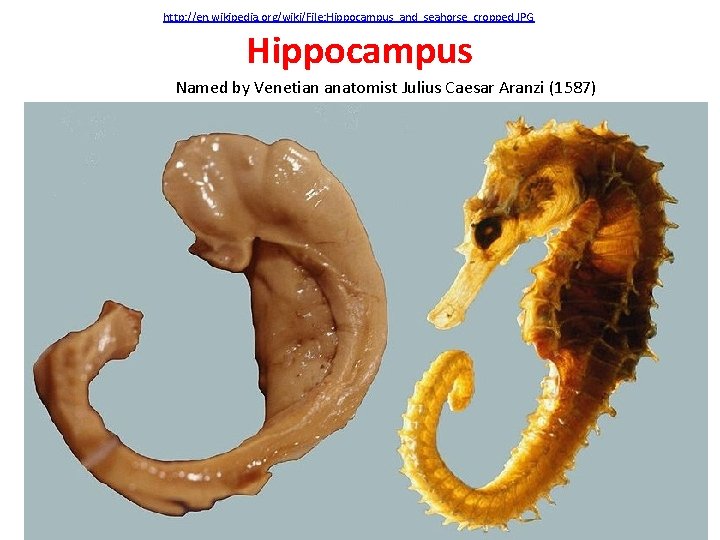
http: //en. wikipedia. org/wiki/File: Gray 739 -emphasizing-hippocampus. png Hippocampus
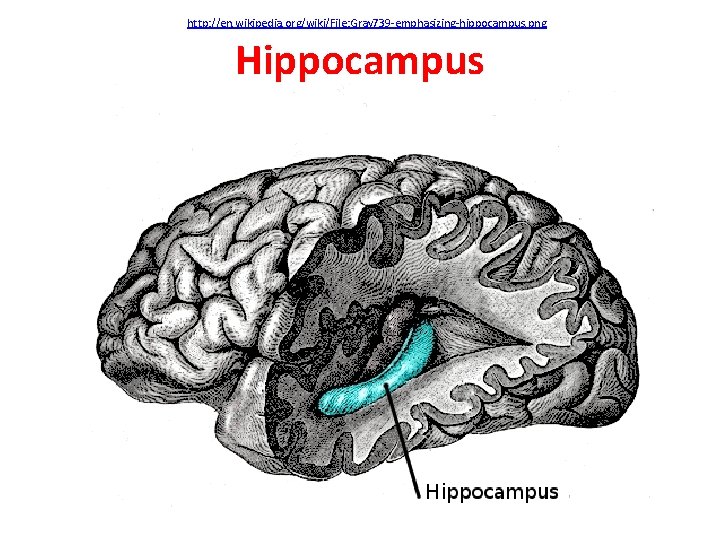
http: //en. wikipedia. org/wiki/File: MRI_Location_Hippocampus_up. . png Hippocampus
http: //en. wikipedia. org/wiki/File: Hippocampus. gif Hippocampus
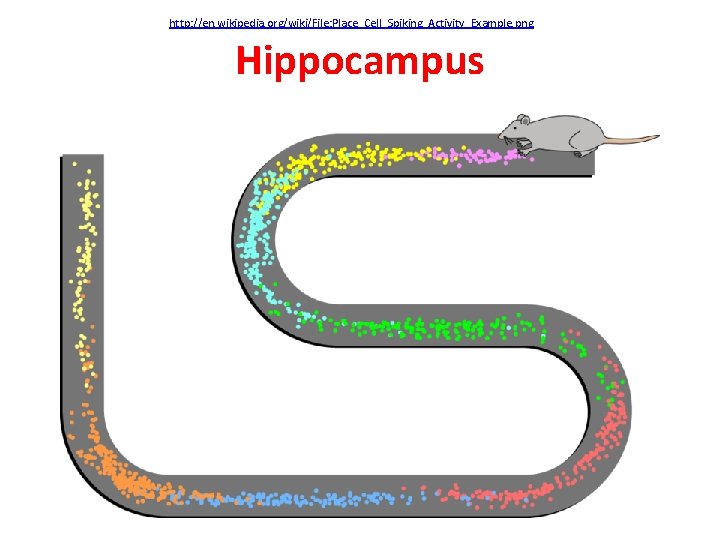
http: //en. wikipedia. org/wiki/File: Place_Cell_Spiking_Activity_Example. png Hippocampus
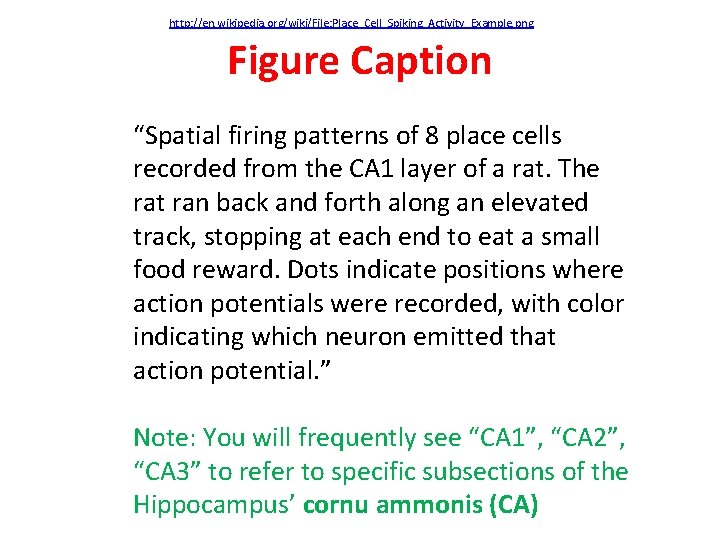
http: //en. wikipedia. org/wiki/File: Place_Cell_Spiking_Activity_Example. png Figure Caption “Spatial firing patterns of 8 place cells recorded from the CA 1 layer of a rat. The rat ran back and forth along an elevated track, stopping at each end to eat a small food reward. Dots indicate positions where action potentials were recorded, with color indicating which neuron emitted that action potential. ” Note: You will frequently see “CA 1”, “CA 2”, “CA 3” to refer to specific subsections of the Hippocampus’ cornu ammonis (CA)
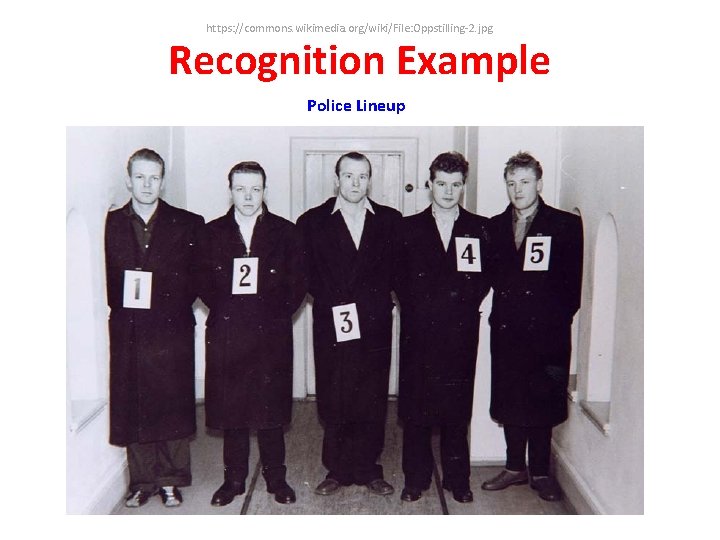
Memory Processes • Retrieval – The use of stored information. – Recall – A type of retrieval that requires information about a previously presented stimulus that is not currently in the environment. – Recognition– A type of retrieval that requires judging a stimulus that is physically present in the environment.
https: //commons. wikimedia. org/wiki/File: Oppstilling-2. jpg Recognition Example Police Lineup
Multiple Choice Tests Rely on Recognition Discussion Question - What are the costs & benefits of colleges & universities “going Test Optional” i. e. , not requiring applicants to submit standardized test scores? http: //en. wikipedia. org/wiki/File: Cito_Eindtoets_Basisonderwijs. JPG http: //en. wikipedia. org/wiki/File: Matura 2005_ILOSzczecin. jpg
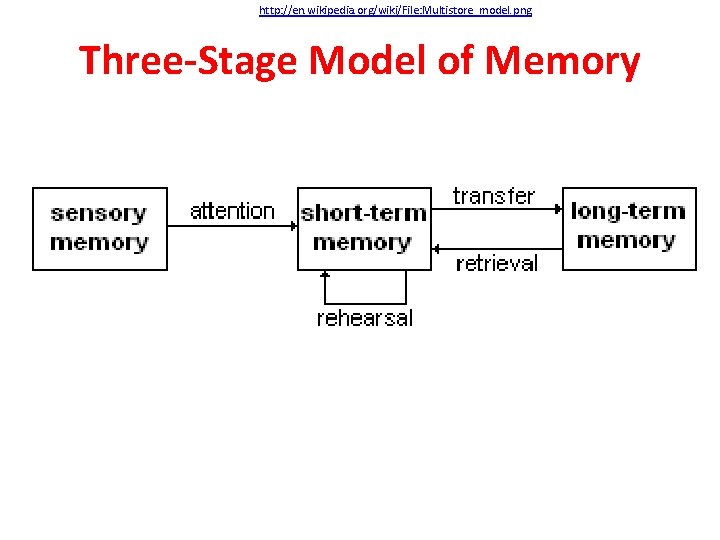
http: //en. wikipedia. org/wiki/File: Multistore_model. png Three-Stage Model of Memory
Sensory Memory • Sensory Memory – “holds sensory information for a few seconds or less after an item is perceived. ” http: //en. wikipedia. org/wiki/Memory#Sensory_memory – Iconic Memory • fast decaying store of visual information – Echoic Memory • fast decaying store of auditory information – Haptic Memory • fast decaying store of tactile (“touch”) information
Short Term Memory • Short Term (Working) Memory – a type of memory that operates in the seconds to minutes time scale, with a limited capacity. • Miller’s Magic Number – The alleged capacity of short term memory (STM) is approximately 7 items + 2.
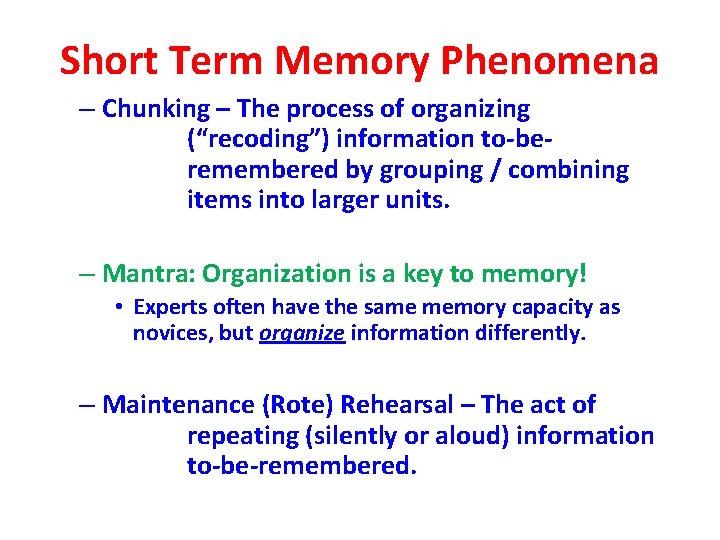
Short Term Memory Phenomena – Chunking – The process of organizing (“recoding”) information to-beremembered by grouping / combining items into larger units. – Mantra: Organization is a key to memory! • Experts often have the same memory capacity as novices, but organize information differently. – Maintenance (Rote) Rehearsal – The act of repeating (silently or aloud) information to-be-remembered.
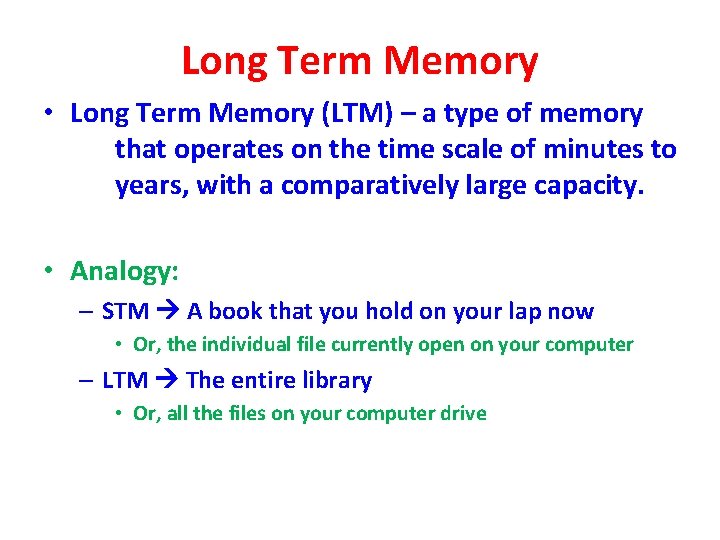
Long Term Memory • Long Term Memory (LTM) – a type of memory that operates on the time scale of minutes to years, with a comparatively large capacity. • Analogy: – STM A book that you hold on your lap now • Or, the individual file currently open on your computer – LTM The entire library • Or, all the files on your computer drive
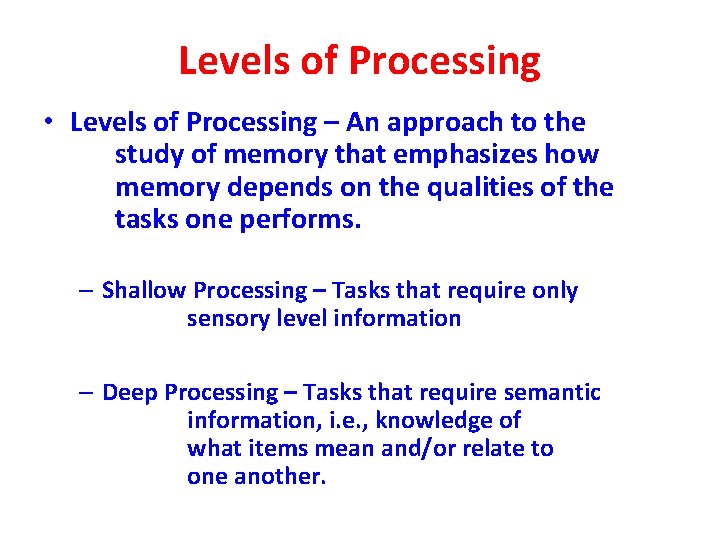
Levels of Processing • Levels of Processing – An approach to the study of memory that emphasizes how memory depends on the qualities of the tasks one performs. – Shallow Processing – Tasks that require only sensory level information – Deep Processing – Tasks that require semantic information, i. e. , knowledge of what items mean and/or relate to one another.
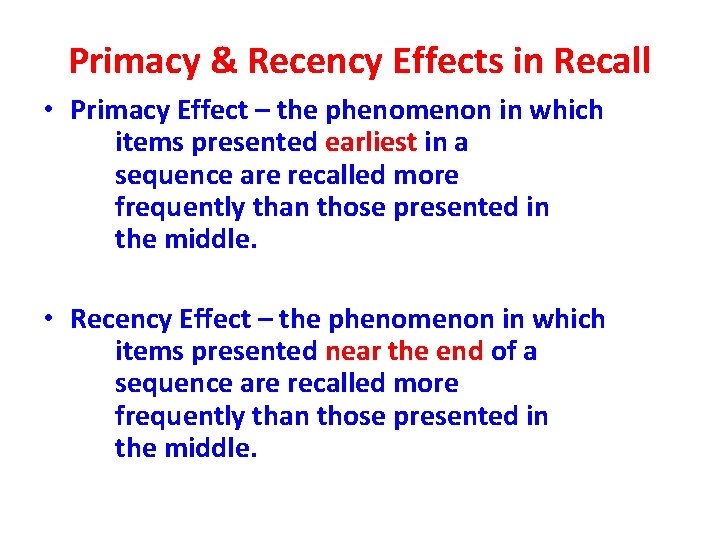
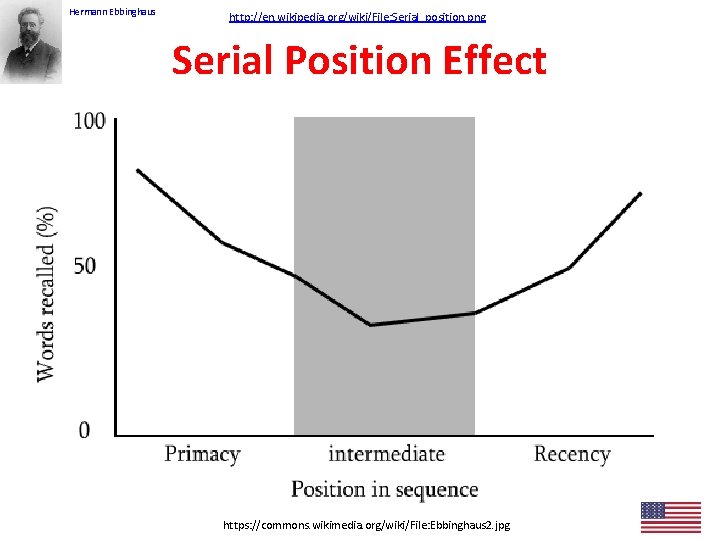
Primacy & Recency Effects in Recall • Primacy Effect – the phenomenon in which items presented earliest in a sequence are recalled more frequently than those presented in the middle. • Recency Effect – the phenomenon in which items presented near the end of a sequence are recalled more frequently than those presented in the middle.
Hermann Ebbinghaus http: //en. wikipedia. org/wiki/File: Serial_position. png Serial Position Effect https: //commons. wikimedia. org/wiki/File: Ebbinghaus 2. jpg
Serial Position Effect • The recency effect can be disrupted with an interference task, e. g. , testing recall after requiring participants to count backwards from 100, by 7’s. – This disruption demonstrates that the recency effect relies on retrieval from working memory. – The interference task does not similarly disrupt primacy effect, suggesting that distinct neural events govern the recency and primacy effects.
Serial Position Effect • The primacy effect can be enhanced or reduced, respectively, by slowing or speeding the stimulus presentation. – Slowing the presentation rate allows more time for rote rehearsal and long term storage. – Slowing or speeding the presentation rate has no effect on the recency effect, suggesting that distinct neural events govern the recency and primacy effects.
Dissociations • Dissociation – occurs when one behavior (“A”) can be disrupted without altering a separate behavior (“B”), suggesting at least some independence between the neural events governing the two behaviors. • Double Dissociation – occurs when one behavior (“A”) can be disrupted without altering a separate behavior (“B”) –and vice versa – suggesting considerable independence between the neural events governing the two behaviors.