
Memory persistence of learning over time through the


- Slides: 14
Memory § persistence of learning over time through the storage and retrieval of information
Encoding: Getting Information In Encoding Automatic Effortful
Effortful Encoding § Rehearsal: conscious repetition of information § Types § Maintenance Rehearsal: rote memory § Elaborative Rehearsal: associating unlike terms § Deep Processing: understand meaning
Effortful Encoding § Imagery § mental pictures § Mnemonics § techniques that use vivid imagery and organizational devices
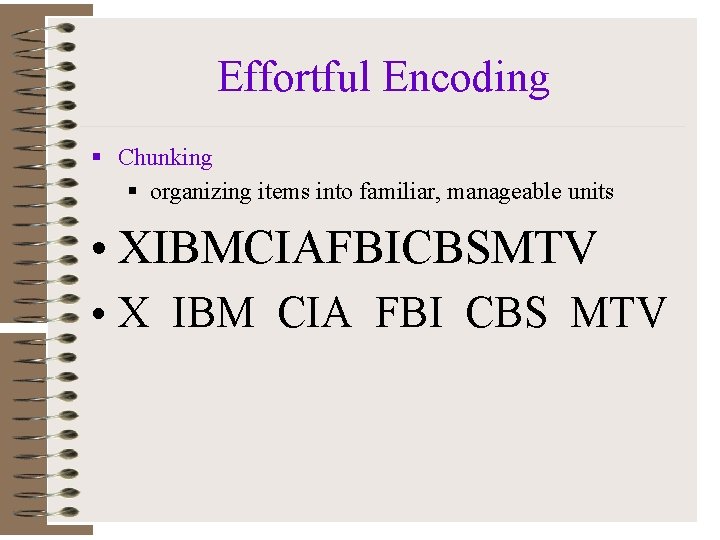
Effortful Encoding § Chunking § organizing items into familiar, manageable units • XIBMCIAFBICBSMTV • X IBM CIA FBI CBS MTV
Encoding Phenomena • • Serial Position Effect Next-in-Line Effect Sleep Effect Spacing Effect – Distributed practice over mass practice
Storage § Sensory Memory § the immediate, initial recording of sensory information in the memory system § extremely temporary § Iconic memory § Echoic memory § determine what needs to passed on and what does not § bypassed by rehearsal techniques
Storage § Short-Term Memory § consciously activated memory that holds a few items briefly § our mental scratch pad § will hold approx. 7 +/- 2 items § time and space limited
Storage § Long-Term Memory § the relatively permanent and limitless storehouse of the memory system
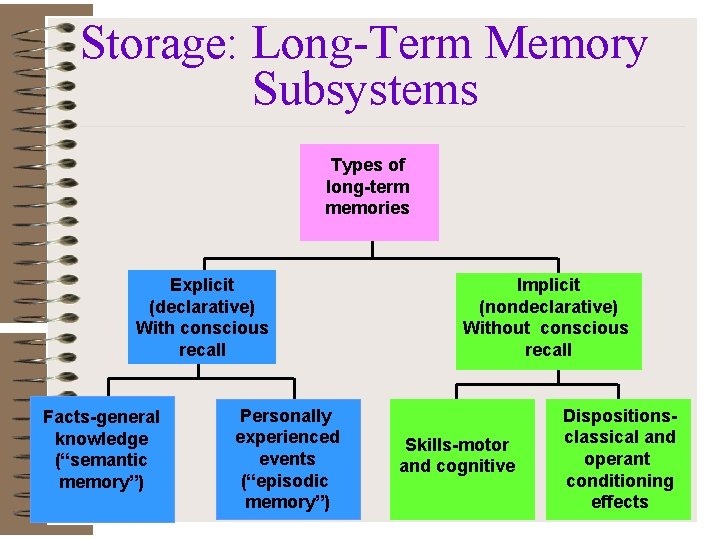
Storage: Long-Term Memory Subsystems Types of long-term memories Explicit (declarative) With conscious recall Facts-general knowledge (“semantic memory”) Personally experienced events (“episodic memory”) Implicit (nondeclarative) Without conscious recall Skills-motor and cognitive Dispositionsclassical and operant conditioning effects
Retrieval • Encoding Specificity Principle: retrieval is affected by encoding situations – context: things going on internally (mood congruent memory) and externally (environment) while encoding – physical state: if under the influence of a substance such as caffeine while encoding, will best retrieve under the influence of that substance (state dependent retrieval)
Retrieval § Recall § measure of memory in which the person must retrieve information learned earlier § as on a fill-in-the blank test § Recognition § Measure of memory in which the person has only to identify (recognize) items previously learned § as on a multiple-choice test
Retrieval Cues § Deja Vu (French)--already seen § Often causes the eerie feeling of “having experienced before” § cues from a current situation may subconsciously trigger retrieval of an earlier similar experience (priming) § Flashbulb memories § Vivid recollection of often emotional events § Where were you when the 911 attacks took place?
Biological Basis of Memory § Synaptic changes § Long-term Potentiation § increase in synapse’s firing potential of memory neurons after brief, rapid stimulation § Strong emotions make for stronger memories § some stress hormones boost learning and retention § Hippocampus