
Memory Part II Storage and Retrieval Memory Information



- Slides: 41
Memory Part II Storage and Retrieval
Memory – Information Processing • “Three-Stage Processing” Model • Memories are stored in a three-step process of sensory memory, short-term memory, and long-term memory
Memory – Information Processing • Sensory Memory – the immediate, initial recording of sensory information; fleeting, tobe-remembered information
Memory – Information Processing • Short-Term Memory – activated memory that holds a few items briefly, such as the seven-digits of a phone number while you are dialing, and then the information is either stored, or forgotten
Memory – Information Processing • Long-term Memory – the relatively permanent and limitless storehouse of memories
Sensory Memory • Sensory memory retention is only fleeting and momentary • Sensory memory retention allows us to remember small, quick bits of information for a very short period of time
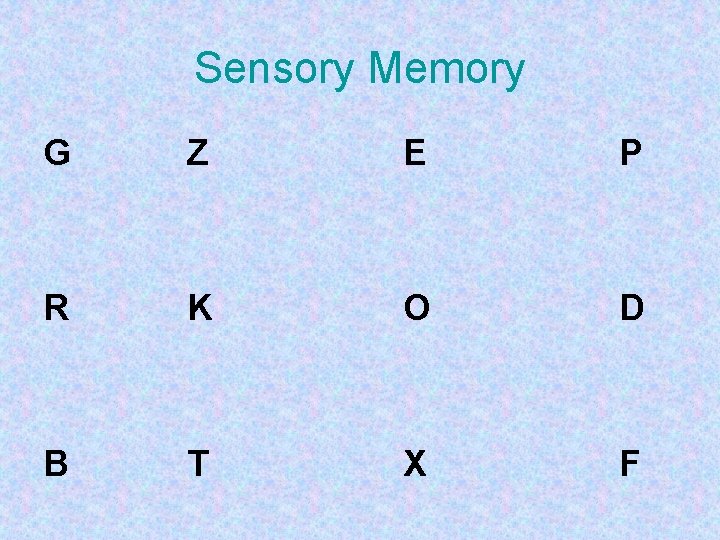
Sensory Memory G Z E P R K O D B T X F
Sensory Memory • How many letters can you recall? • Most people can recall four or five letters in that short of a time span, but know that there were more.
Sensory Memory • Sensory memory retention is what is used when you see a face in the crowd for a split second…. you recognize features quickly, determine she/he was cute, but then you can’t remember any details of their face
Sensory Memory • Was he/she cute? • What was he/she wearing? What color was it? • What color was his/her hair? How long was it? • What color was her lipstick? • What was his/her facial expression? • What color were his/her eyes?
Short-Term Memory or Working Memory • The ability to hold and manipulate information over a brief period of time. Forgetting can occur rapidly, especially if distracted
Short-Term Memory or Working Memory • Short-term memory has two important characteristics. – First, short-term memory can contain at any one time seven, plus or minus two, "chunks" of information. – Second, items remain in short-term memory around twenty to thirty seconds.
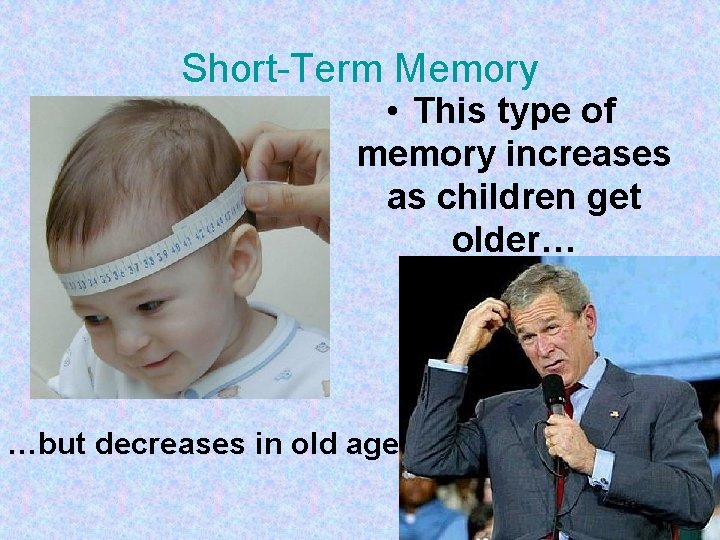
Short-Term Memory • This type of memory increases as children get older… …but decreases in old age
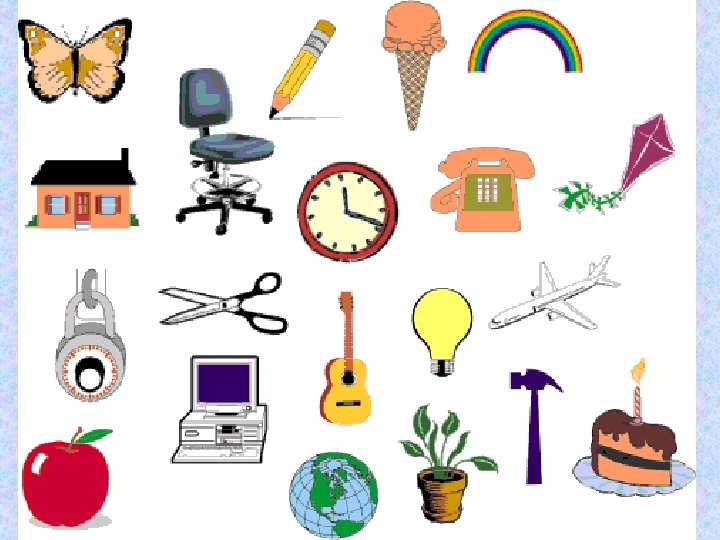
• Activity • Pens and pencils DOWN • Look at the picture • You will have 15 seconds
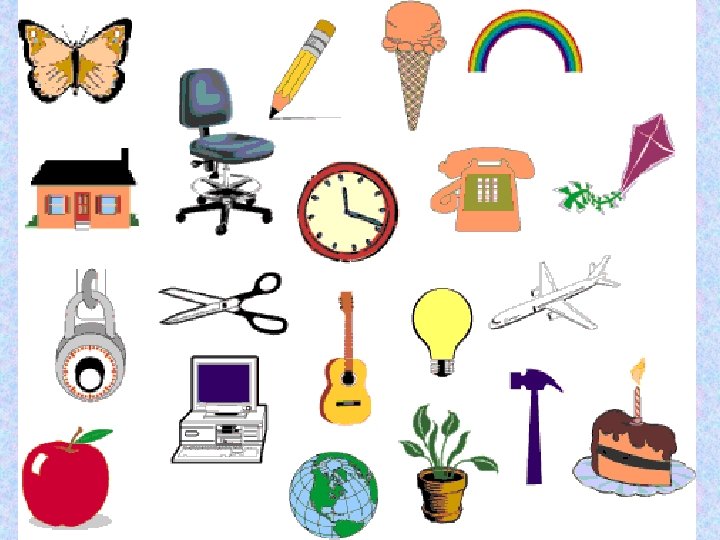
Short-Term Memory • Write down the words of all the pictures you can remember. • How many objects did you remember?
Short-Term Memory • We can only consciously process a very limited amount of information in our short-term memory.
Short-Term Memory • We can only consciously process a very limited amount of information in our short-term memory. • Overload your short-term memory? You might forget what you read, ask yourself where you put your briefcase, and ask your phone partner the same thing twice.
Long-Term Memory • A system in the brain that can store vast amounts of information on a relatively enduring basis • The information can be facts you learned a few minutes ago, personal memories that are decades old, or skills learned with practice.
Long-Term Memory • The average adult has more than a billion bits of information in memory • Storage capacity of long-term memories has been estimated at million times that (1, 000 X 1, 000, 000)
Retrieval • Retrieval is the process of getting information out of memory storage • You may need to remember exact facts and figures, or you may only need to remember general terms and identifications.
Retrieval • Recall – memory is the ability to retrieve exact information learned at an earlier time – IE. Fill in the blank test. – IE. Columbus sailed in the year ____. 6 x 6 = _____. Define retrieval ______. My Social Security number is _______.
Retrieval • Recognition – a measure of memory in which a person only needs to identify items previously learned – IE. A multiple-choice test. – IE. Of the following choices, which is the correct answer to 6 x 6 ____. You can’t remember the names of all 400 kids you graduated high school with, but if I show you pictures of them you can remember who you went to school with and who you didn’t.
Retrieval • Relearning – the principle that if you’ve learned something and forgot it, you probably will learn the material more easily the second time – therefore, retrieval is easier and quicker as well – IE. Learned to play the guitar and played for five years. Haven’t played in 10 years, but you pick up a guitar and play a few tunes, and with a few lessons you play as well as you did before.
Retrieval • Retrieval Cues – clues that provide reminders of information that otherwise would be more difficult to remember; clues that can guide us the where to look for the right answers.
Retrieval • Priming – the activation of particular associations in memory; this may be done consciously or unconsciously, purposefully or incidentally
Retrieval – IE. Mnemonic clues (Roy G Biv) are primers that allow you to remember information many types of factual information – IE. A “Missing Child” poster makes you think about your own abduction as a child – IE. The color red prompts memories of days on your grandfathers farm, with its big red barn – IE. The first letter of each vocabulary word is provided on your test.
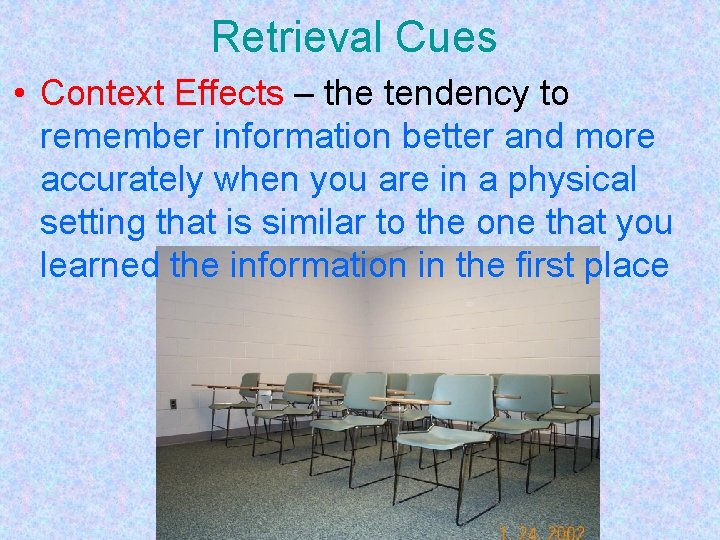
Retrieval Cues • Context Effects – the tendency to remember information better and more accurately when you are in a physical setting that is similar to the one that you learned the information in the first place
Retrieval Cues • Mood-Congruent – along with the statedependent theory, our moods bias our memories also (we remember things better when we are in the same mood as when the memory was formed) – IE. You had a fantastic 5 th birthday party, with lots of friends, gifts, clowns, etc. BUT, you had a cold that day and were sad. Your memory of your 5 th birthday party may be that it was long, dreary, and sad.
Retrieval Cues • State-Dependent Theory – what we learn in one physical state – such as drunk or sober – is sometimes more easily recalled when we are again in that same state
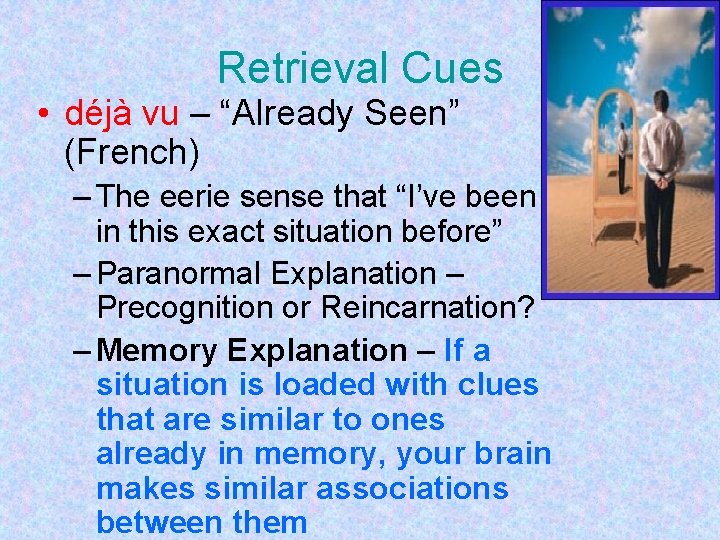
Retrieval Cues • déjà vu – “Already Seen” (French) – The eerie sense that “I’ve been in this exact situation before” – Paranormal Explanation – Precognition or Reincarnation? – Memory Explanation – If a situation is loaded with clues that are similar to ones already in memory, your brain makes similar associations between them
Memory Forgetting, Memory Construction, and Improving Memory
Retrieval Failures • Repression - a basic defense mechanism that banishes from consciousness anxiety-arousing thoughts, feelings, and memories • People can knowingly, or unknowingly, revise their own histories
Retrieval Failures • Tip-Of-The-Tongue Experience – the inability to get a bit of information that you’re absolutely certain is stored in your memory – the information is very close, but just out of reach
Medical Memory Loss • Amnesia – severe memory loss – Retrograde – forget things from the past – Anterograde – inability to form new memories but remember the past • Alzheimers – as plaques build in the brain and interfere with neural transmissions, memories cannot be formed or retrieved
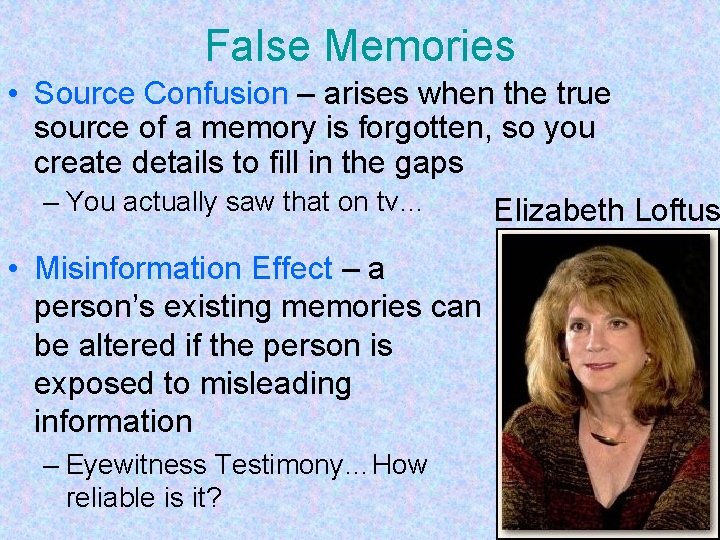
False Memories • Source Confusion – arises when the true source of a memory is forgotten, so you create details to fill in the gaps – You actually saw that on tv… Elizabeth Loftus • Misinformation Effect – a person’s existing memories can be altered if the person is exposed to misleading information – Eyewitness Testimony…How reliable is it?
How To Make Memories Last? A Few Suggestions • • • Focus your attention Commit the necessary time Space your study sessions Organize the information Elaborate on the material
How To Make Memories Last? A Few Suggestions • Use visual imagery and other mnemonics • Explain it to a friend • Reduce Interferences • Since we usually remember the early part and the last part, spend extra time on the middle • Use contextual clues to jog memory