
Memory Models and Research Methods Chapter 5 Outline
- Slides: 26
Memory: Models and Research Methods Chapter 5
Outline 1. Tasks Used for Measuring Memory 2. Traditional Model of Memory 1. Sensory Store 2. Short-Term Store 3. Long-Term Store 3. Alternative Perspectives 4. Exceptional Memory and Deficits in Memory
Basic Concepts • Memory – Is the means by which we retain and draw on our past experiences to use this information in the present
Basic Concepts • Memory – As a process, memory refers to the dynamic mechanisms associated with retaining common operations of memory: • Encoding – you transform sensory data into a form of mental representation • Storage – you keep encoded information in memory • Retrieval – you pull out or use information stored in memory
? 1. Tasks Used for Measuring Memory Write down the name of the disorder. Which of the following disorders it could be: 1. Prosopagnosia 2. Anosognosia 3. Autotopagnosia
1. Tasks Used for Measuring Memory Recall Versus Recognition Tasks • Recall – You have to reproduce a fact, a word, or other item from memory • Recognition – You have to select or otherwise identify an item as being one that you learned previously – Recognition is usually much better than recall
1. Tasks Used for Measuring Memory 1. Explicit-memory tasks • You must consciously recall or recognize particular information 1. Declarative-knowledge tasks - you must recall facts - What is your first name? 2. Recall tasks - you must produce a fact, a word or other item from memory - Dysfunction of the basal ganglia is known to cause ------.
1. Tasks Used for Measuring Memory 1. Explicit-memory tasks (cont. ) 3. Serial-recall tasks - you must repeat the items in a list in the exact order in which you heard or read them - If you were shown the digits 3 -4 -2 -5 -6, you would be expected to repeat “ 3 -4 -2 -5 -6 4. Free-recall tasks - you must repeat the items in a list n any order in which you can recall them - If you were presented with the digits 3 -4 -2 -5 -6, you would receive full credit if you repeated “ 4 -2 -3 -6 -5”
1. Tasks Used for Measuring Memory 1. Explicit-memory tasks (cont. ) 5. Cued-recall task - you must memorize a list of paired items; then when you are given one item in the pair, you must recall the pair for that item - list of pairs: “book-pen, dog-table”; when given the stimulus “book” you would be expected to say “pen” 6. Recognition tasks - you must select or otherwise identify an item as being one that you learned previously - multiple choice test
1. Tasks Used for Measuring Memory - 2. Implicit memory tasks You must draw on information in memory without consciously realizing that you are doing so
1. Tasks Used for Measuring Memory 2. Implicit memory tasks (cont. ) 1. Word completion tasks - you are presented with a word fragment, such as the first three letters of a word and you are asked to complete the word - e. g. BOO_ 2. Task involving procedural memory - you must remember learned skills and automatic behaviors, rather than facts - e. g. reading mirror writing, riding a bike
2. Traditional Model of Memory 1. Sensory Store • Capable of storing relatively limited amounts of information for very brief periods • Initial repository of much information that eventually enters the short- and long-term stores
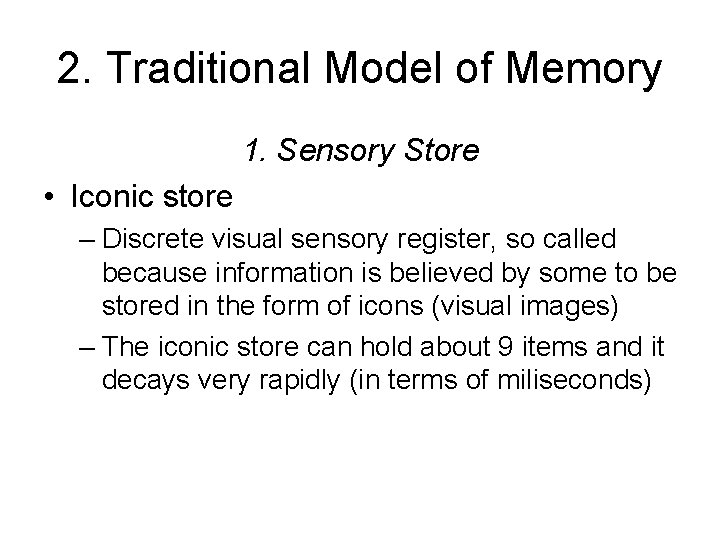
2. Traditional Model of Memory 1. Sensory Store • Iconic store – Discrete visual sensory register, so called because information is believed by some to be stored in the form of icons (visual images) – The iconic store can hold about 9 items and it decays very rapidly (in terms of miliseconds)
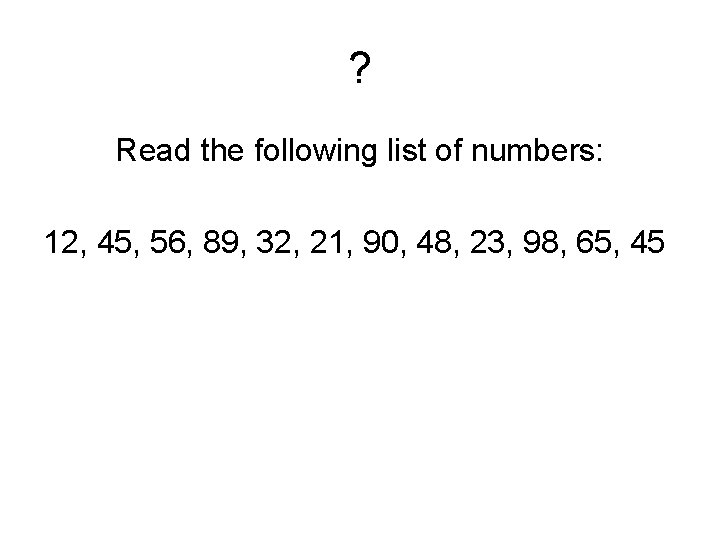
? Read the following list of numbers: 12, 45, 56, 89, 32, 21, 90, 48, 23, 98, 65, 45
? Write down as many items from the list as you can.
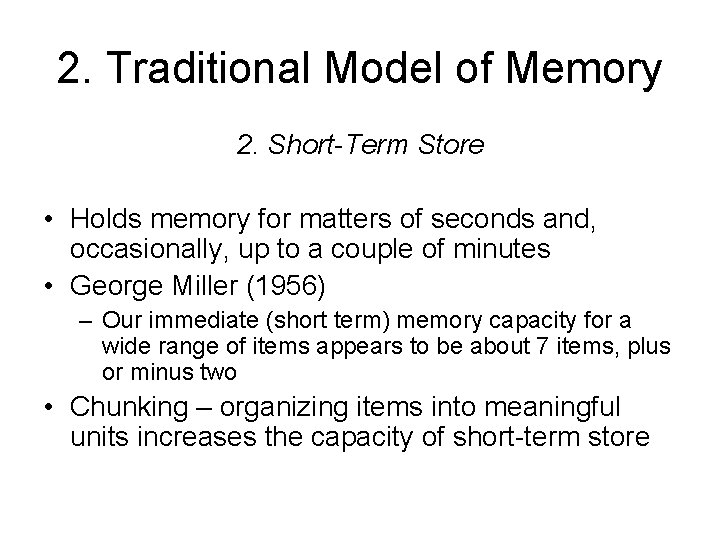
2. Traditional Model of Memory 2. Short-Term Store • Holds memory for matters of seconds and, occasionally, up to a couple of minutes • George Miller (1956) – Our immediate (short term) memory capacity for a wide range of items appears to be about 7 items, plus or minus two • Chunking – organizing items into meaningful units increases the capacity of short-term store
2. Traditional Model of Memory 3. Long-Term Store • Store of memories that stay with us over long periods, perhaps indefinitely • Wilder Penfield – Performed operations on the brains of conscious patients afflicted with epilepsy – used electrical stimulation of various parts of the cerebral cortex to locate the origins of each patient’s problem – Patients sometimes would appear to recall memories from way back in their childhoods that may not have been called to mind for many years
3. Alternative Perspectives 1. Self-reference effect – Very high levels of recall when we are asked to relate words meaningfully to ourselves – Each of us has a very elaborate self-schema, an organized system of internal cues regarding ourselves, our attributes, and our personal experiences – Therefore, we can richly and elaborately encode information related to ourselves much more so than information about other topics
3. Alternative Perspectives 2. Working memory • Is part of long-term memory and also comprises short-term memory • It holds only the most recently activated portion of long-term memory, and it moves these activated elements into and out of brief, temporary memory storage
3. Alternative Perspectives 3. Episodic versus Semantic memory • Semantic memory – General world knowledge – our memory for facts that are not unique to us and that are not recalled in any particular temporal context • I remember the name of the researcher who investigated the difference between semantic and episodic memory. • Episodic memory – Personally experienced events and episodes • I saw my friend Connie in the dentist’s office yesterday.
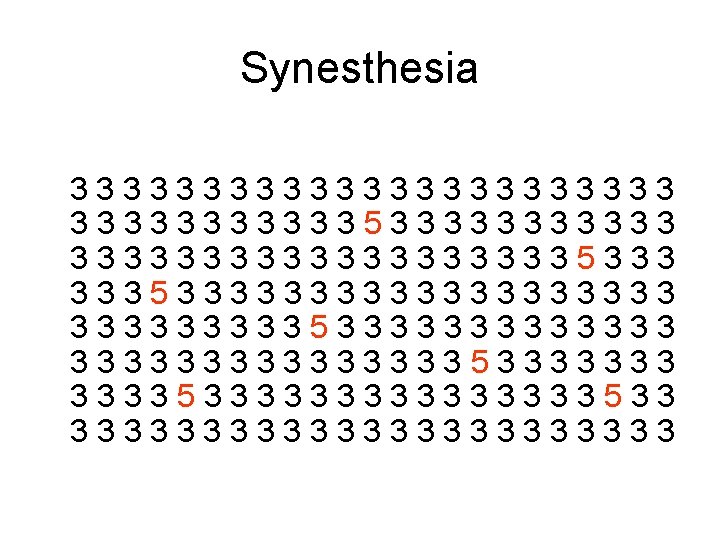
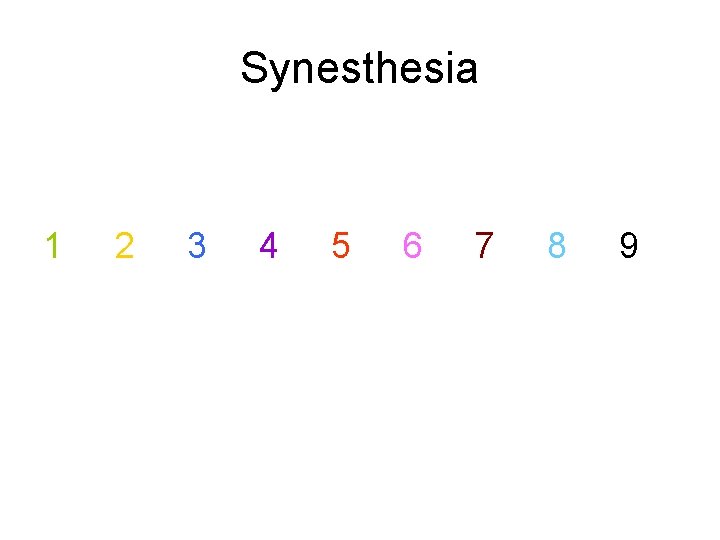
4. Exceptional Memory and Deficits in Memory 1. Outstanding Memory: Mnemonists • Someone who demonstrates extraordinarily keen memory ability, usually based on using a special technique for memory enhancement • Luria (1968) – mnemonist S. – Could remember words 15 years after a session in which he learned them – S. had disorder called synesthesia which enabled him to encode information efficiently • Syntesthesia – Patient Experiences some sensations in a sensory modality different from the sense that was physically stimulated (e. g. colors are associated with sounds)
4. Exceptional Memory and Deficits in Memory 2. Deficits in Memory: Amnesia • Retrograde amnesia – Individuals loose their purposeful memory for events prior to whatever trauma induced memory loss • Anterograde amnesia – Difficulty remembering events that occurred from the time of a brain trauma • Infantile amnesia – The inability to recall events that happened when we were very young
4. Exceptional Memory and Deficits in Memory 3. Memory and brain structures • Double dissociation – People with different kinds of neuropathologies show opposite patterns of deficits • Hippocampus – Important in explicit memory • Amygdala – Important in encoding memories with emotional aspects • Basal ganglia – Primary structures controlling procedural knowledge • Cerebellum – Crucial in procedural memory
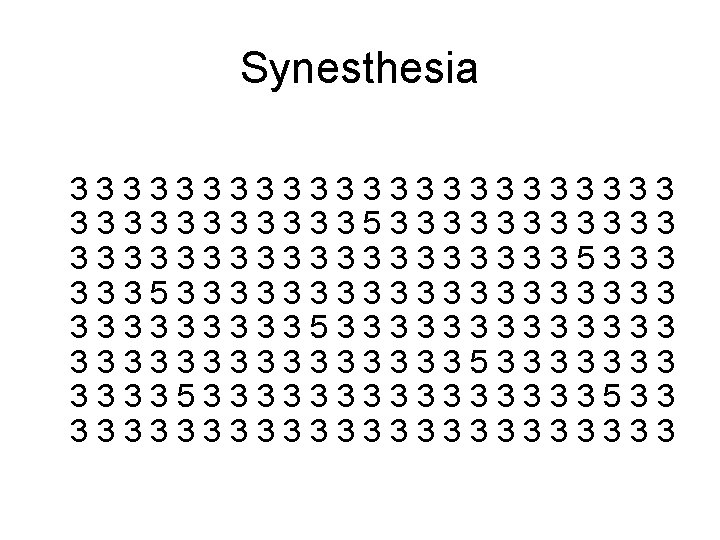
Synesthesia 333333333333533333333335333333333353333333353333333533333333533 333333333333
Synesthesia 333333333333533333333335333333333353333333353333333533333333533 333333333333
Synesthesia 1 2 3 4 5 6 7 8 9