
MEMORY MEMORY Memory is the ability to take
MEMORY
MEMORY • Memory is the ability to take information, store it, and recall it at a later time • Memory is essential to all our lives. Without a memory of the past, we cannot operate in the present or think about the future. • We would not be able to remember what we did yesterday, what we have done today or what we plan to do tomorrow. • Without memory, we could not learn anything.
MEMORY PROCESSES • Encoding--transforming information into a form that can be entered and retained in the memory system • Storage--retaining information in memory so that it can be used at a later time • Retrieval--recovering information stored in memory so that we are consciously aware of it
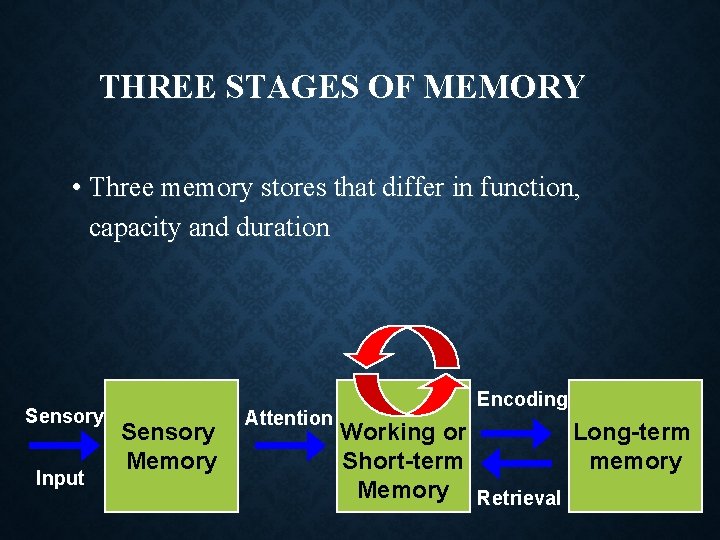
THREE STAGES OF MEMORY • Three memory stores that differ in function, capacity and duration Sensory Input Sensory Memory Attention Encoding Long-term Working or memory Short-term Memory Retrieval
SENSORY MEMORY • Function —process for basic physical characteristics • Capacity—large • can hold many items at once • Duration—very brief retention of images • 1/2 sec for visual information • 3 -4 sec for auditory information
Divided into two types: Visual sensory memory—brief memory of an image or icon. Also called iconic memory. Auditory sensory memory—brief memory of a sound or echo. Also called echoic memory. (Auditory sensory memories may last a bit longer than visual sensory memories) Attention is needed to transfer information to working memory
SHORT-TERM MEMORY OR WORKING MEMORY • Function—conscious processing of information • where information is actively worked on • Capacity—limited (holds 7+/-2 items) • Duration—brief storage (about 30 seconds)
• Maintenance Rehearsal Mental or verbal repetition of information allows information to remain in working memory longer than the usual 30 seconds • Chunking Grouping small bits of information into larger units of information expands working memory load Which is easier to remember? 4 8 3 7 9 2 5 1 6 483 792 516
LONG-TERM MEMORY • Once information passes from sensory to working memory, it can be encoded into long-term memory • Function—organizes and stores information • more passive form of storage than working memory • Unlimited capacity • Duration—thought by some to be permanent • Capacity-- Unlimited
AUTOMATIC VS. EFFORTFUL ENCODING Automatic processing • Unconscious encoding of information • Examples: • What did you eat for lunch today? • Was the last time you studied during the day or night? • You know the meanings of these very words you are reading. Are you actively trying to process the definition of the words?
AUTOMATIC VS. EFFORTFUL ENCODING Effortful processing • Requires attention and conscious effort • Examples: • Memorizing your notes for your upcoming Introduction to Psychology exams • Repeating a phone number in your head until you can write it down
TYPES OF LONG-TERM MEMORY • Explicit memory—memory with awareness; information can be consciously recollected; also called declarative memory (Declarative or conscious Memory consciously recalled or declared Can use explicit memory to directly respond to a question) • Implicit memory—memory without awareness; memory that affects behavior but cannot consciously be recalled; also called nondeclarative memory
EXPLICIT MEMORY Two subtypes of explicit memory • Episodic information—information about events or “episodes” • Semantic information—information about facts, general knowledge, school work
EPISODIC MEMORY • Memory tied to your own personal experiences • Examples: • What month is your birthday? • Do you like to eat caramel apples? • Q: Why are these explicit memories? • A: Because you can actively declare your answers to these questions
SEMANTIC MEMORY • Memory not tied to personal events • General facts and definitions about the world • Examples: • How many tires on a car? • What is a cloud? • What color is a banana? • Does NOT depend on tying the item to your past
IMPLICIT MEMORY • Non-declarative memory • Influences your thoughts or behavior, but does not enter consciousness
PROCEDURAL MEMORY • Memory that enables you to perform specific learned skills or habitual responses • Examples: • Riding a bike • Using the shift stick while driving • Tying your shoe laces Don’t have to consciously remember the steps involved in these actions to perform them • Try to explain to someone how to tie a shoelace
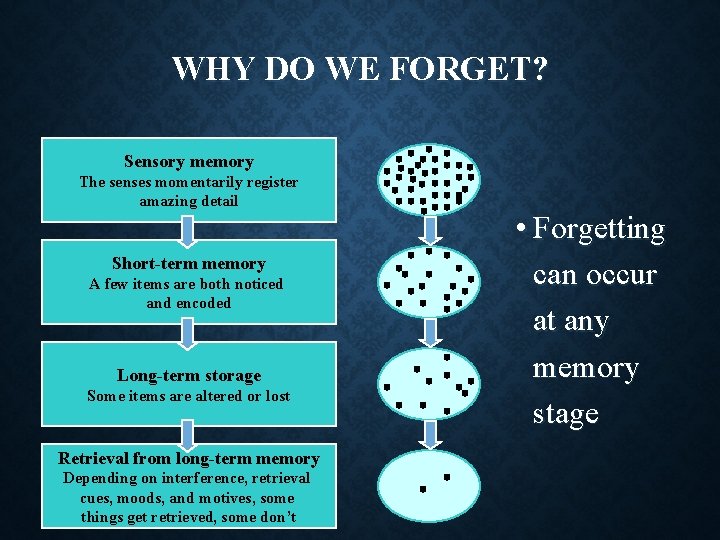
WHY DO WE FORGET? Sensory memory The senses momentarily register amazing detail Short-term memory A few items are both noticed and encoded Long-term storage Some items are altered or lost Retrieval from long-term memory Depending on interference, retrieval cues, moods, and motives, some things get retrieved, some don’t • Forgetting can occur at any memory stage
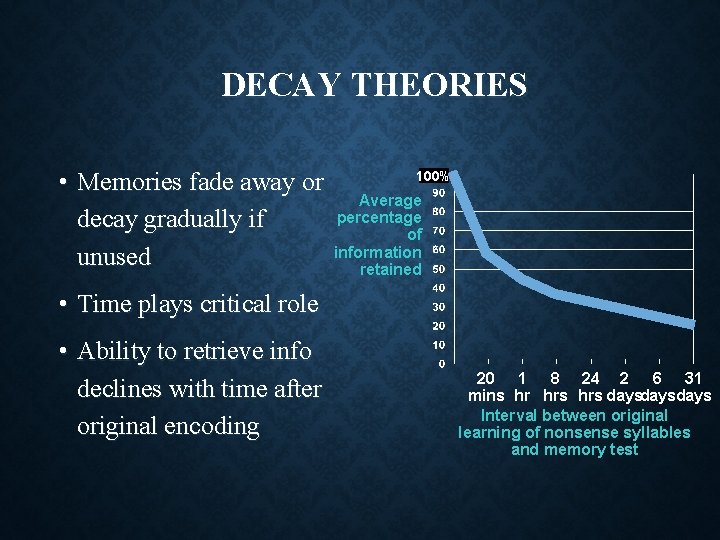
DECAY THEORIES 100% • Memories fade away or Average percentage decay gradually if of information unused retained • Time plays critical role • Ability to retrieve info declines with time after original encoding 20 1 8 24 2 6 31 mins hr hrs daysdays Interval between original learning of nonsense syllables and memory test
MEASURES OF RETRIEVAL • Recall—test of LTM that involves retrieving memories without cues, also termed free recall • Cued recall—test of LTM that involves remembering an item of information in response to a retrieval cue • Recognition—test of LTM that involves identifying correct information from a series of possible choices • Serial position effect—tendency to remember items at the beginning and end of a list better than items in the middle
- Slides: 20