
Memory Management Strategies Learning Goals for Today Background
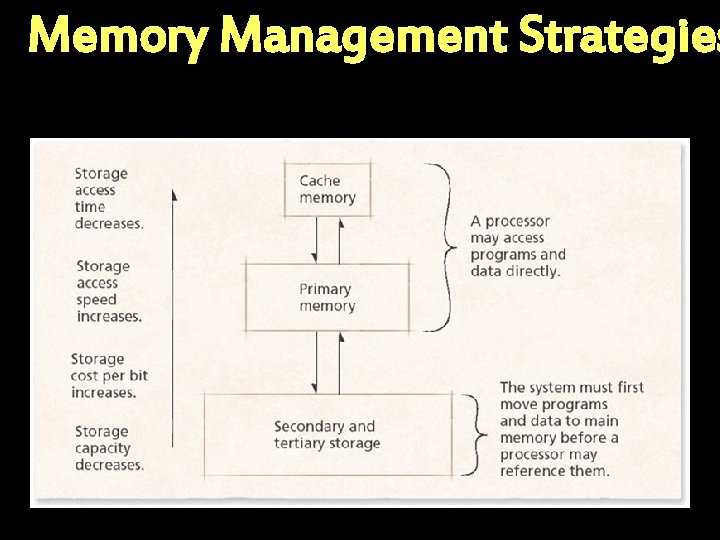
Memory Management Strategies

Learning Goals for Today • • Background Swapping Contiguous Memory Allocation Paging Structure of the Page Table Segmentation Example: The Intel Pentium

Today’s Objectives To provide a detailed description of various ways of organizing memory hardware To discuss various memory-management techniques, including paging and segmentation To provide a detailed description of the Intel Pentium, which supports both pure segmentation and segmentation with paging
Background Program must be brought (from disk) into memory and placed within a process for it to be run Main memory and registers are only storage CPU can access directly Register access in one CPU clock (or less) Main memory can take many cycles Cache sits between main memory and CPU registers Protection of memory required to ensure correct operation
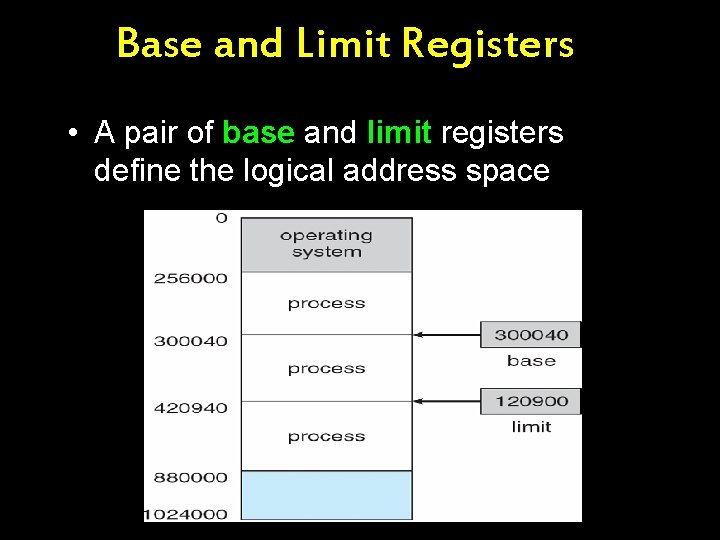
Base and Limit Registers • A pair of base and limit registers define the logical address space
Binding of Instructions and Data to Memory Address binding of instructions and data to memory addresses can happen at three different stages – Compile time: If memory location known a priori, absolute code can be generated; must recompile code starting location changes – Load time: Must generate relocatable code if memory location is not known at compile time – Execution time: Binding delayed until run time if the process can be moved during its execution from one memory segment to another. Need hardware support fo address maps (e. g. , base and limit registers)

Multistep Processing of a User Program

Logical vs. Physical Address Space • The concept of a logical address space that is bound to a separate physical address space is central to proper memory management – Logical address – generated by the CPU; also referred to as virtual address – Physical address – address seen by the memory unit • Logical and physical addresses are the same in compile-time and load-time address-binding schemes; logical (virtual) and physical

Memory-Management Unit (MMU) • Hardware device that maps virtual to physical address • In MMU scheme, the value in the relocation register is added to every address generated by a user process at the time it is sent to memory • The user program deals with logical addresses; it never sees the real physical addresses
Dynamic Loading • Routine is not loaded until it is called • Better memory-space utilization; unused routine is never loaded • Useful when large amounts of code are needed to handle infrequently occurring cases • No special support from the operating system is required implemented through program design
Swapping • A process can be swapped temporarily out of memory to a backing store, and then brought back into memory for continued execution • Backing store – fast disk large enough to accommodate copies of all memory images for all users; must provide direct access to these memory images • Roll out, roll in – swapping variant used for priority-based scheduling algorithms; lower-priority process is swapped out so higher-priority process can be loaded and executed • Major part of swap time is transfer time; total transfer time is directly proportional to the amount of memory swapped • Modified versions of swapping are found on many systems (i. e. , UNIX, Linux, and Windows) • System maintains a ready queue of ready-to-run processes which have memory images on disk
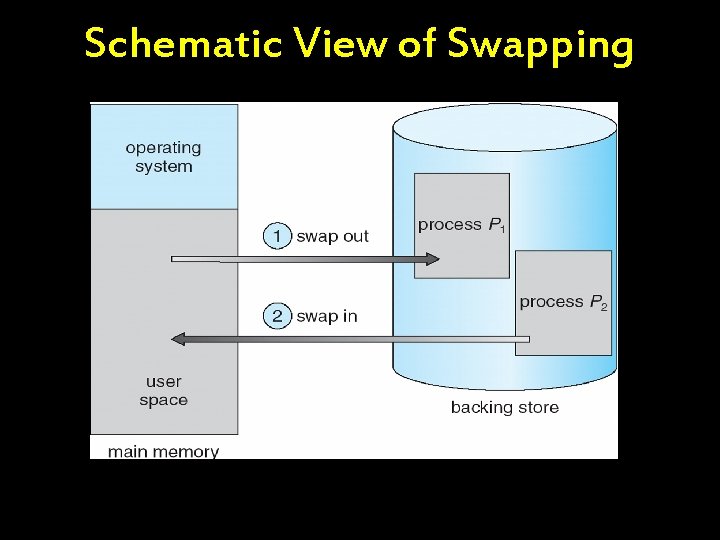
Schematic View of Swapping
Contiguous Allocation • Main memory usually into two partitions: – Resident operating system, usually held in low memo with interrupt vector – User processes then held in high memory • Relocation registers used to protect user processes from each other, and from changing operating-system code and data – Base register contains value of smallest physical address – Limit register contains range of logical addresses – each logical address must be less than the limit
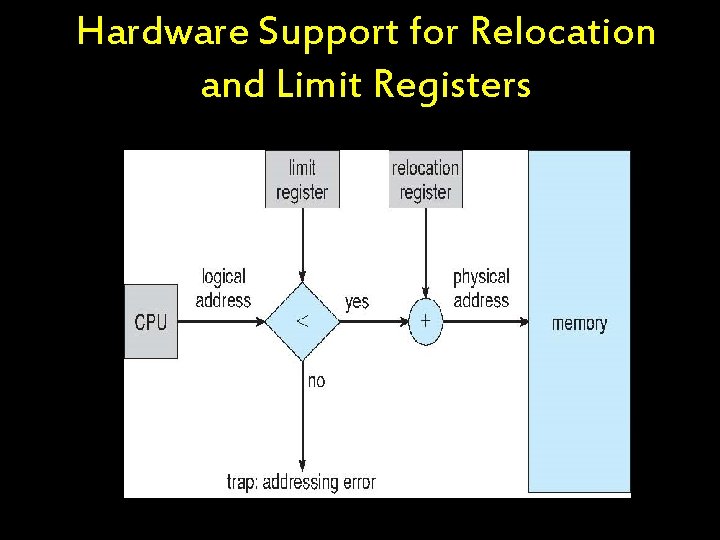
Hardware Support for Relocation and Limit Registers
Contiguous Allocation (Cont) • Multiple-partition allocation – Hole – block of available memory; holes of various size are scattered throughout memory – When a process arrives, it is allocated memory from a hole large enough to accommodate it – Operating system maintains information about: a) allocated partitions b) free partitions (hole)

Dynamic Storage-Allocation Problem How to satisfy a request of size n from a list of free holes? ? • First-fit: Allocate the first hole that is big enough • Best-fit: Allocate the smallest hole that is big enough; must search entire list, unless ordered by size – Produces the smallest leftover hole • Worst-fit: Allocate the largest hole; must also search entire list – Produces the largest leftover hole
Fragmentation External Fragmentation – total memory space exists to satisfy a request, but it is not contiguous Internal Fragmentation – allocated memory may be slightly larger than requested memory; this size difference is memory internal to a partition, but not being used Reduce external fragmentation by compaction – Shuffle memory contents to place all free memory together in one large block – Compaction is possible only if relocation is dynamic, and is done at execution time
Paging Logical address space of a process can be noncontiguous; process is allocated physical memor whenever the latter is available Divide physical memory into fixed-sized blocks calle rames (size is power of 2, between 512 bytes and 8 bytes) Divide logical memory into blocks of same size calle pages Keep track of all free frames To run a program of size n pages, need to find n free
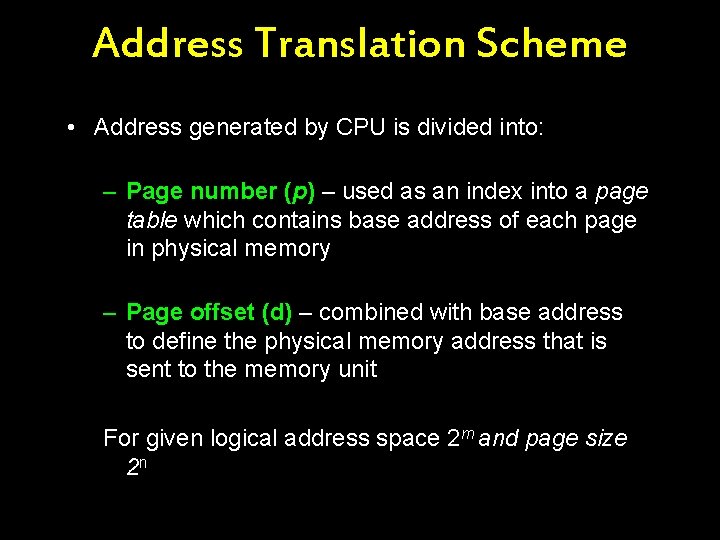
Address Translation Scheme • Address generated by CPU is divided into: – Page number (p) – used as an index into a page table which contains base address of each page in physical memory – Page offset (d) – combined with base address to define the physical memory address that is sent to the memory unit For given logical address space 2 m and page size 2 n
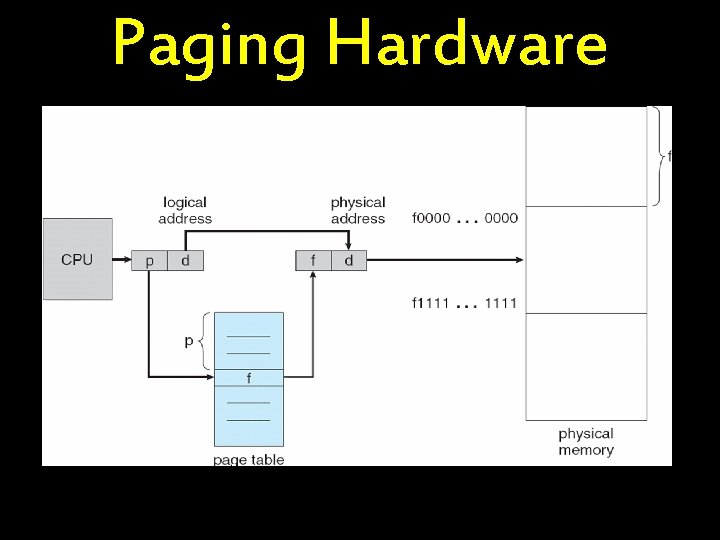
Paging Hardware
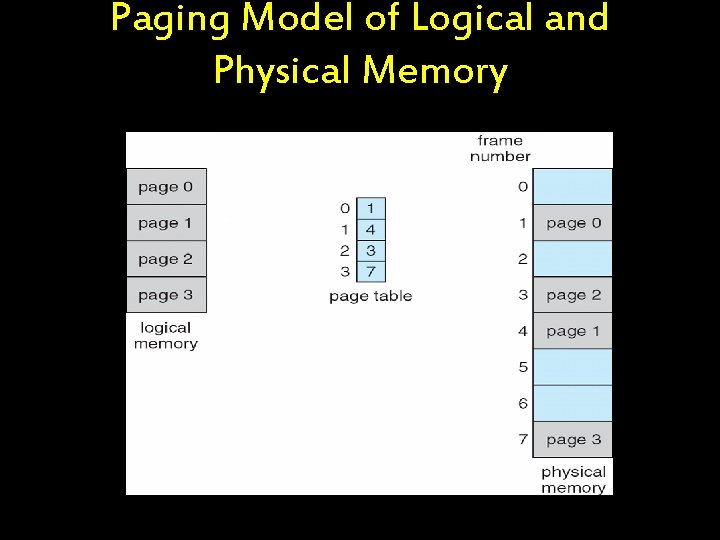
Paging Model of Logical and Physical Memory
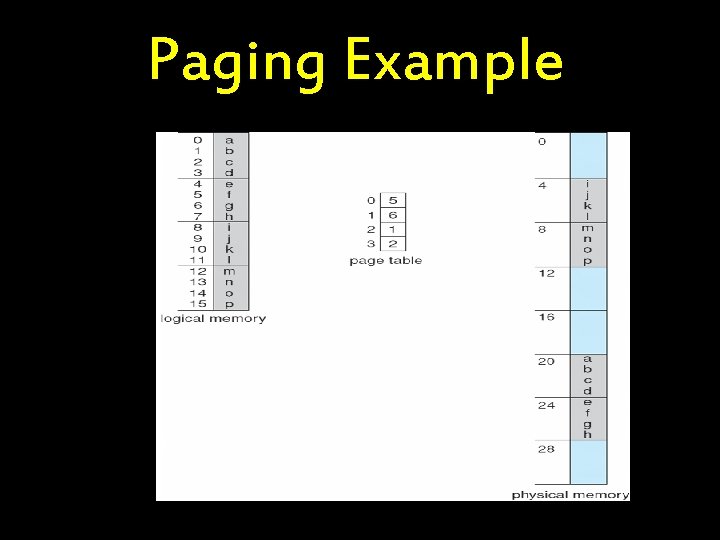
Paging Example
Memory Protection • Memory protection implemented by associating protection bit with each frame • Valid-invalid bit attached to each entry in the page table: – “valid” indicates that the associated page is in the process’ logical address space, and is thus a legal page – “invalid” indicates that the page is not in the process’ logical address space

Segmentation Memory-management scheme that supports user view of memory A program is a collection of segments – A segment is a logical unit such as: main program procedure function method object local variables, global variables common block
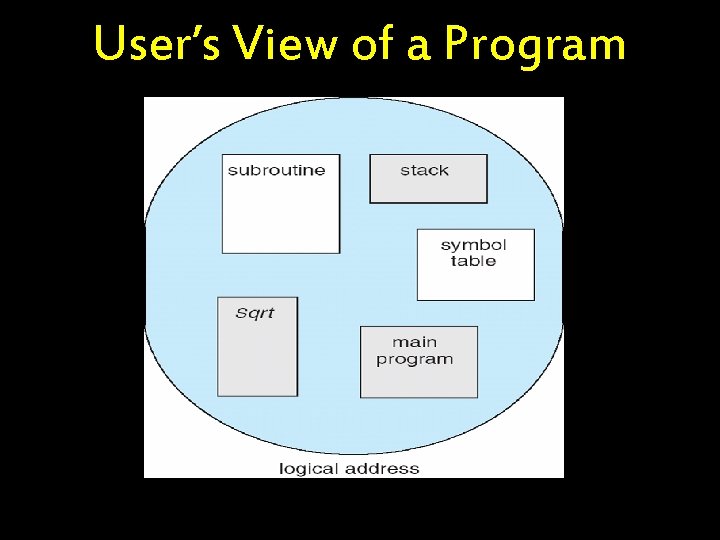
User’s View of a Program
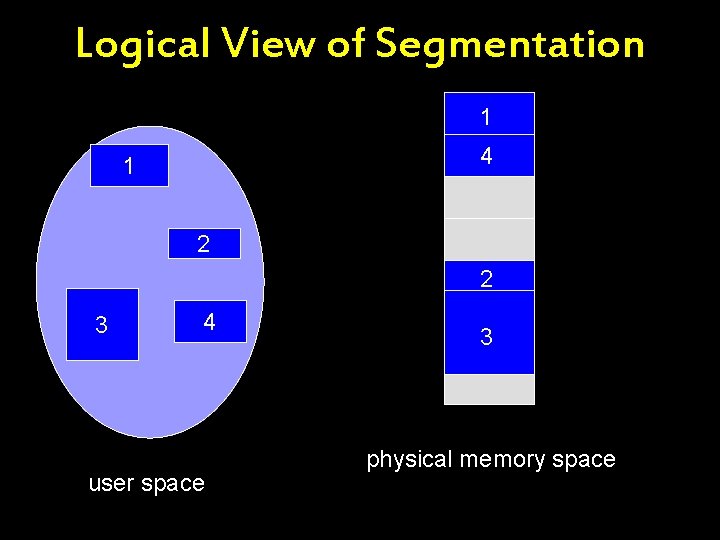
Logical View of Segmentation 1 4 1 2 2 3 4 user space 3 physical memory space
Example: The Intel Pentium • Supports both segmentation and segmentation with paging • CPU generates logical address – Given to segmentation unit • Which produces linear addresses – Linear address given to paging unit • Which generates physical address in main memory • Paging units form equivalent of MMU

Thank you You can find copy of this presentation at http: //Shashitechno. wordpress, com Questions Shashikant vaishnav Engineering College Bikaner
- Slides: 28