
Memory Management Problem Records of various lengths need
Memory Management Problem: Records (of various lengths) need to be stored. Model: A big array of space to store them, managed by a memory manager. • Like a coat-check stand, give them your coat, get back a ticket. • Later, return the ticket for your coat. • We call the ticket a handle.
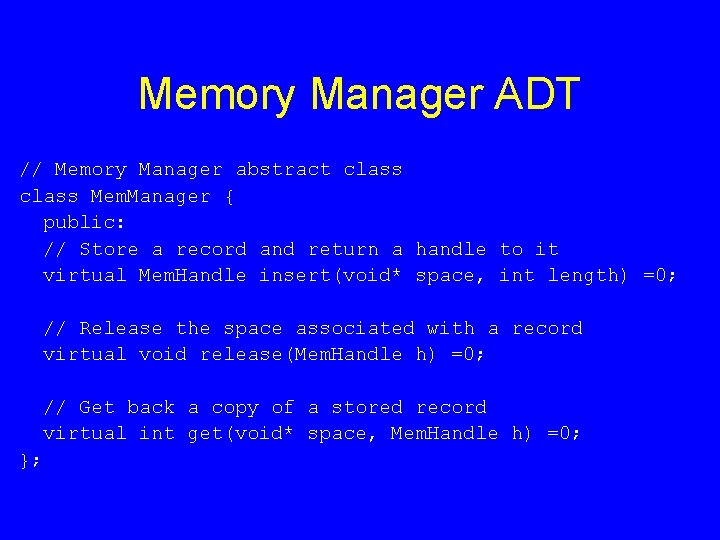
Memory Manager ADT // Memory Manager abstract class Mem. Manager { public: // Store a record and return a handle to it virtual Mem. Handle insert(void* space, int length) =0; // Release the space associated with a record virtual void release(Mem. Handle h) =0; // Get back a copy of a stored record virtual int get(void* space, Mem. Handle h) =0; };
Implementation Issues • The client doesn’t know what is in the ticket. • The memory manager doesn’t know what is in the message. • Multiple clients can share a memory manager. • The memory manager might interact with a buffer pool: – The client decides what gets stored – The memory manager decides where things get stored – The buffer pool decides when blocks are in main memory
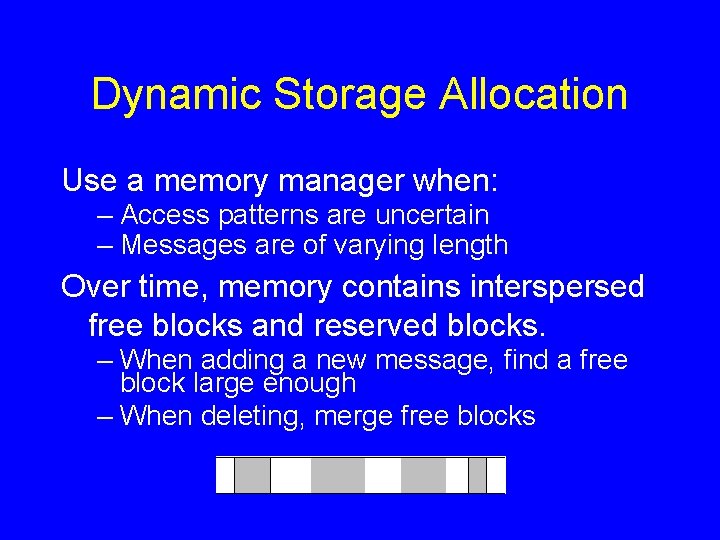
Dynamic Storage Allocation Use a memory manager when: – Access patterns are uncertain – Messages are of varying length Over time, memory contains interspersed free blocks and reserved blocks. – When adding a new message, find a free block large enough – When deleting, merge free blocks

Fragmentation Internal fragmentation: when more space is allocated than the message size. – Might be done to make memory management easier – Example: Sectors and clusters on disk External fragmentation: Free blocks too small to be useful.
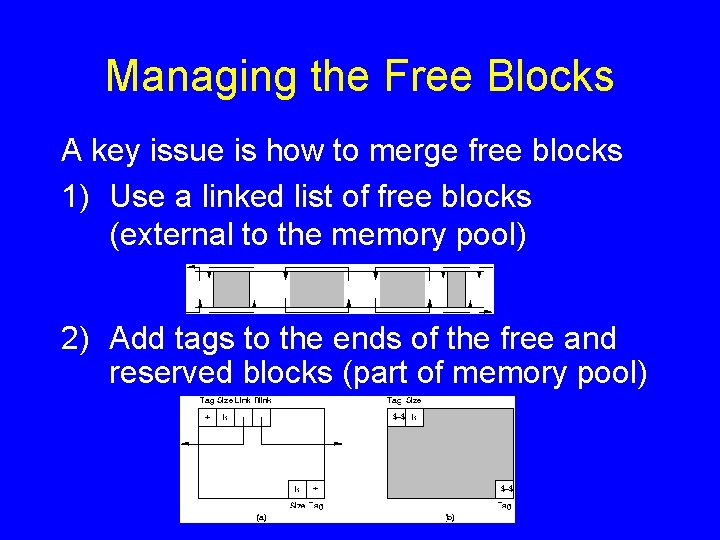
Managing the Free Blocks A key issue is how to merge free blocks 1) Use a linked list of free blocks (external to the memory pool) 2) Add tags to the ends of the free and reserved blocks (part of memory pool)
Selecting a Free Block Somehow, need to pick one of the free blocks in which to store the message • It must be at least as large as the message (plus whatever info the memory manager needs, such as size and tags) • Extra space can be returned as a free block • Want to minimize fragmentation, and avoid failing to service requests
Sequential Fit Methods • First Fit: Start from beginning, pick first free block that is big enough – Store list in memory-pool order – Circular first fit: Move forward from current position • Best Fit: Pick the smallest block big enough – Store by block size, or search list – Protect large blocks for big requests • Worst Fit: Pick the biggest block – Store by block size, or search list – Avoid external fragmentation
Failure Policies What do we do if there is no free block that can hold the message? Must resort to a failure policy. • • Reject the request Grow the memory Compact the memory Garbage collection
- Slides: 9