
Memory Management Prepared By Prof Alok Haldar Department
Memory Management Prepared By Prof. Alok Haldar Department of Computer Science Kharagpur College Prepared By, Prof. Alok Haldar, Dept. of Comp. Sc. , Kharagpur College
Memory Management • Background • Swapping • Contiguous Allocation • Paging • Segmentation with Paging Prepared By, Prof. Alok Haldar, Dept. of Comp. Sc. , Kharagpur College
Background • Program must be brought into memory and placed within a process for it to be run. • Input queue – collection of processes on the disk that are waiting to be brought into memory to run the program. • User programs go through several steps before being run. Prepared By, Prof. Alok Haldar, Dept. of Comp. Sc. , Kharagpur College
Binding of Instructions and Data to Memory Address binding of instructions and data to memory addresses can happen at three different stages. • Compile time: If memory location known a priori, absolute code can be generated; must recompile code if starting location changes. • Load time: Must generate relocatable code if memory location is not known at compile time. • Execution time: Binding delayed until run time if the process can be moved during its execution from one memory segment to another. Need hardware support for address maps (e. g. , base and limit registers). Prepared By, Prof. Alok Haldar, Dept. of Comp. Sc. , Kharagpur College
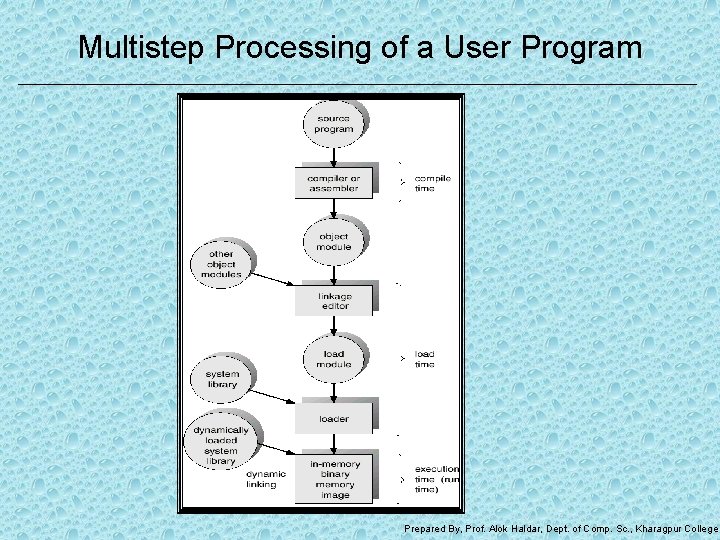
Multistep Processing of a User Program Prepared By, Prof. Alok Haldar, Dept. of Comp. Sc. , Kharagpur College

Logical vs. Physical Address Space • The concept of a logical address space that is bound to a separate physical address space is central to proper memory management. – Logical address – generated by the CPU; also referred to as virtual address. – Physical address – address seen by the memory unit. • Logical and physical addresses are the same in compile-time and load-time address-binding schemes; logical (virtual) and physical addresses differ in execution-time address-binding scheme. Prepared By, Prof. Alok Haldar, Dept. of Comp. Sc. , Kharagpur College
Memory-Management Unit (MMU) • Hardware device that maps virtual to physical address. • In MMU scheme, the value in the relocation register is added to every address generated by a user process at the time it is sent to memory. • The user program deals with logical addresses; it never sees the real physical addresses Prepared By, Prof. Alok Haldar, Dept. of Comp. Sc. , Kharagpur College
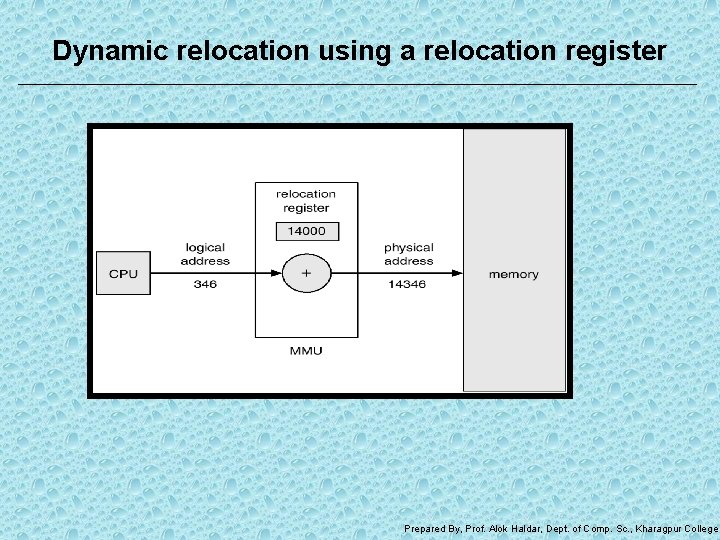
Dynamic relocation using a relocation register Prepared By, Prof. Alok Haldar, Dept. of Comp. Sc. , Kharagpur College
Dynamic Loading • Routine is not loaded until it is called • Better memory-space utilization; unused routine is never loaded. • Useful when large amounts of code are needed to handle infrequently occurring cases. • No special support from the operating system is required implemented through program design. Prepared By, Prof. Alok Haldar, Dept. of Comp. Sc. , Kharagpur College
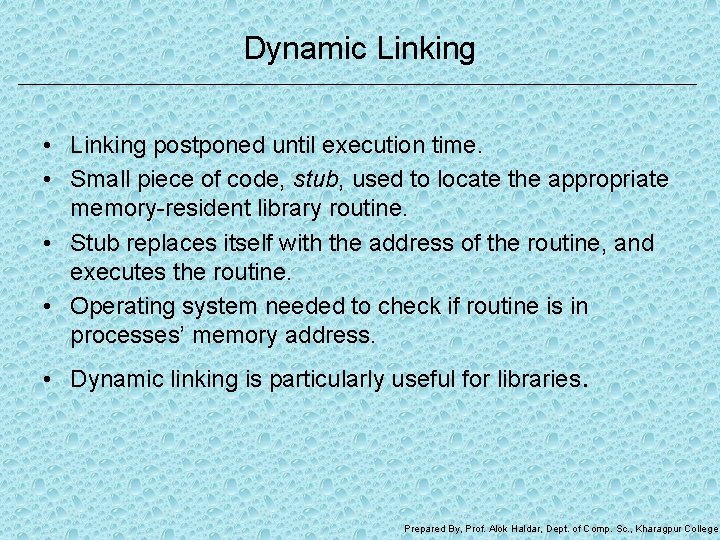
Dynamic Linking • Linking postponed until execution time. • Small piece of code, stub, used to locate the appropriate memory-resident library routine. • Stub replaces itself with the address of the routine, and executes the routine. • Operating system needed to check if routine is in processes’ memory address. • Dynamic linking is particularly useful for libraries. Prepared By, Prof. Alok Haldar, Dept. of Comp. Sc. , Kharagpur College
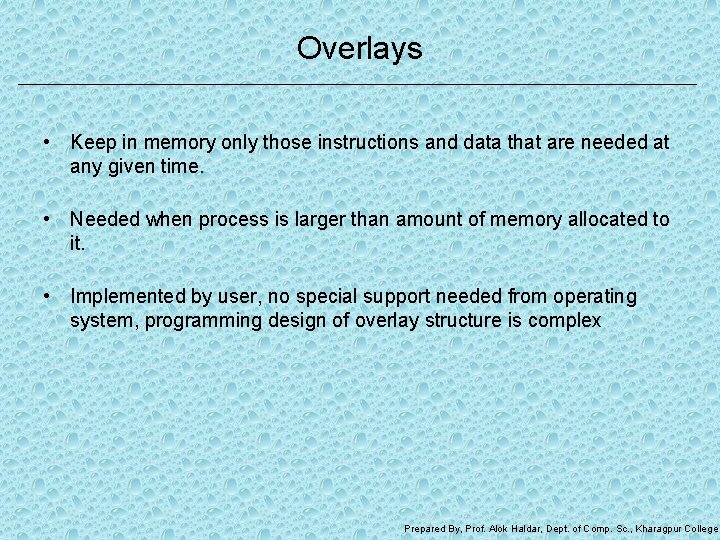
Overlays • Keep in memory only those instructions and data that are needed at any given time. • Needed when process is larger than amount of memory allocated to it. • Implemented by user, no special support needed from operating system, programming design of overlay structure is complex Prepared By, Prof. Alok Haldar, Dept. of Comp. Sc. , Kharagpur College
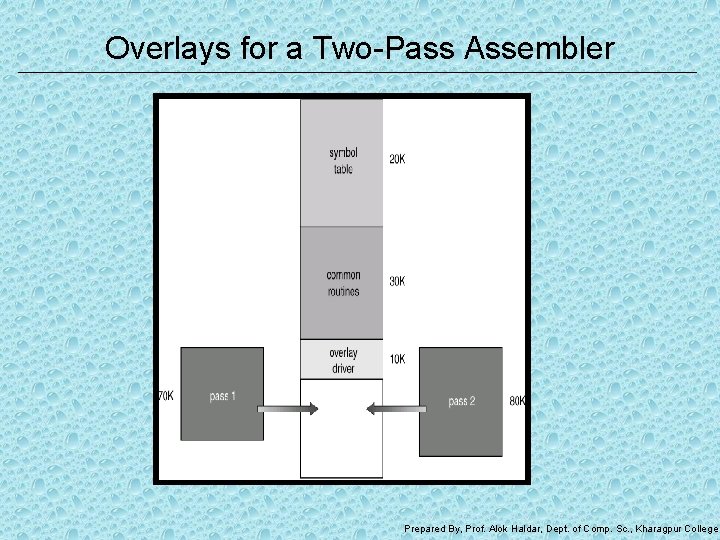
Overlays for a Two-Pass Assembler Prepared By, Prof. Alok Haldar, Dept. of Comp. Sc. , Kharagpur College
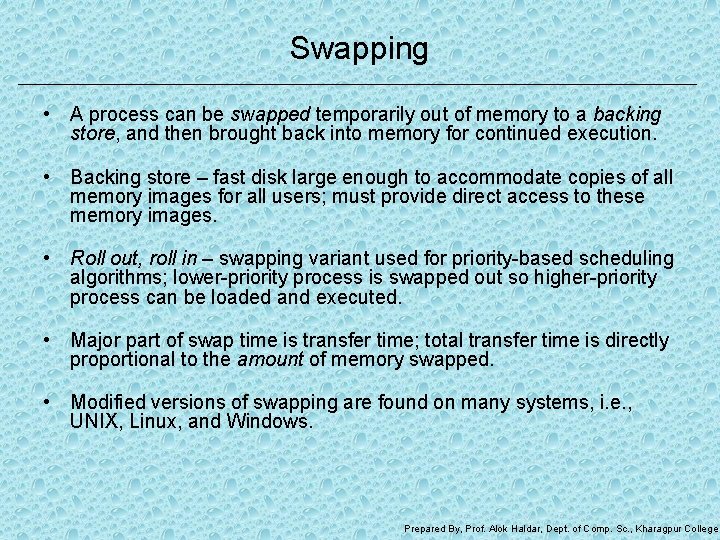
Swapping • A process can be swapped temporarily out of memory to a backing store, and then brought back into memory for continued execution. • Backing store – fast disk large enough to accommodate copies of all memory images for all users; must provide direct access to these memory images. • Roll out, roll in – swapping variant used for priority-based scheduling algorithms; lower-priority process is swapped out so higher-priority process can be loaded and executed. • Major part of swap time is transfer time; total transfer time is directly proportional to the amount of memory swapped. • Modified versions of swapping are found on many systems, i. e. , UNIX, Linux, and Windows. Prepared By, Prof. Alok Haldar, Dept. of Comp. Sc. , Kharagpur College
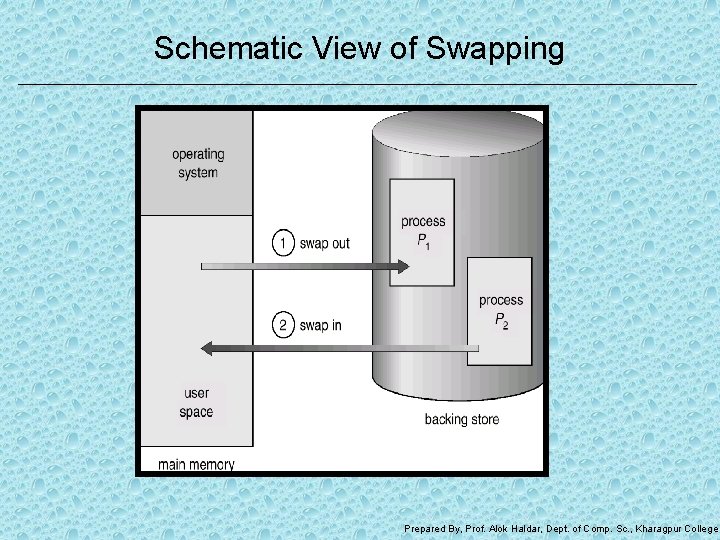
Schematic View of Swapping Prepared By, Prof. Alok Haldar, Dept. of Comp. Sc. , Kharagpur College
Contiguous Allocation • Main memory usually into two partitions: – Resident operating system, usually held in low memory with interrupt vector. – User processes then held in high memory. • Single-partition allocation – Relocation-register scheme used to protect user processes from each other, and from changing operating-system code and data. – Relocation register contains value of smallest physical address; limit register contains range of logical addresses – each logical address must be less than the limit register Prepared By, Prof. Alok Haldar, Dept. of Comp. Sc. , Kharagpur College
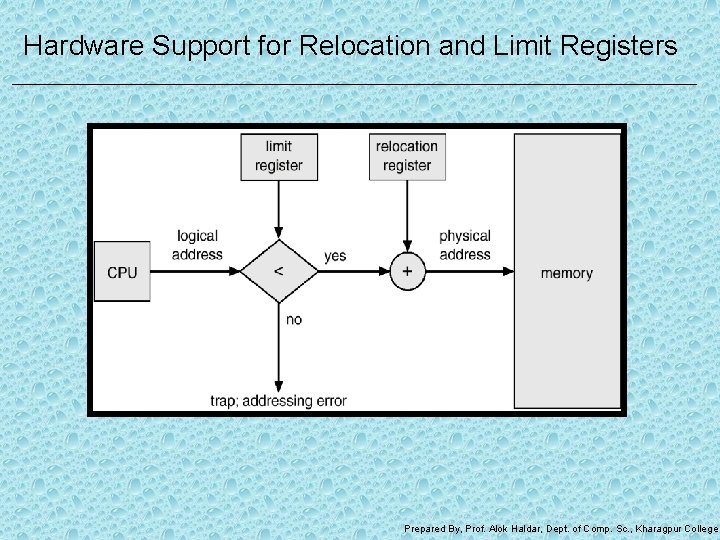
Hardware Support for Relocation and Limit Registers Prepared By, Prof. Alok Haldar, Dept. of Comp. Sc. , Kharagpur College
- Slides: 16