
Memory management Jordi Cortadella and Jordi Petit Department
![Allocating/deallocating arrays new and delete can also create/destroy arrays of objects c my. Class[0]](https://slidetodoc.com/presentation_image/e9dfd85d8498ead16aafd281ebf08252/image-7.jpg "Allocating/deallocating arrays new and delete can also create/destroy arrays of objects c my. Class[0]")
![References: examples auto & r = x[get. Index(a, b)]. val; . . . r.](https://slidetodoc.com/presentation_image/e9dfd85d8498ead16aafd281ebf08252/image-9.jpg "References: examples auto & r = x[get. Index(a, b)]. val; . . . r.")
![The Vector class the. Size: the. Capacity: objects: 3 5 a[0] a[1] a[2] the.](https://slidetodoc.com/presentation_image/e9dfd85d8498ead16aafd281ebf08252/image-15.jpg "The Vector class the. Size: the. Capacity: objects: 3 5 a[0] a[1] a[2] the.")
![C: arrays int a[100]; // an array of 100 int’s double m[30][40]; // a](https://slidetodoc.com/presentation_image/e9dfd85d8498ead16aafd281ebf08252/image-31.jpg "C: arrays int a[100]; // an array of 100 int’s double m[30][40]; // a")
![C arrays and C++ vectors double sum(double v[], int n) { double s =](https://slidetodoc.com/presentation_image/e9dfd85d8498ead16aafd281ebf08252/image-33.jpg "C arrays and C++ vectors double sum(double v[], int n) { double s =")
- Slides: 38
Memory management Jordi Cortadella and Jordi Petit Department of Computer Science
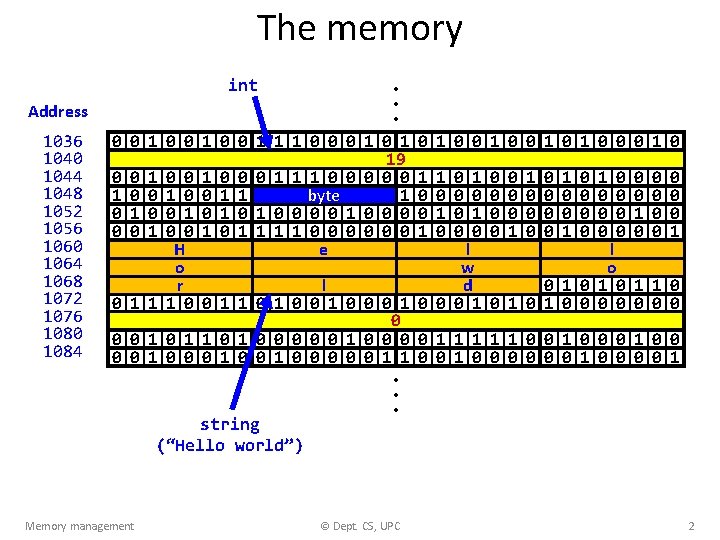
The memory int Address 1036 1040 1044 1048 1052 1056 1060 1064 1068 1072 1076 1080 1084 0 0 0 1 0 0 0 0 0 1 0 1 0 0 1 1 0 0 0 1 H 1 1 o 0 0 r 1 1 0 0 1 0 1 0 0 0 0 1 1 0 0 0 1 0 1 0 1 0 0 0 1 1 0 0 0 0 1 0 1 0 1 0 0 1 0 0 0 0 string (“Hello world”) Memory management 0 0 0 1 0 0 byte 0 1 0 0 0 1 e 0 0 1 1 l 0 1 0 0 0 1 0 0 1 1 1 0 0 • • • 0 1 0 0190 0 1 0 0 0 1 1 1 0 000 0 0 1 1 0 • • • © Dept. CS, UPC 1 0 1 0 0 0 1 0 0 0 l 1 1 w 0 0 d 0 0 1 1 1 0 0 0 0 1 0 0 0 0 0 0 1 0 0 1 0 0 0 0 0 0 1 0 1 0 0 0 0 1 l 0 0 o 1 1 0 0 0 0 1 0 1 1 0 0 0 1 0 0 1 2
Pointers • Given a type T, T* is another type called “pointer to T”. It holds the memory address of an object of type T. • Examples: int* pi; my. Class* p. C; • Pointers are often used to manage the memory space of dynamic data structures. • In some cases, it might be convenient to obtain the address of a variable during runtime. Memory management © Dept. CS, UPC 3
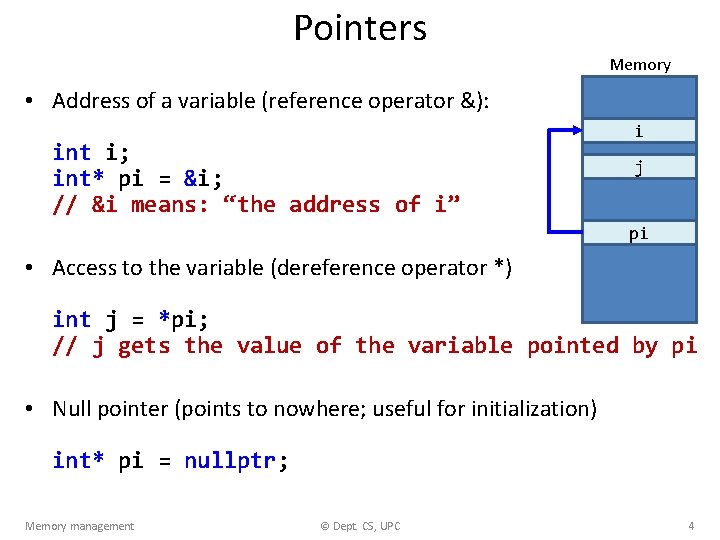
Pointers Memory • Address of a variable (reference operator &): int i; int* pi = &i; // &i means: “the address of i” i j pi • Access to the variable (dereference operator *) int j = *pi; // j gets the value of the variable pointed by pi • Null pointer (points to nowhere; useful for initialization) int* pi = nullptr; Memory management © Dept. CS, UPC 4
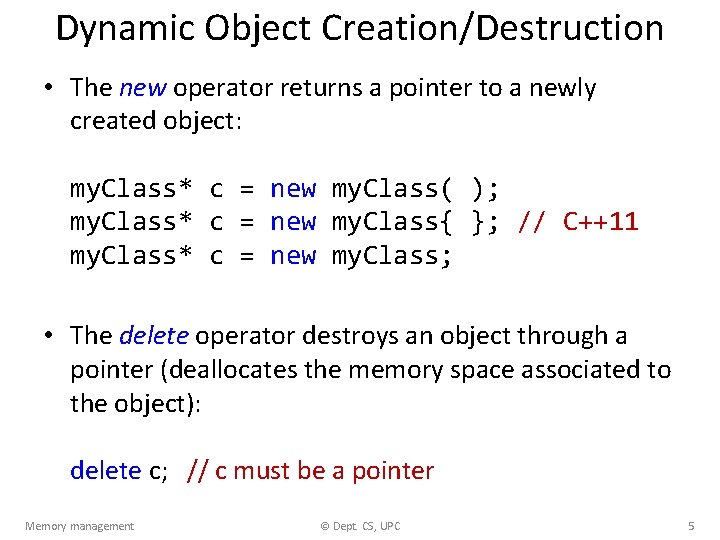
Dynamic Object Creation/Destruction • The new operator returns a pointer to a newly created object: my. Class* c = new my. Class( ); my. Class* c = new my. Class{ }; // C++11 my. Class* c = new my. Class; • The delete operator destroys an object through a pointer (deallocates the memory space associated to the object): delete c; // c must be a pointer Memory management © Dept. CS, UPC 5
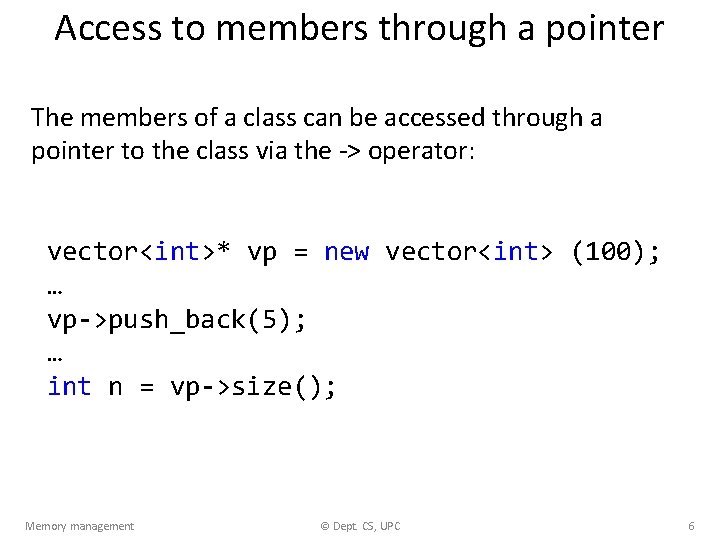
Access to members through a pointer The members of a class can be accessed through a pointer to the class via the -> operator: vector<int>* vp = new vector<int> (100); … vp->push_back(5); … int n = vp->size(); Memory management © Dept. CS, UPC 6
Allocating/deallocating arrays new and delete can also create/destroy arrays of objects c my. Class[0] my. Class[1] my. Class[2] my. Class[3] my. Class[4] my. Class[5] my. Class[6] my. Class[7] my. Class[8] // c is a pointer to an // array of objects my. Class* c = new my. Class[10]; // c[i] refers to one of the // elements of the array c[i]. some_method_of_my. Class(); // deallocating the array delete [] c; my. Class[9] Memory management © Dept. CS, UPC 7
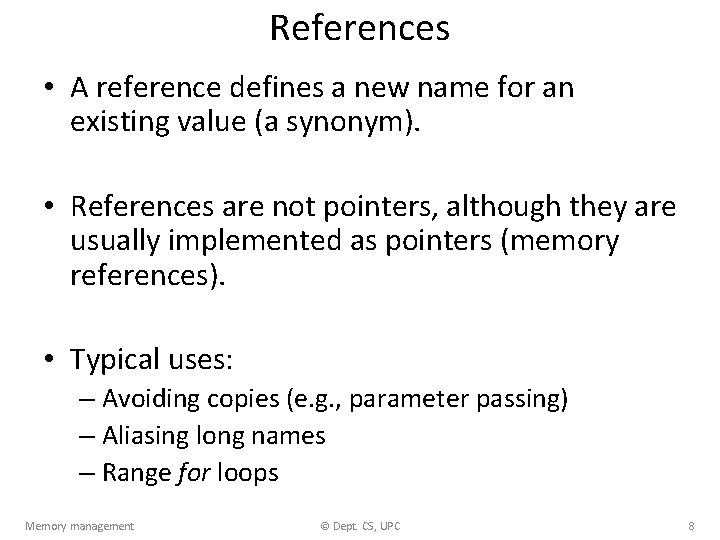
References • A reference defines a new name for an existing value (a synonym). • References are not pointers, although they are usually implemented as pointers (memory references). • Typical uses: – Avoiding copies (e. g. , parameter passing) – Aliasing long names – Range for loops Memory management © Dept. CS, UPC 8
References: examples auto & r = x[get. Index(a, b)]. val; . . . r. define. Value(n); // avoids a long name for r. . . // avoids a copy of a large data structure big. Vector & V = my. Matrix. get. Row(i); . . . // An alternative for the following loop: // for (int i =0; i < a. size(); ++i) ++a[i]; for (auto x: arr) ++x; // does not work (why? ) for (auto & x: arr) ++x; // it works! Memory management © Dept. CS, UPC 9
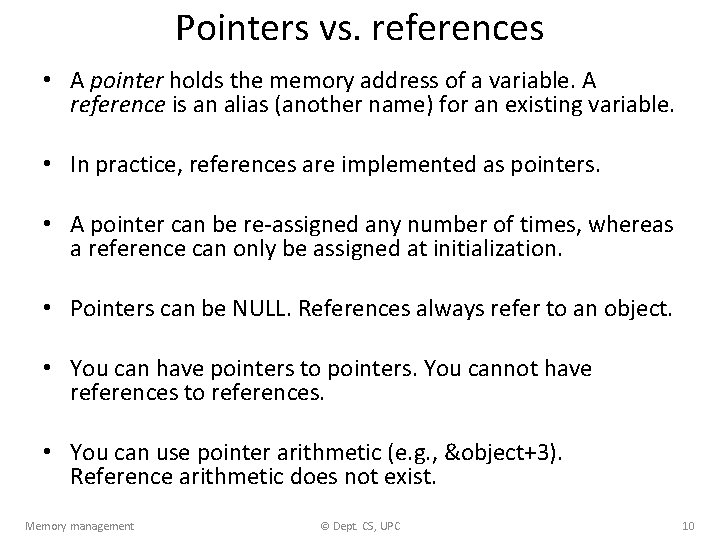
Pointers vs. references • A pointer holds the memory address of a variable. A reference is an alias (another name) for an existing variable. • In practice, references are implemented as pointers. • A pointer can be re-assigned any number of times, whereas a reference can only be assigned at initialization. • Pointers can be NULL. References always refer to an object. • You can have pointers to pointers. You cannot have references to references. • You can use pointer arithmetic (e. g. , &object+3). Reference arithmetic does not exist. Memory management © Dept. CS, UPC 10
The Vector class (an approximation to the STL vector class)
The Vector class • The natural replacement of C-style arrays. • Main advantages: – – It can dynamically grow and shrink. It is a template class (can handle any type T) No need to take care of the allocated memory. Data is allocated in a contiguous memory area. • We will implement a Vector class, a simplified version of STL’s vector. • Based on Weiss’ book (4 th edition), see Chapter 3. 4. Memory management © Dept. CS, UPC 12
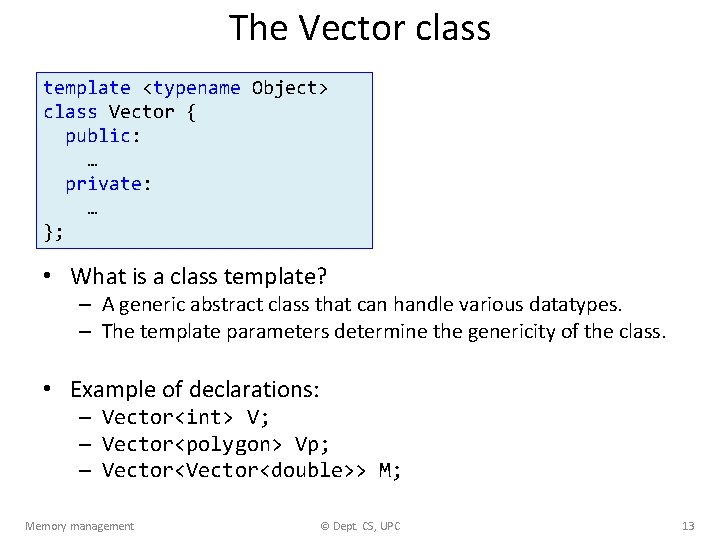
The Vector class template <typename Object> class Vector { public: … private: … }; • What is a class template? – A generic abstract class that can handle various datatypes. – The template parameters determine the genericity of the class. • Example of declarations: – Vector<int> V; – Vector<polygon> Vp; – Vector<double>> M; Memory management © Dept. CS, UPC 13
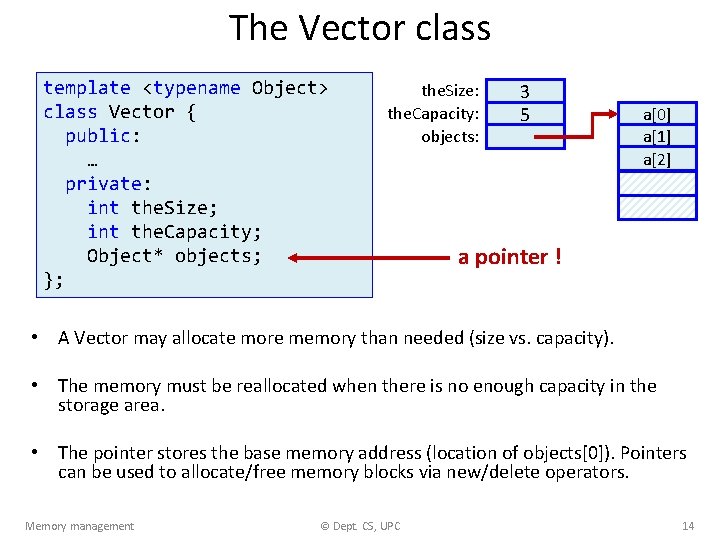
The Vector class template <typename Object> class Vector { public: … private: int the. Size; int the. Capacity; Object* objects; }; the. Size: the. Capacity: objects: 3 5 a[0] a[1] a[2] a pointer ! • A Vector may allocate more memory than needed (size vs. capacity). • The memory must be reallocated when there is no enough capacity in the storage area. • The pointer stores the base memory address (location of objects[0]). Pointers can be used to allocate/free memory blocks via new/delete operators. Memory management © Dept. CS, UPC 14
The Vector class the. Size: the. Capacity: objects: 3 5 a[0] a[1] a[2] the. Size: the. Capacity: objects: 4 5 a[0] a[1] a[2] a[3] a. push_back(…) ? Memory management the. Size: the. Capacity: objects: a. push_back(…) © Dept. CS, UPC 5 5 a[0] a[1] a[2] a[3] a[4] 15
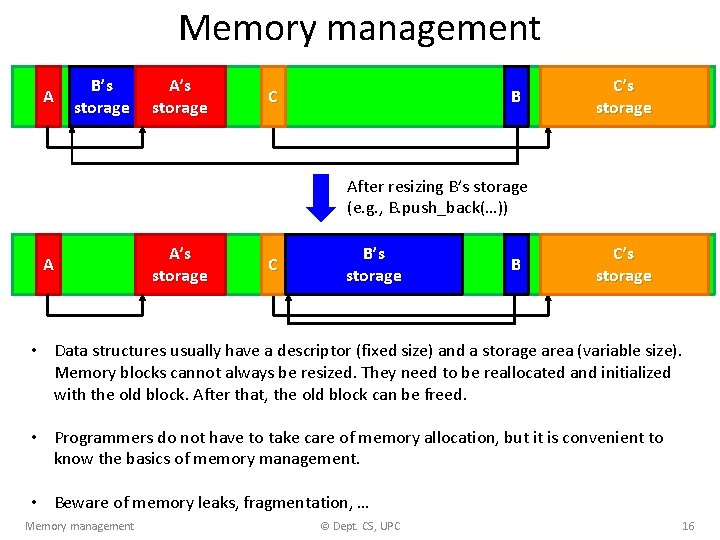
Memory management A B’s storage A’s storage C B C’s storage After resizing B’s storage (e. g. , B. push_back(…)) A A’s storage C B’s storage B C’s storage • Data structures usually have a descriptor (fixed size) and a storage area (variable size). Memory blocks cannot always be resized. They need to be reallocated and initialized with the old block. After that, the old block can be freed. • Programmers do not have to take care of memory allocation, but it is convenient to know the basics of memory management. • Beware of memory leaks, fragmentation, … Memory management © Dept. CS, UPC 16
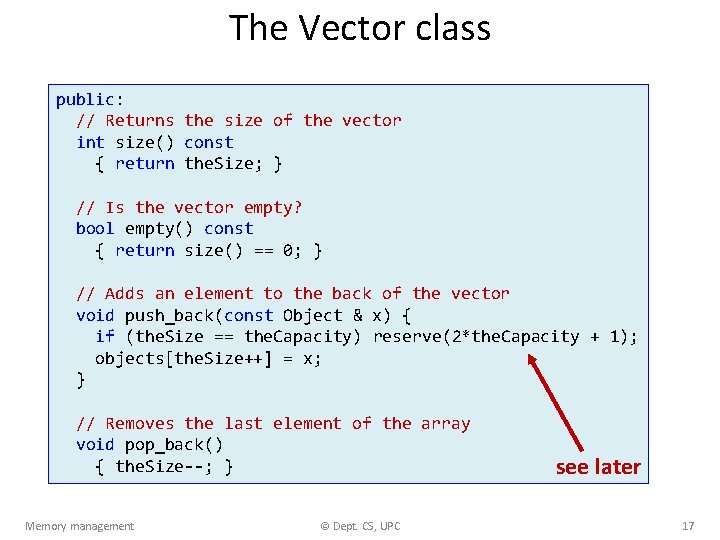
The Vector class public: // Returns the size of the vector int size() const { return the. Size; } // Is the vector empty? bool empty() const { return size() == 0; } // Adds an element to the back of the vector void push_back(const Object & x) { if (the. Size == the. Capacity) reserve(2*the. Capacity + 1); objects[the. Size++] = x; } // Removes the last element of the array void pop_back() { the. Size--; } Memory management © Dept. CS, UPC see later 17
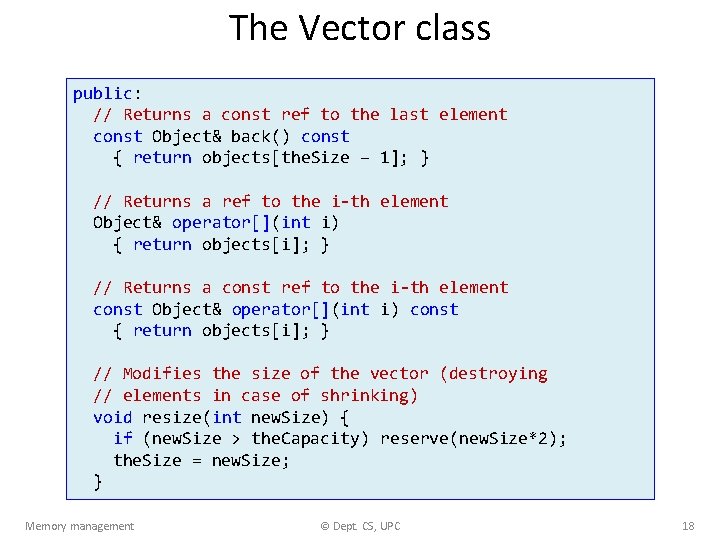
The Vector class public: // Returns a const ref to the last element const Object& back() const { return objects[the. Size – 1]; } // Returns a ref to the i-th element Object& operator[](int i) { return objects[i]; } // Returns a const ref to the i-th element const Object& operator[](int i) const { return objects[i]; } // Modifies the size of the vector (destroying // elements in case of shrinking) void resize(int new. Size) { if (new. Size > the. Capacity) reserve(new. Size*2); the. Size = new. Size; } Memory management © Dept. CS, UPC 18
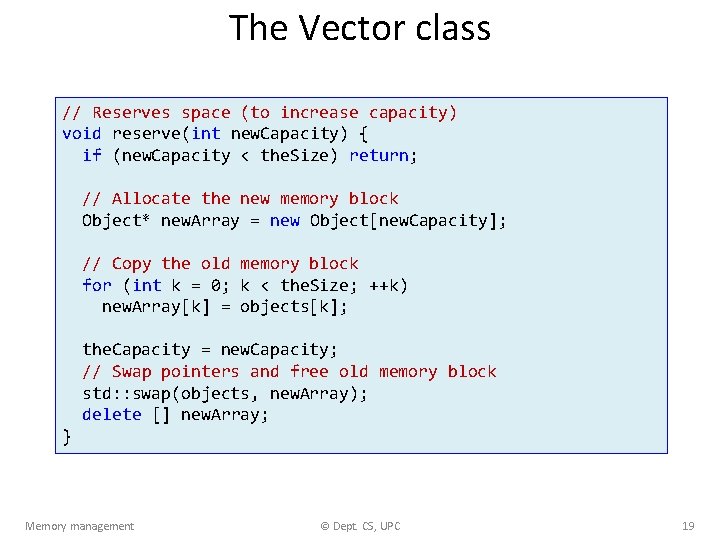
The Vector class // Reserves space (to increase capacity) void reserve(int new. Capacity) { if (new. Capacity < the. Size) return; // Allocate the new memory block Object* new. Array = new Object[new. Capacity]; // Copy the old memory block for (int k = 0; k < the. Size; ++k) new. Array[k] = objects[k]; the. Capacity = new. Capacity; // Swap pointers and free old memory block std: : swap(objects, new. Array); delete [] new. Array; } Memory management © Dept. CS, UPC 19
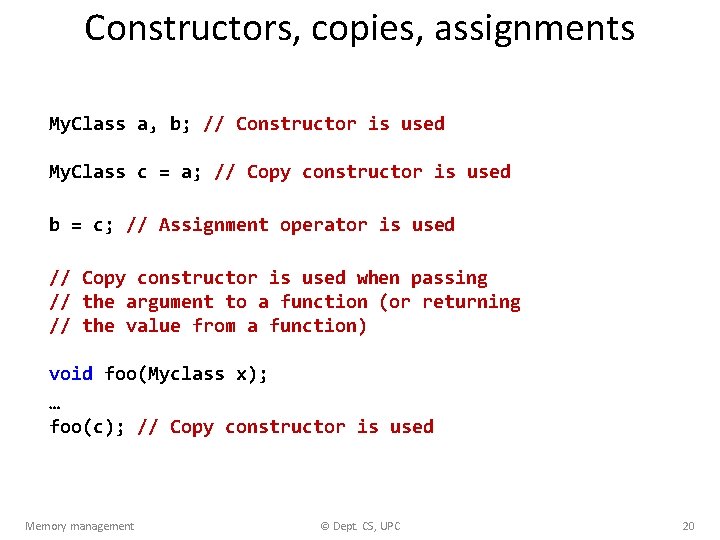
Constructors, copies, assignments My. Class a, b; // Constructor is used My. Class c = a; // Copy constructor is used b = c; // Assignment operator is used // Copy constructor is used when passing // the argument to a function (or returning // the value from a function) void foo(Myclass x); … foo(c); // Copy constructor is used Memory management © Dept. CS, UPC 20
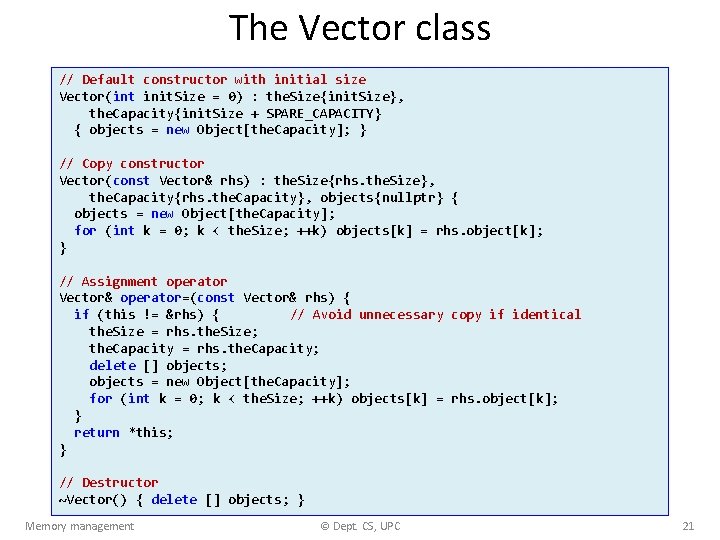
The Vector class // Default constructor with initial size Vector(int init. Size = 0) : the. Size{init. Size}, the. Capacity{init. Size + SPARE_CAPACITY} { objects = new Object[the. Capacity]; } // Copy constructor Vector(const Vector& rhs) : the. Size{rhs. the. Size}, the. Capacity{rhs. the. Capacity}, objects{nullptr} { objects = new Object[the. Capacity]; for (int k = 0; k < the. Size; ++k) objects[k] = rhs. object[k]; } // Assignment operator Vector& operator=(const Vector& rhs) { if (this != &rhs) { // Avoid unnecessary copy if identical the. Size = rhs. the. Size; the. Capacity = rhs. the. Capacity; delete [] objects; objects = new Object[the. Capacity]; for (int k = 0; k < the. Size; ++k) objects[k] = rhs. object[k]; } return *this; } // Destructor ~Vector() { delete [] objects; } Memory management © Dept. CS, UPC 21
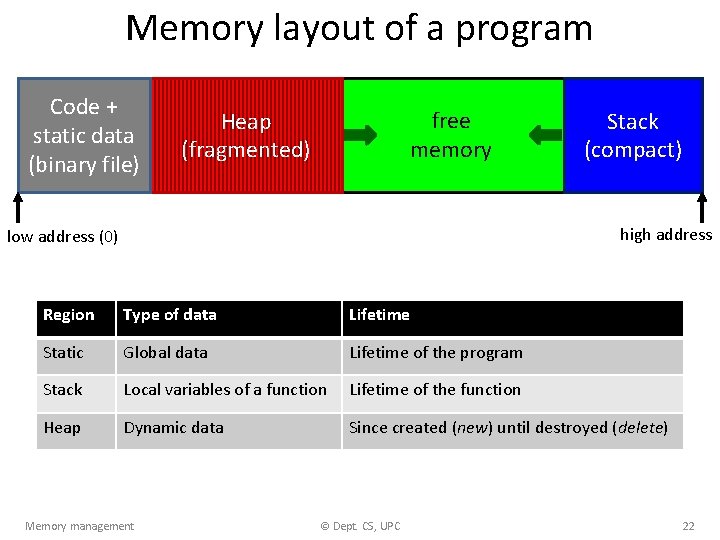
Memory layout of a program Code + static data (binary file) free memory Heap (fragmented) Stack (compact) high address low address (0) Region Type of data Lifetime Static Global data Lifetime of the program Stack Local variables of a function Lifetime of the function Heap Dynamic data Since created (new) until destroyed (delete) Memory management © Dept. CS, UPC 22
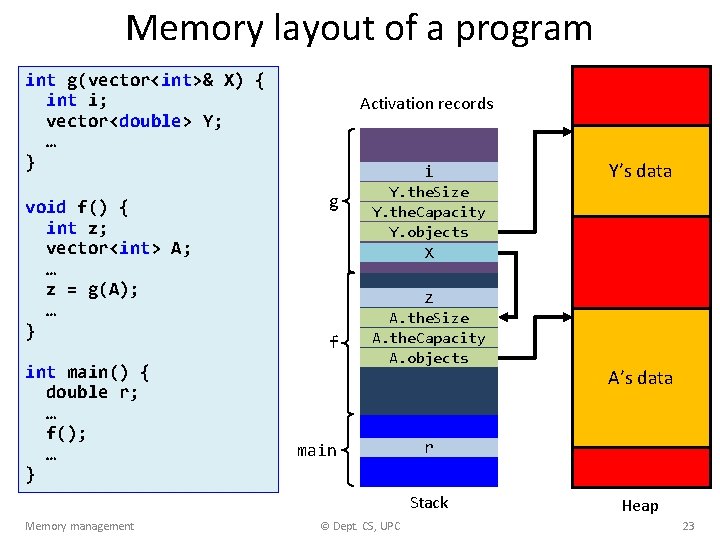
Memory layout of a program int g(vector<int>& X) { int i; vector<double> Y; … } void f() { int z; vector<int> A; … z = g(A); … } int main() { double r; … f(); … } Activation records i g Y. the. Size Y. the. Capacity Y. objects X z f A. the. Size A. the. Capacity A. objects main © Dept. CS, UPC A’s data r Stack Memory management Y’s data Heap 23
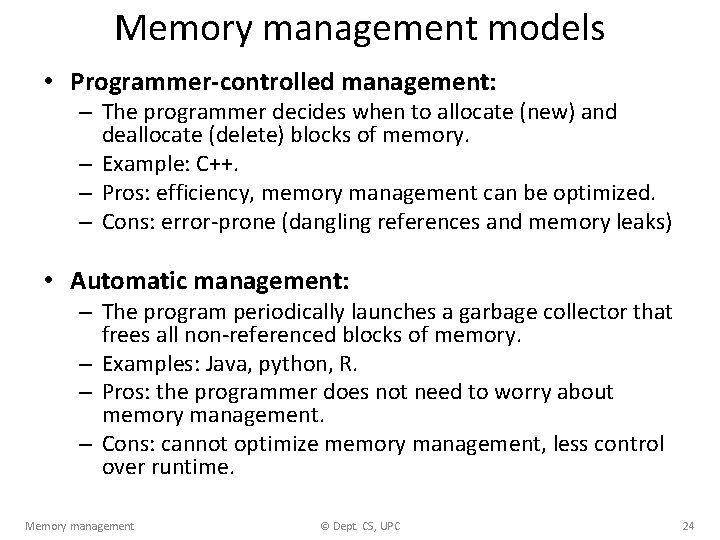
Memory management models • Programmer-controlled management: – The programmer decides when to allocate (new) and deallocate (delete) blocks of memory. – Example: C++. – Pros: efficiency, memory management can be optimized. – Cons: error-prone (dangling references and memory leaks) • Automatic management: – The program periodically launches a garbage collector that frees all non-referenced blocks of memory. – Examples: Java, python, R. – Pros: the programmer does not need to worry about memory management. – Cons: cannot optimize memory management, less control over runtime. Memory management © Dept. CS, UPC 24
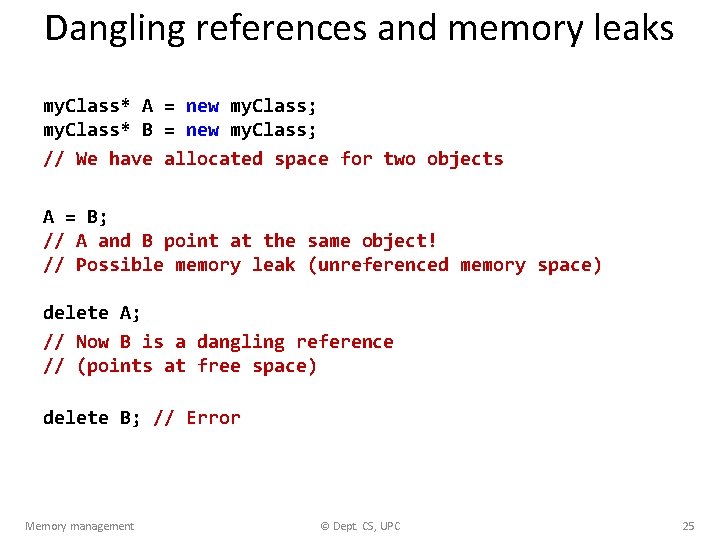
Dangling references and memory leaks my. Class* A = new my. Class; my. Class* B = new my. Class; // We have allocated space for two objects A = B; // A and B point at the same object! // Possible memory leak (unreferenced memory space) delete A; // Now B is a dangling reference // (points at free space) delete B; // Error Memory management © Dept. CS, UPC 25
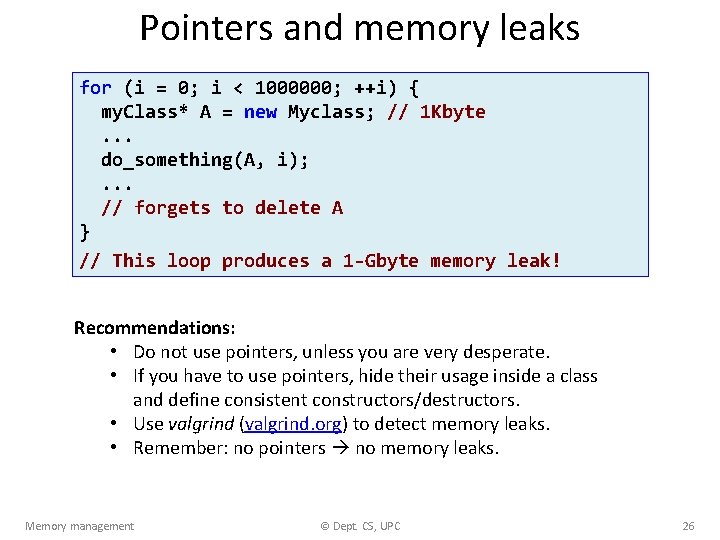
Pointers and memory leaks for (i = 0; i < 1000000; ++i) { my. Class* A = new Myclass; // 1 Kbyte. . . do_something(A, i); . . . // forgets to delete A } // This loop produces a 1 -Gbyte memory leak! Recommendations: • Do not use pointers, unless you are very desperate. • If you have to use pointers, hide their usage inside a class and define consistent constructors/destructors. • Use valgrind (valgrind. org) to detect memory leaks. • Remember: no pointers no memory leaks. Memory management © Dept. CS, UPC 26
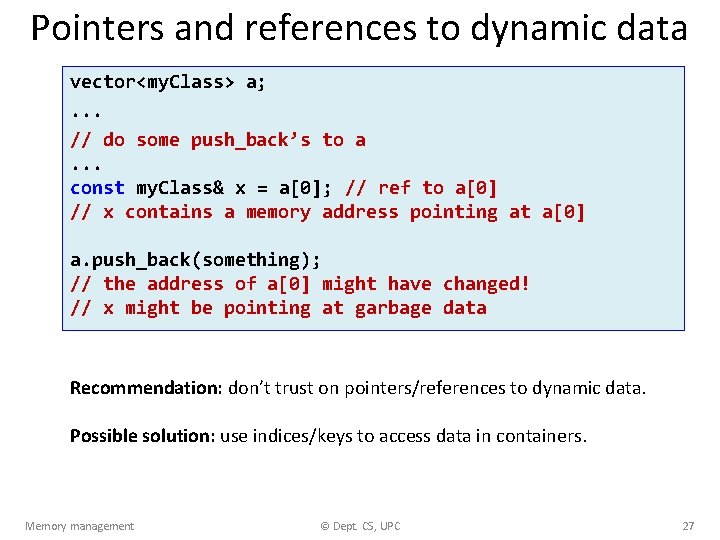
Pointers and references to dynamic data vector<my. Class> a; . . . // do some push_back’s to a. . . const my. Class& x = a[0]; // ref to a[0] // x contains a memory address pointing at a[0] a. push_back(something); // the address of a[0] might have changed! // x might be pointing at garbage data Recommendation: don’t trust on pointers/references to dynamic data. Possible solution: use indices/keys to access data in containers. Memory management © Dept. CS, UPC 27
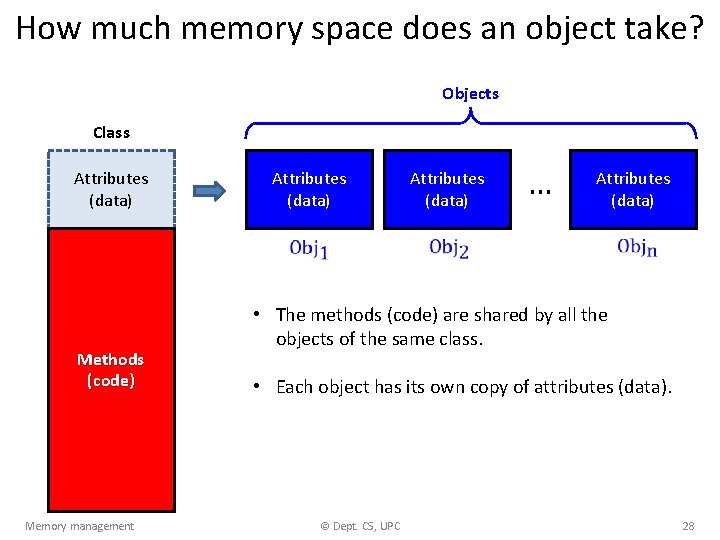
How much memory space does an object take? Objects Class Attributes (data) Memory management … Attributes (data) Methods (code) Attributes (data) • The methods (code) are shared by all the objects of the same class. • Each object has its own copy of attributes (data). © Dept. CS, UPC 28
About C (the predecessor of C++) • Developed by Dennis Ritchie at Bell Labs and used to re-implement Unix. • It was designed to be easily mappable to machine instructions and provide low-level memory access. • Today, it is still necessary to use some C libraries, designed by skilled experts, that have not been rewritten in other languages (the same happens with some FORTRAN libraries). • Some aspects that must be known to interface with C libraries: – No references (only pointers). – No object-oriented support (no STL, no vectors, no maps, etc). – Vectors must be implemented as arrays. Memory management © Dept. CS, UPC 29
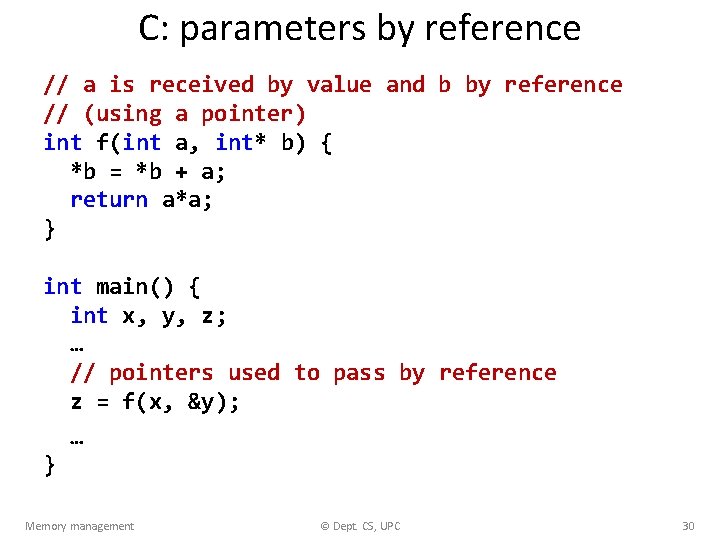
C: parameters by reference // a is received by value and b by reference // (using a pointer) int f(int a, int* b) { *b = *b + a; return a*a; } int main() { int x, y, z; … // pointers used to pass by reference z = f(x, &y); … } Memory management © Dept. CS, UPC 30
C: arrays int a[100]; // an array of 100 int’s double m[30][40]; // a matrix of size 30 x 40 int c[]; // also int* c: an array of unknown size char* s; // a string (array of unknown size) … // memory allocation for n integers c = malloc(n*sizeof(int)); // memory allocation for m chars s = malloc(m*sizeof(char)); … // Anything that is allocated must be freed // (or memory leaks will occur) free(c); free(s); Memory management © Dept. CS, UPC 31
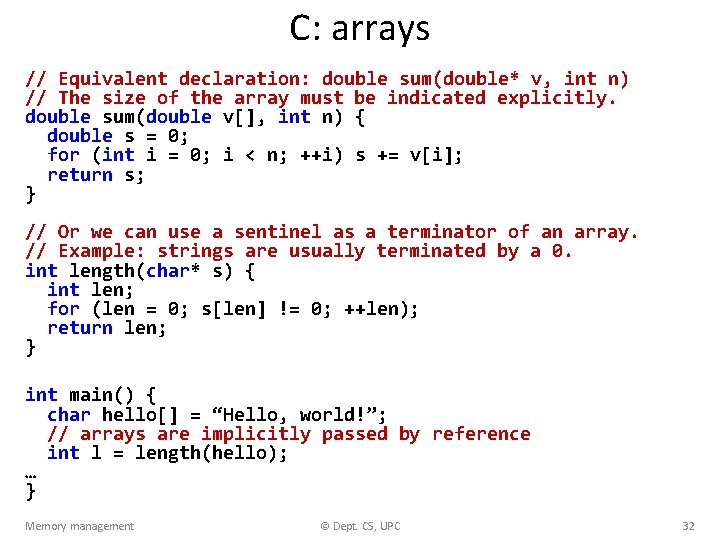
C: arrays // Equivalent declaration: double sum(double* v, int n) // The size of the array must be indicated explicitly. double sum(double v[], int n) { double s = 0; for (int i = 0; i < n; ++i) s += v[i]; return s; } // Or we can use a sentinel as a terminator of an array. // Example: strings are usually terminated by a 0. int length(char* s) { int len; for (len = 0; s[len] != 0; ++len); return len; } int main() { char hello[] = “Hello, world!”; // arrays are implicitly passed by reference int l = length(hello); … } Memory management © Dept. CS, UPC 32
C arrays and C++ vectors double sum(double v[], int n) { double s = 0; for (int i = 0; i < n; ++i) s += v[i]; return s; } // Any C++ vector is an object that contains // a private array. This array can be accessed // using the ‘data()’ method (C++11). int main() { vector<double> a; … double s = sum(a. data(), a. size()); } The internal array of the vector Functions using the internal array of a vector should NEVER resize the array ! Memory management © Dept. CS, UPC 33
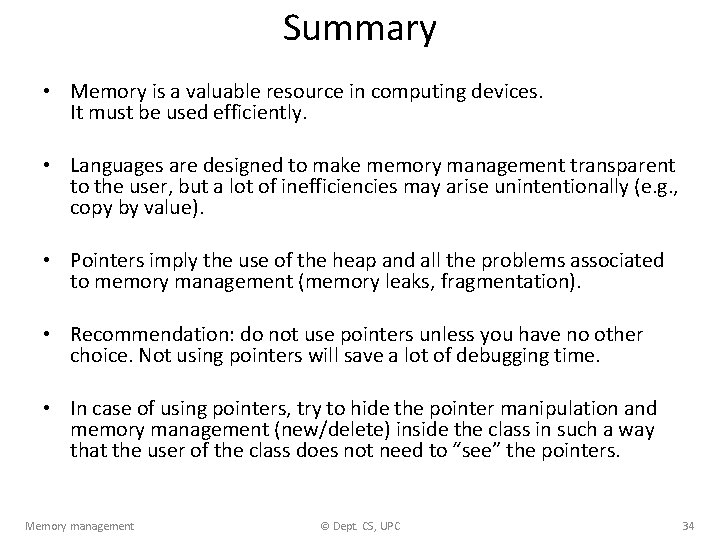
Summary • Memory is a valuable resource in computing devices. It must be used efficiently. • Languages are designed to make memory management transparent to the user, but a lot of inefficiencies may arise unintentionally (e. g. , copy by value). • Pointers imply the use of the heap and all the problems associated to memory management (memory leaks, fragmentation). • Recommendation: do not use pointers unless you have no other choice. Not using pointers will save a lot of debugging time. • In case of using pointers, try to hide the pointer manipulation and memory management (new/delete) inside the class in such a way that the user of the class does not need to “see” the pointers. Memory management © Dept. CS, UPC 34
EXERCISES Memory management © Dept. CS, UPC 35
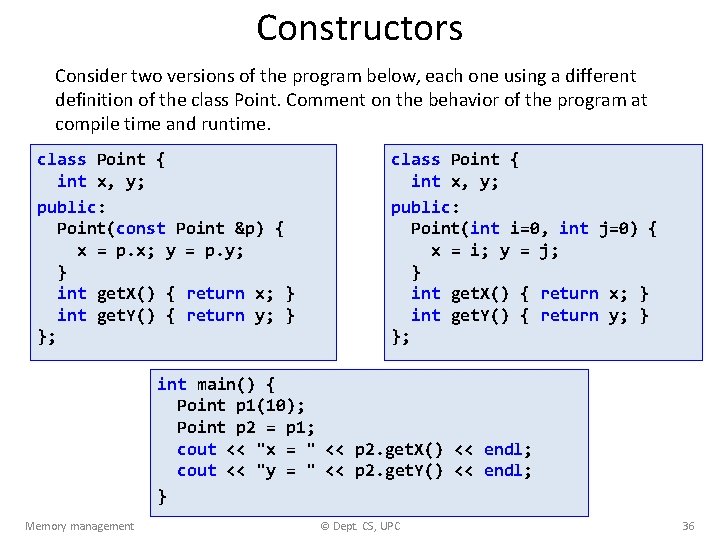
Constructors Consider two versions of the program below, each one using a different definition of the class Point. Comment on the behavior of the program at compile time and runtime. class Point { int x, y; public: Point(const Point &p) { x = p. x; y = p. y; } int get. X() { return x; } int get. Y() { return y; } }; class Point { int x, y; public: Point(int i=0, int j=0) { x = i; y = j; } int get. X() { return x; } int get. Y() { return y; } }; int main() { Point p 1(10); Point p 2 = p 1; cout << "x = " << p 2. get. X() << endl; cout << "y = " << p 2. get. Y() << endl; } Memory management © Dept. CS, UPC 36
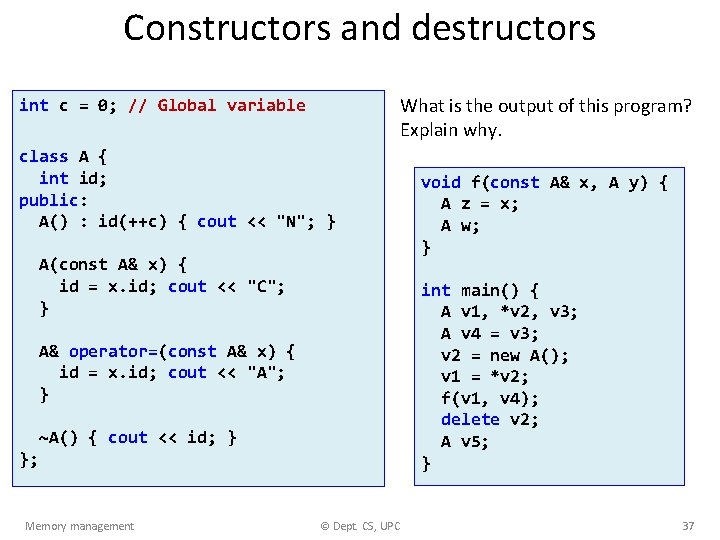
Constructors and destructors What is the output of this program? Explain why. int c = 0; // Global variable class A { int id; public: A() : id(++c) { cout << "N"; } A(const A& x) { id = x. id; cout << "C"; } int main() { A v 1, *v 2, v 3; A v 4 = v 3; v 2 = new A(); v 1 = *v 2; f(v 1, v 4); delete v 2; A v 5; } A& operator=(const A& x) { id = x. id; cout << "A"; } ~A() { cout << id; } }; Memory management void f(const A& x, A y) { A z = x; A w; } © Dept. CS, UPC 37
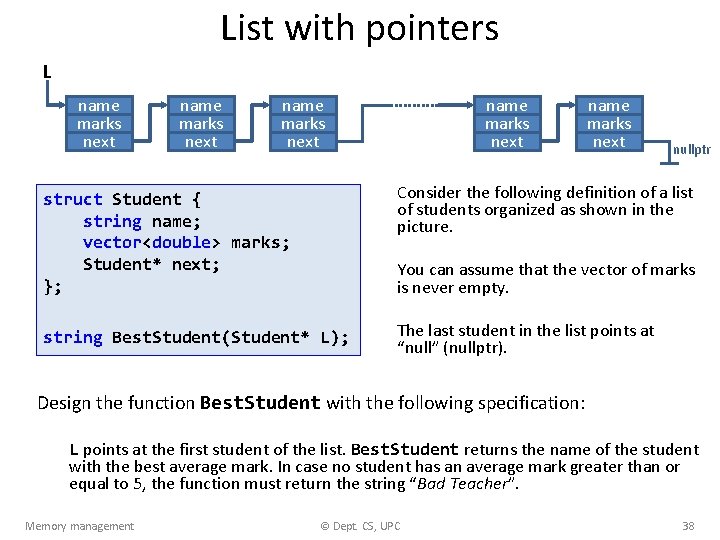
List with pointers L name marks next name marks next nullptr struct Student { string name; vector<double> marks; Student* next; }; Consider the following definition of a list of students organized as shown in the picture. string Best. Student(Student* L); The last student in the list points at “null” (nullptr). You can assume that the vector of marks is never empty. Design the function Best. Student with the following specification: L points at the first student of the list. Best. Student returns the name of the student with the best average mark. In case no student has an average mark greater than or equal to 5, the function must return the string “Bad Teacher”. Memory management © Dept. CS, UPC 38