
Memory Management Contd Segmentation Virtual Memory OSTEP Book
Memory Management (Cont’d) Segmentation, Virtual Memory OSTEP Book (See Schedule Page) http: //pages. cs. wisc. edu/~remzi/OSTEP/ Chapter 12 -16 Address Spaces, Memory API, Address Translation, Segmentation Instructor: Haryadi Gunawi CMSC 15400 1
Segmentation. . . 2
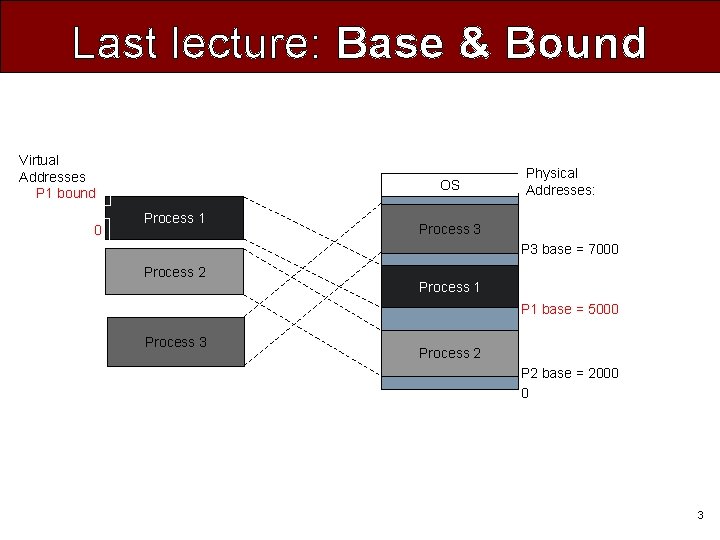
Last lecture: Base & Bound Virtual Addresses P 1 bound 0 OS Process 1 Physical Addresses: Process 3 P 3 base = 7000 Process 2 Process 1 P 1 base = 5000 Process 3 Process 2 P 2 base = 2000 0 3
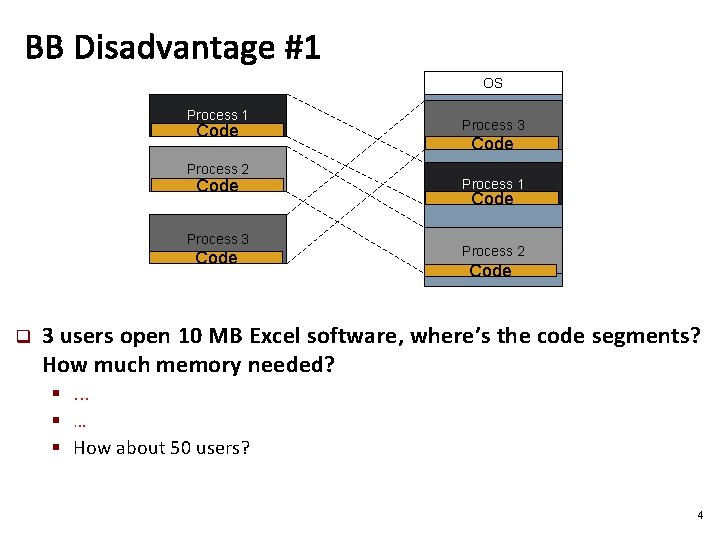
BB Disadvantage #1 OS Process 1 Code Process 2 Code Process 3 Code q Process 3 Code Process 1 Code Process 2 Code 3 users open 10 MB Excel software, where’s the code segments? How much memory needed? §. . . § … § How about 50 users? 4
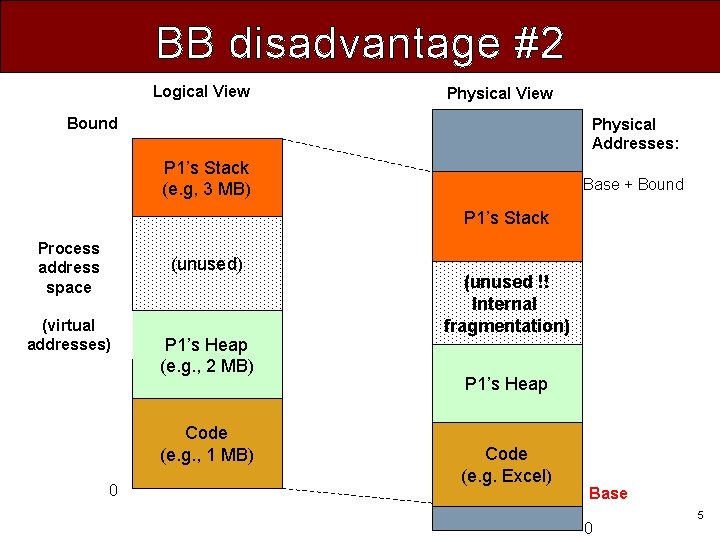
BB disadvantage #2 Logical View Physical View Bound Physical Addresses: P 1’s Stack (e. g, 3 MB) Base + Bound P 1’s Stack Process address space (unused) (virtual addresses) P 1’s Heap (e. g. , 2 MB) Code (e. g. , 1 MB) 0 (unused !! Internal fragmentation) P 1’s Heap Code (e. g. Excel) Base 0 5
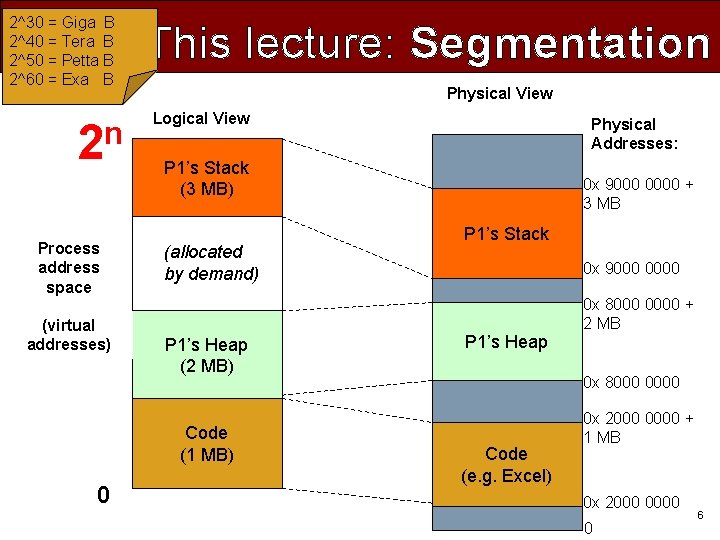
2^30 = Giga B 2^40 = Tera B 2^50 = Petta B 2^60 = Exa B 2 n Process address space (virtual addresses) This lecture: Segmentation Physical View Logical View P 1’s Stack (3 MB) (allocated by demand) P 1’s Heap (2 MB) Code (1 MB) 0 Physical Addresses: 0 x 9000 0000 + 3 MB P 1’s Stack 0 x 9000 0000 P 1’s Heap 0 x 8000 0000 + 2 MB 0 x 8000 0000 Code (e. g. Excel) 0 x 2000 0000 + 1 MB 0 x 2000 0 6
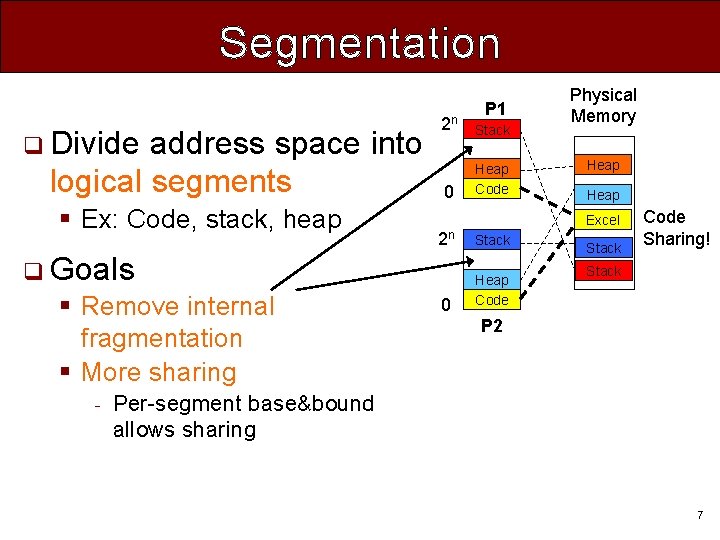
Segmentation q Divide address space into logical segments § Ex: Code, stack, heap 2 n Stack 0 Heap Code - Physical Memory Heap Excel 2 n Stack 0 Heap Code q Goals § Remove internal fragmentation § More sharing P 1 Stack Code Sharing! Stack P 2 Per-segment base&bound allows sharing 7
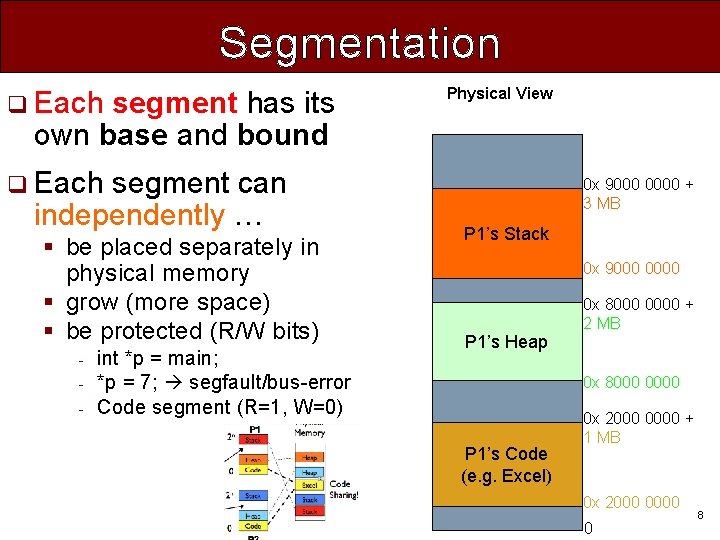
Segmentation q Each segment has its own base and bound segment can independently … Physical View q Each § be placed separately in physical memory § grow (more space) § be protected (R/W bits) - int *p = main; *p = 7; segfault/bus-error Code segment (R=1, W=0) 0 x 9000 0000 + 3 MB P 1’s Stack 0 x 9000 0000 P 1’s Heap 0 x 8000 0000 + 2 MB 0 x 8000 0000 P 1’s Code (e. g. Excel) 0 x 2000 0000 + 1 MB 0 x 2000 0 8
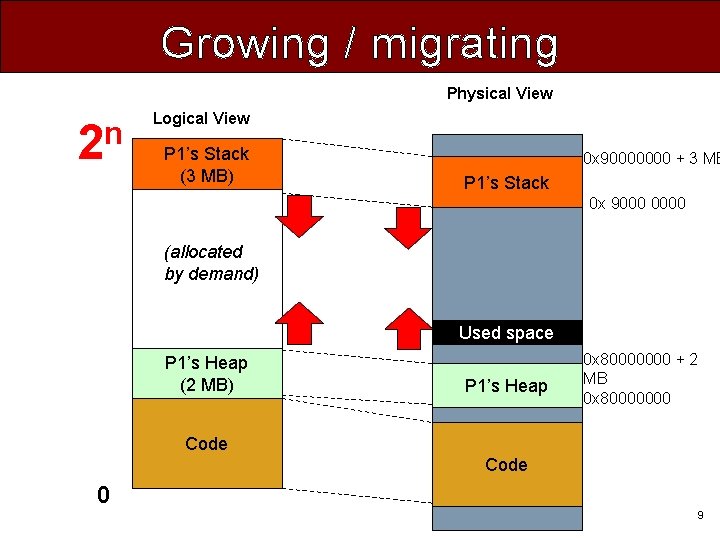
Growing / migrating Physical View 2 n Logical View P 1’s Stack (3 MB) 0 x 90000000 + 3 MB P 1’s Stack 0 x 9000 0000 (allocated by demand) Used space P 1’s Heap (2 MB) P 1’s Heap 0 x 80000000 + 2 MB 0 x 80000000 Code 0 9
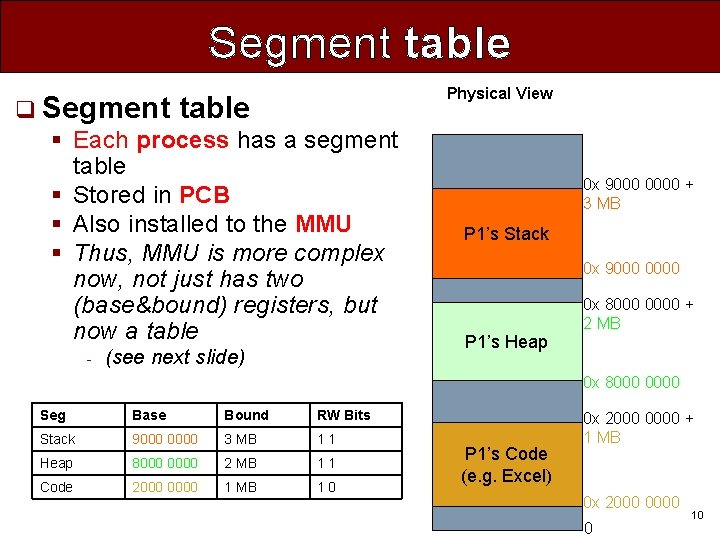
Segment table q Segment table § Each process has a segment table § Stored in PCB § Also installed to the MMU § Thus, MMU is more complex now, not just has two (base&bound) registers, but now a table - (see next slide) Physical View 0 x 9000 0000 + 3 MB P 1’s Stack 0 x 9000 0000 P 1’s Heap 0 x 8000 0000 + 2 MB 0 x 8000 0000 Seg Base Bound RW Bits Stack 9000 0000 3 MB 11 Heap 8000 0000 2 MB 11 Code 2000 0000 1 MB 10 P 1’s Code (e. g. Excel) 0 x 2000 0000 + 1 MB 0 x 2000 0 10
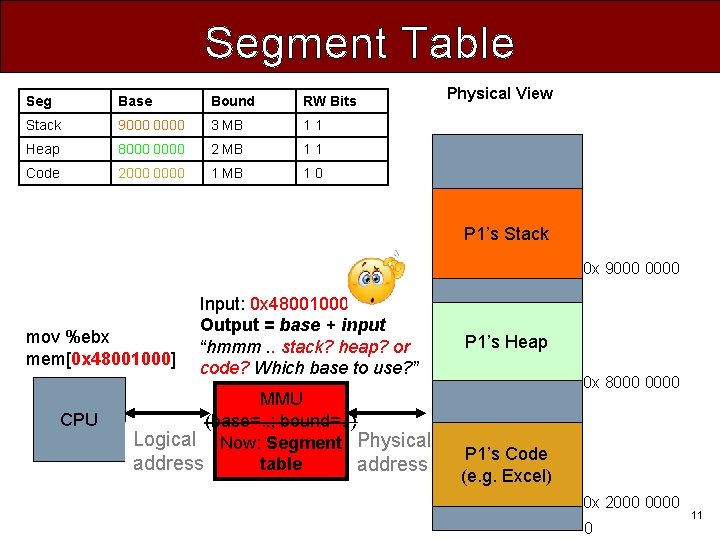
Segment Table Seg Base Bound RW Bits Stack 9000 0000 3 MB 11 Heap 8000 0000 2 MB 11 Code 2000 0000 1 MB 10 Physical View P 1’s Stack 0 x 9000 0000 mov %ebx mem[0 x 48001000] CPU Input: 0 x 48001000 Output = base + input “hmmm. . stack? heap? or code? Which base to use? ” MMU (base=. . ; bound=. . ) Logical Now: Segment Physical address table address P 1’s Heap 0 x 8000 0000 P 1’s Code (e. g. Excel) 0 x 2000 0 11
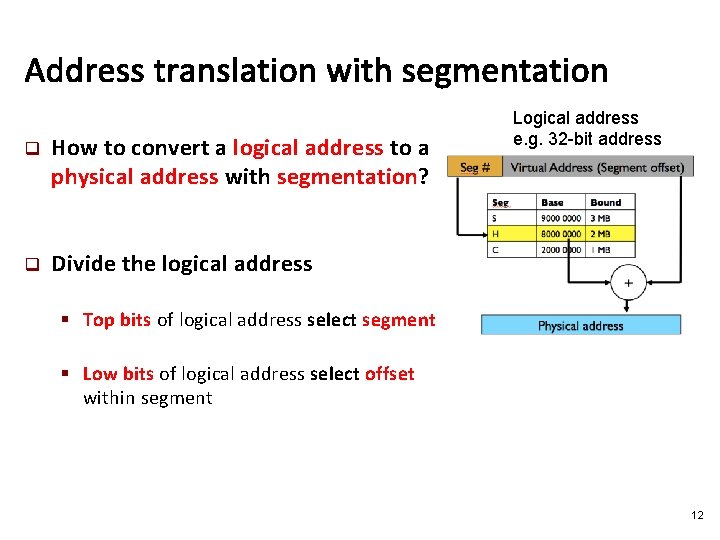
Address translation with segmentation q How to convert a logical address to a physical address with segmentation? q Divide the logical address Logical address e. g. 32 -bit address § Top bits of logical address select segment § Low bits of logical address select offset within segment 12
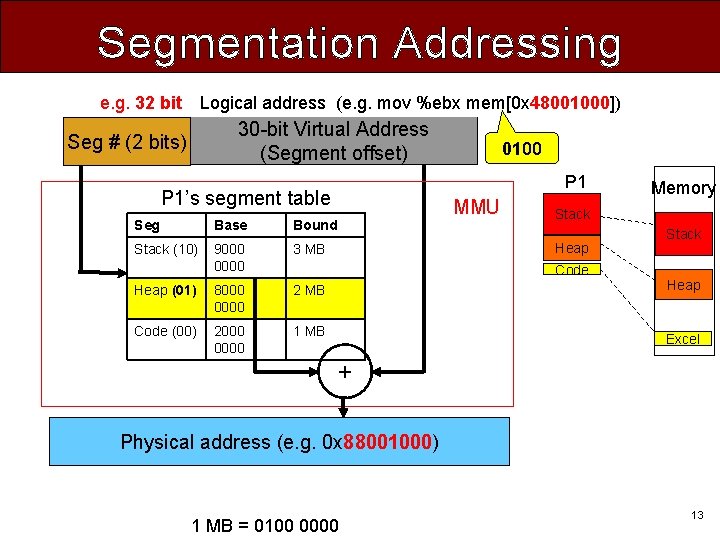
Segmentation Addressing e. g. 32 bit Logical address (e. g. mov %ebx mem[0 x 48001000]) 30 -bit Virtual Address (Segment offset) Seg # (2 bits) P 1’s segment table Seg Base Bound Stack (10) 9000 0000 3 MB Heap (01) 8000 0000 2 MB Code (00) 2000 0000 1 MB 0100 MMU Memory Stack Heap Code Stack Heap Excel + Physical address (e. g. 0 x 88001000) 1 MB = 0100 0000 13
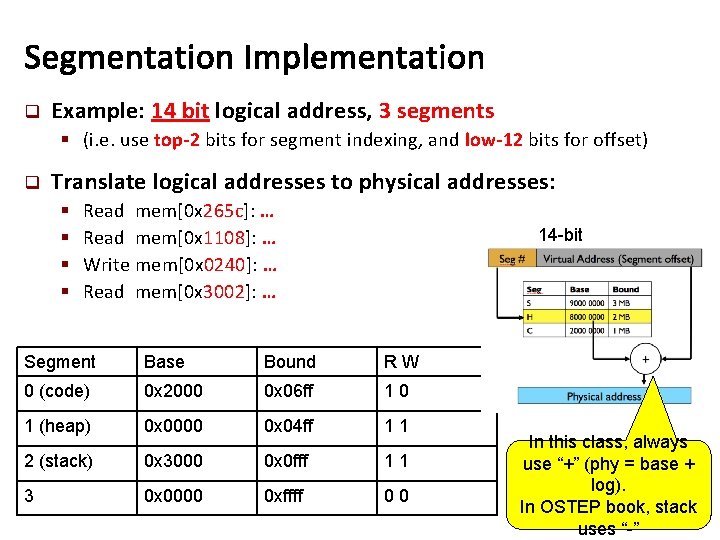
Segmentation Implementation q Example: 14 bit logical address, 3 segments § (i. e. use top-2 bits for segment indexing, and low-12 bits for offset) q Translate logical addresses to physical addresses: § § Read mem[0 x 265 c]: … Read mem[0 x 1108]: … Write mem[0 x 0240]: … Read mem[0 x 3002]: … 14 -bit Segment Base Bound RW 0 (code) 0 x 2000 0 x 06 ff 10 1 (heap) 0 x 0000 0 x 04 ff 11 2 (stack) 0 x 3000 0 x 0 fff 11 3 0 x 0000 0 xffff 00 In this class, always use “+” (phy = base + log). In OSTEP book, stack 14 uses “-”
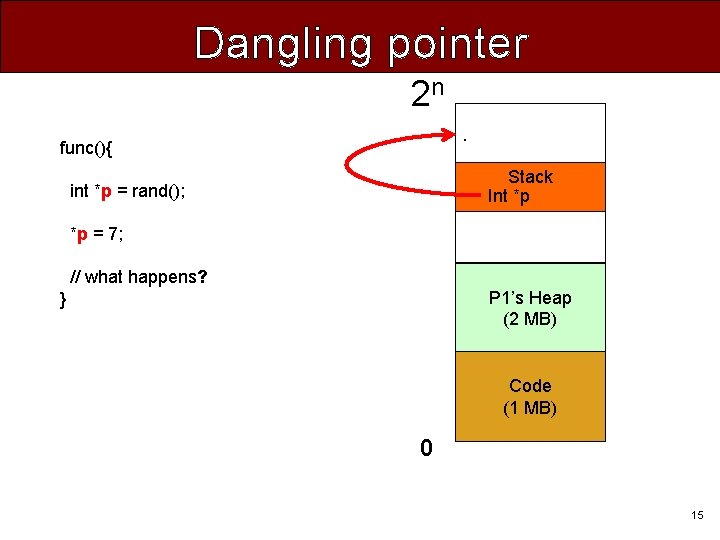
Dangling pointer 2 n. func(){ Stack Int *p int *p = rand(); *p = 7; // what happens? P 1’s Heap (2 MB) } Code (1 MB) 0 15
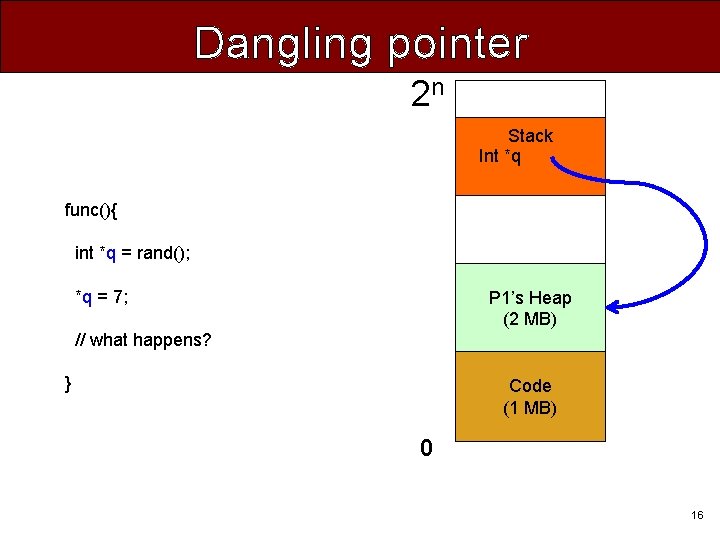
Dangling pointer 2 n Stack Int *q func(){ int *q = rand(); *q = 7; P 1’s Heap (2 MB) // what happens? } Code (1 MB) 0 16
![Example: 16 -bit addressing e. g. Mem[0 x 4012] q 16 -bit How many](http://slidetodoc.com/presentation_image_h2/6aa951212ff8e53d80f4b476bfaec1f1/image-17.jpg "Example: 16 -bit addressing e. g. Mem[0 x 4012] q 16 -bit How many")
Example: 16 -bit addressing e. g. Mem[0 x 4012] q 16 -bit How many bits for segment indexing? § Say, we need 3 segments, for code, stack, and heap § … q How many bits for the virtual address (the segment offset part)? § … q What’s the largest size of a segment? § … § Implication to malloc()? § Implication to program/code size? P 1 Stack Heap Code Stack Heap Excel 17
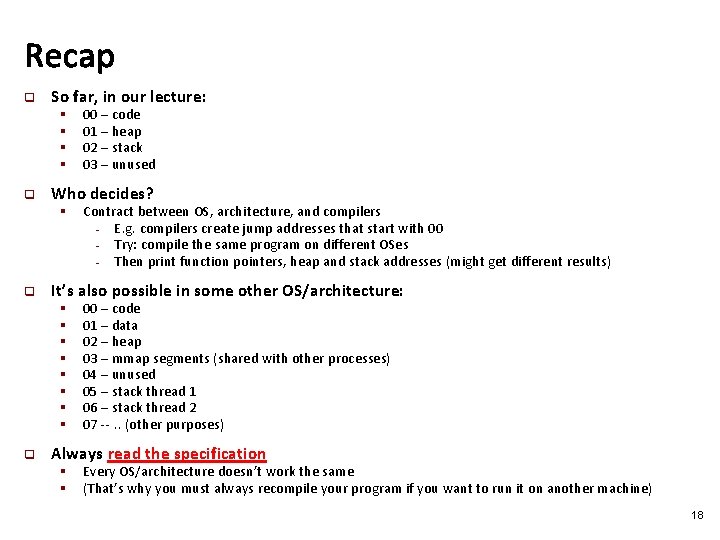
Recap q So far, in our lecture: § § q Who decides? § q Contract between OS, architecture, and compilers - E. g. compilers create jump addresses that start with 00 - Try: compile the same program on different OSes - Then print function pointers, heap and stack addresses (might get different results) It’s also possible in some other OS/architecture: § § § § q 00 – code 01 – heap 02 – stack 03 – unused 00 – code 01 – data 02 – heap 03 – mmap segments (shared with other processes) 04 – unused 05 – stack thread 1 06 – stack thread 2 07 --. . (other purposes) Always read the specification § § Every OS/architecture doesn’t work the same (That’s why you must always recompile your program if you want to run it on another machine) 18
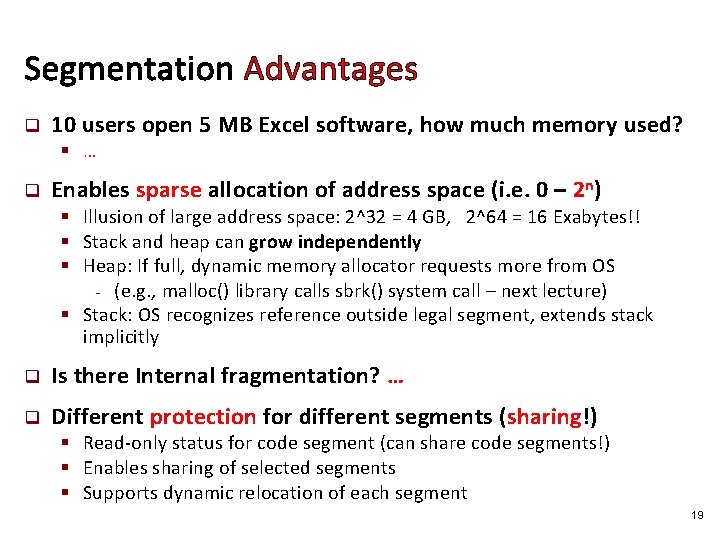
Segmentation Advantages q 10 users open 5 MB Excel software, how much memory used? § … q Enables sparse allocation of address space (i. e. 0 – 2 n) § Illusion of large address space: 2^32 = 4 GB, 2^64 = 16 Exabytes!! § Stack and heap can grow independently § Heap: If full, dynamic memory allocator requests more from OS - (e. g. , malloc() library calls sbrk() system call – next lecture) § Stack: OS recognizes reference outside legal segment, extends stack implicitly q Is there Internal fragmentation? … q Different protection for different segments (sharing!) § Read-only status for code segment (can share code segments!) § Enables sharing of selected segments § Supports dynamic relocation of each segment 19
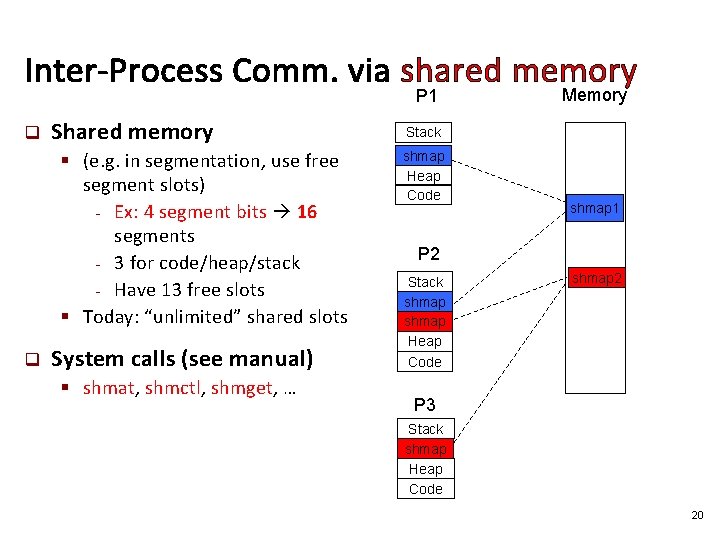
Inter-Process Comm. via shared memory P 1 q Shared memory § (e. g. in segmentation, use free segment slots) - Ex: 4 segment bits 16 segments - 3 for code/heap/stack - Have 13 free slots § Today: “unlimited” shared slots q System calls (see manual) § shmat, shmctl, shmget, … Memory Stack shmap Heap Code shmap 1 P 2 Stack shmap Heap Code shmap 2 P 3 Stack shmap Heap Code 20
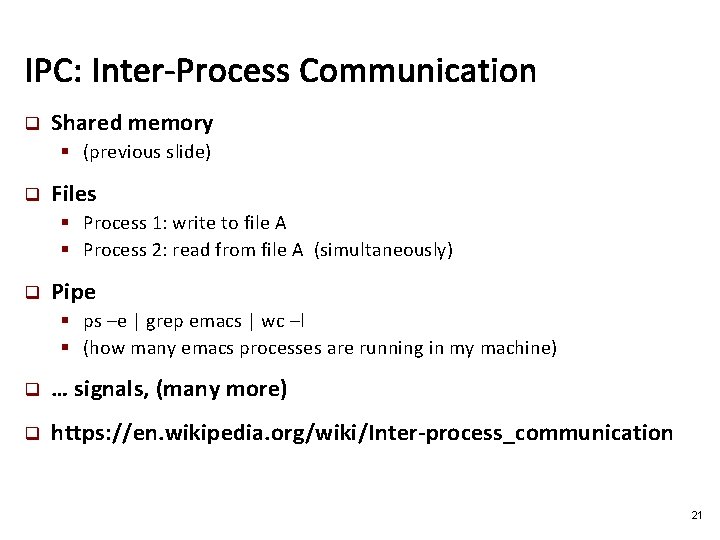
IPC: Inter-Process Communication q Shared memory § (previous slide) q Files § Process 1: write to file A § Process 2: read from file A (simultaneously) q Pipe § ps –e | grep emacs | wc –l § (how many emacs processes are running in my machine) q … signals, (many more) q https: //en. wikipedia. org/wiki/Inter-process_communication 21
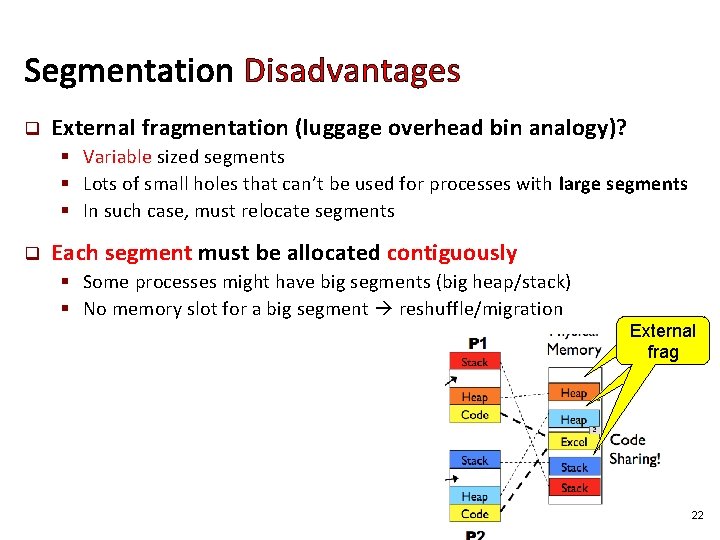
Segmentation Disadvantages q External fragmentation (luggage overhead bin analogy)? § Variable sized segments § Lots of small holes that can’t be used for processes with large segments § In such case, must relocate segments q Each segment must be allocated contiguously § Some processes might have big segments (big heap/stack) § No memory slot for a big segment reshuffle/migration External frag 22
What’s after segmentation? Let’s recap. . . 23
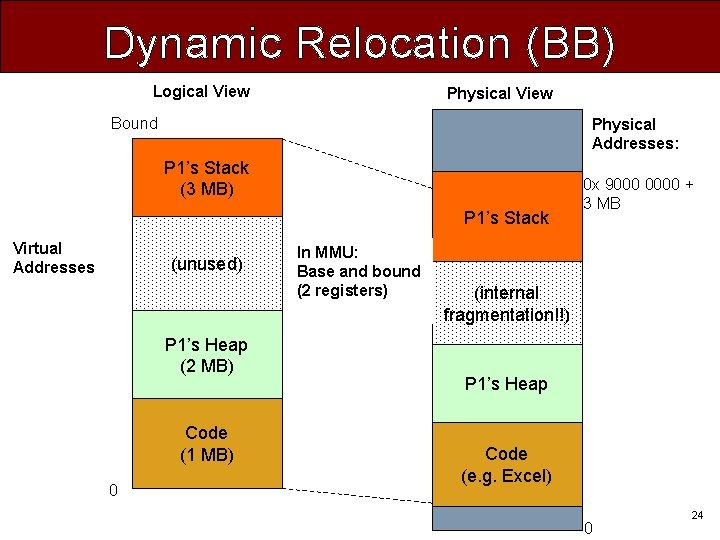
Dynamic Relocation (BB) Logical View Physical View Bound Physical Addresses: P 1’s Stack (3 MB) P 1’s Stack Virtual Addresses (unused) P 1’s Heap (2 MB) Code (1 MB) 0 In MMU: Base and bound (2 registers) 0 x 9000 0000 + 3 MB (internal fragmentation!!) P 1’s Heap Code (e. g. Excel) 0 24
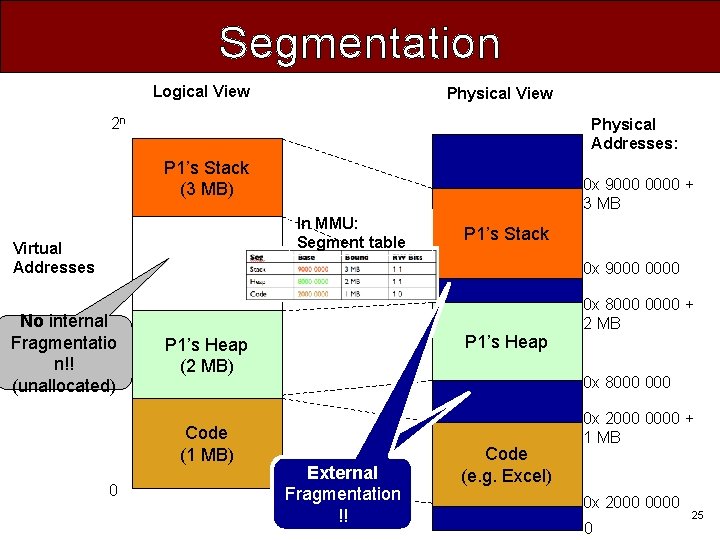
Segmentation Logical View Physical View 2 n Physical Addresses: P 1’s Stack (3 MB) 0 x 9000 0000 + 3 MB In MMU: Segment table Virtual Addresses P 1’s Stack 0 x 9000 0000 No internal Fragmentatio n!! (unallocated) Code (1 MB) 0 P 1’s Heap (2 MB) 0 x 8000 0000 + 2 MB 0 x 8000 External Fragmentation !! Code (e. g. Excel) 0 x 2000 0000 + 1 MB 0 x 2000 0 25
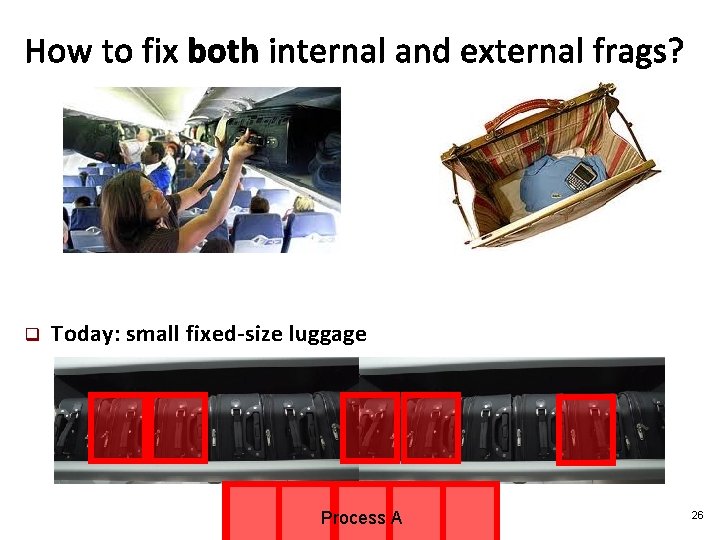
How to fix both internal and external frags? q Today: small fixed-size luggage Process A 26
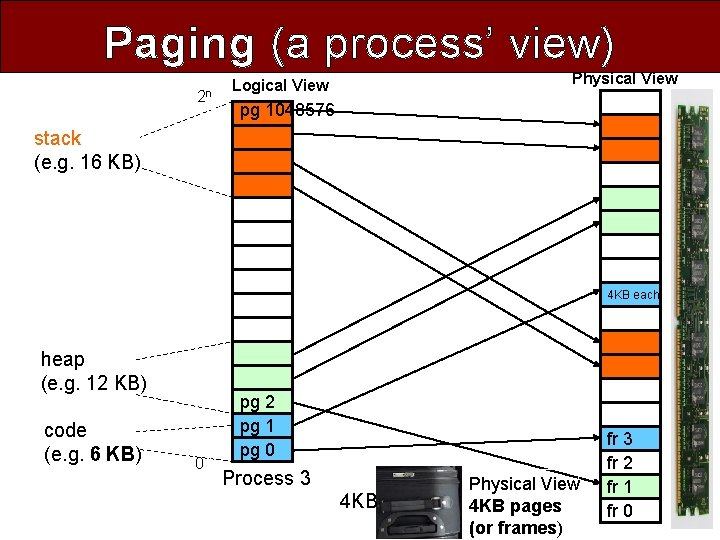
Paging (a process’ view) 2 n Physical View Logical View pg 1048576 stack (e. g. 16 KB) 4 KB each heap (e. g. 12 KB) code (e. g. 6 KB) 0 pg 2 pg 1 pg 0 Process 3 4 KB Physical View 4 KB pages (or frames) fr 3 fr 2 fr 1 fr 0 27
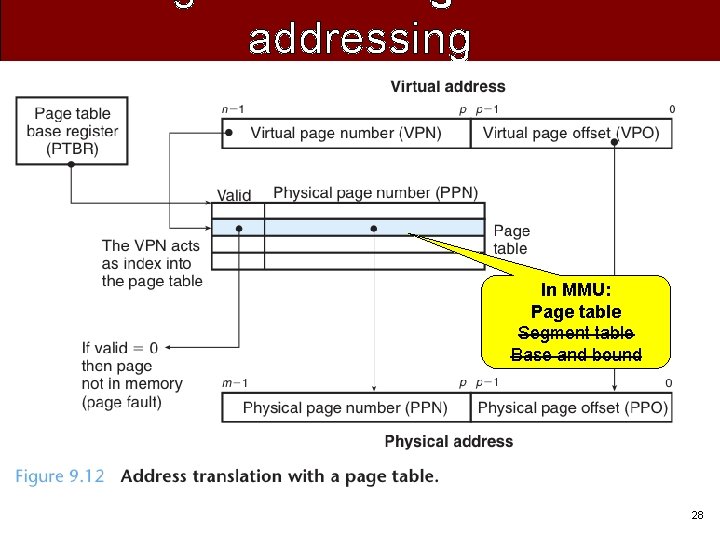
addressing q… In MMU: Page table Segment table Base and bound 28
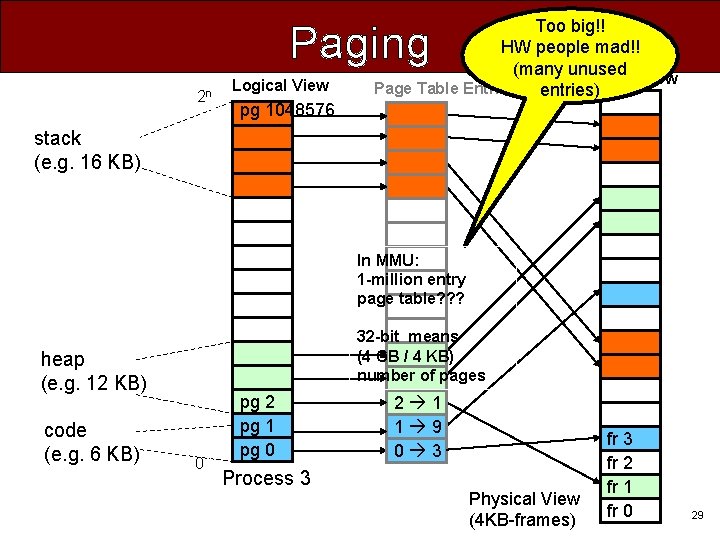
Too big!! HW people mad!! (many unused Physical View Page Table Entries entries) Paging 2 n Logical View pg 1048576 stack (e. g. 16 KB) In MMU: 1 -million entry page table? ? ? 32 -bit means (4 GB / 4 KB) number of pages heap (e. g. 12 KB) code (e. g. 6 KB) 0 pg 2 pg 1 pg 0 Process 3 2 1 1 9 0 3 Physical View (4 KB-frames) fr 3 fr 2 fr 1 fr 0 29
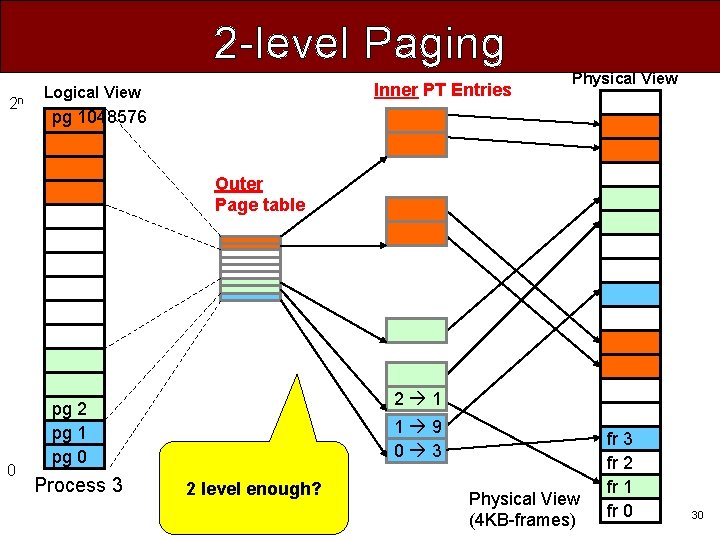
2 -level Paging 2 n Inner PT Entries Logical View Physical View pg 1048576 Outer Page table 0 2 1 pg 2 pg 1 pg 0 Process 3 1 9 0 3 2 level enough? Physical View (4 KB-frames) fr 3 fr 2 fr 1 fr 0 30
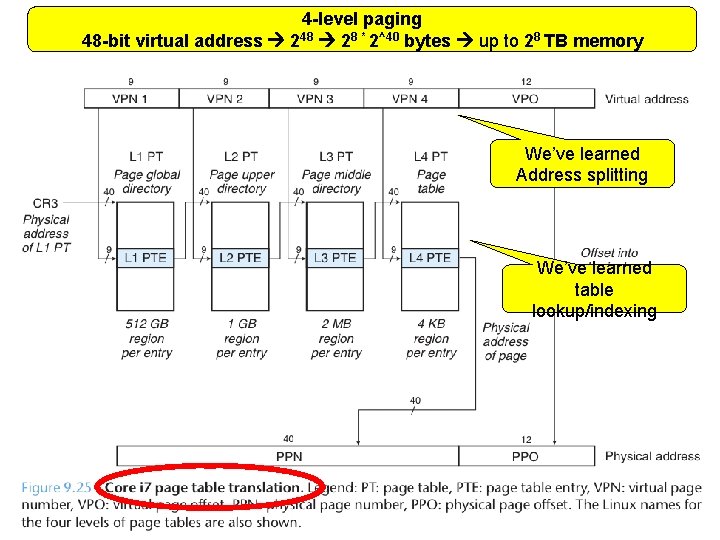
4 -level paging 48 -bit virtual address 248 28 * 2^40 bytes up to 28 TB memory We’ve learned Address splitting We’ve learned table lookup/indexing 31
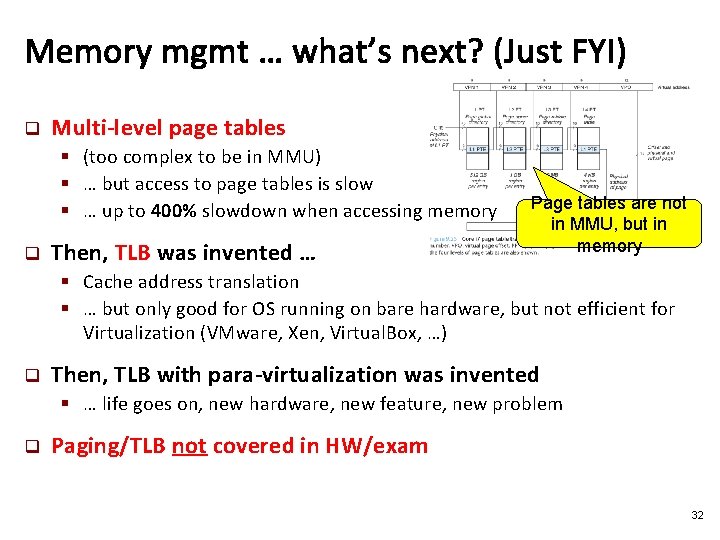
Memory mgmt … what’s next? (Just FYI) q Multi-level page tables § (too complex to be in MMU) § … but access to page tables is slow § … up to 400% slowdown when accessing memory q Then, TLB was invented … Page tables are not in MMU, but in memory § Cache address translation § … but only good for OS running on bare hardware, but not efficient for Virtualization (VMware, Xen, Virtual. Box, …) q Then, TLB with para-virtualization was invented § … life goes on, new hardware, new feature, new problem q Paging/TLB not covered in HW/exam 32
Virtual Memory (with swap space). . . 33
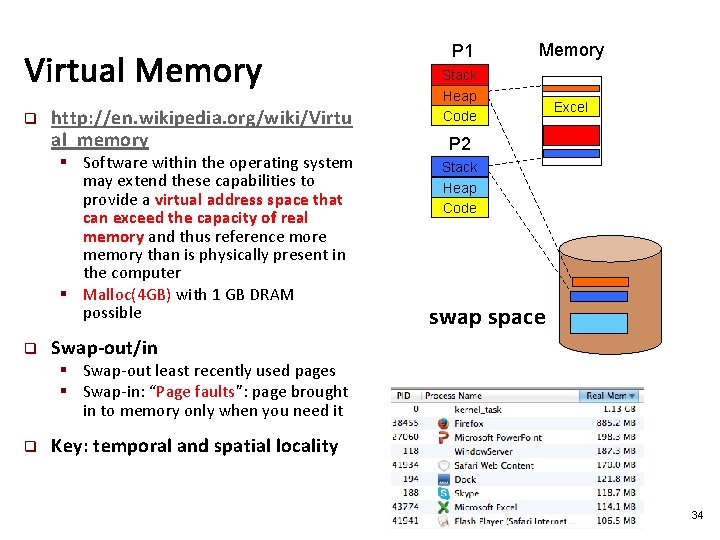
Virtual Memory q http: //en. wikipedia. org/wiki/Virtu al_memory § Software within the operating system may extend these capabilities to provide a virtual address space that can exceed the capacity of real memory and thus reference more memory than is physically present in the computer § Malloc(4 GB) with 1 GB DRAM possible q P 1 Memory Stack Heap Code Excel P 2 Stack Heap Code swap space Swap-out/in § Swap-out least recently used pages § Swap-in: “Page faults”: page brought in to memory only when you need it q Key: temporal and spatial locality 34

Summary. . . 35
Goals of MM q Efficiency § Do not waste memory resources § Keep fragmentation low q Sharing § Several processes coexist in main memory § Cooperating processes can share portions of address space - Two processes (e. g. banking system) share the same data segment - Multiple processes open Office or Excel (share code segment) q Transparency § Processes are not aware that memory is shared § Works regardless of number and/or location of processes q Protection § Robustness: Cannot corrupt OS or other processes § Privacy: Cannot read data of other processes 36
Take-away points q Memory management problems § Appear in many layers of software stack q malloc(), etc. § § § q malloc is a library, not a system call malloc manages the dynamic data (i. e. pointers) in the heap malloc(? ? ) uniform size? malloc(2000) get how many bytes? So, internal or external fragmentation problem? p=malloc(100); *(p+101) = 0; crash or not? Why? Java Garbage Collector (GC) § Same as malloc (but users don’t’ need to call malloc or free) § Automatic free space management 37

END. . . 38

EXTRA. . . 39
- Slides: 39