
Memory Management 1202022 A Berrached CS 4315 UHD
Memory Management 1/20/2022 A. Berrached: CS 4315: UHD 1
Memory Management 1/20/2022 A. Berrached: CS 4315: UHD 2
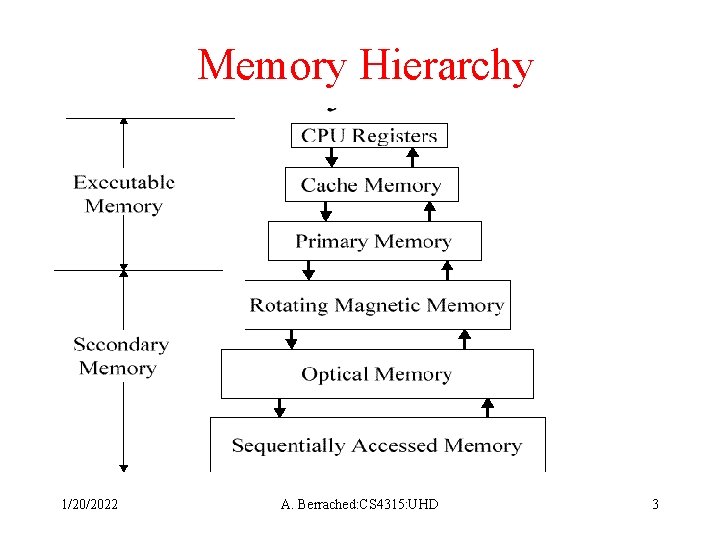
Memory Hierarchy 1/20/2022 A. Berrached: CS 4315: UHD 3
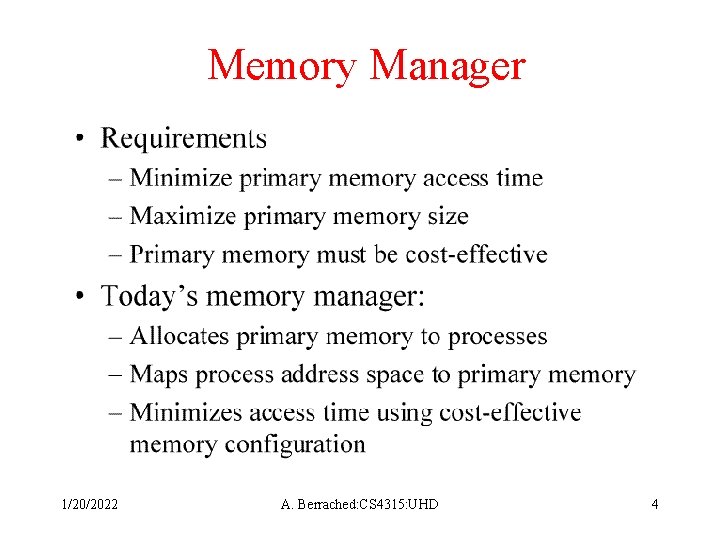
Memory Manager 1/20/2022 A. Berrached: CS 4315: UHD 4
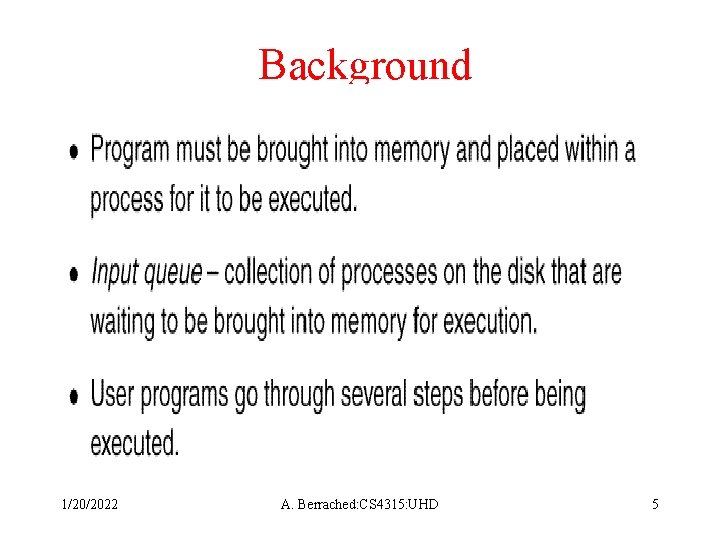
Background 1/20/2022 A. Berrached: CS 4315: UHD 5
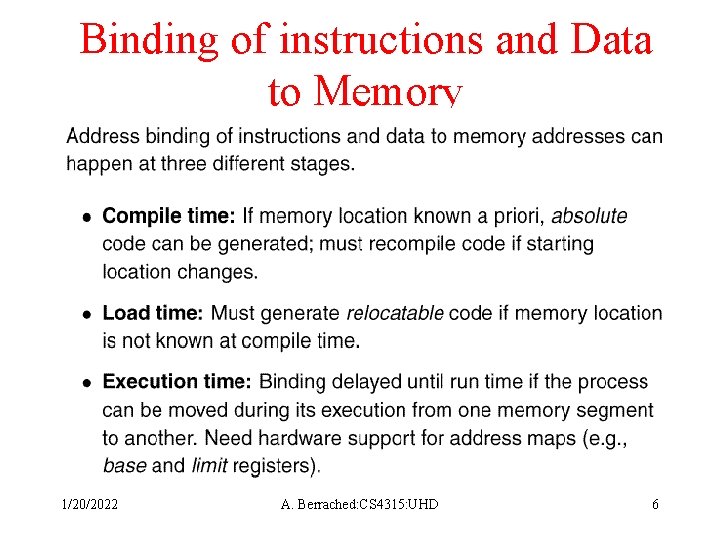
Binding of instructions and Data to Memory 1/20/2022 A. Berrached: CS 4315: UHD 6
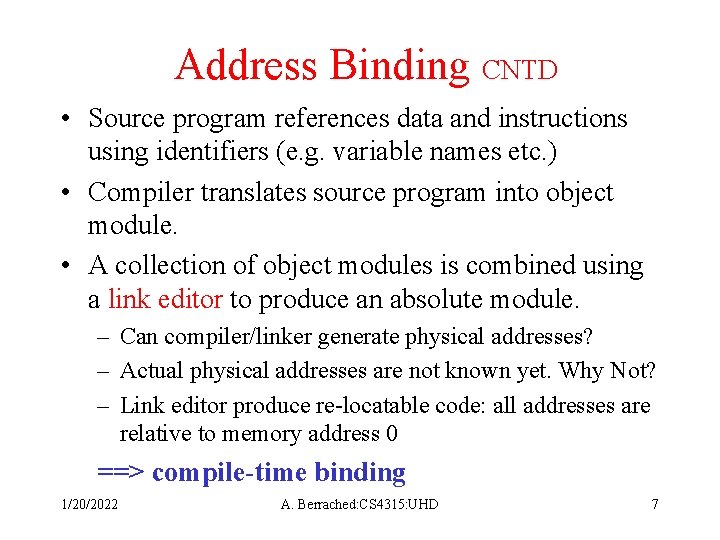
Address Binding CNTD • Source program references data and instructions using identifiers (e. g. variable names etc. ) • Compiler translates source program into object module. • A collection of object modules is combined using a link editor to produce an absolute module. – Can compiler/linker generate physical addresses? – Actual physical addresses are not known yet. Why Not? – Link editor produce re-locatable code: all addresses are relative to memory address 0 ==> compile-time binding 1/20/2022 A. Berrached: CS 4315: UHD 7
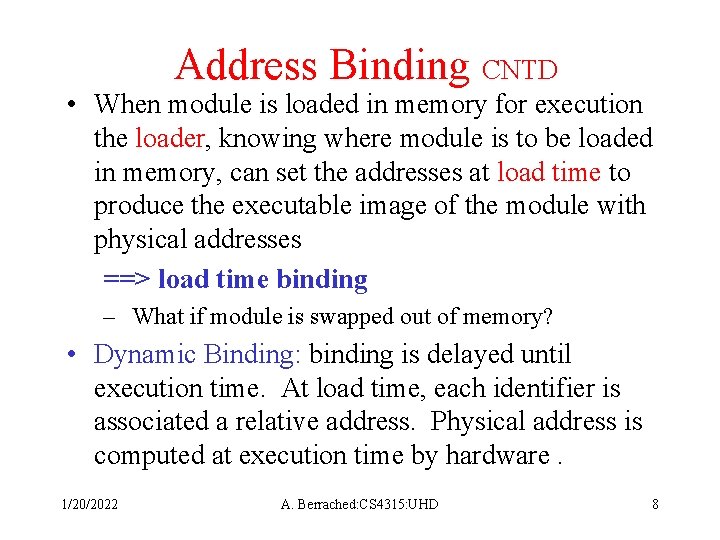
Address Binding CNTD • When module is loaded in memory for execution the loader, knowing where module is to be loaded in memory, can set the addresses at load time to produce the executable image of the module with physical addresses ==> load time binding – What if module is swapped out of memory? • Dynamic Binding: binding is delayed until execution time. At load time, each identifier is associated a relative address. Physical address is computed at execution time by hardware. 1/20/2022 A. Berrached: CS 4315: UHD 8
Dynamic Address Binding • All addresses to data and instructions are made relative to beginning of the module i. e. as if process address space starts at physical address 0. • Hardware provides a base register (also called a relocation register). • When process is switched to CPU the base register is loaded with the initial address of the module. • At run time: 1/20/2022 A. Berrached: CS 4315: UHD 9
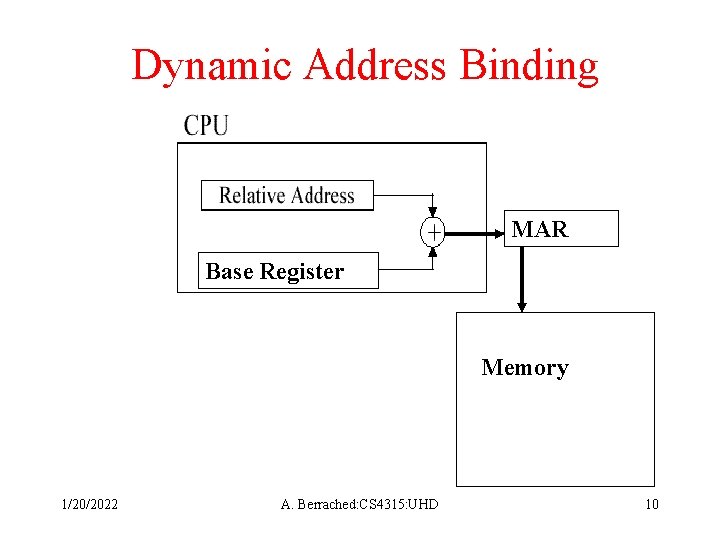
Dynamic Address Binding MAR Base Register Memory 1/20/2022 A. Berrached: CS 4315: UHD 10
Logical Address vs. Physical Address • The concept of logical address space that is bound to a physical address space is central to contemporary memory management. • Logical address: address generated by user program (also referred to as virtual address). • Physical address: address seen by the memory unit. 1/20/2022 A. Berrached: CS 4315: UHD 11

Memory Management Unit (MMU) • The hardware unit that maps logical addresses to physical addresses. • For the dynamic address binding scheme, the MMU intercepts each logical address generated by the program and translates it into its equivalent physical address. It can also provide some basic memory protection 1/20/2022 A. Berrached: CS 4315: UHD 12
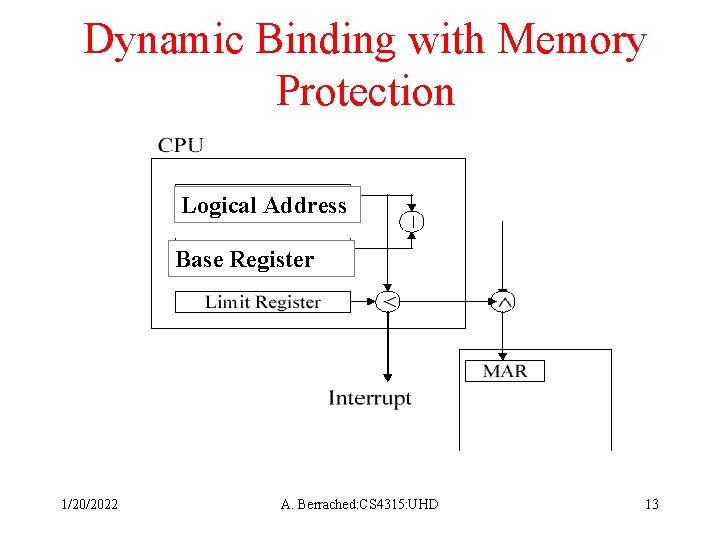
Dynamic Binding with Memory Protection Logical Address Base Register 1/20/2022 A. Berrached: CS 4315: UHD 13
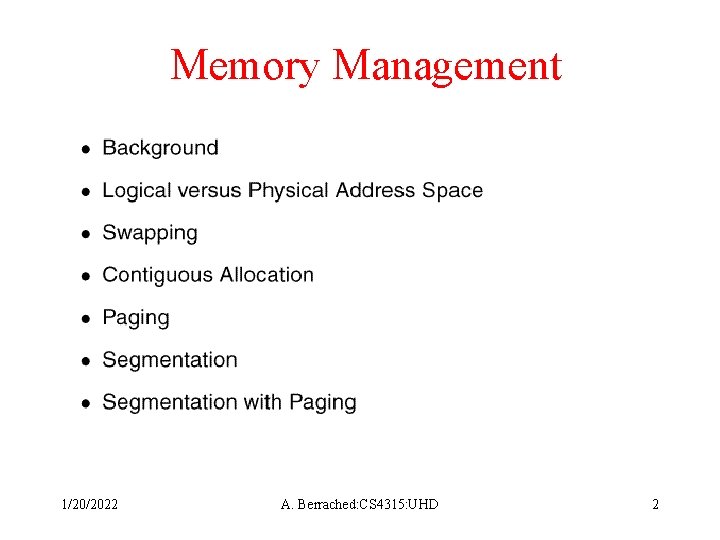
Memory Allocation • Given a set of processes waiting to be loaded in memory, how is memory space allocated to processes – Contiguous Allocation – Paging – Segmentation 1/20/2022 A. Berrached: CS 4315: UHD 14
Contiguous Allocation • Main Memory is divided in two main partitions: – Resident operating system (usually held in low memory with interrupt vector) – User processes held in high memory 1/20/2022 A. Berrached: CS 4315: UHD 15
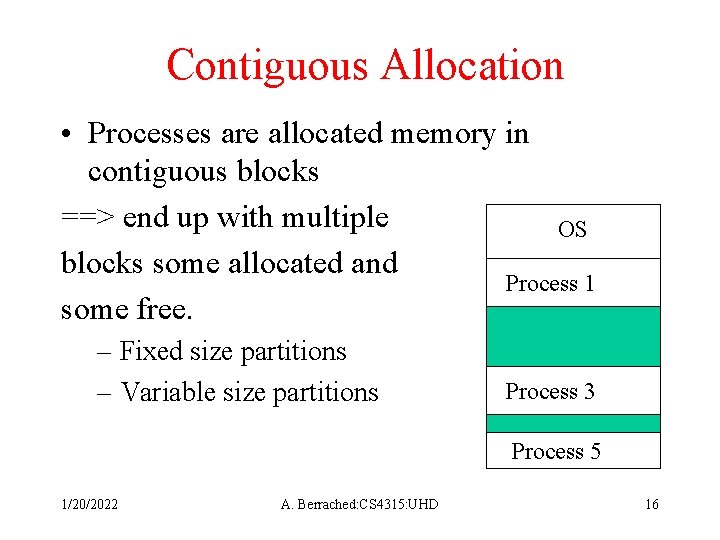
Contiguous Allocation • Processes are allocated memory in contiguous blocks ==> end up with multiple OS blocks some allocated and Process 1 some free. – Fixed size partitions – Variable size partitions Process 3 Process 5 1/20/2022 A. Berrached: CS 4315: UHD 16
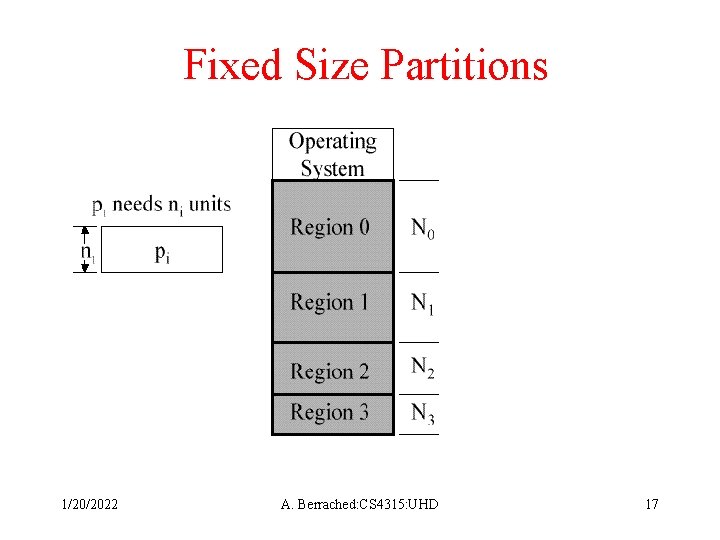
Fixed Size Partitions 1/20/2022 A. Berrached: CS 4315: UHD 17
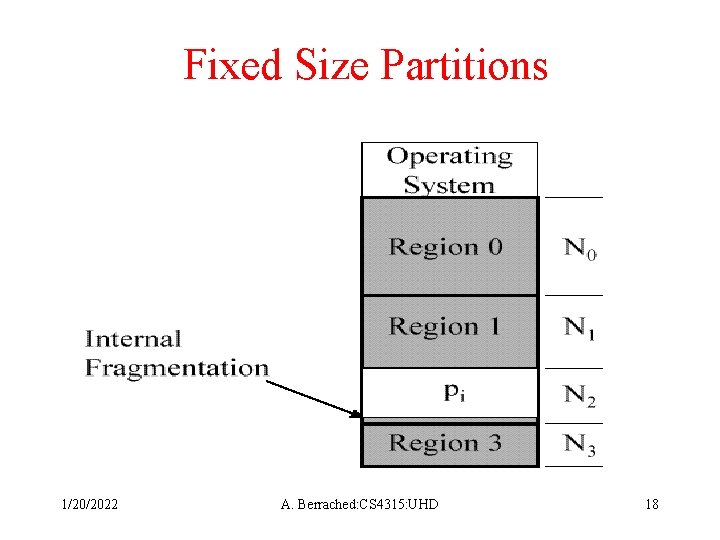
Fixed Size Partitions 1/20/2022 A. Berrached: CS 4315: UHD 18
Variable Size Partitions • OS maintains list of allocated blocks and list of free blocks (holes). • OS maintains one queue of processes on free list • When a process arrives, it is allocated memory from a hole large enough to accommodate it. 1/20/2022 A. Berrached: CS 4315: UHD 19
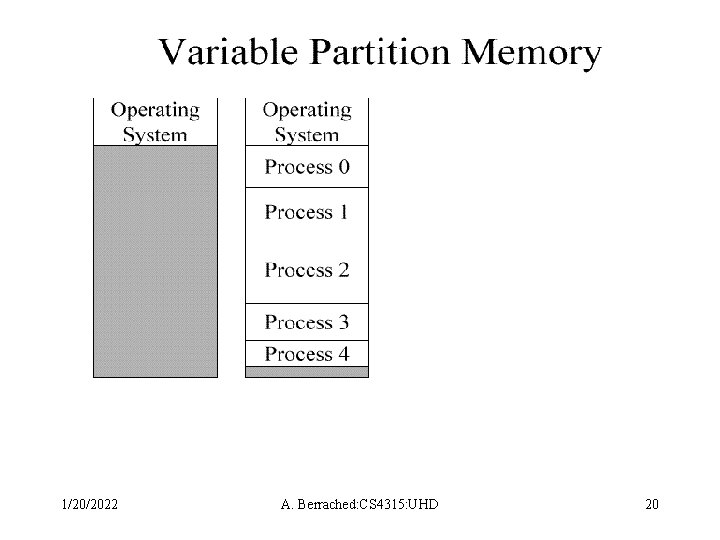
1/20/2022 A. Berrached: CS 4315: UHD 20
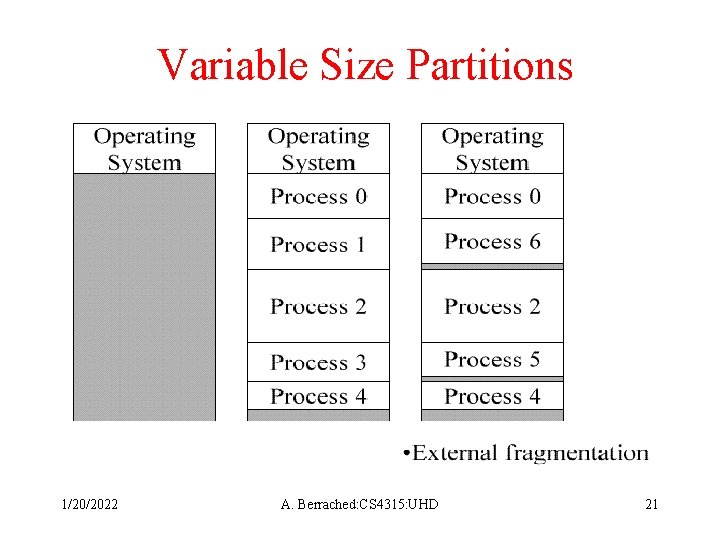
Variable Size Partitions 1/20/2022 A. Berrached: CS 4315: UHD 21
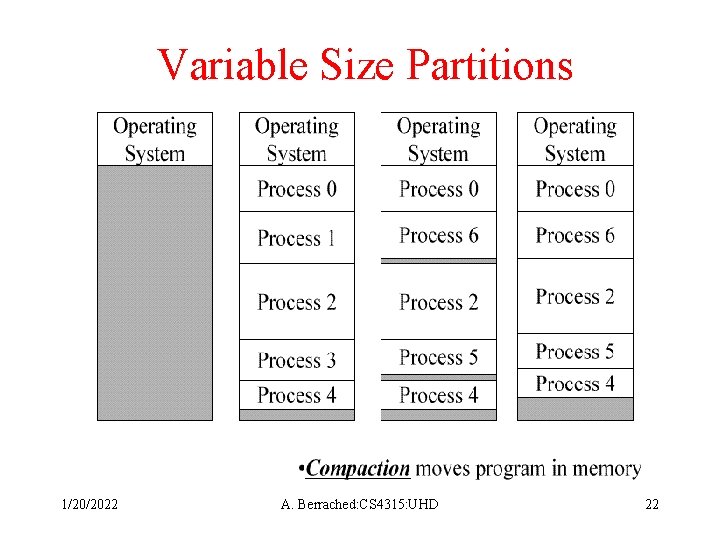
Variable Size Partitions 1/20/2022 A. Berrached: CS 4315: UHD 22
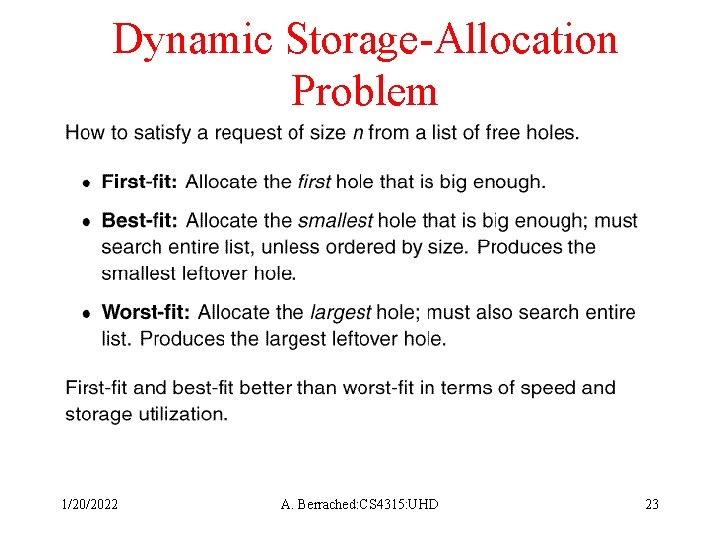
Dynamic Storage-Allocation Problem 1/20/2022 A. Berrached: CS 4315: UHD 23
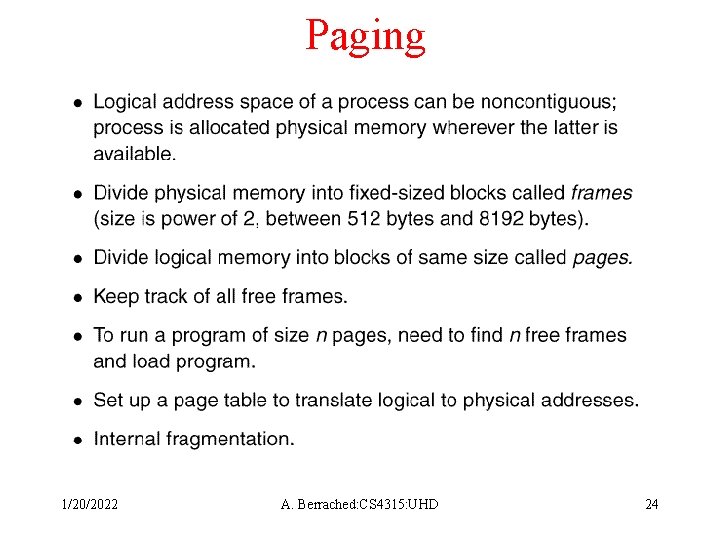
Paging 1/20/2022 A. Berrached: CS 4315: UHD 24
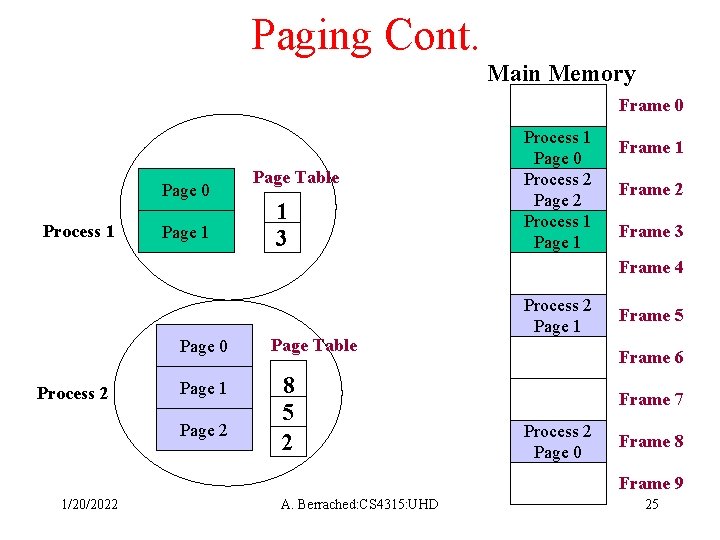
Paging Cont. Main Memory Frame 0 Page 0 Process 1 Page Table 1 3 Process 1 Page 0 Process 2 Page 2 Process 1 Page 1 Frame 2 Frame 3 Frame 4 Page 0 Process 2 Page 1 Page 2 Page Table 8 5 2 Process 2 Page 1 Frame 5 Frame 6 Frame 7 Process 2 Page 0 Frame 8 Frame 9 1/20/2022 A. Berrached: CS 4315: UHD 25
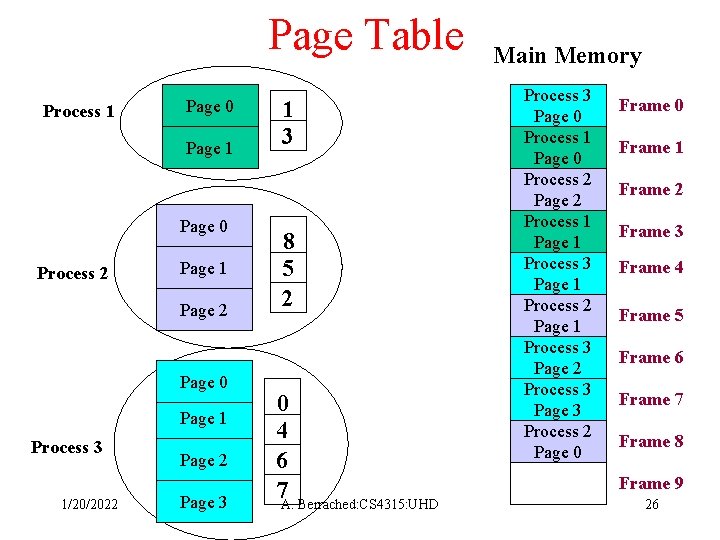
Page Table Process 1 Page 0 Page 1 Page 0 Process 2 Page 1 Page 2 Page 0 Page 1 Process 3 1/20/2022 Page 3 1 3 8 5 2 0 4 6 7 A. Berrached: CS 4315: UHD Main Memory Process 3 Page 0 Process 1 Page 0 Process 2 Page 2 Process 1 Page 1 Process 3 Page 1 Process 2 Page 1 Process 3 Page 2 Process 3 Page 3 Process 2 Page 0 Frame 1 Frame 2 Frame 3 Frame 4 Frame 5 Frame 6 Frame 7 Frame 8 Frame 9 26
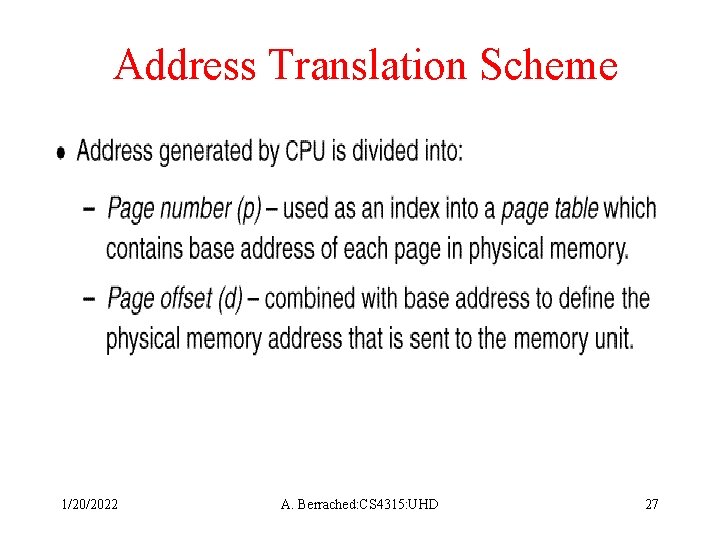
Address Translation Scheme 1/20/2022 A. Berrached: CS 4315: UHD 27
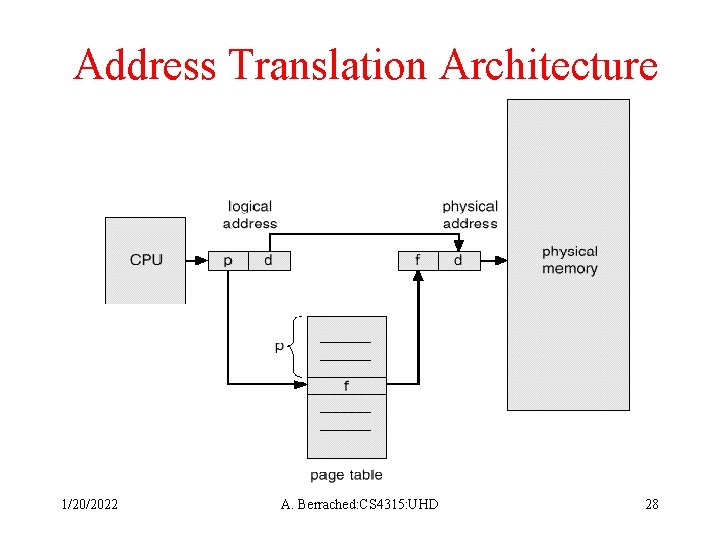
Address Translation Architecture 1/20/2022 A. Berrached: CS 4315: UHD 28
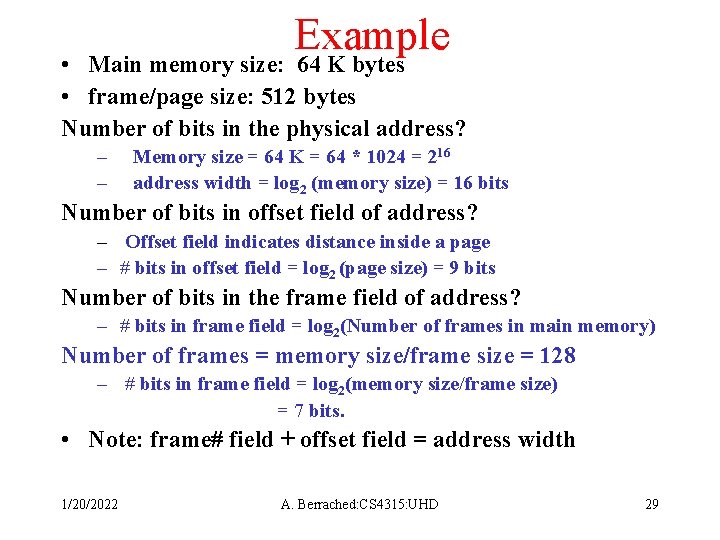
Example • Main memory size: 64 K bytes • frame/page size: 512 bytes Number of bits in the physical address? – – Memory size = 64 K = 64 * 1024 = 216 address width = log 2 (memory size) = 16 bits Number of bits in offset field of address? – Offset field indicates distance inside a page – # bits in offset field = log 2 (page size) = 9 bits Number of bits in the frame field of address? – # bits in frame field = log 2(Number of frames in main memory) Number of frames = memory size/frame size = 128 – # bits in frame field = log 2(memory size/frame size) = 7 bits. • Note: frame# field + offset field = address width 1/20/2022 A. Berrached: CS 4315: UHD 29
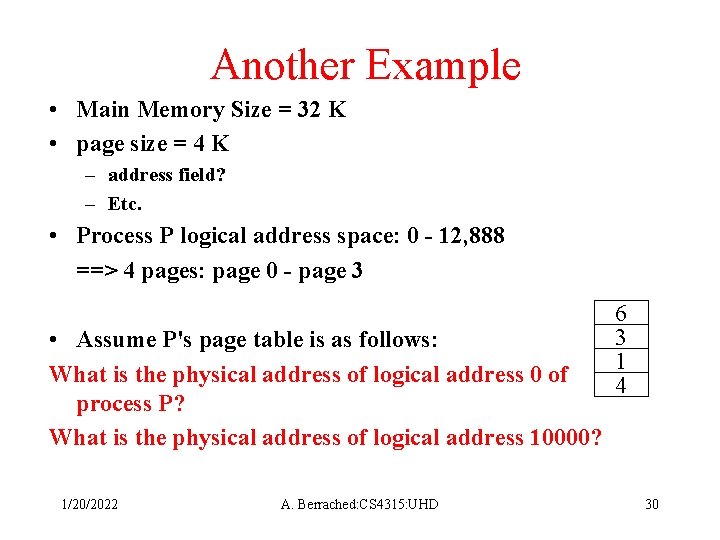
Another Example • Main Memory Size = 32 K • page size = 4 K – address field? – Etc. • Process P logical address space: 0 - 12, 888 ==> 4 pages: page 0 - page 3 • Assume P's page table is as follows: What is the physical address of logical address 0 of process P? What is the physical address of logical address 10000? 1/20/2022 A. Berrached: CS 4315: UHD 6 3 1 4 30
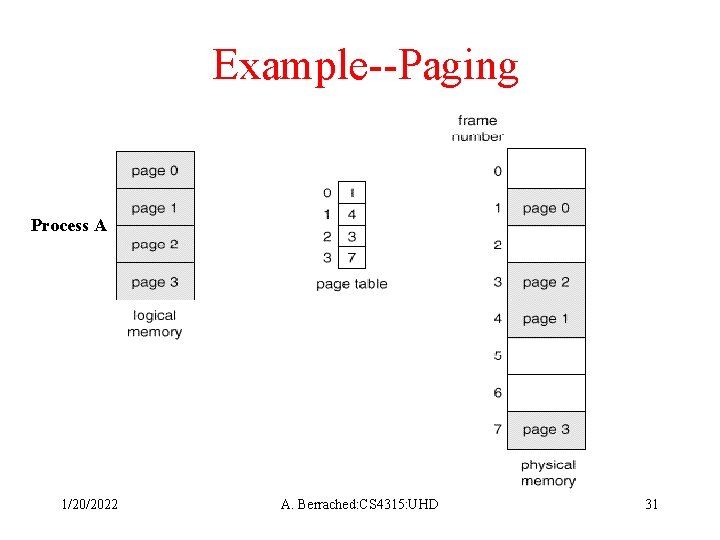
Example--Paging Process A 1/20/2022 A. Berrached: CS 4315: UHD 31
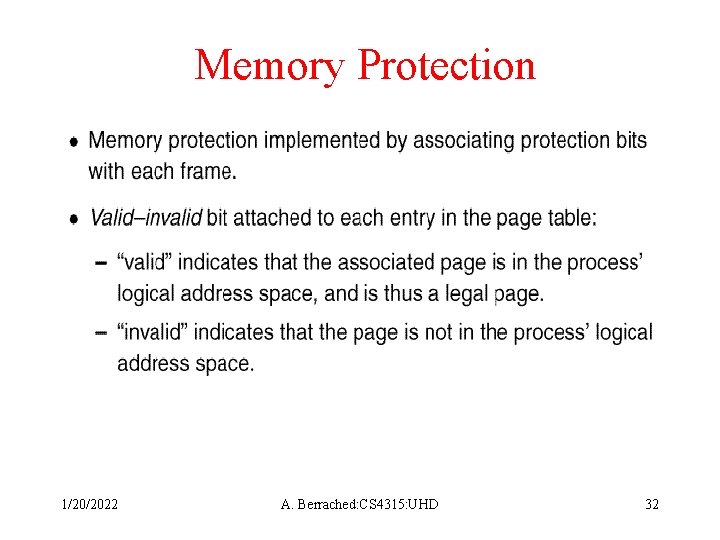
Memory Protection 1/20/2022 A. Berrached: CS 4315: UHD 32
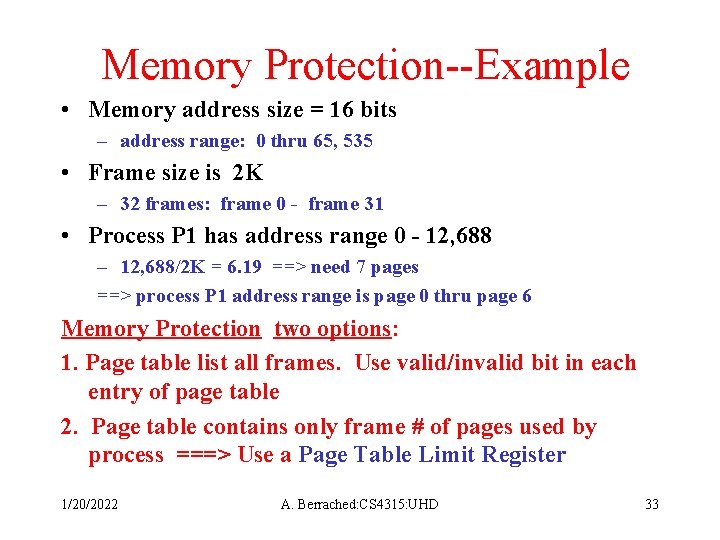
Memory Protection--Example • Memory address size = 16 bits – address range: 0 thru 65, 535 • Frame size is 2 K – 32 frames: frame 0 - frame 31 • Process P 1 has address range 0 - 12, 688 – 12, 688/2 K = 6. 19 ==> need 7 pages ==> process P 1 address range is page 0 thru page 6 Memory Protection two options: 1. Page table list all frames. Use valid/invalid bit in each entry of page table 2. Page table contains only frame # of pages used by process ===> Use a Page Table Limit Register 1/20/2022 A. Berrached: CS 4315: UHD 33
Internal Fragmentation--Example Cont. • Process P 1 address space: 0 -12, 688 page 0 - page 6 • in last page, only addresses 12, 288 - 12, 688 are legal • the rest of the page is "empty" ==> Internal fragmentation • On average, 1/2 page per process is wasted to fragmentation ==> fragmentation increases with larger page size 1/20/2022 A. Berrached: CS 4315: UHD 34
Implementation of a Page Table • Page table is kept in memory. • Page-table base register (PTBR) points to the page table. • Page-table length register(PTLR) indicates the size of the page table. • Two major problems: – 1. every data/instruction access requires two memory accesses. One for the page table and one to access data/instruction – 2. Page table takes up memory space. 1/20/2022 A. Berrached: CS 4315: UHD 35
Two-memory Access Problem • Can be solved by the use of a special fast-lookup hardware cache called associative register or Table Look-aside Buffer (TLB). • TLB is contained within the CPU • TLB is used to cache that part of the page table that is "most likely" to be referenced in the future. 1/20/2022 A. Berrached: CS 4315: UHD 36
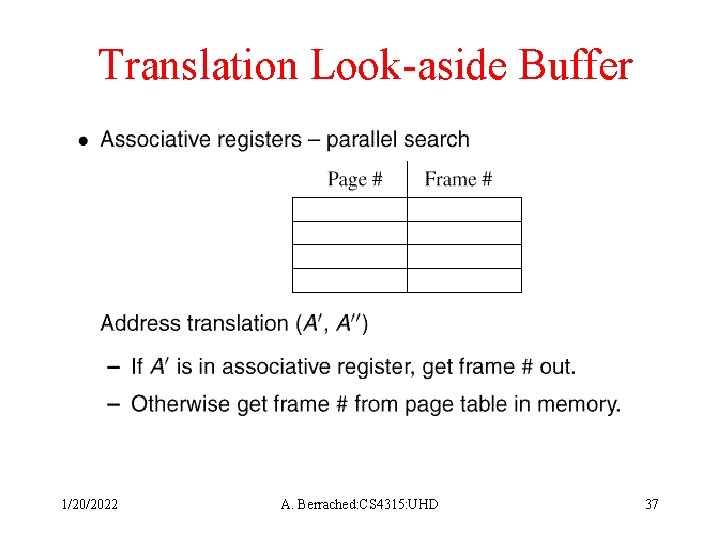
Translation Look-aside Buffer 1/20/2022 A. Berrached: CS 4315: UHD 37
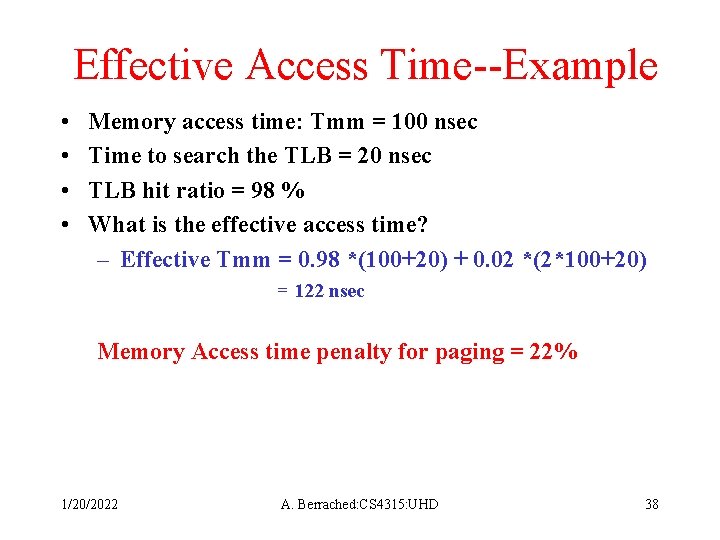
Effective Access Time--Example • • Memory access time: Tmm = 100 nsec Time to search the TLB = 20 nsec TLB hit ratio = 98 % What is the effective access time? – Effective Tmm = 0. 98 *(100+20) + 0. 02 *(2*100+20) = 122 nsec Memory Access time penalty for paging = 22% 1/20/2022 A. Berrached: CS 4315: UHD 38
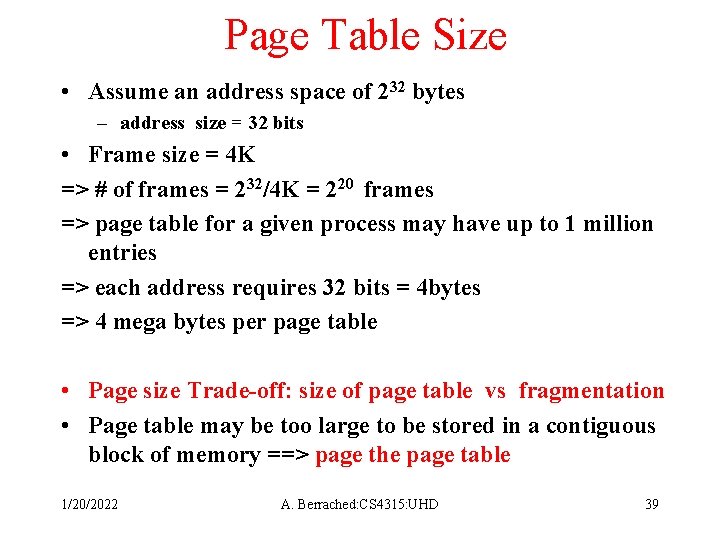
Page Table Size • Assume an address space of 232 bytes – address size = 32 bits • Frame size = 4 K => # of frames = 232/4 K = 220 frames => page table for a given process may have up to 1 million entries => each address requires 32 bits = 4 bytes => 4 mega bytes per page table • Page size Trade-off: size of page table vs fragmentation • Page table may be too large to be stored in a contiguous block of memory ==> page the page table 1/20/2022 A. Berrached: CS 4315: UHD 39
- Slides: 39