
Memory Management 1 Background Programs must be brought
Memory Management 1
Background • Programs must be brought (from disk) into memory for them to be run • Main memory and registers are only storage CPU can access directly • Register access in one CPU clock (or less) • Main memory can take many cycles • Cache sits between main memory and CPU registers • Protection of memory access privileges required to ensure correct operation 2
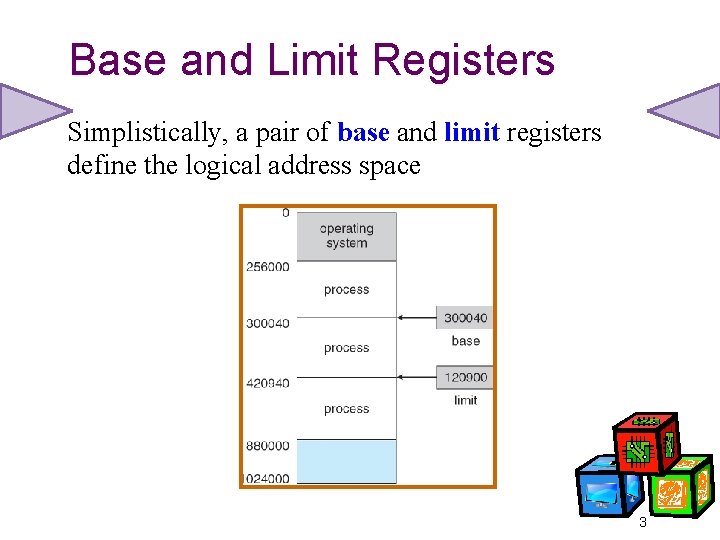
Base and Limit Registers Simplistically, a pair of base and limit registers define the logical address space 3
Logical vs. Physical Address Space • The concept of a logical address space that is bound to a separate physical address space is central to proper memory management – Logical address – generated by the CPU; also referred to as virtual address – Physical address – address seen by the memory unit • Memory-Management Unit (MMU) is the hardware device that maps virtual to physical address • Logical and physical addresses are the same in compile-time address-binding schemes; logical (virtual) and physical addresses differ in execution-time address-binding scheme. The user program deals with logical addresses - it never sees the real physical addresses 4
Binding of Instructions and Data to Memory Address binding of instructions and data to memory addresses can happen at two different stages – Compile time: If memory location known a priori, absolute code can be generated; must recompile code if starting location changes – Execution time: Binding delayed until run time if the process can be moved during its execution from one memory segment to another. Needs hardware support for address maps. 5
Dynamic Loading • Routine is not loaded until it is called. • Better memory-space utilization; unused routine is never loaded. • Useful when large amounts of code are needed to handle infrequently occurring cases • No special support from the operating system is required, implemented through program design. 6

Allocation Possibilities 7
Contiguous Allocation • Main memory usually divided into two partitions: – Resident operating system, usually held in low memory. – User processes then held in high memory. • Relocation registers used to protect user processes from each other, and from changing operating-system code and data. – Base register contains value of smallest physical address – Limit register contains range of logical addresses – each logical address must be less than the limit register. – MMU maps logical address dynamically. 8
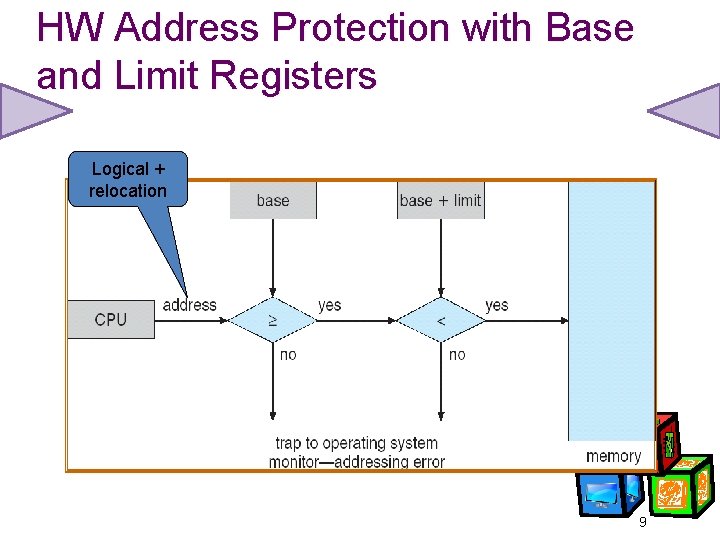
HW Address Protection with Base and Limit Registers Logical + relocation 9
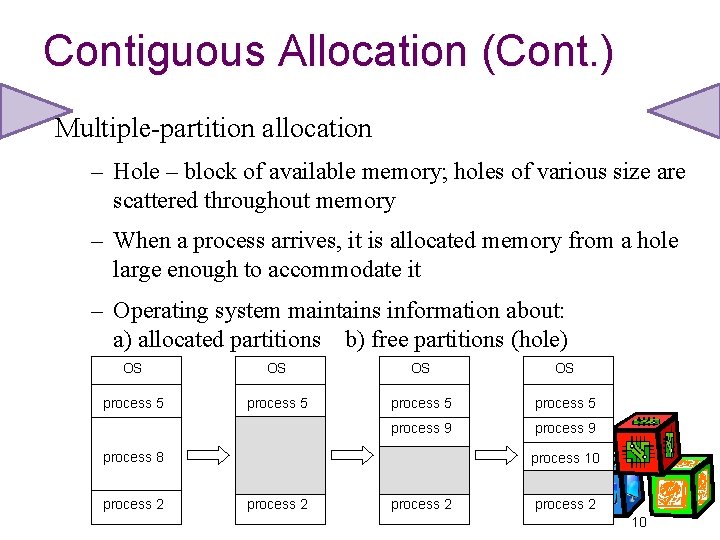
Contiguous Allocation (Cont. ) Multiple-partition allocation – Hole – block of available memory; holes of various size are scattered throughout memory – When a process arrives, it is allocated memory from a hole large enough to accommodate it – Operating system maintains information about: a) allocated partitions b) free partitions (hole) OS OS process 5 process 9 process 8 process 2 process 10 process 2 10
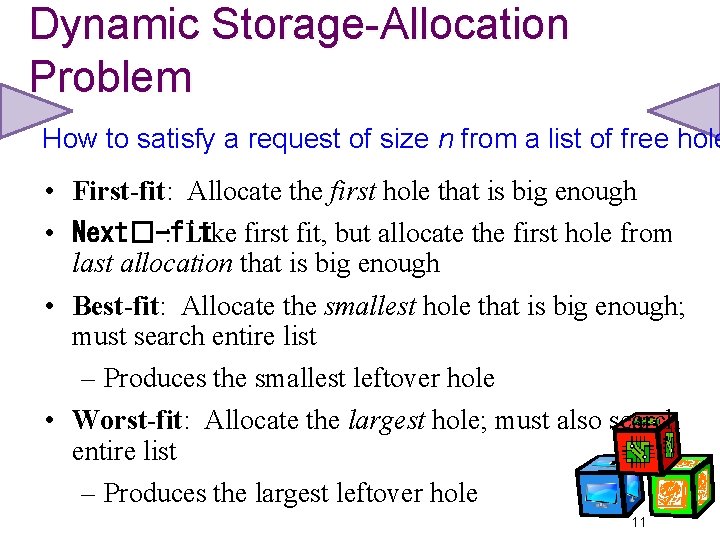
Dynamic Storage-Allocation Problem How to satisfy a request of size n from a list of free hole • First-fit: Allocate the first hole that is big enough • Next�-fit : Like first fit, but allocate the first hole from last allocation that is big enough • Best-fit: Allocate the smallest hole that is big enough; must search entire list – Produces the smallest leftover hole • Worst-fit: Allocate the largest hole; must also search entire list – Produces the largest leftover hole 11
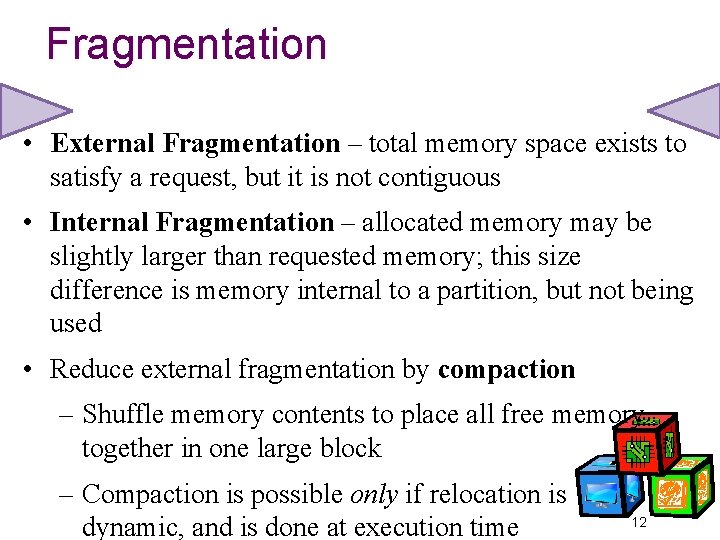
Fragmentation • External Fragmentation – total memory space exists to satisfy a request, but it is not contiguous • Internal Fragmentation – allocated memory may be slightly larger than requested memory; this size difference is memory internal to a partition, but not being used • Reduce external fragmentation by compaction – Shuffle memory contents to place all free memory together in one large block – Compaction is possible only if relocation is dynamic, and is done at execution time 12
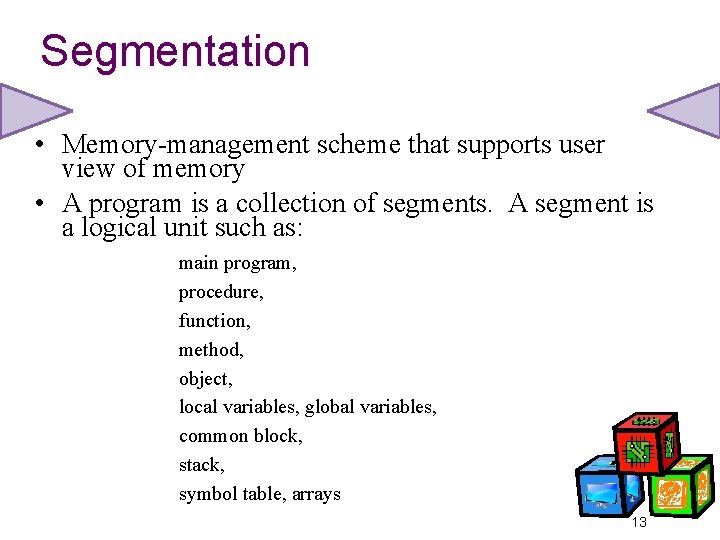
Segmentation • Memory-management scheme that supports user view of memory • A program is a collection of segments. A segment is a logical unit such as: main program, procedure, function, method, object, local variables, global variables, common block, stack, symbol table, arrays 13
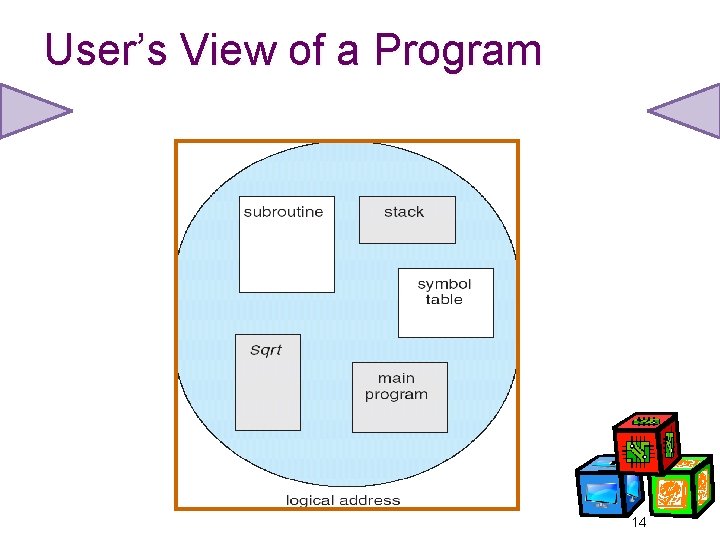
User’s View of a Program 14
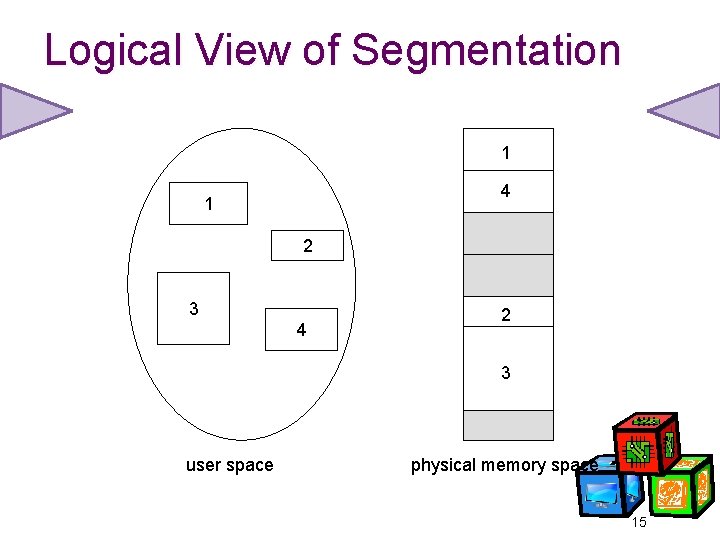
Logical View of Segmentation 1 4 1 2 3 4 2 3 user space physical memory space 15
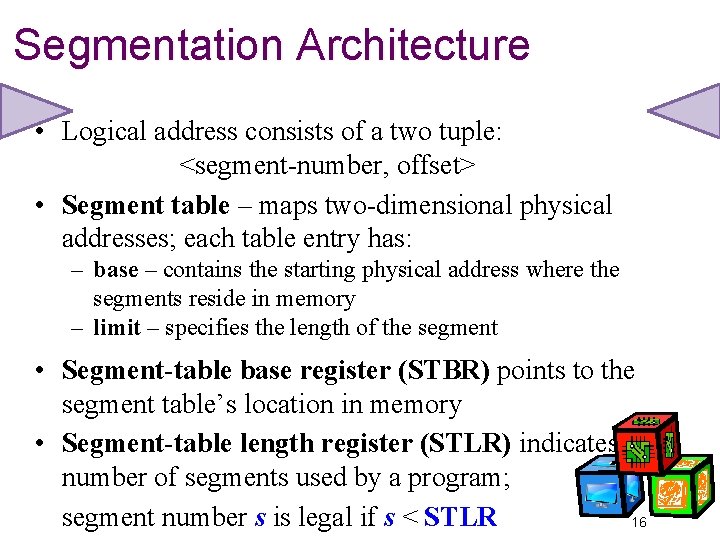
Segmentation Architecture • Logical address consists of a two tuple: <segment-number, offset> • Segment table – maps two-dimensional physical addresses; each table entry has: – base – contains the starting physical address where the segments reside in memory – limit – specifies the length of the segment • Segment-table base register (STBR) points to the segment table’s location in memory • Segment-table length register (STLR) indicates number of segments used by a program; segment number s is legal if s < STLR 16
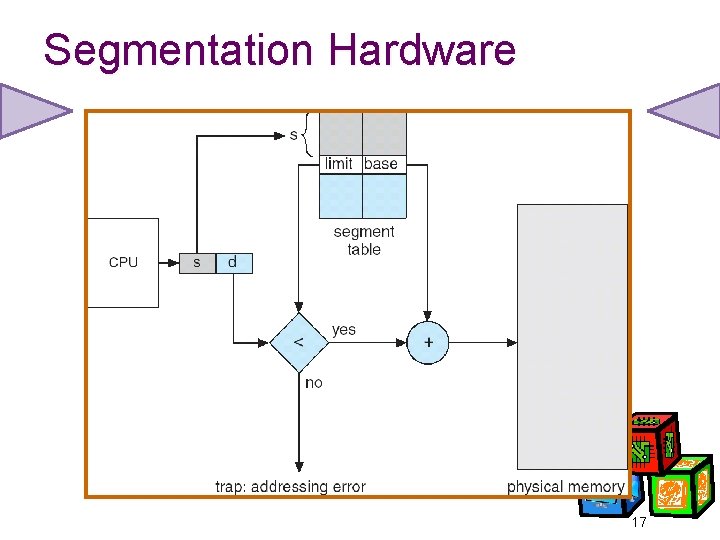
Segmentation Hardware 17
Segmentation Architecture - Cont. • Protection – With each entry in segment table associate: • validation bit = 0 illegal segment • read/write/execute privileges • Protection bits associated with segments; code sharing occurs at segment level. • Since segments vary in length, memory allocation is a dynamic storage-allocation problem. 18
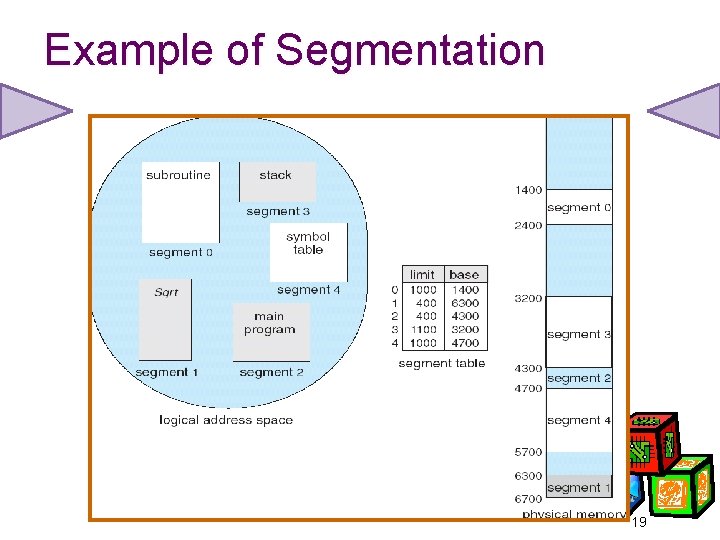
Example of Segmentation 19
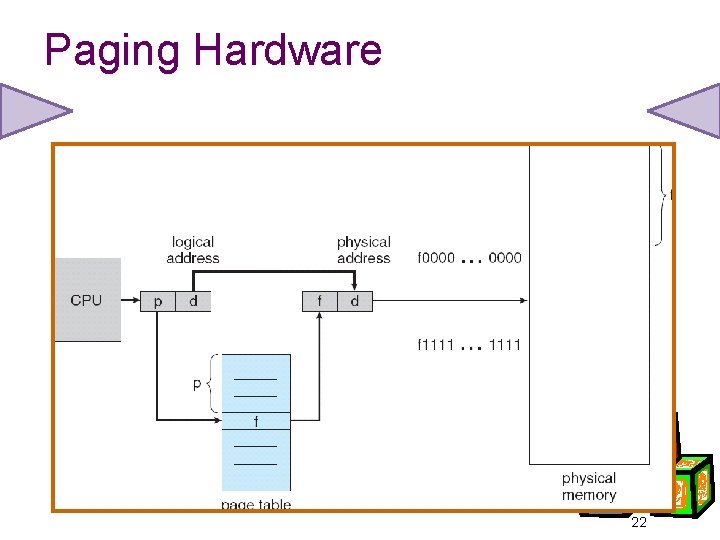
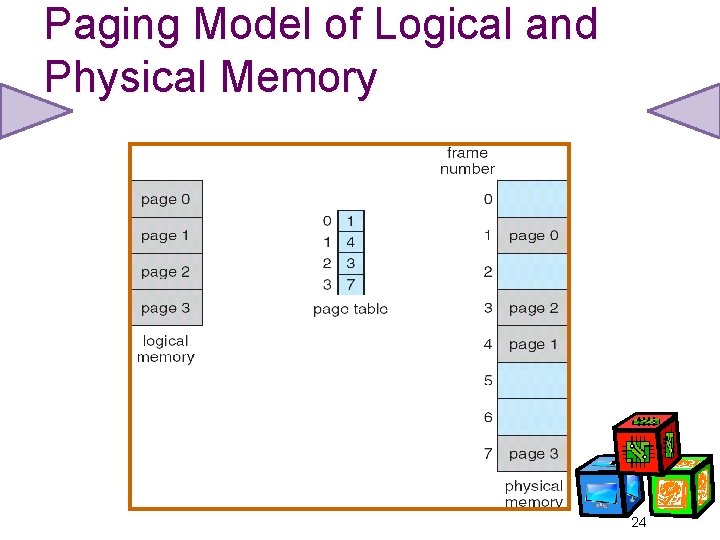
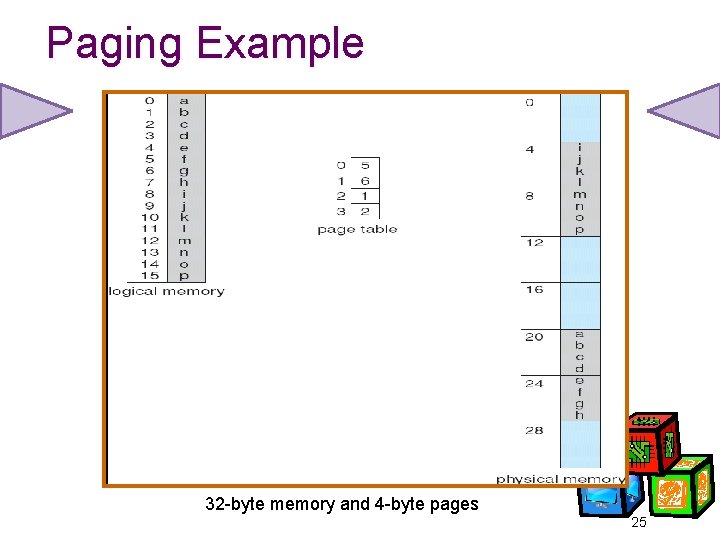
Paging • Logical address space of process can be noncontiguous; process is allocated physical memory whenever the latter is available. • Divide physical memory into fixed-sized blocks called frames (size is power of 2). • Divide logical memory into blocks of same size called pages. • Keep track of all free frames. • To run a program of size n pages, need to find n free frames and load program. • Set up a page table to translate logical to physical addresses. 20
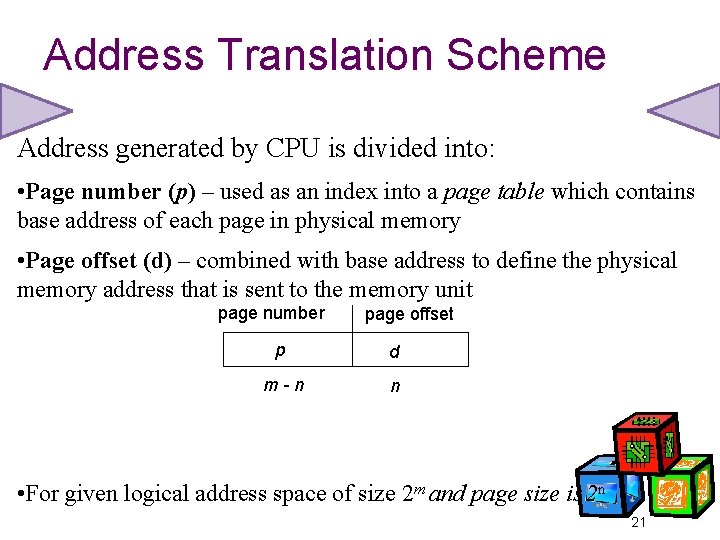
Address Translation Scheme Address generated by CPU is divided into: • Page number (p) – used as an index into a page table which contains base address of each page in physical memory • Page offset (d) – combined with base address to define the physical memory address that is sent to the memory unit page number page offset p d m-n n • For given logical address space of size 2 m and page size is 2 n 21
Paging Hardware 22
Shared Pages • Shared code – One copy of read-only (reentrant) code shared among processes (i. e. , text editors, compilers, window systems). – Each page table maps onto the same physical copy of the shared code. • Private code and data – Each process keeps a separate copy of the code and data. 23
Paging Model of Logical and Physical Memory 24
Paging Example 32 -byte memory and 4 -byte pages 25
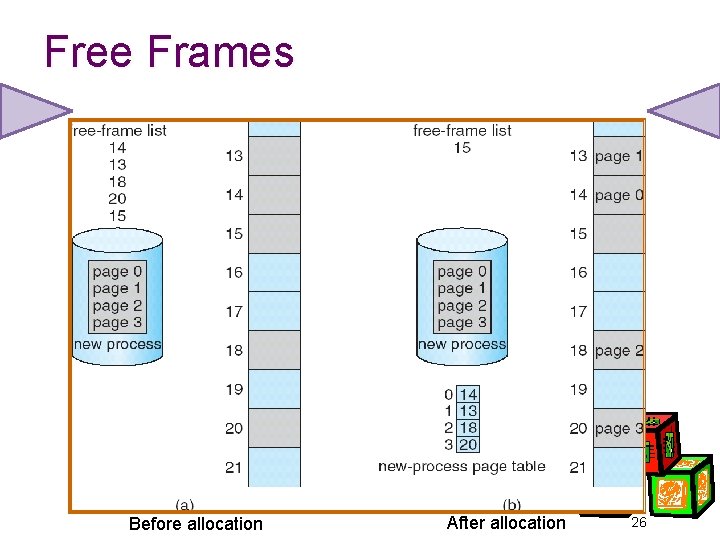
Free Frames Before allocation After allocation 26
Active Memory To check if a page is a valid memory address we have a Valid-invalid bit attached to each entry in the page table: – “valid” indicates that the associated page is in the process’ logical address space, and is thus a legal page. – “invalid” indicates that the page is not mapped at this time. 27
Trashing • Thrashing may be caused by programs or workloads that present insufficient locality of reference • If the working set of a program or a workload cannot be effectively held within physical memory, then constant data swapping, i. e. , thrashing, may occur 28
Thrashing • To resolve thrashing due to excessive paging, a user can do any of the following. – Increase the amount of RAM in the computer (generally the best long-term solution). – Decrease the number of programs being run on the computer. – Replace programs that are memory-heavy with equivalents that use less memory. 29
Swapping • A process can be swapped temporarily out of memory to a backing store, and then brought back into memory for continued execution • Backing store – disk large enough to accommodate copies of all memory images for all users; • Roll out, roll in – swapping variant used for prioritybased scheduling algorithms; lower-priority process is swapped out so higher-priority process can be loaded and executed • System maintains a ready queue of ready-to-run processes which have memory images on disk 30
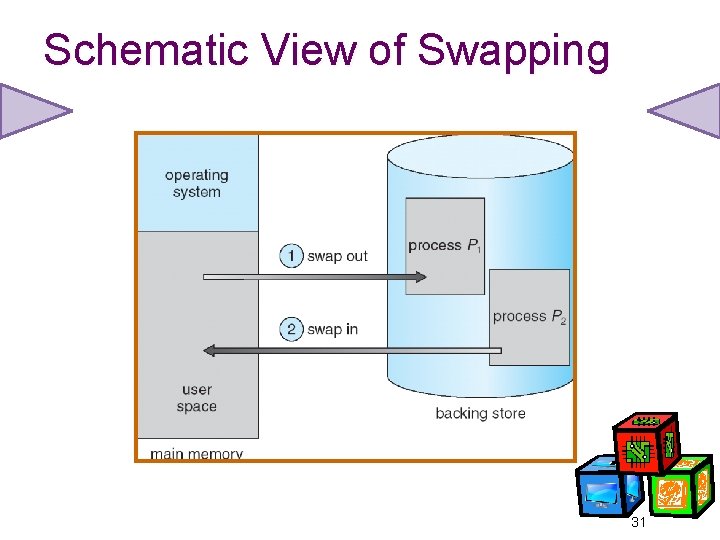
Schematic View of Swapping 31
Implementation of Page Table • Page table is kept in main memory • Page-table base register (PTBR) points to the page table • Page-table length register (PRLR) indicates size of the page table • In this scheme every data/instruction access requires two memory accesses. One for the page table and one for the data/instruction. • The two memory access problem can be solved by the use of a special fast-lookup hardware cache called associative memory or translation look-aside buffers (TLBs) • Some TLBs store address-space identifiers (ASIDs) in each TLB entry – uniquely identifies each process to 32
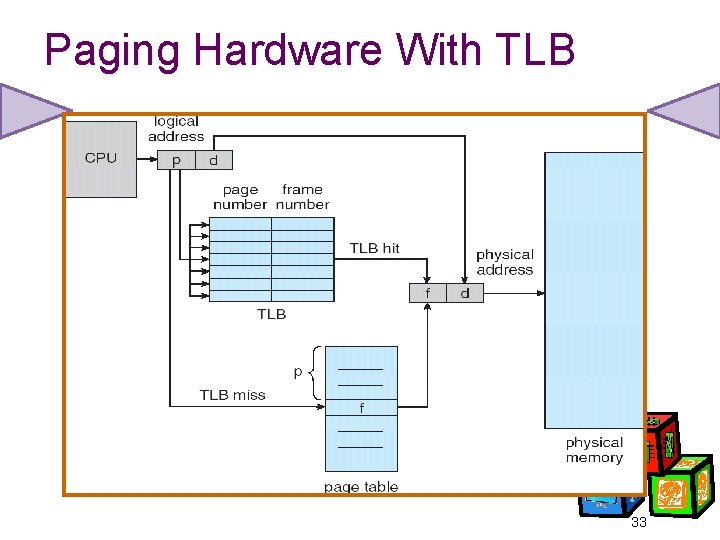
Paging Hardware With TLB 33
Structure of the Page Table • As the number of processes increases, the percentage of memory devoted to page tables also increases. • The following structures solved this problem: – Hierarchical Paging – Hashed Page Tables – Inverted Page Tables 34

Hierarchical Page Tables • Break up the logical address space into multiple page tables. • A simple technique is a two-level page table (the page table is paged). 35
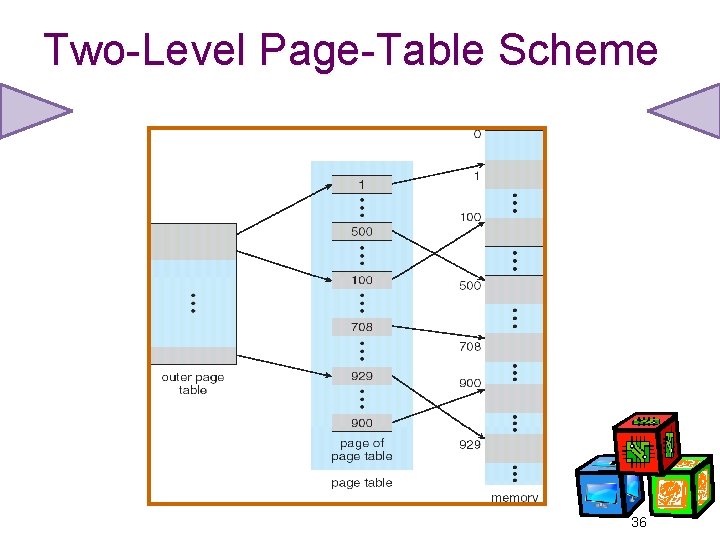
Two-Level Page-Table Scheme 36
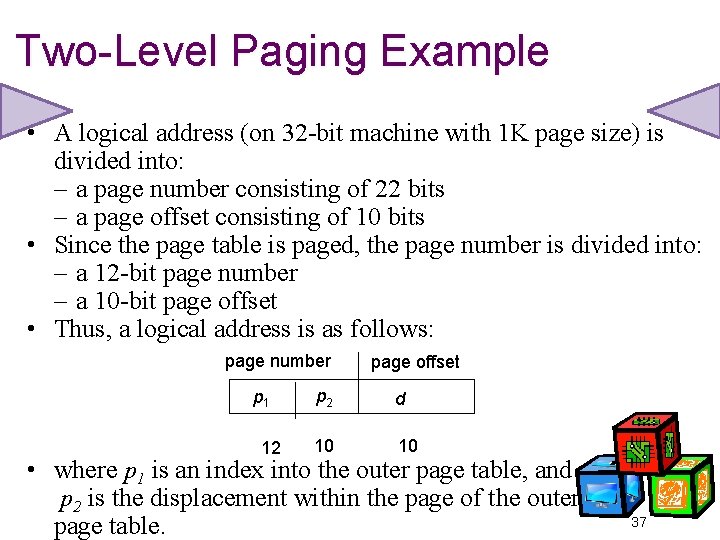
Two-Level Paging Example • A logical address (on 32 -bit machine with 1 K page size) is divided into: – a page number consisting of 22 bits – a page offset consisting of 10 bits • Since the page table is paged, the page number is divided into: – a 12 -bit page number – a 10 -bit page offset • Thus, a logical address is as follows: page number p 1 12 page offset p 2 d 10 10 • where p 1 is an index into the outer page table, and p 2 is the displacement within the page of the outer page table. 37
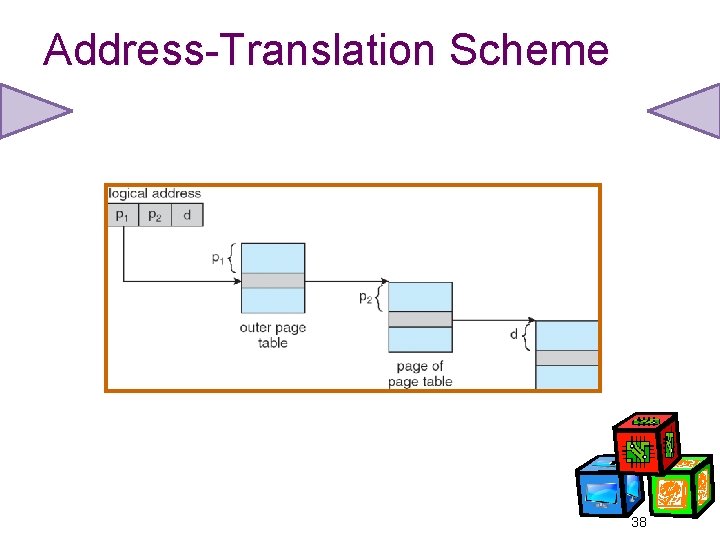
Address-Translation Scheme 38
Hashed Page Tables • Common in address spaces > 32 bits. • The virtual page number is hashed into a page table. This page table contains a chain of elements hashing to the same location. • Virtual page numbers are compared in this chain searching for a match. • If a match is found, the corresponding physical frame is extracted. 39
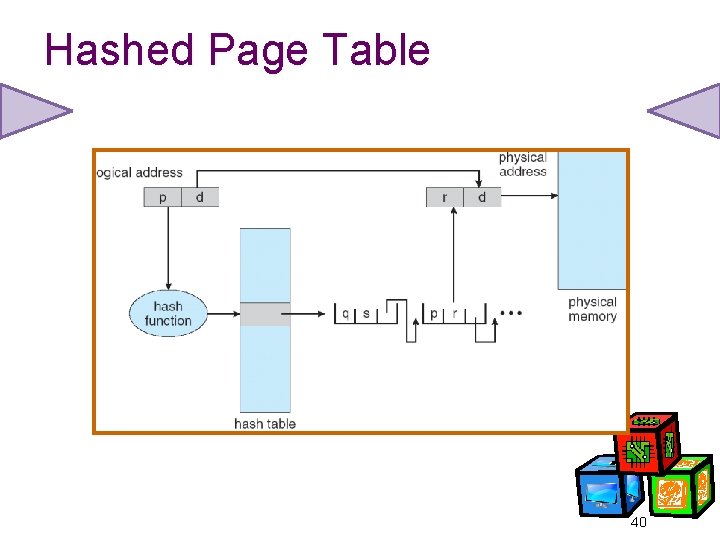
Hashed Page Table 40
Inverted Page Table • One entry for each real page of memory. • Entry consists of the virtual address of the page stored in that real memory location, with information about the process that owns that page. • Decreases memory needed to store each page table, but increases time needed to search the table when a page reference occurs. • Use hash table to limit the search to one - or at most a few - page-table entries. 41
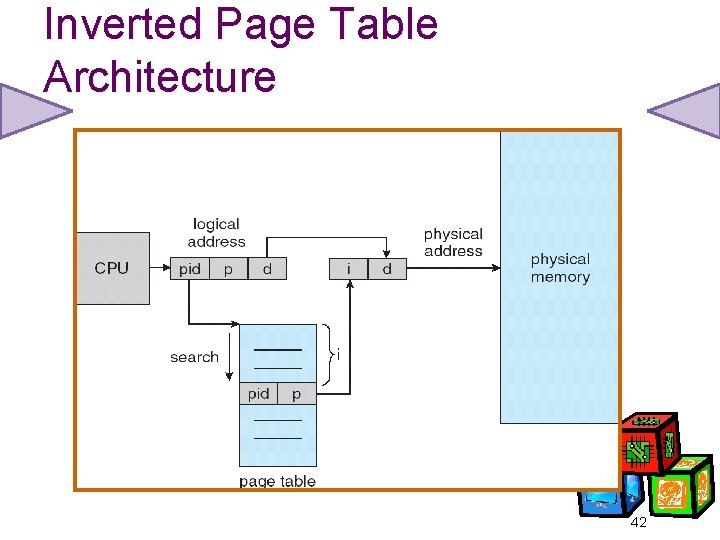
Inverted Page Table Architecture 42
- Slides: 42