
Memory Latches Registers 1 Structured Logic Arrays 2
- Slides: 36
Memory, Latches, & Registers 1) Structured Logic Arrays 2) Memory Arrays 3) Transparent Latches 4) How to save a few bucks at toll booths 5) Edge-triggered Registers Comp 411 – Fall 2008 10/23/08 L 13 – Memory 1
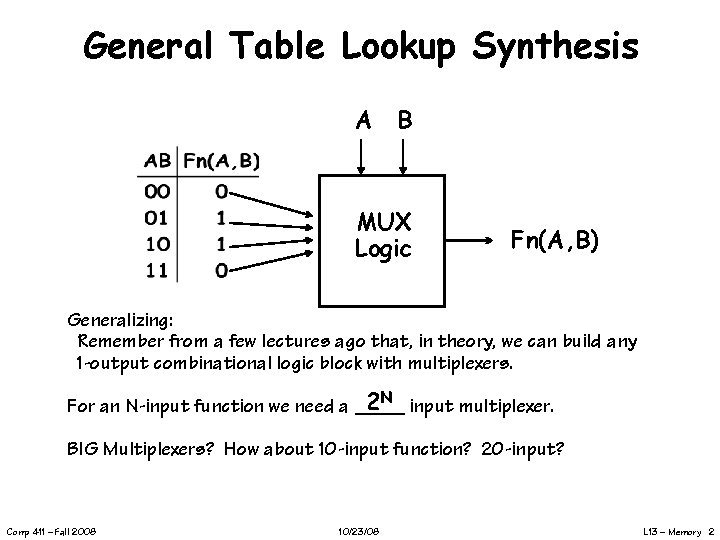
General Table Lookup Synthesis A B MUX Logic Fn(A, B) Generalizing: Remember from a few lectures ago that, in theory, we can build any 1 -output combinational logic block with multiplexers. 2 N input multiplexer. For an N-input function we need a _____ BIG Multiplexers? How about 10 -input function? 20 -input? Comp 411 – Fall 2008 10/23/08 L 13 – Memory 2
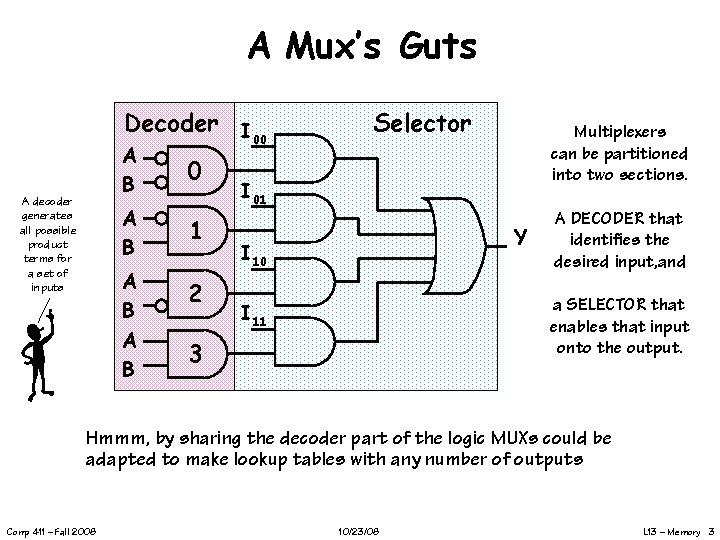
A Mux’s Guts Decoder A B A decoder generates all possible product terms for a set of inputs 0 A B 1 A B 2 A B 3 I 00 Selector Multiplexers can be partitioned into two sections. I 01 Y I 10 A DECODER that identifies the desired input, and a SELECTOR that enables that input onto the output. I 11 Hmmm, by sharing the decoder part of the logic MUXs could be adapted to make lookup tables with any number of outputs Comp 411 – Fall 2008 10/23/08 L 13 – Memory 3
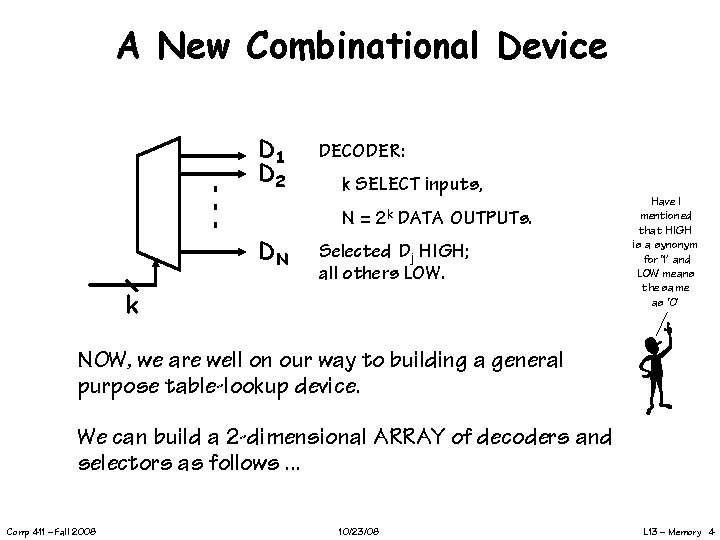
A New Combinational Device D 1 D 2 DECODER: k SELECT inputs, N= DN 2 k DATA OUTPUTs. Selected Dj HIGH; all others LOW. k Have I mentioned that HIGH is a synonym for ‘ 1’ and LOW means the same as ‘ 0’ NOW, we are well on our way to building a general purpose table-lookup device. We can build a 2 -dimensional ARRAY of decoders and selectors as follows. . . Comp 411 – Fall 2008 10/23/08 L 13 – Memory 4
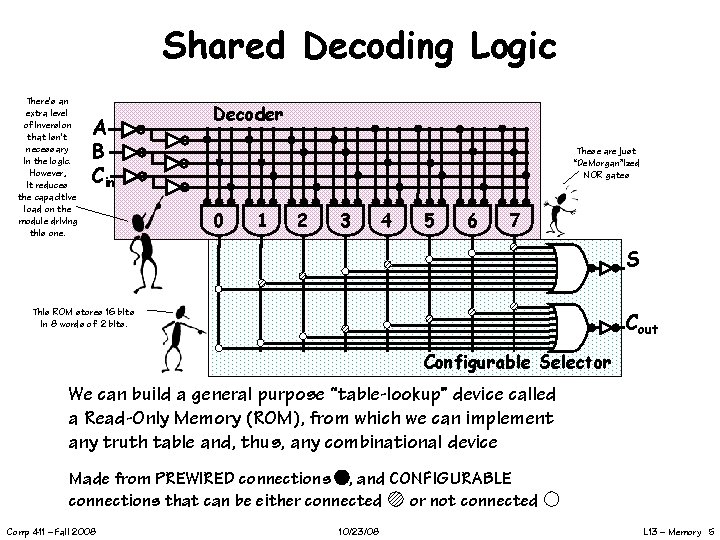
Shared Decoding Logic There’s an extra level of inversion that isn’t necessary in the logic. However, it reduces the capacitive load on the module driving this one. A B Cin Decoder These are just “De. Morgan”ized NOR gates 0 1 2 3 4 5 6 7 S Cout This ROM stores 16 bits in 8 words of 2 bits. Configurable Selector We can build a general purpose “table-lookup” device called a Read-Only Memory (ROM), from which we can implement any truth table and, thus, any combinational device Made from PREWIRED connections , and CONFIGURABLE connections that can be either connected or not connected Comp 411 – Fall 2008 10/23/08 L 13 – Memory 5
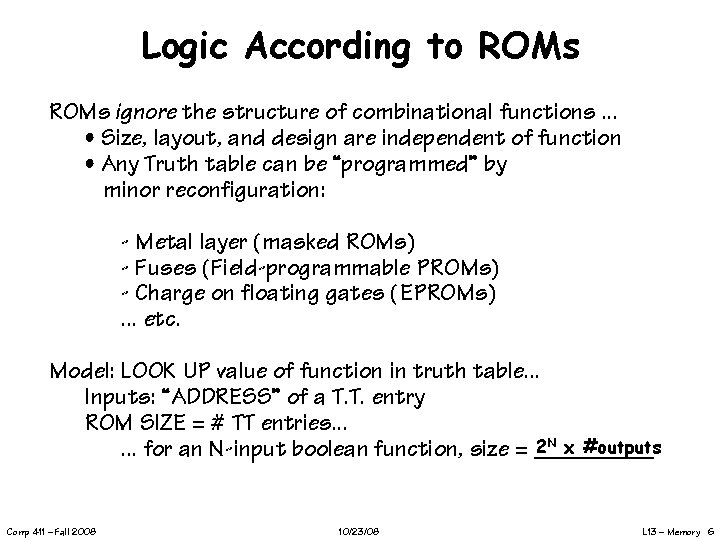
Logic According to ROMs ignore the structure of combinational functions. . . • Size, layout, and design are independent of function • Any Truth table can be “programmed” by minor reconfiguration: - Metal layer (masked ROMs) - Fuses (Field-programmable PROMs) - Charge on floating gates (EPROMs). . . etc. Model: LOOK UP value of function in truth table. . . Inputs: “ADDRESS” of a T. T. entry ROM SIZE = # TT entries. . . 2 N x #outputs. . . for an N-input boolean function, size = _____ Comp 411 – Fall 2008 10/23/08 L 13 – Memory 6
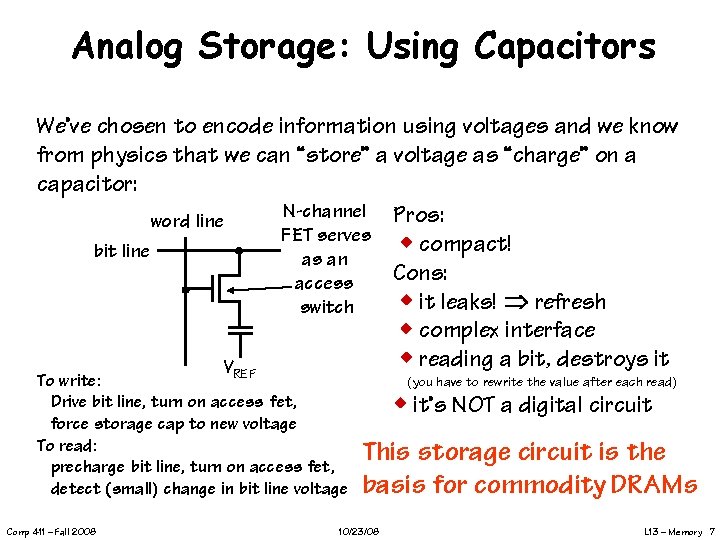
Analog Storage: Using Capacitors We’ve chosen to encode information using voltages and we know from physics that we can “store” a voltage as “charge” on a capacitor: N-channel Pros: word line FET serves w compact! bit line as an Cons: access w it leaks! refresh switch w complex interface w reading a bit, destroys it VREF To write: Drive bit line, turn on access fet, force storage cap to new voltage To read: precharge bit line, turn on access fet, detect (small) change in bit line voltage Comp 411 – Fall 2008 (you have to rewrite the value after each read) w it’s NOT a digital circuit This storage circuit is the basis for commodity DRAMs 10/23/08 L 13 – Memory 7
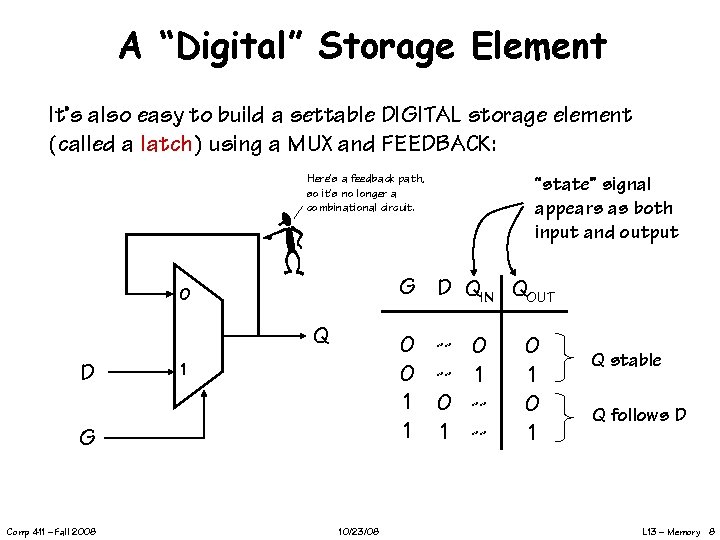
A “Digital” Storage Element It’s also easy to build a settable DIGITAL storage element (called a latch) using a MUX and FEEDBACK: Here’s a feedback path, so it’s no longer a combinational circuit. A G D QIN QOUT 0 Q Y D B 0 -- 0 0 -- 1 1 0 -1 1 -- 1 G S Comp 411 – Fall 2008 “state” signal appears as both input and output 10/23/08 0 1 Q stable Q follows D L 13 – Memory 8
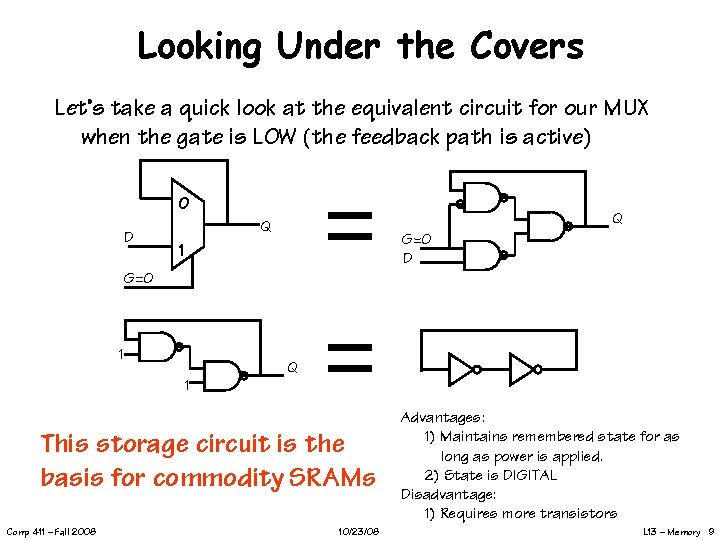
Looking Under the Covers Let’s take a quick look at the equivalent circuit for our MUX when the gate is LOW (the feedback path is active) 0 D Q Q G=0 D 1 G=0 1 Q 1 This storage circuit is the basis for commodity SRAMs Comp 411 – Fall 2008 10/23/08 Advantages: 1) Maintains remembered state for as long as power is applied. 2) State is DIGITAL Disadvantage: 1) Requires more transistors L 13 – Memory 9
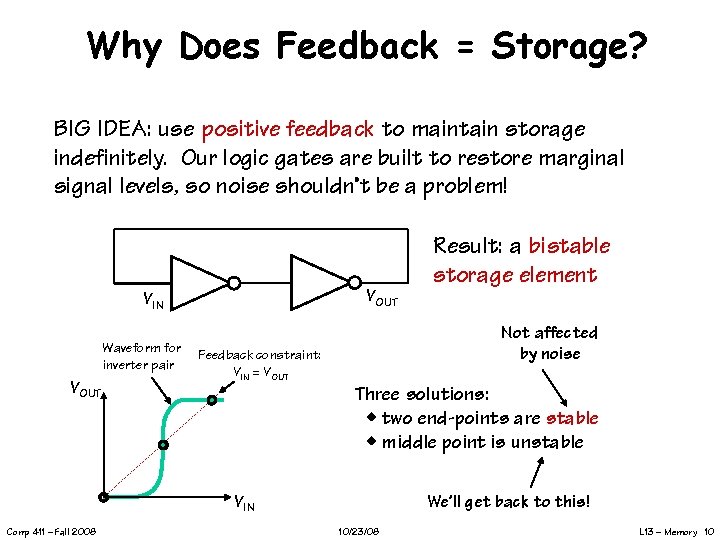
Why Does Feedback = Storage? BIG IDEA: use positive feedback to maintain storage indefinitely. Our logic gates are built to restore marginal signal levels, so noise shouldn’t be a problem! Result: a bistable storage element VOUT VIN Waveform for inverter pair VOUT Not affected by noise Feedback constraint: VIN = V OUT Three solutions: w two end-points are stable w middle point is unstable VIN Comp 411 – Fall 2008 We’ll get back to this! 10/23/08 L 13 – Memory 10
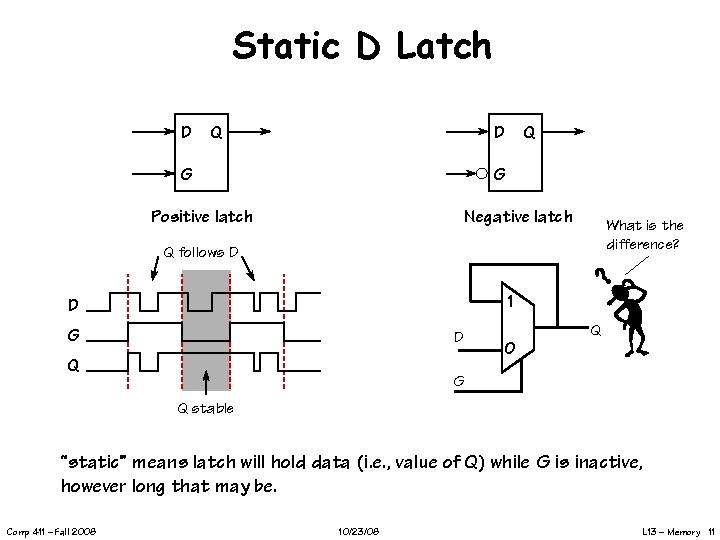
Static D Latch D Q D G Q G Positive latch Negative latch What is the difference? Q follows D 1 D G D Q Q 0 G Q stable “static” means latch will hold data (i. e. , value of Q) while G is inactive, however long that may be. Comp 411 – Fall 2008 10/23/08 L 13 – Memory 11
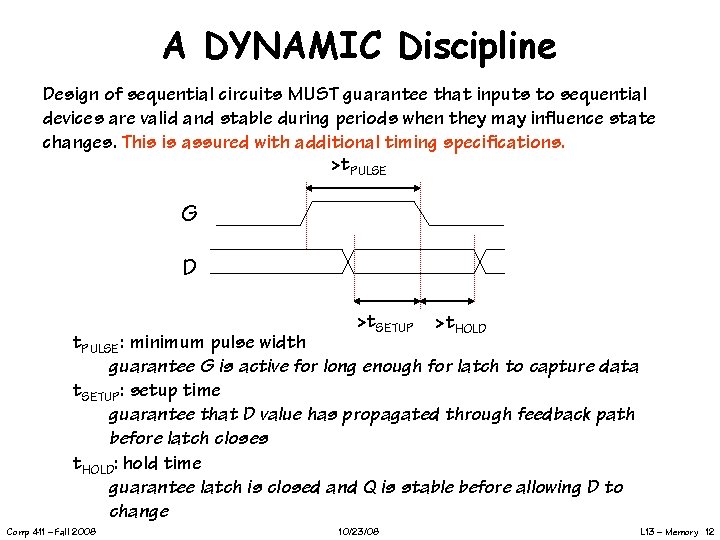
A DYNAMIC Discipline Design of sequential circuits MUST guarantee that inputs to sequential devices are valid and stable during periods when they may influence state changes. This is assured with additional timing specifications. >t. PULSE G D >t. SETUP >t. HOLD t. PULSE: minimum pulse width guarantee G is active for long enough for latch to capture data t. SETUP: setup time guarantee that D value has propagated through feedback path before latch closes t. HOLD: hold time guarantee latch is closed and Q is stable before allowing D to change Comp 411 – Fall 2008 10/23/08 L 13 – Memory 12
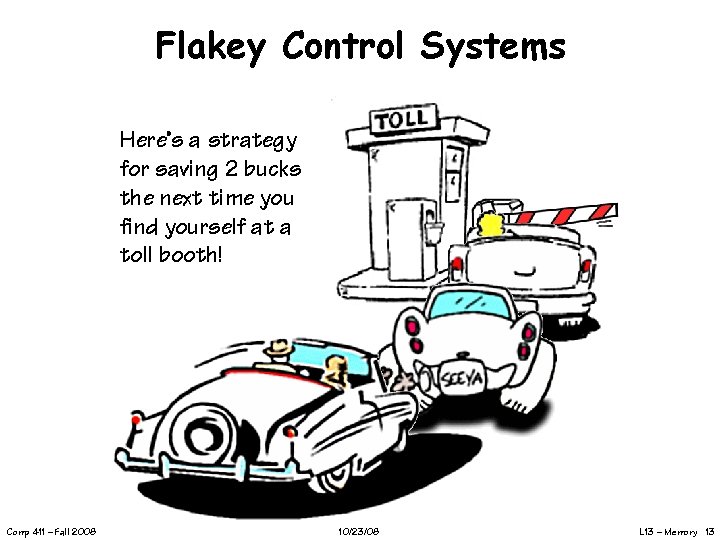
Flakey Control Systems Here’s a strategy for saving 2 bucks the next time you find yourself at a toll booth! Comp 411 – Fall 2008 10/23/08 L 13 – Memory 13
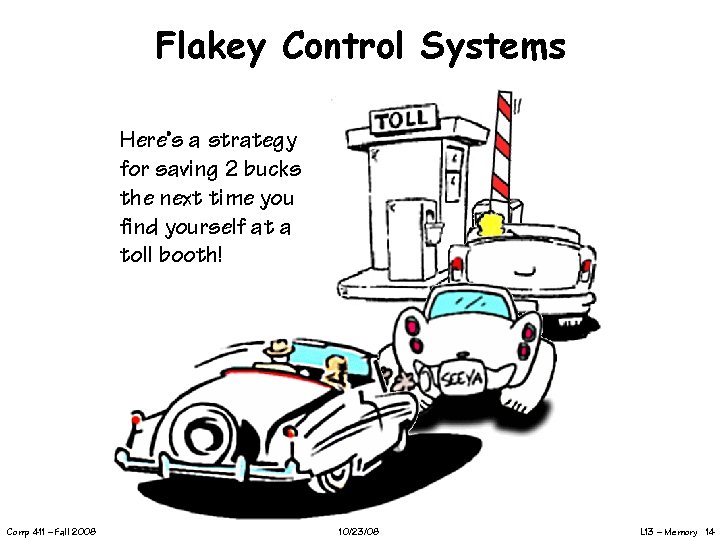
Flakey Control Systems Here’s a strategy for saving 2 bucks the next time you find yourself at a toll booth! Comp 411 – Fall 2008 10/23/08 L 13 – Memory 14
Flakey Control Systems Here’s a strategy for saving 2 bucks the next time you find yourself at a toll booth! WARNING: Professional Drivers Used! DON’T try this At home! Comp 411 – Fall 2008 10/23/08 L 13 – Memory 15
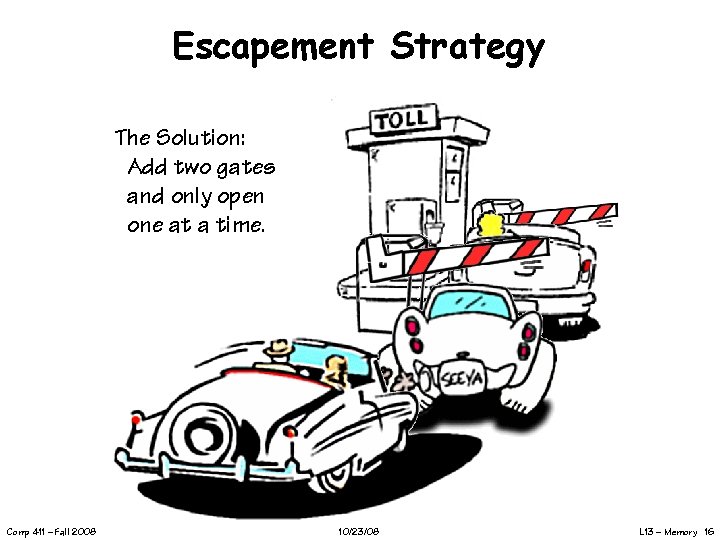
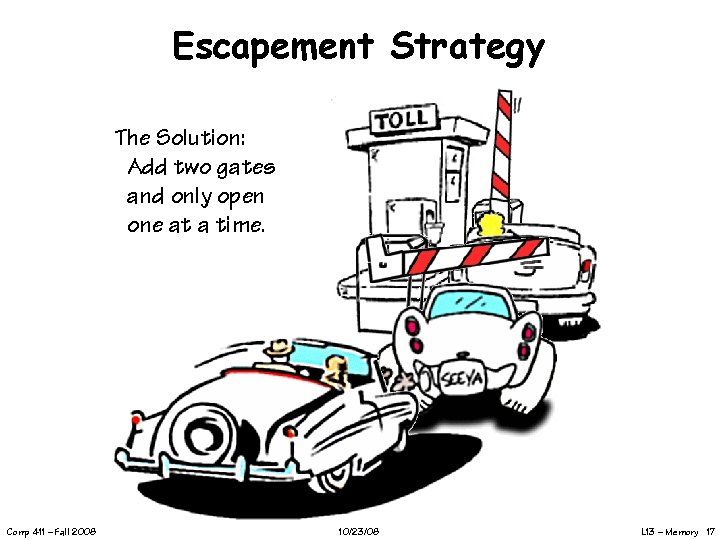
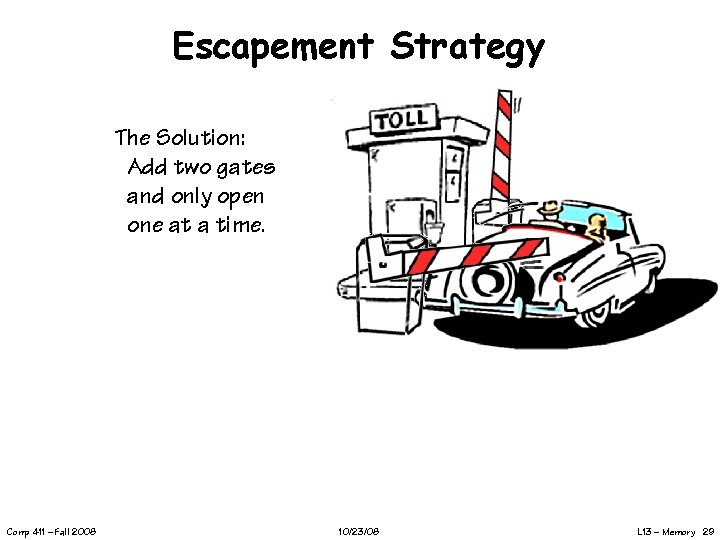
Escapement Strategy The Solution: Add two gates and only open one at a time. Comp 411 – Fall 2008 10/23/08 L 13 – Memory 16
Escapement Strategy The Solution: Add two gates and only open one at a time. Comp 411 – Fall 2008 10/23/08 L 13 – Memory 17
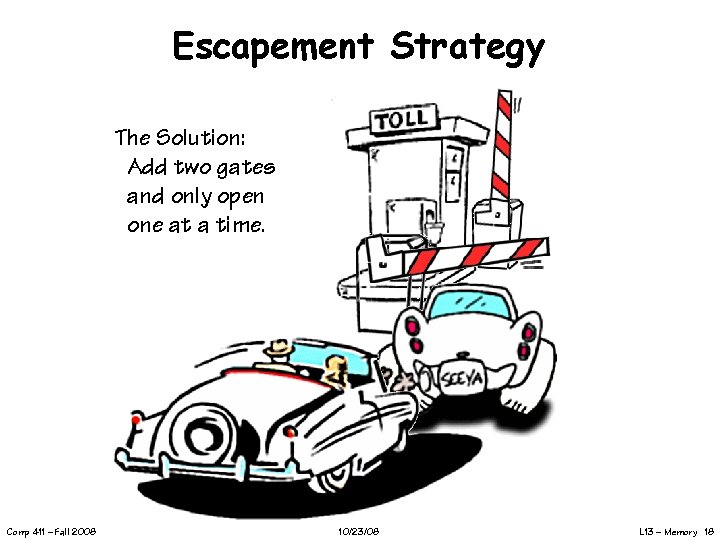
Escapement Strategy The Solution: Add two gates and only open one at a time. Comp 411 – Fall 2008 10/23/08 L 13 – Memory 18
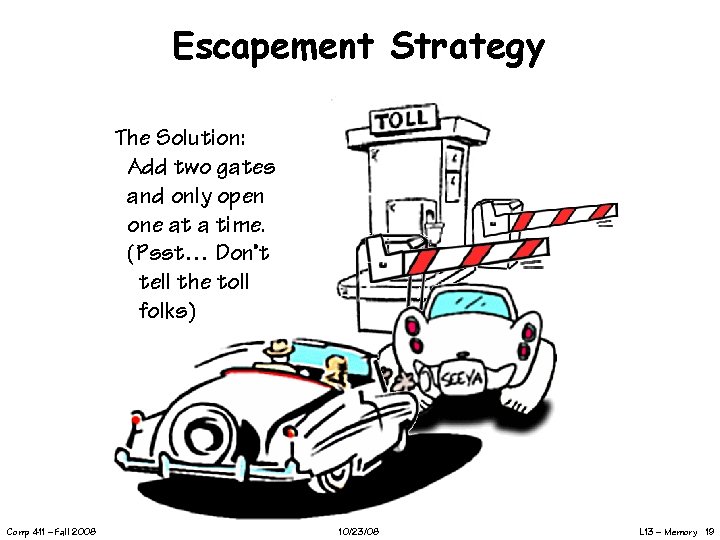
Escapement Strategy The Solution: Add two gates and only open one at a time. (Psst… Don’t tell the toll folks) Comp 411 – Fall 2008 10/23/08 L 13 – Memory 19
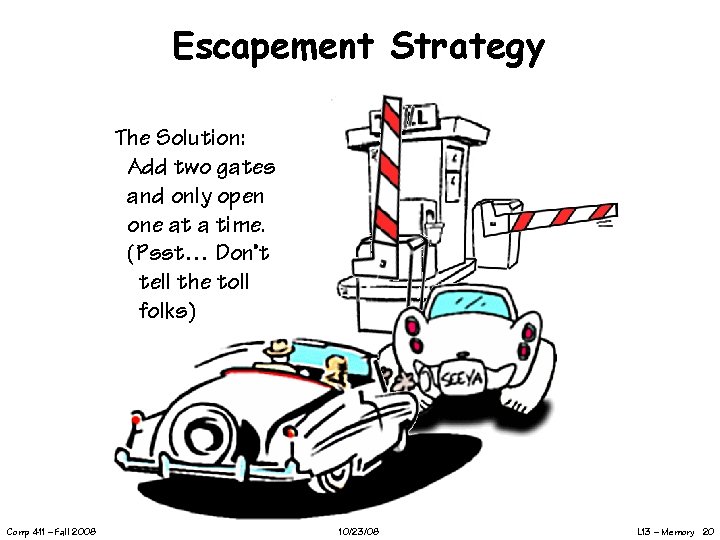
Escapement Strategy The Solution: Add two gates and only open one at a time. (Psst… Don’t tell the toll folks) Comp 411 – Fall 2008 10/23/08 L 13 – Memory 20
Escapement Strategy The Solution: Add two gates and only open one at a time. (Psst… Don’t tell the toll folks) Comp 411 – Fall 2008 10/23/08 L 13 – Memory 21
Escapement Strategy The Solution: Add two gates and only open one at a time. (Psst… Don’t tell the toll folks) Comp 411 – Fall 2008 10/23/08 L 13 – Memory 22
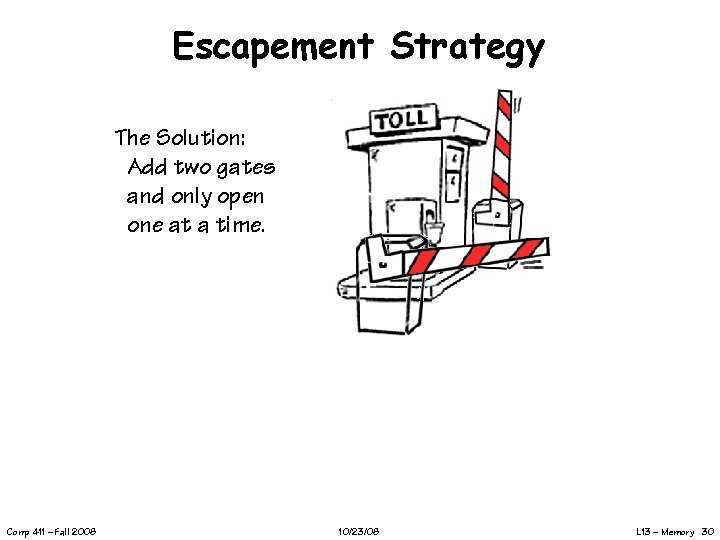
Escapement Strategy The Solution: Add two gates and only open one at a time. Comp 411 – Fall 2008 10/23/08 L 13 – Memory 23
Escapement Strategy The Solution: Add two gates and only open one at a time. Comp 411 – Fall 2008 10/23/08 L 13 – Memory 24
Escapement Strategy The Solution: Add two gates and only open one at a time. (Psst… Don’t tell the toll folks) Comp 411 – Fall 2008 10/23/08 L 13 – Memory 25
Escapement Strategy The Solution: Add two gates and only open one at a time. (Psst… Don’t tell the toll folks) Comp 411 – Fall 2008 10/23/08 L 13 – Memory 26
Escapement Strategy The Solution: Add two gates and only open one at a time. (Psst… Don’t tell the toll folks) Comp 411 – Fall 2008 10/23/08 L 13 – Memory 27
Escapement Strategy The Solution: Add two gates and only open one at a time. (Psst… Don’t tell the toll folks) Comp 411 – Fall 2008 10/23/08 L 13 – Memory 28
Escapement Strategy The Solution: Add two gates and only open one at a time. Comp 411 – Fall 2008 10/23/08 L 13 – Memory 29
Escapement Strategy The Solution: Add two gates and only open one at a time. Comp 411 – Fall 2008 10/23/08 L 13 – Memory 30
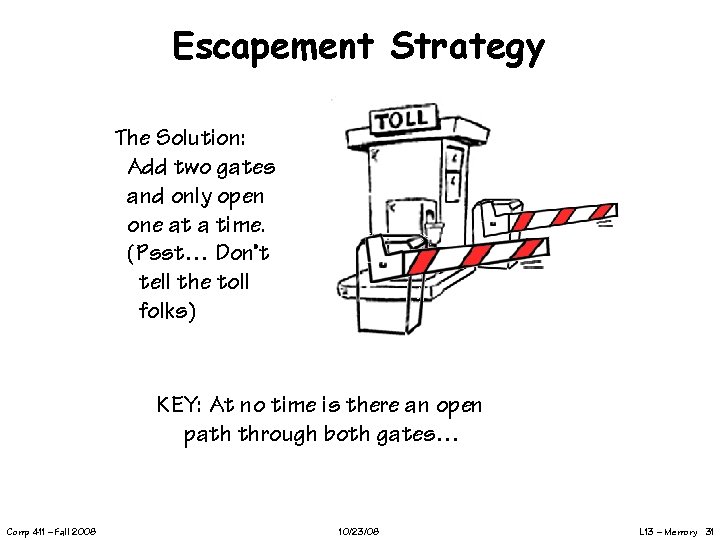
Escapement Strategy The Solution: Add two gates and only open one at a time. (Psst… Don’t tell the toll folks) KEY: At no time is there an open path through both gates… Comp 411 – Fall 2008 10/23/08 L 13 – Memory 31
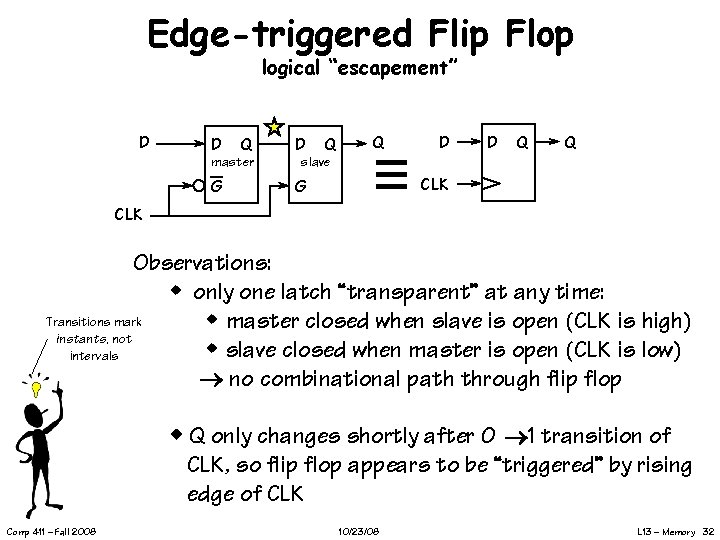
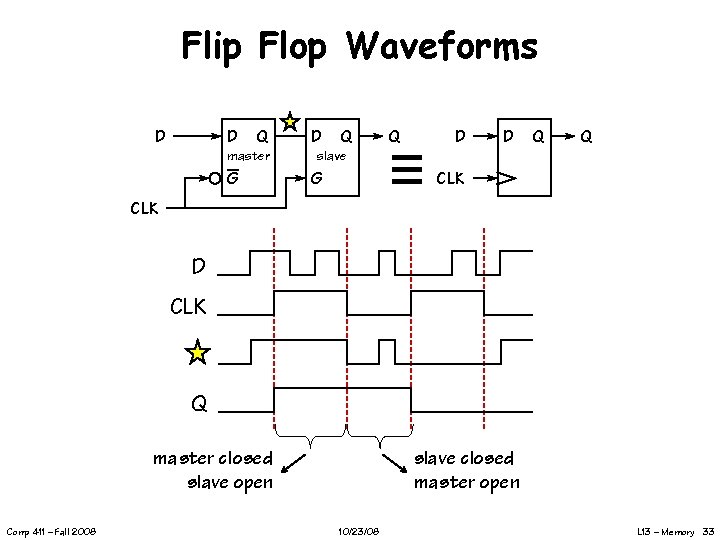
Edge-triggered Flip Flop logical “escapement” D D Q master G D Q Q D D Q Q slave CLK G CLK Observations: w only one latch “transparent” at any time: Transitions mark w master closed when slave is open (CLK is high) instants, not w slave closed when master is open (CLK is low) intervals no combinational path through flip flop w Q only changes shortly after 0 1 transition of CLK, so flip flop appears to be “triggered” by rising edge of CLK Comp 411 – Fall 2008 10/23/08 L 13 – Memory 32
Flip Flop Waveforms D D Q master G D Q Q D D Q Q slave G CLK D CLK Q master closed slave open Comp 411 – Fall 2008 slave closed master open 10/23/08 L 13 – Memory 33
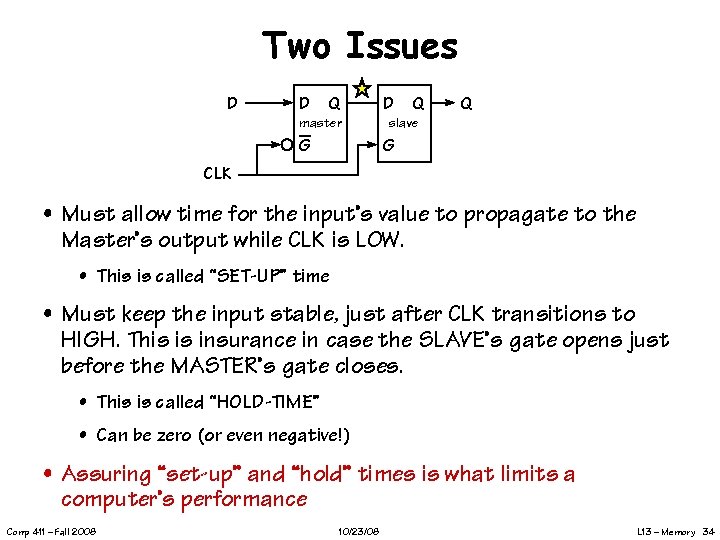
Two Issues D D Q master G D Q Q slave G CLK • Must allow time for the input’s value to propagate to the Master’s output while CLK is LOW. • This is called “SET-UP” time • Must keep the input stable, just after CLK transitions to HIGH. This is insurance in case the SLAVE’s gate opens just before the MASTER’s gate closes. • This is called “HOLD-TIME” • Can be zero (or even negative!) • Assuring “set-up” and “hold” times is what limits a computer’s performance Comp 411 – Fall 2008 10/23/08 L 13 – Memory 34
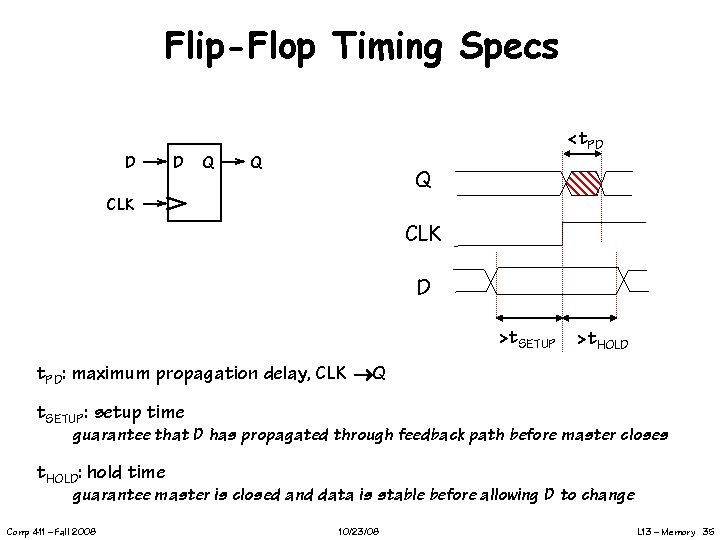
Flip-Flop Timing Specs <t. PD D D Q Q Q CLK D >t. SETUP >t. HOLD t. PD: maximum propagation delay, CLK Q t. SETUP: setup time guarantee that D has propagated through feedback path before master closes t. HOLD: hold time guarantee master is closed and data is stable before allowing D to change Comp 411 – Fall 2008 10/23/08 L 13 – Memory 35
Summary • Regular Arrays can be used to implement arbitrary logic functions • ROMs decode every input combination (fixed-AND array) and compute the output for it (customized-OR array) • PLAs decode an minimal set of input combinations (both AND and OR arrays customized) • Memories • ROMs are HARDWIRED memories • RAMs include storage elements at each WORD-line and BIT-line intersection • dynamic memory: compact, only reliable short-term • static memory: controlled use of positive feedback • Level-sensitive D-latches for static storage • Dynamic discipline (setup and hold times) Comp 411 – Fall 2008 10/23/08 L 13 – Memory 36