
MEMORY FALLIBILITY ITS EFFECT ON EYEWITNESS RELIABILITY TAYLOR
MEMORY FALLIBILITY & ITS EFFECT ON EYEWITNESS RELIABILITY TAYLOR ROGAN
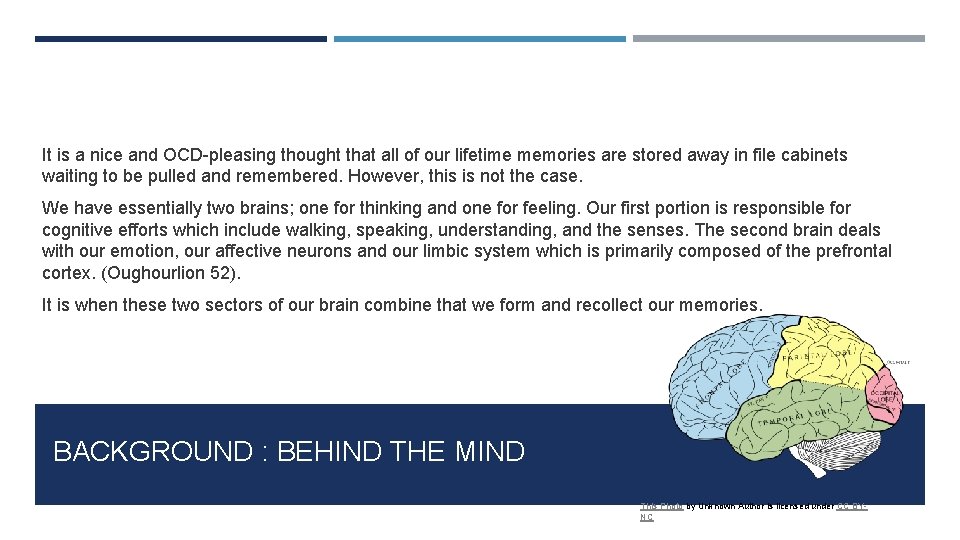
It is a nice and OCD-pleasing thought that all of our lifetime memories are stored away in file cabinets waiting to be pulled and remembered. However, this is not the case. We have essentially two brains; one for thinking and one for feeling. Our first portion is responsible for cognitive efforts which include walking, speaking, understanding, and the senses. The second brain deals with our emotion, our affective neurons and our limbic system which is primarily composed of the prefrontal cortex. (Oughourlion 52). It is when these two sectors of our brain combine that we form and recollect our memories. BACKGROUND : BEHIND THE MIND This Photo by Unknown Author is licensed under CC BYNC
HOW DO OUR BRAINS PROCESS MEMORIES Memories are not vivid recollections of past details, but rather scattered and random pieces of information that our brain together to form the best case scenario. Many times when we remember something it is a collection of what we envisioned it to be. If we remember a situation being embarrassing, we will remember those memories and add on to them, making the memory go along with our perceptions. If trying to recall an event, our brain will find the most vivid memories and from there fill in the gaps. These gaps could be small, such as the color of a shirt but that could be a large difference if this is in a courtroom setting. In some situations there are things that our brain will naturally focus on, leaving other details to go unnoticed or mistaken. For example, in a robbery, if a weapon is present, it will grab our attention, and we are more likely to mistake what the thief looked like.
HOW OUR BRAINS MISINTERPRET With our memories being fragmented- it is easy for our brains to miscommunicate what actually happened Our brains can be swayed subconsciously by factors out of our control; for example The way a question is asked The wording of a phrase Suggestiveness by an interviewer Receiving feedback from another source or person Expertise All of these factors and more affect how our brains recollect our memories. The goal of the brain is to formulate a memory that makes the most logical sense and that would apply to our present thoughts. Ex. During a police questioning, if the officer is suggestive towards one story or words a question to favor an outcome, chances are that the person being questioned will believe the authority that the officer has and their memory will shift to better support that idea.
HOW OUR BELIEFS CAN BE SWAYED – CASE STUDY Psychologists and people of authoritative positions are more likely to sway our beliefs. We can also be hypnotized into believing something occurred when it did not. In 1986, Nadean Cool, sought therapy from a psychiatrist to help her cope with her reaction to a traumatic event experienced by her daughter. During therapy, the psychiatrist used hypnosis and other suggestive techniques to dig out buried memories of abuse that Cool herself had allegedly experienced. From this, Cool became convinced that she had repressed memories of having been in a satanic cult, of eating babies, of being raped, of having sex with animals and of being forced to watch the murder of her eight-year-old friend. Cool was told, she had experienced severe childhood sexual and physical abuse. It wasn’t until 1997 that Cool finally realized that false memories had been planted, and she sued the psychiatrist for malpractice and won.
HOW AND WHY DO WE BELIEVE OUR FALSE MEMORIES? Our brains work subconsciously, and ironically we have no control over how our memories are collected and formed. The Misinformation Effect and memory conformity go hand-in-hand. Memories can be incorrectly retrieved most likely due to influence from a false informant. Witnesses may change their statements or beliefs if other people saw different things. Usually conversations between witnesses are used to validate one persons perspective. Misinformation has the potential for invading our memories when we talk to other people, when we are suggestively interrogated or when we read or view media coverage about some event that we may have experienced ourselves. Memories are more easily modified, for instance, when the passage of time allows the original memory to fade.
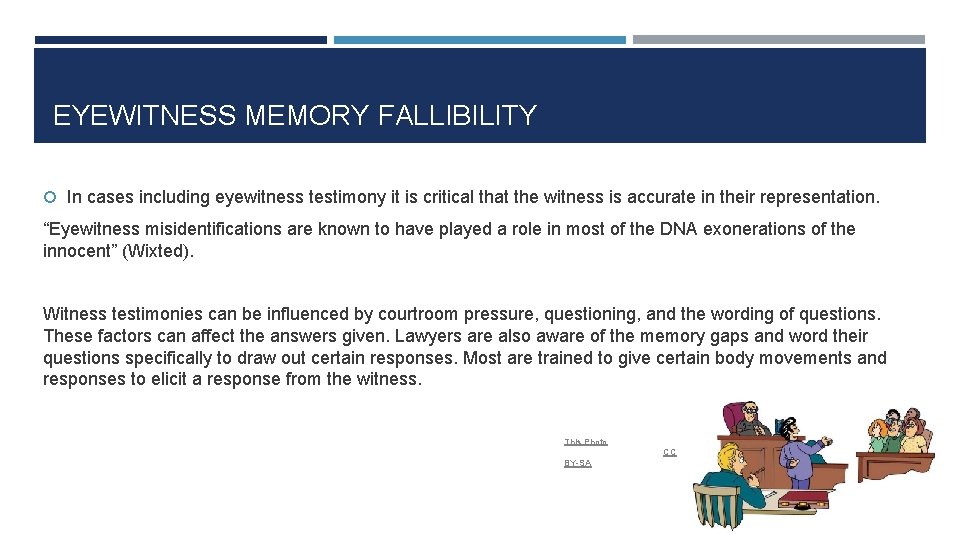
EYEWITNESS MEMORY FALLIBILITY In cases including eyewitness testimony it is critical that the witness is accurate in their representation. “Eyewitness misidentifications are known to have played a role in most of the DNA exonerations of the innocent” (Wixted). Witness testimonies can be influenced by courtroom pressure, questioning, and the wording of questions. These factors can affect the answers given. Lawyers are also aware of the memory gaps and word their questions specifically to draw out certain responses. Most are trained to give certain body movements and responses to elicit a response from the witness. This Photo by Unknown Author is licensed under CC BY-SA
WHY EYEWITNESSES HAVE SO MUCH POWER Jurors do not have enough knowledge about false memories, to be educated and aware when hearing eyewitness testimonies. Historically, eyewitness testimony is taken more seriously by jurors, than DNA evidence is. Although people are often mistaken, most people believe other people rather than data. With what is known about false memories, it is truthful that witness testimonies are most likely not completely truthful.
COURTROOM SETTINGS- WHY NOT HAVE EXPERTS? With what is known regarding memory fallibility, a beneficial but not foolproof solution could be having experts in the courtroom to ensure the jurors are aware of possible false memories, and help sort through true and false statements. Courts in the past have dismissed the idea of having an expert alongside a witness, but with false identifications recognized as a leading cause of wrongful convictions in the US, it might be the best case scenario. Expert testimony could educate jurors about the shortcomings of eyewitnesses, and allow them to be somewhat skeptical when hearing testimonies.
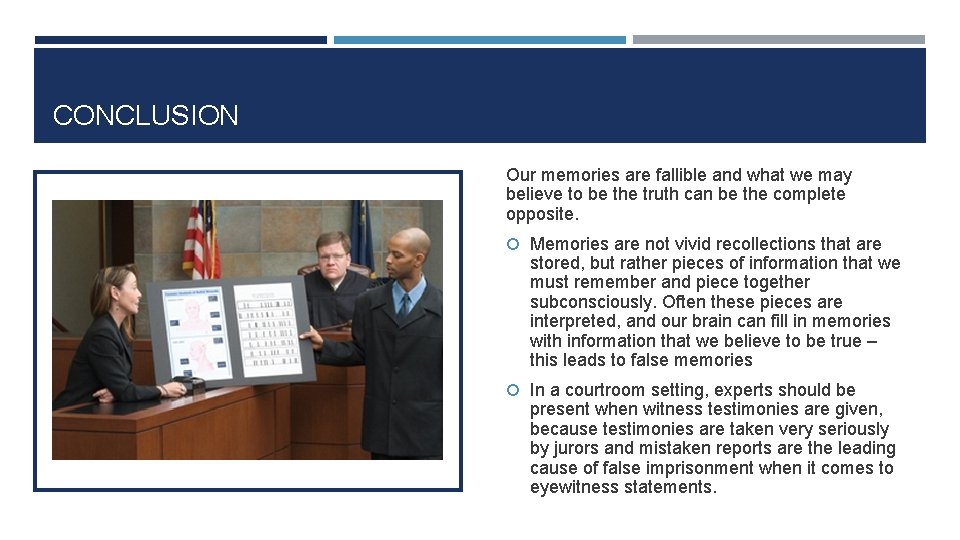
CONCLUSION Our memories are fallible and what we may believe to be the truth can be the complete opposite. Memories are not vivid recollections that are stored, but rather pieces of information that we must remember and piece together subconsciously. Often these pieces are interpreted, and our brain can fill in memories with information that we believe to be true – this leads to false memories In a courtroom setting, experts should be present when witness testimonies are given, because testimonies are taken very seriously by jurors and mistaken reports are the leading cause of false imprisonment when it comes to eyewitness statements.
THANK YOU
WORKS CITED “Creating False Memories. ” Creating False Memories, staff. washington. edu/eloftus/Articles/sciam. htm. “The Province of the Jurist: Judicial Resistance to Expert Testimony on Eyewitnesses as Institutional Rivalry. ” Harvard Law Review, vol. 126, no. 8, June 2013, pp. 2381– 2402. EBSCOhost, sacredheart. idm. oclc. org/login? url=https: //search. ebscohost. com/login. aspx? direct=true&db=aph&AN=88089886&site=ehost-live&scope=site. Anooshian, Linda J. , and Pennie S. Seibert. “Diversity within Spatial Cognition: Memory Processes Underlying Place Recognition. ” Applied Cognitive Psychology, vol. 10, no. 4, Aug. 1996, pp. 281– 299. EBSCOhost, doi: 10. 1002/(SICI)10990720(199608)10: 4<281: : AID-ACP 382>3. 0. CO; 2 -8. Brainerd, C. J. “Murder Must Memorise. ” Memory, vol. 21, no. 5, July 2013, pp. 547– 555. EBSCOhost, doi: 10. 1080/09658211. 2013. 791322. Charman, Steve D. , et al. “The Effect of Biased Lineup Instructions on Eyewitness Identification Confidence. ” Applied Cognitive Psychology, vol. 32, no. 3, May 2018, pp. 287– 297. EBSCOhost, doi: 10. 1002/acp. 3401. Howe, Mark. L. “Memory Lessons from the Courtroom: Reflections on Being a Memory Expert on the Witness Stand. ” Memory, vol. 21, no. 5, July 2013, pp. 576– 583. EBSCOhost, doi: 10. 1080/09658211. 2012. 725735. “REAL MEMORIES, PHONY MEMORIES. ” The Mind's Past, by Michael S. Gazzaniga, 1 st ed. , University of California Press, Berkeley; Los Angeles; London, 1998, pp. 123– 149. JSTOR, www. jstor. org/stable/10. 1525/j. ctt 1 pn 55 c. 9. Sanchez, Christopher A. , and Jamie S. Naylor. “Disfluent Presentations Lead to the Creation of More False Memories. ” PLo. S ONE, vol. 13, no. 1, Jan. 2018, pp. 1– 8. EBSCOhost, doi: 10. 1371/journal. pone. 0191735. Smalarz, Laura, and Gary L. Wells. “Contamination of Eyewitness Self-Reports and the Mistaken-Identification Problem. ” Current Directions in Psychological Science, vol. 24, no. 2, Apr. 2015, pp. 120– 124. EBSCOhost, doi: 10. 1177/0963721414554394. “The Three Brains. ” The Mimetic Brain, by Jean-Michel Oughourlian et al. , Michigan State University Press, 2016, pp. 49– 56. JSTOR, www. jstor. org/stable/10. 14321/j. ctt 18 j 8 z 3 k. 11. Vallas, George. “A Survey of Federal and State Standards for the Admission of Expert Testimony on the Reliability of Eyewitnesses. ” American Journal of Criminal Law, vol. 39, no. 1, Fall 2011, pp. 97– 146. EBSCOhost, sacredheart. idm. oclc. org/login? url=https: //search. ebscohost. com/login. aspx? direct=true&db=aph&AN=7401&site=ehost-live&scope=site. Volz, Katja, et al. “Event-Related Potentials Differ between True and False Memories in the Misinformation Paradigm. ” International Journal of Psychophysiology, vol. 135, Jan. 2019, pp. 95– 105. EBSCOhost, doi: 10. 1016/j. ijpsycho. 2018. 12. 002. Williamson, Paul, et al. “The Effect of Expertise on Memory Conformity: A Test of Informational Influence. ” Behavioral Sciences & the Law, vol. 31, no. 5, Sept. 2013, pp. 607– 623. EBSCOhost, doi: 10. 1002/bsl. 2094. Wilson, Clare. “Can I Trust My Memories? ” New Scientist, no. 3201, Oct. 2018, pp. 36– 37. EBSCOhost, sacredheart. idm. oclc. org/login? url=https: //search. ebscohost. com/login. aspx? direct=true&db=aph&AN=133174186&site=ehostlive&scope=site. Woods, Joshua A. , and Stephen A. Dewhurst. “Putting False Memories into Context: The Effects of Odour Contexts on Correct and False Recallpass: [*]. ” Memory, vol. 27, no. 3, Mar. 2019, pp. 379– 386. EBSCOhost, doi: 10. 1080/09658211. 2018. 1512632. Zaragoza, Maria S. , et al. “Interviewing Witnesses: Forced Confabulation and Confirmatory Feedback Increase False Memories. ” Psychological Science, vol. 12, no. 6, 2001, pp. 473– 477. JSTOR, www. jstor. org/stable/40063673.
- Slides: 12