
Memory Basics CHAPTER 7 7 1 Memory definitions
Memory Basics CHAPTER 7
7 -1 Memory definitions • Memory is a collection of cells capable of storing binary information. • Two types of memory: – Random-Access Memory (RAM) – Read-Only Memory (ROM)
7 -2 Random-Access Memory • Memory cell can be accessed to transfer information to or from any desired location • Access will take the same time regardless of the location – compare to serial memory such as hard drive, tape etc.
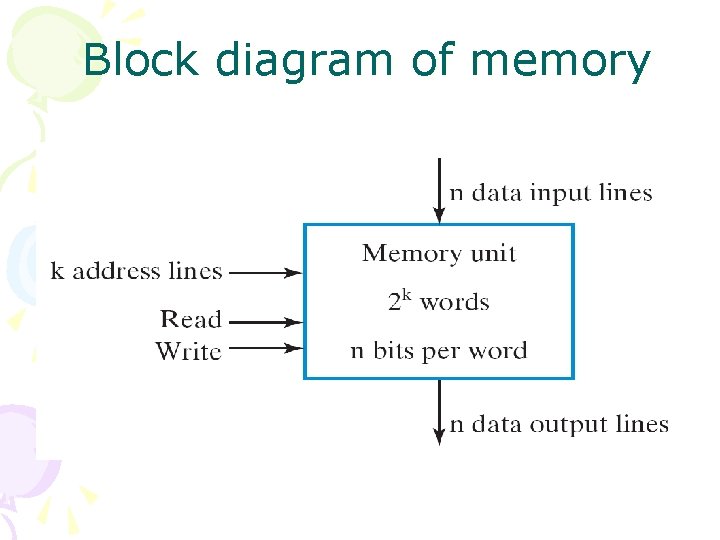
Block diagram of memory
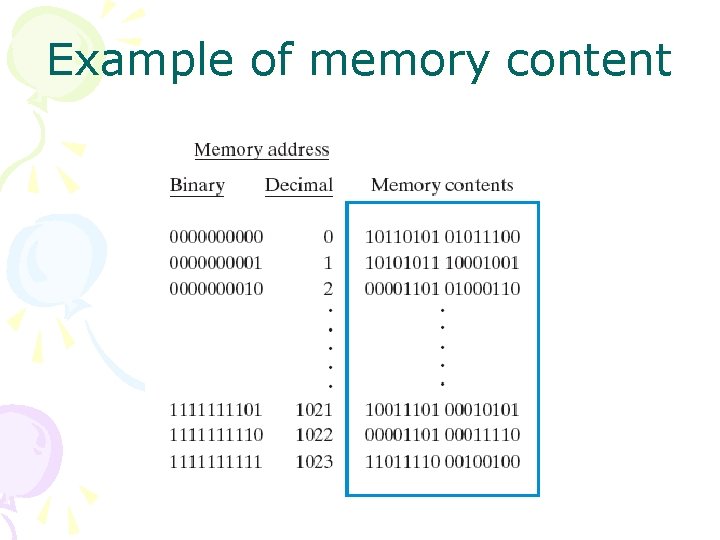
Example of memory content
Write and Read Operation • Write – Apply the address on address lines (bus) – Apply data on data lines (bus) – Activate the Write input • Read – Apply the address on address lines (bus) – Activate the Read input
Timing waveforms • Operation of memory is controlled by an external device, such as CPU • Memory doesn’t employ CPU clock • Operations are timed by changes in values on control input • Access time for read: max. time from application of address to appearance of data on Data Output • Write cycle time: max. time form application of address to completion of all operation required to store a word
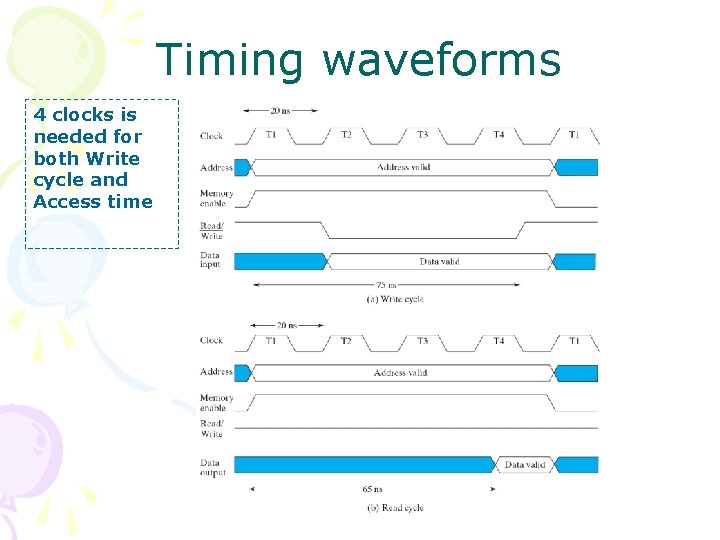
Timing waveforms 4 clocks is needed for both Write cycle and Access time

Properties of memory • Volatile: data disappeared after turning off the power – Static RAM (SRAM): faster, less capacity – Dynamic RAM (DRAM): slower, need refresh, more capacity • Non-volatile: date kept after turning off the power – Magnetic disk
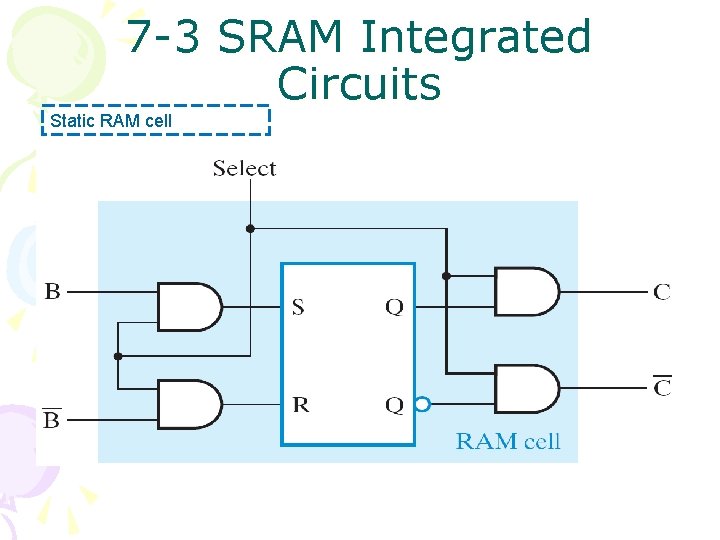
7 -3 SRAM Integrated Circuits Static RAM cell
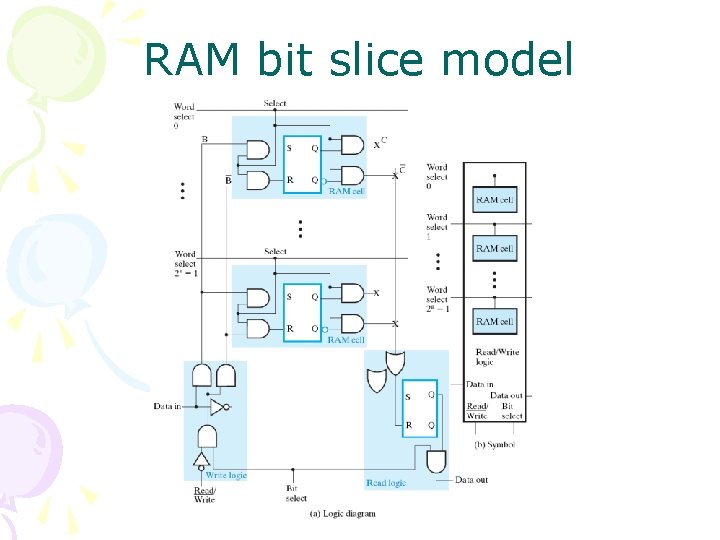
RAM bit slice model
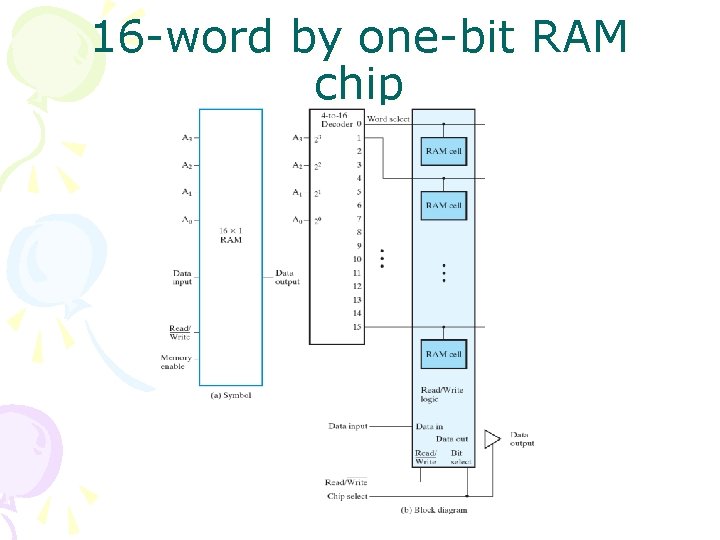
16 -word by one-bit RAM chip
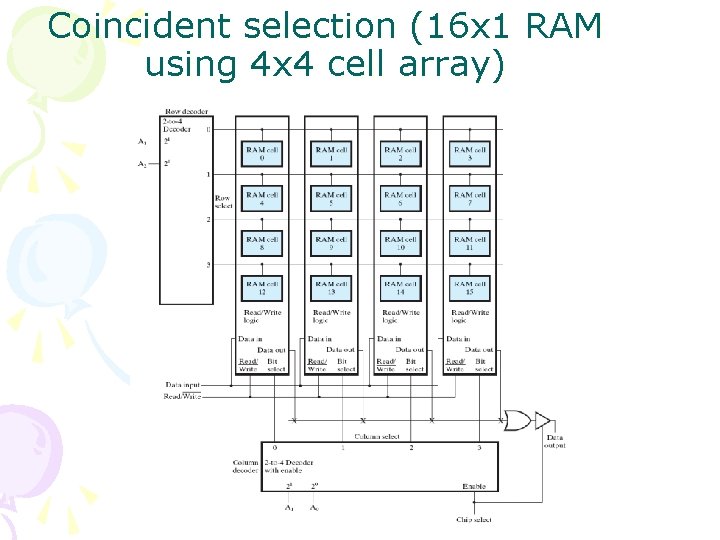
Coincident selection (16 x 1 RAM using 4 x 4 cell array)

Coincident selection (8 x 2 RAM using 4 x 4 cell array)
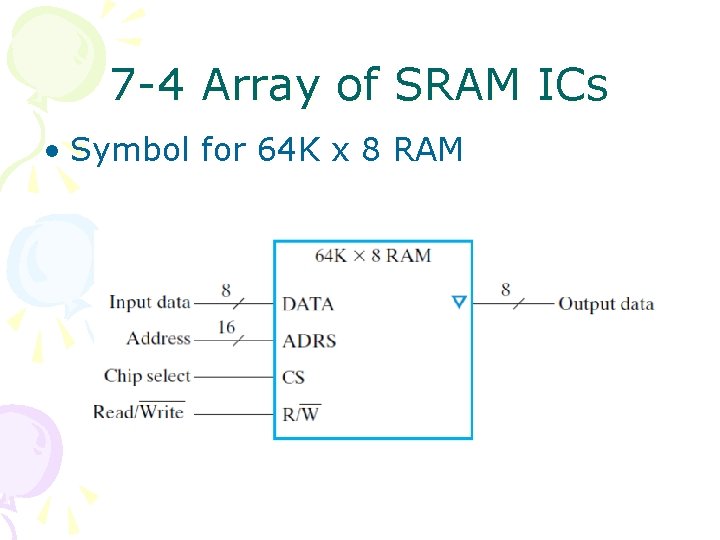
7 -4 Array of SRAM ICs • Symbol for 64 K x 8 RAM

Block diagram of a 256 K x 8 RAM • Extension from 64 K x 8 RAM • Fig. 8 -10
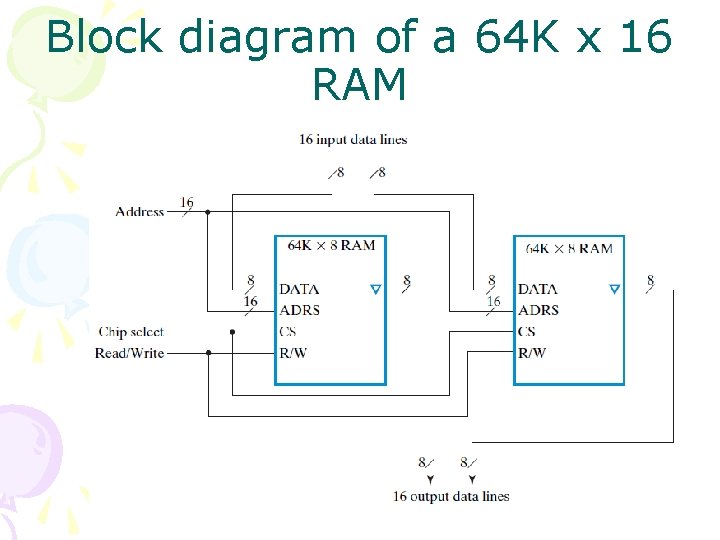
Block diagram of a 64 K x 16 RAM
- Slides: 17